


 Скачать презентацию Chapter 16 Remarriage and Stepfamilies Chapter Outline
1cc4a173daf4510e8dc3f90babce91b4.ppt
- Количество слайдов: 43
 Chapter 16 Remarriage and Stepfamilies
 Chapter Outline • • Remarriage Stepfamilies Strengths of Stepfamilies The New Stepmother The New Stepfather Children in Stepfamilies Developmental Tasks for Stepfamilies
 True or False? • About two years is recommended between the end of a marriage and a remarriage.
 Answer: True • About two years is recommended between the end of a marriage and a remarriage.
 True or False? • The divorced who live with a new partner before remarriage report a happier remarriage than those who do not live together before a remarriage.
 Answer: False Living together is associated with subsequent instability in the new marriage. • Xu, Hudspeth and Bartkowski (2006) analyzed national data on 3480 remarried respondents and found that those who lived together before remarriage reported lower marital happiness than those who had not lived together before remarriage. •
 Remarriage for the Divorced – 90% of remarriages consist of persons who are divorced rather than widowed. • Preparation for Remarriage – It is not uncommon for persons who are divorced to live together with a new partner before remarriage. •
 Remarriage • Pg. 457 This never-married woman with no children is marrying a man with six children. • Of her experience she said, “It hasn’t always been easy…but it really is worth it. ” •
 Remarriage • Pg. 458 • Increasingly, the widowed are using the Internet to meet new partners.
 Stages of Remarriage Boundary Maintenance – A parent must decide how to relate to his or her ex-spouse in order to maintain a good parenting relationship for the biological children while keeping an emotional distance. • Emotional Remarriage – Beginning to trust and love another person in a new relationship. •
 Stages of Remarriage Psychic Remarriage – Giving up the freedom and autonomy of being single to develop a mental state conducive to pairing. • Community Remarriage – A change in focus from single friends to a new mate and other couples. •
 Stages of Remarriage Parental Remarriage – Working out the nuances of living with someone else’s children. • Economic and Legal Remarriage – Alimony and child support can threaten the harmony and economic survival of second marriages. •
 Question • What is the difference between psychic remarriage and emotional remarriage? A. Psychic remarriage refers to adjusting to freedom and autonomy. Emotional remarriage refers to beginning to love and trust a new partner. B. Psychic remarriage refers to adjustment to children. Emotional remarriage refers to economic responsibilities to the first marriage. C. Psychic remarriage refers to connection with a deceased spouse. Emotional remarriage refers to a parent's connection with his/her child.
 Answer: A • Psychic remarriage refers to adjusting to freedom and autonomy. Emotional remarriage refers to beginning to love and trust a new partner.
 Remarriage for the Widowed – Remarriage for the widowed is usually very different from remarriage for the divorced. • Stability of Remarriages – National data reflects that remarriages are more likely than first marriages to end in divorce in the early years of remarriage. •
 Your Opinion? • To what degree do you believe a father should be financially obligated to his first children before providing money for his second set of children?
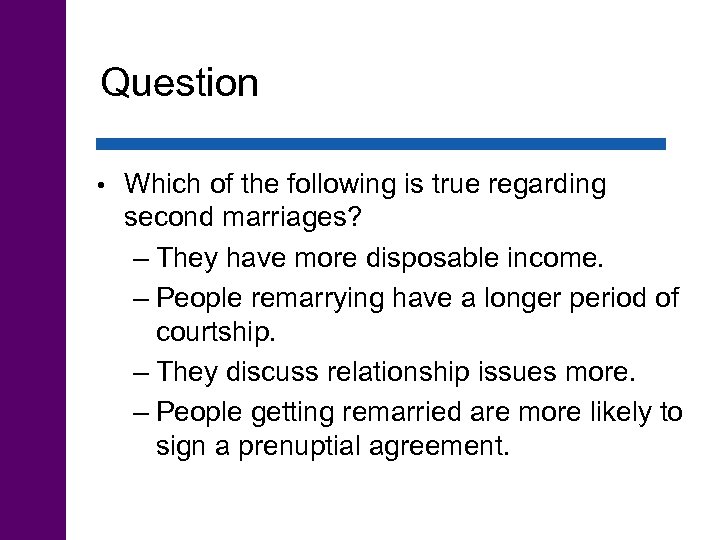 Question • Which of the following is true regarding second marriages? – They have more disposable income. – People remarrying have a longer period of courtship. – They discuss relationship issues more. – People getting remarried are more likely to sign a prenuptial agreement.
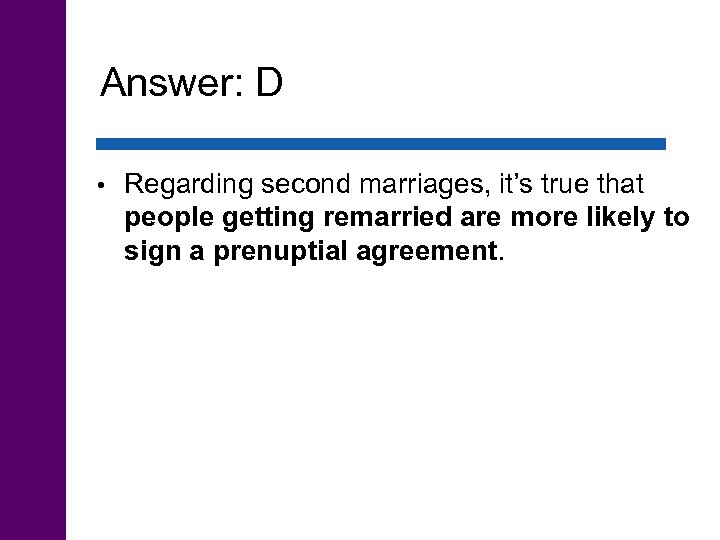 Answer: D • Regarding second marriages, it’s true that people getting remarried are more likely to sign a prenuptial agreement.
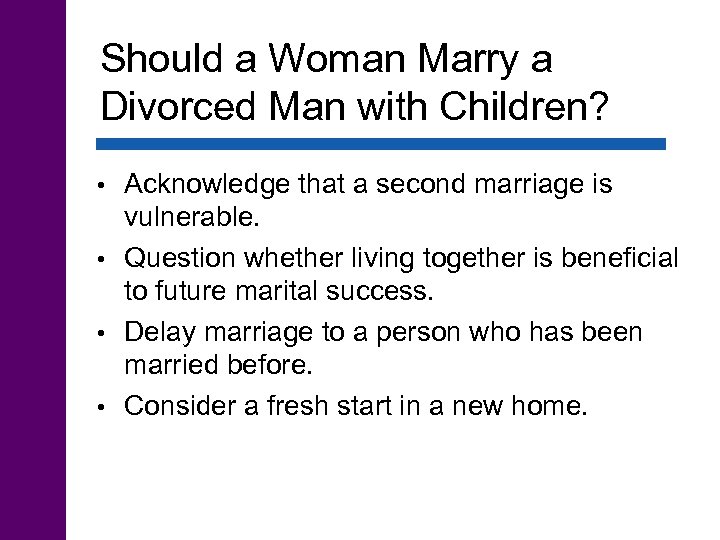 Should a Woman Marry a Divorced Man with Children? Acknowledge that a second marriage is vulnerable. • Question whether living together is beneficial to future marital success. • Delay marriage to a person who has been married before. • Consider a fresh start in a new home. •
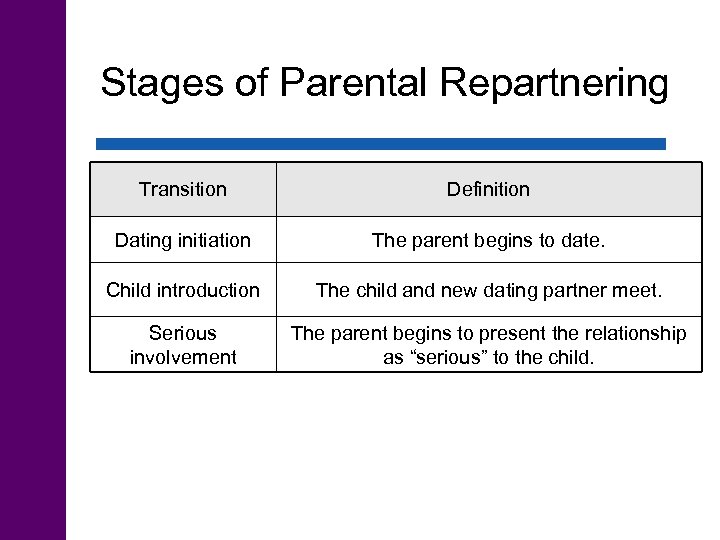 Stages of Parental Repartnering Transition Definition Dating initiation The parent begins to date. Child introduction The child and new dating partner meet. Serious involvement The parent begins to present the relationship as “serious” to the child.
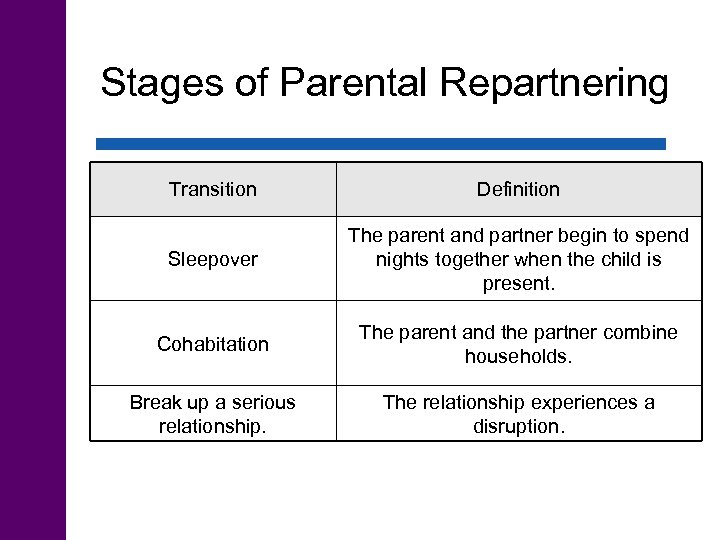 Stages of Parental Repartnering Transition Definition Sleepover The parent and partner begin to spend nights together when the child is present. Cohabitation The parent and the partner combine households. Break up a serious relationship. The relationship experiences a disruption.
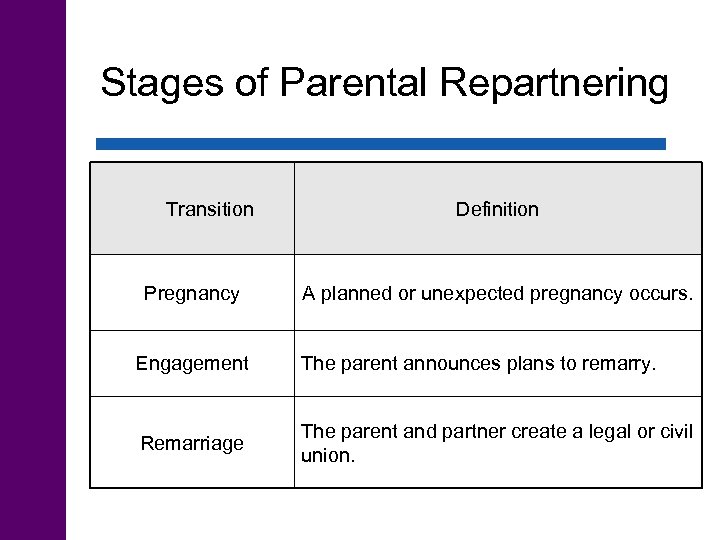 Stages of Parental Repartnering Transition Pregnancy Definition A planned or unexpected pregnancy occurs. Engagement The parent announces plans to remarry. Remarriage The parent and partner create a legal or civil union.
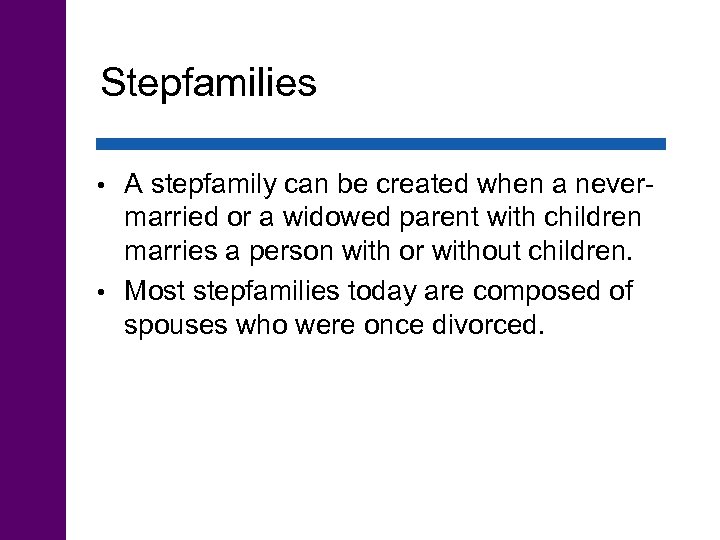 Stepfamilies A stepfamily can be created when a nevermarried or a widowed parent with children marries a person with or without children. • Most stepfamilies today are composed of spouses who were once divorced. •
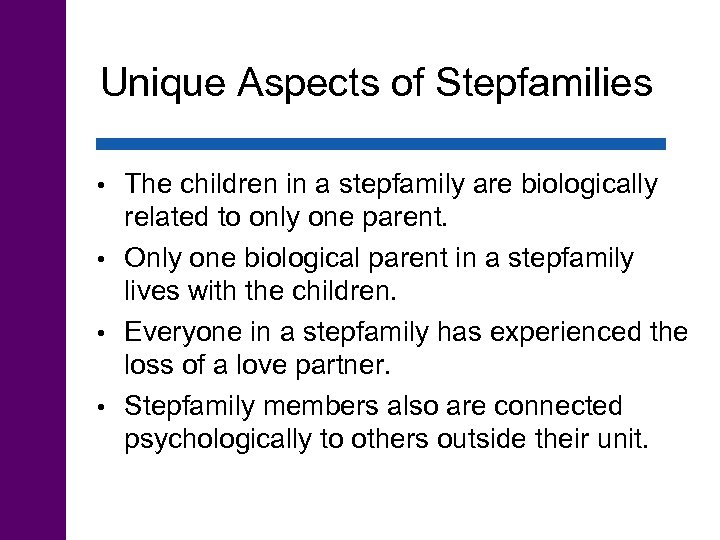 Unique Aspects of Stepfamilies The children in a stepfamily are biologically related to only one parent. • Only one biological parent in a stepfamily lives with the children. • Everyone in a stepfamily has experienced the loss of a love partner. • Stepfamily members also are connected psychologically to others outside their unit. •
 Stepfamilies: Theoretical Perspectives Structural-Functional Perspective. – Functionalists view the stepfamily system as vulnerable to an alliance between the biological parent and the biological children who have a history together. • Conflict Perspective. – Conflict in the stepfamily system is seen as desirable in that it leads to equality and individual autonomy. •
 Stepfamilies: Theoretical Perspectives • Interactionist Perspective. – Symbolic interactionists emphasize the meanings and interpretations that members of the stepfamily develop for events and interactions in the family.
 Question • A conflict theorist views conflict in stepfamilies as A. unnecessary competition. B. too much power is being given to the children. C. a symptom of a dysfunctional family. D. normal and natural and can lead to equality and autonomy.
 Answer: D • A conflict theorist views conflict in stepfamilies as normal and natural and can lead to equality and autonomy.
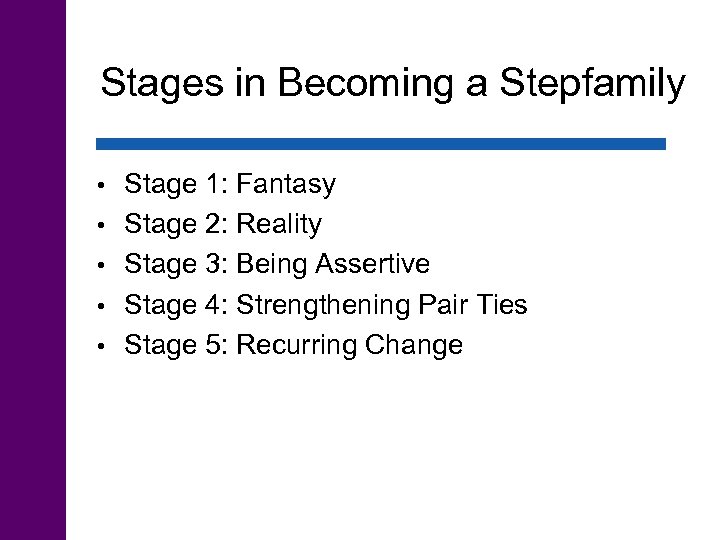 Stages in Becoming a Stepfamily • • • Stage 1: Fantasy Stage 2: Reality Stage 3: Being Assertive Stage 4: Strengthening Pair Ties Stage 5: Recurring Change
 Strengths of Stepfamilies Exposure to a Variety of Behavior Patterns • Happier Parents • Opportunity for New Relationship with Stepsiblings • More Objective Stepparents •
 Question • What is the usual order of stages in becoming a stepfamily? A. strengthening pair ties, reality, fantasy, resolution, change B. resolution, change, reality, fantasy, strengthening pair ties C. fantasy, reality, being assertive, strengthening pair ties, recurring change D. change, fantasy, resolution, reality, strengthening pair ties
 Answer: C • The usual order of stages in becoming a stepfamily is: fantasy, reality, being assertive, strengthening pair ties, recurring change.
 Women in Stepfamilies Accepting Partner’s Children – It’s difficult to love someone else’s children. • Partner’s Children Accepting Stepmother – A stepchild may feel the need to keep an emotional distance in the relationship with the stepmother so as not to incur the anger of the biological mother. •
 Women in Stepfamilies Resenting Alimony and Child Support – It is not unusual for a wife to become upset when her husband sends a portion of his income to a woman with whom he used to live. • Her New Partner and How Her Children Accept Him – For many remarried wives, two concerns are how her new husband accepts her children and how her children accept him. •
 The Stepmother • Pg. 466 • The role of stepmom played by Julia Roberts provided insight into this very difficult role.
 Women in Stepfamilies • Having Another Child – Couples with a mutual birth may tolerate more marital stress than couples with no mutual children. – In spite of the decreased satisfaction with one’s stepchildren, having a child in a second marriage is associated with increased stability in the relationship.
 Men in Stepfamilies Men with biological children enter stepfamilies with: – An appreciation for the role of parent – some skills in reference to the role – A bond with a child or children who usually live in another house. • The more engaged the stepfather in disciplining his stepchildren, the greater the level of satisfaction. •
 Men in Stepfamilies • Two factors that contribute to a positive stepfather-stepchild relationship: 1. Active involvement in teaching the stepchild something mutually valued. 2. An intense love relationship between the stepfather and the biological mother of the stepchild.
 Stepfather • Pg. 469 This stepfather has been the “real” father in this brides life. • He is giving his stepdaughter away on her wedding day. •
 Children in Stepfamilies • Problems experienced by children in stepfamilies include: – feeling abandoned – having divided loyalties – discipline – stepsiblings
 Developmental Tasks for Stepfamilies Acknowledge losses and changes. • Nurture the new marriage relationship. • Integrate the stepfather into the child’s life. • Allow time for relationship between partner and children to develop. •
 Developmental Tasks for Stepfamilies Have realistic expectations. • Accept your stepchildren. • Establish your own family rituals. • Decide about money. •
 Developmental Tasks for Stepfamilies Give parental authority to your spouse. • Support child’s relationship with absent parent. • Cooperate with the child’s biological parents. •