


 Скачать презентацию Chapter 16 Reconstruction Its Rise and Fall 1865
9709be30850d46476ad614e68fc27311.ppt
- Количество слайдов: 37
 Chapter 16 Reconstruction: Its Rise and Fall, 1865– 1877
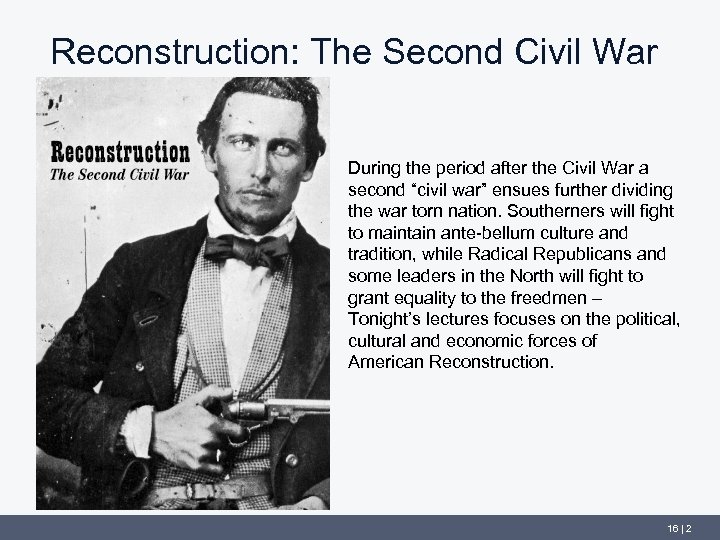 Reconstruction: The Second Civil War During the period after the Civil War a second “civil war” ensues further dividing the war torn nation. Southerners will fight to maintain ante-bellum culture and tradition, while Radical Republicans and some leaders in the North will fight to grant equality to the freedmen – Tonight’s lectures focuses on the political, cultural and economic forces of American Reconstruction. 16 | 2
 Lincoln Re-elected 1864 • Lincoln’s inaugural address closed with these words: – “With malice toward none; with charity for all; with firmness in the right, as God gives us to see the right, let us strive on to finish the work we are in; to bind up the nation's wounds; to care for him who shall have borne the battle, and for his widow and his orphan. . . to do all which may achieve and cherish a just and lasting peace among ourselves and with all nations. “ • Lincoln’s 10% Plan • Wade-Davis Bill 16 | 3
 Lincoln • Two days after General Robert E. Lee’s surrender, Lincoln delivered his last public address in which he made known his reconstruction policy • On April 14 th, Lincoln was assassinated by John Wilkes Booth, a Virginian actor upset over the South’s defeat 16 | 4
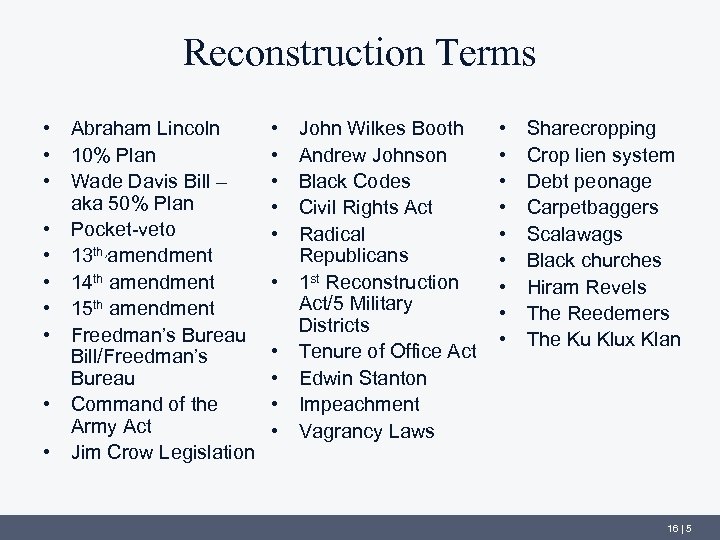 Reconstruction Terms • Abraham Lincoln • 10% Plan • Wade Davis Bill – aka 50% Plan • Pocket-veto • 13 th, amendment • 14 th amendment • 15 th amendment • Freedman’s Bureau Bill/Freedman’s Bureau • Command of the Army Act • Jim Crow Legislation • • • John Wilkes Booth Andrew Johnson Black Codes Civil Rights Act Radical Republicans 1 st Reconstruction Act/5 Military Districts Tenure of Office Act Edwin Stanton Impeachment Vagrancy Laws • • • Sharecropping Crop lien system Debt peonage Carpetbaggers Scalawags Black churches Hiram Revels The Reedemers The Ku Klux Klan 16 | 5
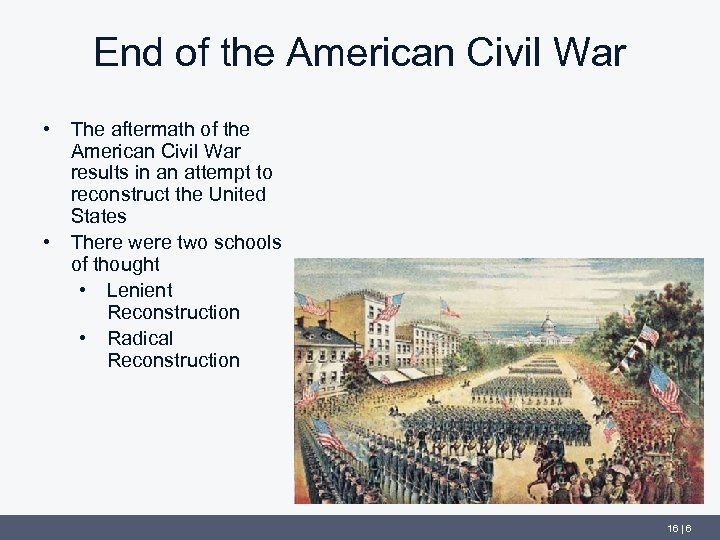 End of the American Civil War • The aftermath of the American Civil War results in an attempt to reconstruct the United States • There were two schools of thought • Lenient Reconstruction • Radical Reconstruction 16 | 6
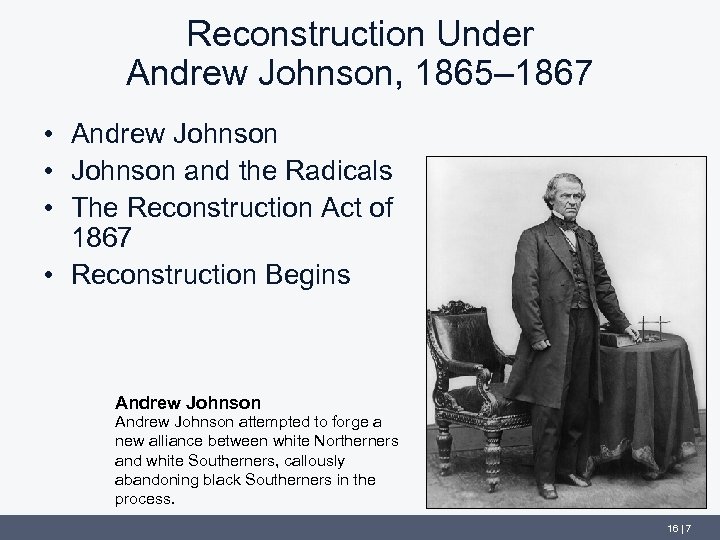 Reconstruction Under Andrew Johnson, 1865– 1867 • Andrew Johnson • Johnson and the Radicals • The Reconstruction Act of 1867 • Reconstruction Begins Andrew Johnson attempted to forge a new alliance between white Northerners and white Southerners, callously abandoning black Southerners in the process. 16 | 7
 Andrew Johnson’s plan • Andrew Johnson, Lincoln’s Vice President assumes the Presidency • Johnson was a Southerner who had remained loyal to the Union • His view and Lincoln’s view was that the people of the Southern states had never legally seceded, instead they were misled by some disloyal citizens • The war was an act of individuals and those responsible were all who needed to be held accountable 16 | 8
 Andrew Johnson’s plan, cont. • Thus, in 1863 Lincoln proclaimed that if in any state 10 percent of the voters of record in 1860 would form a government loyal to the U. S. Constitution and would acknowledge obedience to the laws of the Congress and the proclamations of the president, he would recognize the government so created as the state's legal government. • Johnson agreed • Congress rejected this plan and challenged Lincoln's right to deal with the matter without consultation. Some members of Congress advocated severe punishment for all the seceded states. Yet even before the war was wholly over, new governments had been set up in Virginia, Tennessee, Arkansas and Louisiana. 16 | 9
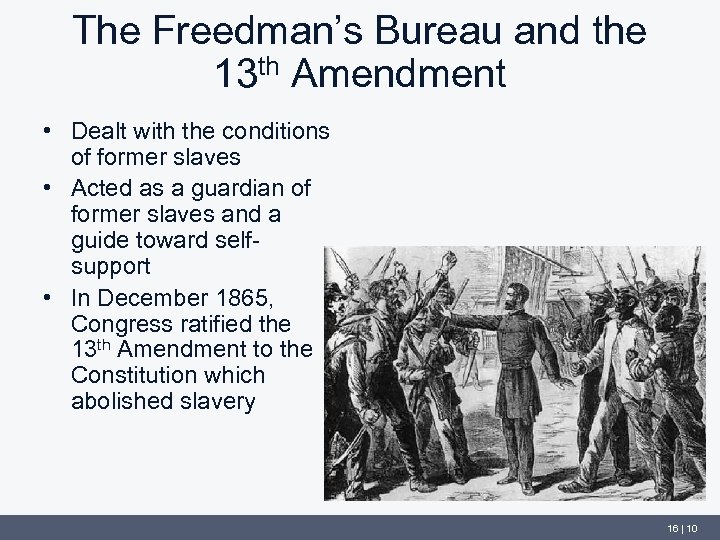 The Freedman’s Bureau and the 13 th Amendment • Dealt with the conditions of former slaves • Acted as a guardian of former slaves and a guide toward selfsupport • In December 1865, Congress ratified the 13 th Amendment to the Constitution which abolished slavery 16 | 10
 Former Confederate States Actions Based Upon Johnson’s Plan • • • Hold conventions to repeal ordinances of secession Abolish slavery and ratify the 13 th Amendment Repudiate war debt Draft new state constitutions Native Unionist appointed Governor in each state Almost complete by end of 1865 16 | 11
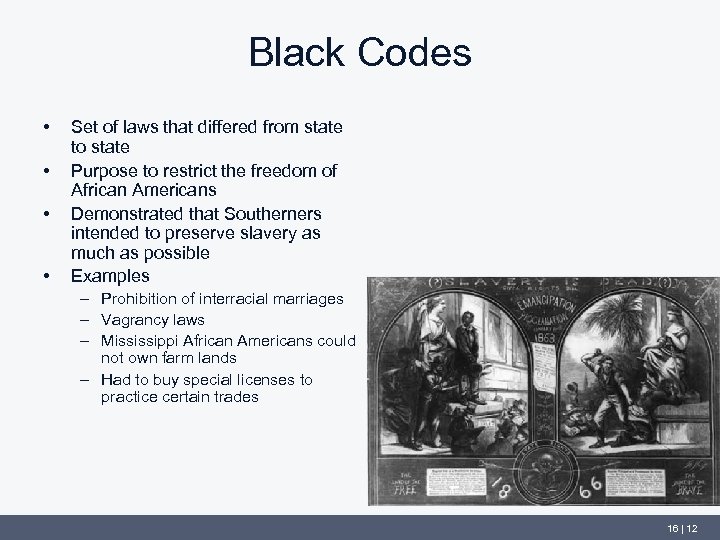 Black Codes • • Set of laws that differed from state to state Purpose to restrict the freedom of African Americans Demonstrated that Southerners intended to preserve slavery as much as possible Examples – Prohibition of interracial marriages – Vagrancy laws – Mississippi African Americans could not own farm lands – Had to buy special licenses to practice certain trades 16 | 12
 Carpetbaggers and Scalawags • White Republicans in top positions in the South during reconstruction • Carpetbaggers – Derogatory term used by southerners – Moved from the North to the South to obtain top government positions – Often Union veterans • Scalawags – Derogatory term used by southern – Native southern White Republicans – Opposed secession, but after was declared many had fought for the Confederate States of America 16 | 13
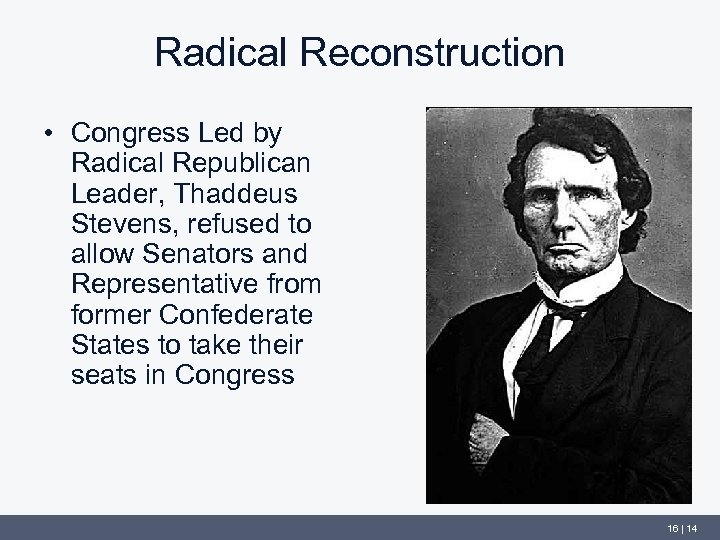 Radical Reconstruction • Congress Led by Radical Republican Leader, Thaddeus Stevens, refused to allow Senators and Representative from former Confederate States to take their seats in Congress 16 | 14
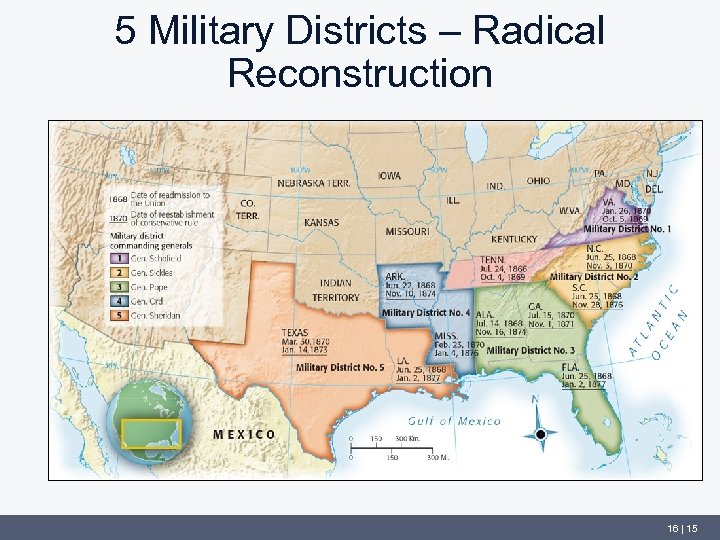 5 Military Districts – Radical Reconstruction 16 | 15
 The 14 th Amendment • July 1866, Congress passed the 14 th Amendment, "All persons born or naturalized in the United States and subject to the jurisdiction thereof, are citizens of the United States and of the states in which they reside, " thus repudiating the Dred Scott ruling which had denied slaves their right of citizenship. 16 | 16
 The Reconstruction Act of March 1867 • In response, certain groups in the North advocated intervention to protect the rights of blacks in the South. • In the Reconstruction Act of March 1867, Congress, ignoring the governments that had been established in the Southern states, divided the South into five districts and placed them under military rule. • Escape from permanent military government was open to those states that established civil governments, took an oath of allegiance, ratified the 14 th Amendment and adopted black suffrage. 16 | 17
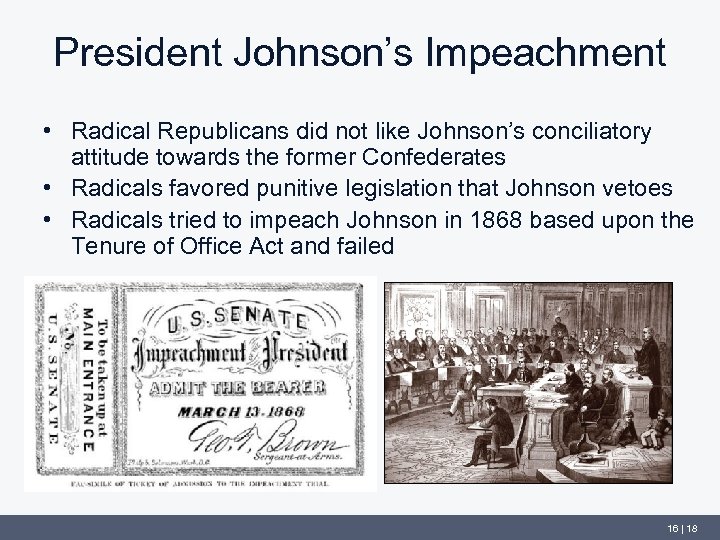 President Johnson’s Impeachment • Radical Republicans did not like Johnson’s conciliatory attitude towards the former Confederates • Radicals favored punitive legislation that Johnson vetoes • Radicals tried to impeach Johnson in 1868 based upon the Tenure of Office Act and failed 16 | 18
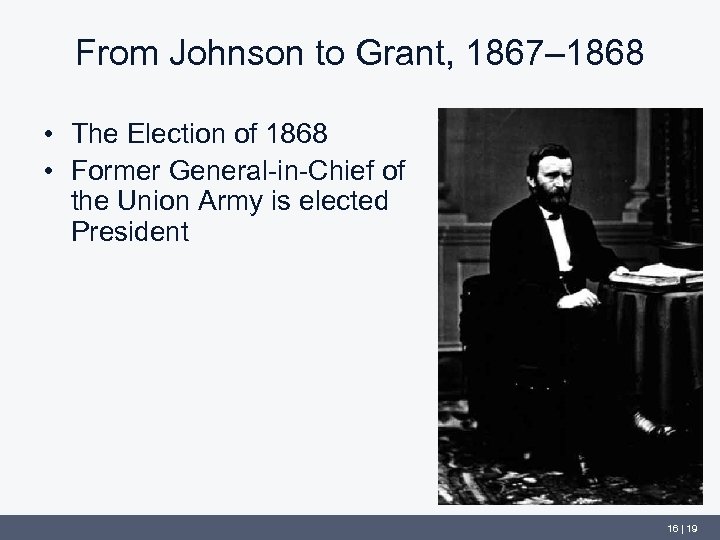 From Johnson to Grant, 1867– 1868 • The Election of 1868 • Former General-in-Chief of the Union Army is elected President 16 | 19
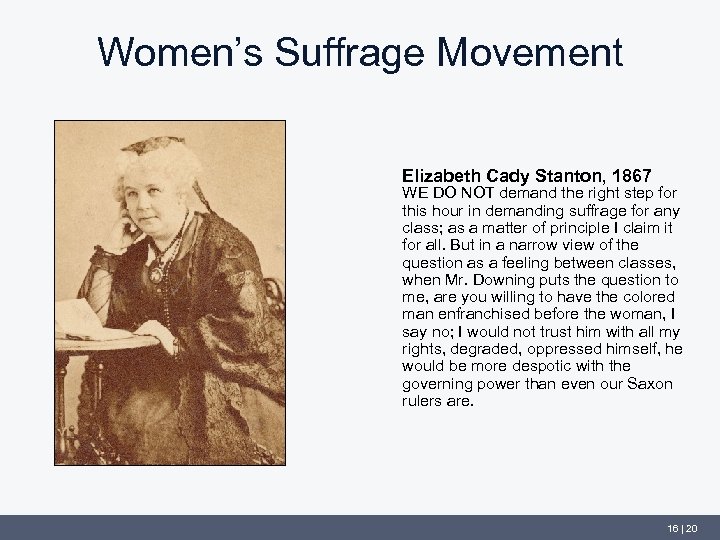 Women’s Suffrage Movement Elizabeth Cady Stanton, 1867 WE DO NOT demand the right step for this hour in demanding suffrage for any class; as a matter of principle I claim it for all. But in a narrow view of the question as a feeling between classes, when Mr. Downing puts the question to me, are you willing to have the colored man enfranchised before the woman, I say no; I would not trust him with all my rights, degraded, oppressed himself, he would be more despotic with the governing power than even our Saxon rulers are. 16 | 20
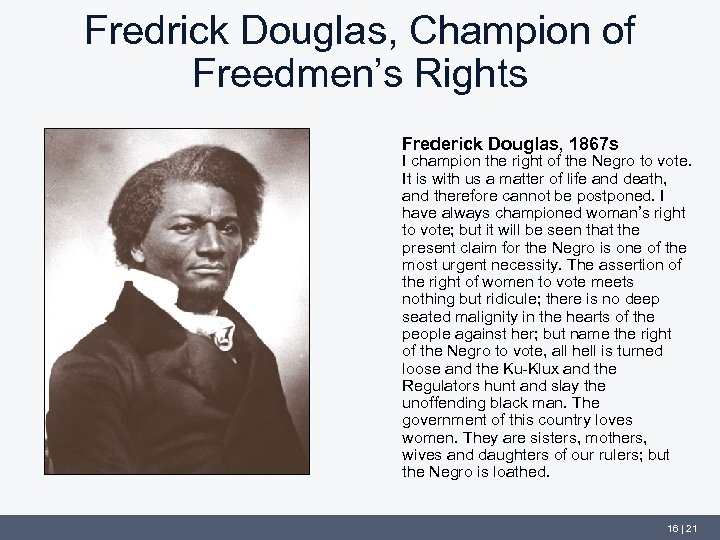 Fredrick Douglas, Champion of Freedmen’s Rights Frederick Douglas, 1867 s I champion the right of the Negro to vote. It is with us a matter of life and death, and therefore cannot be postponed. I have always championed woman’s right to vote; but it will be seen that the present claim for the Negro is one of the most urgent necessity. The assertion of the right of women to vote meets nothing but ridicule; there is no deep seated malignity in the hearts of the people against her; but name the right of the Negro to vote, all hell is turned loose and the Ku-Klux and the Regulators hunt and slay the unoffending black man. The government of this country loves women. They are sisters, mothers, wives and daughters of our rulers; but the Negro is loathed. 16 | 21
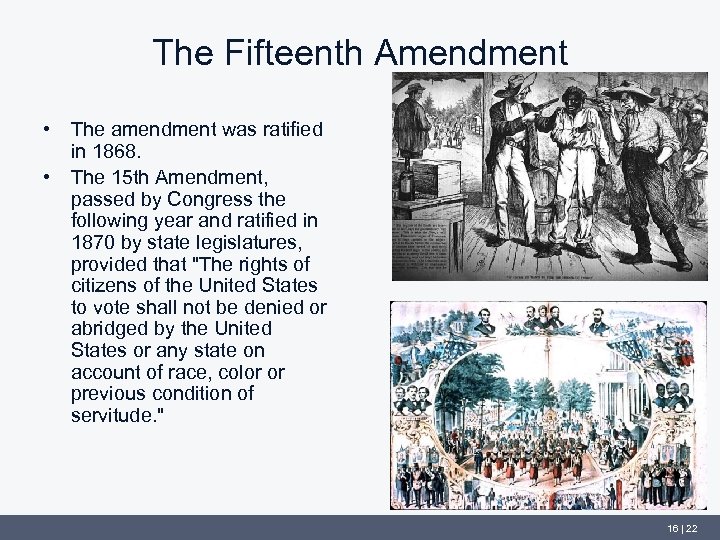 The Fifteenth Amendment • The amendment was ratified in 1868. • The 15 th Amendment, passed by Congress the following year and ratified in 1870 by state legislatures, provided that "The rights of citizens of the United States to vote shall not be denied or abridged by the United States or any state on account of race, color or previous condition of servitude. " 16 | 22
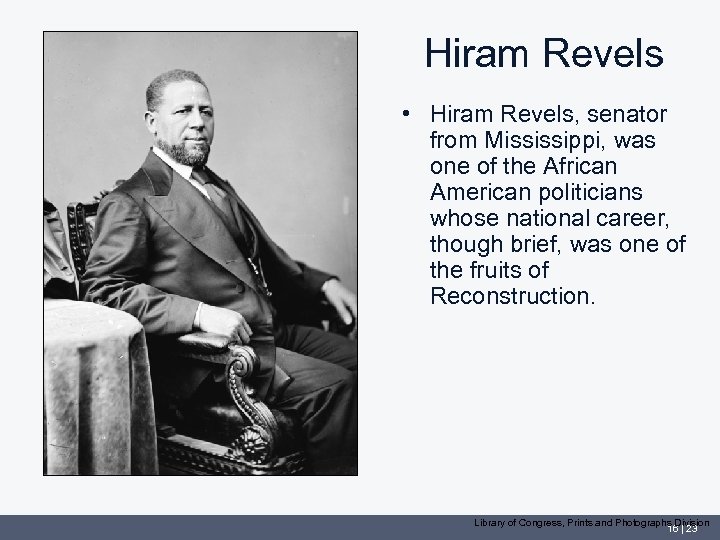 Hiram Revels • Hiram Revels, senator from Mississippi, was one of the African American politicians whose national career, though brief, was one of the fruits of Reconstruction. Library of Congress, Prints and Photographs Division 16 | 23
 Grant’s Troubled Administration • • Grant and Congress Grant and His Party The Rise of the Klan Issues with Native Americans • The Transcontinental Railroad 16 | 24
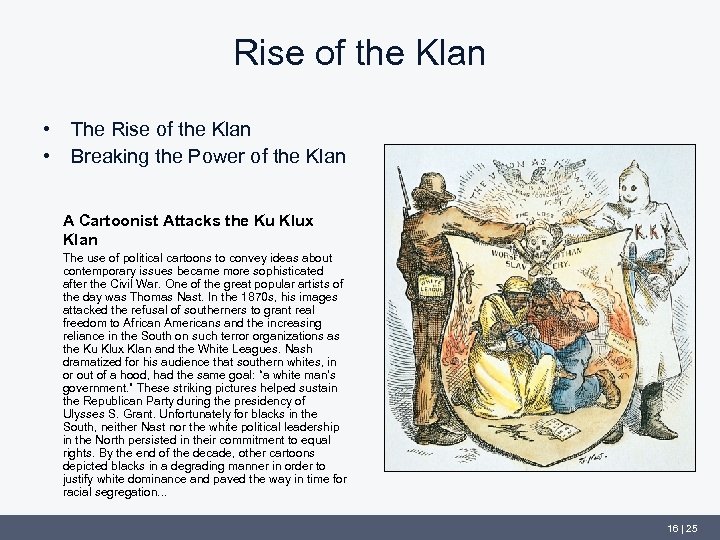 Rise of the Klan • The Rise of the Klan • Breaking the Power of the Klan A Cartoonist Attacks the Ku Klux Klan The use of political cartoons to convey ideas about contemporary issues became more sophisticated after the Civil War. One of the great popular artists of the day was Thomas Nast. In the 1870 s, his images attacked the refusal of southerners to grant real freedom to African Americans and the increasing reliance in the South on such terror organizations as the Ku Klux Klan and the White Leagues. Nash dramatized for his audience that southern whites, in or out of a hood, had the same goal: “a white man’s government. ” These striking pictures helped sustain the Republican Party during the presidency of Ulysses S. Grant. Unfortunately for blacks in the South, neither Nast nor the white political leadership in the North persisted in their commitment to equal rights. By the end of the decade, other cartoons depicted blacks in a degrading manner in order to justify white dominance and paved the way in time for racial segregation. . . 16 | 25
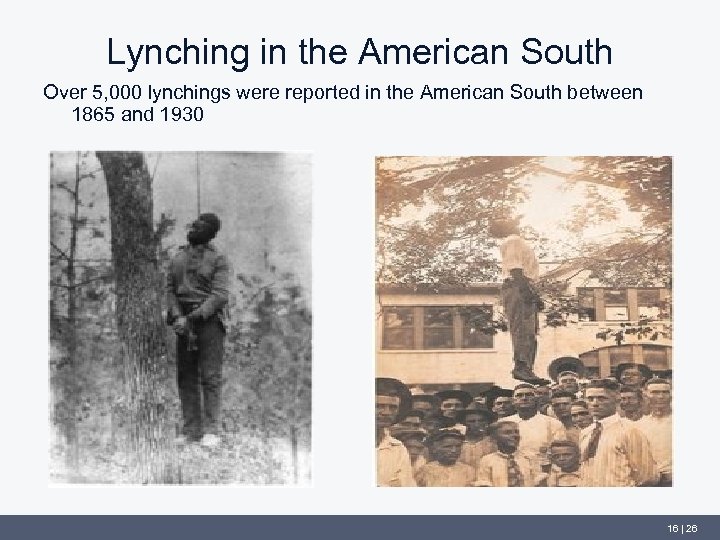 Lynching in the American South Over 5, 000 lynchings were reported in the American South between 1865 and 1930 16 | 26
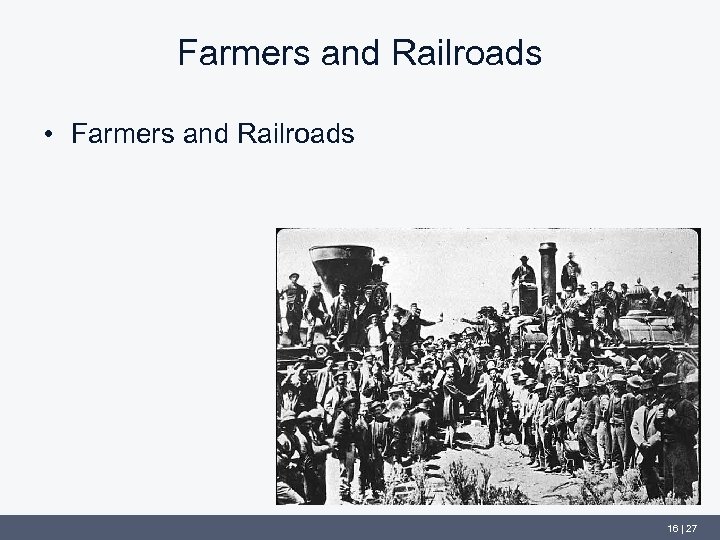 Farmers and Railroads • Farmers and Railroads 16 | 27
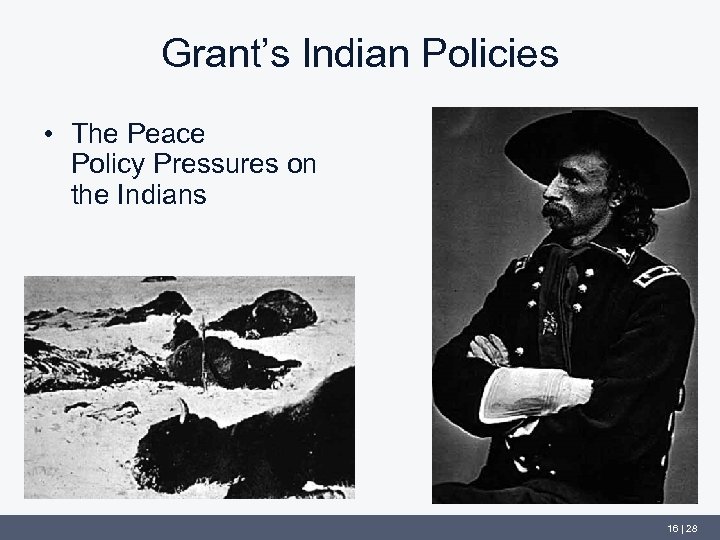 Grant’s Indian Policies • The Peace Policy Pressures on the Indians 16 | 28
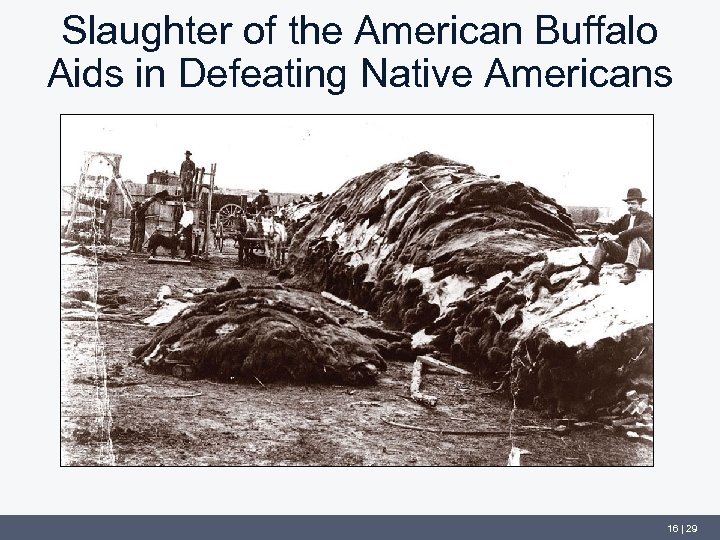 Slaughter of the American Buffalo Aids in Defeating Native Americans 16 | 29
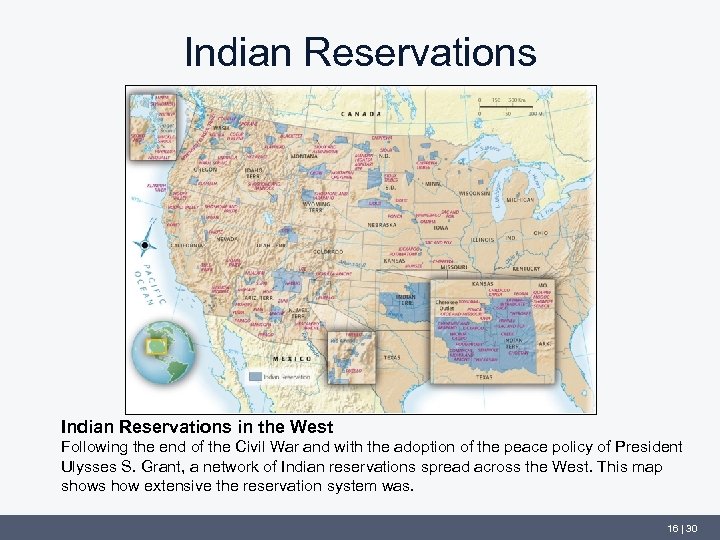 Indian Reservations in the West Following the end of the Civil War and with the adoption of the peace policy of President Ulysses S. Grant, a network of Indian reservations spread across the West. This map shows how extensive the reservation system was. 16 | 30
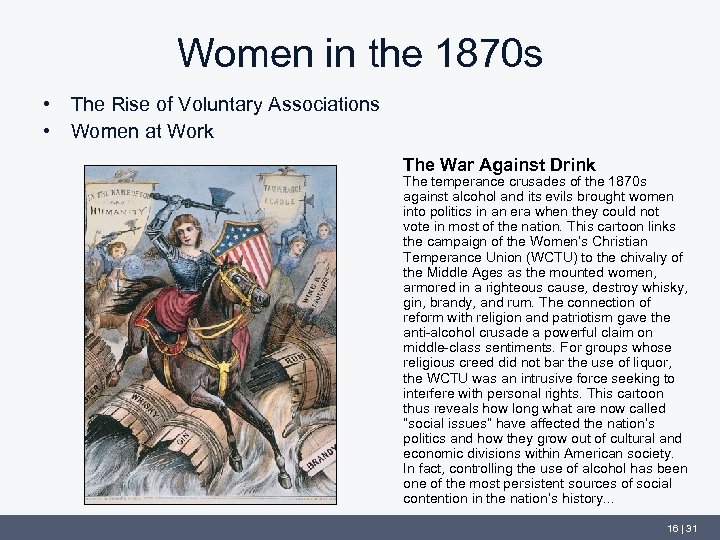 Women in the 1870 s • The Rise of Voluntary Associations • Women at Work The War Against Drink The temperance crusades of the 1870 s against alcohol and its evils brought women into politics in an era when they could not vote in most of the nation. This cartoon links the campaign of the Women’s Christian Temperance Union (WCTU) to the chivalry of the Middle Ages as the mounted women, armored in a righteous cause, destroy whisky, gin, brandy, and rum. The connection of reform with religion and patriotism gave the anti-alcohol crusade a powerful claim on middle-class sentiments. For groups whose religious creed did not bar the use of liquor, the WCTU was an intrusive force seeking to interfere with personal rights. This cartoon thus reveals how long what are now called “social issues” have affected the nation’s politics and how they grow out of cultural and economic divisions within American society. In fact, controlling the use of alcohol has been one of the most persistent sources of social contention in the nation’s history. . . 16 | 31
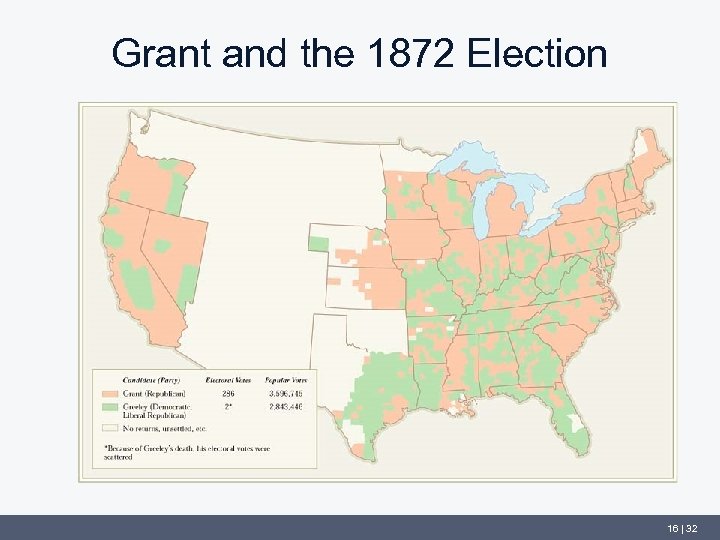 Grant and the 1872 Election 16 | 32
 Grant’s Second Administration • A Surge of Scandals • Consequences of the Panic of 1873 – The Plight of the Unemployed – Distress and Protest Among the Farmers – Inflationary Solutions 16 | 33
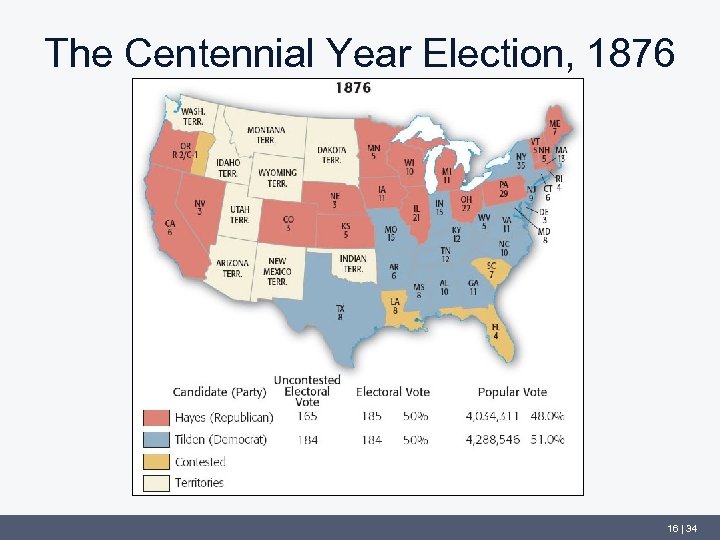 The Centennial Year Election, 1876 16 | 34
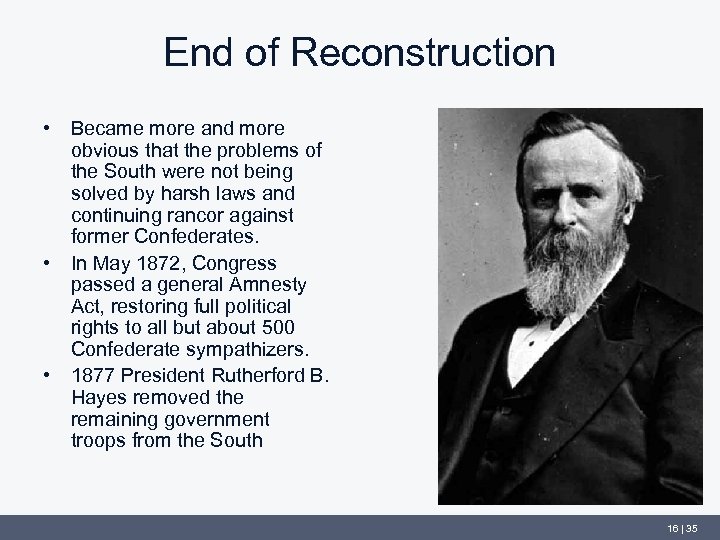 End of Reconstruction • Became more and more obvious that the problems of the South were not being solved by harsh laws and continuing rancor against former Confederates. • In May 1872, Congress passed a general Amnesty Act, restoring full political rights to all but about 500 Confederate sympathizers. • 1877 President Rutherford B. Hayes removed the remaining government troops from the South 16 | 35
 The Failure of Reconstruction, 1875– 1876 • The Stigma of Corruption • The Resurgence of the Democrats • Why Reconstruction Failed 16 | 36
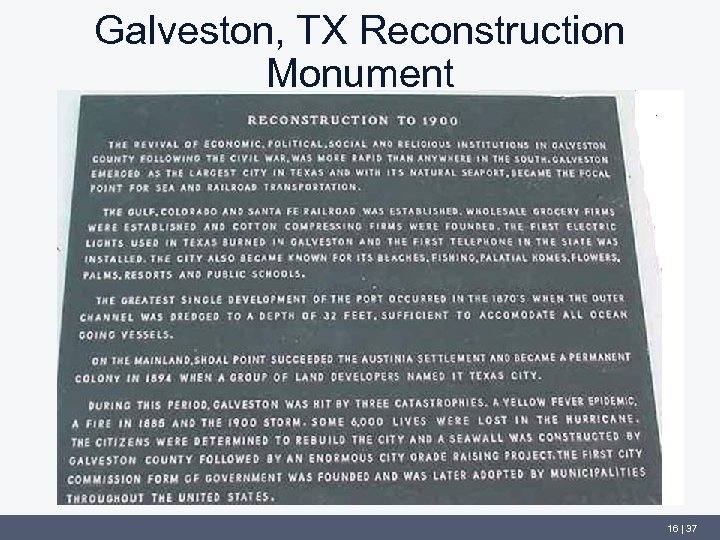 Galveston, TX Reconstruction Monument 16 | 37