


 Скачать презентацию Chapter 16 Mc Graw-Hill Irwin Option Valuation Copyright
460d6686f14db1a488b7c3cd81e121a5.ppt
- Количество слайдов: 47
 Chapter 16 Mc. Graw-Hill/Irwin Option Valuation Copyright © 2008 by The Mc. Graw-Hill Companies, Inc. All rights reserved.
 Option Valuation • Our goal in this chapter is to discuss how to calculate stock option prices. • We will discuss many details of the very famous Black. Scholes-Merton option pricing model. • We will discuss "implied volatility, " which is the market’s forward-looking uncertainty gauge. 2
 Just What is an Option Worth? • In truth, this is a very difficult question to answer. • At expiration, an option is worth its intrinsic value. • Before expiration, put-call parity allows us to price options. But, – To calculate the price of a call, we need to know the put price. – To calculate the price of a put, we need to know the call price. • So, what we want to know the value of a call option: – Before expiration, and – Without knowing the price of the put 3
 The Black-Scholes-Merton Option Pricing Model • The Black-Scholes option pricing model allows us to calculate the price of a call option before maturity (and, no put price is needed). – Dates from the early 1970 s – Created by Professors Fischer Black and Myron Scholes – Made option pricing much easier—The CBOE was launched soon after the Black-Scholes model appeared. • Today, many finance professionals refer to an extended version of the model – The Black-Scholes-Merton option pricing model. – Recognizing the important contributions by professor Robert Merton. 4
 The Black-Scholes-Merton Option Pricing Model • The Black-Scholes-Merton option pricing model says the value of a stock option is determined by six factors: S, the current price of the underlying stock y, the dividend yield of the underlying stock K, the strike price specified in the option contract r, the risk-free interest rate over the life of the option contract T, the time remaining until the option contract expires , (sigma) which is the price volatility of the underlying stock 5
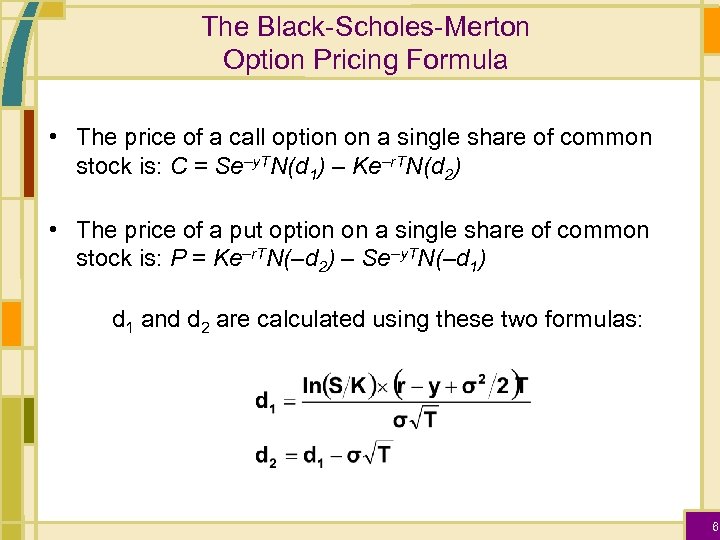 The Black-Scholes-Merton Option Pricing Formula • The price of a call option on a single share of common stock is: C = Se–y. TN(d 1) – Ke–r. TN(d 2) • The price of a put option on a single share of common stock is: P = Ke–r. TN(–d 2) – Se–y. TN(–d 1) d 1 and d 2 are calculated using these two formulas: 6
 Formula Details • In the Black-Scholes-Merton formula, three common fuctions are used to price call and put option prices: – e-rt, or exp(-rt), is the natural exponent of the value of –rt (in common terms, it is a discount factor) – ln(S/K) is the natural log of the "moneyness" term, S/K. – N(d 1) and N(d 2) denotes the standard normal probability for the values of d 1 and d 2. • In addition, the formula makes use of the fact that: N(-d 1) = 1 - N(d 1) 7
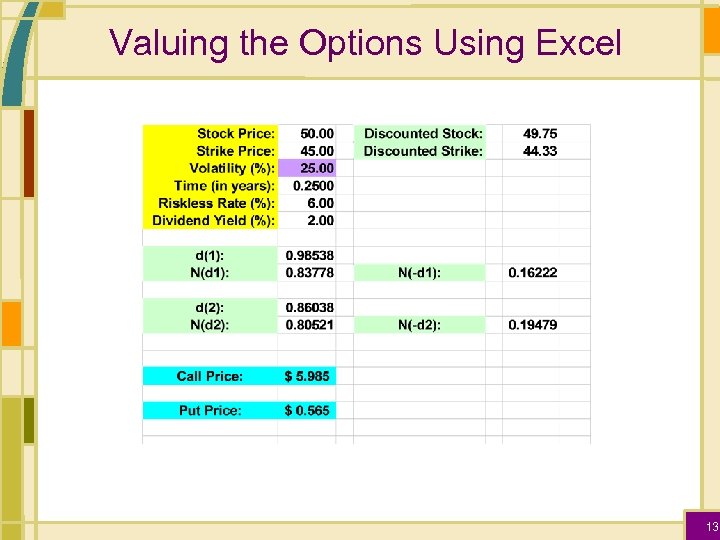
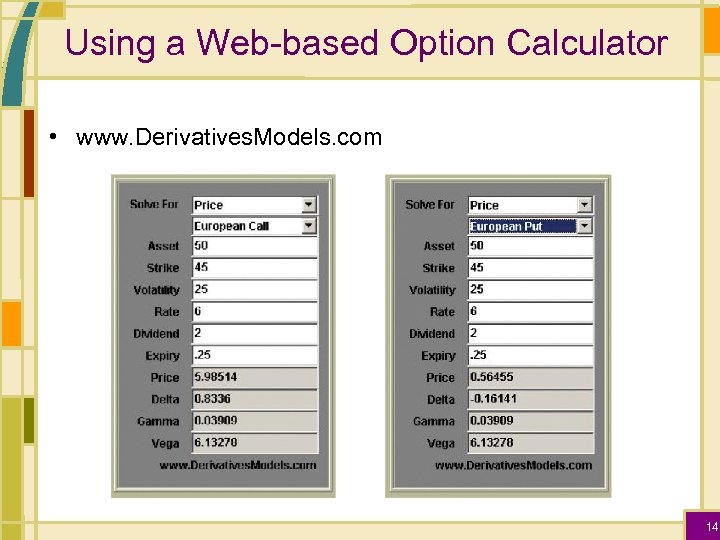
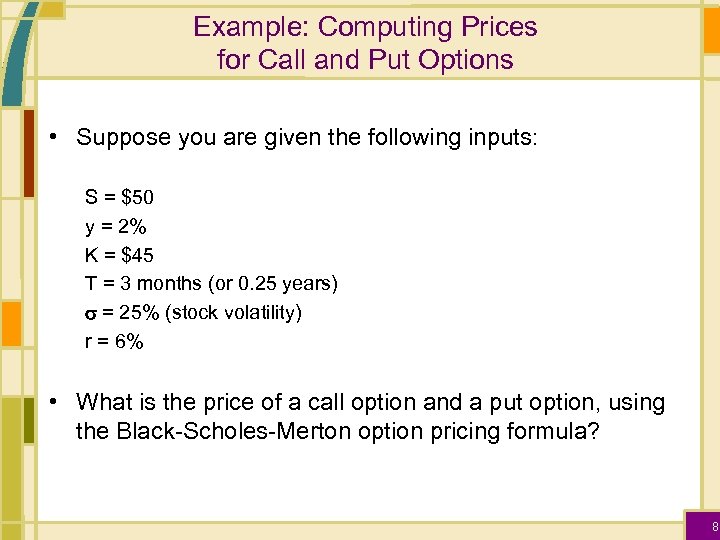 Example: Computing Prices for Call and Put Options • Suppose you are given the following inputs: S = $50 y = 2% K = $45 T = 3 months (or 0. 25 years) s = 25% (stock volatility) r = 6% • What is the price of a call option and a put option, using the Black-Scholes-Merton option pricing formula? 8
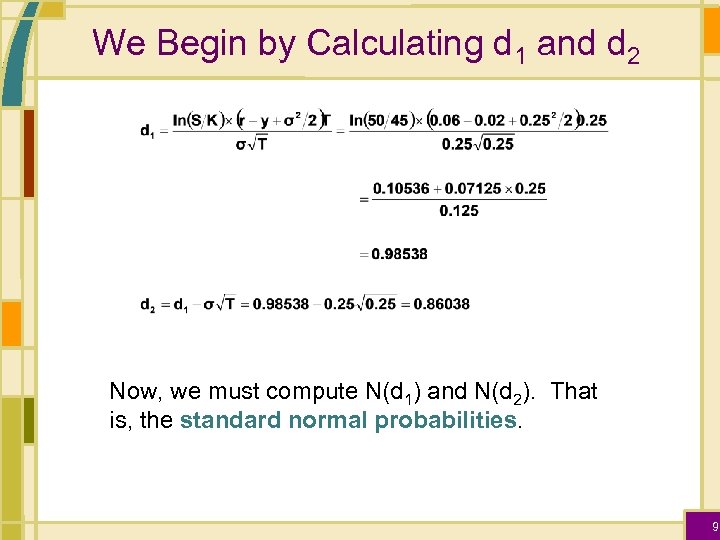 We Begin by Calculating d 1 and d 2 Now, we must compute N(d 1) and N(d 2). That is, the standard normal probabilities. 9
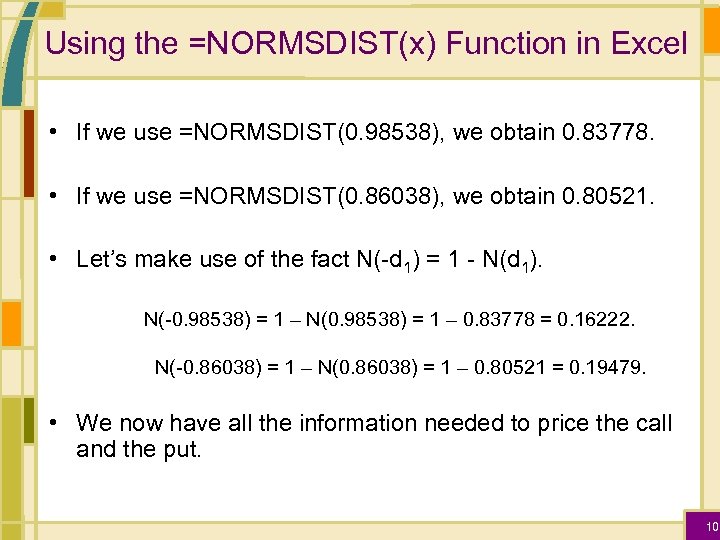 Using the =NORMSDIST(x) Function in Excel • If we use =NORMSDIST(0. 98538), we obtain 0. 83778. • If we use =NORMSDIST(0. 86038), we obtain 0. 80521. • Let’s make use of the fact N(-d 1) = 1 - N(d 1). N(-0. 98538) = 1 – N(0. 98538) = 1 – 0. 83778 = 0. 16222. N(-0. 86038) = 1 – N(0. 86038) = 1 – 0. 80521 = 0. 19479. • We now have all the information needed to price the call and the put. 10
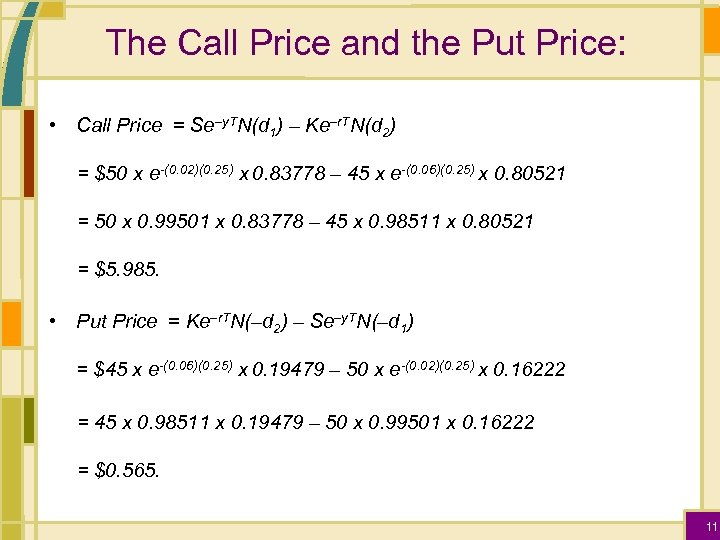 The Call Price and the Put Price: • Call Price = Se–y. TN(d 1) – Ke–r. TN(d 2) = $50 x e-(0. 02)(0. 25) x 0. 83778 – 45 x e-(0. 06)(0. 25) x 0. 80521 = 50 x 0. 99501 x 0. 83778 – 45 x 0. 98511 x 0. 80521 = $5. 985. • Put Price = Ke–r. TN(–d 2) – Se–y. TN(–d 1) = $45 x e-(0. 06)(0. 25) x 0. 19479 – 50 x e-(0. 02)(0. 25) x 0. 16222 = 45 x 0. 98511 x 0. 19479 – 50 x 0. 99501 x 0. 16222 = $0. 565. 11
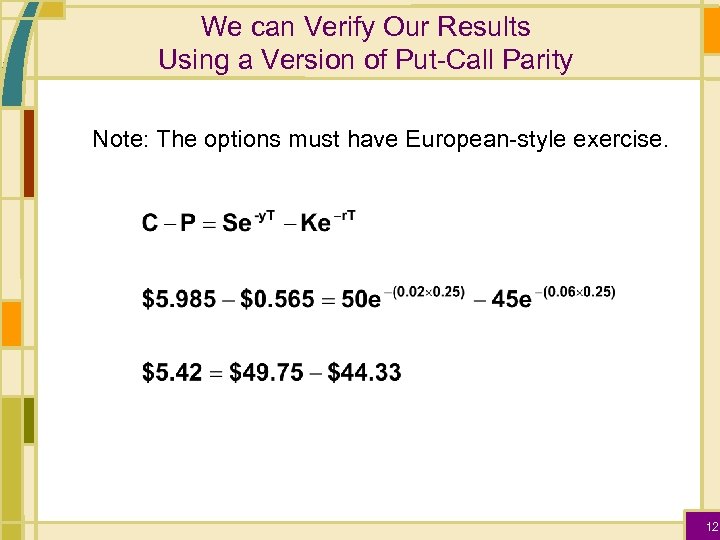 We can Verify Our Results Using a Version of Put-Call Parity Note: The options must have European-style exercise. 12
 Valuing the Options Using Excel 13
 Using a Web-based Option Calculator • www. Derivatives. Models. com 14
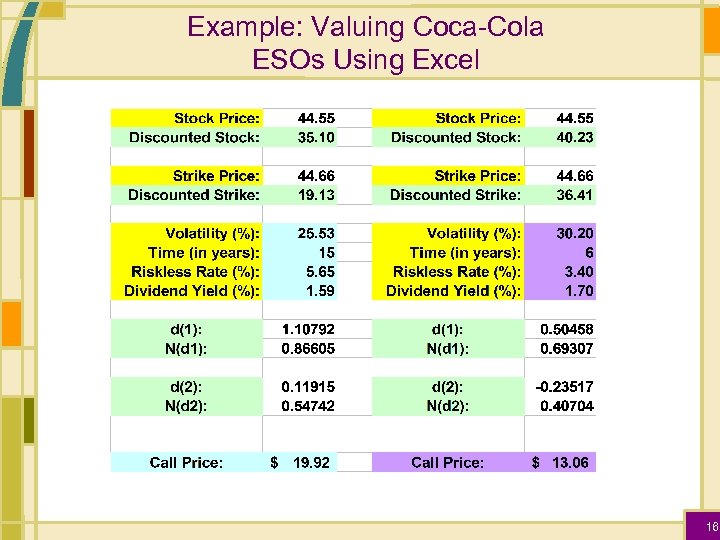
 Valuing Employee Stock Options • Companies issuing stock options to employees must report estimates of the value of these ESOs • The Black-Scholes-Merton formula is widely used for this purpose. • For example, in December 2002, the Coca-Cola Company granted ESOs with a stated life of 15 years. • However, to allow for the fact that ESOs are often exercised before maturity, Coca-Cola also used a life of 6 years to value these ESOs. 15
 Example: Valuing Coca-Cola ESOs Using Excel 16
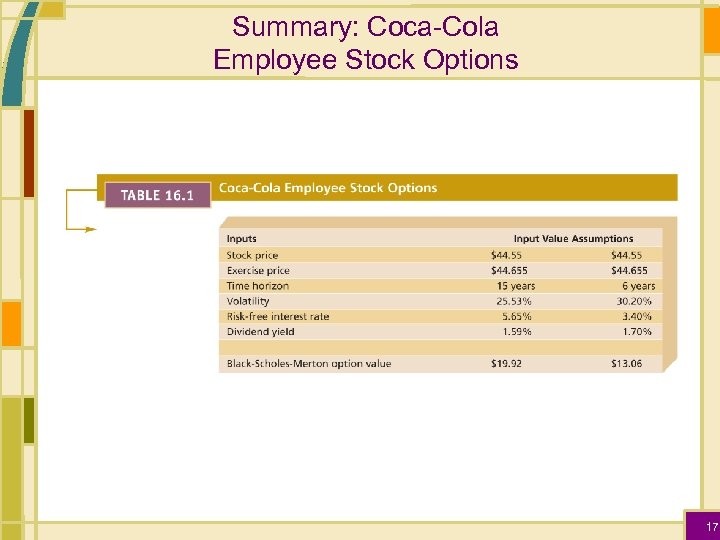 Summary: Coca-Cola Employee Stock Options 17
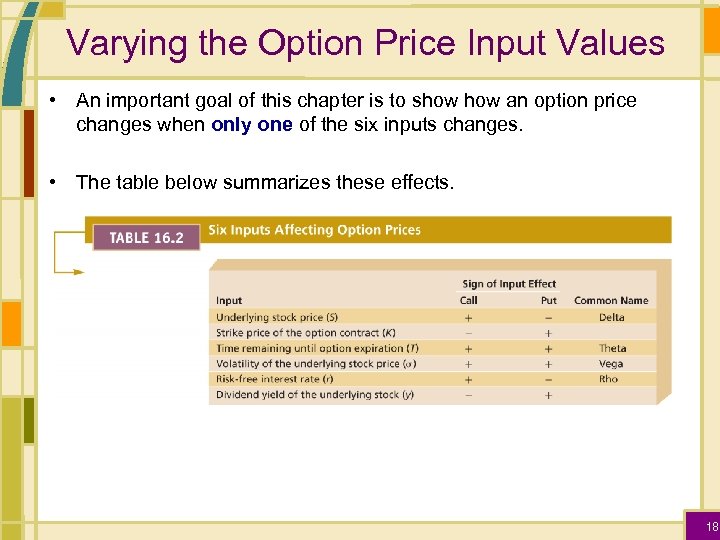 Varying the Option Price Input Values • An important goal of this chapter is to show an option price changes when only one of the six inputs changes. • The table below summarizes these effects. 18
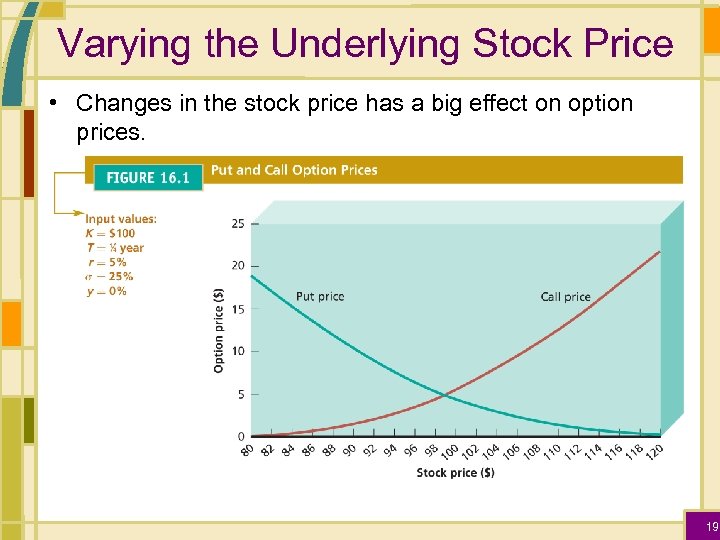 Varying the Underlying Stock Price • Changes in the stock price has a big effect on option prices. 19
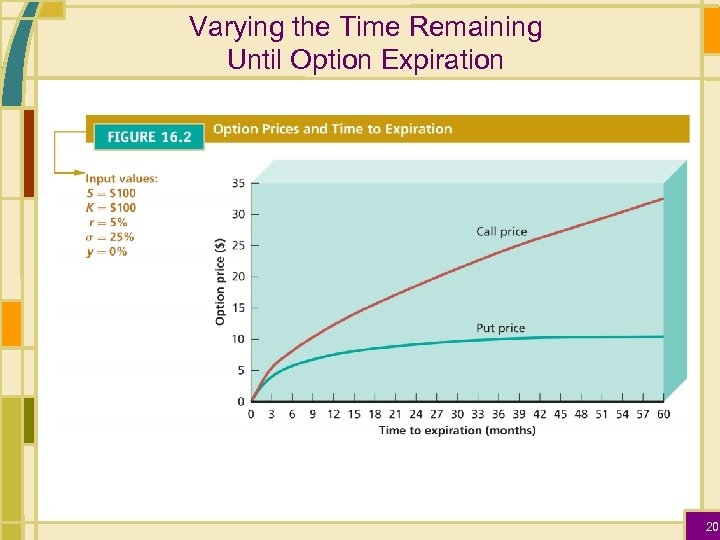 Varying the Time Remaining Until Option Expiration 20
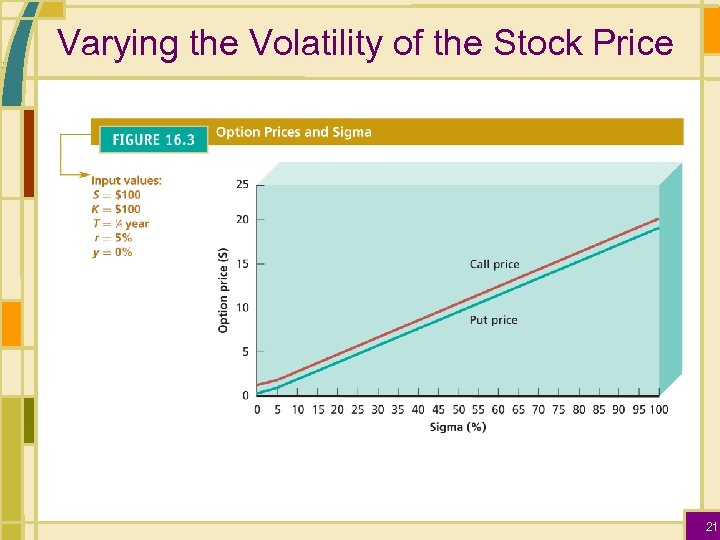 Varying the Volatility of the Stock Price 21
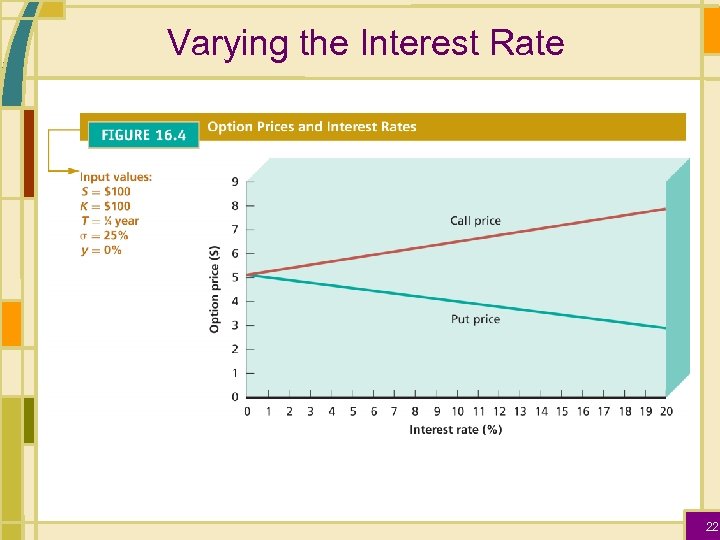 Varying the Interest Rate 22
 Calculating the Impact of Input Changes • Option traders must know how changes in input prices affect the value of the options that are in their portfolio. • Two inputs have the biggest effect over a time span of a few days: – Changes in the stock price (street name: Delta) – Changes in the volatility of the stock price (street name: Vega) 23
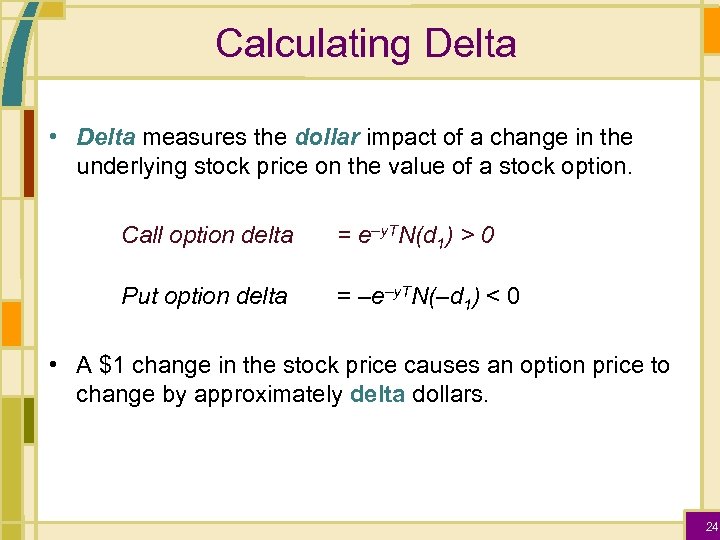 Calculating Delta • Delta measures the dollar impact of a change in the underlying stock price on the value of a stock option. Call option delta = e–y. TN(d 1) > 0 Put option delta = –e–y. TN(–d 1) < 0 • A $1 change in the stock price causes an option price to change by approximately delta dollars. 24
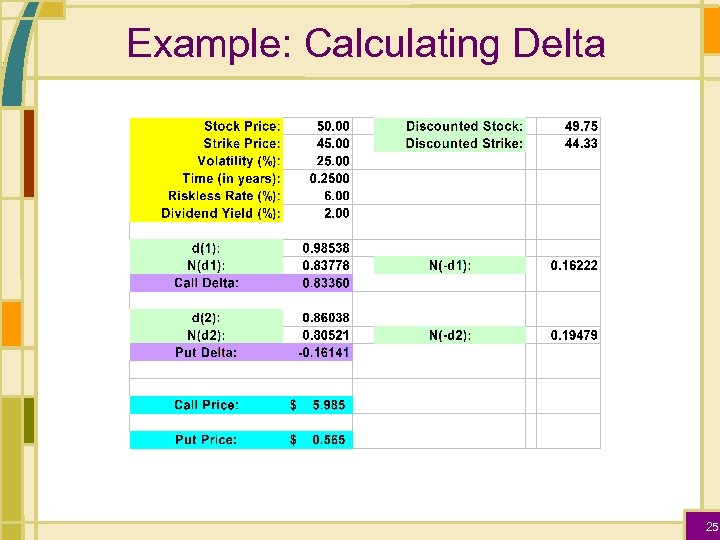 Example: Calculating Delta 25
 The "Delta" Prediction: • The call delta value of 0. 8336 predicts that if the stock price increases by $1, the call option price will increase by $0. 83. – If the stock price is $51, the call option value is $6. 837—an actual increase of about $0. 85. – How well does Delta predict if the stock price changes by $0. 25? • The put delta value of -0. 1938 predicts that if the stock price increases by $1, the put option price will decrease by $0. 19. – If the stock price is $51, the put option value is $0. 422—an actual decrease of about $0. 14. – How well does Delta predict if the stock price changes by $0. 25? 26
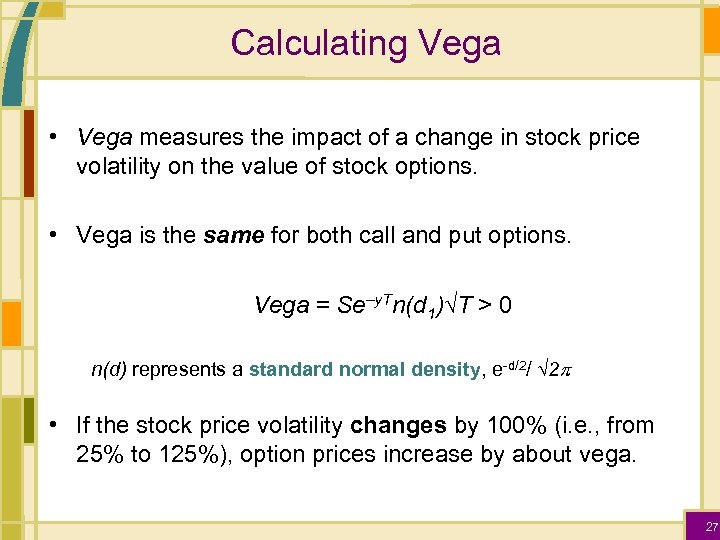 Calculating Vega • Vega measures the impact of a change in stock price volatility on the value of stock options. • Vega is the same for both call and put options. Vega = Se–y. Tn(d 1) T > 0 n(d) represents a standard normal density, e-d/2/ 2 p • If the stock price volatility changes by 100% (i. e. , from 25% to 125%), option prices increase by about vega. 27
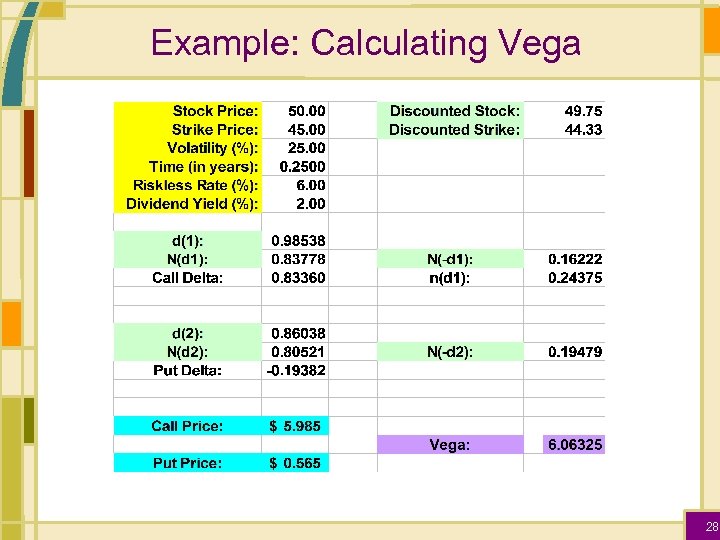 Example: Calculating Vega 28
 The "Vega" Prediction: • The vega value of 6. 063 predicts that if the stock price volatility increases by 100% (i. e. , from 25% to 125%), call and put option prices will increase by $6. 063. • Generally, traders divide vega by 100—that way the prediction is: if the stock price volatility increases by 1% (25% to 26%), call and put option prices will both increase by about $0. 063. • If stock price volatility increases from 25% to 26%, you can use the spreadsheet to see that the – Call option price is now $6. 047, an increase of $0. 062. – Put option price is now $0. 627, an increase of $0. 062. 29
 Other Impacts on Option Prices from Input Changes • Gamma measures delta sensitivity to a stock price change. – A $1 stock price change causes delta to change by approximately the amount gamma. • Theta measures option price sensitivity to a change in time remaining until option expiration. – A one-day change causes the option price to change by approximately the amount theta. • Rho measures option price sensitivity to a change in the interest rate. – A 1% interest rate change causes the option price to change by approximately the amount rho. 30
 Implied Standard Deviations • Of the six input factors for the Black-Scholes-Merton stock option pricing model, only the stock price volatility is not directly observable. • A stock price volatility estimated from an option price is called an implied standard deviation (ISD) or implied volatility (IVOL). • Calculating an implied volatility requires: – All other input factors, and – Either a call or put option price 31
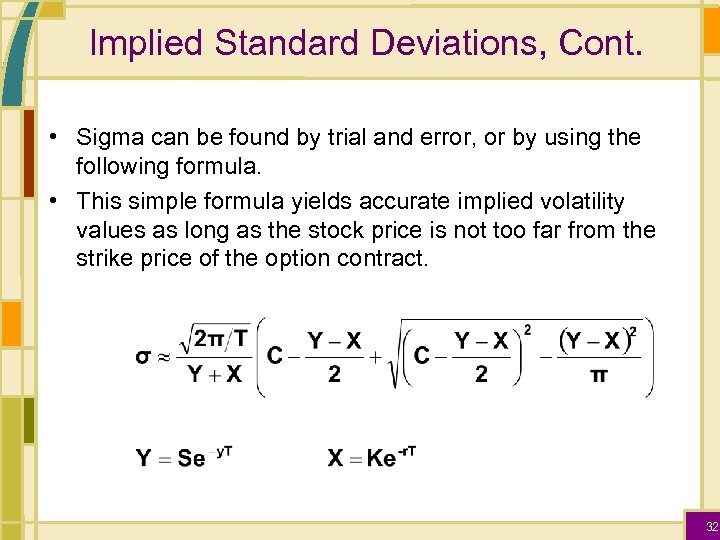 Implied Standard Deviations, Cont. • Sigma can be found by trial and error, or by using the following formula. • This simple formula yields accurate implied volatility values as long as the stock price is not too far from the strike price of the option contract. 32
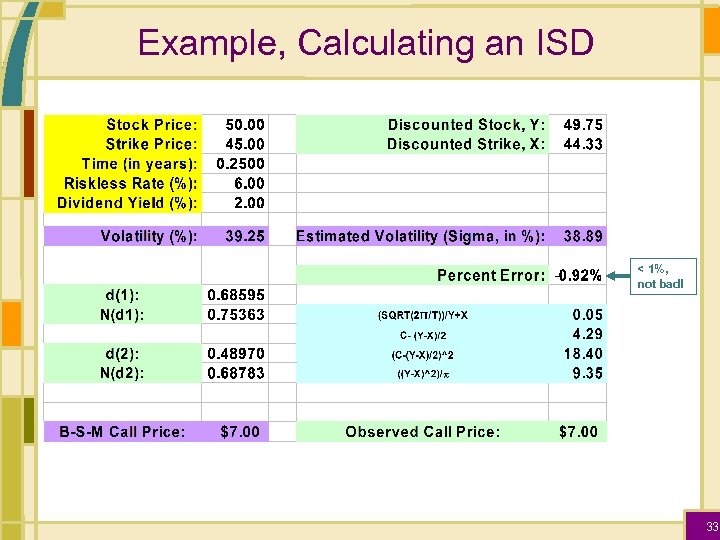 Example, Calculating an ISD < 1%, not bad! 33
 CBOE Implied Volatilities for Stock Indexes • The CBOE publishes data for three implied volatility indexes: – S&P 500 Index Option Volatility, ticker symbol VIX – S&P 100 Index Option Volatility, ticker symbol VXO – Nasdaq 100 Index Option Volatility, ticker symbol VXN • Each of these volatility indexes are calculating using ISDs from eight options: – 4 calls with two maturity dates: • 2 slightly out of the money • 2 slightly in the money – 4 puts with two maturity dates: • 2 slightly out of the money • 2 slightly in the money • The purpose of these indexes is to give investors information about market volatility in the coming months. 34
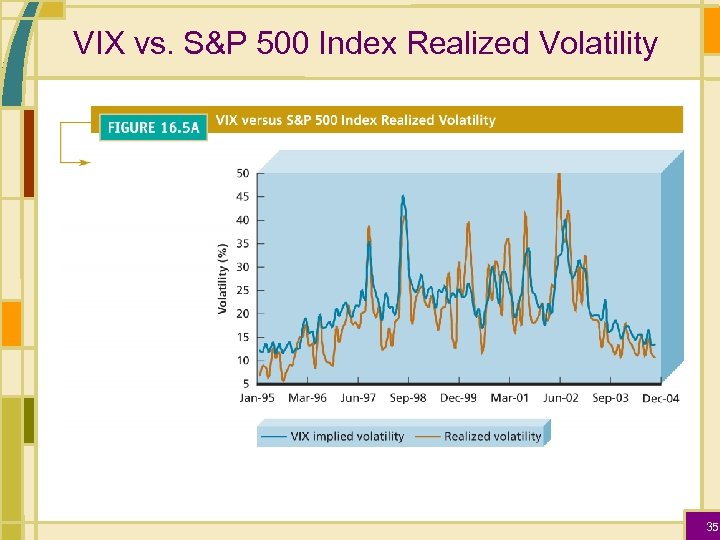 VIX vs. S&P 500 Index Realized Volatility 35
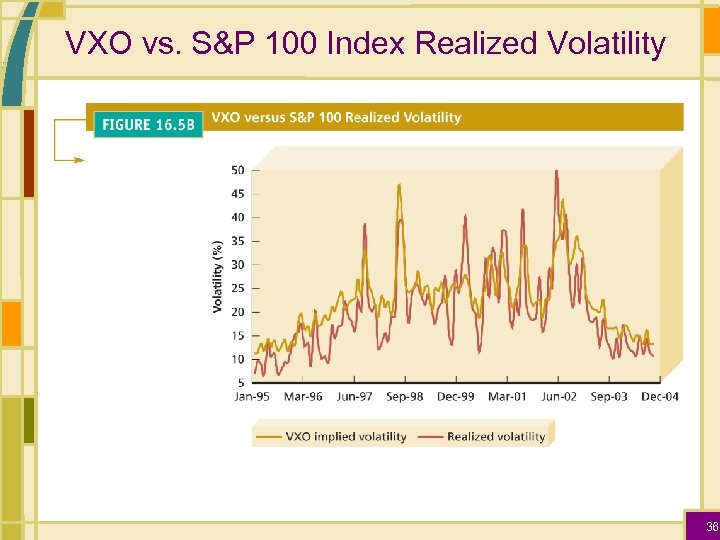 VXO vs. S&P 100 Index Realized Volatility 36
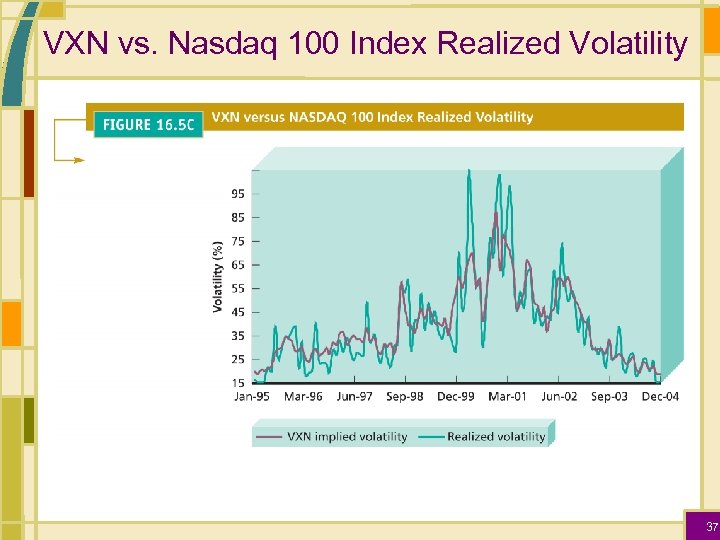 VXN vs. Nasdaq 100 Index Realized Volatility 37
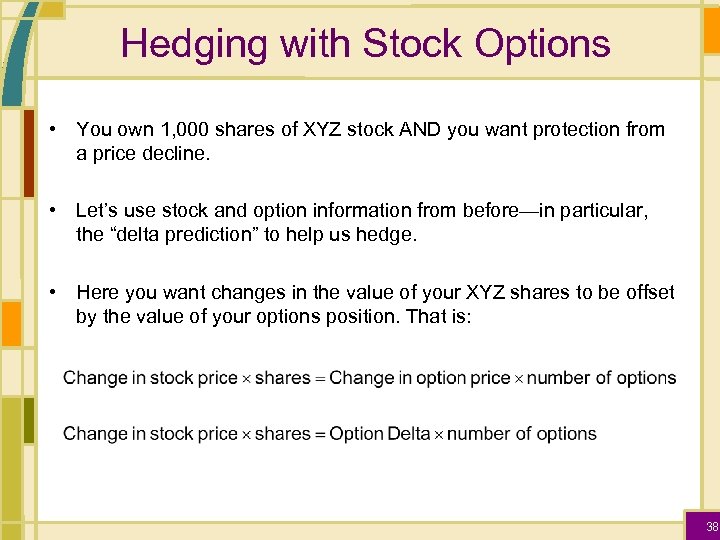 Hedging with Stock Options • You own 1, 000 shares of XYZ stock AND you want protection from a price decline. • Let’s use stock and option information from before—in particular, the “delta prediction” to help us hedge. • Here you want changes in the value of your XYZ shares to be offset by the value of your options position. That is: 38
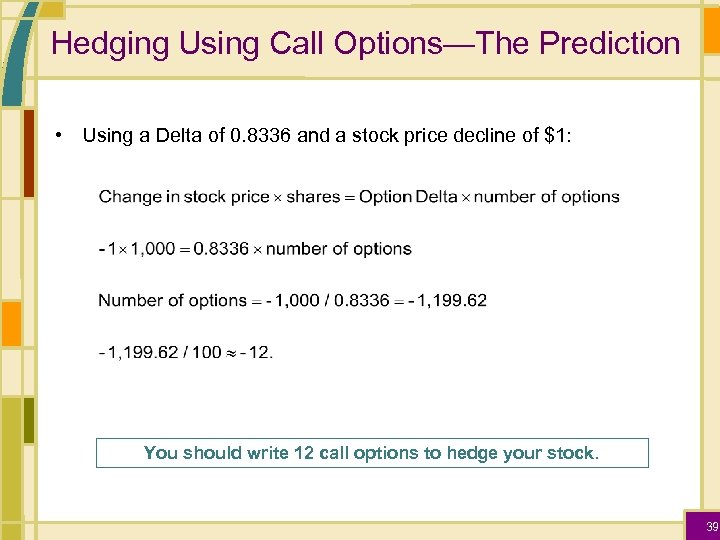 Hedging Using Call Options—The Prediction • Using a Delta of 0. 8336 and a stock price decline of $1: You should write 12 call options to hedge your stock. 39
 Hedging Using Call Options—The Results • XYZ Shares fall by $1—so, you lose $1, 000. • What about the value of your option position? – At the new XYZ stock price of $49, each call option is now worth $5. 17—a decrease of $. 81 for each call ($81 per contract). – Because you wrote 12 call option contracts, your call option gain was $972. • Your call option gain nearly offsets your loss of $1, 000. • Why is it not exact? – Call Delta falls when the stock price falls. – Therefore, you did not quite sell enough call options. 40
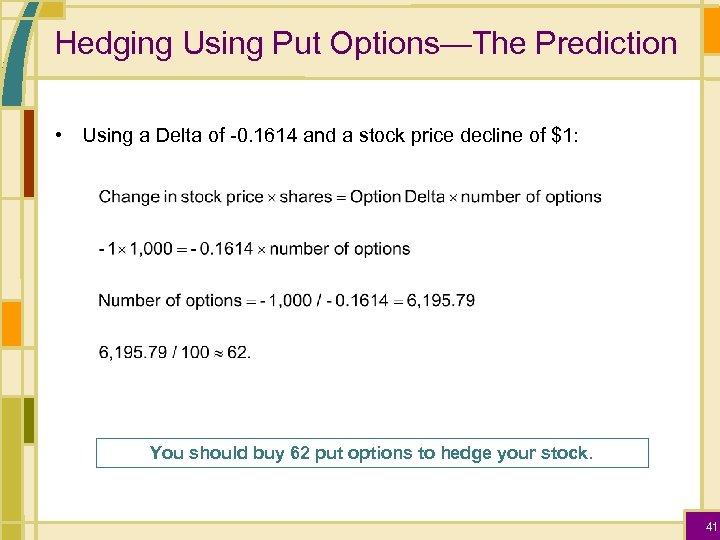 Hedging Using Put Options—The Prediction • Using a Delta of -0. 1614 and a stock price decline of $1: You should buy 62 put options to hedge your stock. 41
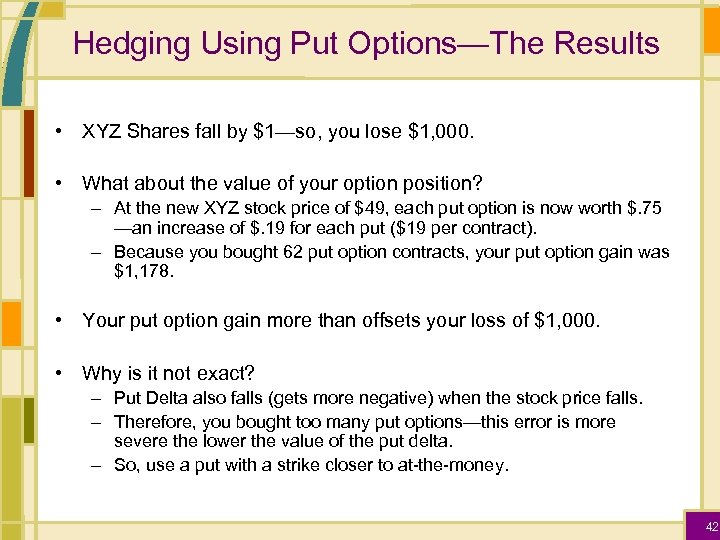 Hedging Using Put Options—The Results • XYZ Shares fall by $1—so, you lose $1, 000. • What about the value of your option position? – At the new XYZ stock price of $49, each put option is now worth $. 75 —an increase of $. 19 for each put ($19 per contract). – Because you bought 62 put option contracts, your put option gain was $1, 178. • Your put option gain more than offsets your loss of $1, 000. • Why is it not exact? – Put Delta also falls (gets more negative) when the stock price falls. – Therefore, you bought too many put options—this error is more severe the lower the value of the put delta. – So, use a put with a strike closer to at-the-money. 42
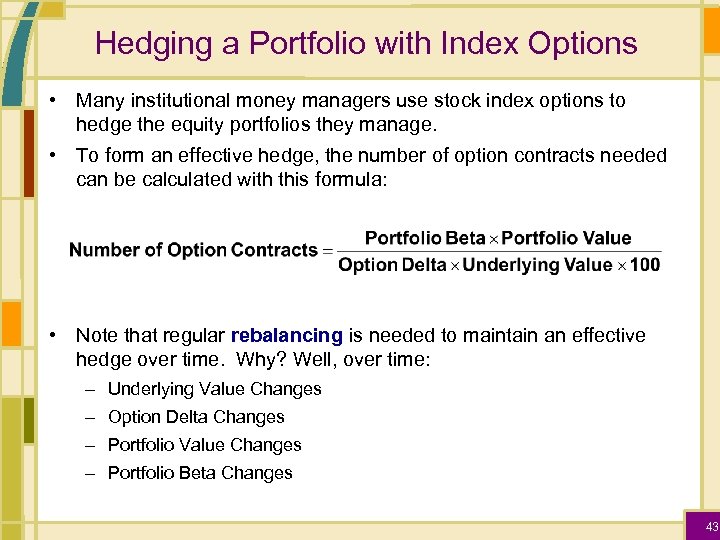 Hedging a Portfolio with Index Options • Many institutional money managers use stock index options to hedge the equity portfolios they manage. • To form an effective hedge, the number of option contracts needed can be calculated with this formula: • Note that regular rebalancing is needed to maintain an effective hedge over time. Why? Well, over time: – Underlying Value Changes – Option Delta Changes – Portfolio Value Changes – Portfolio Beta Changes 43
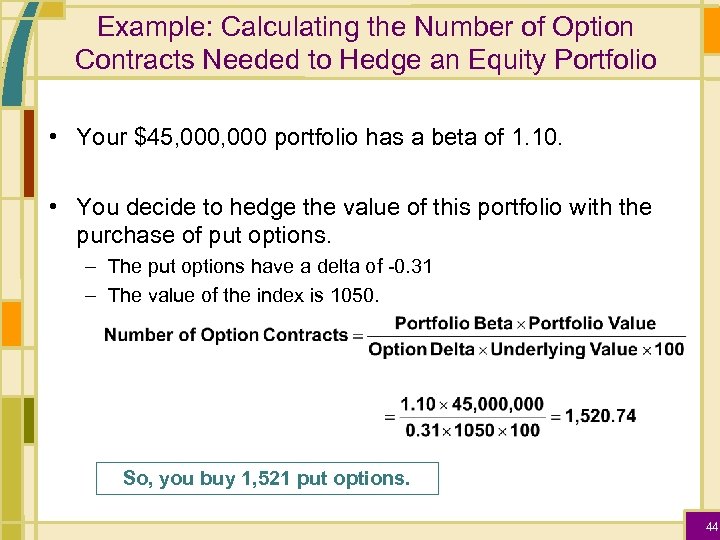 Example: Calculating the Number of Option Contracts Needed to Hedge an Equity Portfolio • Your $45, 000 portfolio has a beta of 1. 10. • You decide to hedge the value of this portfolio with the purchase of put options. – The put options have a delta of -0. 31 – The value of the index is 1050. So, you buy 1, 521 put options. 44
 Useful Websites • • • www. jeresearch. com (information on option formulas) www. cboe. com (for a free option price calculator) www. Derivatives. Models. com (derivatives calculator) www. numa. com (for “everything option”) www. wsj. com/free (option price quotes) www. aantix. com (for stock option reports) www. ino. com (Web Center for Futures and Options) www. optionetics. com (Optionetics) www. pmpublishing. com (free daily volatility summaries) www. ivolatility. com (for applications of implied volatility) 45
 Chapter Review, I. • The Black-Scholes-Merton Option Pricing Model • Valuing Employee Stock Options • Varying the Option Price Input Values – – – Varying the Underlying Stock Price Varying the Option’s Strike Price Varying the Time Remaining until Option Expiration Varying the Volatility of the Stock Price Varying the Interest Rate Varying the Dividend Yield 46
 Chapter Review, II. • Measuring the Impact of Input Changes on Option Prices – – Interpreting Option Deltas Interpreting Option Etas Interpreting Option Vegas Interpreting an Option’s Gamma, Theta, and Rho • Implied Standard Deviations • Hedging with Stock Options • Hedging a Stock Portfolio with Stock Index Options 47