


 Скачать презентацию Chapter 16 Cenozoic Geologic History The Paleogene and
cd63055ce91e5b19f2d040864e4d9f5f.ppt
- Количество слайдов: 198
 Chapter 16 Cenozoic Geologic History— The Paleogene and Neogene
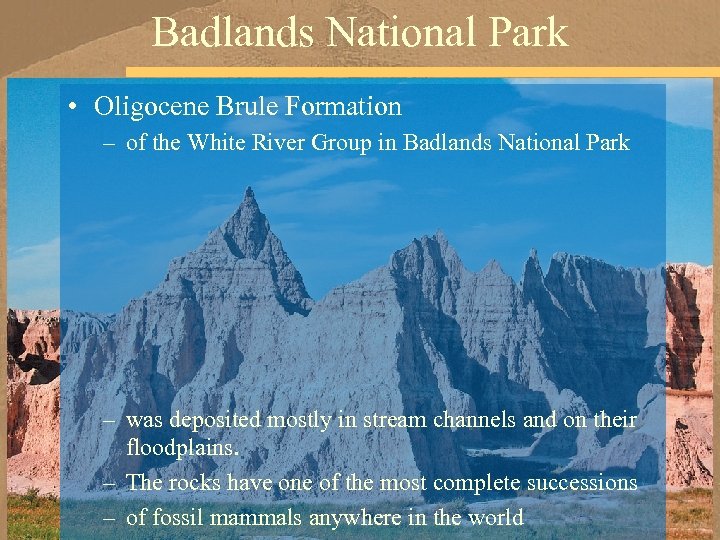 Badlands National Park • Oligocene Brule Formation – of the White River Group in Badlands National Park – was deposited mostly in stream channels and on their floodplains. – The rocks have one of the most complete successions – of fossil mammals anywhere in the world
 1. 4% of Geologic Time • The Cenozoic Era is only – 1. 4% of geologic time, or – just 20 minutes on our hypothetical 24 -hour clock for geologic time • It was long enough for significant changes to occur – as plates changed position – mountains and landscapes continued to develop, – an ice age took place, – and the biota evolved
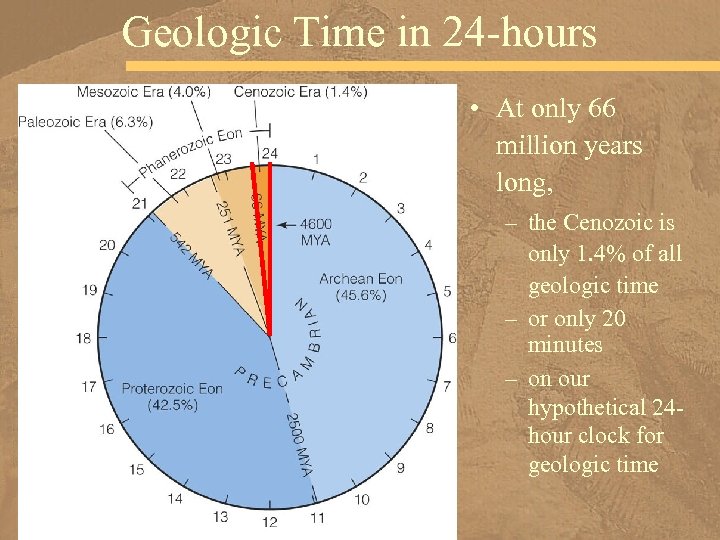 Geologic Time in 24 -hours • At only 66 million years long, – the Cenozoic is only 1. 4% of all geologic time – or only 20 minutes – on our hypothetical 24 hour clock for geologic time
 Cenozoic Events • Many events that began during the Cenozoic continue to the present, – including the ongoing erosion – of the Grand Canyon, – continued uplift and erosion of the Himalayas in Asia – and the Andes in South America, – the origin and evolution of the San Andreas fault, – and the origin of the volcanoes – that make the Cascade Range
 Neogene and Paleogene • Geologists divide the Cenozoic Era – into two periods of unequal duration – The terms Paleogene Period • 66 to 23 million years ago • includes Paleocene, Eocene, and the Oligocene epochs – and Neogene Period • 23 million years ago to the present • includes Miocene, Pleistocene, Holocene epochs • Although the terms • Tertiary Period (66 – 1. 8 million years ago) and • Quaternary Period (the last 1. 8 million years) – are used by some geologists – they are no longer recommended – as subdivisions of the Cenozoic Era
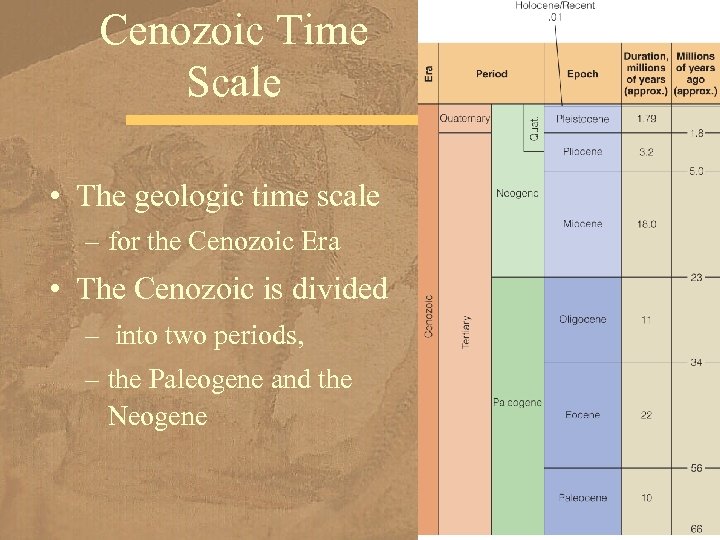 Cenozoic Time Scale • The geologic time scale – for the Cenozoic Era • The Cenozoic is divided – into two periods, – the Paleogene and the Neogene
 Cenozoic Rocks Are Accessible • Geologists know more about – the Cenozoic Earth and life history – than for any other interval of geologic time – because Cenozoic rocks • being the youngest – are the most accessible at or near the surface
 Cenozoic Rocks Are Accessible • Vast exposures of Cenozoic sedimentary – and igneous rocks in western North America – record the presence of a shallow sea • in the continental interior, – terrestrial depositional environments, – lava flows, – and volcanism on a huge scale in the Pacific Northwest
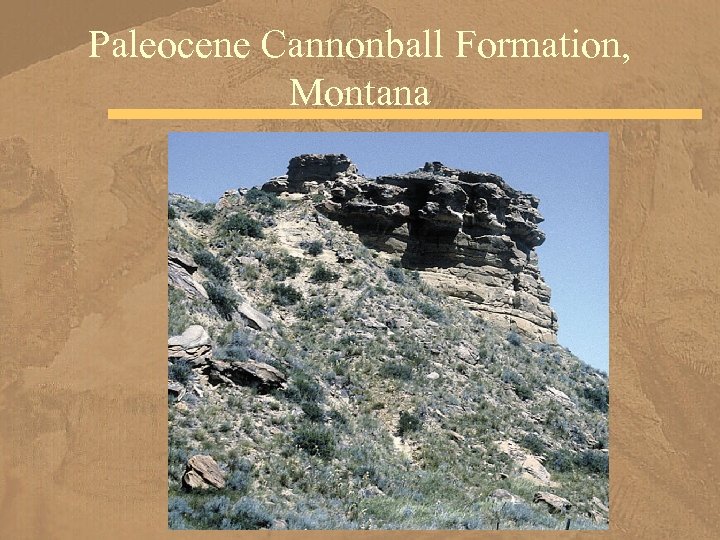 Paleocene Cannonball Formation, Montana
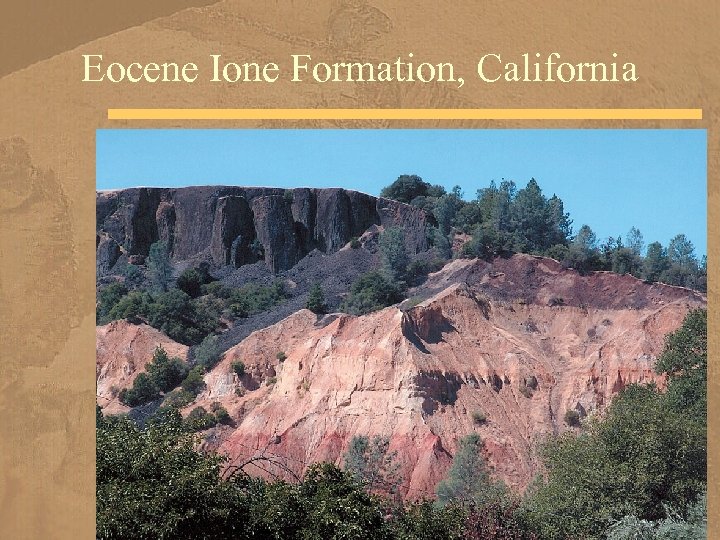 Eocene Ione Formation, California
 Cenozoic in Eastern North America • Exposures of Cenozoic rocks – in eastern North America – are limited, – except for Ice Age deposits, – but notable exceptions are Florida • where fossil-bearing rocks • of Middle to Late Cenozoic age are present, – and Maryland
 Cenozoic Geologic History • One reason to study Cenozoic geologic history – is the fact that the present distribution • of land sea, – climatic and oceanic circulation patterns, – and Earth's present-day distinctive topography – resulted from systems interactions during this time
 Neogene Was Unusual • The latter part of the Neogene was unusual – because it was one of the few times in Earth history – when widespread glaciers were present. – Therefore, we consider the Pleistocene and Holocene epochs separately
 Cenozoic Plate Tectonics • The progressive fragmentation of Pangaea, – the supercontinent that existed at the end of the Paleozoic – accounts for the present distribution of Earth's landmasses • Moving plates also directly affect the biosphere • because the geographic locations of continents – profoundly influence the atmosphere – and hydrosphere
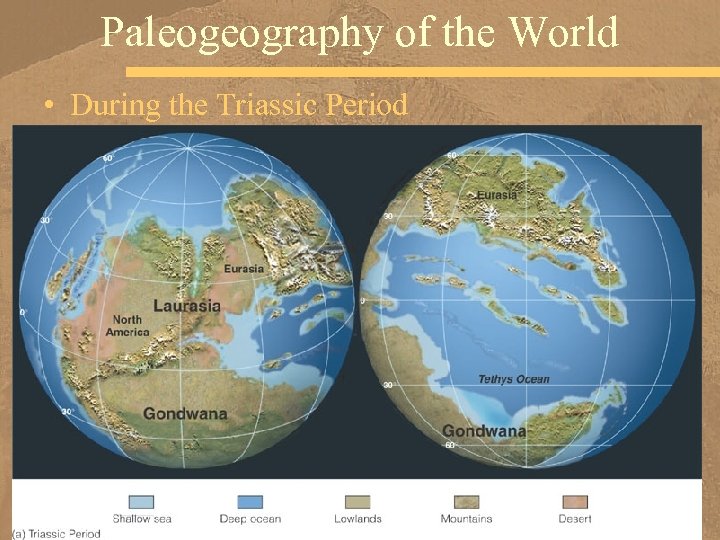 Paleogeography of the World • During the Triassic Period
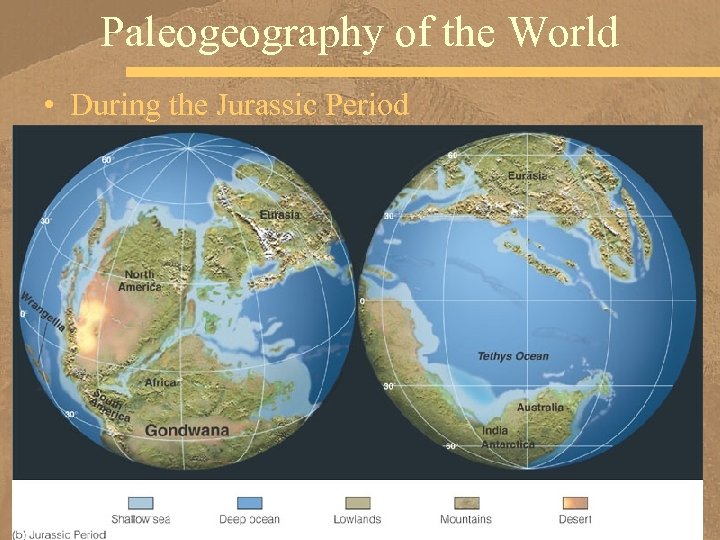 Paleogeography of the World • During the Jurassic Period
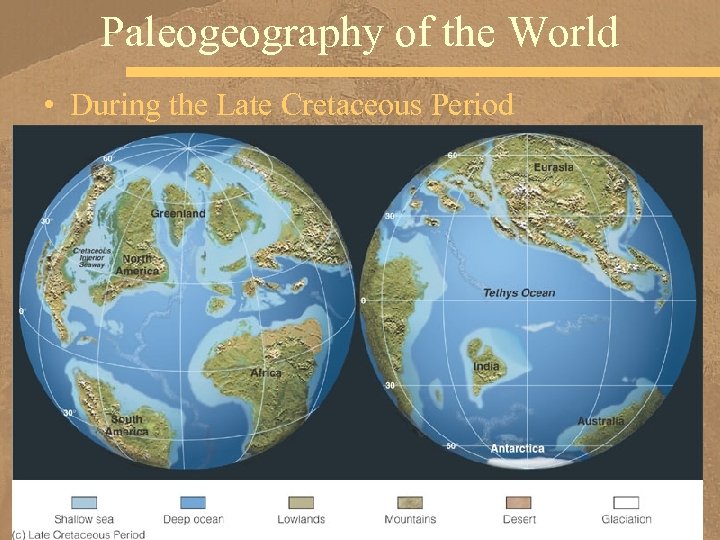 Paleogeography of the World • During the Late Cretaceous Period
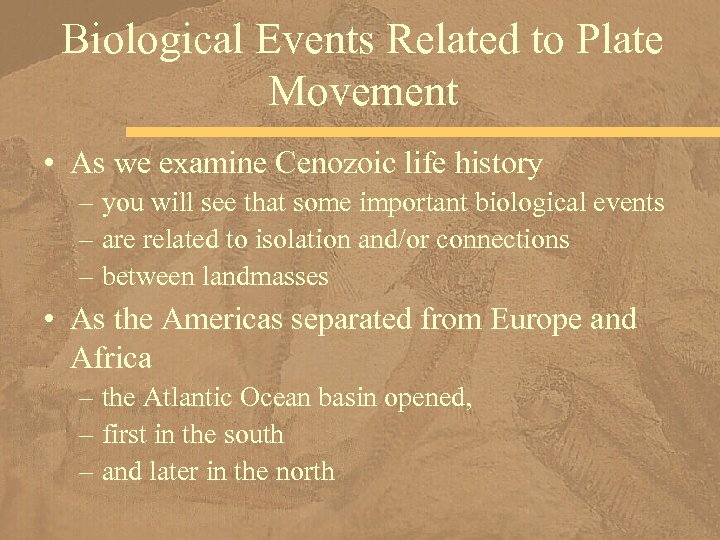 Biological Events Related to Plate Movement • As we examine Cenozoic life history – you will see that some important biological events – are related to isolation and/or connections – between landmasses • As the Americas separated from Europe and Africa – the Atlantic Ocean basin opened, – first in the south – and later in the north
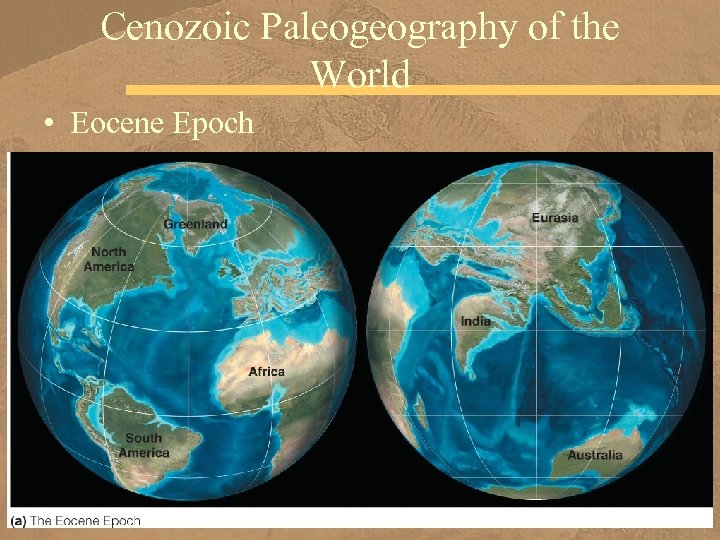 Cenozoic Paleogeography of the World • Eocene Epoch
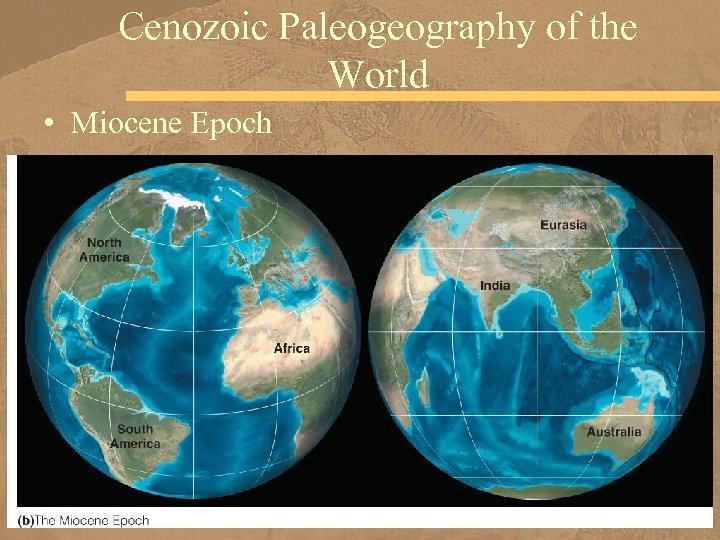 Cenozoic Paleogeography of the World • Miocene Epoch
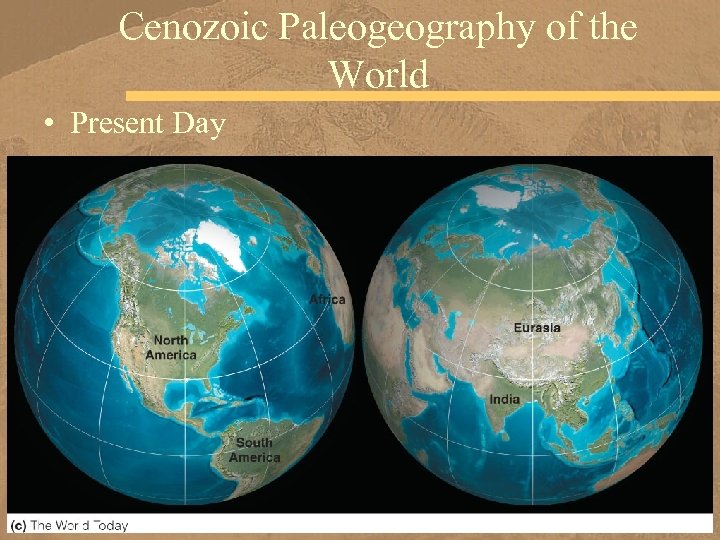 Cenozoic Paleogeography of the World • Present Day
 Spreading Ridges • Spreading ridges such as – the Mid-Atlantic Ridge and East Pacific Rise – were established, – along which new oceanic crust formed – and continues to form • However, the age of the oceanic crust – in the Pacific is very asymmetric, – because much of the crust in the eastern Pacific Ocean basin has been subducted – beneath the westerly moving North and South America plates
 Northward Movement of the Indian Plate • Another important plate tectonic event – involved the northward movement of the Indian plate – and its eventual collision with Asia • Simultaneous northward movement of the African plate – caused the closure of the Tethys Sea – and initiated the tectonic activity that currently takes place – throughout an east–west zone – from the Mediterranean through northern India
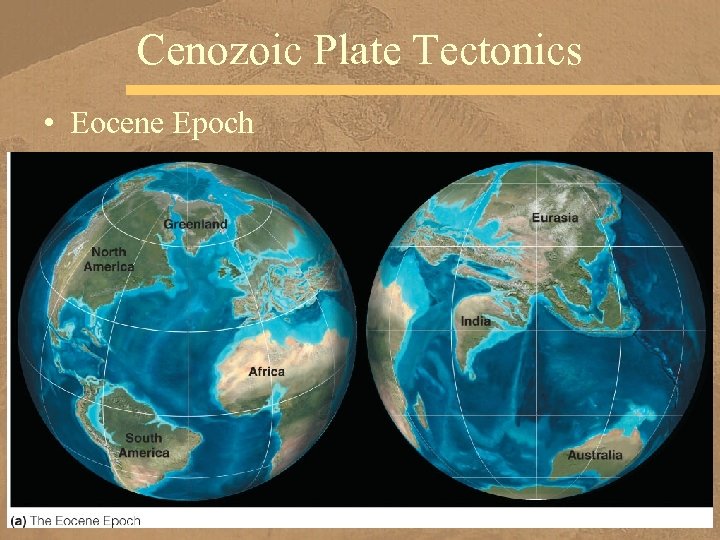 Cenozoic Plate Tectonics • Eocene Epoch
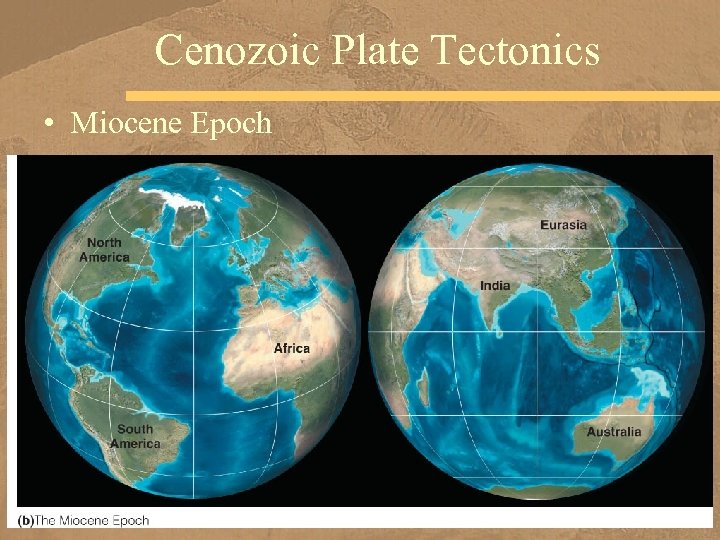 Cenozoic Plate Tectonics • Miocene Epoch
 Volcanoes in Italy and Greece • Erupting volcanoes in Italy and Greece – as well as seismic activity – in the entire region remind us – of the continuing plate interactions – in this part of the world • Neogene rifting – began in East Africa, the Red Sea, – and the Gulf of Aden
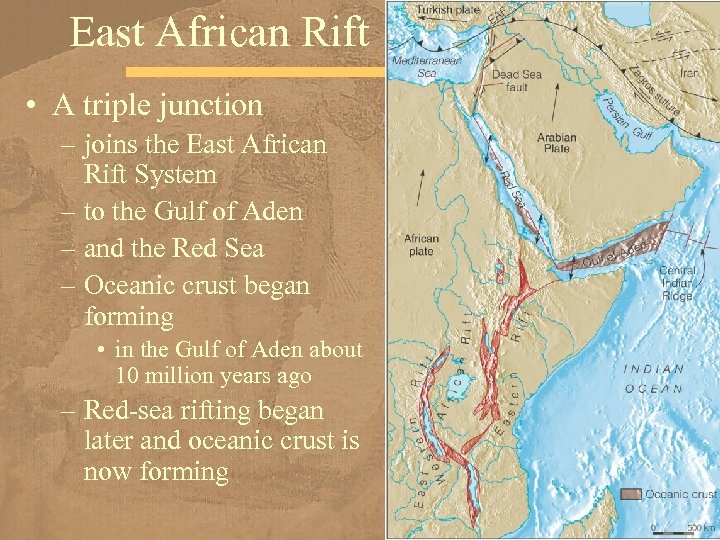 East African Rift • A triple junction – joins the East African Rift System – to the Gulf of Aden – and the Red Sea – Oceanic crust began forming • in the Gulf of Aden about 10 million years ago – Red-sea rifting began later and oceanic crust is now forming
 East Africa Rifting • Rifting in East Africa is in its early stages, – because the continental crust – has not yet stretched and thinned enough – for new oceanic crust to form from below • Nevertheless, this area is – seismically active and has many active volcanoes • In the Red Sea, – rifting and the Late Pliocene origin of oceanic crust – followed vast eruptions of basalt
 Arabian Plate • In the Gulf of Aden – Earth's crust had stretched and thinned enough – by Late Miocene time – for upwelling basaltic magma to form new oceanic crust • The Arabian plate is moving north, – so it too causes some of the deformation – taking place from the Mediterranean through India
 Americas Move West • North and South American plates continued their westerly movement – as the Atlantic Ocean basin widened • Subduction zones bounded both continents – on their western margins, – but the situation changed in North America – as it moved over the northerly extension – of the East Pacific Rise – and it now has a transform plate boundary
 Cenozoic Orogenic Belts • Remember that an orogeny – is an episode of mountain building, – during which deformation takes place over an elongate area • Most orogenies involve – volcanism, – the emplacement of plutons, – and regional metamorphism – as Earth's crust is locally thickened – and stands higher than adjacent areas
 Two Major Orogenic Belt • Cenozoic orogenic activity – took place largely in two major zones or belts, – the Alpine–Himalayan orogenic belt – and the circum-Pacific orogenic belt • Both belts are made up of smaller segments – known as orogens, – each of which shows the characteristics of orogeny
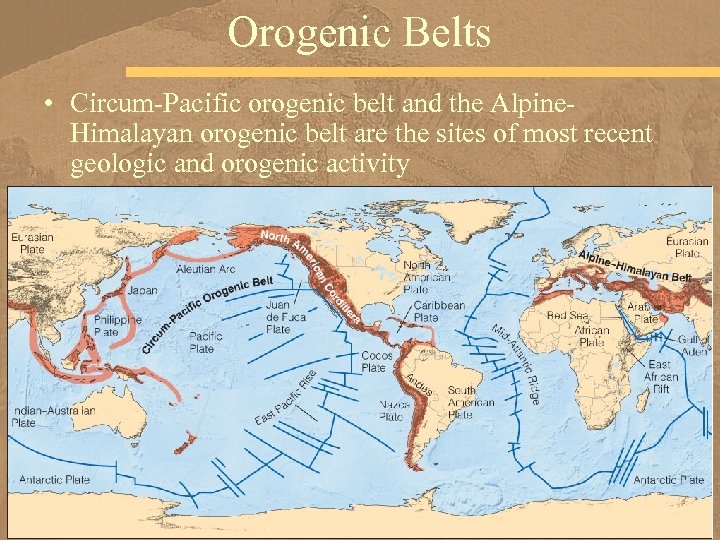 Orogenic Belts • Circum-Pacific orogenic belt and the Alpine. Himalayan orogenic belt are the sites of most recent geologic and orogenic activity
 The Alpine-Himalayan Orogenic Belt • The Alpine-Himalayan orogenic belt extends eastward from Spain through the Mediterranean region – as well as the Middle East and India – and on into Southeast Asia • During Mesozoic time, – the Tethys Sea separated Gondwana from Eurasia
 Closure of the Tethys Sea • Closure of Tethys Sea took place during the Cenozoic – as the African and Indian plates collided – with the huge landmass to the north • Volcanism, seismicity, and deformation – remind us that the Alpine-Himalayan orogenic belt – remains quite active
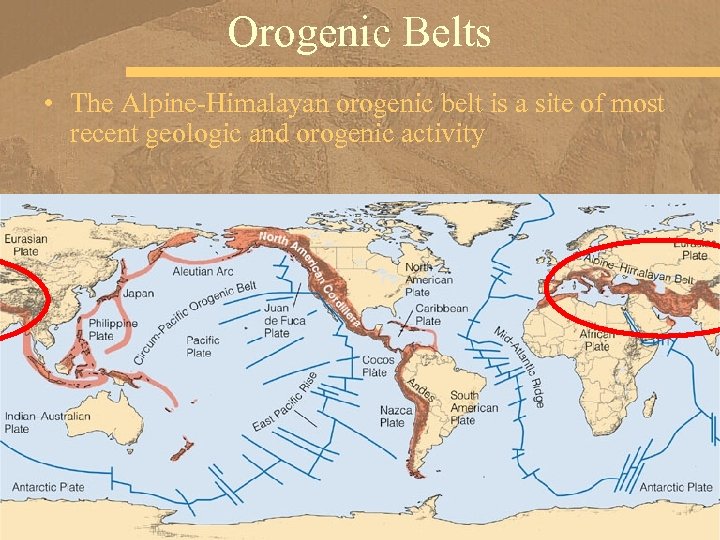 Orogenic Belts • The Alpine-Himalayan orogenic belt is a site of most recent geologic and orogenic activity
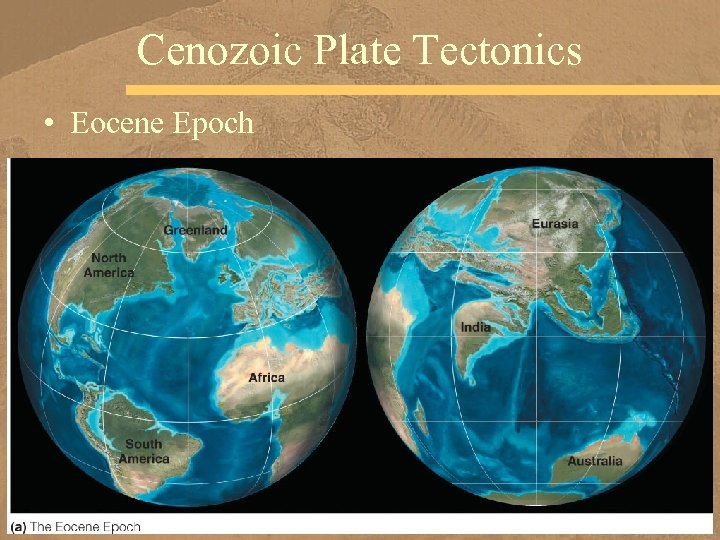 Cenozoic Plate Tectonics • Eocene Epoch
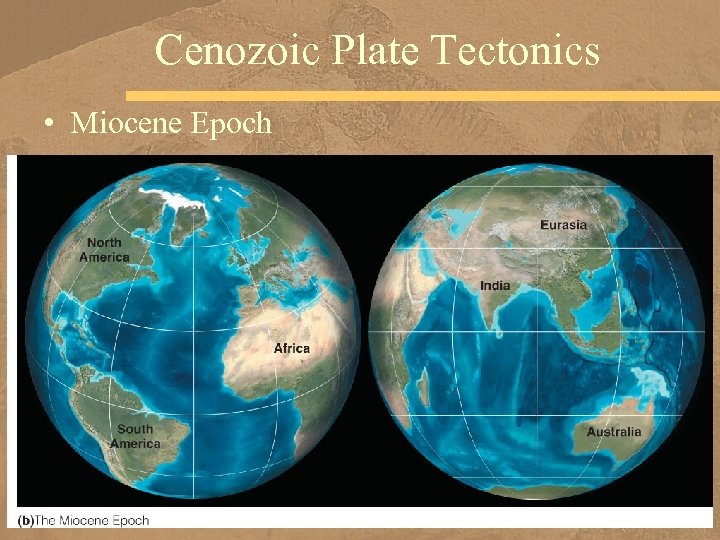 Cenozoic Plate Tectonics • Miocene Epoch
 The Alps • During the Alpine orogeny – deformation took place – in a linear zone – in southern Europe – extending from Spain – eastward through Greece and Turkey • Concurrent deformation – also occurred along Africa's northwest coast
 Alpine Deformation • Many details of this long, complex event – are poorly understood, – but the overall picture is now becoming clear • Events leading to Alpine deformation – began during the Mesozoic, – yet Eocene to Late Miocene – deformation was also important
 Northward Moving Plates • Northward movements of the African and Arabian plates – against Eurasia caused compression and deformation, – but the overall picture is complicated by – the collision of several smaller plates with Europe • These small plates were also deformed – and are now found in – the mountains in the Alpine orogen
 European Mountain Building • Mountain building produced – the Pyrenees • between Spain and France, – the Apennines of Italy, – as well as the Alps of mainland Europe • Indeed, the compressional forces – generated by colliding plates – resulted in complex thrust faults – and huge overturned folds known as nappes
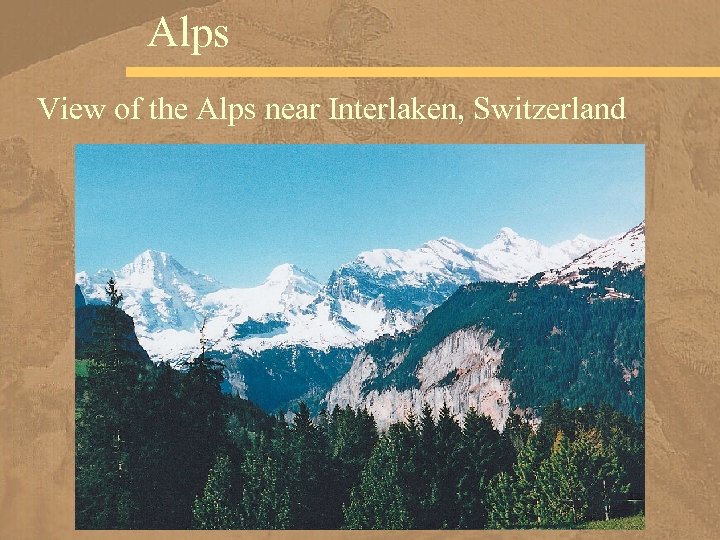 Alps View of the Alps near Interlaken, Switzerland
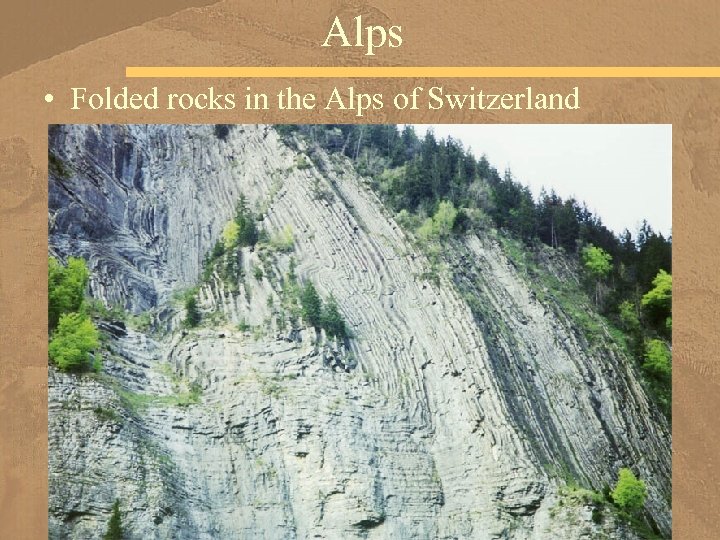 Alps • Folded rocks in the Alps of Switzerland
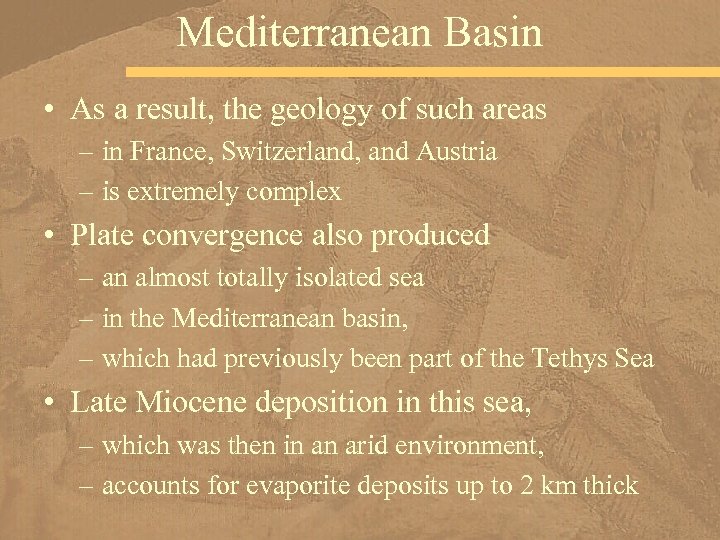 Mediterranean Basin • As a result, the geology of such areas – in France, Switzerland, and Austria – is extremely complex • Plate convergence also produced – an almost totally isolated sea – in the Mediterranean basin, – which had previously been part of the Tethys Sea • Late Miocene deposition in this sea, – which was then in an arid environment, – accounts for evaporite deposits up to 2 km thick
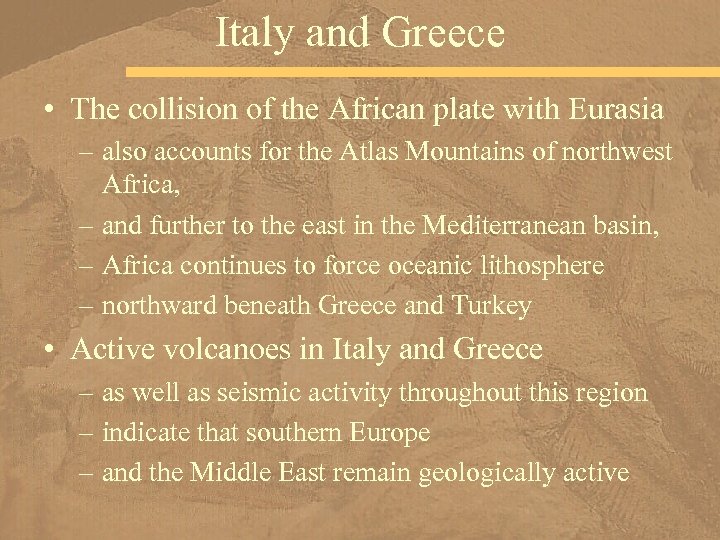 Italy and Greece • The collision of the African plate with Eurasia – also accounts for the Atlas Mountains of northwest Africa, – and further to the east in the Mediterranean basin, – Africa continues to force oceanic lithosphere – northward beneath Greece and Turkey • Active volcanoes in Italy and Greece – as well as seismic activity throughout this region – indicate that southern Europe – and the Middle East remain geologically active
 Geologically Active • In 2005, for instance, – an earthquake of 7. 6 on the Richter scale – killed more than 86, 000 people in Pakistan • Mount Vesuvius in Italy has erupted 80 times – since it destroyed Pompeii in A. D. 79
 The Himalayas— Roof of the World • During the Early Cretaceous, – India broke away from Gondwana – and began moving north, – and oceanic lithosphere was consumed – at a subduction zone – along the southern margin of Asia
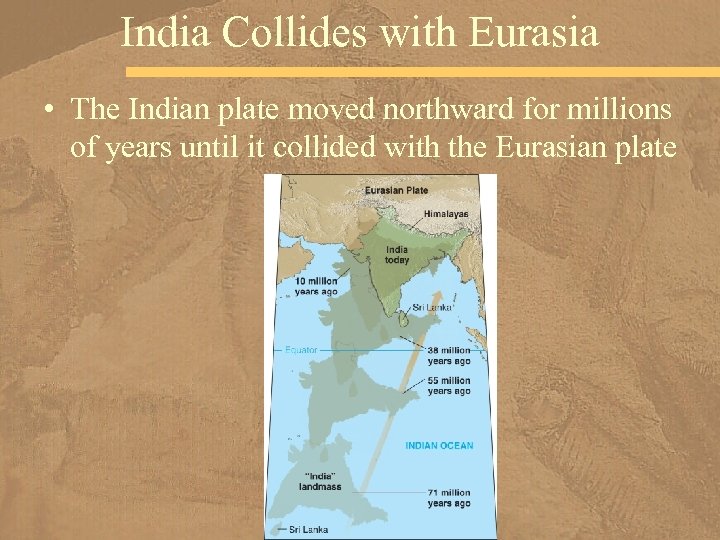 India Collides with Eurasia • The Indian plate moved northward for millions of years until it collided with the Eurasian plate
 Volcanic Chain • The descending plate partially melted, – forming magma that rose to form a volcanic chain – and large granitic plutons in what is now Tibet • The Indian plate eventually approached these volcanoes – and destroyed them as it collided with Asia
 Continental Plates Sutured • As India collided with Asia, – the two continental plates – were sutured along a zone – now recognized as the Himalayan orogen
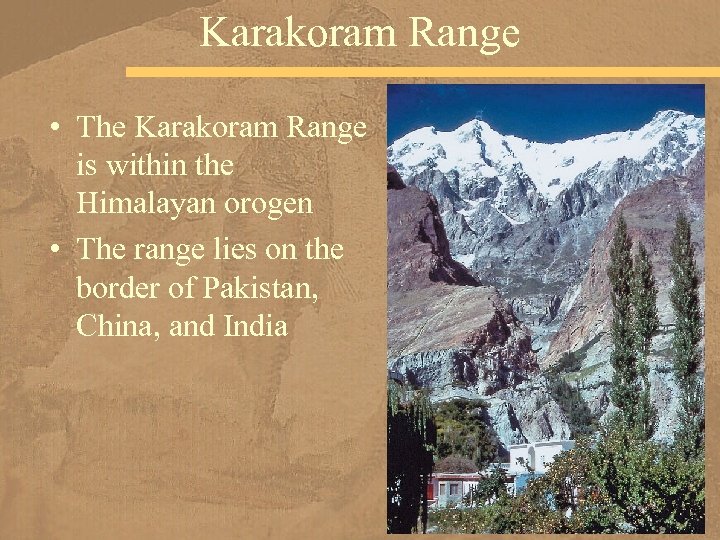 Karakoram Range • The Karakoram Range is within the Himalayan orogen • The range lies on the border of Pakistan, China, and India
 Collision Timing • Sometime between 40 and 50 million years ago – India's drift rate decreased abruptly – from 15 to 20 cm/year to about 5 cm/year • Because continental lithosphere – is not dense enough to be subducted, – this decrease most likely marks – the time of collision – and India's resistance to subduction
 Crustal Thickening and Uplift • Because of India's low density – and resistance to subduction – it was underthrust about 2000 km under Asia, – causing crustal thickening and uplift, – a process that continues at about 5 cm/year • Furthermore, sedimentary rocks – formed in the sea south of Asia – were thrust northward into Tibet, – and two huge thrust faults carried – Paleozoic and Mesozoic rocks of Asian origin – onto the Indian plate
 Missing Volcanism • In the Himalayan orogen there is no volcanism – because the Indian plate does not penetrate deeply enough to generate magma, – but seismic activity continues • Indeed, the entire Himalayan region – including the Tibetan plateau – and well into China – is seismically active • The May 12, 2008 Sichuan earthquake in China – in which about 70, 000 people perished – was a result of this collision between India and Asia
 The Circum-Pacific Orogenic Belt • The circum-Pacific orogenic belt – consists of orogens – along the western margins of South, Central, and North America – as well as the eastern margin of Asia – and the islands north of Australia and New Zealand • Subduction of oceanic lithosphere – accompanied by deformation and igneous activity – characterize the orogens – in the western and northern Pacific
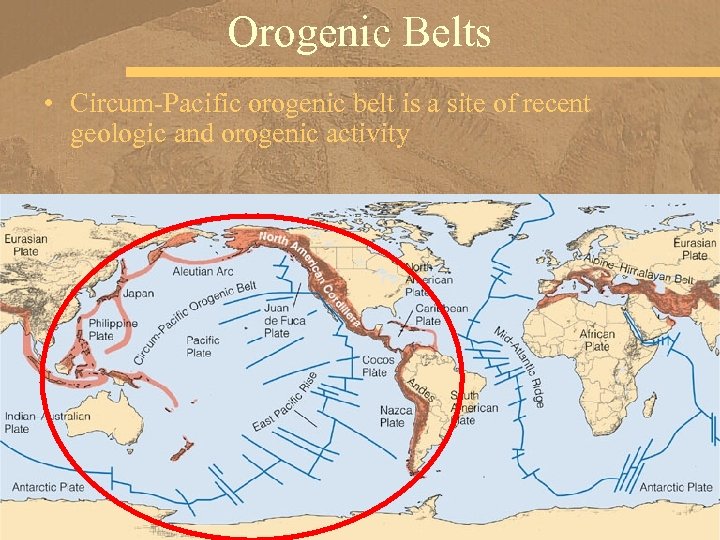 Orogenic Belts • Circum-Pacific orogenic belt is a site of recent geologic and orogenic activity
 Origin of Japan • Japan, for instance, – is bounded on the east by the Japan Trench, – where the Pacific plate is subducted • The Sea of Japan, – a back-arc marginal basin, – lies between Japan and mainland Asia • According to some geologists, – Japan was once part of mainland Asia – and was separated when back-arc spreading took place
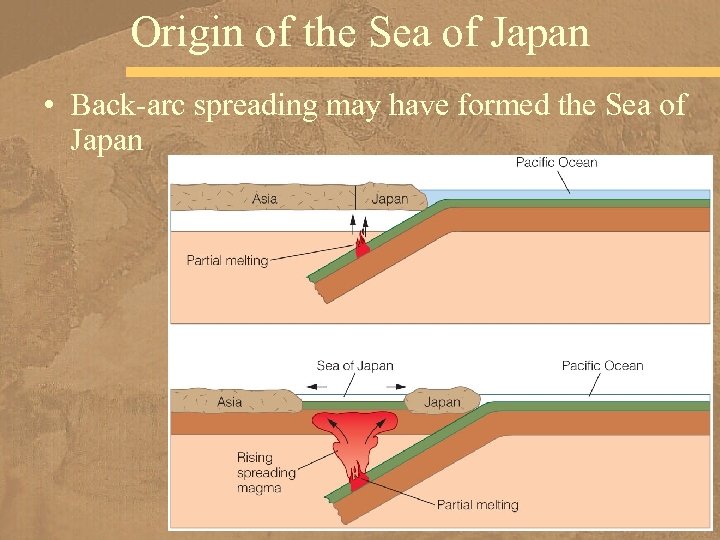 Origin of the Sea of Japan • Back-arc spreading may have formed the Sea of Japan
 Japan's Geology Is Complex • Separation began during the Cretaceous – as Japan moved westward – over the Pacific plate – and oceanic crust formed in the Sea of Japan • Japan's geology is complex, – and much of its deformation – predates the Cenozoic, – but considerable deformation, metamorphism, and volcanism – occurred during the Cenozoic – and continues to the present
 Northern Pacific • In the northern part of the Pacific Ocean, – basin subduction of the Pacific plate – at the Aleutian trench – accounts for the tectonic activity in that region • Of the 80 or so potentially active volcanoes – in Alaska, • at least half have erupted since 1760, • and of course, seismic activity is ongoing
 Eastern Pacific • In the eastern part of the Pacific, – the Cocos and Nazca plates – move west from the East Pacific Rise – only to be consumed – at subduction zones in Central and South America • Volcanism and seismic activity – indicate these orogens – in both Central and South America – are active
 Andes Mountains • One manifestation – of on-going tectonic activity in South America – is the Andes Mountains – with more than 49 peaks higher than 6000 m • The Andes formed, and continue to do so, – as Mesozoic-Cenozoic plate convergence – resulted in crustal thickening – as sedimentary rocks were deformed, – uplifted, – and intruded by huge granitic plutons
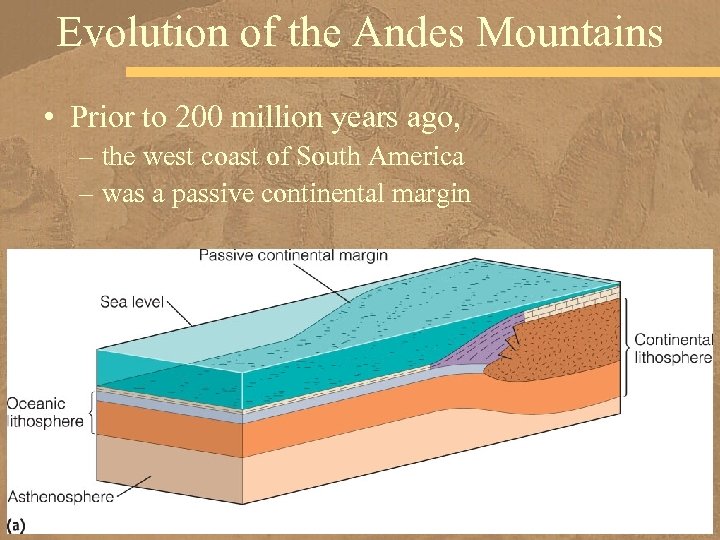 Evolution of the Andes Mountains • Prior to 200 million years ago, – the west coast of South America – was a passive continental margin
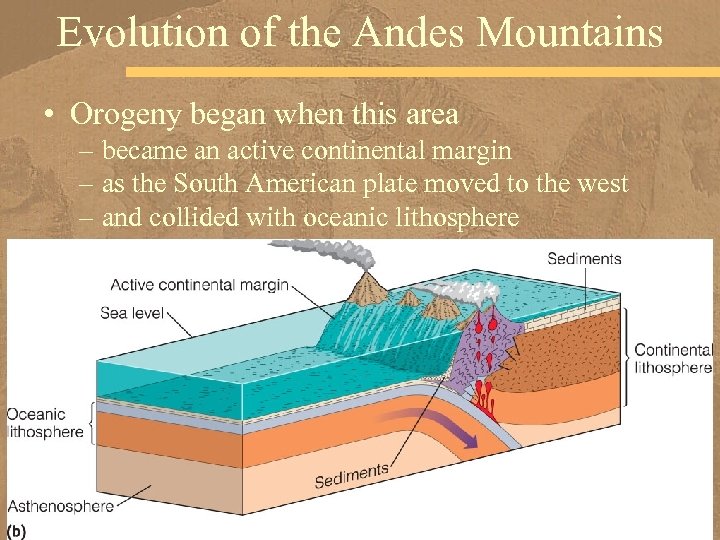 Evolution of the Andes Mountains • Orogeny began when this area – became an active continental margin – as the South American plate moved to the west – and collided with oceanic lithosphere
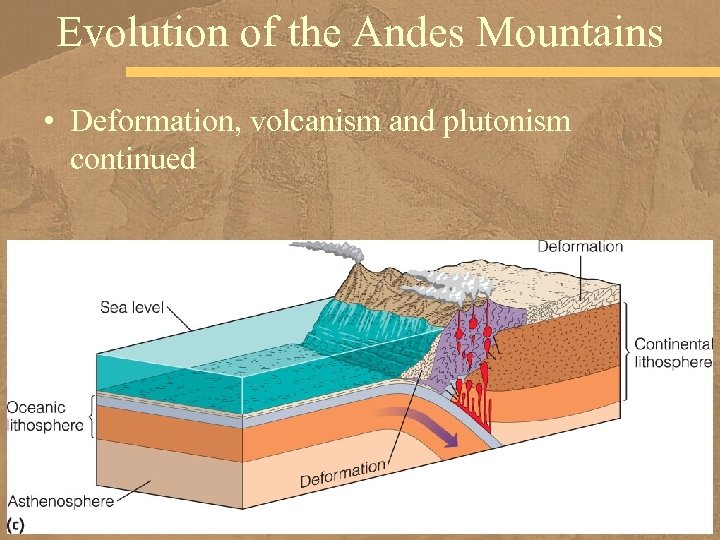 Evolution of the Andes Mountains • Deformation, volcanism and plutonism continued
 The North American Cordillera • The North American Cordillera, – a complex mountainous region – in western North America, – is a large segment – of the circum-Pacific orogenic belt – extending from Alaska to central Mexico • In the United States it widens to 1200 km, – stretching east-west – from the eastern flank of the Rocky Mountains – to the Pacific Ocean
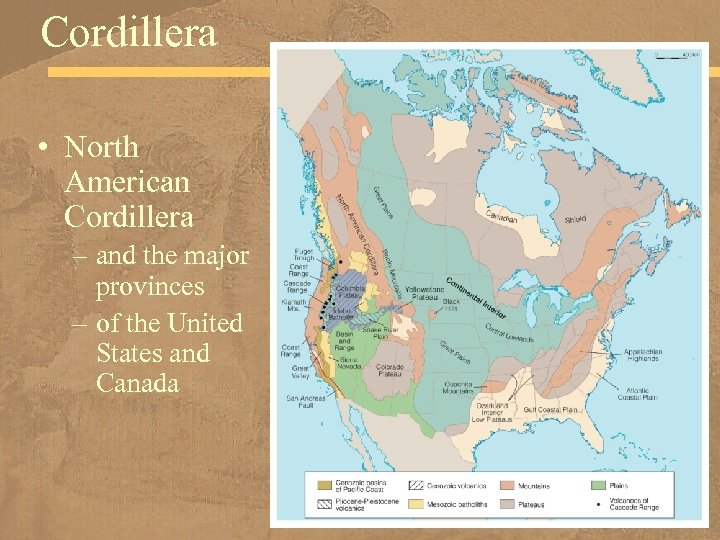 Cordillera • North American Cordillera – and the major provinces – of the United States and Canada
 Cordilleran Geologic Evolution • The geologic evolution – of the North American Cordillera – actually began during the Neoproterozoic – when huge quantities of sediment accumulated – along a westward-facing continental margin
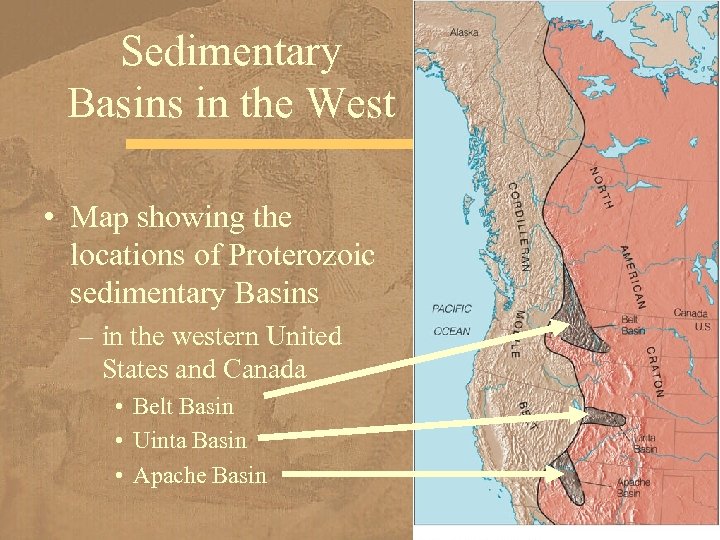 Sedimentary Basins in the West • Map showing the locations of Proterozoic sedimentary Basins – in the western United States and Canada • Belt Basin • Uinta Basin • Apache Basin
 Cordilleran Geologic Evolution • Deposition continued into the Paleozoic, – and during the Devonian – part of the region was deformed – at the time of the Antler orogeny • A protracted episode – of deformation known as the Cordilleran orogeny – began during the Late Jurassic – as the Nevadan, Sevier, and Laramide orogenies – progressively affected areas from west to east
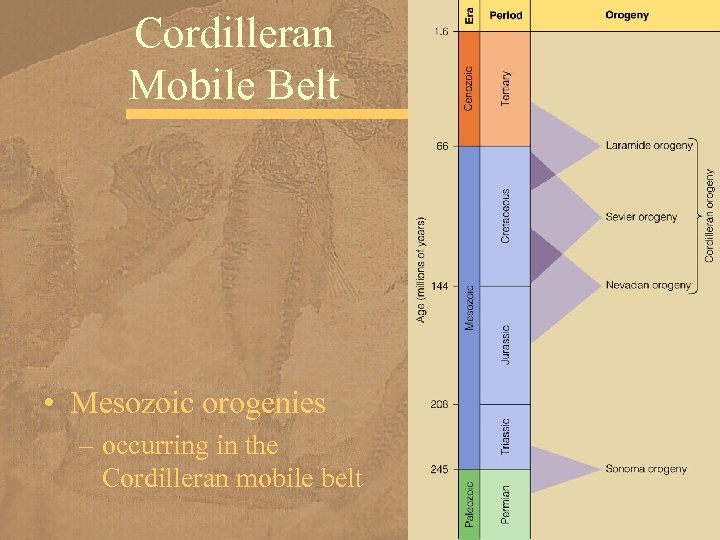 Cordilleran Mobile Belt • Mesozoic orogenies – occurring in the Cordilleran mobile belt
 Cordillera Evolved • After Laramide deformation – ceased during Eocene time, • the North American Cordillera – continued to evolve – as parts of it experienced – large-scale block-faulting, – extensive volcanism, – and vertical uplift and deep erosion • During about the first half of the Cenozoic Era, – a subduction zone was present – along the entire western margin of the Cordillera, – but now most of it is a transform plate boundary
 Plate Interactions Continue • Present-day seismic activity – and volcanism – indicate that plate interactions – continue in the Cordillera, – especially near its western margin
 The Laramide Orogeny • We already mentioned – that the Laramide orogeny – was the third in a series of deformational events – in the Cordillera beginning during the Late Jurassic • However, this orogeny – was Late Cretaceous to Eocene – and it differed from the previous orogenies – in important ways
 Laramide Differences • First, it occurred much farther inland – from a convergent plate boundary, – and neither volcanism – nor emplacement of plutons was very common • Second, deformation mostly took the form – of vertical, fault-bounded uplifts – rather than the compression-induced – folding and thrust faulting – typical of most orogenies • To account for these differences, – geologists modified their model – for orogenies at convergent plate boundaries
 Earlier Steep Subduction • During the preceding Nevadan and Sevier orogenies, – the Farallon plate was subducted at about a 50° angle – along the western margin of North America • Volcanism and plutonism – took place 150 to 200 km inland – from the oceanic trench – and sediments of the continental margin – were compressed and deformed
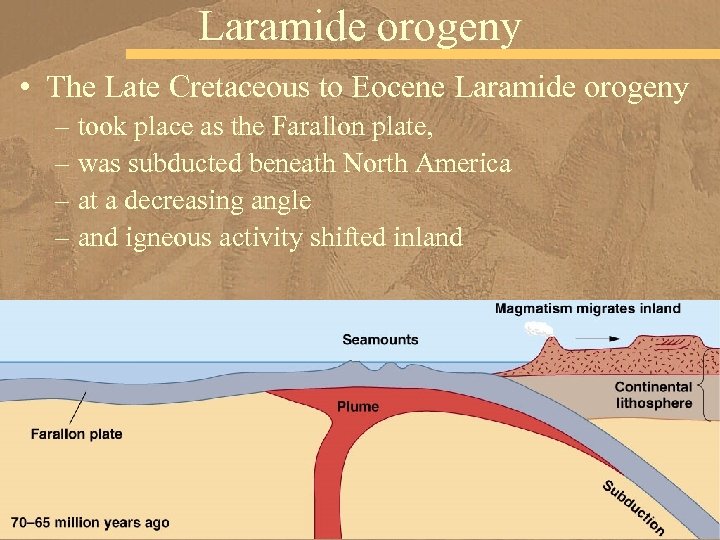 Laramide orogeny • The Late Cretaceous to Eocene Laramide orogeny – took place as the Farallon plate, – was subducted beneath North America – at a decreasing angle – and igneous activity shifted inland
 Change to Shallow Subduction • Most geologists agree that – by Early Paleogene time – there was a change in the subduction angle – from steep to gentle – and the Farallon plate moved nearly horizontally – beneath North America • According to one hypothesis, – a buoyant oceanic plateau – that was part of the Farallon plate – that descended beneath North America – resulted in shallow subduction
 Change to Shallow Subduction • Another hypothesis holds that North America – overrode the Farallon plate, – beneath which was – the deflected head of the mantle plume • The lithosphere above the mantle plume – was buoyed up, – accounting for a change – from steep to shallow subduction
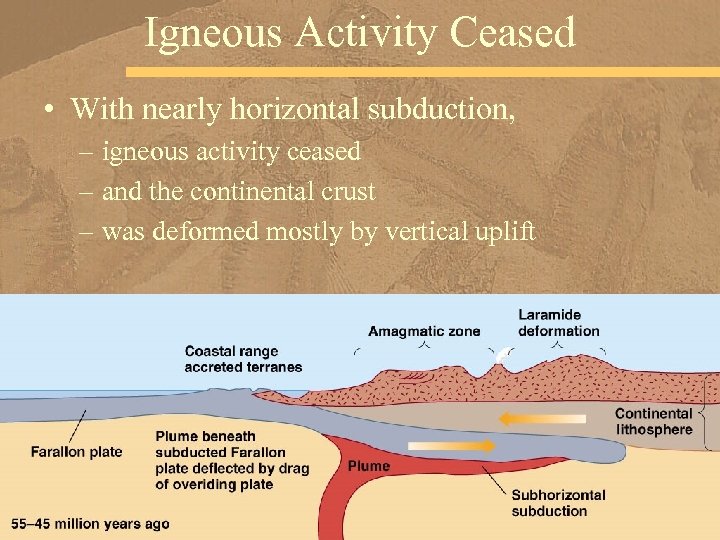 Igneous Activity Ceased • With nearly horizontal subduction, – igneous activity ceased – and the continental crust – was deformed mostly by vertical uplift
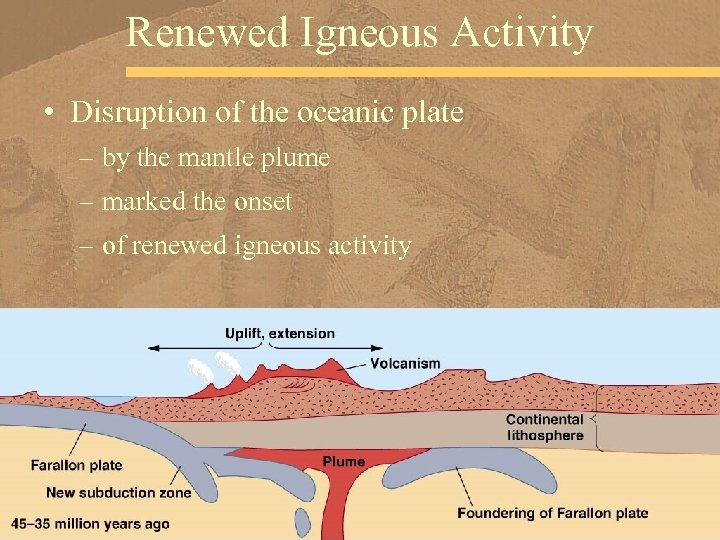 Renewed Igneous Activity • Disruption of the oceanic plate – by the mantle plume – marked the onset – of renewed igneous activity
 Change in the Style of Deformation • As a result, the igneous activity shifted farther inland – and finally ceased, – because the descending plate – no longer penetrated to the mantle • This changing angle of subduction – also caused a change in the style of deformation • The fold-thrust deformation of the Sevier orogeny – gave way to large-scale buckling and fracturing, – which yielded fault-bounded vertical uplifts
 Location of Deformation • Erosion of the uplifted blocks – yielded rugged mountainous topography – and supplied sediments to the intervening basins • The Laramide orogen – is centered in the middle and southern – Rocky Mountains of Wyoming and Colorado, – but deformation also took place – far to the north and south
 Overthrust • In the northern Rocky Mountains – of Montana and Alberta, Canada, – huge slabs of pre-Laramide strata – moved eastward – along overthrust faults • An overthrust fault – is a large-scale, – low angle thrust fault – with movement measured in kilometers
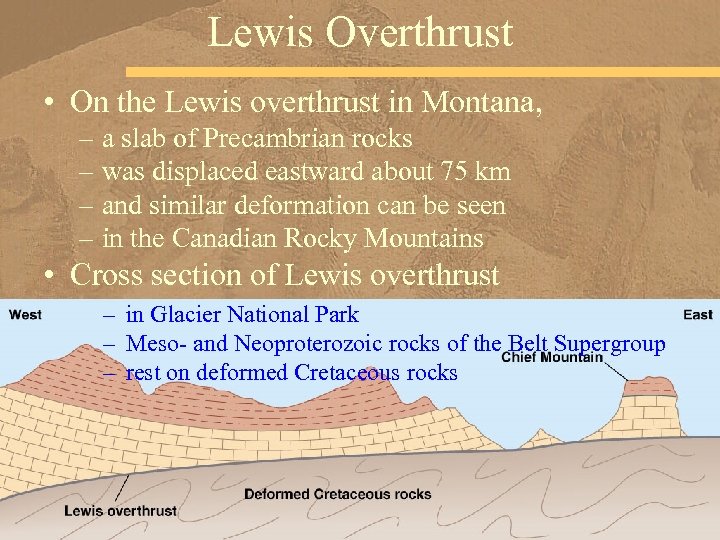 Lewis Overthrust • On the Lewis overthrust in Montana, – a slab of Precambrian rocks – was displaced eastward about 75 km – and similar deformation can be seen – in the Canadian Rocky Mountains • Cross section of Lewis overthrust – in Glacier National Park – Meso- and Neoproterozoic rocks of the Belt Supergroup – rest on deformed Cretaceous rocks
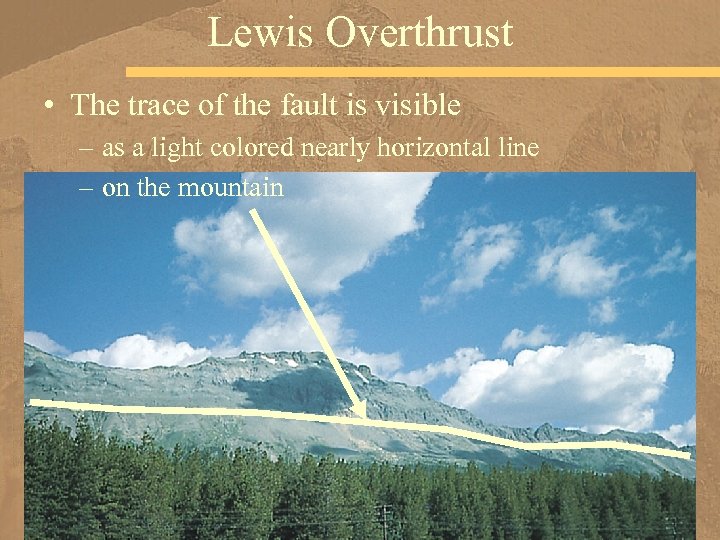 Lewis Overthrust • The trace of the fault is visible – as a light colored nearly horizontal line – on the mountain
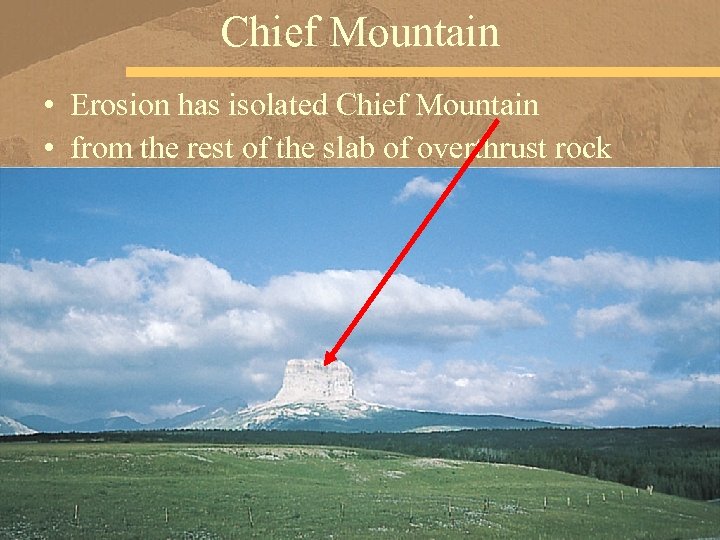 Chief Mountain • Erosion has isolated Chief Mountain • from the rest of the slab of overthrust rock
 Igneous Activity Resumed • Far to the south of the main Laramide orogen, – sedimentary rocks in the Sierra Madre Oriental – of east-central Mexico – are now part of a major fold-thrust belt • By Middle Eocene time, – Laramide deformation ceased – and igneous activity resumed in the Cordillera – when the mantle plume beneath the lithosphere – disrupted the overlying oceanic plate
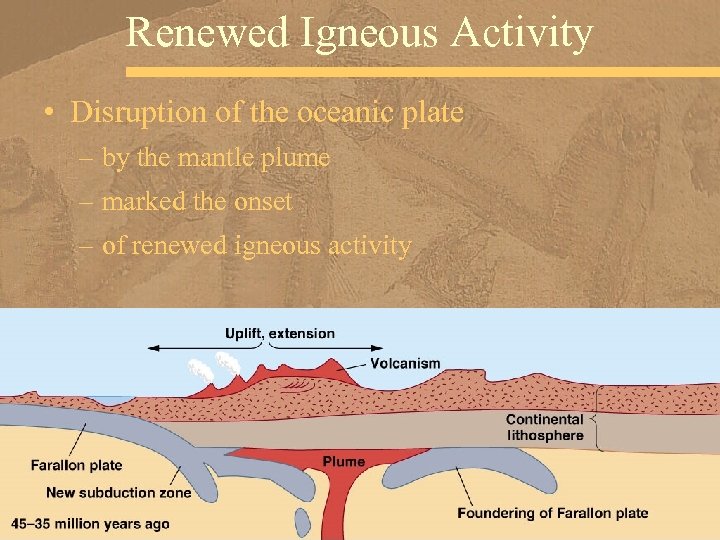 Renewed Igneous Activity • Disruption of the oceanic plate – by the mantle plume – marked the onset – of renewed igneous activity
 Erosion • The uplifted blocks of the Laramide orogen – continued to erode, and by the Neogene – the rugged, eroded mountains – had been nearly buried in their own debris, – forming a vast plain across which streams flowed • During a renewed cycle of erosion, – these streams removed – much of the basin fill sediments – and incised their valleys into the uplifted blocks
 Late Neogene Uplift • Late Neogene uplift – accounts for the present ranges, – and uplift continues in some areas
 Cordilleran Igneous Activity • The vast batholiths in – Idaho, – British Columbia, Canada, – and the Sierra Nevada of California – were emplaced during the Mesozoic, – but intrusive activity – continued into the Paleogene Period • Numerous small plutons formed – including copper- and molybdenum-bearing stocks – in Utah, Nevada, Arizona, and New Mexico
 Volcanism • Volcanism – was common in the Cordillera, – but it varied in location, intensity, and eruptive style – and it ceased temporarily in the area of the Laramide orogen • In the Pacific Northwest, – the Columbia Plateau is underlain – by 200, 000 km 3 of Miocene lava flows – of the Columbia River basalts
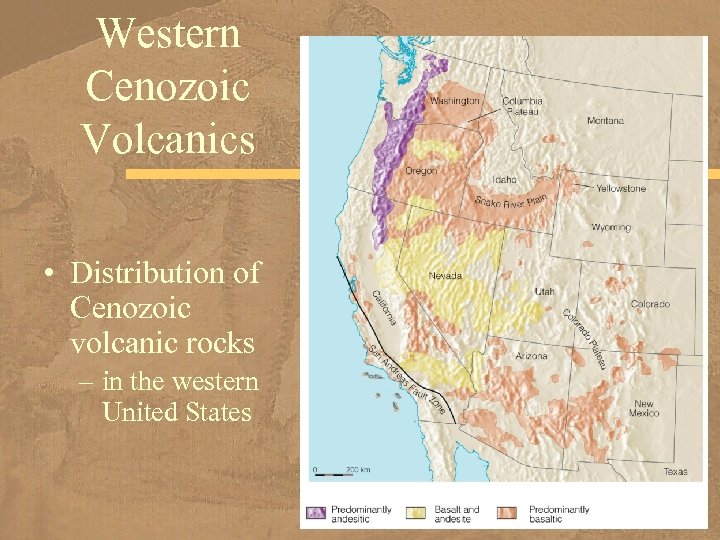 Western Cenozoic Volcanics • Distribution of Cenozoic volcanic rocks – in the western United States
 Columbia River Basalts • These vast lava flows – have an aggregate thickness of about 2500 m – and are now well exposed in the walls of the deep canyons – eroded by the Columbia and Snake rivers – and their tributaries • The relationship of this huge outpouring of lava – to plate tectonics remains unclear, – but some geologists think – it resulted from a mantle plume – beneath western North America
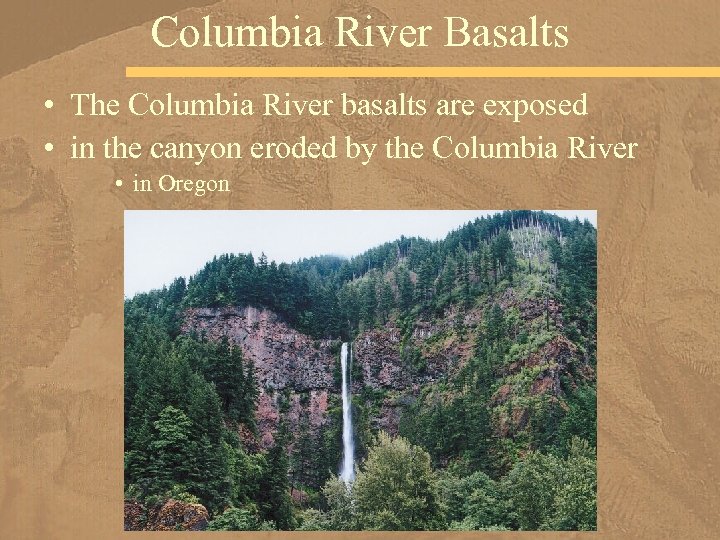 Columbia River Basalts • The Columbia River basalts are exposed • in the canyon eroded by the Columbia River • in Oregon
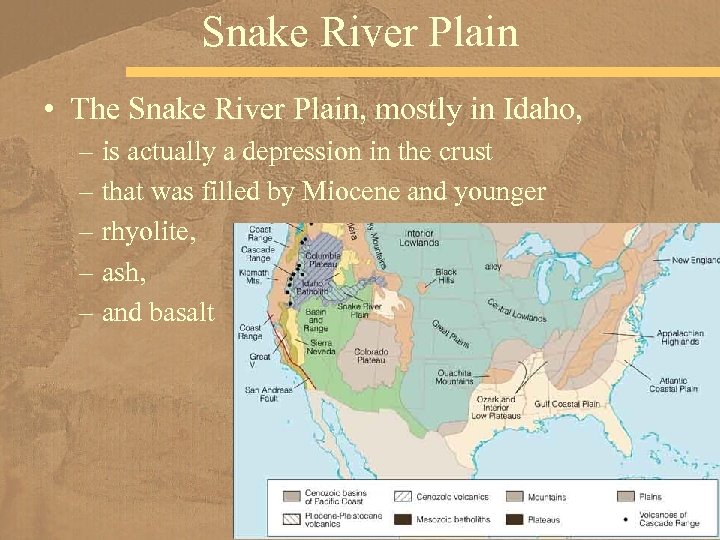 Snake River Plain • The Snake River Plain, mostly in Idaho, – is actually a depression in the crust – that was filled by Miocene and younger – rhyolite, – ash, – and basalt
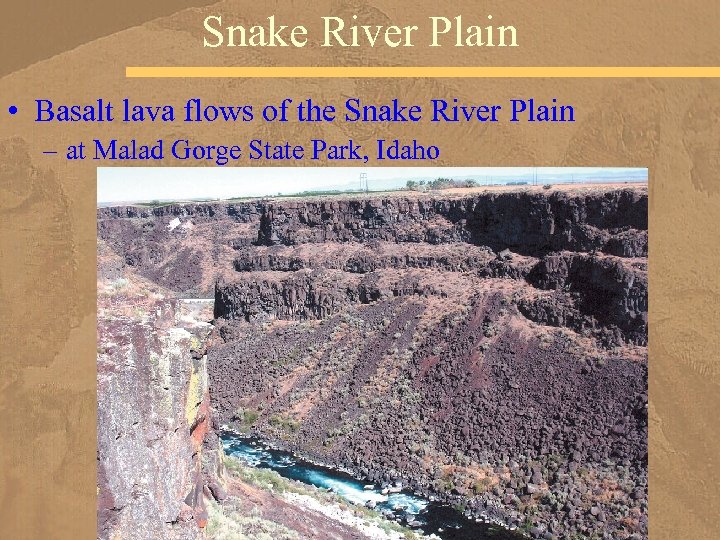 Snake River Plain • Basalt lava flows of the Snake River Plain – at Malad Gorge State Park, Idaho
 Mantle Plume • The volcanic rocks of the Snake River Plain are oldest – in the southwest part of the area – and become younger toward the northeast, – leading some geologists to propose – that North America has migrated – over a mantle plume – that now lies beneath Yellowstone National Park • in Wyoming
 Yellowstone Plateau • Other geologists disagree – thinking that these volcanic rocks – erupted along an intracontinental rift zone – bordering the Snake River Plain – on the northeast is the Yellowstone Plateau, – an area of Late Pliocene and Pleistocene volcanism • A mantle plume may lie beneath the area, – but the heat may come from – an intruded body of magma – that has not yet completely cooled
 Other Volcanism • Elsewhere in the Cordillera, – andesite, volcanic breccia and welded tuffs – mostly of Oligocene age, – cover more than 25, 000 km 2 – in the San Juan volcanic field • In Arizona, the San Francisco volcanic field – formed during the Pliocene and Pleistocene, – and volcanism took place along Oregon’s Coast
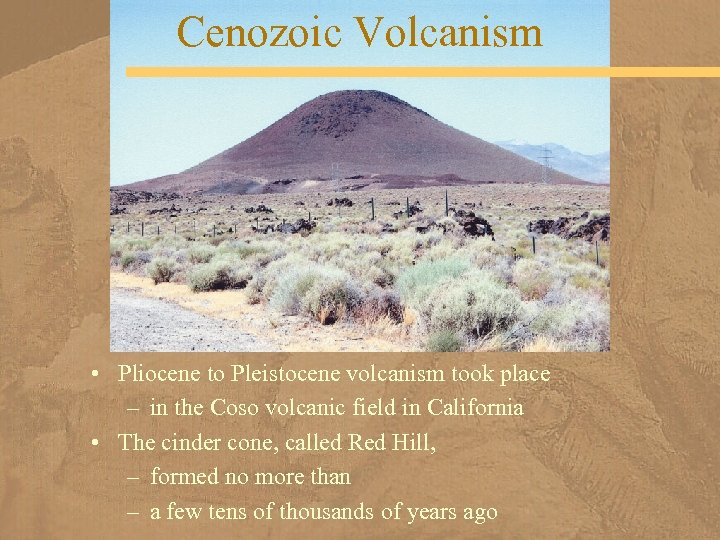 Cenozoic Volcanism • Pliocene to Pleistocene volcanism took place – in the Coso volcanic field in California • The cinder cone, called Red Hill, – formed no more than – a few tens of thousands of years ago
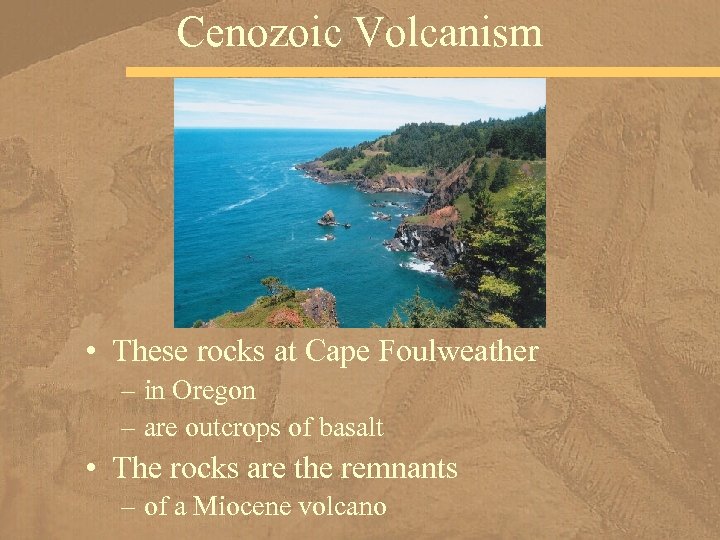 Cenozoic Volcanism • These rocks at Cape Foulweather – in Oregon – are outcrops of basalt • The rocks are the remnants – of a Miocene volcano
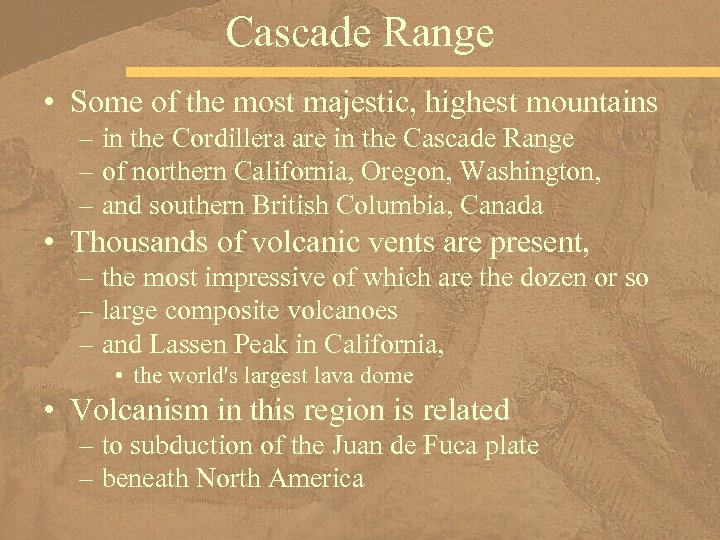 Cascade Range • Some of the most majestic, highest mountains – in the Cordillera are in the Cascade Range – of northern California, Oregon, Washington, – and southern British Columbia, Canada • Thousands of volcanic vents are present, – the most impressive of which are the dozen or so – large composite volcanoes – and Lassen Peak in California, • the world's largest lava dome • Volcanism in this region is related – to subduction of the Juan de Fuca plate – beneath North America
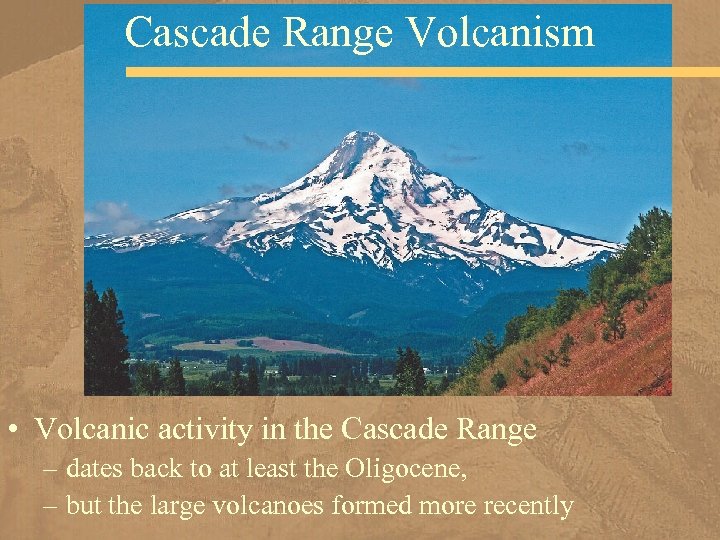 Cascade Range Volcanism • Volcanic activity in the Cascade Range – dates back to at least the Oligocene, – but the large volcanoes formed more recently
 Timing of Cascade Volcanism • Volcanism in the Cascade Range – goes back at least to Oligocene, – but the most recent episode – began during the Late Miocene or Early Pliocene • The eruption of Lassen Peak in California • from 1914 to 1947 – and the eruptions of Mount St. Helens in Washington • in 1980 and again in 2004 – indicate that Cascade volcanoes remain active
 Basin and Range Province • Earth's crust in the Basin and Range Province, • an area of nearly 780, 000 km 2 centered on Nevada • but extending into adjacent states and northern Mexico, – has been stretched and thinned – yielding north-south oriented mountain ranges – with intervening valleys or basins • The 400 or so ranges are bounded on one or both sides – by steeply dipping normal faults – that probably curve and dip less steeply with depth
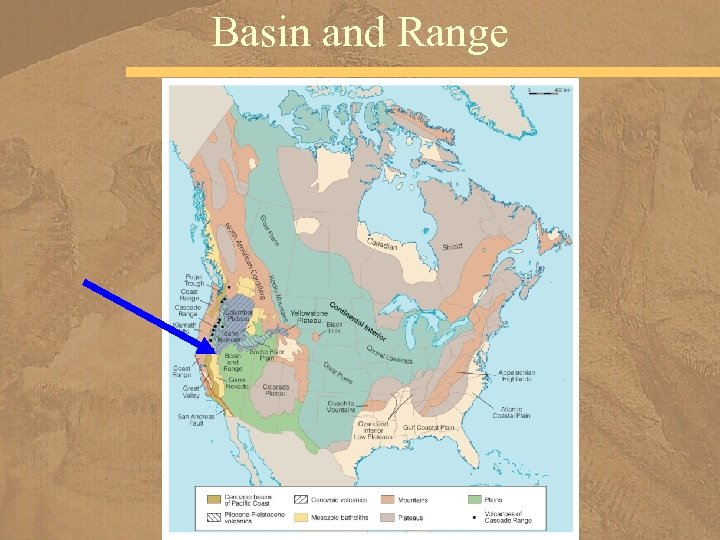 Basin and Range
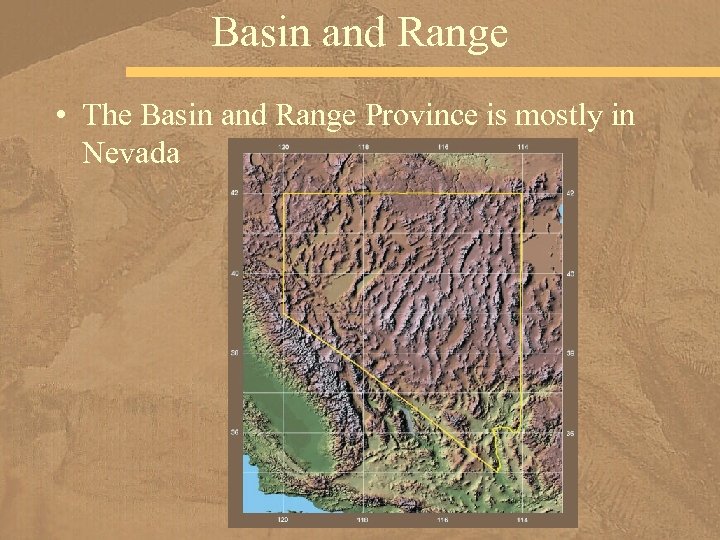 Basin and Range • The Basin and Range Province is mostly in Nevada
 Basin and Range Deformation • The faults outline blocks – that show displacement and rotation • Before faulting began, – the region was deformed during – the Nevadan, Sevier, and Laramide orogenies • Then during the Paleogene, – the entire area was highlands – undergoing extensive erosion, – but Early Miocene eruptions of rhyolitic lava flows – and pyroclastic materials covered large areas
 Late Miocene Faulting • By Late Miocene, large-scale faulting – had begun, forming the basins and ranges • Sediment derived from the ranges – was transported into the adjacent basins – and accumulated as alluvial fan – and playa lake deposits • At its western margin – the Basin and Range Province – is bounded by normal faults – along the east flank of the Sierra Nevada
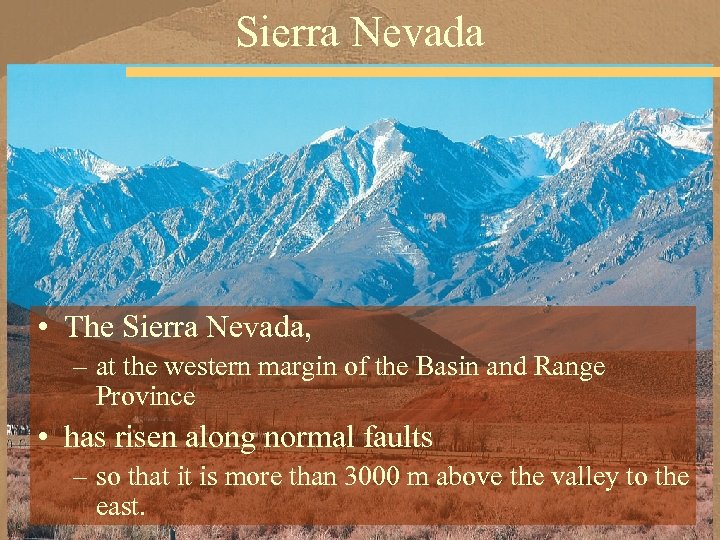 Sierra Nevada • The Sierra Nevada, – at the western margin of the Basin and Range Province • has risen along normal faults – so that it is more than 3000 m above the valley to the east.
 Basin-and-Range Structure • Before this uplift took place, – the Basin and Range had a subtropical climate, – but the rising mountains – created a rain shadow – making the climate increasingly arid • Geologists have proposed several models – to account for basin-and-range structure – but have not reached a consensus
 Several Models • Among these are – back-arc spreading, – spreading at the East Pacific Rise, • the northern part of which is thought to now lie beneath this region, – spreading above a mantle plume, – and deformation related to movements – along the San Andreas fault
 Colorado Plateau • The vast elevated region – in Colorado, Utah, Arizona, and New Mexico – known as the Colorado Plateau – has volcanic mountains rising above it, brilliantly colored rocks, and deep canyons • Earlier we noted that – during the Permian and Triassic – the Colorado Plateau region – was the site of extensive red bed deposition • Many of these rocks are now exposed – in the uplifts and canyons
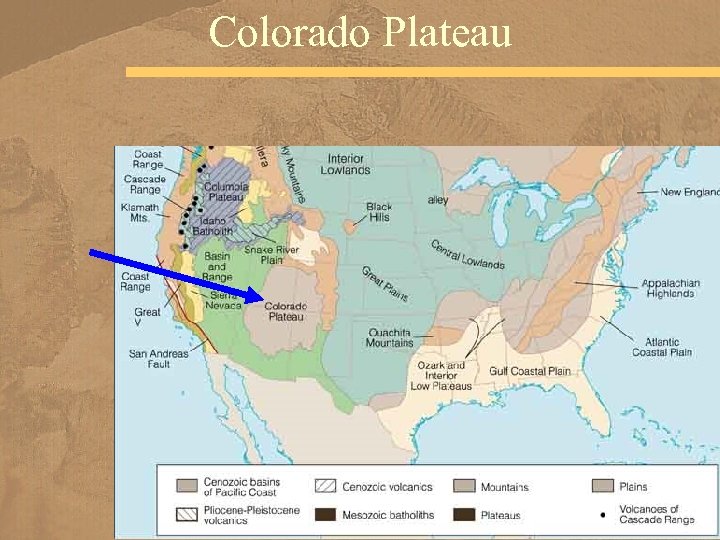 Colorado Plateau
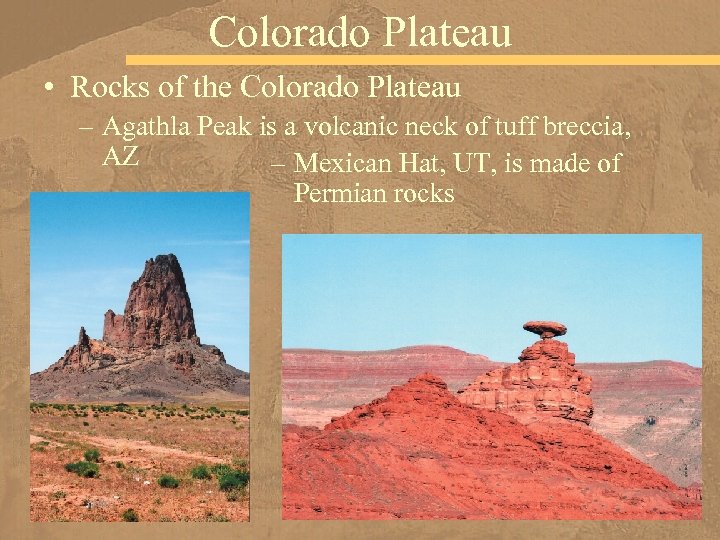 Colorado Plateau • Rocks of the Colorado Plateau – Agathla Peak is a volcanic neck of tuff breccia, AZ – Mexican Hat, UT, is made of Permian rocks
 Colorado Plateau • Cretaceous-age marine sedimentary rocks – indicate that the Colorado Plateau – was below sea level, – but during the Paleogene Period, – Laramide deformation yielded – broad anticlines and arches and basins, – and a number of large normal faults • However, deformation was far less intense – than elsewhere in the Cordillera
 Neogene Uplift • Neogene uplift elevated the region – from near sea level – to the 1200 to 1800 m elevations seen today, – and as uplift proceeded – streams and rivers – began eroding deep canyons
 Canyon Origins • Geologists disagree on the details – of just how the deep canyons – so typical of the region developed • such as the Grand Canyon • Some think the streams were antecedent, – meaning they existed – before the present topography developed, – in which case they simply eroded downward – as uplift proceeded
 Canyon Origins • Others think the streams were superposed, – implying that younger strata covered the area – on which streams were established • During uplift, – the streams stripped away these younger rocks – and eroded down into the underlying strata • In either case, the landscape continues to evolve – as erosion of the canyons and their tributaries – deepens and widens them
 Rio Grande Rift • The Rio Grande rift extends north to south • about 1000 km • from central Colorado through New Mexico and into northern Mexico • The Rio Grande rift is similar to – the Mesoproterozoic Midcontinent Rift – and the present-day rifting in the Gulf of Aden, Red Sea and East Africa • The Earth’s crust has been stretched and thinned, – and the rift is bounded on both sides by normal faults, – seismic activity continues, – and volcanoes and caldaras are present
 Rio Grande Rift • The Rio Grande Rift consists of several basins – through which the present-day Rio Grande flows, – although the river simply exploited an easy route to the sea – but was not responsible for the rift itself • Rifting began about 29 million years ago, – and persisted for 10 to 12 million years (L. Oligicene – E. Miocene) • A second period of rifting began during the Middle Miocene, about 17 million years ago, – and it continues to the present
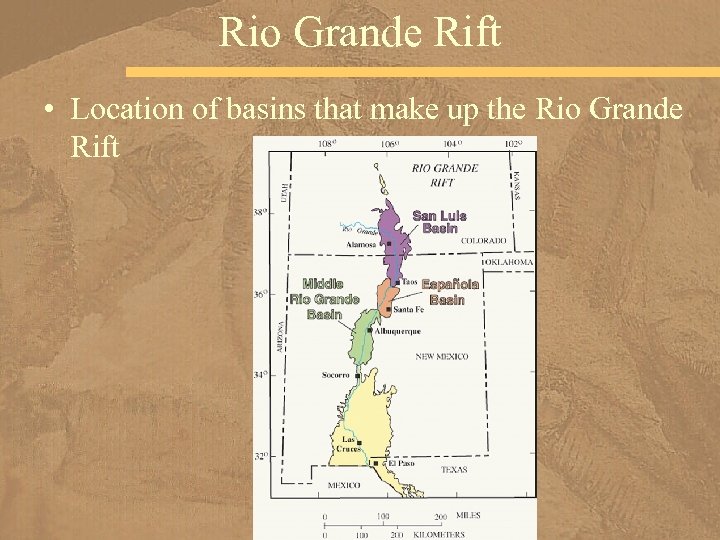 Rio Grande Rift • Location of basins that make up the Rio Grande Rift
 Rio Grande Rift • The displacement on some faults – is as much as 8000 m, – but concurrent with faulting, – the basins along the rift filled with huge quantities of sediments and volcanic rocks
 Rio Grande Rift • Some of the volcanic features – such as Valles caldera, and the Bandelier tuff, – are prominent features in New Mexico • Rifting continues, but it is progressing very slowly – only 2 mm or less per year – So even though ongoing rifting – may eventually split the area – so that it resembles the Red Sea, – it will be in the distant future
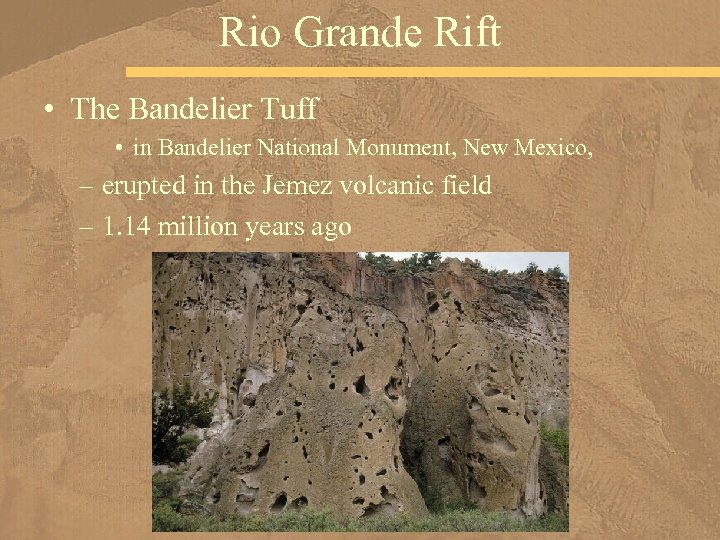 Rio Grande Rift • The Bandelier Tuff • in Bandelier National Monument, New Mexico, – erupted in the Jemez volcanic field – 1. 14 million years ago
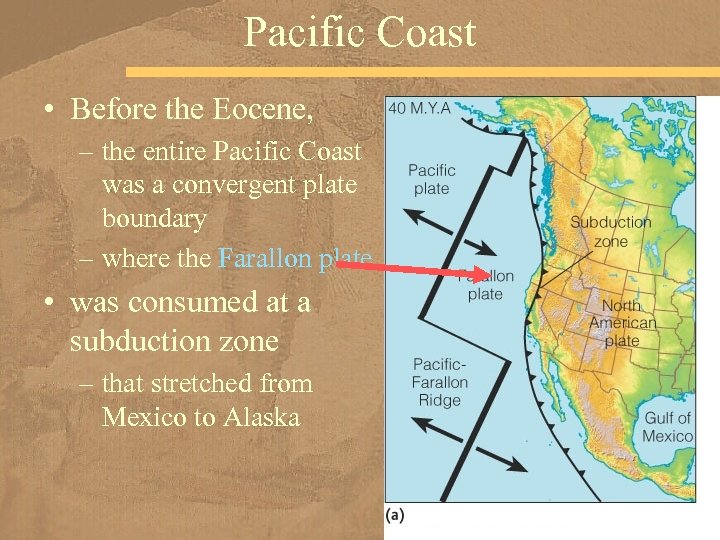 Pacific Coast • Before the Eocene, – the entire Pacific Coast was a convergent plate boundary – where the Farallon plate • was consumed at a subduction zone – that stretched from Mexico to Alaska
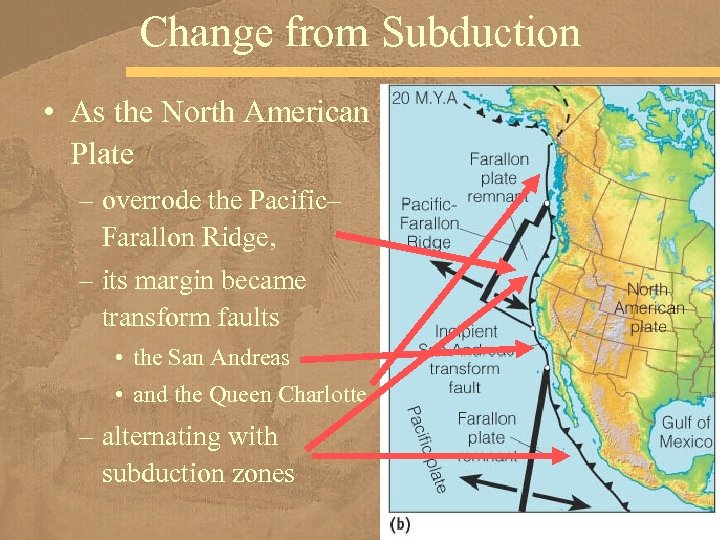 Change from Subduction • As the North American Plate – overrode the Pacific– Farallon Ridge, – its margin became transform faults • the San Andreas • and the Queen Charlotte – alternating with subduction zones
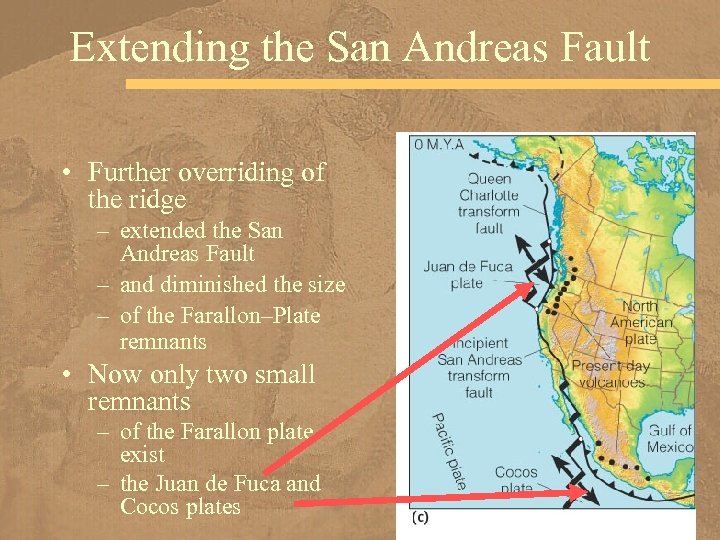 Extending the San Andreas Fault • Further overriding of the ridge – extended the San Andreas Fault – and diminished the size – of the Farallon–Plate remnants • Now only two small remnants – of the Farallon plate exist – the Juan de Fuca and Cocos plates
 Present Activity • Only two small remnants of the Farallon plate remain – the Juan de Fuca and Cocos plates • Continuing subduction of these plates – accounts for the present seismic activity – and volcanism – in the Pacific Northwest and Central America • Another consequence of plate interactions – in this region involved the westward movement – of the North American plate – and its collision with the Pacific–Farallon ridge
 Continent–Ridge Collision • Because the Pacific–Farallon ridge – was oriented at an angle to the margin of North America, – the continent–ridge collision took place first – during the Eocene in northern Canada – and only later during the Oligocene in southern California
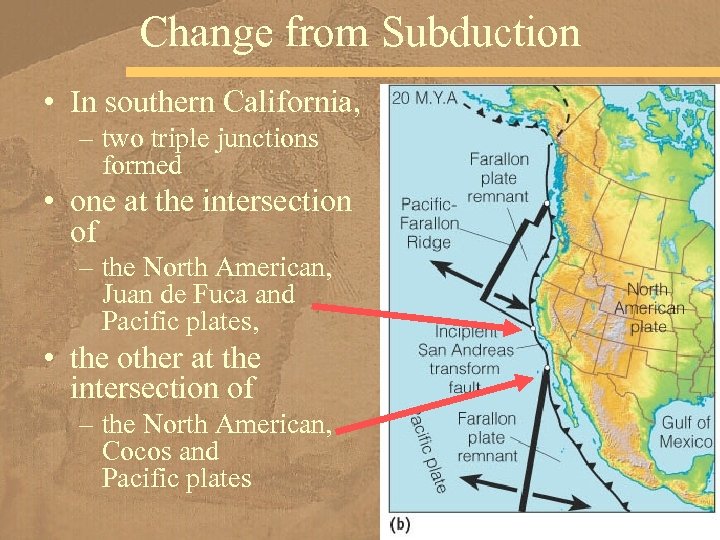 Change from Subduction • In southern California, – two triple junctions formed • one at the intersection of – the North American, Juan de Fuca and Pacific plates, • the other at the intersection of – the North American, Cocos and Pacific plates
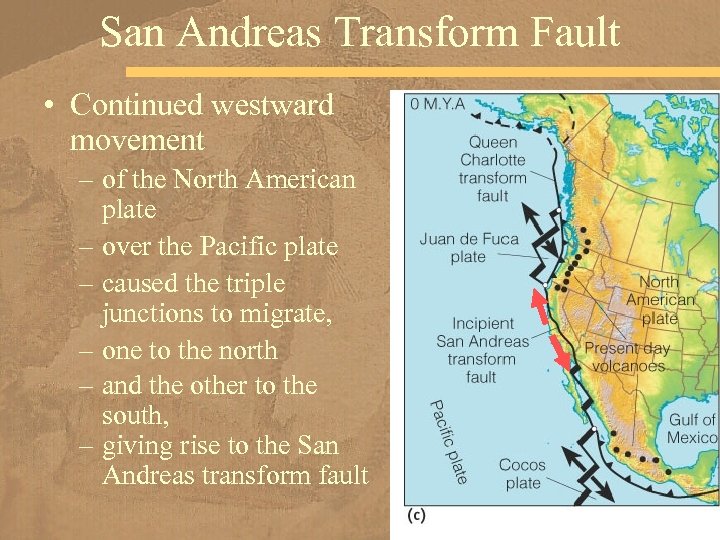 San Andreas Transform Fault • Continued westward movement – of the North American plate – over the Pacific plate – caused the triple junctions to migrate, – one to the north – and the other to the south, – giving rise to the San Andreas transform fault
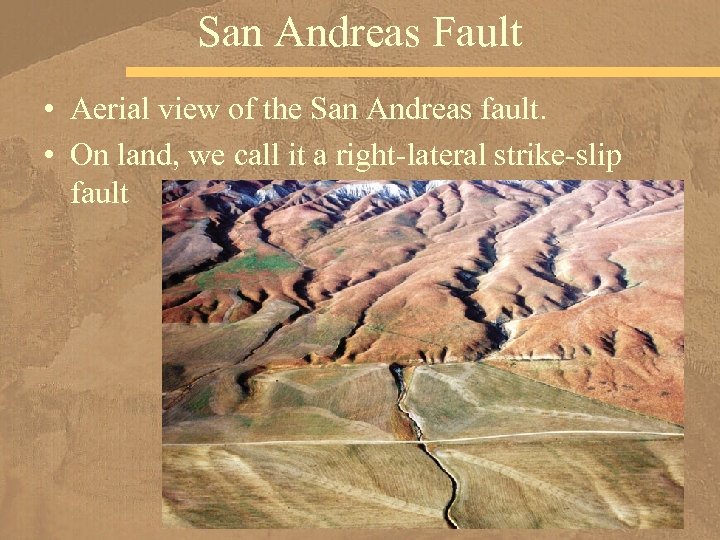 San Andreas Fault • Aerial view of the San Andreas fault. • On land, we call it a right-lateral strike-slip fault
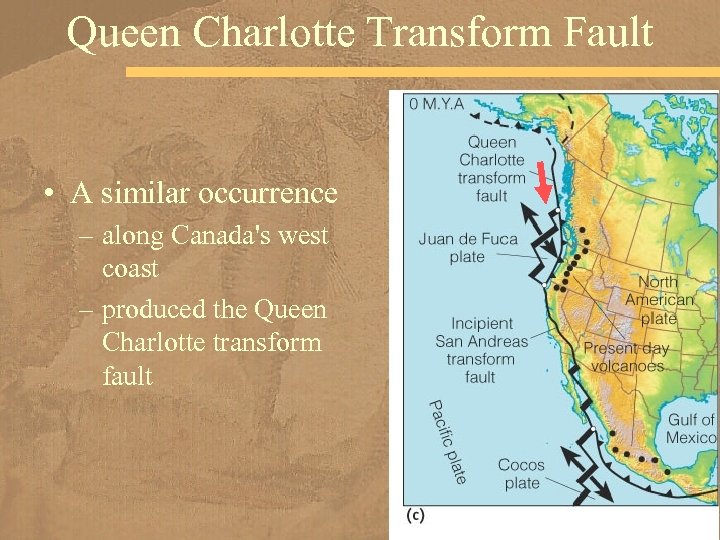 Queen Charlotte Transform Fault • A similar occurrence – along Canada's west coast – produced the Queen Charlotte transform fault
 Complex Zone of Shattered Rocks • Seismic activity on the San Andreas fault – results from continuing movements – of the Pacific and North American plates – along this complex zone of shattered rocks • Indeed, where the fault cuts though coastal California – it is actually a zone – as much as 2 km wide, – and it has numerous branches
 Fault Bound Basins • Movements on such complex fault systems – subject blocks of rocks in and near the fault zone – to extensional and compressive stresses – forming basins and elevated areas, – the higher areas supplying sediments to lower areas • Many of the fault-founded basins – in the southern California area – have subsided below sea level – and soon filled with turbidites and other deposits • A number of these basins areas – of prolific oil and gas production
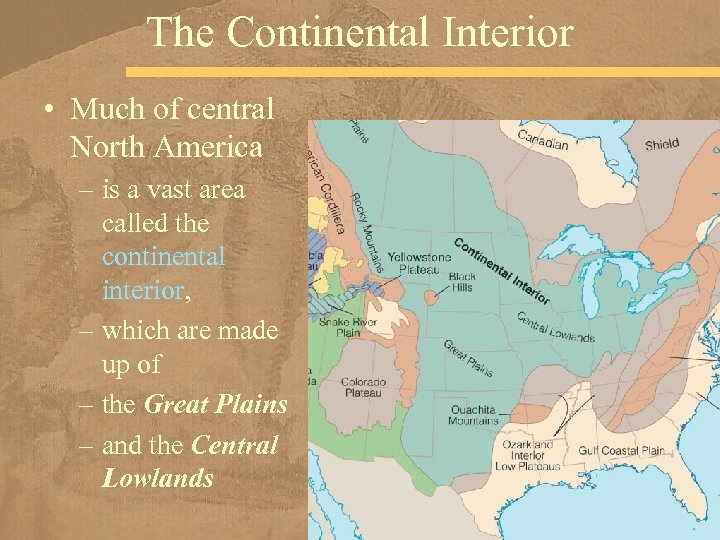 The Continental Interior • Much of central North America – is a vast area called the continental interior, – which are made up of – the Great Plains – and the Central Lowlands
 Early Paleogene • During the Cretaceous, – the Great Plains were covered – by the Zuni epeiric sea, • but by Early Paleogene time – the sea had largely withdrawn – except for a sizeable remnant – that remained in North Dakota
 Laramide Derived Sediments • Sediments eroded from the Laramide highlands – were transported to this sea and deposited – in transitional and marine environments • Following this marine deposition, – all other sedimentation in the Great Plains – took place in terrestrial environments, – especially fluvial systems • These formed eastward-thinning wedges – of sediment that now underlie – the entire region
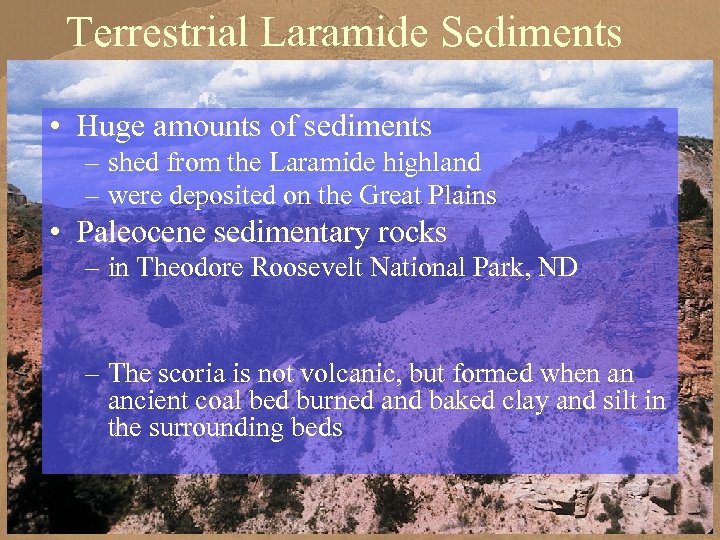 Terrestrial Laramide Sediments • Huge amounts of sediments – shed from the Laramide highland – were deposited on the Great Plains • Paleocene sedimentary rocks – in Theodore Roosevelt National Park, ND – The scoria is not volcanic, but formed when an ancient coal bed burned and baked clay and silt in the surrounding beds
 Black Hills Sediment Source • The only local sediment source – within the Great Plains – was the Black Hills in South Dakota • This area has a history of marine deposition – during the Cretaceous – followed by the origin of terrestrial deposits • derived from the Black Hills – that are now well exposed – in Badlands National Park, South Dakota
 Semitropical Forest/Grasslands • Judging from the sedimentary rocks – and their numerous fossil mammals and other animals, – the area was initially covered – by semitropical forest – but grasslands replaced the forests, – as the climate became more arid
 Local Igneous Activity • Igneous activity was not widespread – in the continental interior, – but it was significant in some parts of the Great Plains • For instance, igneous activity – in northeastern New Mexico – was responsible for volcanoes and – numerous lava flows • Several small plutons were emplaced – in Colorado, Wyoming, Montana, South Dakota, and New Mexico
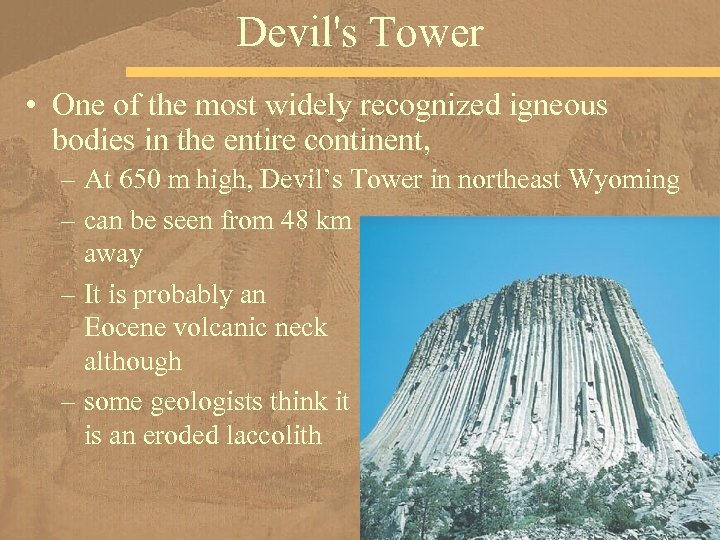 Devil's Tower • One of the most widely recognized igneous bodies in the entire continent, – At 650 m high, Devil’s Tower in northeast Wyoming – can be seen from 48 km away – It is probably an Eocene volcanic neck although – some geologists think it is an eroded laccolith
 Central Lowlands Erosion • Our discussion thus far has focused on the Great Plains, – but what about the Central Lowlands to the east? • Pleistocene glacial deposits – are present in the northern part of this region, – as well as in the northern Great Plains, • but during most of the Cenozoic Era, – nearly all of the Central Lowlands – was an area of active erosion – rather than deposition
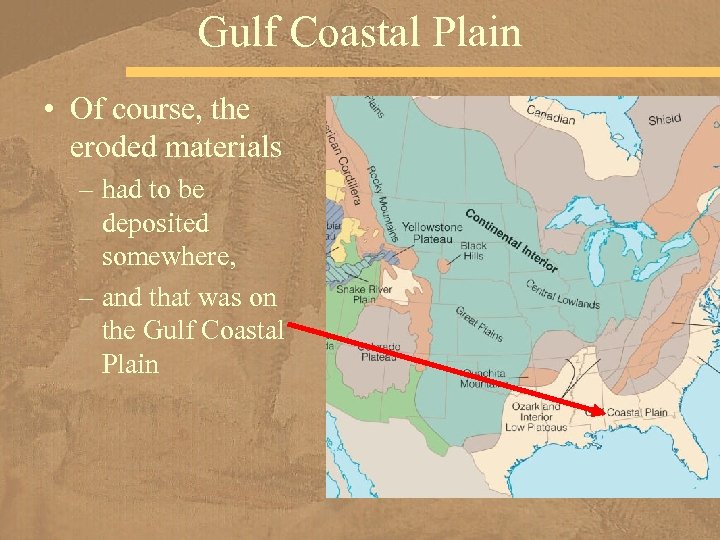 Gulf Coastal Plain • Of course, the eroded materials – had to be deposited somewhere, – and that was on the Gulf Coastal Plain
 Cenozoic History of the Appalachian Mountains • Deformation and mountain building – in the area of the present Appalachian mountains – began during the Neoproterozoic – with the Grenville orogeny • The area was deformed again – during the Taconic and Acadian orogenies, – and during the Late Paleozoic – closure of the Iapetus Ocean, – which resulted in the Hercynian-Alleghenian orogeny
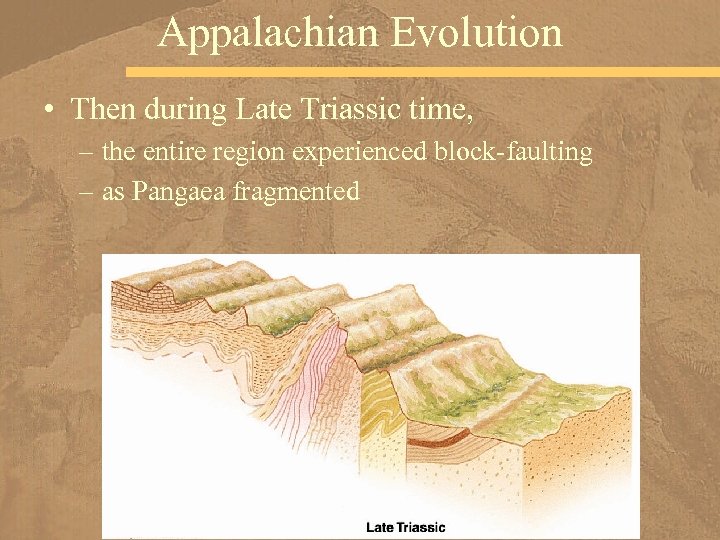 Appalachian Evolution • Then during Late Triassic time, – the entire region experienced block-faulting – as Pangaea fragmented
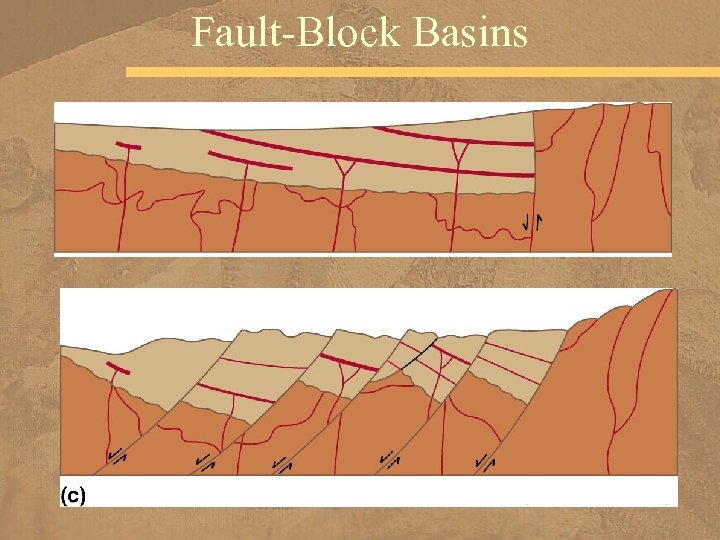 Fault-Block Basins
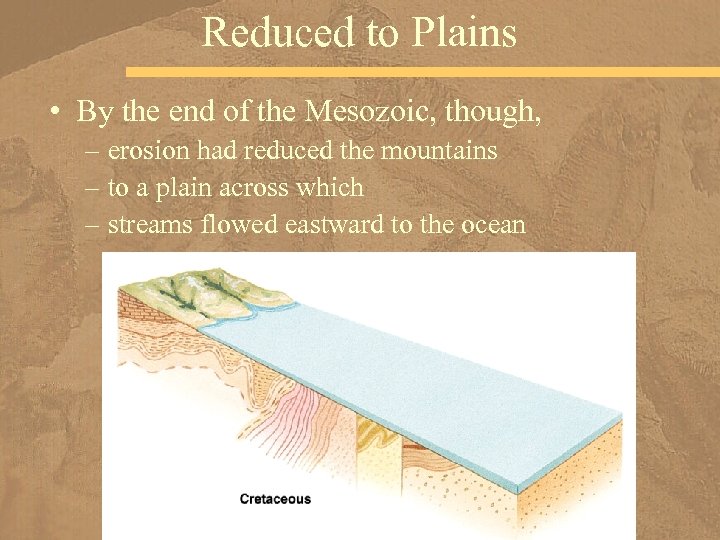 Reduced to Plains • By the end of the Mesozoic, though, – erosion had reduced the mountains – to a plain across which – streams flowed eastward to the ocean
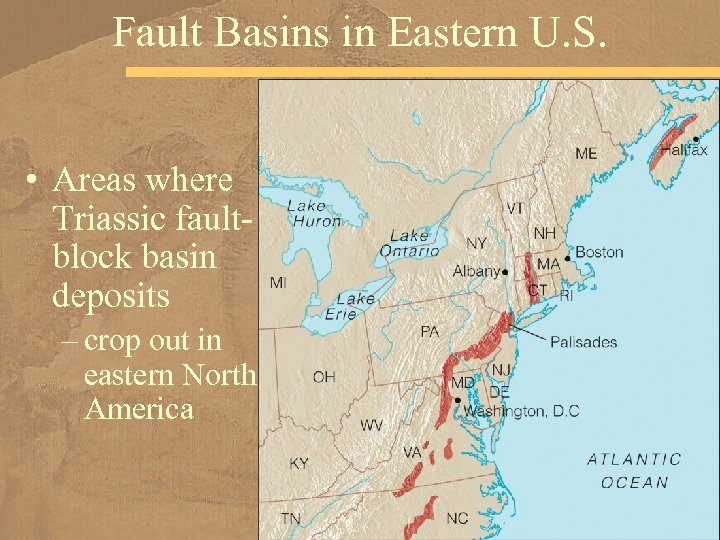 Fault Basins in Eastern U. S. • Areas where Triassic faultblock basin deposits – crop out in eastern North America
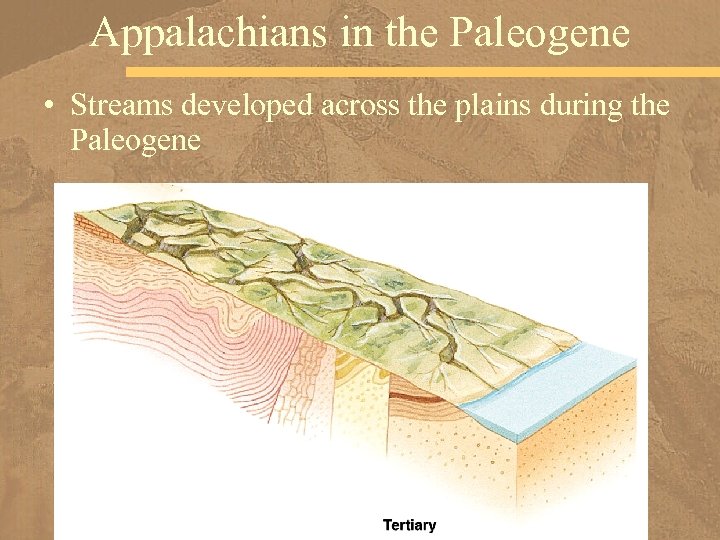 Appalachians in the Paleogene • Streams developed across the plains during the Paleogene
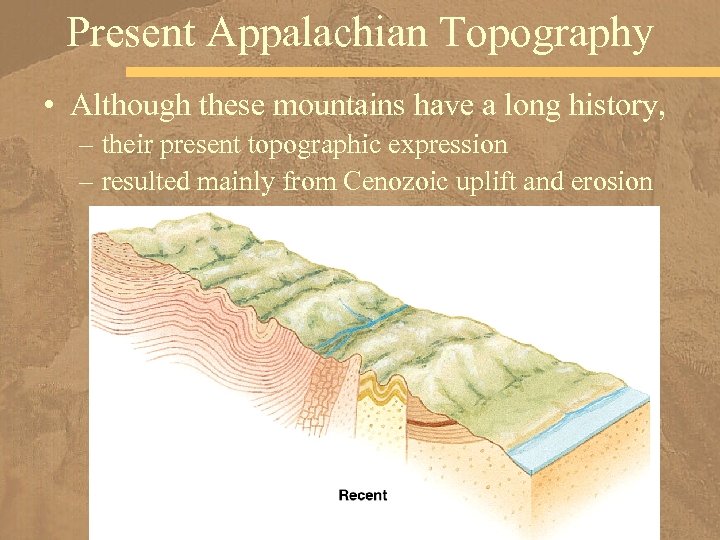 Present Appalachian Topography • Although these mountains have a long history, – their present topographic expression – resulted mainly from Cenozoic uplift and erosion
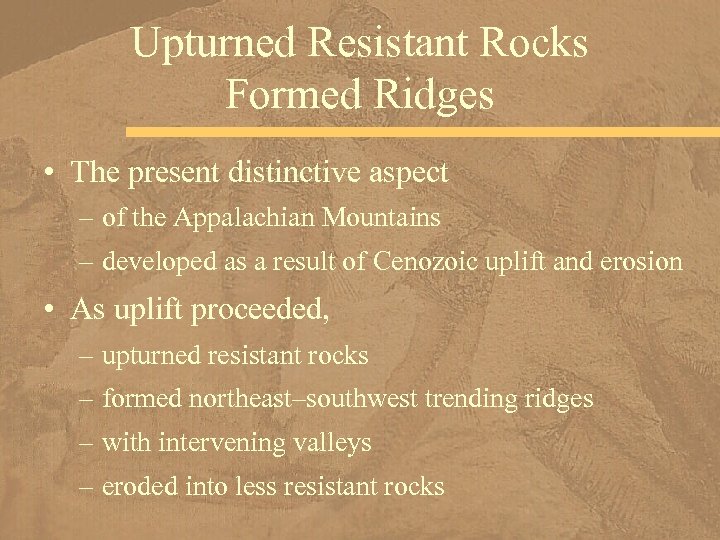 Upturned Resistant Rocks Formed Ridges • The present distinctive aspect – of the Appalachian Mountains – developed as a result of Cenozoic uplift and erosion • As uplift proceeded, – upturned resistant rocks – formed northeast–southwest trending ridges – with intervening valleys – eroded into less resistant rocks
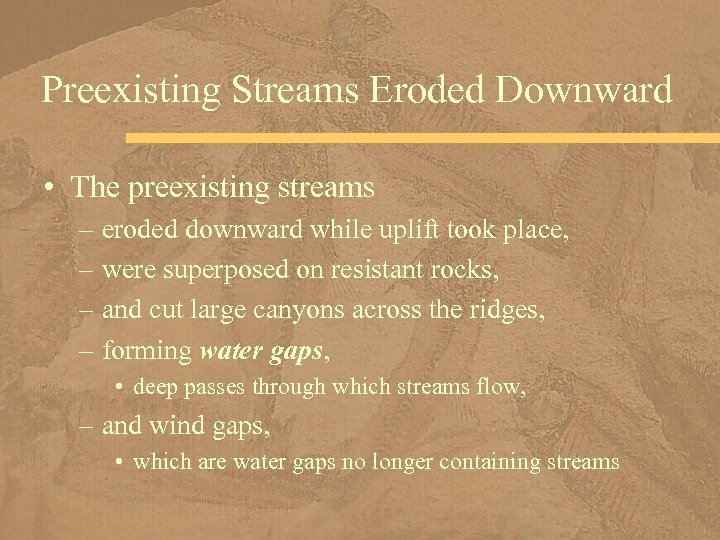 Preexisting Streams Eroded Downward • The preexisting streams – eroded downward while uplift took place, – were superposed on resistant rocks, – and cut large canyons across the ridges, – forming water gaps, • deep passes through which streams flow, – and wind gaps, • which are water gaps no longer containing streams
 Cycles of Erosion? • Erosion surfaces at different elevations – in the Appalachians – are a source of continuing debate – among geologists • Some are convinced – these more or less planar surfaces – show evidence of uplift followed – by extensive erosion and then renewed uplift – and another cycle of erosion
 Other Views • Others think that – each surface represents – differential response to weathering and erosion • According to this view, – a low-elevation erosion surface developed on softer strata – that eroded more or less uniformly, • whereas higher surfaces represent – weathering and erosion – of more resistant rocks
 The Southern and Eastern Continental Margins • In a previous section – we mentioned that much of the Central Lowlands – eroded during the Cenozoic • Even in the Great Plains – where vast deposits of Cenozoic rocks are present, – sediment was carried across the region – and into the drainage systems – that emptied into the Gulf of Mexico
 Appalachians Shed Sediments Westward and Eastward • Likewise, sediment – eroded from the western margin – of the Appalachian Mountains – ended up in the Gulf, – but these mountains – also shed huge quantities of sediment – eastward – that was deposited – along the Atlantic Coastal Plain
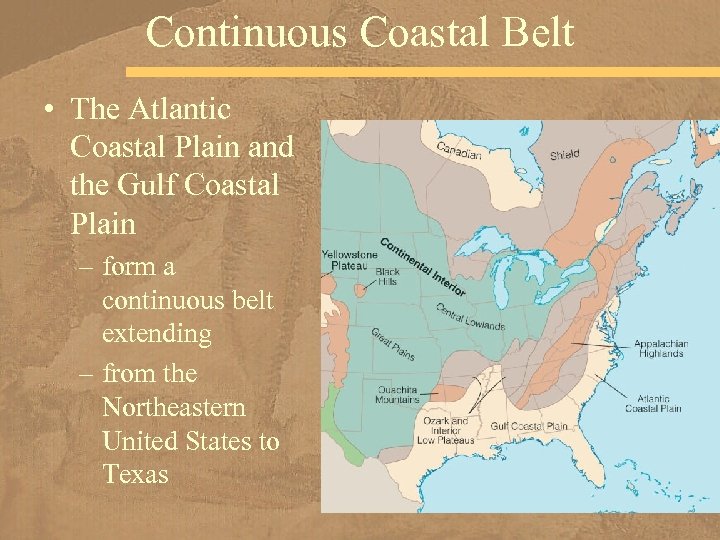 Continuous Coastal Belt • The Atlantic Coastal Plain and the Gulf Coastal Plain – form a continuous belt extending – from the Northeastern United States to Texas
 Coastal Plain Similarities • Both areas have – horizontal or gently seaward-dipping strata – deposited mostly by streams • Seaward of the coastal plains – lie the continental shelf, slope and rise, – also areas of notable Mesozoic and Cenozoic deposition
 The Gulf Coastal Plain • After the withdrawal of the Zuni sea • Cretaceous to Early Paleogene, – the Cenozoic Tejas epeiric sea – made a brief appearance on the continent • But even at its maximum extent – it was largely restricted – to the Atlantic and Gulf Coastal plains – and parts of coastal California • It did, however, – extend up the Mississippi River Valley, – where it reached as far north as southern Illinois
 Gulf Coast Sedimentation Pattern • The overall Gulf Coast sedimentation pattern – was established during the Jurassic – and persisted throughout the Cenozoic • Sediments derived – from the Cordillera, – western Appalachians, – and the Central Lowlands – were transported toward the Gulf of Mexico, – where they were deposited – in terrestrial, transitional, and marine environments
 Seaward-Thickening Wedges • In general, the sediments – form seaward-thickening wedges – grading from terrestrial facies – in the north to marine facies in the south
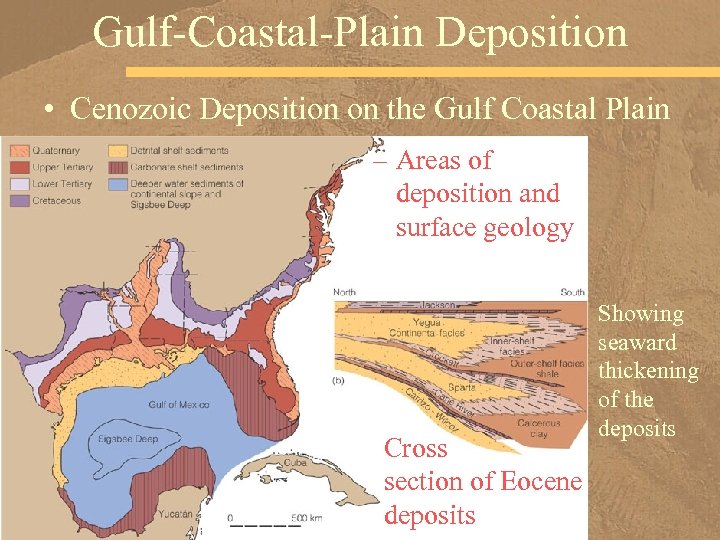 Gulf-Coastal-Plain Deposition • Cenozoic Deposition on the Gulf Coastal Plain – Areas of deposition and surface geology Cross section of Eocene deposits Showing seaward thickening of the deposits
 Tejas epeiric sea • Sedimentary facies development – was controlled mostly – by regression of the Tejas epeiric sea • After its maximum extent – – into the continent during the Paleogene, this sea began its long withdrawal toward the Gulf of Mexico
 Regression Periodically Reversed • Its regression, however, – was periodically reversed – by minor transgressions • Eight transgressive–regressive episodes – are recorded in Gulf Coastal Plain sedimentary rocks, – accounting for the intertonguing – among the various facies
 Reservoirs for Hydrocarbons • Many sedimentary rocks – in the Gulf Coastal Plain – are either source rocks – or reservoirs for hydrocarbons
 Carbonate Deposition • Most of the Gulf Coastal Plain – was dominated by detrital deposition, • but in the Florida section of the region – and the Gulf Coast of Mexico – significant carbonate deposition took place • Florida was a carbonate platform – during the Cretaceous and – continued as an area of carbonate deposition – into the Early Paleogene • Carbonate deposition continues even now – in Florida Bay and the Florida Keys
 Great Bahama Bank • Southeast of Florida, – across the 85 -km-wide Florida Strait, – lies the Great Bahama Bank, – an area of carbonate deposition – from the Cretaceous to the present
 The Atlantic Continental Margin • The east coast of North America – includes the Atlantic Coastal Plain – and extends seaward – across the continental shelf, slope, and rise
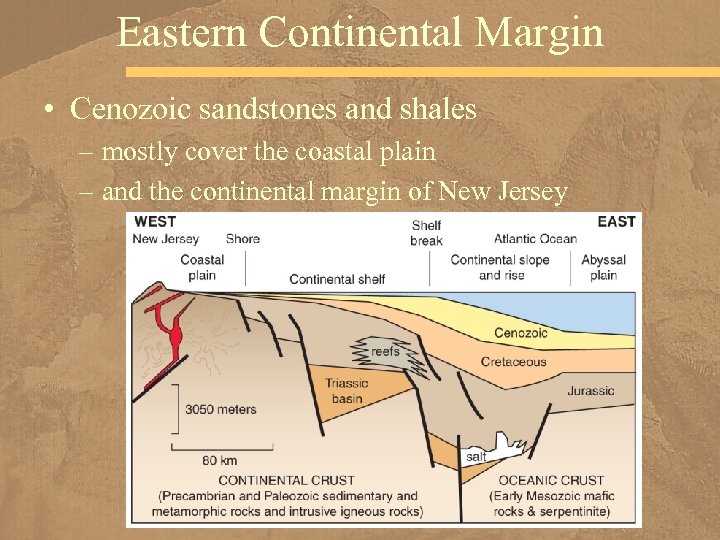 Eastern Continental Margin • Cenozoic sandstones and shales – mostly cover the coastal plain – and the continental margin of New Jersey
 Passive Continental Margin • When Pangaea began fragmenting – during the Early Mesozoic, – continental crust rifted, – and a new ocean basin began to form • Remember that the North American plate – moved westerly, – so its eastern margin was within the plate, – where a passive continental margin developed
 Mesozoic and Cenozoic basins • The Atlantic continental margin – has a number of Mesozoic and Cenozoic basins, – formed as a result of rifting, – in which sedimentation began by Jurassic time • Even though Jurassic-aged rocks – have been detected in only a few deep wells, – geologists assume they underlie – the entire continental margin
 Cretaceous and Cenozoic rocks • The distribution – of Cretaceous and Cenozoic rocks – is better known – because both are exposed – on the Atlantic Coastal Plain, – and both have been penetrated – by wells on the continental shelf
 Appalachian Source • Sedimentary rocks – on the broad Atlantic Coastal Plain – as well as those underlying the continental shelf, slope, and rise, – were derived from the Appalachian Mountains
 Streams Sediments • Numerous rivers and streams – transported sediments toward the east – where they were deposited in seaward-thickening wedges • up to 14 km thick – that grade from terrestrial deposits on the west – to marine deposits further east • For instance, – the Calvert Cliffs in Maryland – are made up of rocks – deposited in marginal marine environments
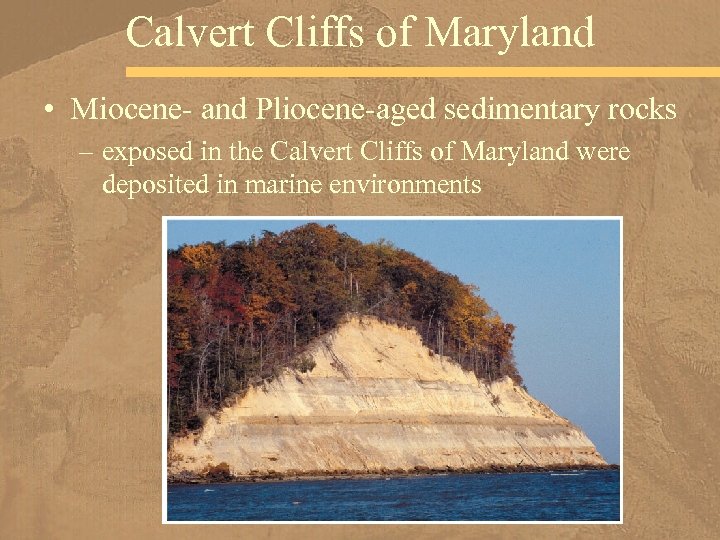 Calvert Cliffs of Maryland • Miocene- and Pliocene-aged sedimentary rocks – exposed in the Calvert Cliffs of Maryland were deposited in marine environments
 Chesapeake Bolide Impact • Evidence indicates – that a 3 to 5 -km-diameter comet or asteroid impact – occurred in the present-day area of Chesapeake Bay • This postulated event took place about 35 million years ago, – during the Late Eocene, – and left an impact crater – measuring 85 km in diameter and 1. 3 km deep
 Detecting the Impact Site • The impact site is now buried – beneath 300 to 500 m – of younger sedimentary rocks, • Drilling and geophysical surveys – have detected – the impact site
 Paleogene and Neogene Mineral Resources • The Eocene Green River Formation – of Wyoming, Utah, and Colorado – is well known for its fossils, – but it also contains – huge quantities of oil shale – and evaporites of economic interest • Oil shale consists of – clay particles, carbonate minerals, – and an organic compound called kerogen – from which liquid oil – and combustible gases can be extracted
 Green River Formation Resources • No oil is currently derived from these rocks – but according to one estimate, – 80 billion barrels of oil – could be recovered with present technology • The evaporite mineral trona – is mined from Green River rocks – for sodium compounds
 Florida’s Phosphate Rocks • Mining of phosphorous-rich sedimentary rocks – in Central Florida accounts for more than half – of that state's mineral production • The phosphorous from these rocks – has a variety of uses in metallurgy, – preserved foods, ceramics, matches, – fertilizers, and animal feed supplements • Some of these phosphate rocks also contain – interesting assemblages of fossil mammals
 Diatomite • Diatomite is a soft, low-density sedimentary rock – made up of microscopic shells of diatoms, • single-celled marine and freshwater plants • with skeletons of silicon dioxide (Si. O 2) • In fact, it is so porous and light – that when dry it will float • Diatomite is used mostly – to purify gas – and to filter liquids such as – molasses, fruit juices, and sewage
 Diatomite Production • The United States leads the world – in diatomite production, – mostly from Cenozoic deposits – in California, Oregon, and Washington
 Huge Deposits of Coal • Historically, most coal mined in the United States – has been Pennsylvanian-aged bituminous coal – from mines in – Pennsylvania, West Virginia, Kentucky, and Ohio • Now, though, huge deposits – of lignite and subbituminous coal – in the Northern Great Plains – are becoming important resources
 30 -m Thick Coal Beds • These Late Cretaceous to Early Paleogene-aged coal deposits – are most abundant – in the Williston and Powder River basins – of North Dakota, Montana, and Wyoming • Besides having a low sulfur content, – which make them desirable, – some of these coal beds – are more than 30 m thick!
 Gold Production • Gold from the Pacific Coast states, – particularly California, – comes largely from – stream gravel – in which placer deposits are found • A placer is an accumulation – resulting from the separation and concentration – of minerals of greater density – from those of lesser density – in streams or on beaches
 The Source of the Gold • The gold in these placers – was weathered and eroded – from Mesozoic-aged quartz veins – in the Sierra Nevada batholith – and adjacent rocks
 Hydrocarbon Recovery • Hydrocarbons are recovered – from the fault-bounded basins – in Southern California – and from many rocks of the Gulf Coastal Plain • Many rocks in the Gulf Coastal Plain – form reservoirs for petroleum and natural gas – because of different physical properties of the strata, – and are thus called stratigraphic traps
 Hydrocarbon Traps • Hydrocarbons are also found – in geologic structures, such as folds, – particularly those adjacent to salt domes • Such reservoirs are accordingly called structural traps • Because rock salt is a low-density sedimentary rock, – when deeply buried and under pressure – it rises toward the surface, – and in doing so it penetrates – and deforms the overlying rocks
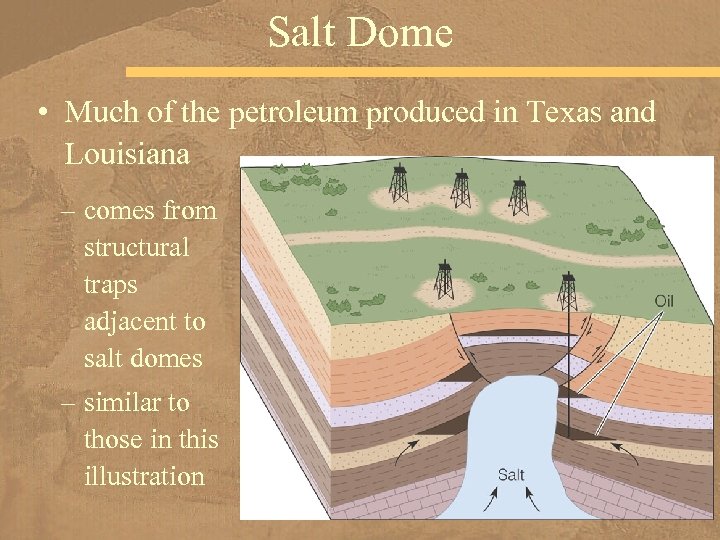 Salt Dome • Much of the petroleum produced in Texas and Louisiana – comes from structural traps adjacent to salt domes – similar to those in this illustration
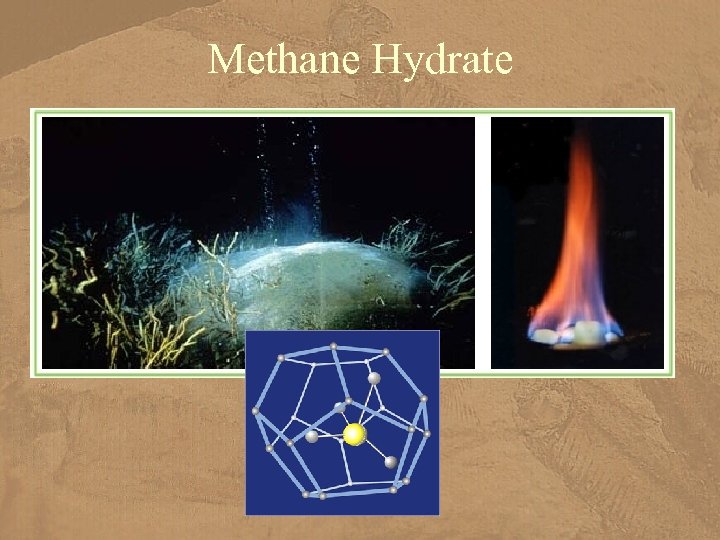
 Methane Hydrate • Another potential resource is methane hydrate, – which consists of single methane molecules – bound up in networks formed by frozen water • Huge deposits of methane hydrate – are present along the eastern continental margin • of North America, – but so far it is not known whether they can be effectively recovered • and used as an energy source • According to one estimate, the amount of carbon in methane hydrates worldwide – is double that in all coal, oil, – and conventional natural gas reserves
 Methane Hydrate