


 Скачать презентацию CHAPTER 15 The Term Structure of Interest Rates
06233e4080e259d1d7874e7c566510d6.ppt
- Количество слайдов: 29
 CHAPTER 15 The Term Structure of Interest Rates INVESTMENTS | BODIE, KANE, MARCUS Mc. Graw-Hill/Irwin Copyright © 2011 by The Mc. Graw-Hill Companies, Inc. All rights reserved.
 2 Overview of Term Structure • The yield curve is a graph that displays the relationship between yield and maturity. • Information on expected future short term rates can be implied from the yield curve. INVESTMENTS | BODIE, KANE, MARCUS
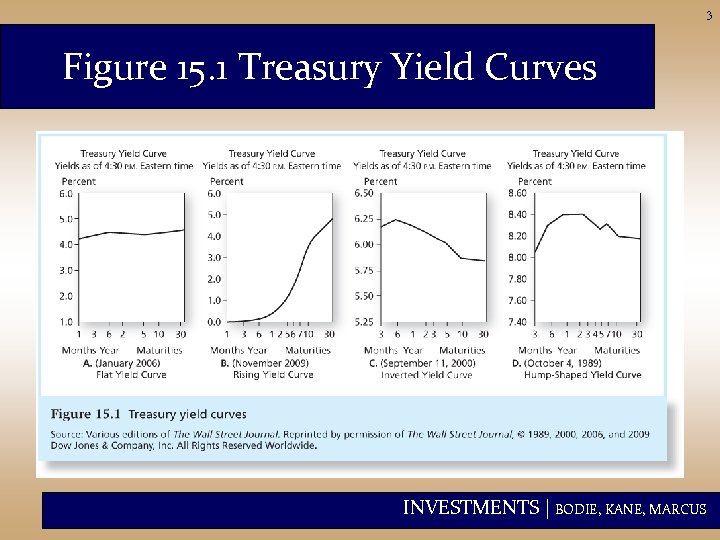 3 Figure 15. 1 Treasury Yield Curves INVESTMENTS | BODIE, KANE, MARCUS
 4 Bond Pricing • Yields on different maturity bonds are not all equal. • We need to consider each bond cash flow as a stand-alone zero-coupon bond. • Bond stripping and bond reconstitution offer opportunities for arbitrage. • The value of the bond should be the sum of the values of its parts. INVESTMENTS | BODIE, KANE, MARCUS
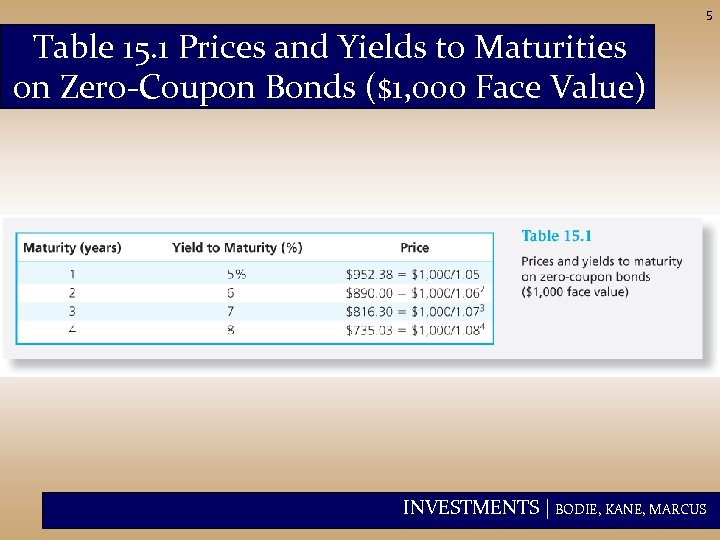 5 Table 15. 1 Prices and Yields to Maturities on Zero-Coupon Bonds ($1, 000 Face Value) INVESTMENTS | BODIE, KANE, MARCUS
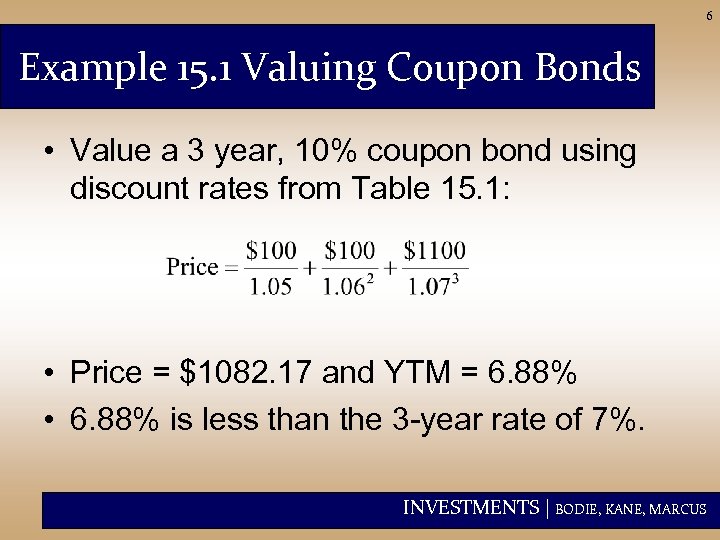 6 Example 15. 1 Valuing Coupon Bonds • Value a 3 year, 10% coupon bond using discount rates from Table 15. 1: • Price = $1082. 17 and YTM = 6. 88% • 6. 88% is less than the 3 -year rate of 7%. INVESTMENTS | BODIE, KANE, MARCUS
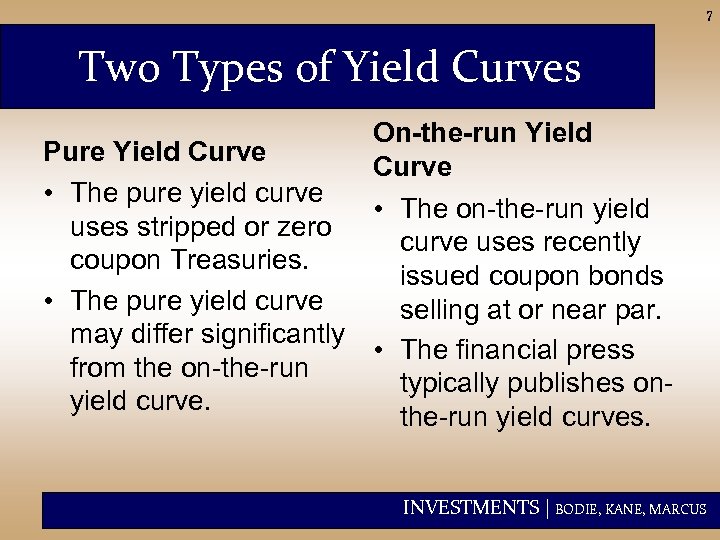 7 Two Types of Yield Curves On-the-run Yield Pure Yield Curve • The pure yield curve • The on-the-run yield uses stripped or zero curve uses recently coupon Treasuries. issued coupon bonds • The pure yield curve selling at or near par. may differ significantly • The financial press from the on-the-run typically publishes onyield curve. the-run yield curves. INVESTMENTS | BODIE, KANE, MARCUS
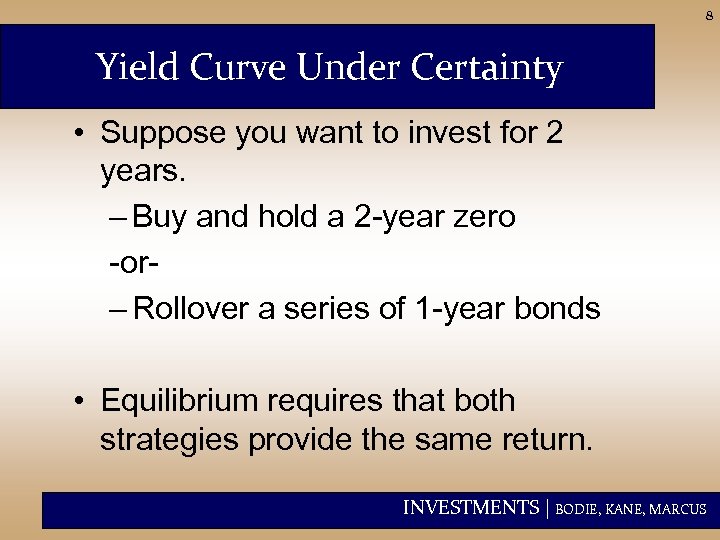 8 Yield Curve Under Certainty • Suppose you want to invest for 2 years. – Buy and hold a 2 -year zero -or– Rollover a series of 1 -year bonds • Equilibrium requires that both strategies provide the same return. INVESTMENTS | BODIE, KANE, MARCUS
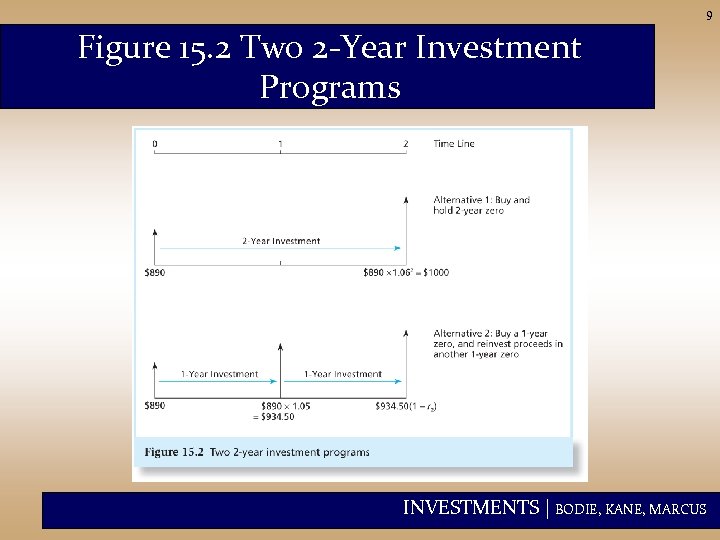 9 Figure 15. 2 Two 2 -Year Investment Programs INVESTMENTS | BODIE, KANE, MARCUS
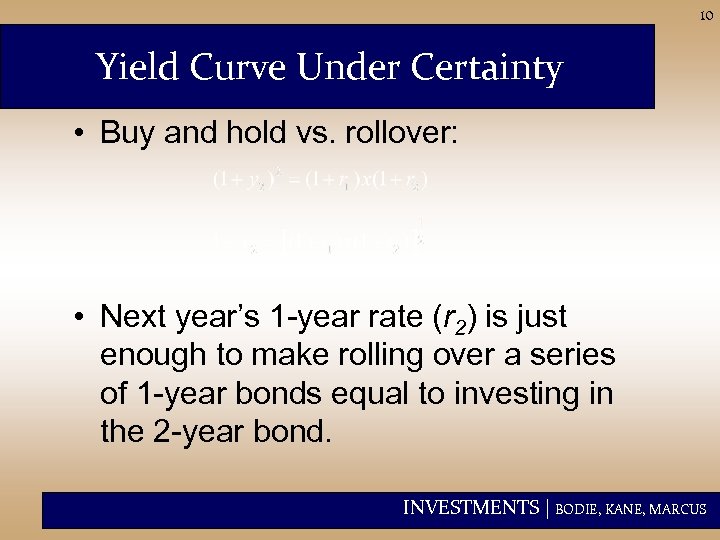 10 Yield Curve Under Certainty • Buy and hold vs. rollover: • Next year’s 1 -year rate (r 2) is just enough to make rolling over a series of 1 -year bonds equal to investing in the 2 -year bond. INVESTMENTS | BODIE, KANE, MARCUS
 11 Spot Rates vs. Short Rates • Spot rate – the rate that prevails today for a given maturity • Short rate – the rate for a given maturity (e. g. one year) at different points in time. • A spot rate is the geometric average of its component short rates. INVESTMENTS | BODIE, KANE, MARCUS
 Short Rates and Yield Curve Slope 12 • When next year’s short rate, r 2 , is less greater than this year’s short rate, r 1, the yield curve slopes down. up. – May indicate rates are expected to fall. are expected to rise. INVESTMENTS | BODIE, KANE, MARCUS
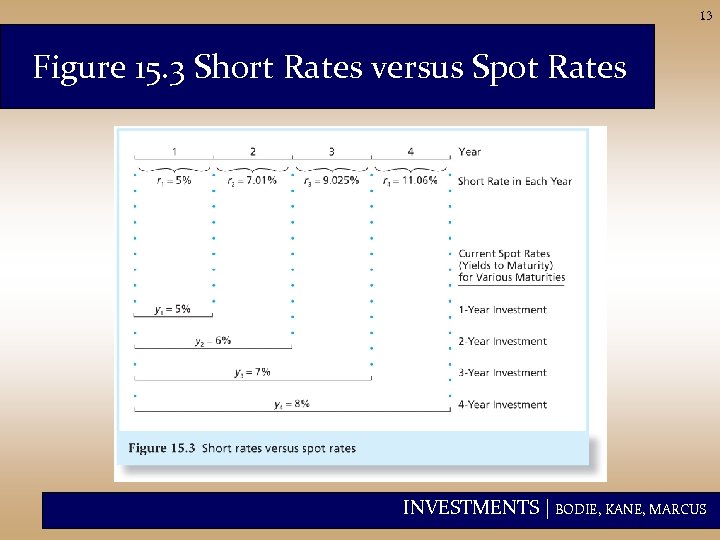 13 Figure 15. 3 Short Rates versus Spot Rates INVESTMENTS | BODIE, KANE, MARCUS
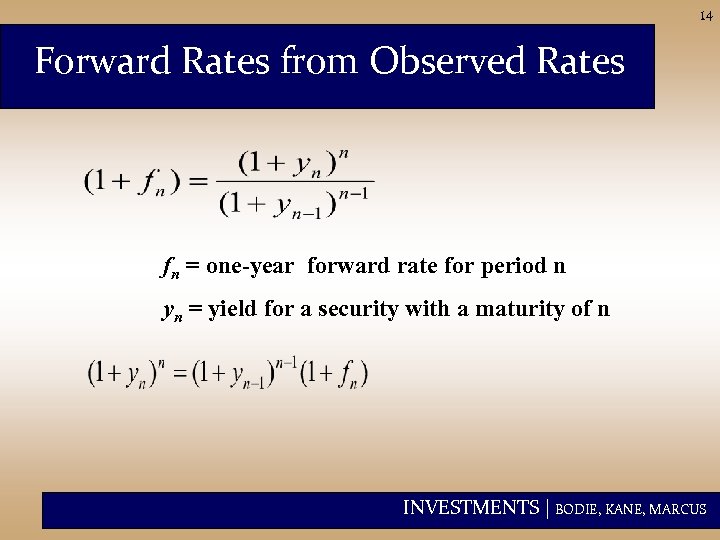 14 Forward Rates from Observed Rates fn = one-year forward rate for period n yn = yield for a security with a maturity of n INVESTMENTS | BODIE, KANE, MARCUS
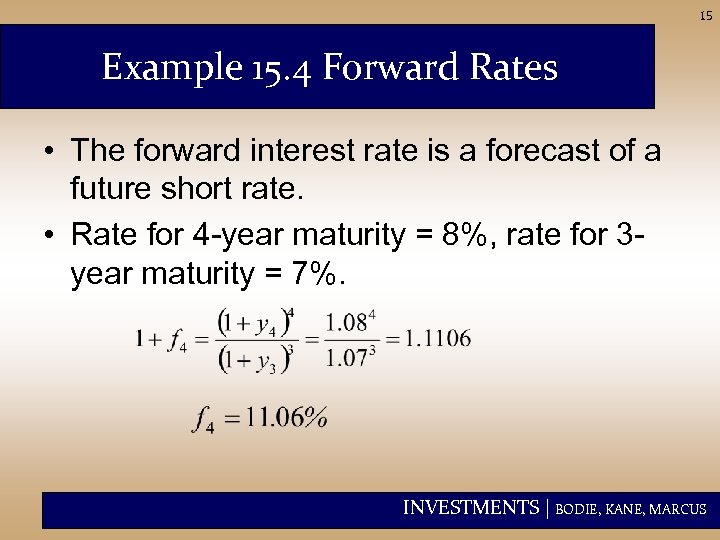 15 Example 15. 4 Forward Rates • The forward interest rate is a forecast of a future short rate. • Rate for 4 -year maturity = 8%, rate for 3 year maturity = 7%. INVESTMENTS | BODIE, KANE, MARCUS
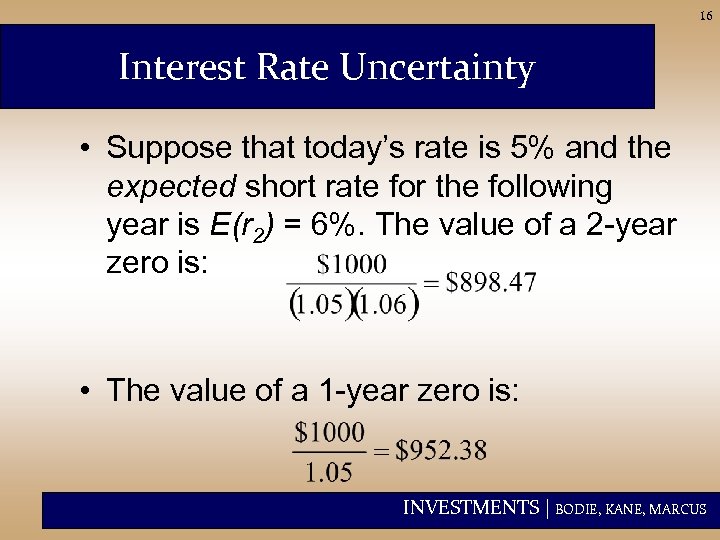 16 Interest Rate Uncertainty • Suppose that today’s rate is 5% and the expected short rate for the following year is E(r 2) = 6%. The value of a 2 -year zero is: • The value of a 1 -year zero is: INVESTMENTS | BODIE, KANE, MARCUS
 17 Interest Rate Uncertainty • The investor wants to invest for 1 year. – Buy the 2 -year bond today and plan to sell it at the end of the first year for $1000/1. 06 =$943. 40. – 0 r– Buy the 1 -year bond today and hold to maturity. INVESTMENTS | BODIE, KANE, MARCUS
 18 Interest Rate Uncertainty • What if next year’s interest rate is more (or less) than 6%? – The actual return on the 2 -year bond is uncertain! INVESTMENTS | BODIE, KANE, MARCUS
 19 Interest Rate Uncertainty • Investors require a risk premium to hold a longer-term bond. • This liquidity premium compensates short-term investors for the uncertainty about future prices. INVESTMENTS | BODIE, KANE, MARCUS
 20 Theories of Term Structure • Expectations • Liquidity Preference – Upward bias over expectations INVESTMENTS | BODIE, KANE, MARCUS
 21 Expectations Theory • Observed long-term rate is a function of today’s short-term rate and expected future short-term rates. • fn = E(rn) and liquidity premiums are zero. INVESTMENTS | BODIE, KANE, MARCUS
 22 Liquidity Premium Theory • Long-term bonds are more risky; therefore, fn generally exceeds E(rn) • The excess of fn over E(rn) is the liquidity premium. • The yield curve has an upward bias built into the long-term rates because of the liquidity premium. INVESTMENTS | BODIE, KANE, MARCUS
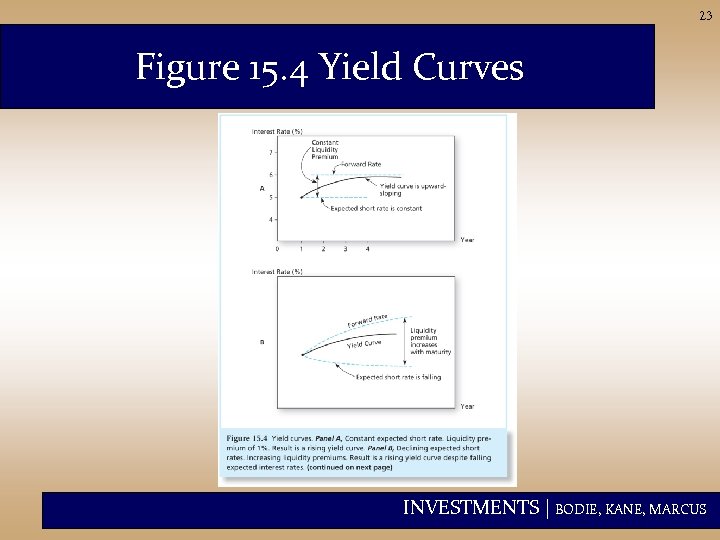 23 Figure 15. 4 Yield Curves INVESTMENTS | BODIE, KANE, MARCUS
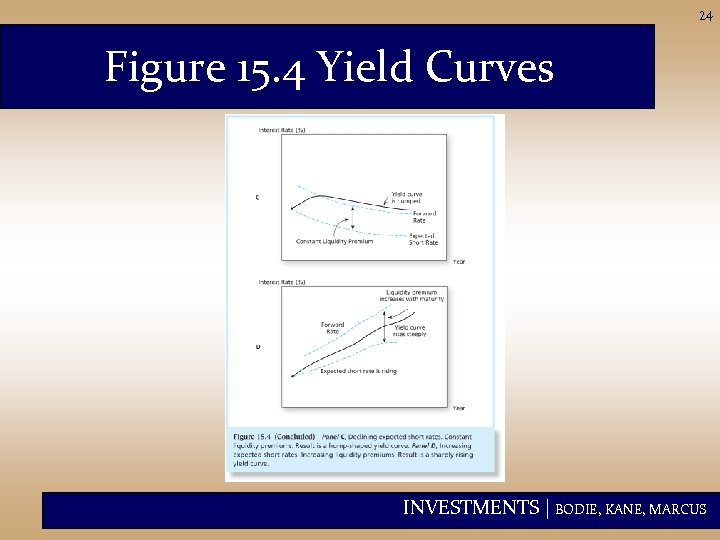 24 Figure 15. 4 Yield Curves INVESTMENTS | BODIE, KANE, MARCUS
 25 Interpreting the Term Structure • The yield curve reflects expectations of future interest rates. • The forecasts of future rates are clouded by other factors, such as liquidity premiums. • An upward sloping curve could indicate: – Rates are expected to rise – And/or – Investors require large liquidity premiums to hold long term bonds. INVESTMENTS | BODIE, KANE, MARCUS
 26 Interpreting the Term Structure • The yield curve is a good predictor of the business cycle. – Long term rates tend to rise in anticipation of economic expansion. – Inverted yield curve may indicate that interest rates are expected to fall and signal a recession. INVESTMENTS | BODIE, KANE, MARCUS
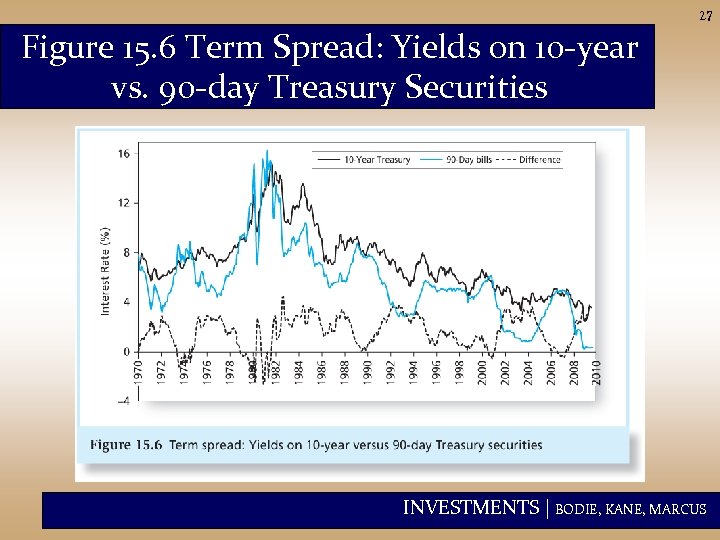 27 Figure 15. 6 Term Spread: Yields on 10 -year vs. 90 -day Treasury Securities INVESTMENTS | BODIE, KANE, MARCUS
 28 Forward Rates as Forward Contracts • In general, forward rates will not equal the eventually realized short rate – Still an important consideration when trying to make decisions : • Locking in loan rates INVESTMENTS | BODIE, KANE, MARCUS
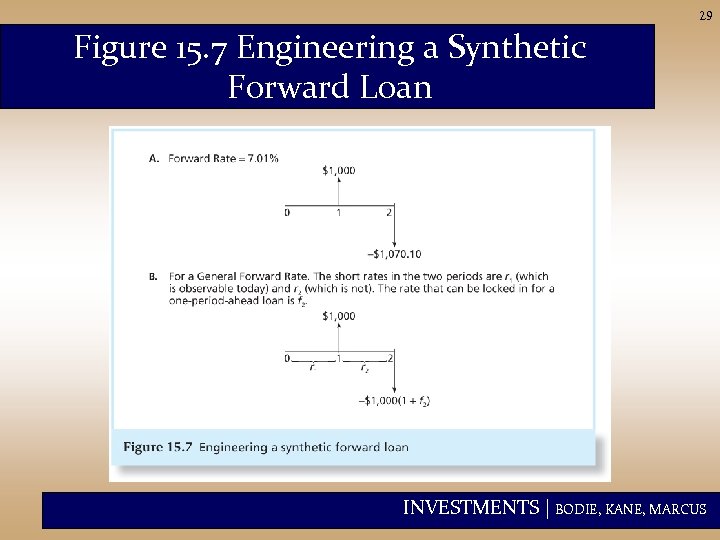 29 Figure 15. 7 Engineering a Synthetic Forward Loan INVESTMENTS | BODIE, KANE, MARCUS