


 Скачать презентацию Chapter 15 The Ferment of Reform and Culture
3493b94989622a099c4bc685cfdf1fe7.ppt
- Количество слайдов: 20
 Chapter 15 The Ferment of Reform and Culture 1790– 1860
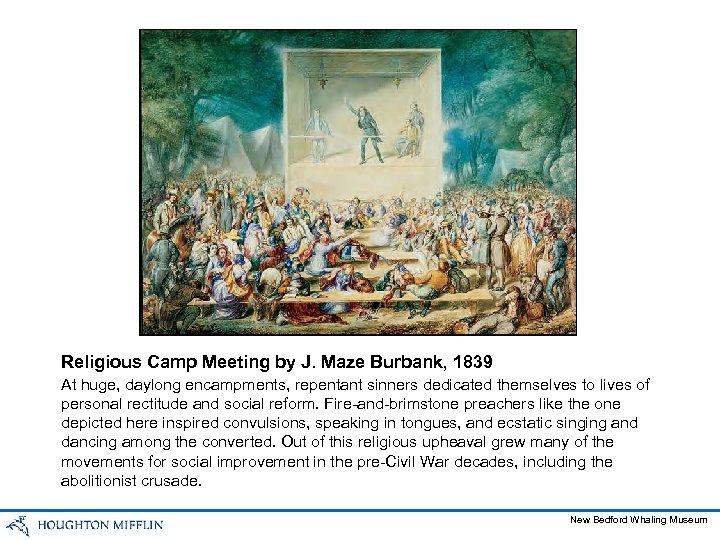 Religious Camp Meeting by J. Maze Burbank, 1839 At huge, daylong encampments, repentant sinners dedicated themselves to lives of personal rectitude and social reform. Fire-and-brimstone preachers like the one depicted here inspired convulsions, speaking in tongues, and ecstatic singing and dancing among the converted. Out of this religious upheaval grew many of the movements for social improvement in the pre-Civil War decades, including the abolitionist crusade. New Bedford Whaling Museum
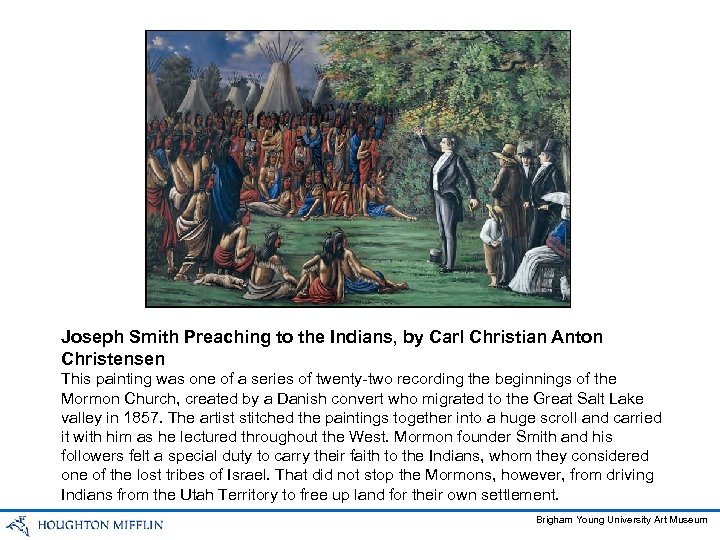 Joseph Smith Preaching to the Indians, by Carl Christian Anton Christensen This painting was one of a series of twenty-two recording the beginnings of the Mormon Church, created by a Danish convert who migrated to the Great Salt Lake valley in 1857. The artist stitched the paintings together into a huge scroll and carried it with him as he lectured throughout the West. Mormon founder Smith and his followers felt a special duty to carry their faith to the Indians, whom they considered one of the lost tribes of Israel. That did not stop the Mormons, however, from driving Indians from the Utah Territory to free up land for their own settlement. Brigham Young University Art Museum
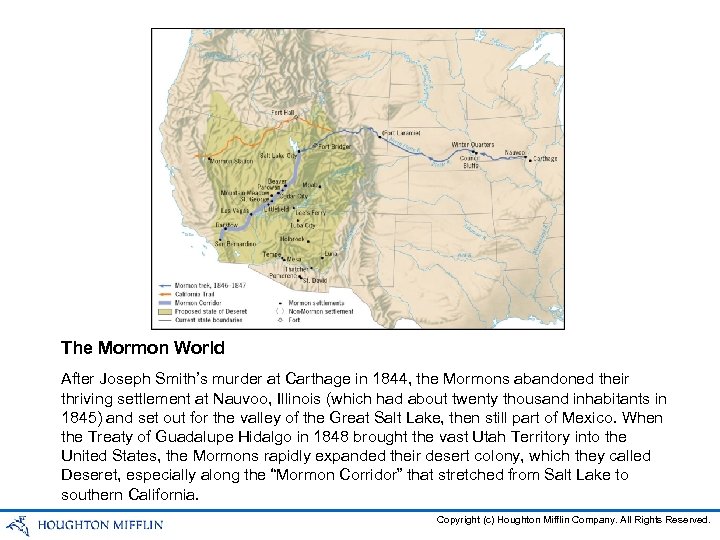 The Mormon World After Joseph Smith’s murder at Carthage in 1844, the Mormons abandoned their thriving settlement at Nauvoo, Illinois (which had about twenty thousand inhabitants in 1845) and set out for the valley of the Great Salt Lake, then still part of Mexico. When the Treaty of Guadalupe Hidalgo in 1848 brought the vast Utah Territory into the United States, the Mormons rapidly expanded their desert colony, which they called Deseret, especially along the “Mormon Corridor” that stretched from Salt Lake to southern California. Copyright (c) Houghton Mifflin Company. All Rights Reserved.
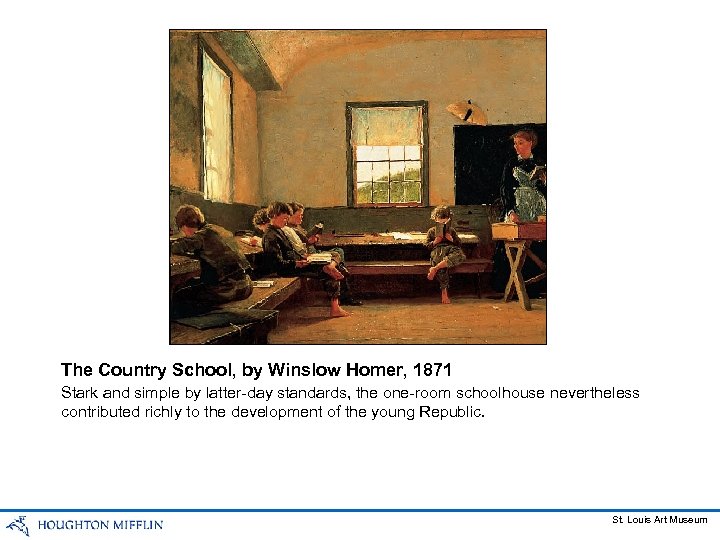 The Country School, by Winslow Homer, 1871 Stark and simple by latter-day standards, the one-room schoolhouse nevertheless contributed richly to the development of the young Republic. St. Louis Art Museum
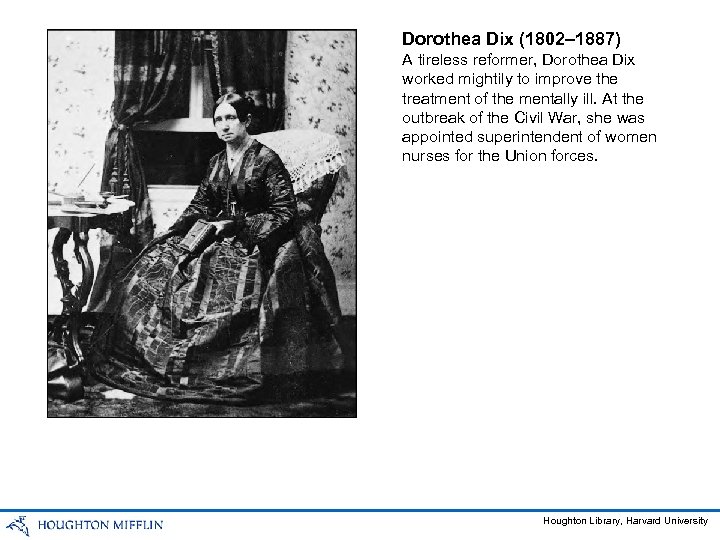 Dorothea Dix (1802– 1887) A tireless reformer, Dorothea Dix worked mightily to improve the treatment of the mentally ill. At the outbreak of the Civil War, she was appointed superintendent of women nurses for the Union forces. Houghton Library, Harvard University
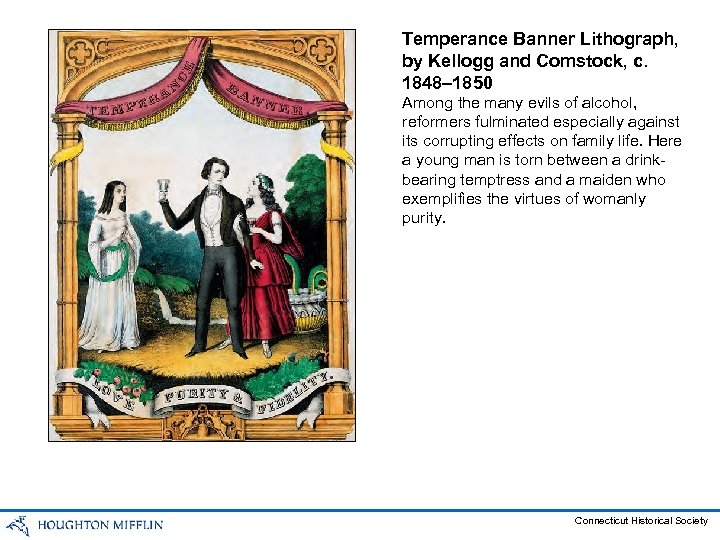 Temperance Banner Lithograph, by Kellogg and Comstock, c. 1848– 1850 Among the many evils of alcohol, reformers fulminated especially against its corrupting effects on family life. Here a young man is torn between a drinkbearing temptress and a maiden who exemplifies the virtues of womanly purity. Connecticut Historical Society
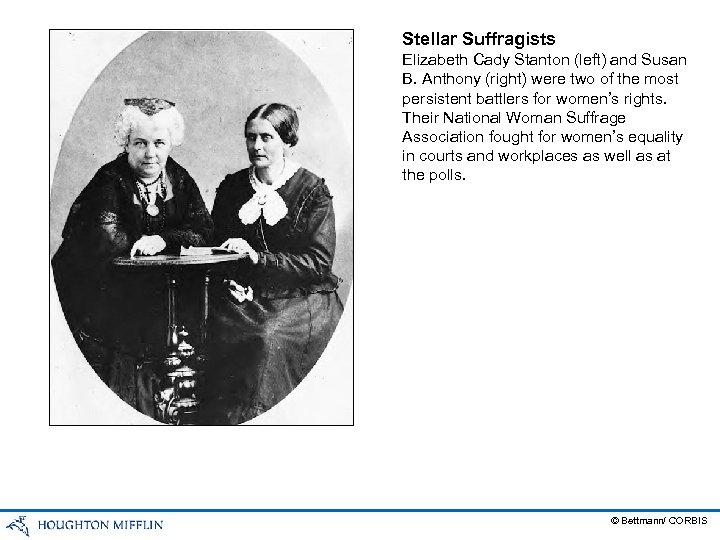 Stellar Suffragists Elizabeth Cady Stanton (left) and Susan B. Anthony (right) were two of the most persistent battlers for women’s rights. Their National Woman Suffrage Association fought for women’s equality in courts and workplaces as well as at the polls. © Bettmann/ CORBIS
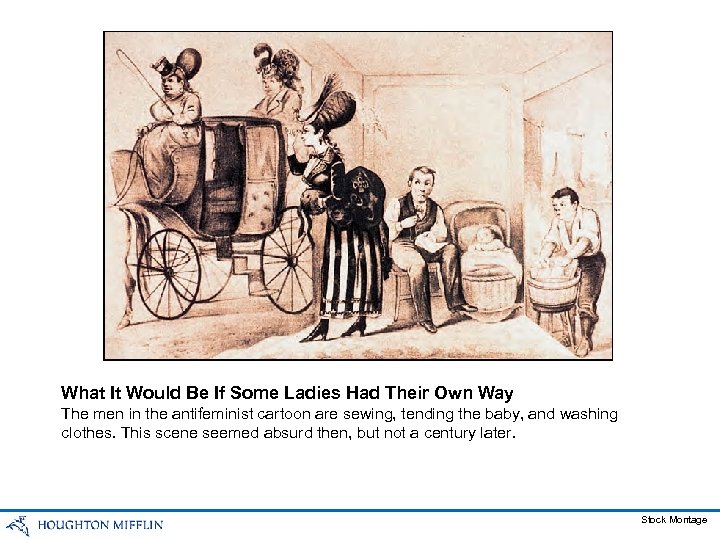 What It Would Be If Some Ladies Had Their Own Way The men in the antifeminist cartoon are sewing, tending the baby, and washing clothes. This scene seemed absurd then, but not a century later. Stock Montage
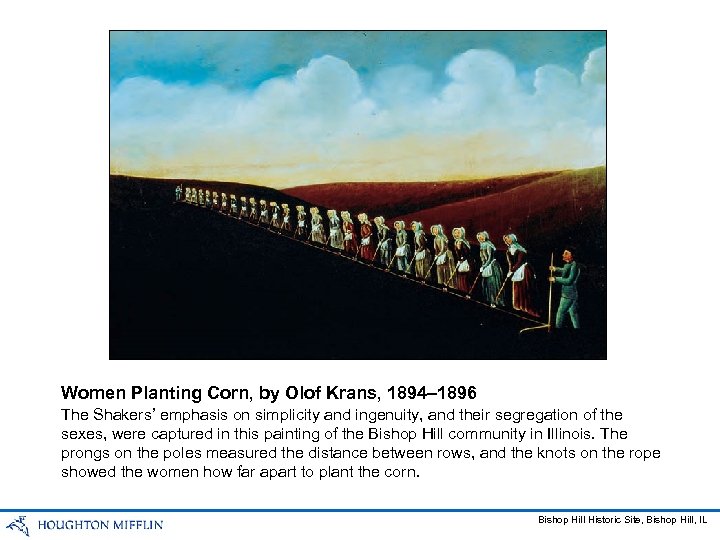 Women Planting Corn, by Olof Krans, 1894– 1896 The Shakers’ emphasis on simplicity and ingenuity, and their segregation of the sexes, were captured in this painting of the Bishop Hill community in Illinois. The prongs on the poles measured the distance between rows, and the knots on the rope showed the women how far apart to plant the corn. Bishop Hill Historic Site, Bishop Hill, IL
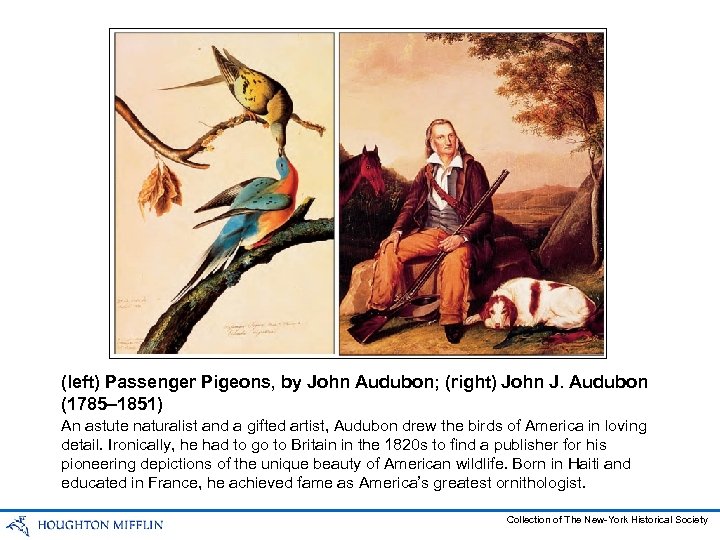 (left) Passenger Pigeons, by John Audubon; (right) John J. Audubon (1785– 1851) An astute naturalist and a gifted artist, Audubon drew the birds of America in loving detail. Ironically, he had to go to Britain in the 1820 s to find a publisher for his pioneering depictions of the unique beauty of American wildlife. Born in Haiti and educated in France, he achieved fame as America’s greatest ornithologist. Collection of The New-York Historical Society
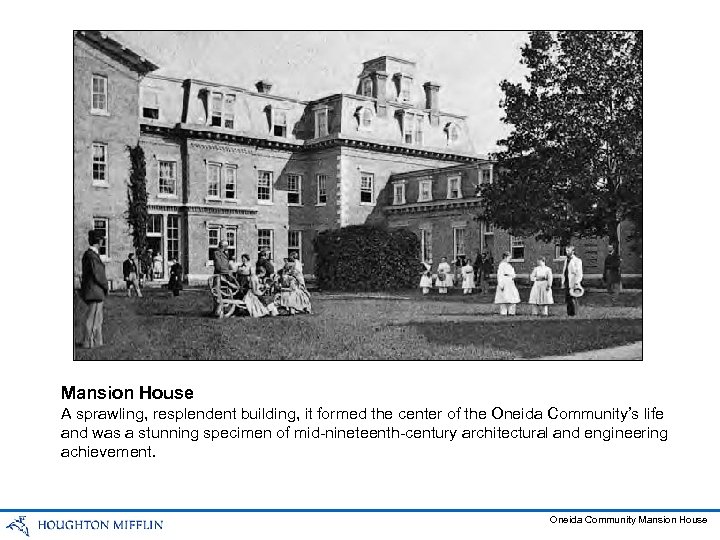 Mansion House A sprawling, resplendent building, it formed the center of the Oneida Community’s life and was a stunning specimen of mid-nineteenth-century architectural and engineering achievement. Oneida Community Mansion House
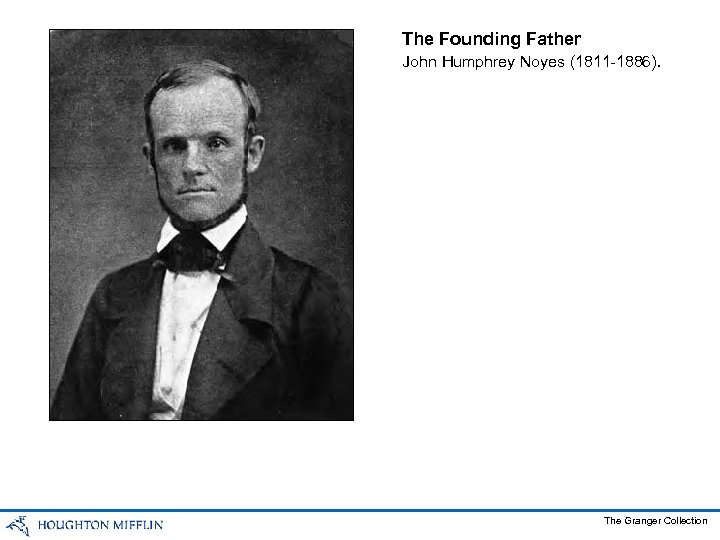 The Founding Father John Humphrey Noyes (1811 -1886). The Granger Collection
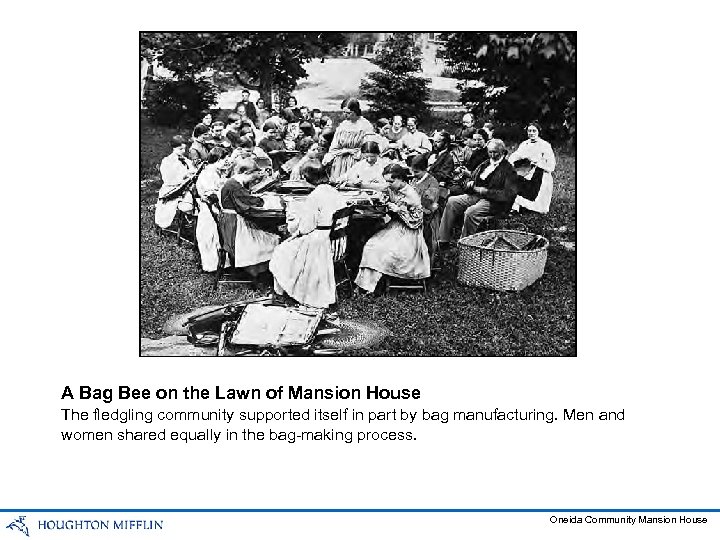 A Bag Bee on the Lawn of Mansion House The fledgling community supported itself in part by bag manufacturing. Men and women shared equally in the bag-making process. Oneida Community Mansion House
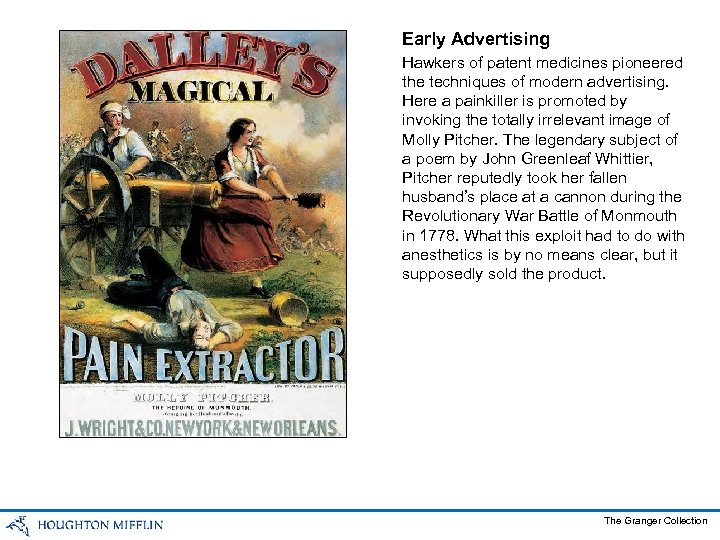 Early Advertising Hawkers of patent medicines pioneered the techniques of modern advertising. Here a painkiller is promoted by invoking the totally irrelevant image of Molly Pitcher. The legendary subject of a poem by John Greenleaf Whittier, Pitcher reputedly took her fallen husband’s place at a cannon during the Revolutionary War Battle of Monmouth in 1778. What this exploit had to do with anesthetics is by no means clear, but it supposedly sold the product. The Granger Collection
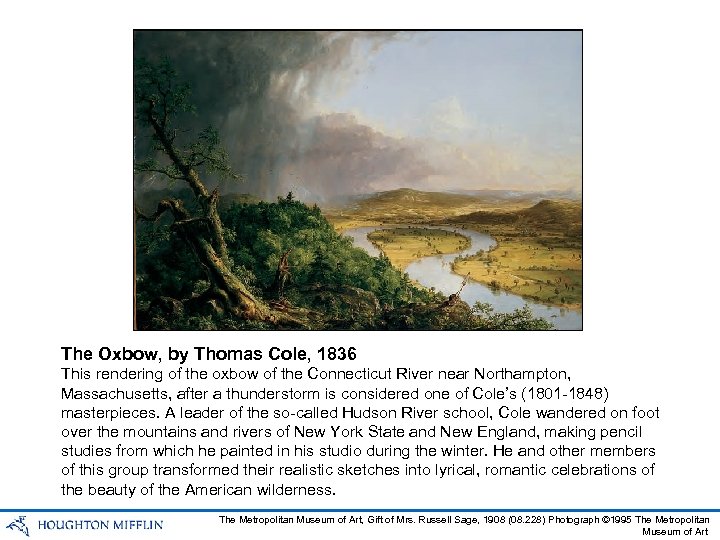 The Oxbow, by Thomas Cole, 1836 This rendering of the oxbow of the Connecticut River near Northampton, Massachusetts, after a thunderstorm is considered one of Cole’s (1801 -1848) masterpieces. A leader of the so-called Hudson River school, Cole wandered on foot over the mountains and rivers of New York State and New England, making pencil studies from which he painted in his studio during the winter. He and other members of this group transformed their realistic sketches into lyrical, romantic celebrations of the beauty of the American wilderness. The Metropolitan Museum of Art, Gift of Mrs. Russell Sage, 1908 (08. 228) Photograph © 1995 The Metropolitan Museum of Art
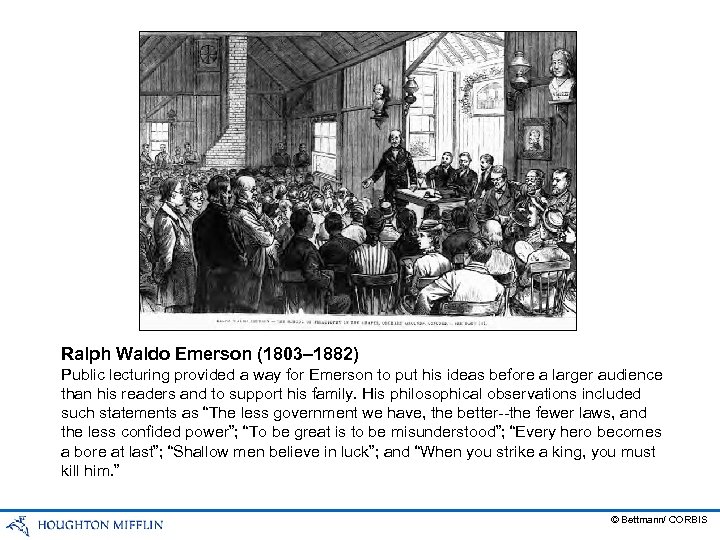 Ralph Waldo Emerson (1803– 1882) Public lecturing provided a way for Emerson to put his ideas before a larger audience than his readers and to support his family. His philosophical observations included such statements as “The less government we have, the better--the fewer laws, and the less confided power”; “To be great is to be misunderstood”; “Every hero becomes a bore at last”; “Shallow men believe in luck”; and “When you strike a king, you must kill him. ” © Bettmann/ CORBIS
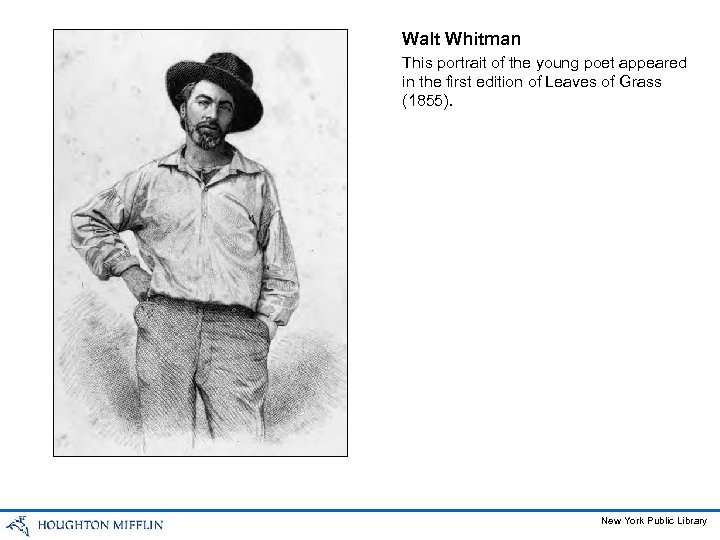 Walt Whitman This portrait of the young poet appeared in the first edition of Leaves of Grass (1855). New York Public Library
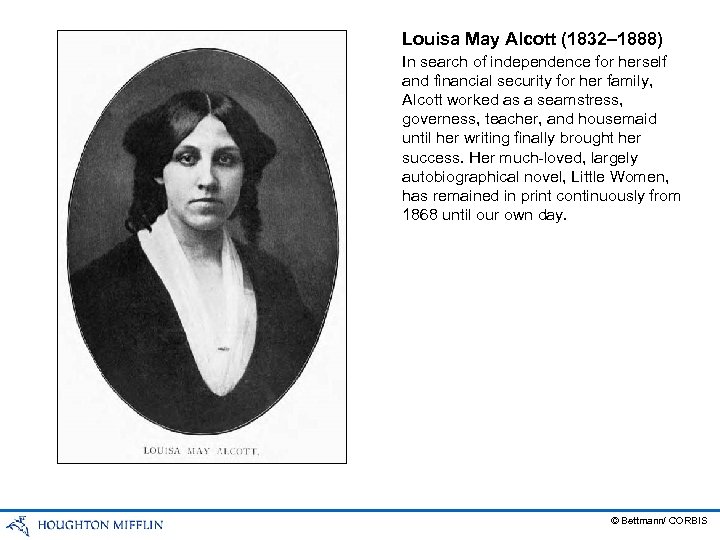 Louisa May Alcott (1832– 1888) In search of independence for herself and financial security for her family, Alcott worked as a seamstress, governess, teacher, and housemaid until her writing finally brought her success. Her much-loved, largely autobiographical novel, Little Women, has remained in print continuously from 1868 until our own day. © Bettmann/ CORBIS
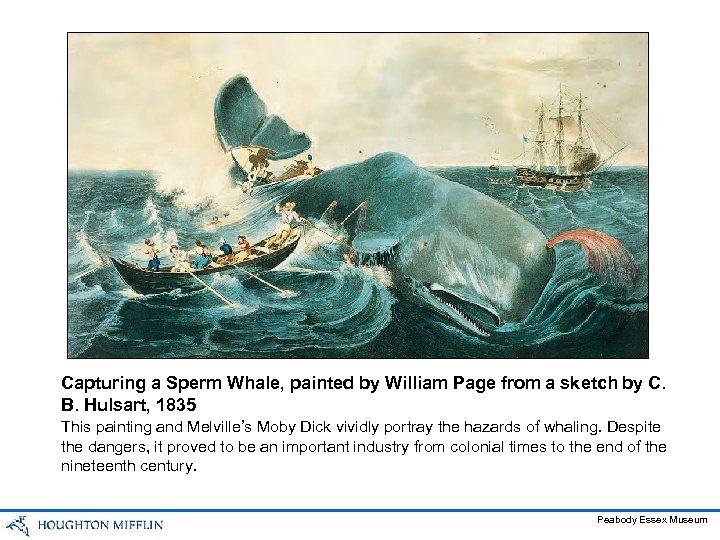 Capturing a Sperm Whale, painted by William Page from a sketch by C. B. Hulsart, 1835 This painting and Melville’s Moby Dick vividly portray the hazards of whaling. Despite the dangers, it proved to be an important industry from colonial times to the end of the nineteenth century. Peabody Essex Museum