


 Скачать презентацию Chapter 15 Security Operating System Concepts with Java
c6b0f02d84707fe5b1ce55ddd456694c.ppt
- Количество слайдов: 45
 Chapter 15: Security Operating System Concepts with Java – 8 th Edition 14. 1 Silberschatz, Galvin and Gagne © 2009
 Chapter 15: Security n The Security Problem n Program Threats n System and Network Threats n Cryptography as a Security Tool n User Authentication n Implementing Security Defenses n Firewalling to Protect Systems and Networks n Computer-Security Classifications n An Example: Windows XP Operating System Concepts with Java – 8 th Edition 14. 2 Silberschatz, Galvin and Gagne © 2009
 Objectives n To discuss security threats and attacks n To explain the fundamentals of encryption, authentication, and hashing n To examine the uses of cryptography in computing n To describe the various countermeasures to security attacks Operating System Concepts with Java – 8 th Edition 14. 3 Silberschatz, Galvin and Gagne © 2009
 The Security Problem n Security must consider external environment of the system, and protect the system resources n Intruders (crackers) attempt to breach security n Threat is potential security violation n Attack is attempt to breach security n Attack can be accidental or malicious n Easier to protect against accidental than malicious misuse Operating System Concepts with Java – 8 th Edition 14. 4 Silberschatz, Galvin and Gagne © 2009
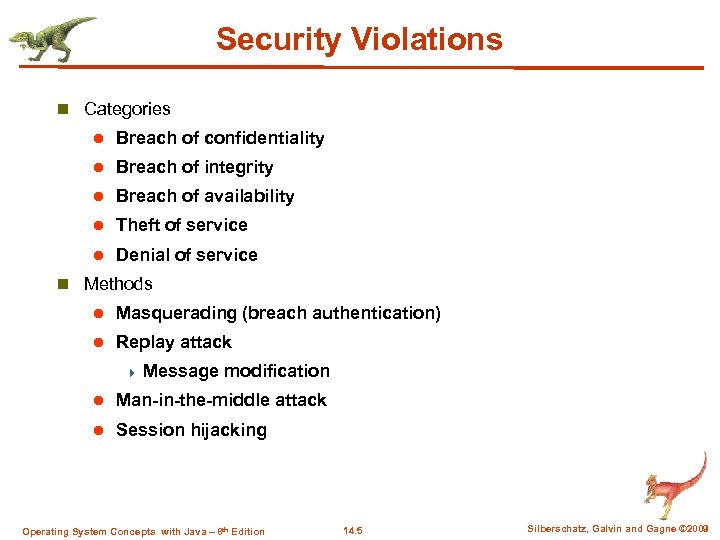 Security Violations n Categories l Breach of confidentiality l Breach of integrity l Breach of availability l Theft of service l Denial of service n Methods l Masquerading (breach authentication) l Replay attack 4 Message modification l Man-in-the-middle attack l Session hijacking Operating System Concepts with Java – 8 th Edition 14. 5 Silberschatz, Galvin and Gagne © 2009
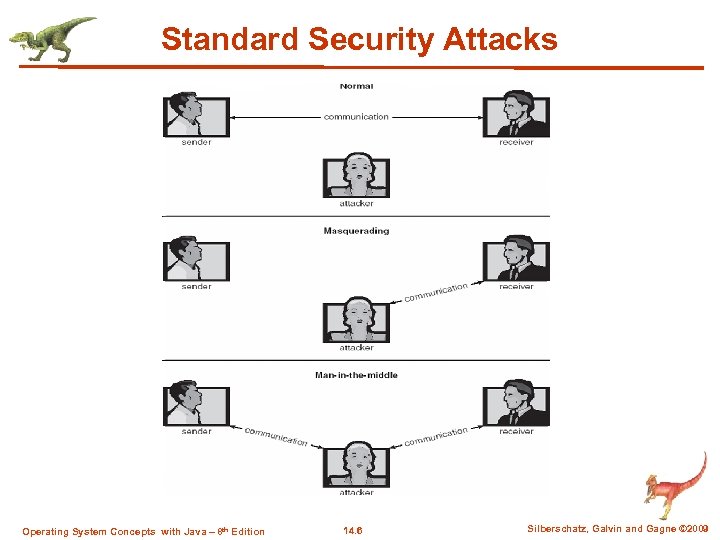 Standard Security Attacks Operating System Concepts with Java – 8 th Edition 14. 6 Silberschatz, Galvin and Gagne © 2009
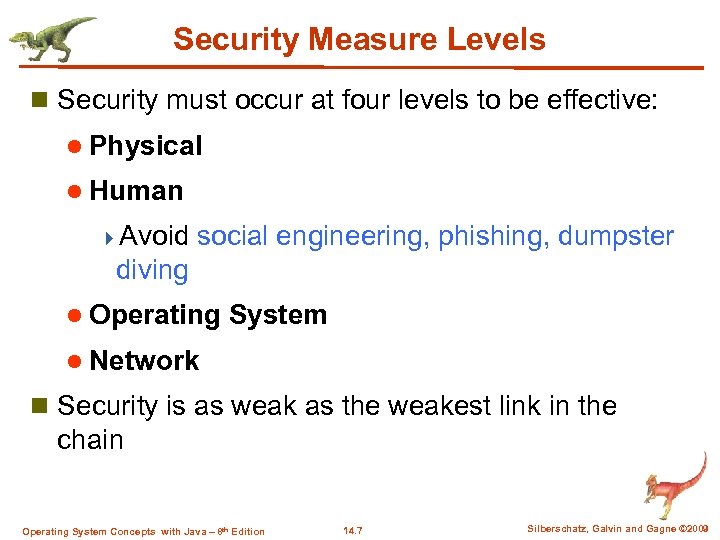 Security Measure Levels n Security must occur at four levels to be effective: l Physical l Human 4 Avoid social engineering, phishing, dumpster diving l Operating System l Network n Security is as weak as the weakest link in the chain Operating System Concepts with Java – 8 th Edition 14. 7 Silberschatz, Galvin and Gagne © 2009
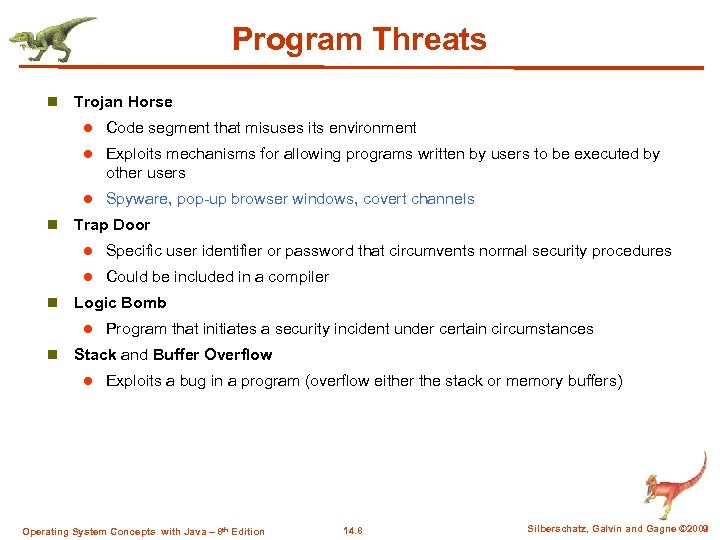 Program Threats n Trojan Horse l l Exploits mechanisms for allowing programs written by users to be executed by other users l n Code segment that misuses its environment Spyware, pop-up browser windows, covert channels Trap Door l l n Specific user identifier or password that circumvents normal security procedures Could be included in a compiler Logic Bomb l n Program that initiates a security incident under certain circumstances Stack and Buffer Overflow l Exploits a bug in a program (overflow either the stack or memory buffers) Operating System Concepts with Java – 8 th Edition 14. 8 Silberschatz, Galvin and Gagne © 2009
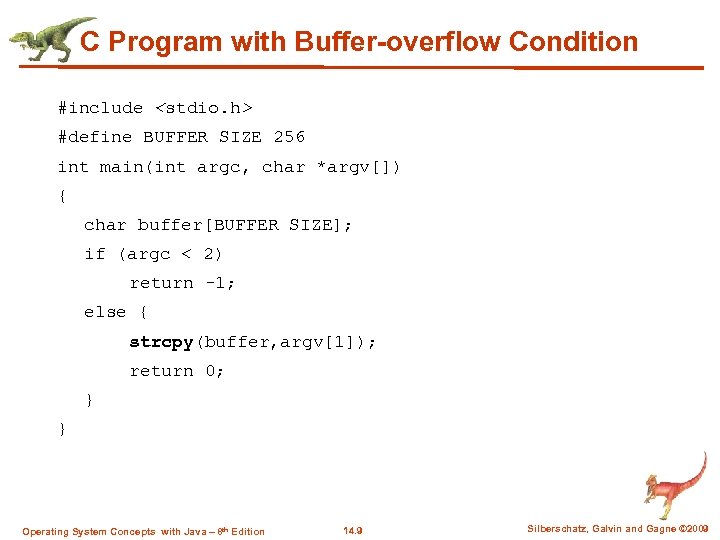 C Program with Buffer-overflow Condition #include
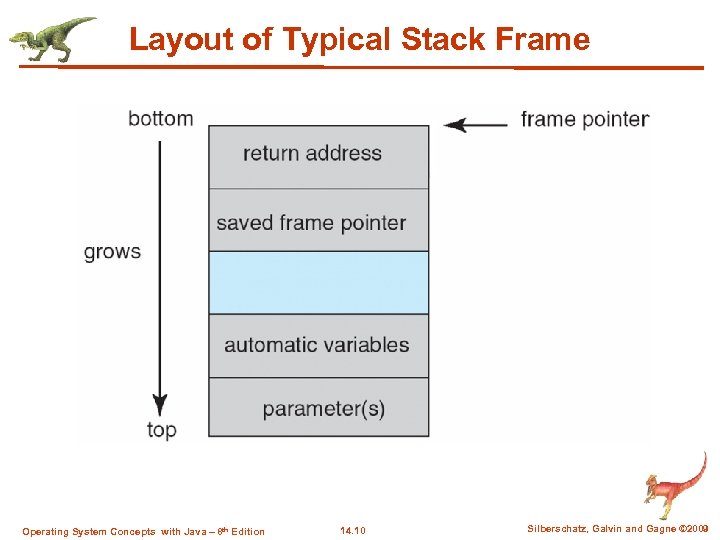 Layout of Typical Stack Frame Operating System Concepts with Java – 8 th Edition 14. 10 Silberschatz, Galvin and Gagne © 2009
![Modified Shell Code #include <stdio. h> int main(int argc, char *argv[]) { execvp(‘‘binsh’’, ‘‘bin](https://present5.com/presentation/c6b0f02d84707fe5b1ce55ddd456694c/image-11.jpg "Modified Shell Code #include <stdio. h> int main(int argc, char *argv[]) { execvp(‘‘binsh’’, ‘‘bin") Modified Shell Code #include
Modified Shell Code #include
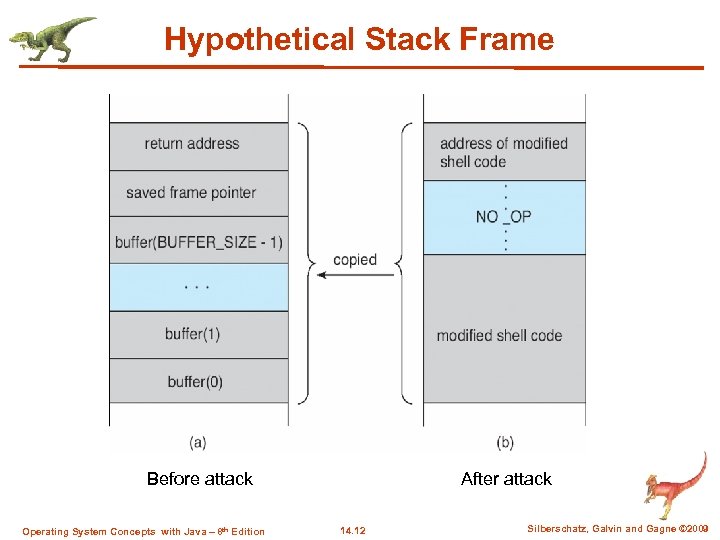 Hypothetical Stack Frame After attack Before attack Operating System Concepts with Java – 8 th Edition 14. 12 Silberschatz, Galvin and Gagne © 2009
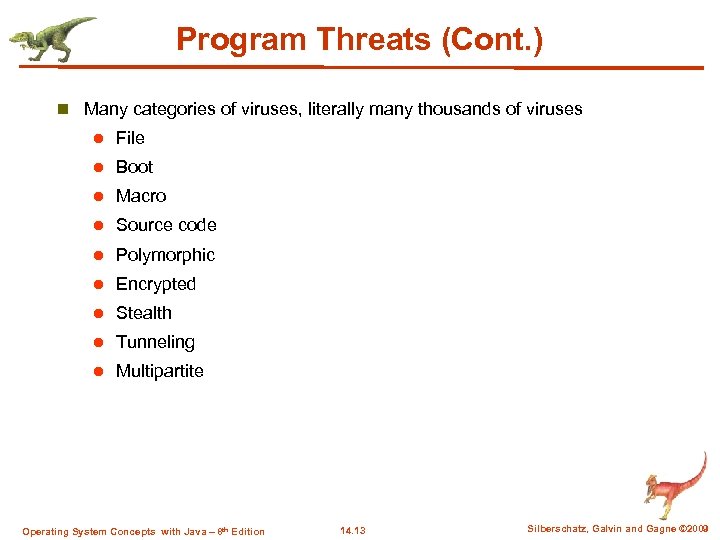 Program Threats (Cont. ) n Many categories of viruses, literally many thousands of viruses l File l Boot l Macro l Source code l Polymorphic l Encrypted l Stealth l Tunneling l Multipartite Operating System Concepts with Java – 8 th Edition 14. 13 Silberschatz, Galvin and Gagne © 2009
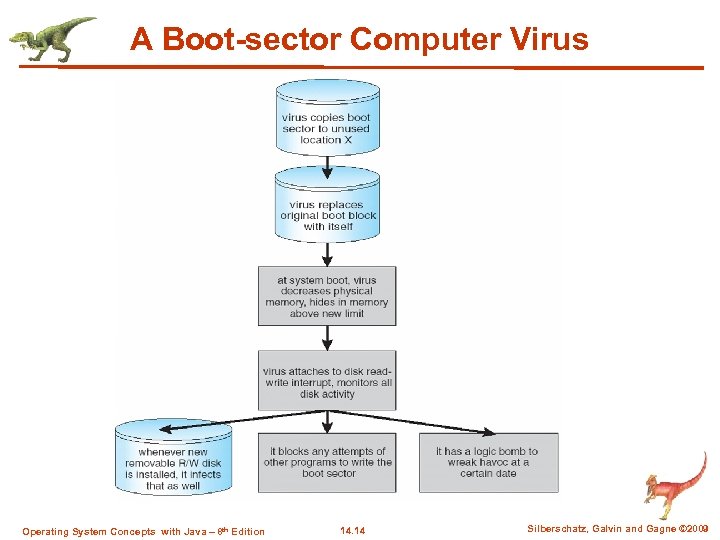 A Boot-sector Computer Virus Operating System Concepts with Java – 8 th Edition 14. 14 Silberschatz, Galvin and Gagne © 2009
 System and Network Threats n Worms – use spawn mechanism; standalone program n Internet worm l Exploited UNIX networking features (remote access) and bugs in finger and sendmail programs l Grappling hook program uploaded main worm program n Port scanning l Automated attempt to connect to a range of ports on one or a range of IP addresses n Denial of Service l Overload the targeted computer preventing it from doing any useful work l Distributed denial-of-service (DDOS) come from multiple sites at once Operating System Concepts with Java – 8 th Edition 14. 15 Silberschatz, Galvin and Gagne © 2009
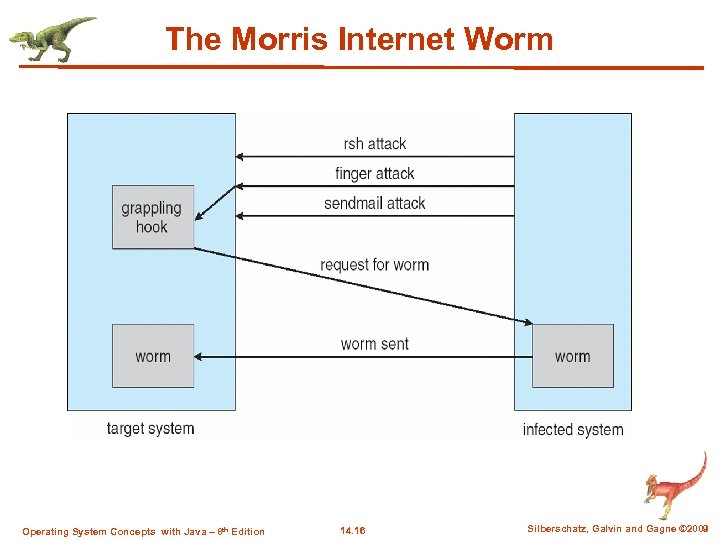 The Morris Internet Worm Operating System Concepts with Java – 8 th Edition 14. 16 Silberschatz, Galvin and Gagne © 2009
 Cryptography as a Security Tool n Broadest security tool available l Source and destination of messages cannot be trusted without cryptography l Means to constrain potential senders (sources) and / or receivers (destinations) of messages n Based on secrets (keys) Operating System Concepts with Java – 8 th Edition 14. 17 Silberschatz, Galvin and Gagne © 2009
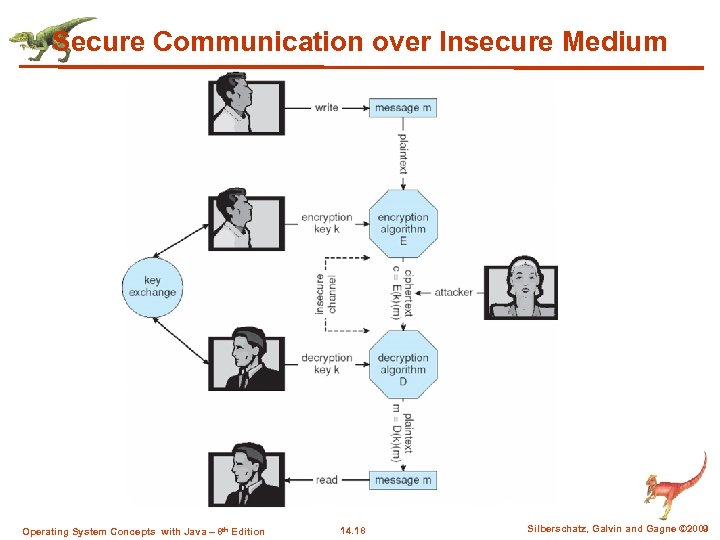 Secure Communication over Insecure Medium Operating System Concepts with Java – 8 th Edition 14. 18 Silberschatz, Galvin and Gagne © 2009
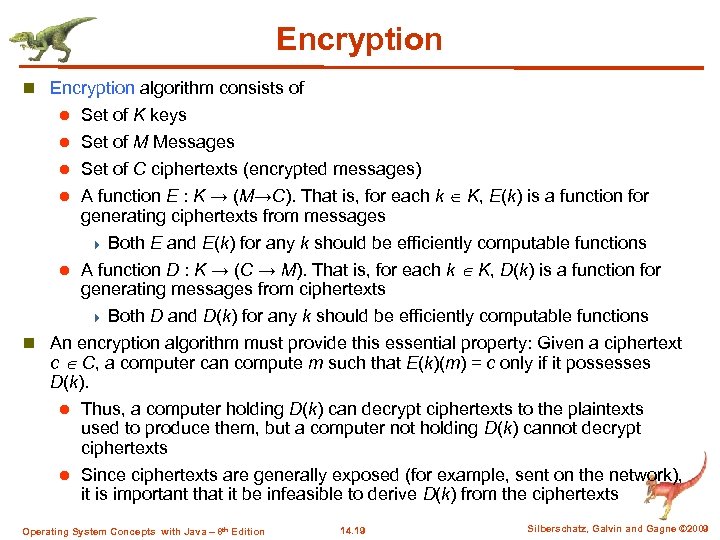 Encryption n Encryption algorithm consists of l l l Set of K keys Set of M Messages Set of C ciphertexts (encrypted messages) A function E : K → (M→C). That is, for each k K, E(k) is a function for generating ciphertexts from messages 4 Both E and E(k) for any k should be efficiently computable functions A function D : K → (C → M). That is, for each k K, D(k) is a function for generating messages from ciphertexts 4 Both D and D(k) for any k should be efficiently computable functions n An encryption algorithm must provide this essential property: Given a ciphertext c C, a computer can compute m such that E(k)(m) = c only if it possesses D(k). l Thus, a computer holding D(k) can decrypt ciphertexts to the plaintexts used to produce them, but a computer not holding D(k) cannot decrypt ciphertexts l Since ciphertexts are generally exposed (for example, sent on the network), it is important that it be infeasible to derive D(k) from the ciphertexts Operating System Concepts with Java – 8 th Edition 14. 19 Silberschatz, Galvin and Gagne © 2009
 Symmetric Encryption n Same key used to encrypt and decrypt l E(k) can be derived from D(k), and vice versa n DES is most commonly used symmetric block-encryption algorithm (created by US Govt) l Encrypts a block of data at a time n Triple-DES considered more secure n Advanced Encryption Standard (AES), twofish up and coming n RC 4 is most common symmetric stream cipher, but known to have vulnerabilities l Encrypts/decrypts a stream of bytes (i. e wireless transmission) l Key is a input to psuedo-random-bit generator 4 Generates an infinite keystream Operating System Concepts with Java – 8 th Edition 14. 20 Silberschatz, Galvin and Gagne © 2009
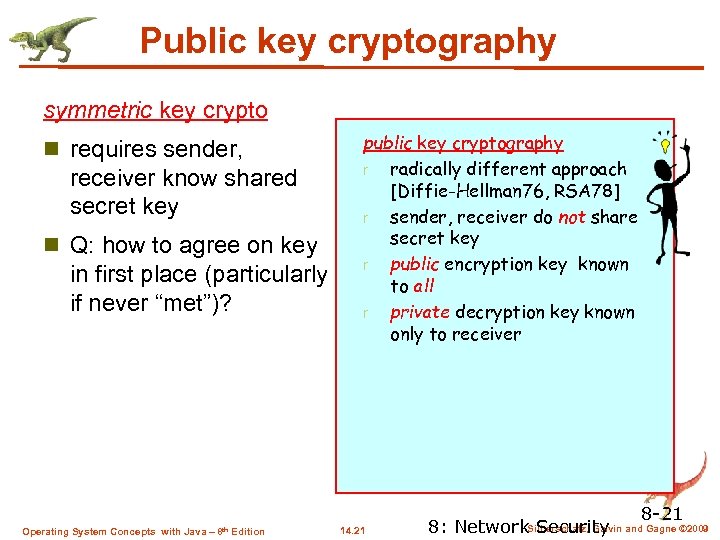 Public key cryptography symmetric key crypto n requires sender, receiver know shared secret key n Q: how to agree on key in first place (particularly if never “met”)? Operating System Concepts with Java – 8 th Edition public key cryptography r radically different approach [Diffie-Hellman 76, RSA 78] r sender, receiver do not share secret key r public encryption key known to all r private decryption key known only to receiver 14. 21 8 -21 8: Network. Silberschatz, Galvin and Gagne © 2009 Security
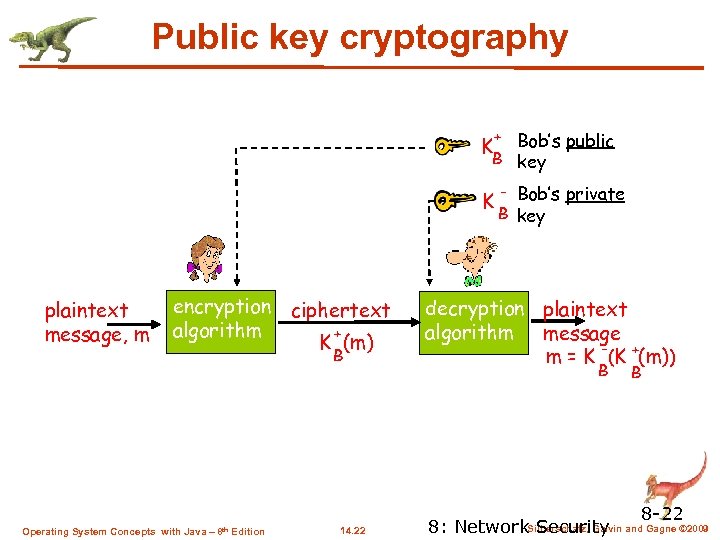 Public key cryptography + Bob’s public B key K K plaintext message, m encryption ciphertext algorithm + K (m) Operating System Concepts with Java – 8 th Edition B 14. 22 - Bob’s private B key decryption plaintext algorithm message m = K -(K +(m)) B B 8 -22 8: Network. Silberschatz, Galvin and Gagne © 2009 Security
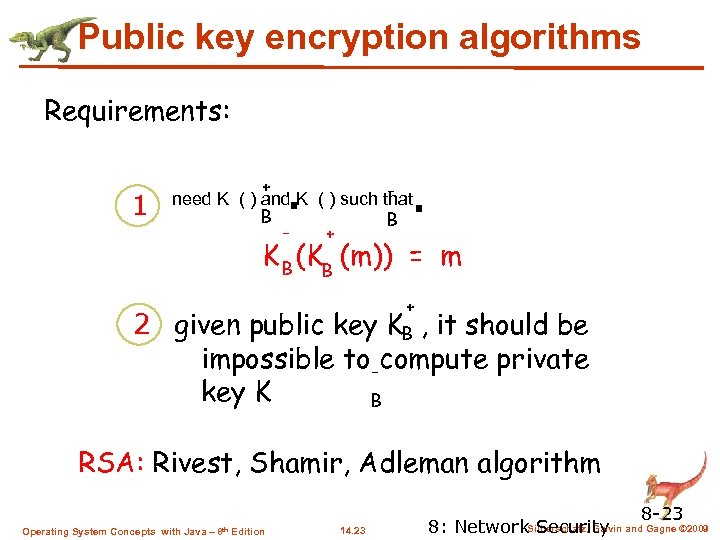 Public key encryption algorithms Requirements: 1 . . + need K ( ) and K ( ) such that B B + K B (KB (m)) = m + 2 given public key KB , it should be impossible to- compute private key K B RSA: Rivest, Shamir, Adleman algorithm Operating System Concepts with Java – 8 th Edition 14. 23 8 -23 8: Network. Silberschatz, Galvin and Gagne © 2009 Security
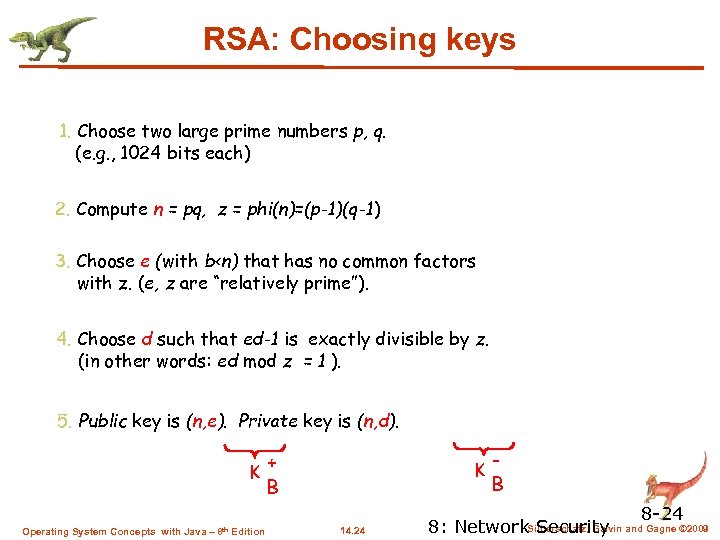 RSA: Choosing keys 1. Choose two large prime numbers p, q. (e. g. , 1024 bits each) 2. Compute n = pq, z = phi(n)=(p-1)(q-1) 3. Choose e (with b
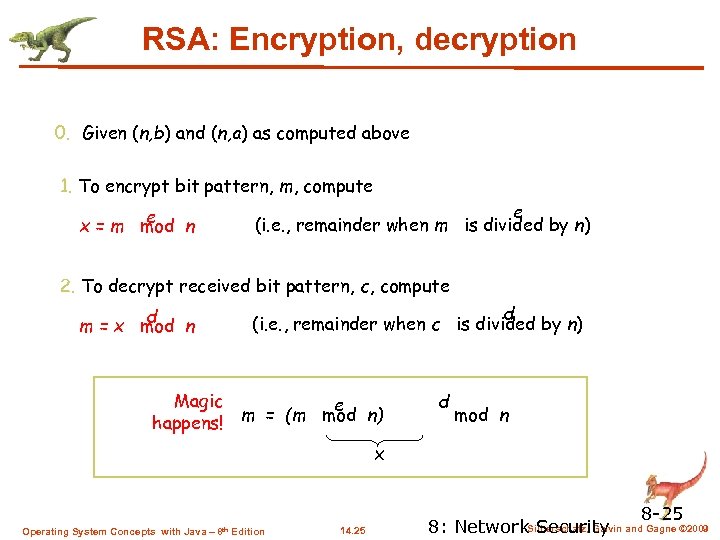 RSA: Encryption, decryption 0. Given (n, b) and (n, a) as computed above 1. To encrypt bit pattern, m, compute e x = m mod n e (i. e. , remainder when m is divided by n) 2. To decrypt received bit pattern, c, compute d m = x mod n d (i. e. , remainder when c is divided by n) Magic e m = (m mod n) happens! d mod n x Operating System Concepts with Java – 8 th Edition 14. 25 8 -25 8: Network. Silberschatz, Galvin and Gagne © 2009 Security
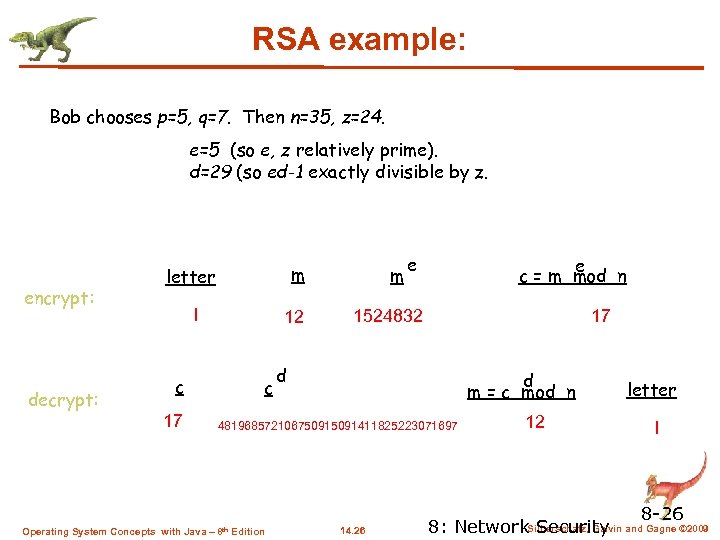 RSA example: Bob chooses p=5, q=7. Then n=35, z=24. e=5 (so e, z relatively prime). d=29 (so ed-1 exactly divisible by z. encrypt: decrypt: letter m l 12 c 17 c m e e c = m mod n 17 1524832 d d m = c mod n 48196857210675091411825223071697 Operating System Concepts with Java – 8 th Edition 14. 26 12 letter l 8 -26 8: Network. Silberschatz, Galvin and Gagne © 2009 Security
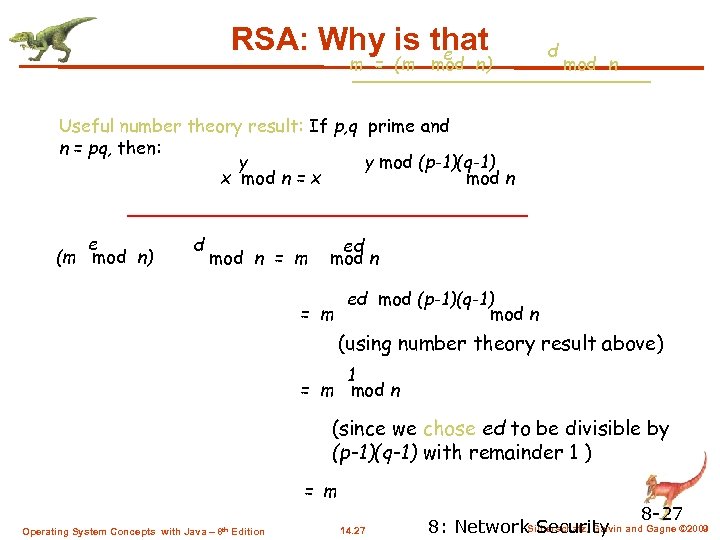 RSA: Why is that e m = (m mod n) d mod n Useful number theory result: If p, q prime and n = pq, then: y y mod (p-1)(q-1) x mod n = x mod n e (m mod n) d mod n = m ed mod n ed mod (p-1)(q-1) = m mod n (using number theory result above) 1 = m mod n (since we chose ed to be divisible by (p-1)(q-1) with remainder 1 ) = m Operating System Concepts with Java – 8 th Edition 14. 27 8 -27 8: Network. Silberschatz, Galvin and Gagne © 2009 Security
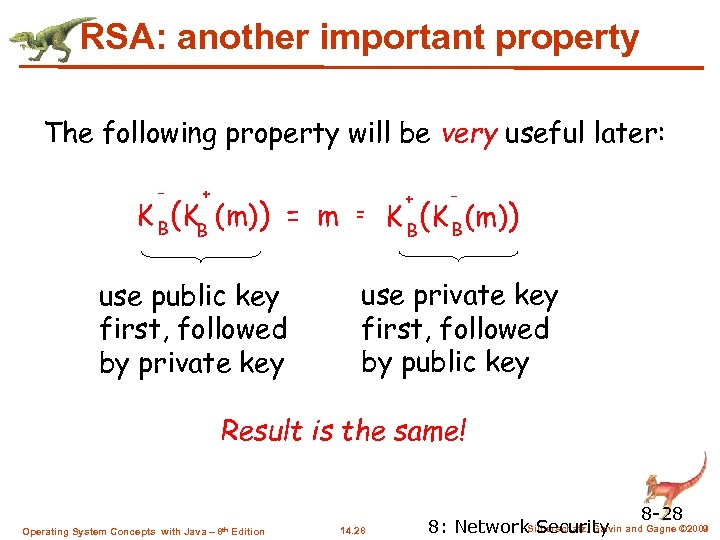 RSA: another important property The following property will be very useful later: - + K B (KB (m)) = m use public key first, followed by private key = + - K B (m)) use private key first, followed by public key Result is the same! Operating System Concepts with Java – 8 th Edition 14. 28 8 -28 8: Network. Silberschatz, Galvin and Gagne © 2009 Security
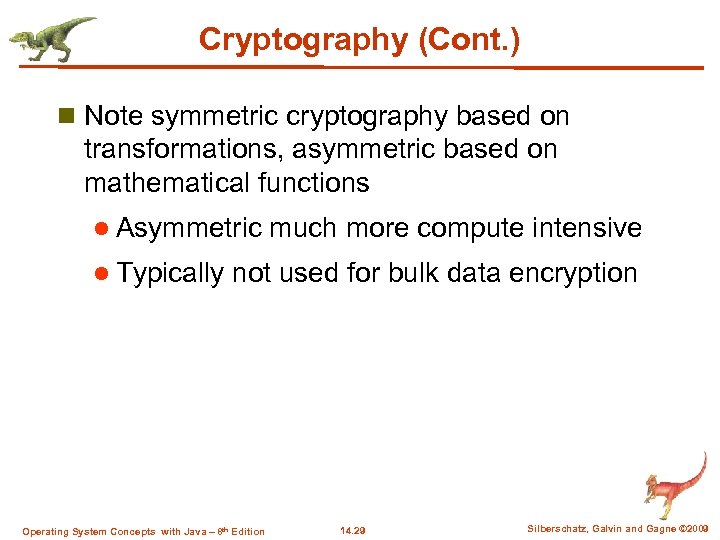 Cryptography (Cont. ) n Note symmetric cryptography based on transformations, asymmetric based on mathematical functions l Asymmetric l Typically much more compute intensive not used for bulk data encryption Operating System Concepts with Java – 8 th Edition 14. 29 Silberschatz, Galvin and Gagne © 2009
 Authentication n Constraining set of potential senders of a message l Complementary and sometimes redundant to encryption l Also can prove message unmodified Operating System Concepts with Java – 8 th Edition 14. 30 Silberschatz, Galvin and Gagne © 2009
 Authentication (Cont. ) n For a message m, a computer can generate an authenticator a A such that V(k)(m, a) = true only if it possesses S(k) n Thus, computer holding S(k) can generate authenticators on messages so that any other computer possessing V(k) can verify them n Computer not holding S(k) cannot generate authenticators on messages that can be verified using V(k) n Since authenticators are generally exposed (for example, they are sent on the network with the messages themselves), it must not be feasible to derive S(k) from the authenticators Operating System Concepts with Java – 8 th Edition 14. 31 Silberschatz, Galvin and Gagne © 2009
 Authentication – Hash Functions n Basis of authentication n Creates small, fixed-size block of data (message digest, hash value) from m n Hash Function H must be collision resistant on m l Must be infeasible to find an m’ ≠ m such that H(m) = H(m’) n If H(m) = H(m’), then m = m’ l The message has not been modified n Common message-digest functions include MD 5, which produces a 128 -bit hash, and SHA-1, which outputs a 160 -bit hash Operating System Concepts with Java – 8 th Edition 14. 32 Silberschatz, Galvin and Gagne © 2009
 Authentication - MAC n Symmetric encryption used in message-authentication code (MAC) authentication algorithm n Simple example: l MAC defines S(k)(m) = f (k, H(m)) 4 Where – f is a function that is one-way on its first argument k cannot be derived from f (k, H(m)) 4 Because of the collision resistance in the hash function, reasonably assured no other message could create the same MAC 4 A suitable verification algorithm is V(k)(m, a) ≡ ( f (k, m) = a) 4 Note that k is needed to compute both S(k) and V(k), so anyone able to compute one can compute the other Operating System Concepts with Java – 8 th Edition 14. 33 Silberschatz, Galvin and Gagne © 2009
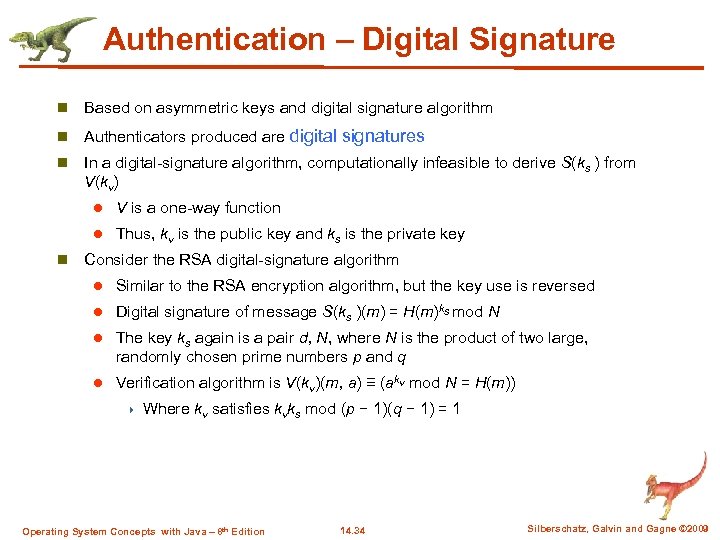 Authentication – Digital Signature n Based on asymmetric keys and digital signature algorithm n Authenticators produced are digital signatures n In a digital-signature algorithm, computationally infeasible to derive S(ks ) from V(kv) l l n V is a one-way function Thus, kv is the public key and ks is the private key Consider the RSA digital-signature algorithm l Similar to the RSA encryption algorithm, but the key use is reversed l Digital signature of message S(ks )(m) = H(m)ks mod N l The key ks again is a pair d, N, where N is the product of two large, randomly chosen prime numbers p and q l Verification algorithm is V(kv)(m, a) ≡ (akv mod N = H(m)) 4 Where kv satisfies kvks mod (p − 1)(q − 1) = 1 Operating System Concepts with Java – 8 th Edition 14. 34 Silberschatz, Galvin and Gagne © 2009
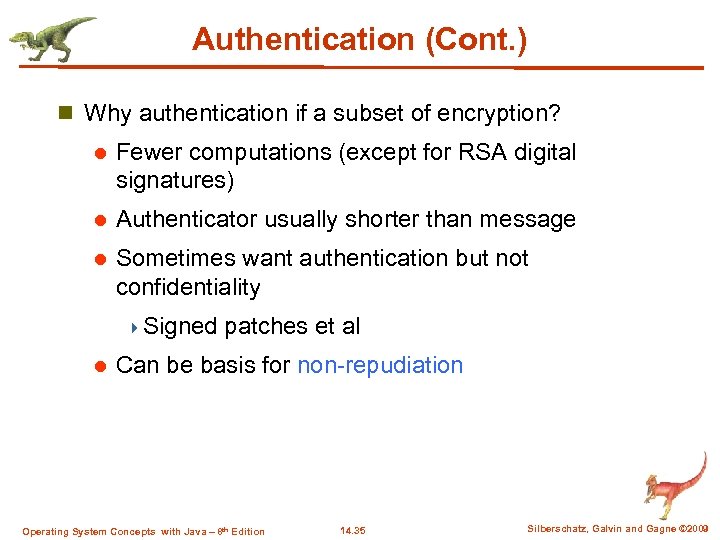 Authentication (Cont. ) n Why authentication if a subset of encryption? l Fewer computations (except for RSA digital signatures) l Authenticator usually shorter than message l Sometimes want authentication but not confidentiality 4 Signed l patches et al Can be basis for non-repudiation Operating System Concepts with Java – 8 th Edition 14. 35 Silberschatz, Galvin and Gagne © 2009
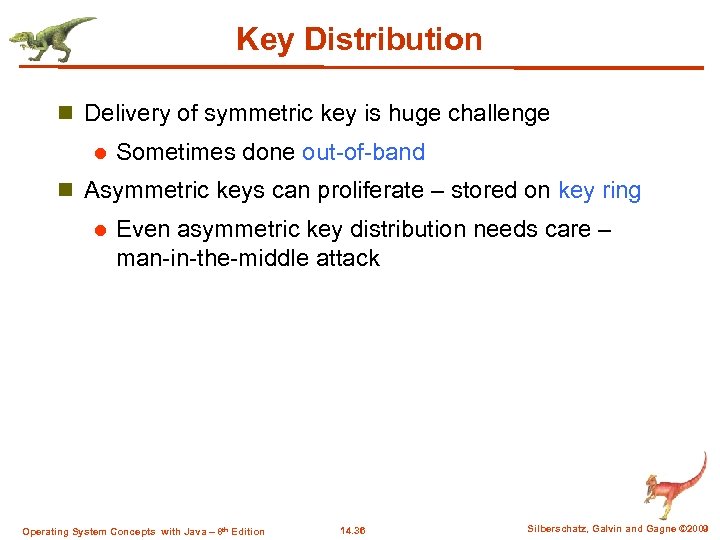 Key Distribution n Delivery of symmetric key is huge challenge l Sometimes done out-of-band n Asymmetric keys can proliferate – stored on key ring l Even asymmetric key distribution needs care – man-in-the-middle attack Operating System Concepts with Java – 8 th Edition 14. 36 Silberschatz, Galvin and Gagne © 2009
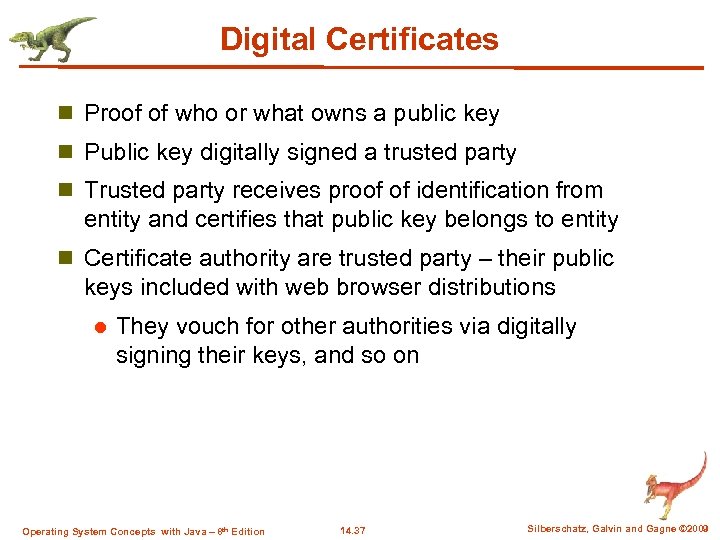 Digital Certificates n Proof of who or what owns a public key n Public key digitally signed a trusted party n Trusted party receives proof of identification from entity and certifies that public key belongs to entity n Certificate authority are trusted party – their public keys included with web browser distributions l They vouch for other authorities via digitally signing their keys, and so on Operating System Concepts with Java – 8 th Edition 14. 37 Silberschatz, Galvin and Gagne © 2009
 Encryption Example - SSL n Insertion of cryptography at one layer of the ISO network model (the n n n transport layer) SSL – Secure Socket Layer (also called TLS) Cryptographic protocol that limits two computers to only exchange messages with each other l Very complicated, with many variations Used between web servers and browsers for secure communication (credit card numbers) The server is verified with a certificate assuring client is talking to correct server Asymmetric cryptography used to establish a secure session key (symmetric encryption) for bulk of communication during session Communication between each computer the uses symmetric key cryptography Operating System Concepts with Java – 8 th Edition 14. 38 Silberschatz, Galvin and Gagne © 2009
 User Authentication n Crucial to identify user correctly, as protection systems depend on user ID n User identity most often established through passwords, can be considered a special case of either keys or capabilities l Also can include something user has and /or a user attribute n Passwords must be kept secret l Frequent change of passwords l Use of “non-guessable” passwords l Log all invalid access attempts n Passwords may also either be encrypted or allowed to be used only once Operating System Concepts with Java – 8 th Edition 14. 39 Silberschatz, Galvin and Gagne © 2009
 Implementing Security Defenses n Defense in depth is most common security theory – multiple layers of security n Security policy describes what is being secured n Vulnerability assessment compares real state of system / network compared to security policy n Intrusion detection endeavors to detect attempted or successful intrusions l Signature-based detection spots known bad patterns l Anomaly detection spots differences from normal behavior 4 Can detect zero-day attacks False-positives and false-negatives a problem n Virus protection n Auditing, accounting, and logging of all or specific system or network activities l Operating System Concepts with Java – 8 th Edition 14. 40 Silberschatz, Galvin and Gagne © 2009
 Firewalling to Protect Systems and Networks n A network firewall is placed between trusted and untrusted hosts The firewall limits network access between these two security domains Can be tunneled or spoofed l Tunneling allows disallowed protocol to travel within allowed protocol (i. e. telnet inside of HTTP) l Firewall rules typically based on host name or IP address which can be spoofed Personal firewall is software layer on given host l Can monitor / limit traffic to and from the host Application proxy firewall understands application protocol and can control them (i. e. SMTP) System-call firewall monitors all important system calls and apply rules to them (i. e. this program can execute that system call) l n n Operating System Concepts with Java – 8 th Edition 14. 41 Silberschatz, Galvin and Gagne © 2009
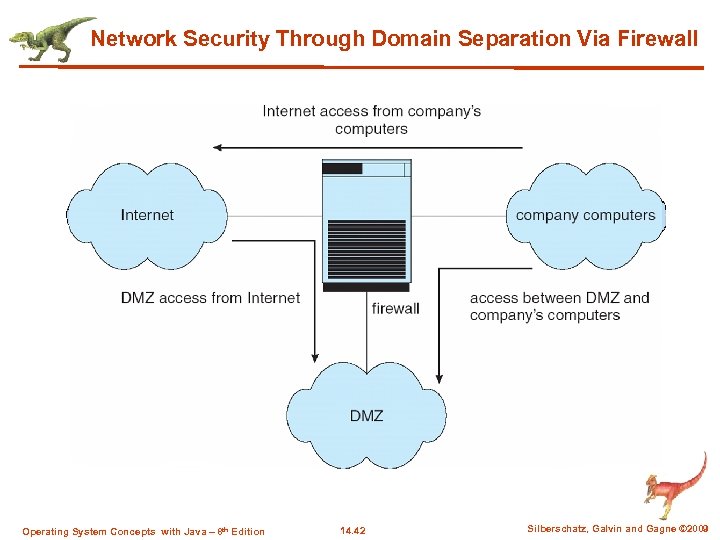 Network Security Through Domain Separation Via Firewall Operating System Concepts with Java – 8 th Edition 14. 42 Silberschatz, Galvin and Gagne © 2009
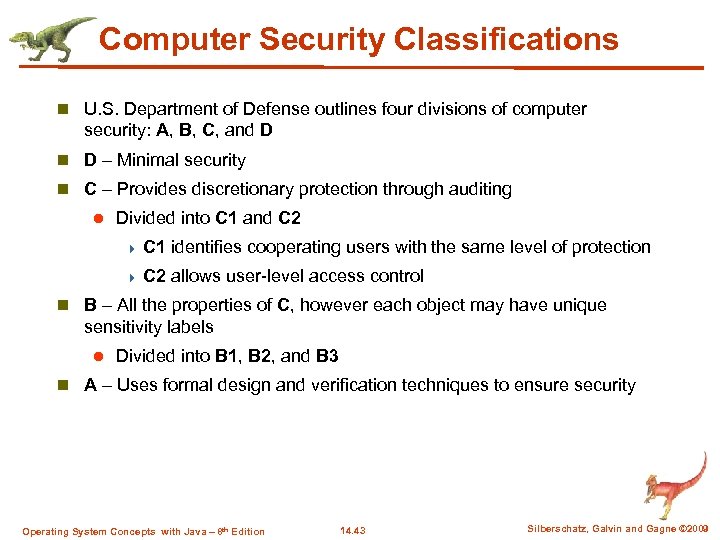 Computer Security Classifications n U. S. Department of Defense outlines four divisions of computer security: A, B, C, and D n D – Minimal security n C – Provides discretionary protection through auditing l Divided into C 1 and C 2 4 C 1 identifies cooperating users with the same level of protection 4 C 2 allows user-level access control n B – All the properties of C, however each object may have unique sensitivity labels l Divided into B 1, B 2, and B 3 n A – Uses formal design and verification techniques to ensure security Operating System Concepts with Java – 8 th Edition 14. 43 Silberschatz, Galvin and Gagne © 2009
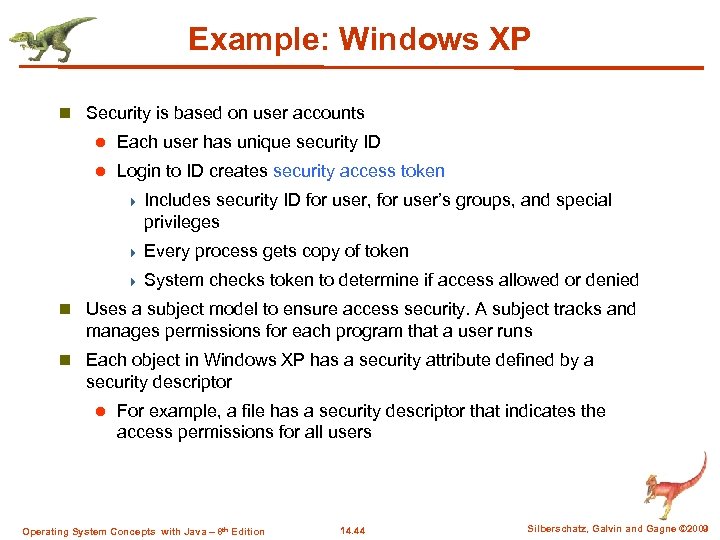 Example: Windows XP n Security is based on user accounts l Each user has unique security ID l Login to ID creates security access token 4 Includes security ID for user, for user’s groups, and special privileges 4 Every process gets copy of token 4 System checks token to determine if access allowed or denied n Uses a subject model to ensure access security. A subject tracks and manages permissions for each program that a user runs n Each object in Windows XP has a security attribute defined by a security descriptor l For example, a file has a security descriptor that indicates the access permissions for all users Operating System Concepts with Java – 8 th Edition 14. 44 Silberschatz, Galvin and Gagne © 2009
 End of Chapter 15 Operating System Concepts with Java – 8 th Edition 14. 45 Silberschatz, Galvin and Gagne © 2009