


 Скачать презентацию Chapter 15 Retail Pricing Mc Graw-Hill Irwin Retailing Management
4544e7867ec389792989f612a9e1a487.ppt
- Количество слайдов: 56
 Chapter 15 Retail Pricing Mc. Graw-Hill/Irwin Retailing Management, 7/e © 2008 by The Mc. Graw-Hill Companies, All rights reserved.
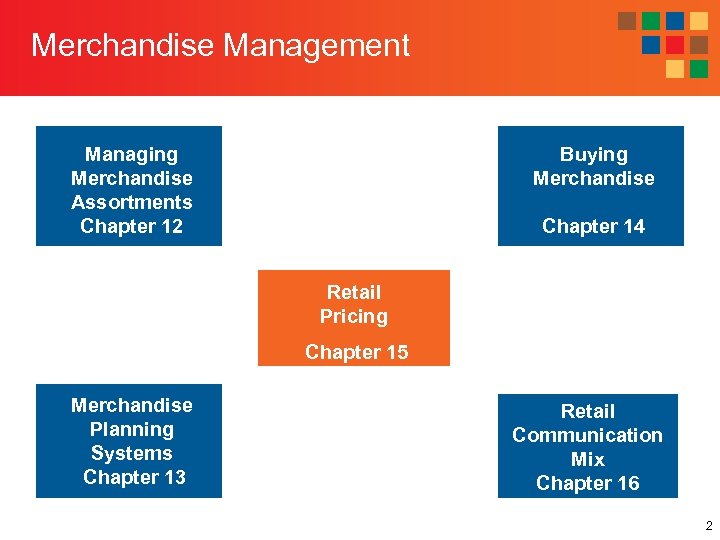 Merchandise Management Managing Merchandise Assortments Chapter 12 Buying Merchandise Chapter 14 Retail Pricing Chapter 15 Merchandise Planning Systems Chapter 13 Retail Communication Mix Chapter 16 2
 Questions ■ What factors do retailers consider when pricing merchandise? ■ What are the legal restrictions on retail pricing? ■ How do retailers set retail prices? ■ How do retailers make adjustments to prices over time and for different market segments? ■ Why do some retailers have frequent sales while others attempt to maintain an everyday-low-price strategy? ■ What pricing tactics do retailers use to influence consumer purchases? 3
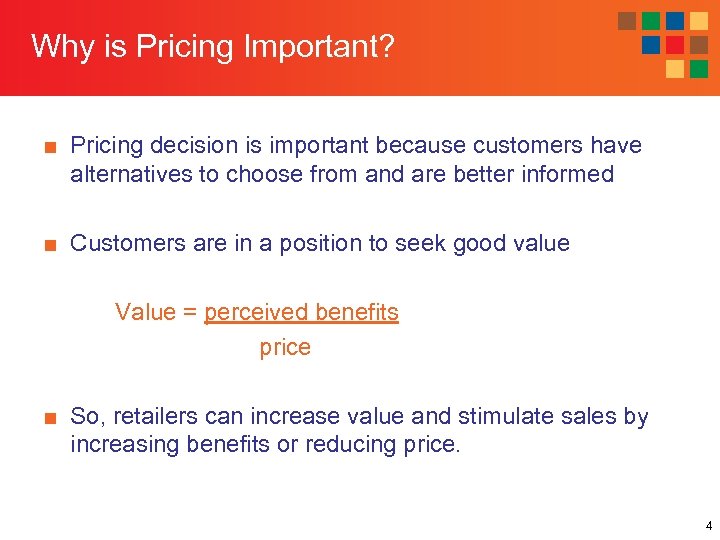 Why is Pricing Important? ■ Pricing decision is important because customers have alternatives to choose from and are better informed ■ Customers are in a position to seek good value Value = perceived benefits price ■ So, retailers can increase value and stimulate sales by increasing benefits or reducing price. 4
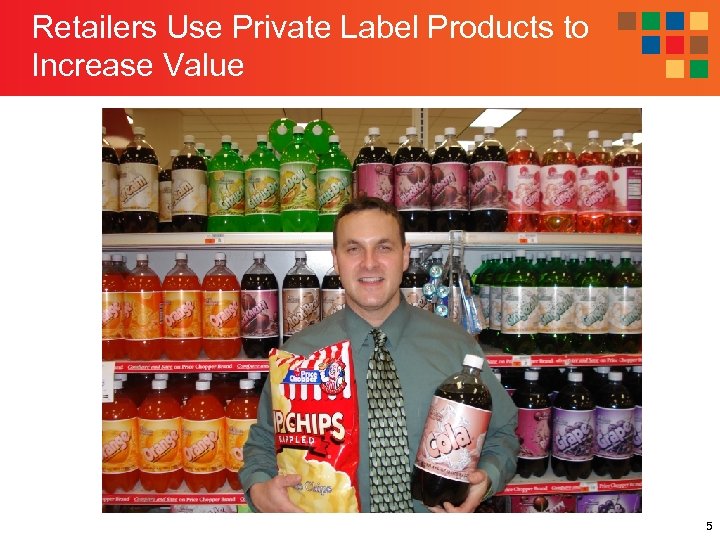 Retailers Use Private Label Products to Increase Value 5
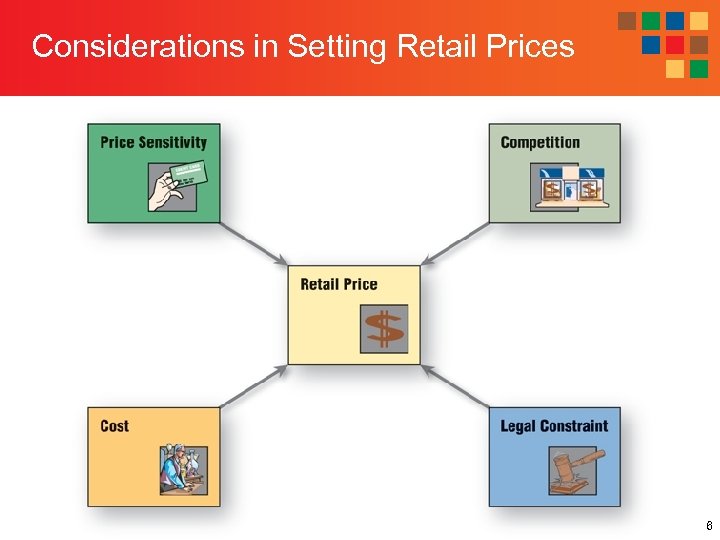 Considerations in Setting Retail Prices 6
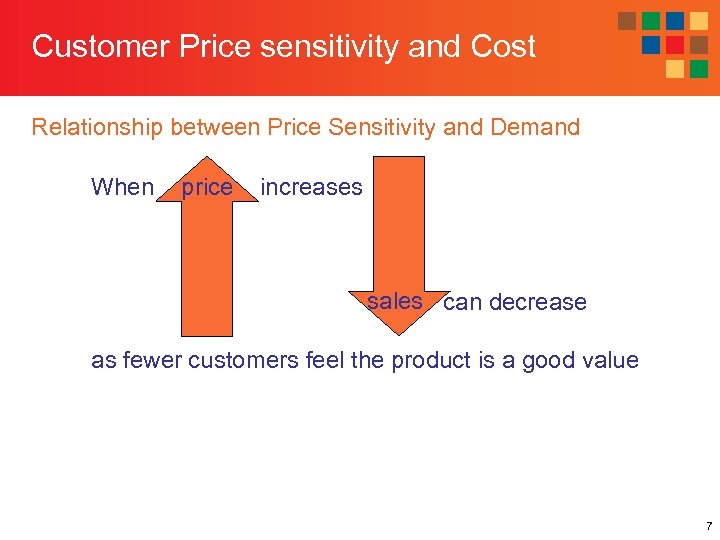 Customer Price sensitivity and Cost Relationship between Price Sensitivity and Demand When price increases sales can decrease as fewer customers feel the product is a good value 7
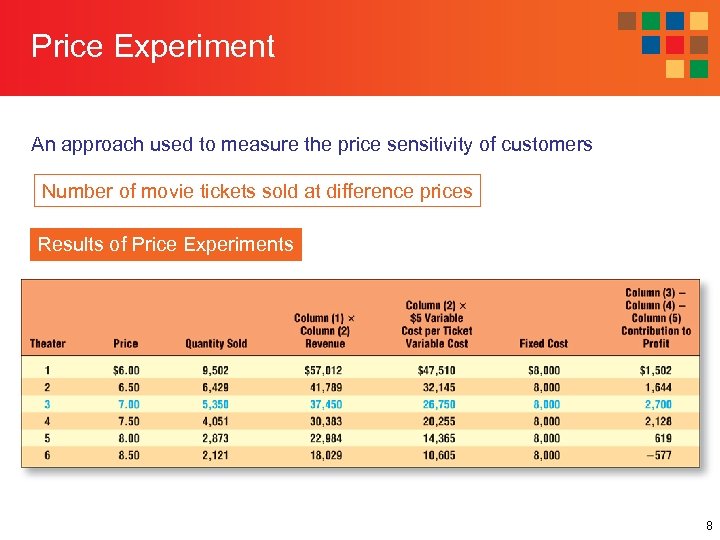 Price Experiment An approach used to measure the price sensitivity of customers Number of movie tickets sold at difference prices Results of Price Experiments 8
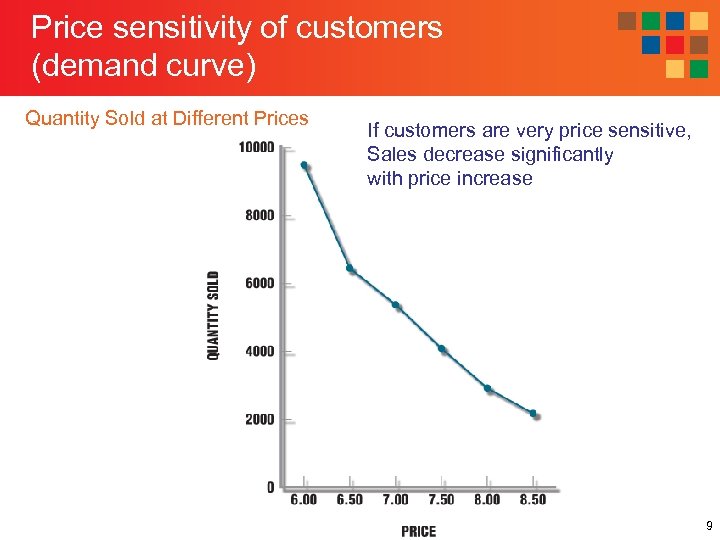 Price sensitivity of customers (demand curve) Quantity Sold at Different Prices If customers are very price sensitive, Sales decrease significantly with price increase 9
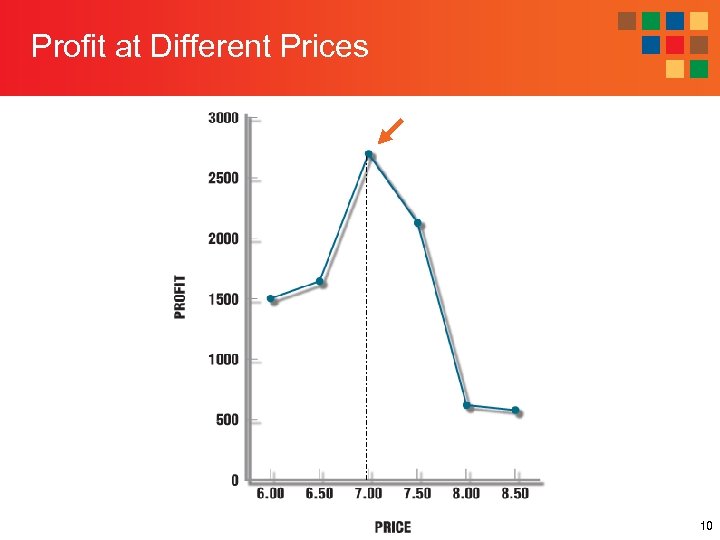 Profit at Different Prices 10
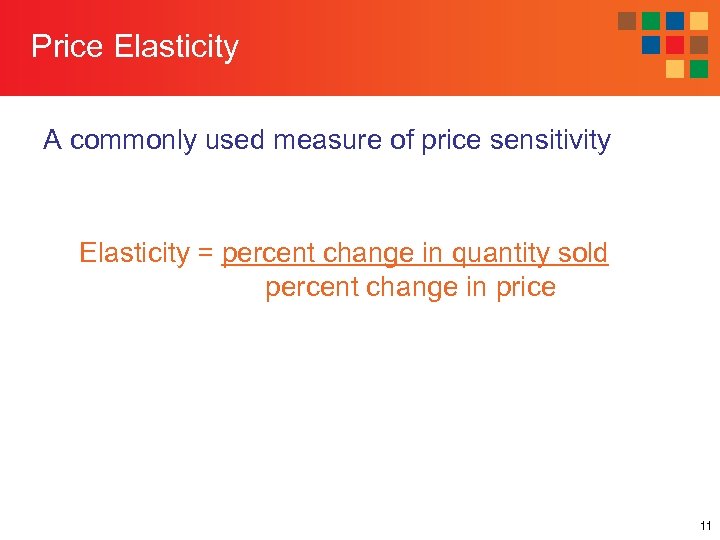 Price Elasticity A commonly used measure of price sensitivity Elasticity = percent change in quantity sold percent change in price 11
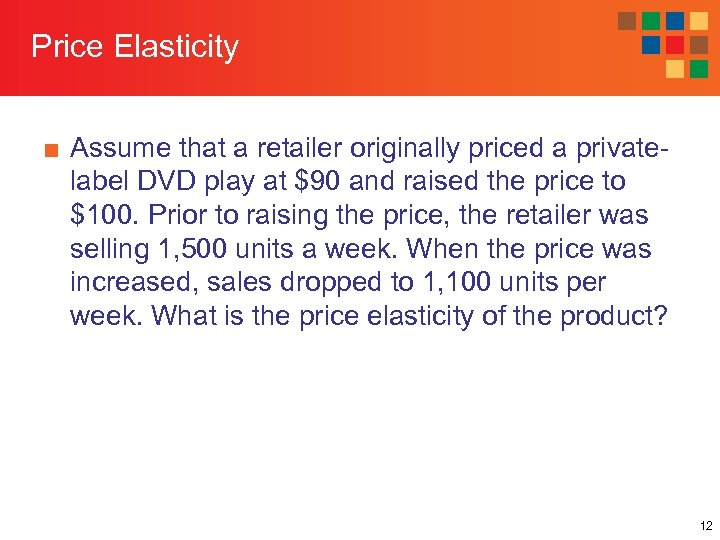 Price Elasticity ■ Assume that a retailer originally priced a privatelabel DVD play at $90 and raised the price to $100. Prior to raising the price, the retailer was selling 1, 500 units a week. When the price was increased, sales dropped to 1, 100 units per week. What is the price elasticity of the product? 12
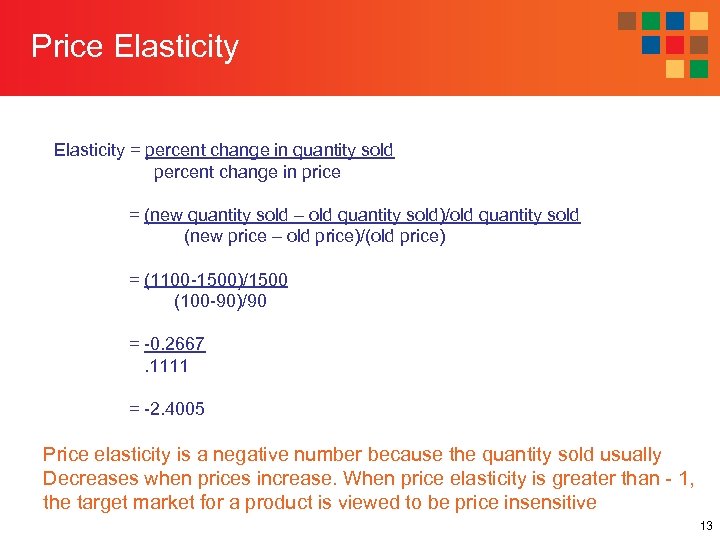 Price Elasticity = percent change in quantity sold percent change in price = (new quantity sold – old quantity sold)/old quantity sold (new price – old price)/(old price) = (1100 -1500)/1500 (100 -90)/90 = -0. 2667. 1111 = -2. 4005 Price elasticity is a negative number because the quantity sold usually Decreases when prices increase. When price elasticity is greater than - 1, the target market for a product is viewed to be price insensitive 13
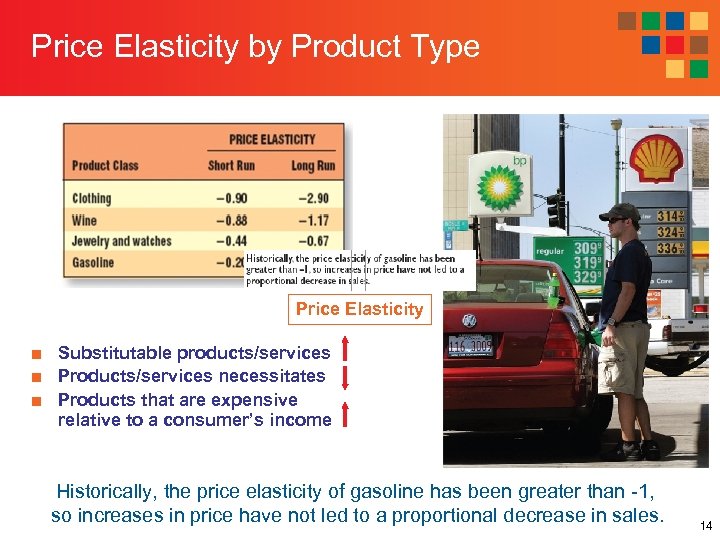 Price Elasticity by Product Type Price Elasticity ■ Substitutable products/services ■ Products/services necessitates ■ Products that are expensive relative to a consumer’s income Historically, the price elasticity of gasoline has been greater than -1, so increases in price have not led to a proportional decrease in sales. 14
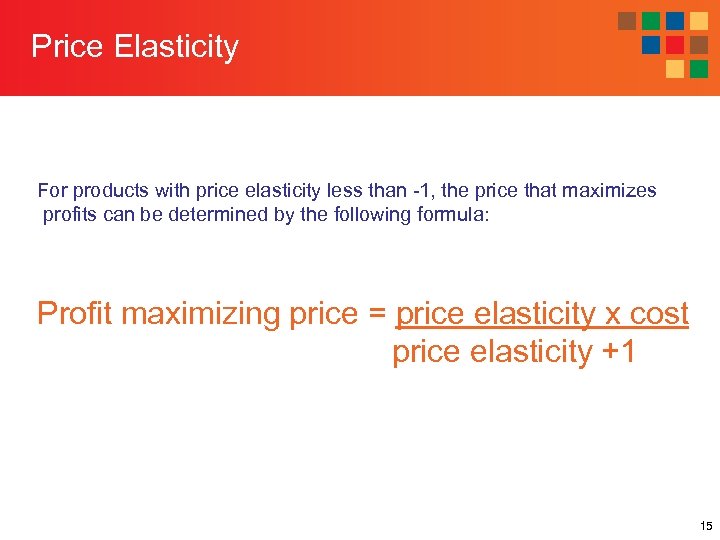 Price Elasticity For products with price elasticity less than -1, the price that maximizes profits can be determined by the following formula: Profit maximizing price = price elasticity x cost price elasticity +1 15
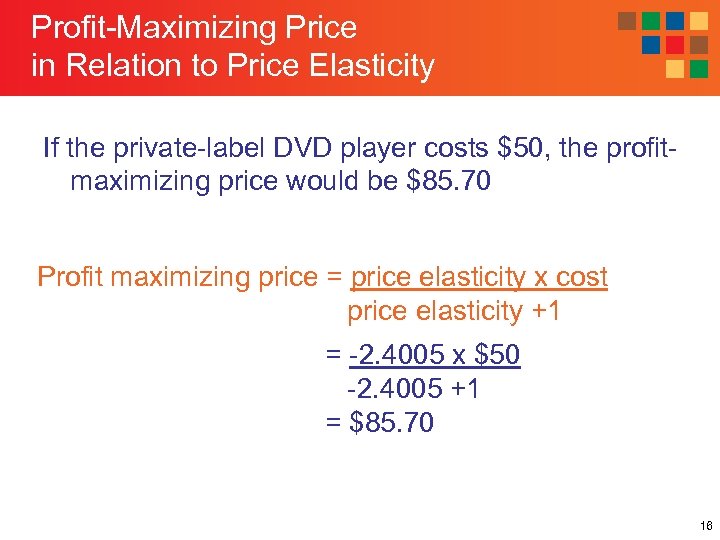 Profit-Maximizing Price in Relation to Price Elasticity If the private-label DVD player costs $50, the profitmaximizing price would be $85. 70 Profit maximizing price = price elasticity x cost price elasticity +1 = -2. 4005 x $50 -2. 4005 +1 = $85. 70 16
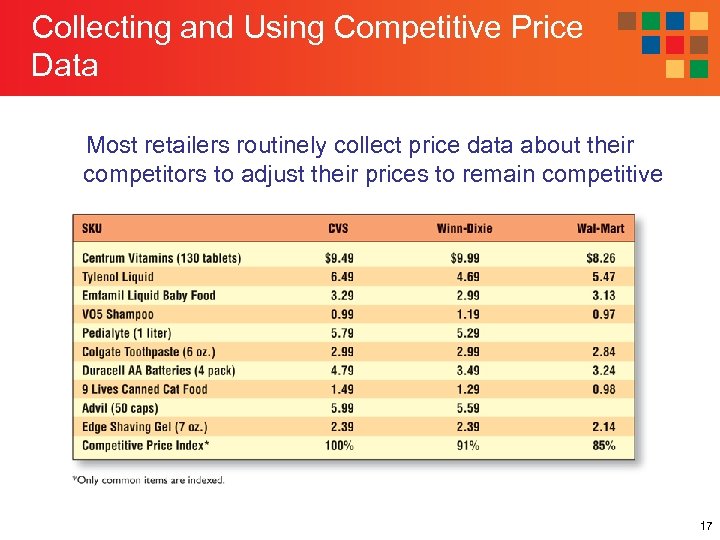 Collecting and Using Competitive Price Data Most retailers routinely collect price data about their competitors to adjust their prices to remain competitive 17
 How Can Retailers Reduce Price Competition? ■ Develop lines of private label merchandise ■ Negotiate with national brands manufacturers for exclusive distribution rights ■ Have vendors make unique products for the retailer 18 Photo. Link/Getty Images
 Legal and Ethical Pricing Issues ■ ■ ■ Price Discrimination Predatory Pricing Resale Price Maintenance Horizontal Price fixing Bait and Switch tactics Scanned vs. Posted Prices Photo. Disc/Getty Images 19
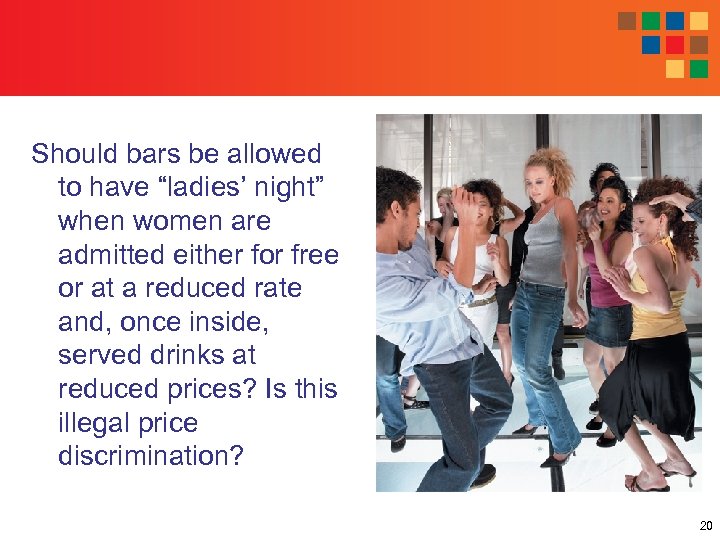 Should bars be allowed to have “ladies’ night” when women are admitted either for free or at a reduced rate and, once inside, served drinks at reduced prices? Is this illegal price discrimination? 20
 Setting Retail Prices How Do Retailers Set Retail Prices? Theoretically, retailers maximize their profits by setting prices based on the price sensitivity of customers and the cost of merchandise and considering the prices being charged by competitors. In reality, Retailers need to set price for over 50, 000 SKUs many times during year ■ Set prices based on pre-determined markup and merchandise cost ■ Make adjustments to markup price based on customer price sensitivity and competition 21
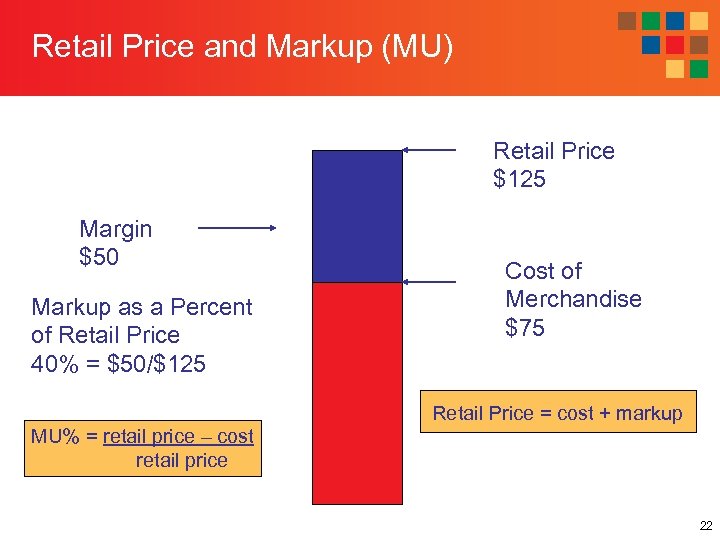 Retail Price and Markup (MU) Retail Price $125 Margin $50 Markup as a Percent of Retail Price 40% = $50/$125 Cost of Merchandise $75 Retail Price = cost + markup MU% = retail price – cost retail price 22
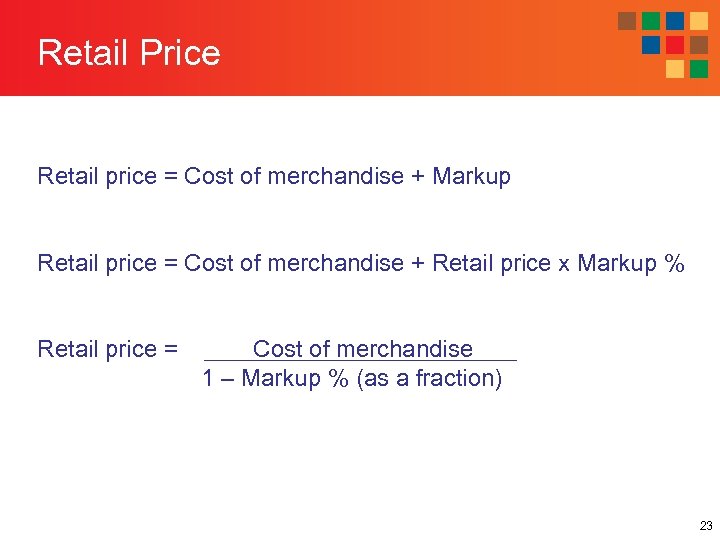 Retail Price Retail price = Cost of merchandise + Markup Retail price = Cost of merchandise + Retail price x Markup % Retail price = Cost of merchandise 1 – Markup % (as a fraction) 23
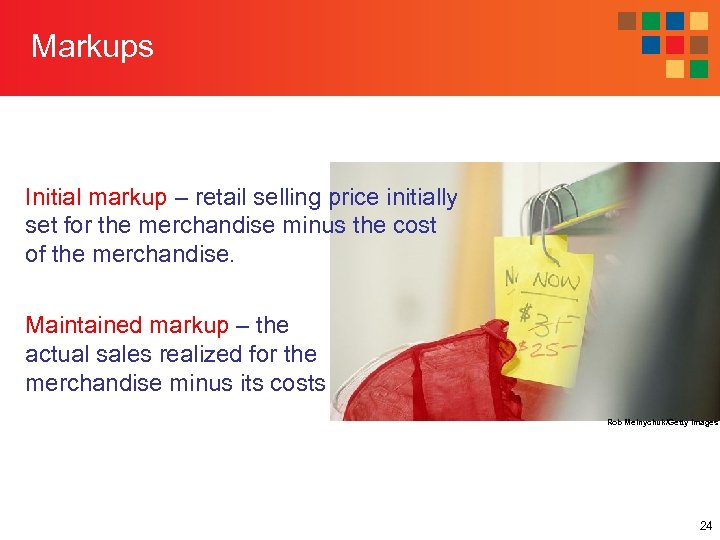 Markups Initial markup – retail selling price initially set for the merchandise minus the cost of the merchandise. Maintained markup – the actual sales realized for the merchandise minus its costs Rob Melnychuk/Getty Images 24
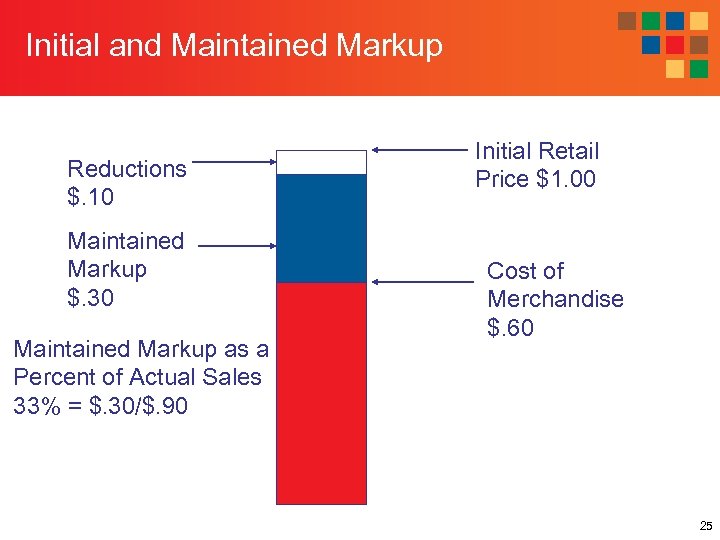 Initial and Maintained Markup Reductions $. 10 Maintained Markup $. 30 Maintained Markup as a Percent of Actual Sales 33% = $. 30/$. 90 Initial Retail Price $1. 00 Cost of Merchandise $. 60 25
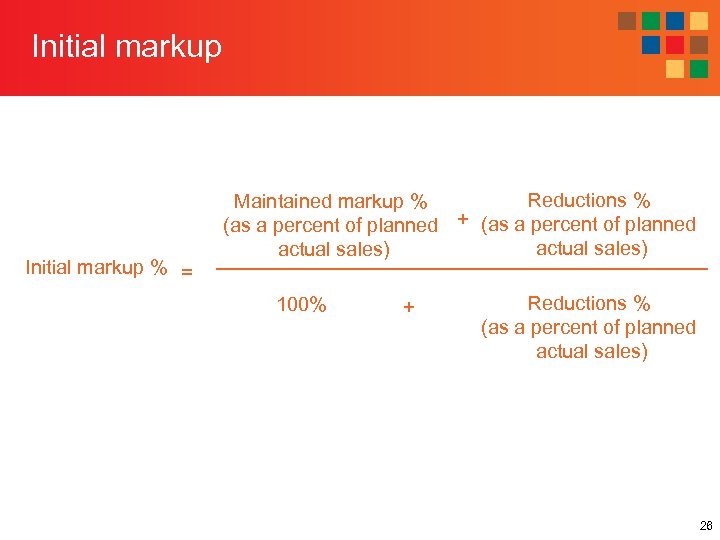 Initial markup 100% + Initial markup % = Reductions % Maintained markup % (as a percent of planned + (as a percent of planned actual sales) Reductions % (as a percent of planned actual sales) 26
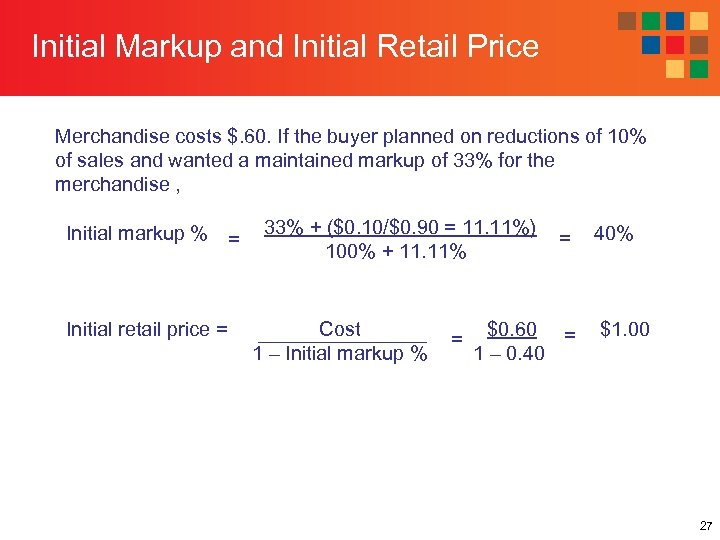 Initial Markup and Initial Retail Price Merchandise costs $. 60. If the buyer planned on reductions of 10% of sales and wanted a maintained markup of 33% for the merchandise , Initial markup % = Initial retail price = 33% + ($0. 10/$0. 90 = 11. 11%) 100% + 11. 11% Cost 1 – Initial markup % = = $0. 60 = 1 – 0. 40 40% $1. 00 27
 Merchandising Optimization Software ■ Setting prices by simply marking up merchandise cost neglect other factors (e. g. , price sensitivity, competition, the sales of complementary products) ■ Merchandising Optimization Software n n n Utilize a set of algorithms that analyzes past and current merchandise sales prices Estimates the relationship between prices and sales generated Determines the optimal (most profitable) initial price for the merchandise and size and timing for markdowns 28
 Profit Impact of Setting a Retail Price: The Use of Break-Even Analysis ■ A retailer might want to know n n n Break-even sales to generate a target profit Break-even volume and dollars to justify introducing a new product, product line, or department Break-even sales change needed to cover a price change ■ Break-even analysis n n n Determines, on the basis of a consideration of fixed and variable costs, how much merchandise needs to be sold to achieve a break-even (zero) profit Fixed costs: don’t change with the quantity of product produced and sold Variable costs: vary directly with the quantity of product produced and sold (e. g. , direct labor and materials used in producing a product) 29
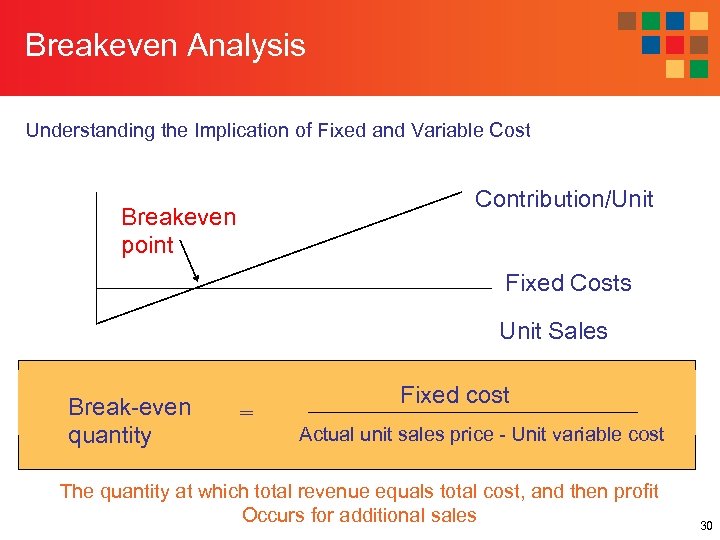 Breakeven Analysis Understanding the Implication of Fixed and Variable Cost Contribution/Unit Breakeven point Fixed Costs Unit Sales Break-even quantity = Fixed cost Actual unit sales price - Unit variable cost The quantity at which total revenue equals total cost, and then profit Occurs for additional sales 30
 Illustration of Breakeven Analysis: Break-even volume of a new private-label product PETs. MART is interested in developing private label, dry dog food targeting owners of older dogs that will sell for $12 a bag. The cost of developing the dog food is $700, 000. This includes salaries for the design team and testing the product. The variable cost of purchasing the product from a private-label manufacturer is $5. How many cargo pants does American Eagle Outfitter have to sell to breakeven on its $400, 000 investment? 31
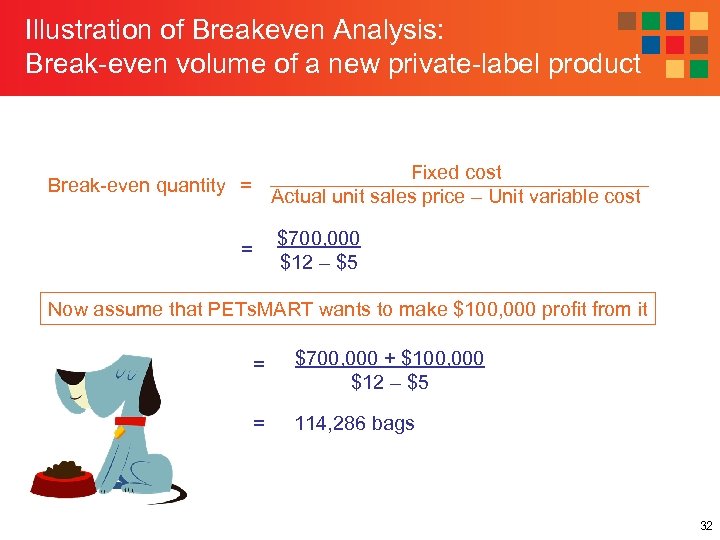 Illustration of Breakeven Analysis: Break-even volume of a new private-label product Fixed cost Actual unit sales price – Unit variable cost Break-even quantity = $700, 000 $12 – $5 = Now assume that PETs. MART wants to make $100, 000 profit from it = $700, 000 + $100, 000 $12 – $5 = 114, 286 bags 32
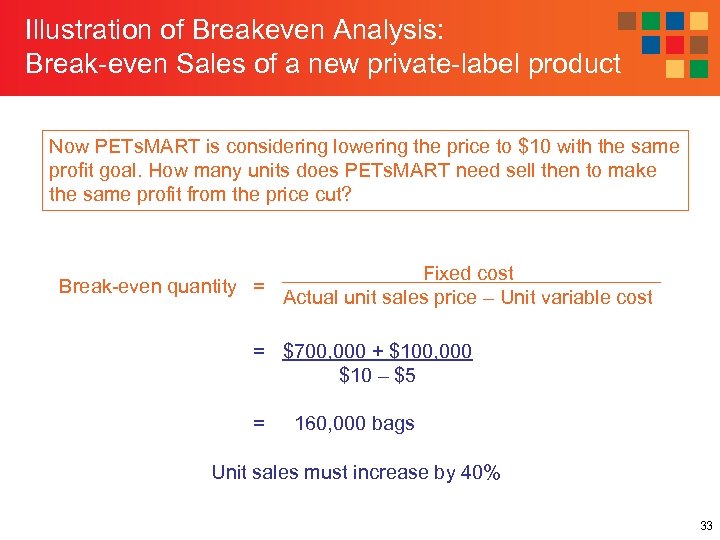 Illustration of Breakeven Analysis: Break-even Sales of a new private-label product Now PETs. MART is considering lowering the price to $10 with the same profit goal. How many units does PETs. MART need sell then to make the same profit from the price cut? Fixed cost Break-even quantity = Actual unit sales price – Unit variable cost = $700, 000 + $100, 000 $10 – $5 = 160, 000 bags Unit sales must increase by 40% 33
 Maximize Profits through Price Discrimination Want Charge Every Customer the Maximum They Are Willing to Pay Problem n n Don’t know willingness to pay With list prices, can’t prevent high willingness to pay customers from buying at low price 34
 Price Adjustments Retailers adjust prices over time (markdowns) and for different customer segments (variable pricing) ■ Why do retailers take markdowns? ■ How do they optimize markdown decisions? ■ How do they reduce the amount of markdowns by working with vendors? ■ How do they liquidate markdown merchandise? ■ What are the mechanics of taking markdowns? 35
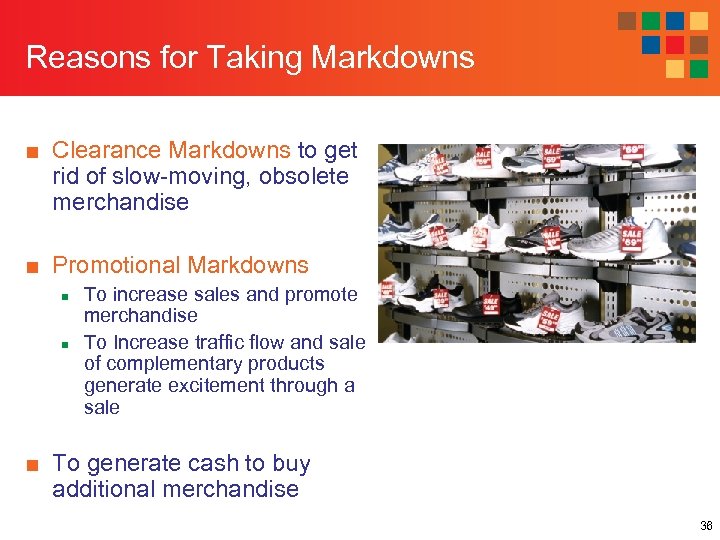 Reasons for Taking Markdowns ■ Clearance Markdowns to get rid of slow-moving, obsolete merchandise ■ Promotional Markdowns n n To increase sales and promote merchandise To Increase traffic flow and sale of complementary products generate excitement through a sale ■ To generate cash to buy additional merchandise 36
 Optimizing Markdown Decisions ■ Traditional Approach- Use a set of arbitrary rules n n Sell-Through: Identifies markdown items when its weekly sell-through percentages fall below a certain level Rule-based: Cuts prices on the basis of how long the merchandise has been in the store ■ Markdown Optimization n Software is used to determine when and how much markdowns should be taken to produce the best results by continually updating pricing forecasts on the basis of actual sales and factoring in differences in price sensitivities 37
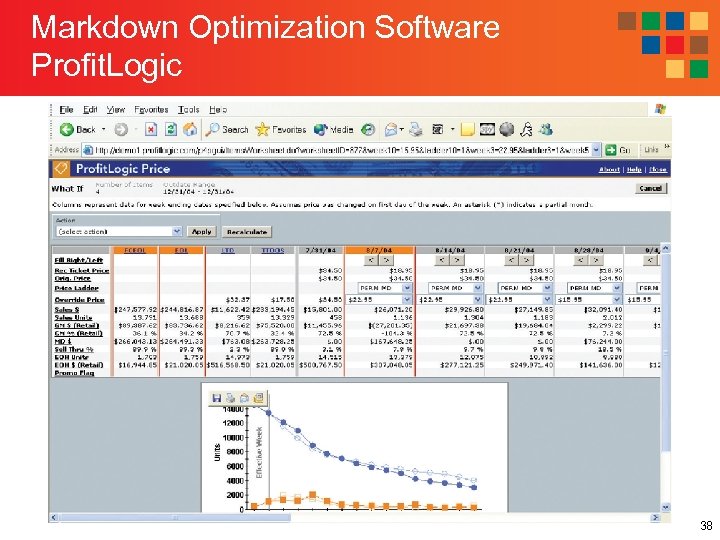 Markdown Optimization Software Profit. Logic 38
 Liquidating Markdown Merchandise Sell the merchandise to another retailer Consolidate the unsold merchandise Place merchandise on Internet auction site Donate merchandise to charity Carry the merchandise over to the next season Photo. Link/Getty Images ■ ■ ■ 39
 Variable Pricing and Price Discrimination Retailers use a variety of techniques to maximize profits by charging different prices to different customers ■ Individualized Variable Pricing (First Degree of Price Discrimination) – Set unique price for each customer equal to customer’s willingness to pay n Auctions, Personalized Internet Prices ■ Self-Selected Variable Pricing (Second Degree of Price Discrimination) – Offer the same price schedule to all customers n Quantity discounts n Early Bird Special n Over Weekend Travel Discount 40
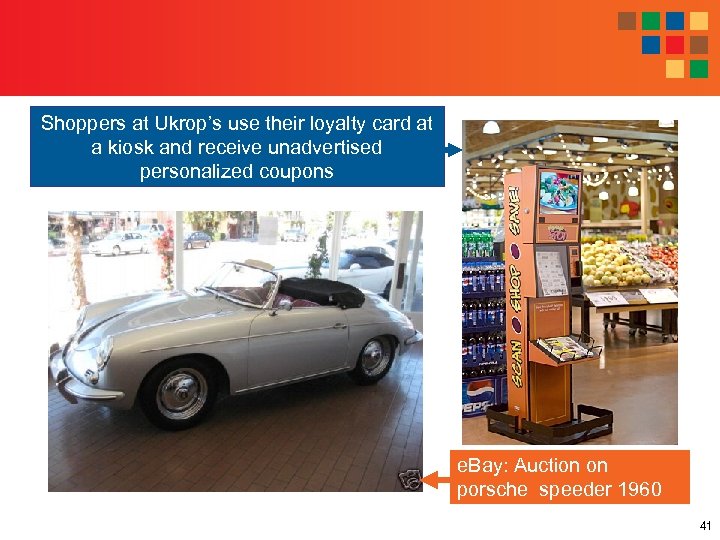 Shoppers at Ukrop’s use their loyalty card at a kiosk and receive unadvertised personalized coupons e. Bay: Auction on porsche speeder 1960 41
 Variable Pricing and Price Discrimination Continued ■ Clearance Markdowns for Fashion Merchandise ■ Coupons ■ Price Bundling n Mc. Donald’s Value Meal ■ Multiple-Unit Pricing or Quantity Discount ■ Variable Pricing by Market Segments (Third Degree of Price Discrimination) – Charge different groups different prices n Seniors Discounts n Kids Menu ■ Zone Pricing (Third Degree of Price Discrimination) – Charge different prices in different stores, markets, regions 42
 Solution to Problems in Implementing Price Discrimination ■ Set prices based on customer characteristics related to willingness to pay ■ Fashion sensitive customers will pay more so charge higher prices when fashion first introduced – reduce price later in season ■ Price sensitive customers will expend effort to get lower prices – coupons ■ Elderly customers eat earlier and are more price sensitive so offer early bird specials C. Borland/Photo. Link/Getty Images 43
 Pricing Strategies: High/Low Pricing Discount the initial prices through frequent sales promotions ■ Advantages n n n Increases profits through price discrimination Sales create excitement Sells merchandise ■ Disadvantages n n Train people to buy on deal and wait Have an adverse effect on profits 44
 Pricing Strategies: Everyday Low Pricing ■ Emphasizes the continuity of retail prices at a level somewhere between the regular none-sale price and the deep-discount sale price of high/low retailers ■ Doesn’t mean lowest price ■ Retailers have adopted a low price guarantee policy to reinforce their EDLP strategy ■ Advantages: n n n Assures customers of low prices Reduces advertising and operating expenses Reduces stockouts and improves inventory management 45
 Pricing Strategies EDLP ■ Assures customers low prices ■ Reduces advertising and operating expenses ■ Better supply chain management n n Hi-Lo ■ Higher profits through price discrimination ■ More excitement ■ Build short-term sales and generates traffic Fewer stockouts Higher inventory turns 46
 Pricing Services Challenges due to ■ The need to match supply and demand ■ The difficulties customers have in determining service quality 47
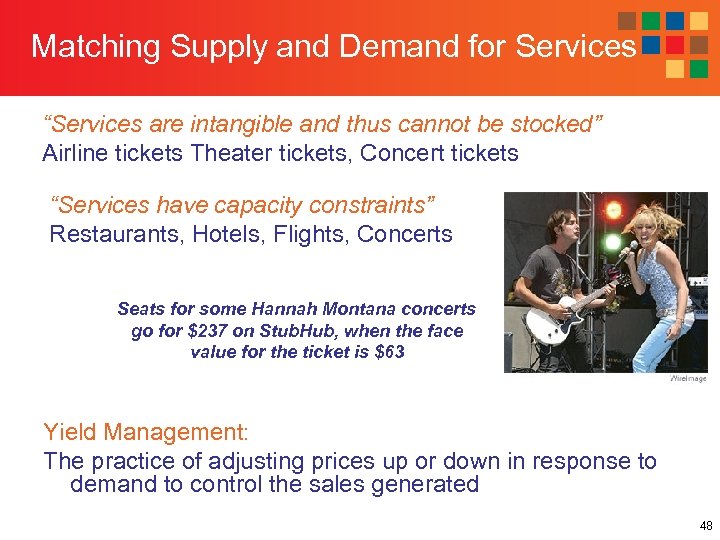 Matching Supply and Demand for Services “Services are intangible and thus cannot be stocked” Airline tickets Theater tickets, Concert tickets “Services have capacity constraints” Restaurants, Hotels, Flights, Concerts Seats for some Hannah Montana concerts go for $237 on Stub. Hub, when the face value for the ticket is $63 Yield Management: The practice of adjusting prices up or down in response to demand to control the sales generated 48
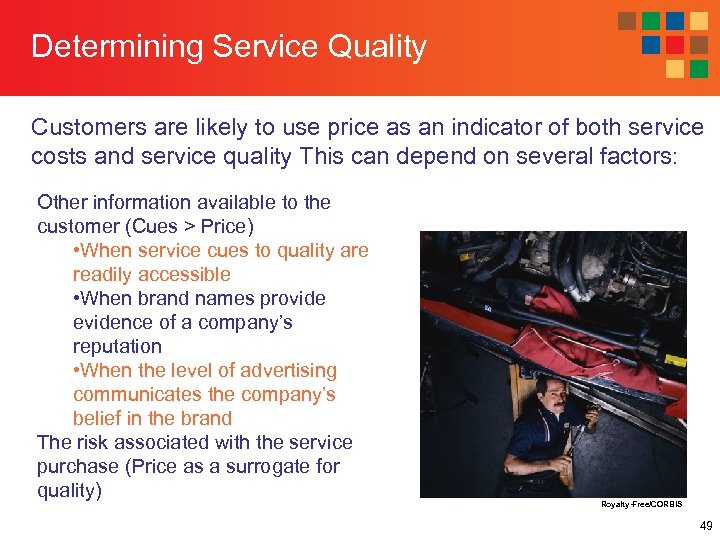 Determining Service Quality Customers are likely to use price as an indicator of both service costs and service quality This can depend on several factors: Other information available to the customer (Cues > Price) • When service cues to quality are readily accessible • When brand names provide evidence of a company’s reputation • When the level of advertising communicates the company’s belief in the brand The risk associated with the service purchase (Price as a surrogate for quality) Royalty-Free/CORBIS 49
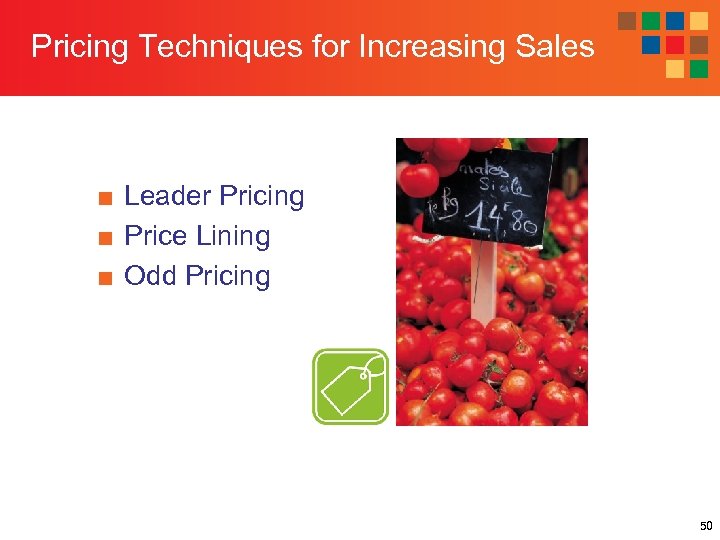 Pricing Techniques for Increasing Sales ■ Leader Pricing ■ Price Lining ■ Odd Pricing 50
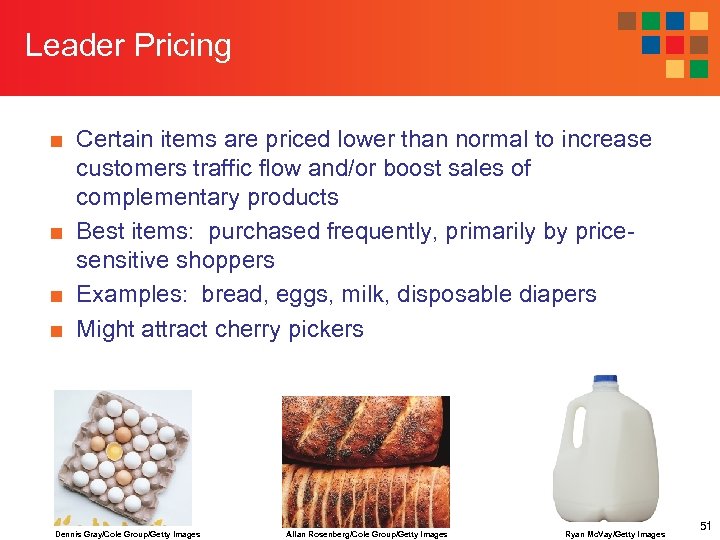 Leader Pricing ■ Certain items are priced lower than normal to increase customers traffic flow and/or boost sales of complementary products ■ Best items: purchased frequently, primarily by pricesensitive shoppers ■ Examples: bread, eggs, milk, disposable diapers ■ Might attract cherry pickers Dennis Gray/Cole Group/Getty Images Allan Rosenberg/Cole Group/Getty Images Ryan Mc. Vay/Getty Images 51
 Price Lining ■ A limited number of predetermined price points. ■ Ex: $59. 99 (good), $89. 99 (better), and 129. 99 (best) ■ Benefits: n n Eliminates confusion of many prices Merchandising task is simplified Gives buyers flexibility Can get customers to “trade up” 52
 Odd Pricing ■ A price that ends in an odd number (. 9) ■ $2. 99 n n Assumption: Consumers perceive as $2 without noticing the digits 9 endings signal low prices Retailers believe the practice increases sales, but probably doesn’t ■ Does delineate: n n Type of store (downscale store might use it. ) Sale 53
 Guidelines for Price-ending Decisions ■ When the price sensitivity of the market is high, it is advantageous to raise or lower prices so they end in high numbers like 9. ■ When the price sensitivity of the market is NOT high, the risk to one’s image of using 9 is likely to outweigh the benefits. Even dollar prices and round numbers are appropriate. ■ Upscale retailers appeal to price-sensitive segments of the market through periodic discounting. Combination strategy works best: break from standard of using round number endings to use 9 endings when communicating discounts and special offers. 54
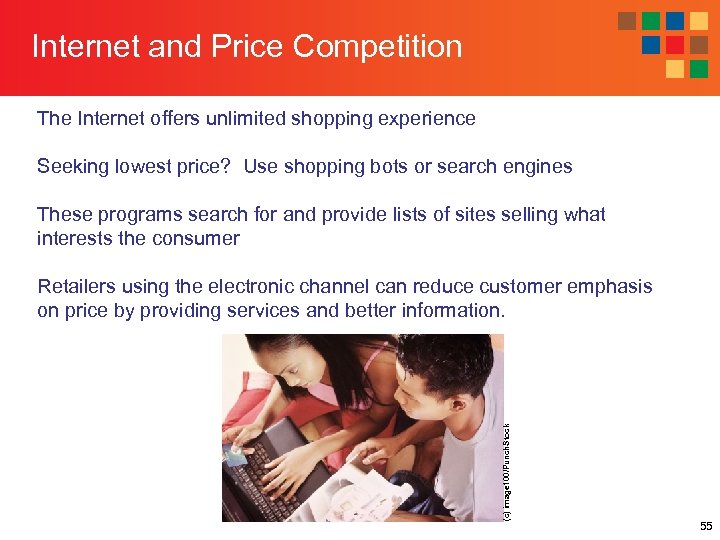 Internet and Price Competition The Internet offers unlimited shopping experience Seeking lowest price? Use shopping bots or search engines These programs search for and provide lists of sites selling what interests the consumer (c) image 100/Punch. Stock Retailers using the electronic channel can reduce customer emphasis on price by providing services and better information. 55
 The Three Most Important Things in Electronic Retailing Location, location Information, information!! 56