


 Скачать презентацию Chapter 15 Order Fulfillment Logistics and Supply Chain
727fd1c50aadfb0ad9ac026b19ec90f8.ppt
- Количество слайдов: 53
 Chapter 15 Order Fulfillment, Logistics, and Supply Chain Management Prentice Hall, 2002 1
 Learning Objectives Order fulfillment SCM Integrating front-office and back-office fucntions Evolution of software for SCM Prentice Hall, 2002 2
 The Toy Order Fulfillment Problem Overall satisfaction with online purchasing declined significantly in December 1999 and January 2000 Order fulfillment infrastructure shown to be very weak Toysrus. com and other toy e-tailers had the most critical problems Prentice Hall, 2002 3
 The Toy Order Fulfillment Problem (cont. ) Fierce competition in the toy industry caused inventory deficiencies Offered free delivery Offered $20 discount Orders could not be met in time for the holidays—so they gave out $100 coupons Amazon. com had to ship orders for several products in several shipments instead of one—raising the delivery cost Prentice Hall, 2002 4
 Order Fulfillment: Overview Introduction Taking orders may be the easiest part Factors responsible for delays in deliveries: Inability to accurately forecast demand Ineffective supply chains Pull type manufacturing Customized products Prentice Hall, 2002 5
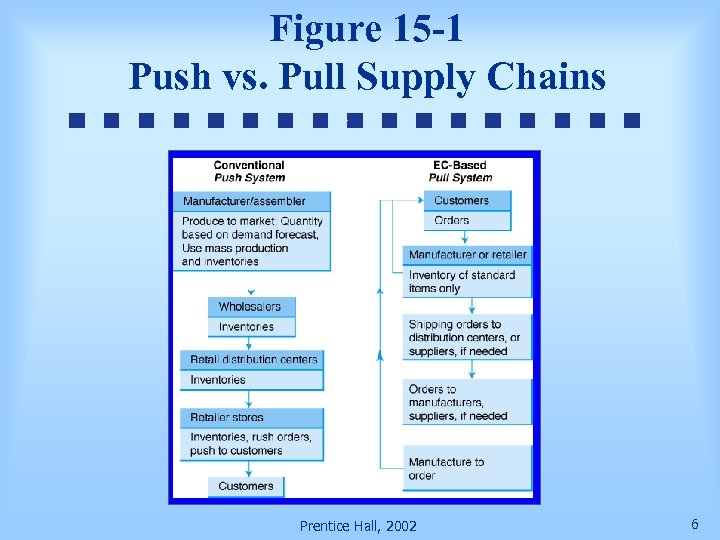 Figure 15 -1 Push vs. Pull Supply Chains Prentice Hall, 2002 6
 Major Concepts Order fulfillment: Deliver right order on time Front office operations: Order taking Advertisement CRM Back office operations Accounting Finance Inventory Packaging Logistics Prentice Hall, 2002 7
 Major Concepts (cont. ) Definitions of logistics: Managing the flow of goods, information and money along the supply chain Aspect of military science dealing with procurement, maintenance, and transportation Management of details of an operation All activities involved in management of product movement Right product Right place Right time Prentice Hall, 2002 8
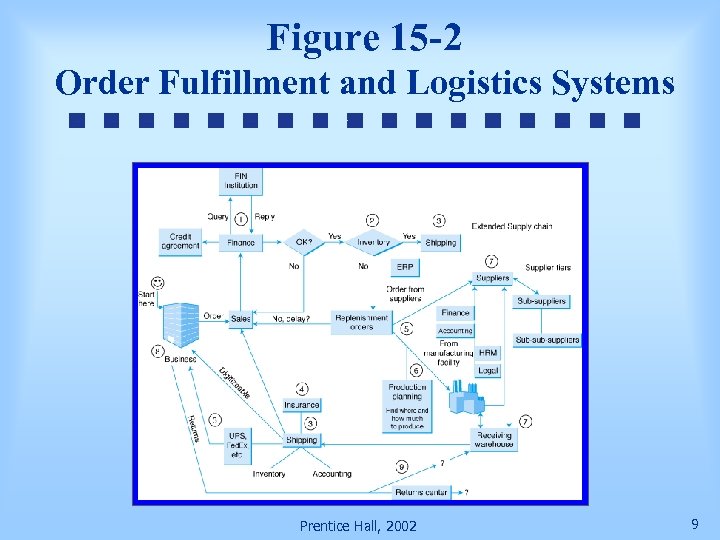 Figure 15 -2 Order Fulfillment and Logistics Systems Prentice Hall, 2002 9
 The Steps of Order Fulfillment 1. 2. 3. 4. 5. Payment Clearance In-stock availability Packaging, shipment Insuring Production (planning, execution) 6. Plant services 7. Purchasing, warehousing 8. Customer contacts 9. Returns (Reverse logistics) 10. Demand forecast 11. Accounting, billing 12. Reverse logistics Prentice Hall, 2002 10
 Shipping a Tropical Fish 1. 2. 3. 4. 5. 6. Placing order, payment Transfer order to Petstore. com, check stock Use a wholesaler to get the fish Supplier finds fish, ships to wholesalers Wholesalers rush to Petstore uses Fed. Ex to ship to customer with copy of credit card payment Discussion: What is the contribution of EC? Prentice Hall, 2002 11
 Supply Chain Management Definition: Flow of material, information, money, etc. from raw material suppliers through factories to customers It includes: organizations, procedures, people SCM: Integration of the business processes along the chain, Planning, Organizing, control of many activities Activities: Purchasing, delivery, packaging, checking, warehousing, etc. Prentice Hall, 2002 12
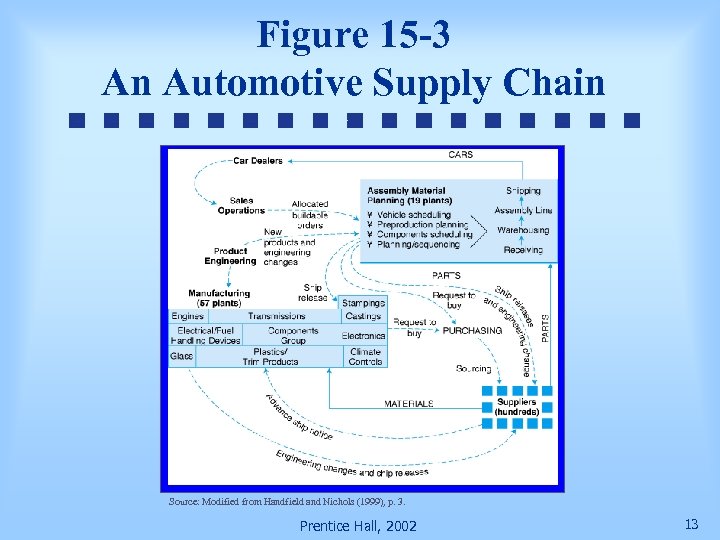 Figure 15 -3 An Automotive Supply Chain Source: Modified from Handfield and Nichols (1999), p. 3. Prentice Hall, 2002 13
 Benefits of SCM Reduce uncertainty along the chain Proper inventory levels in the chain Minimize delays Eliminate rush (unplanned) activities Provide superb customer service Major contributor of success (ever survival) Prentice Hall, 2002 14
 Global Supply Chain Can be very long Possible cross-border problems Need information technology support of: Communication Collaboration Possible delays due to: customs, tax, translations, politics Prentice Hall, 2002 15
 Typical Problems Along the Supply Chain Delays in production, distribution, etc. Expensive Inventories Lack of partners’ coordination Uncertainties in deliveries Poor demand forecast Interference with production Poor quality Prentice Hall, 2002 16
 More Difficulties Virtual companies do not have logistics infrastructures One company is a member of several supply chain Conventional warehouses are too expensive Need automatic warehouses with robots as pickers Prentice Hall, 2002 17
 Bullwhip Effect and Information Sharing Flow of information to and from all participating entities Information sharing between retailers and their suppliers Bullwhip effect refers to erratic shifts in orders up and down supply chain Distorted information leads to: Inefficiencies Ineffective shipments Excessive inventories Poor customer service Missed production schedules Prentice Hall, 2002 18
 The Bullwhip Effect Slight changes in actual demand create problems Partners build “just in case” inventories Lack of trust among partners Stockpiling results in huge cost The manufacturers cannot plan production Cannot order material from suppliers Prentice Hall, 2002 19
 Avoiding the Sting of the Bullwhip How to do it? Information sharing is a must and is facilitated by EDI, extranets, and groupware technologies Trust and agreements in regard to: Ordering and inventory decisions Placing supply chain ahead of individual entities within the corporation Sharing information could save $30 Billion/year just in the grocery industry Prentice Hall, 2002 20
 Preliminary Activities Understand the supply chain (flow charts) Study internal and external parts Performance measurement are a must (Benchmarking) Multidimension performance analysis A BPR may be needed People’s relationships are a must Prentice Hall, 2002 21
 Areas of Opportunities Manufacturing processes Warehousing operation Packaging and delivery Material inspection/receiving Inbound and outbound transportation Reverse logistics (return) In-plant material handling Vendor management program Customer order processing Prentice Hall, 2002 22
 Areas of Opportunities (cont. ) Invoicing, auditing and other accounting activities Collaboration procedures with partners Employee training and deployments Labor scheduling Use of teams and empowerment of employees Automation of processes Use of software for facilitating all the above Inventory management and control Prentice Hall, 2002 23
 Using Inventories Insurance against stock out Can be in several places Can be excessive Can be insufficient Example: Littlewoods stores; UK Prentice Hall, 2002 24
 Using Inventories Using inventories to solve supply chain shortages: Building inventories as insurance against uncertainty —products and parts flow smoothly Very difficult to correctly determine inventory levels for each product and part Customized finished products can only stock components Excessive levels are costly to store Insufficient levels cannot protect against high demand or slow delivery times Prentice Hall, 2002 25
 Using Inventories (cont. ) Example: Littlewoods Stores; UK Retail clothing industry is very competitive Littlewoods instituted an IT-supported initiative to support supply chain efficiency; specifically, to deal with the overstocking problem Prentice Hall, 2002 26
 Littlewoods Stores (cont. ) Use a Web-Based performance reporting system that analyzes daily: Marketing and financial data Merchandising Space planning Purchasing data Prentice Hall, 2002 27
 Littlewoods Stores (cont. ) Using data warehouse, DSS and other enduser oriented software system has helped: Reduce backup inventory expenses Increased the ability to strategically price merchandise differently in different stores Reduced the need for stock liquidations Cut marketing distribution costs significantly Increased the number of Web-based users Prentice Hall, 2002 28
 Proper SCN (cont. ) Coordination is needed because: Supply chain partners depend on each other Partners don’t always work together toward the same goal To properly control uncertainties it is necessary to: Understand the causes/problems Determine how uncertainties will affect other activities up and down the supply chain Formulate ways to eliminate or reduce uncertainties Prentice Hall, 2002 29
 EC Solutions Along the Supply Chain 1. Automate order taking Use EDI/Internet Web-based ordering; intelligent agents 2. Electronic payments 3. Inventory reduction (made-to-order pull process) Improved inventory management Decreased administrative costs Prentice Hall, 2002 30
 EC Solutions Along the Supply Chain (cont. ) Digitization of products—instant order fulfillment Back-office interface Collaborative commerce among members of the supply chain Shortens cycle time Eliminates errors Prentice Hall, 2002 Shortens cycle time Minimizes delays and work interruptions Lower inventories Lower administrative costs 31
 Innovative Solutions to Order Fulfillment Problem (cont. ) Role of 7 -Eleven & convenience stores Can be used as a collection point for returns Can be used as a pick-up place Can be used as a place for order placing Can pay in cash/card to the store Returns are a problem: up to 30% Prentice Hall, 2002 32
 Innovative Solutions to Order Fulfillment Problem (cont. ) Relysoftware. com helps find: “Forwarders”—intermediaries that prepare goods for shipping for companies Relysoftware. com also helps: Forwarders find the best prices on air carriers Carriers fill up empty cargo space by bidding it up Prentice Hall, 2002 33
 Same Day, Even Same Hour Delivery Role of Fed. Ex and similar shippers From a delivery to all-logistics Many services (see Box 13. 4) Complete inventory control Packaging, warehousing, reordering, etc. Tracking services to customers Prentice Hall, 2002 34
 Same Day, Even Same Hour Delivery (cont. ) Supermarket deliveries Transport of fresh food to people who are in homes only at specific hours Distribution systems are critical Fresh food may be spoiled Prentice Hall, 2002 35
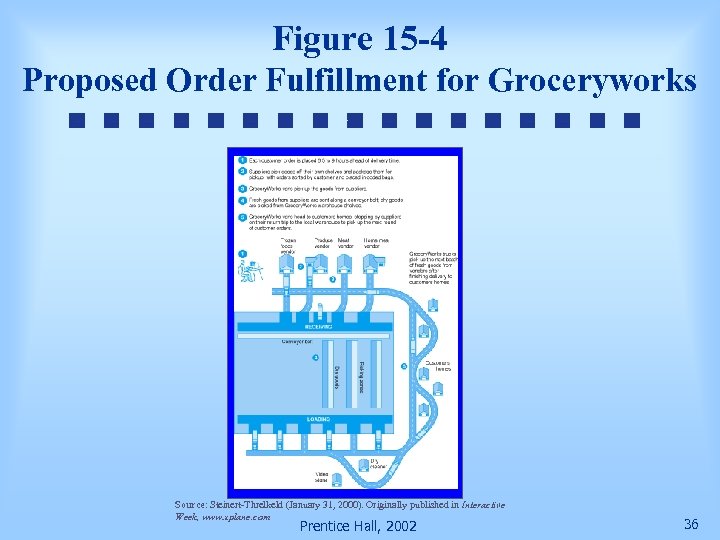 Figure 15 -4 Proposed Order Fulfillment for Groceryworks Source: Steinert-Threlkeld (January 31, 2000). Originally published in Interactive Week, www. xplane. com Prentice Hall, 2002 36
 Automated Warehouses B 2 C order fulfillment—send small quantities to a large number of individuals Step 1: retailers contract Fingerhut to stock products and deliver Web orders Step 2: merchandise stored SKU warehouse Step 3: orders arrive Step 4: computer program consolidates orders from all vendors into “pick waves” Prentice Hall, 2002 37
 Automated Warehouses (cont. ) Step 5: picked items moved by conveyors to packing area; computer configures size and type of packing; types special packing instructions Step 6: conveyer takes packages to scanning station (weighed) Step 7: scan destination; moved by conveyer to waiting trucks Step 8: full trucks depart for Post Offices Prentice Hall, 2002 38
 Handling Returns Necessary for maintaining customer trust and loyalty Return item to place it was purchased Separate logistics of returns from logistics of delivery Allow customer to physically drop returned items at collection stations Completely outsource returns Prentice Hall, 2002 39
 Outsourcing Logistics: The UPS Strategy UPS provides broad EC services: Electronic tracking of packages Electronic supply chain services for corporate customers by industry including: Portal page with industry-related information Statistics Calculators for computing shipping fees Help customers manage electronic supply chains Prentice Hall, 2002 40
 The UPS Strategy (cont. ) UPS provides broad EC services Improved inventory management, warehousing, and delivery Integration with shipping management system Notify customers by e-mail of: Delivery status Expected time of arrival of incoming packages Prentice Hall, 2002 41
 The UPS Strategy (cont. ) Representative tools 7 transportation and delivery applications Track packages Analyze shipping history Calculate exact time-in-transit Downloadable tools Proof of delivery Optimal routing features Delivery of digital documents Wireless access to UPS system Prentice Hall, 2002 42
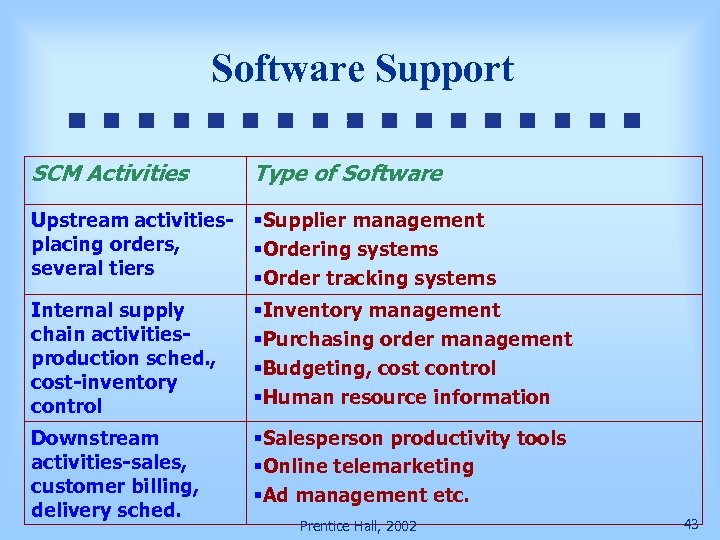 Software Support SCM Activities Type of Software Upstream activities- §Supplier management placing orders, §Ordering systems several tiers §Order tracking systems Internal supply chain activitiesproduction sched. , cost-inventory control §Inventory management §Purchasing order management §Budgeting, cost control §Human resource information Downstream activities-sales, customer billing, delivery sched. §Salesperson productivity tools §Online telemarketing §Ad management etc. Prentice Hall, 2002 43
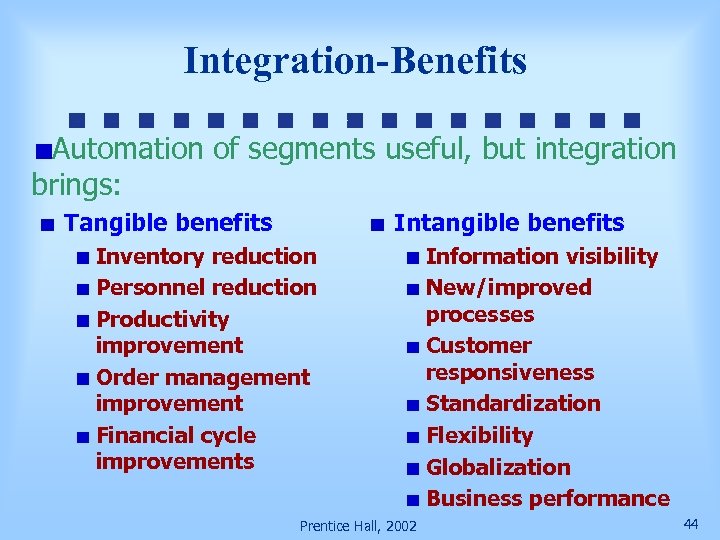 Integration-Benefits Automation of segments useful, but integration brings: Tangible benefits Intangible benefits Inventory reduction Personnel reduction Productivity improvement Order management improvement Financial cycle improvements Prentice Hall, 2002 Information visibility New/improved processes Customer responsiveness Standardization Flexibility Globalization Business performance 44
 Integration Along the Supply Chain Need to streamline operations New business models New organizational relationships (virtual companies) Examples Warner Lambert and Wal-Mart (Box 15. 6) Prentice Hall, 2002 45
 Areas of Integration Order taking - production inventory levels Payment info in B 2 B - Visa, Master. Card, etc. Low inventory levels - automatic ordering Order to manufacturing - generate a list of needed resources & their availability Changes in an order - transmit to suppliers and their suppliers Tracking systems - available to customers Prentice Hall, 2002 46
 Evolution of Software Integration Completely Independent of each other MRP= Material Requirements Planning: Inventory Production MRPII=Manufacturing Requirements Planning more integrated MRP+Finance+Labor Prentice Hall, 2002 47
 Evolution of Software Integration (cont. ) Completely Independent of each other ERP=Enterprise Resources Planning All functional areas Extended ERP includes Suppliers Customers Prentice Hall, 2002 48
 From SAP to my. SAP. com SAP=Traditional ERP=Automate and Integrate transactions My. SAP. com = Web-based comprehensive system Workplace - a personalized, role-based interface Marketplace - one stop destination for business professionals to collaborate Business Scenarios - products for the Internet and intranet Application-hosing - hosting Web applications for SMEs Prentice Hall, 2002 49
 Developing ERP Systems Do-it-yourself, from scratch (only few will) Use Integrated packages such as R/3 from SAP “Best of Bread” approach, using integrating software Rent in from ASP service Prentice Hall, 2002 50
 Post-ERP (2 nd Generation) 1 st generation - transaction processing orientation 2 nd generation Including decision-making capabilities EC requires decision support EC requires business intelligence SCM software: Production Planning, Manpower utilization, Profitability models, market analysis Integration of SCM capabilities Other added functionalities: CRM, KM Prentice Hall, 2002 51
 ASP and ERP Outsourcing Why ASP or lease? Leasing information systems application Back to the days of “time-sharing” A risk prevention strategy Very popular with ERP (expensive, cumbersome) Prentice Hall, 2002 52
 Managerial Issues Planning order fulfillment–critical virtual vendors Returns - can be a complex issue Alliances and Software - support SCM Connect - EC order taking to back-office ops EC Applications – must integrate with SCM Integration software – GE Integration Broker, IBM MQ series, Active Software, NEON. XML integration packages – from View. Logic, Extricity, Web. Methods Enterprise Application Integration 53 Prentice Hall, 2002