


 Скачать презентацию Chapter 15 Formation of Sales and Lease Contracts
f2824f3210fd06e397f136a6afd37837.ppt
- Количество слайдов: 31
 Chapter 15: Formation of Sales and Lease Contracts © 2011 Cengage Learning. All Rights Reserved. May not be copied, scanned, or duplicated, in whole or in part, except for use as permitted in a license distributed with a certain product or service or otherwise on a password-protected website for classroom use. 1
 Learning Objectives • How do Article 2 and Article 2 A of the UCC differ? What types of transactions does each article cover? • In a sales contract, if an offeree includes additional or different terms in an acceptance, will a contract result? If so, what happens to these terms? • What exceptions to the writing requirements of the Statute of Frauds are provided in Article 2 and Article 2 A of the UCC? © 2011 Cengage Learning. All Rights Reserved. May not be copied, scanned, or duplicated, in whole or in part, except for use as permitted in a license distributed with a certain product or service or otherwise on a password-protected website for classroom use. 2
 Learning Objectives • Risk of loss does not necessarily pass with title. If the parties to a contract do not expressly agree when risk passes and the goods are to be delivered without movement by the seller, when does risk pass? • What law governs contracts for the international sale of goods? © 2011 Cengage Learning. All Rights Reserved. May not be copied, scanned, or duplicated, in whole or in part, except for use as permitted in a license distributed with a certain product or service or otherwise on a password-protected website for classroom use. 3
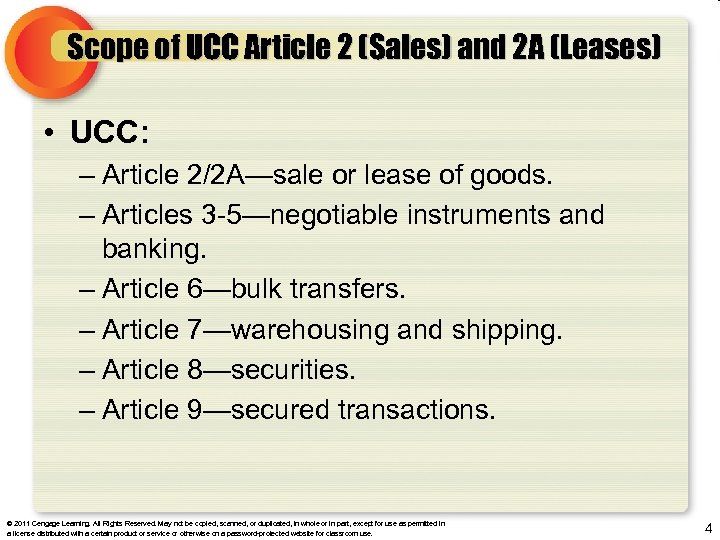 Scope of UCC Article 2 (Sales) and 2 A (Leases) • UCC: – Article 2/2 A—sale or lease of goods. – Articles 3 -5—negotiable instruments and banking. – Article 6—bulk transfers. – Article 7—warehousing and shipping. – Article 8—securities. – Article 9—secured transactions. © 2011 Cengage Learning. All Rights Reserved. May not be copied, scanned, or duplicated, in whole or in part, except for use as permitted in a license distributed with a certain product or service or otherwise on a password-protected website for classroom use. 4
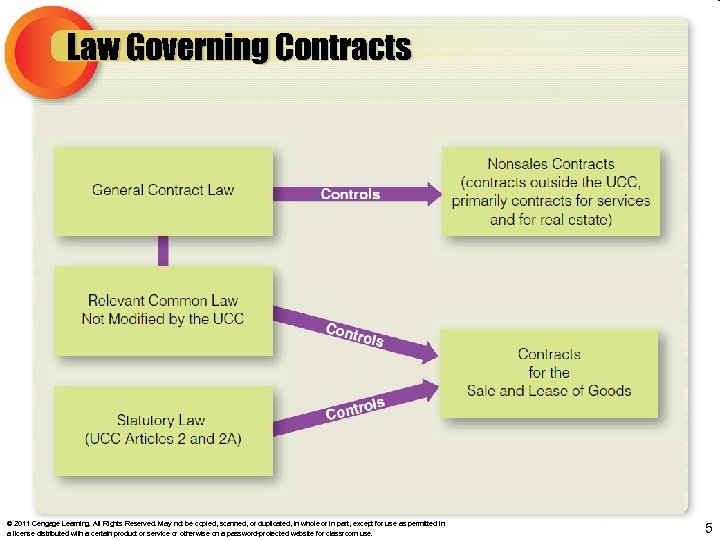 Law Governing Contracts © 2011 Cengage Learning. All Rights Reserved. May not be copied, scanned, or duplicated, in whole or in part, except for use as permitted in a license distributed with a certain product or service or otherwise on a password-protected website for classroom use. 5
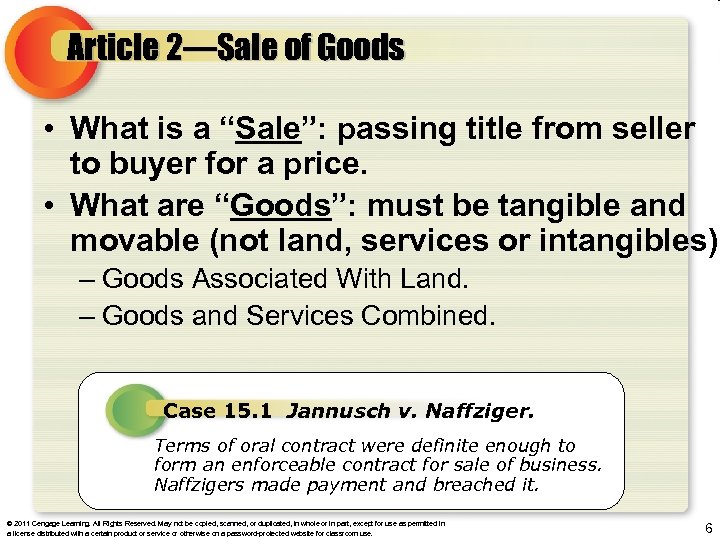 Article 2—Sale of Goods • What is a “Sale”: passing title from seller to buyer for a price. • What are “Goods”: must be tangible and movable (not land, services or intangibles). – Goods Associated With Land. – Goods and Services Combined. Case 15. 1 Jannusch v. Naffziger. Terms of oral contract were definite enough to form an enforceable contract for sale of business. Naffzigers made payment and breached it. © 2011 Cengage Learning. All Rights Reserved. May not be copied, scanned, or duplicated, in whole or in part, except for use as permitted in a license distributed with a certain product or service or otherwise on a password-protected website for classroom use. 6
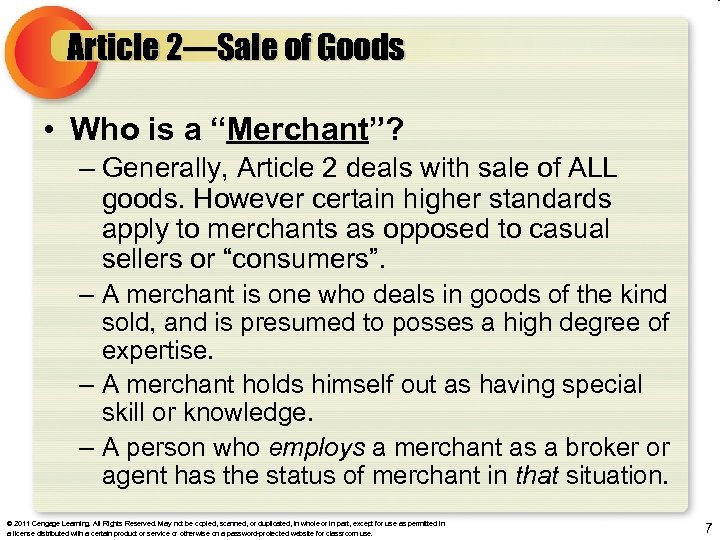 Article 2—Sale of Goods • Who is a “Merchant”? – Generally, Article 2 deals with sale of ALL goods. However certain higher standards apply to merchants as opposed to casual sellers or “consumers”. – A merchant is one who deals in goods of the kind sold, and is presumed to posses a high degree of expertise. – A merchant holds himself out as having special skill or knowledge. – A person who employs a merchant as a broker or agent has the status of merchant in that situation. © 2011 Cengage Learning. All Rights Reserved. May not be copied, scanned, or duplicated, in whole or in part, except for use as permitted in a license distributed with a certain product or service or otherwise on a password-protected website for classroom use. 7
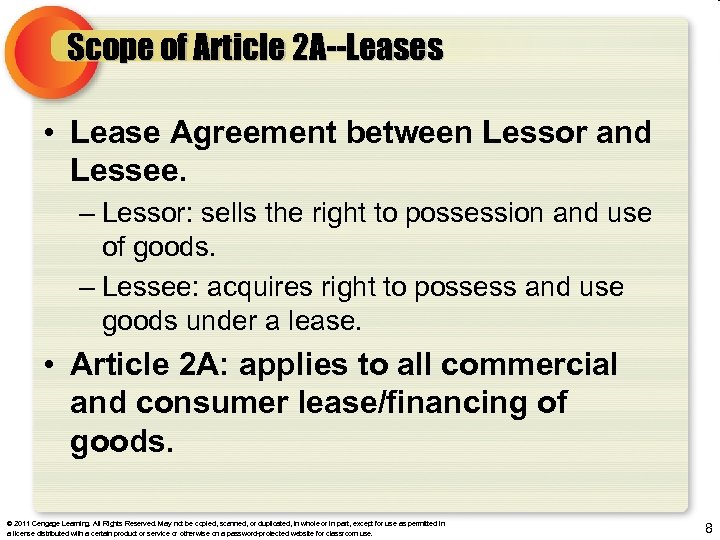 Scope of Article 2 A--Leases • Lease Agreement between Lessor and Lessee. – Lessor: sells the right to possession and use of goods. – Lessee: acquires right to possess and use goods under a lease. • Article 2 A: applies to all commercial and consumer lease/financing of goods. © 2011 Cengage Learning. All Rights Reserved. May not be copied, scanned, or duplicated, in whole or in part, except for use as permitted in a license distributed with a certain product or service or otherwise on a password-protected website for classroom use. 8
 Sales Contracts: Offer • UCC modifies the common law of contracts as follows: – Where UCC speaks, it preempts the common law; – Where UCC is silent, the common law governs. • A valid offer under UCC 2 may include “open” (missing) terms: – Open Price Term: court will determine a reasonable price at time of delivery and enforce the contract. – Open Payment Term: payment is due at the time and place at which buyer is to receive goods. – Open Delivery Term: buyer takes delivery at seller’s place of business. © 2011 Cengage Learning. All Rights Reserved. May not be copied, scanned, or duplicated, in whole or in part, except for use as permitted in a license distributed with a certain product or service or otherwise on a password-protected website for classroom use. 9
 Exception to “Open Terms” • Open Quantity. If no quantity is specified, there is NO contract, unless: – Requirements Contract: buyer has agreed to purchase all he needs from seller. – Output Contract: buyer has agreed to purchase all the products the seller manufactures or produces. © 2011 Cengage Learning. All Rights Reserved. May not be copied, scanned, or duplicated, in whole or in part, except for use as permitted in a license distributed with a certain product or service or otherwise on a password-protected website for classroom use. 10
 Merchant’s Firm Offer • Under common law, an offer can be revoked at any time before acceptance, unless there is an option contract (offeree pays consideration for offeror’s irrevocable promise). • UCC creates a second exception: – Firm offer occurs when merchant-offeror gives assurances in a signed writing that the offer will remain open. – No consideration is necessary for a reasonable period (up to 3 months). © 2011 Cengage Learning. All Rights Reserved. May not be copied, scanned, or duplicated, in whole or in part, except for use as permitted in a license distributed with a certain product or service or otherwise on a password-protected website for classroom use. 11
 Acceptance • Acceptance. – Methods of Acceptance: Seller can specify manner of acceptance. If not, any reasonable means. – Promise to Ship/Prompt Shipment of conforming goods is acceptance. – Non-Conforming Goods: Prompt shipment of non-conforming goods is both an acceptance and a breach, unless the seller notifies the goods are only an “accommodation. ” Notice of the accommodation must indicate no contract has been formed. © 2011 Cengage Learning. All Rights Reserved. May not be copied, scanned, or duplicated, in whole or in part, except for use as permitted in a license distributed with a certain product or service or otherwise on a password-protected website for classroom use. 12
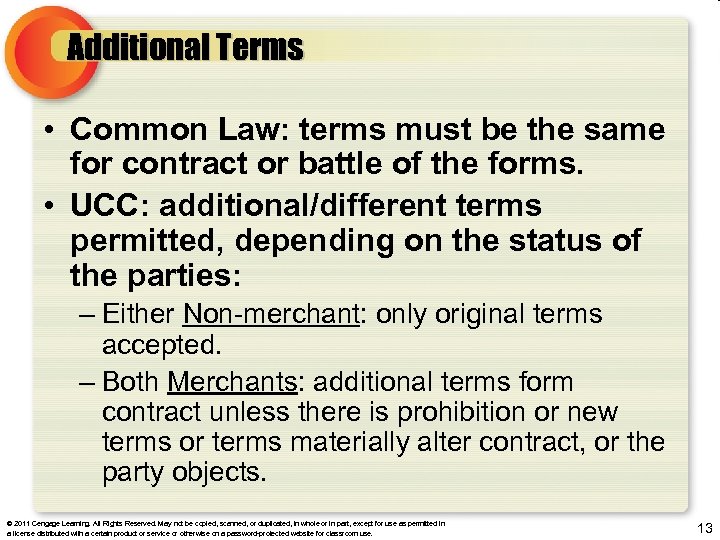 Additional Terms • Common Law: terms must be the same for contract or battle of the forms. • UCC: additional/different terms permitted, depending on the status of the parties: – Either Non-merchant: only original terms accepted. – Both Merchants: additional terms form contract unless there is prohibition or new terms or terms materially alter contract, or the party objects. © 2011 Cengage Learning. All Rights Reserved. May not be copied, scanned, or duplicated, in whole or in part, except for use as permitted in a license distributed with a certain product or service or otherwise on a password-protected website for classroom use. 13
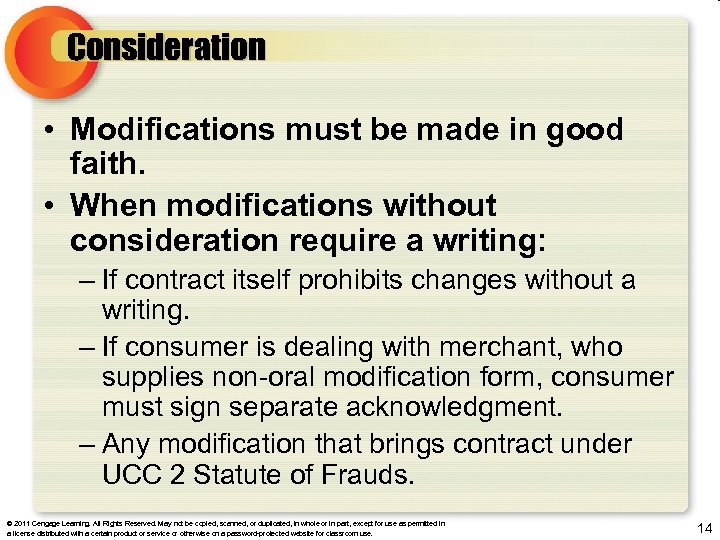 Consideration • Modifications must be made in good faith. • When modifications without consideration require a writing: – If contract itself prohibits changes without a writing. – If consumer is dealing with merchant, who supplies non-oral modification form, consumer must sign separate acknowledgment. – Any modification that brings contract under UCC 2 Statute of Frauds. © 2011 Cengage Learning. All Rights Reserved. May not be copied, scanned, or duplicated, in whole or in part, except for use as permitted in a license distributed with a certain product or service or otherwise on a password-protected website for classroom use. 14
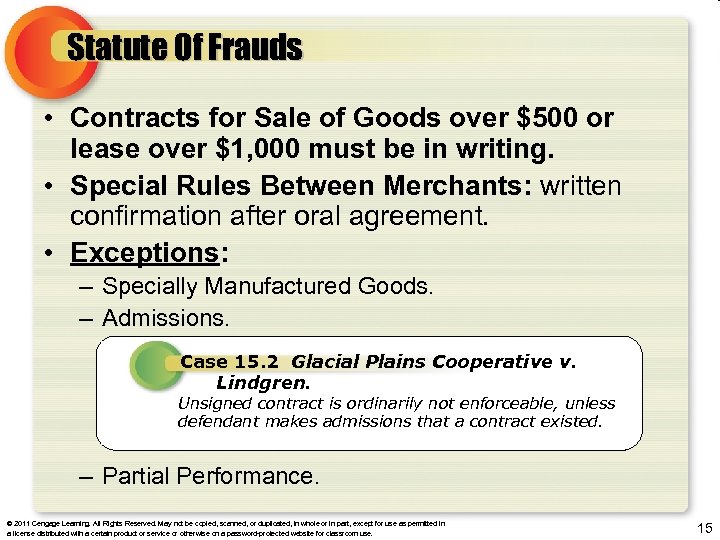 Statute Of Frauds • Contracts for Sale of Goods over $500 or lease over $1, 000 must be in writing. • Special Rules Between Merchants: written confirmation after oral agreement. • Exceptions: – Specially Manufactured Goods. – Admissions. Case 15. 2 Glacial Plains Cooperative v. Lindgren. Unsigned contract is ordinarily not enforceable, unless defendant makes admissions that a contract existed. – Partial Performance. © 2011 Cengage Learning. All Rights Reserved. May not be copied, scanned, or duplicated, in whole or in part, except for use as permitted in a license distributed with a certain product or service or otherwise on a password-protected website for classroom use. 15
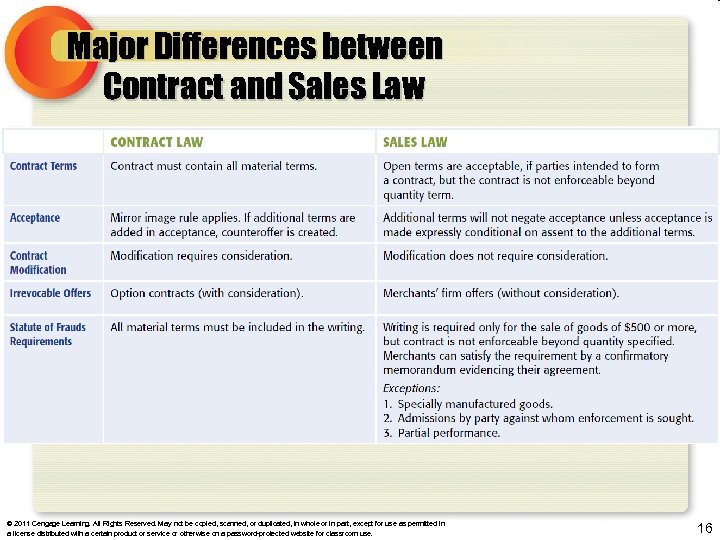 Major Differences between Contract and Sales Law © 2011 Cengage Learning. All Rights Reserved. May not be copied, scanned, or duplicated, in whole or in part, except for use as permitted in a license distributed with a certain product or service or otherwise on a password-protected website for classroom use. 16
 Parol Evidence • Generally, terms of a written agreement or memo cannot be contradicted by prior, extrinsic evidence, unless the evidence is: – Consistent, Additional Terms. – A Course of Dealing and Usage. – A course of Performance, or – Rules of Construction or Interpretation. © 2011 Cengage Learning. All Rights Reserved. May not be copied, scanned, or duplicated, in whole or in part, except for use as permitted in a license distributed with a certain product or service or otherwise on a password-protected website for classroom use. 17
 Unconscionability • Contract that is so unfair and one-side that it would be unreasonable to enforce it. Court can: – Refuse to enforce it. – Enforce contract without unconscionable clause, or – Limit impact of contract to avoid unconscionable result. Case 15. 3 Jones v. Star Credit. Jones contracted to pay $1, 234 for a $300 freezer. Court held contract was unconscionable and reformed it, requiring no further payments. © 2011 Cengage Learning. All Rights Reserved. May not be copied, scanned, or duplicated, in whole or in part, except for use as permitted in a license distributed with a certain product or service or otherwise on a password-protected website for classroom use. 18
 Title and Risk of Loss • Sale of goods requires different rules than real property transactions: risk should not always pass with title. • UCC replaces common law notions of title with identification, risk of loss, and insurable interest. © 2011 Cengage Learning. All Rights Reserved. May not be copied, scanned, or duplicated, in whole or in part, except for use as permitted in a license distributed with a certain product or service or otherwise on a password-protected website for classroom use. 19
 Identification • Before title to goods can pass from seller to buyer, they must exist and be identified. • Identification: takes place when specific goods are designated as subject matter of contract. Gives buyer the right to obtain insurance on the goods and to recover damages from third parties. • Existing Goods: identification takes place at time contract is made. © 2011 Cengage Learning. All Rights Reserved. May not be copied, scanned, or duplicated, in whole or in part, except for use as permitted in a license distributed with a certain product or service or otherwise on a password-protected website for classroom use. 20
 Identification • Future Goods: – If sale of unborn animals (or crops) within 12 months, identification occurs at conception (or planting). – Any other goods, identification takes place when goods are shipped. • Fungible Goods: do not need separation. © 2011 Cengage Learning. All Rights Reserved. May not be copied, scanned, or duplicated, in whole or in part, except for use as permitted in a license distributed with a certain product or service or otherwise on a password-protected website for classroom use. 21
 Passage of Title • Title passes when agreed to by the Parties. • If there is no agreement, under Article 2 -401 title of identified goods passes to the Buyer at the time and place the Seller physically delivers the goods. – Shipment and Destination Contracts. © 2011 Cengage Learning. All Rights Reserved. May not be copied, scanned, or duplicated, in whole or in part, except for use as permitted in a license distributed with a certain product or service or otherwise on a password-protected website for classroom use. 22
 Title: Shipment and Destination Contracts • If there is no agreement, passage of title to buyer depends on whether the contract is a shipment or destination contract: – Shipment: title passes at time and place of shipment. – Destination: title passes when goods are tendered at the destination. © 2011 Cengage Learning. All Rights Reserved. May not be copied, scanned, or duplicated, in whole or in part, except for use as permitted in a license distributed with a certain product or service or otherwise on a password-protected website for classroom use. 23
 Title: Delivery Without Movement of Goods • Unless the parties have agreed otherwise, title passes: – With document of title: when and where document delivered. – Without document: when sales contract is made, if goods have been identified or when identification occurs if they have not been identified. © 2011 Cengage Learning. All Rights Reserved. May not be copied, scanned, or duplicated, in whole or in part, except for use as permitted in a license distributed with a certain product or service or otherwise on a password-protected website for classroom use. 24
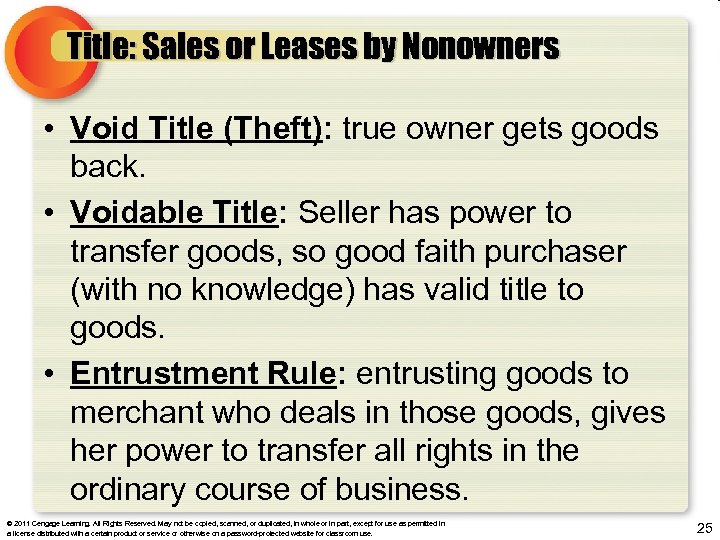 Title: Sales or Leases by Nonowners • Void Title (Theft): true owner gets goods back. • Voidable Title: Seller has power to transfer goods, so good faith purchaser (with no knowledge) has valid title to goods. • Entrustment Rule: entrusting goods to merchant who deals in those goods, gives her power to transfer all rights in the ordinary course of business. © 2011 Cengage Learning. All Rights Reserved. May not be copied, scanned, or duplicated, in whole or in part, except for use as permitted in a license distributed with a certain product or service or otherwise on a password-protected website for classroom use. 25
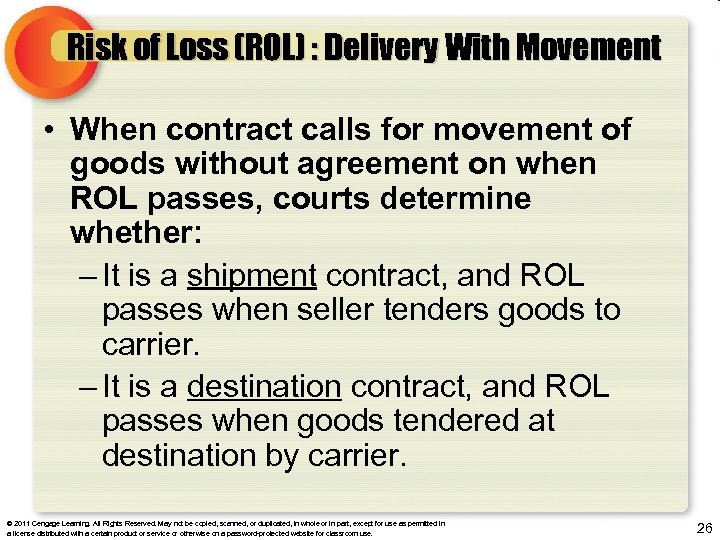 Risk of Loss (ROL) : Delivery With Movement • When contract calls for movement of goods without agreement on when ROL passes, courts determine whether: – It is a shipment contract, and ROL passes when seller tenders goods to carrier. – It is a destination contract, and ROL passes when goods tendered at destination by carrier. © 2011 Cengage Learning. All Rights Reserved. May not be copied, scanned, or duplicated, in whole or in part, except for use as permitted in a license distributed with a certain product or service or otherwise on a password-protected website for classroom use. 26
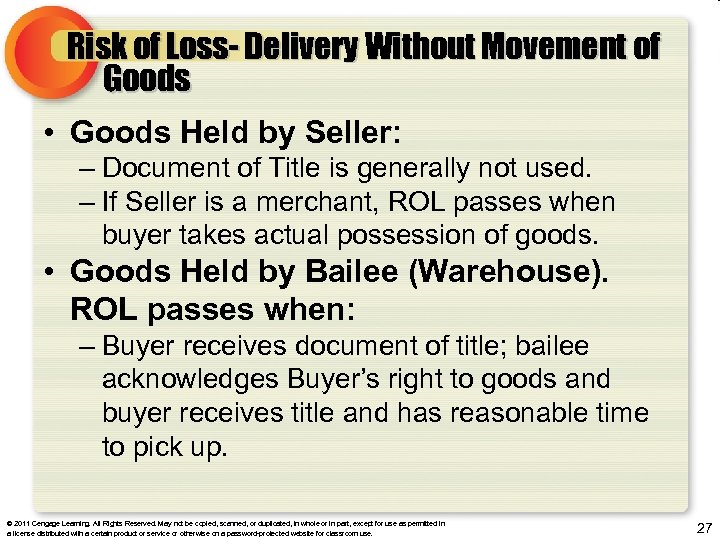 Risk of Loss- Delivery Without Movement of Goods • Goods Held by Seller: – Document of Title is generally not used. – If Seller is a merchant, ROL passes when buyer takes actual possession of goods. • Goods Held by Bailee (Warehouse). ROL passes when: – Buyer receives document of title; bailee acknowledges Buyer’s right to goods and buyer receives title and has reasonable time to pick up. © 2011 Cengage Learning. All Rights Reserved. May not be copied, scanned, or duplicated, in whole or in part, except for use as permitted in a license distributed with a certain product or service or otherwise on a password-protected website for classroom use. 27
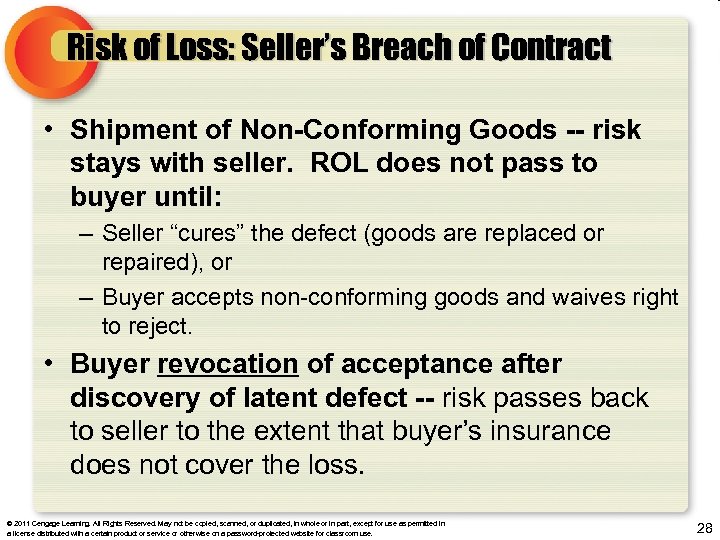 Risk of Loss: Seller’s Breach of Contract • Shipment of Non-Conforming Goods -- risk stays with seller. ROL does not pass to buyer until: – Seller “cures” the defect (goods are replaced or repaired), or – Buyer accepts non-conforming goods and waives right to reject. • Buyer revocation of acceptance after discovery of latent defect -- risk passes back to seller to the extent that buyer’s insurance does not cover the loss. © 2011 Cengage Learning. All Rights Reserved. May not be copied, scanned, or duplicated, in whole or in part, except for use as permitted in a license distributed with a certain product or service or otherwise on a password-protected website for classroom use. 28
 Risk of Loss: Buyer’s Breach • Buyer’s Breach. Goods are identified, risk passes to buyer for a reasonable amount of time after seller learns of the breach, to the extent that seller’s insurance does not cover loss. © 2011 Cengage Learning. All Rights Reserved. May not be copied, scanned, or duplicated, in whole or in part, except for use as permitted in a license distributed with a certain product or service or otherwise on a password-protected website for classroom use. 29
 Insurable Interest • Buyer has an insurable interest in goods that have been identified. • Seller has an insurable interest in goods as long as they retain title or a security interest. • Both buyers and sellers can have an insurable interest at the same time. © 2011 Cengage Learning. All Rights Reserved. May not be copied, scanned, or duplicated, in whole or in part, except for use as permitted in a license distributed with a certain product or service or otherwise on a password-protected website for classroom use. 30
 Contracts for International Sale of Goods • Contracts for the International Sale of Goods (CISG-1980). – As of 2010, signed by 70 countries, including U. S. , Mexico, Canada, and Europe. • CISG Applicability. – Applies to International sale of goods like UCC 2 applies to domestic sale of goods. • Comparison between CISG and UCC 2. – Offers can be irrevocable without writing. – Acceptances are required to be ‘mirrors’ of the offer. © 2011 Cengage Learning. All Rights Reserved. May not be copied, scanned, or duplicated, in whole or in part, except for use as permitted in a license distributed with a certain product or service or otherwise on a password-protected website for classroom use. 31