


 Скачать презентацию Chapter 15 Allocation of Support Department Costs Common
c038c6d76c8efdf05e778f3a7c2ed6bf.ppt
- Количество слайдов: 18
 Chapter 15 Allocation of: Support Department Costs, Common Costs, and Revenues 2009 Foster School of Business Cost Accounting L. Du. Charme 1
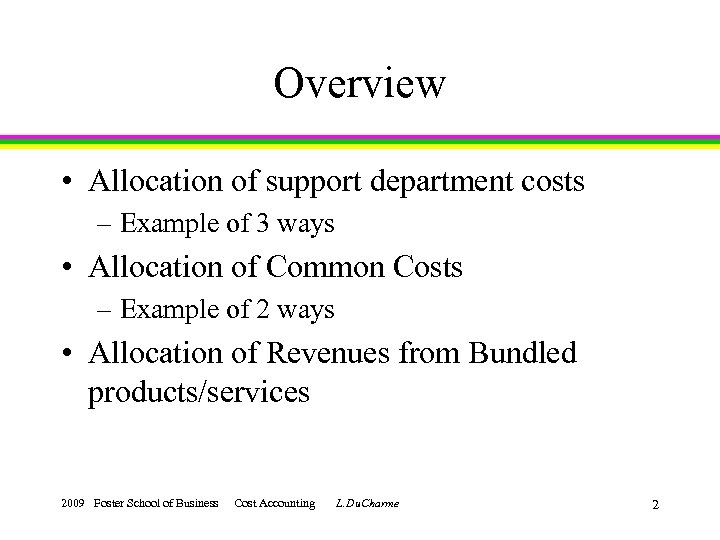 Overview • Allocation of support department costs – Example of 3 ways • Allocation of Common Costs – Example of 2 ways • Allocation of Revenues from Bundled products/services 2009 Foster School of Business Cost Accounting L. Du. Charme 2
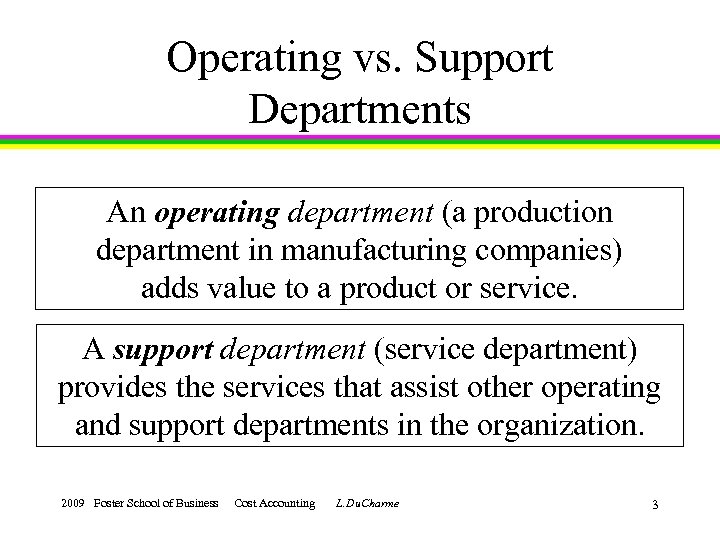 Operating vs. Support Departments An operating department (a production department in manufacturing companies) adds value to a product or service. A support department (service department) provides the services that assist other operating and support departments in the organization. 2009 Foster School of Business Cost Accounting L. Du. Charme 3
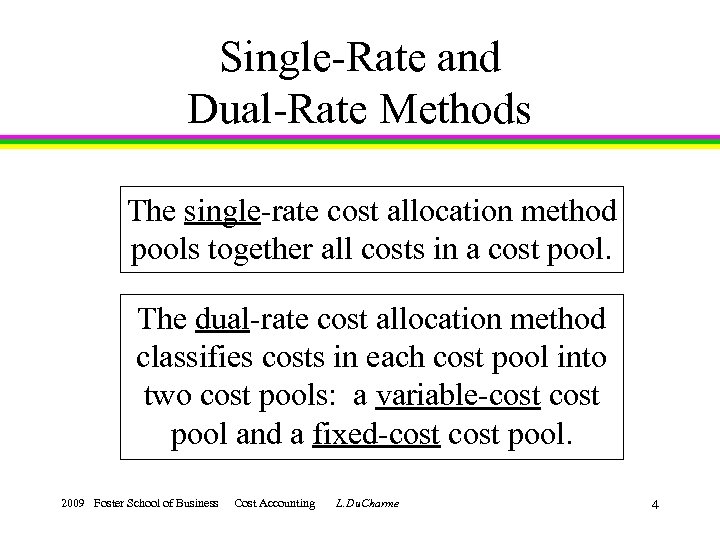 Single-Rate and Dual-Rate Methods The single-rate cost allocation method pools together all costs in a cost pool. The dual-rate cost allocation method classifies costs in each cost pool into two cost pools: a variable-cost pool and a fixed-cost pool. 2009 Foster School of Business Cost Accounting L. Du. Charme 4
 Budgeted versus Actual Rates Budgeted rates let the user department know in advance the cost rates they will be charged. During the budget period, the supplier department, not the user departments, bears the risk of any unfavorable cost variances. Why? 2009 Foster School of Business Cost Accounting L. Du. Charme 5
 Budgeted versus Actual Usage Allocation Bases Organizations commit to infrastructure costs on the basis of a long-run planning horizon. The use of budgeted usage to allocate these fixed costs is consistent with the long-run horizon. Typically, you use actual usage to allocate variable costs. 2009 Foster School of Business Cost Accounting L. Du. Charme 6
 Allocating Support Departments Costs— 3 methods Direct method: Allocates support department costs to operating departments only. Step-down (sequential allocation) method: Allocates support department costs to other support departments and to operating departments. Reciprocal allocation method: Allocates costs by services provided among all support departments. 2009 Foster School of Business Cost Accounting L. Du. Charme 7
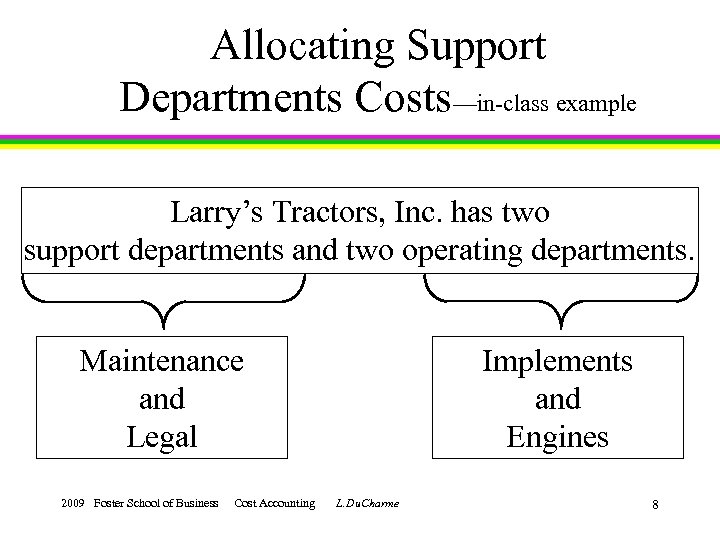 Allocating Support Departments Costs—in-class example Larry’s Tractors, Inc. has two support departments and two operating departments. Maintenance and Legal 2009 Foster School of Business Cost Accounting L. Du. Charme Implements and Engines 8
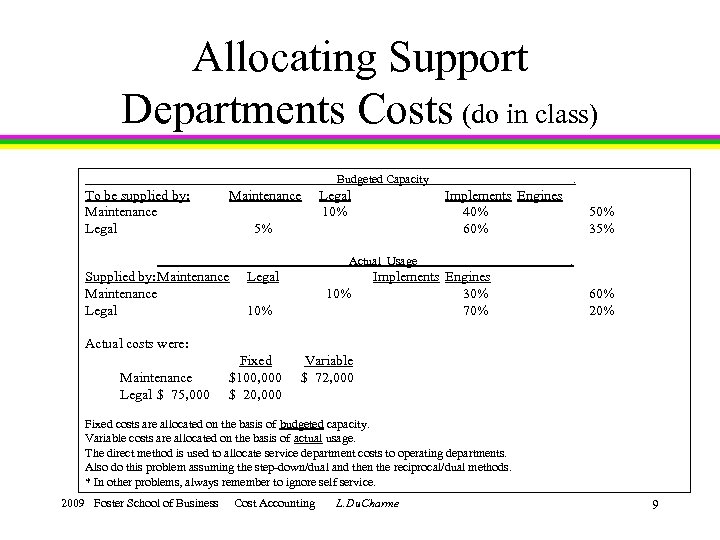 Allocating Support Departments Costs (do in class) Budgeted Capacity . To be supplied by: Maintenance Legal 10% 5% Implements Engines 40% 60% 50% 35% Actual Usage . Supplied by: Maintenance Legal 10% Actual costs were: Fixed Maintenance $100, 000 Legal $ 75, 000 $ 20, 000 10% Implements Engines 30% 70% 60% 20% Variable $ 72, 000 Fixed costs are allocated on the basis of budgeted capacity. Variable costs are allocated on the basis of actual usage. The direct method is used to allocate service department costs to operating departments. Also do this problem assuming the step-down/dual and then the reciprocal/dual methods. * In other problems, always remember to ignore self service. 2009 Foster School of Business Cost Accounting L. Du. Charme 9
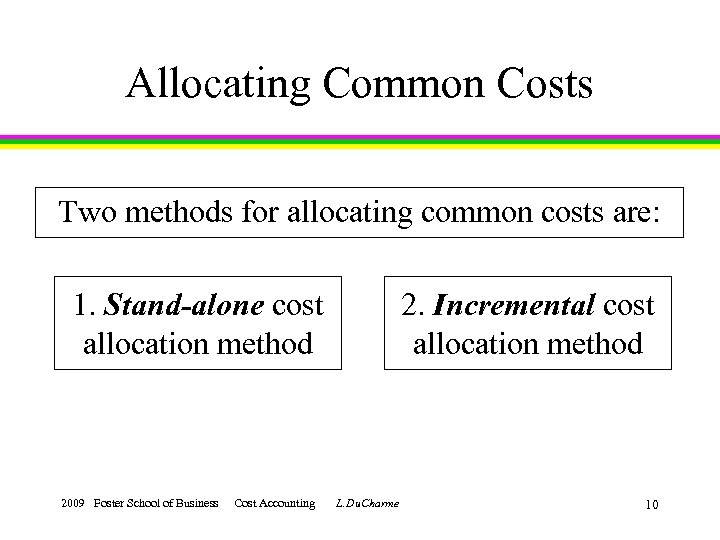 Allocating Common Costs Two methods for allocating common costs are: 1. Stand-alone cost allocation method 2009 Foster School of Business Cost Accounting L. Du. Charme 2. Incremental cost allocation method 10
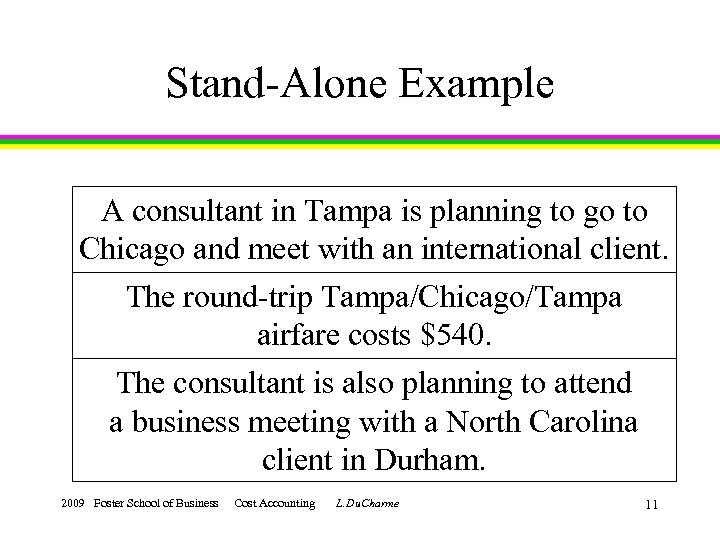 Stand-Alone Example A consultant in Tampa is planning to go to Chicago and meet with an international client. The round-trip Tampa/Chicago/Tampa airfare costs $540. The consultant is also planning to attend a business meeting with a North Carolina client in Durham. 2009 Foster School of Business Cost Accounting L. Du. Charme 11
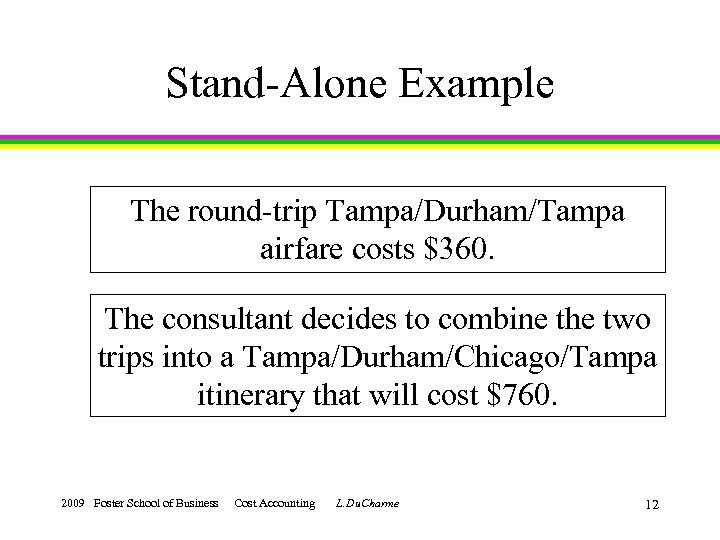 Stand-Alone Example The round-trip Tampa/Durham/Tampa airfare costs $360. The consultant decides to combine the two trips into a Tampa/Durham/Chicago/Tampa itinerary that will cost $760. 2009 Foster School of Business Cost Accounting L. Du. Charme 12
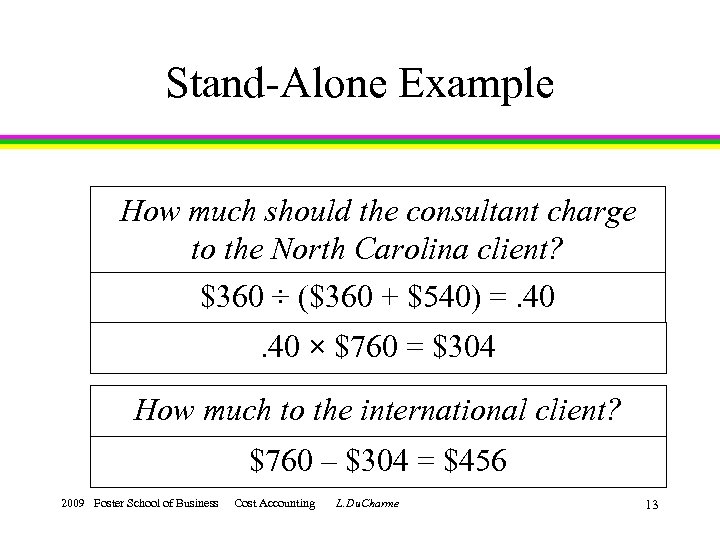 Stand-Alone Example How much should the consultant charge to the North Carolina client? $360 ÷ ($360 + $540) =. 40 × $760 = $304 How much to the international client? $760 – $304 = $456 2009 Foster School of Business Cost Accounting L. Du. Charme 13
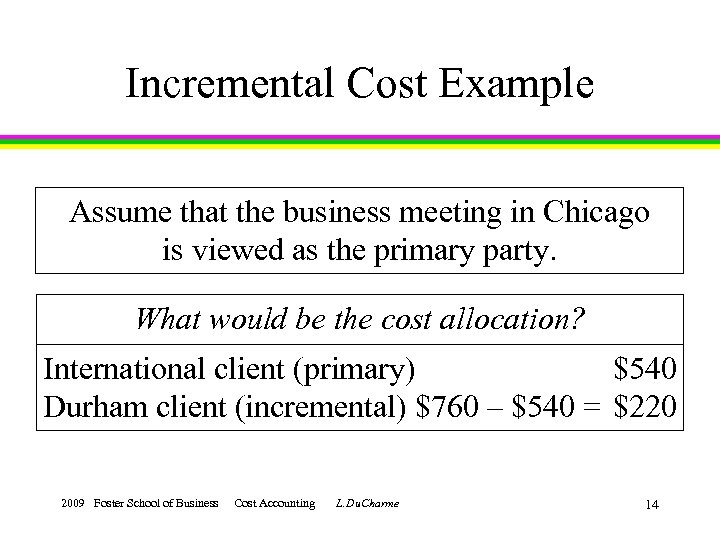 Incremental Cost Example Assume that the business meeting in Chicago is viewed as the primary party. What would be the cost allocation? International client (primary) $540 Durham client (incremental) $760 – $540 = $220 2009 Foster School of Business Cost Accounting L. Du. Charme 14
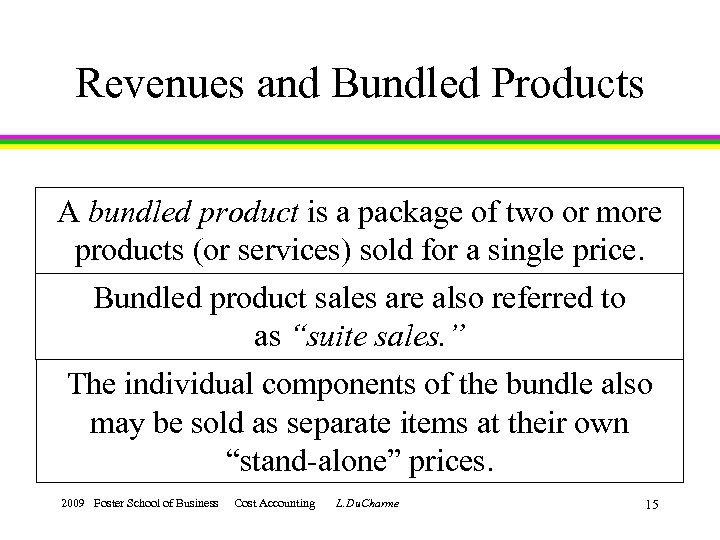 Revenues and Bundled Products A bundled product is a package of two or more products (or services) sold for a single price. Bundled product sales are also referred to as “suite sales. ” The individual components of the bundle also may be sold as separate items at their own “stand-alone” prices. 2009 Foster School of Business Cost Accounting L. Du. Charme 15
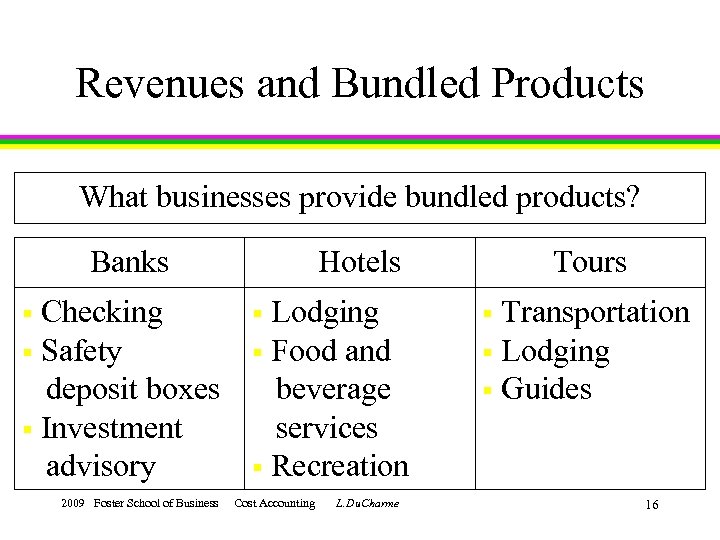 Revenues and Bundled Products What businesses provide bundled products? Banks Hotels Tours § Checking § Lodging § Transportation § Safety § Food and § Lodging deposit boxes beverage § Investment services advisory § Recreation 2009 Foster School of Business Cost Accounting L. Du. Charme § Guides 16
 Allocation of Revenues Allocation of the revenues of a bundled package to the individual products in that package is similar to allocation of common costs. 2009 Foster School of Business Cost Accounting L. Du. Charme 17
 End of Chapter 15 2009 Foster School of Business Cost Accounting L. Du. Charme 18