


 Скачать презентацию CHAPTER 14 THE COST OF CAPITAL FOREIGN INVESTMENTS
e99e3b4cec4d55c46ee3cc9a2a607acd.ppt
- Количество слайдов: 23
 CHAPTER 14 THE COST OF CAPITAL FOREIGN INVESTMENTS
 CHAPTER OVERVIEW: I. THE COST OF EQUITY CAPITAL II. THE WEIGHTED AVERAGE COST OF CAPITAL FOREIGN PROJECTS III. THE ALL-EQUITY COST OF CAPITAL FOREIGN PROJECTS IV. DISCOUNT RATES V. ESTABLISHING A WORLDWIDE CAPITAL STRUCTURE
 I. THE COST OF EQUITY CAPITAL A. Definition 1. the minimum (required) rate of return necessary to induce investors to buy or hold the firm’s stock. 2. used to value future equity cash flows 3. determines common stock price
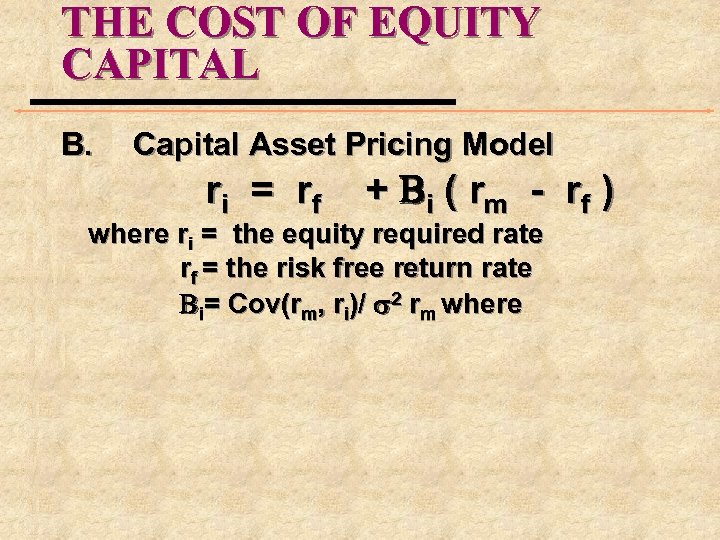 THE COST OF EQUITY CAPITAL B. Capital Asset Pricing Model ri = r f + i ( r m - r f ) where ri = the equity required rate rf = the risk free return rate i= Cov(rm, ri)/ 2 rm where
 THE COST OF EQUITY CAPITAL Cov(rm, ri) is the covariance between asset and market returns and 2 rm , the variance of market returns.
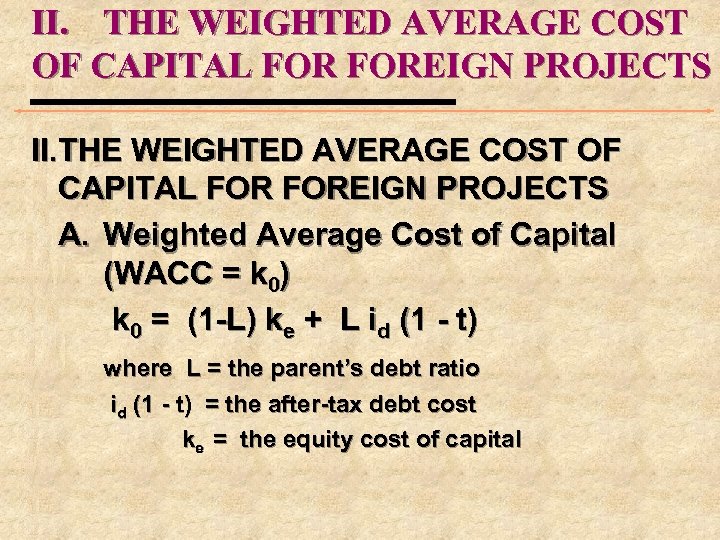 II. THE WEIGHTED AVERAGE COST OF CAPITAL FOR FOREIGN PROJECTS A. Weighted Average Cost of Capital (WACC = k 0) k 0 = (1 -L) ke + L id (1 - t) where L = the parent’s debt ratio id (1 - t) = the after-tax debt cost ke = the equity cost of capital
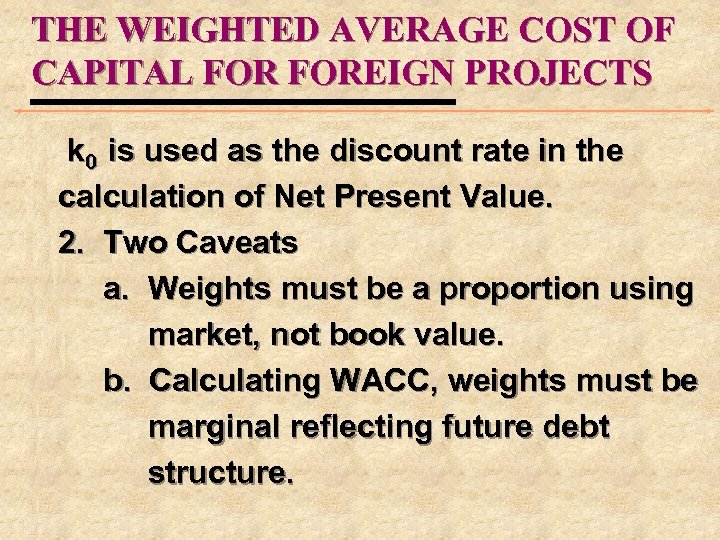 THE WEIGHTED AVERAGE COST OF CAPITAL FOREIGN PROJECTS k 0 is used as the discount rate in the calculation of Net Present Value. 2. Two Caveats a. Weights must be a proportion using market, not book value. b. Calculating WACC, weights must be marginal reflecting future debt structure.
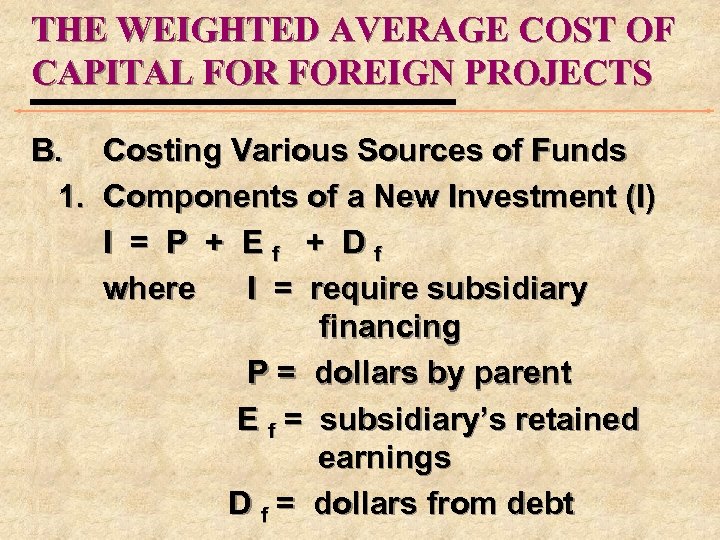 THE WEIGHTED AVERAGE COST OF CAPITAL FOREIGN PROJECTS B. Costing Various Sources of Funds 1. Components of a New Investment (I) I = P + Ef + Df where I = require subsidiary financing P = dollars by parent E f = subsidiary’s retained earnings D f = dollars from debt
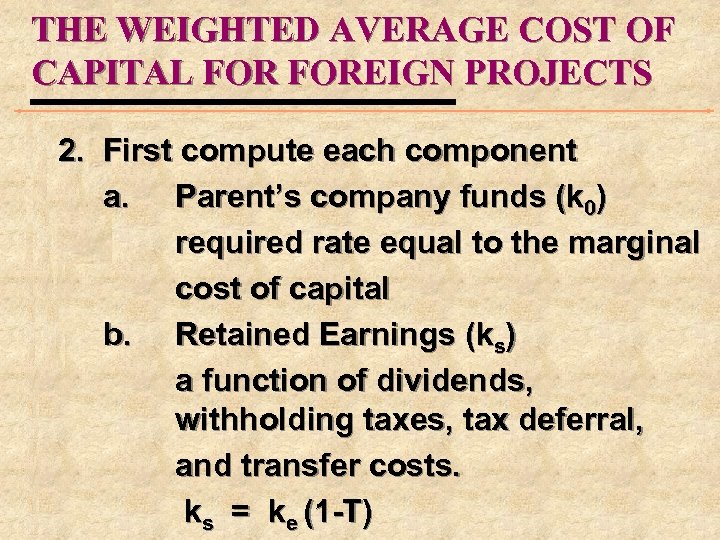 THE WEIGHTED AVERAGE COST OF CAPITAL FOREIGN PROJECTS 2. First compute each component a. Parent’s company funds (k 0) required rate equal to the marginal cost of capital b. Retained Earnings (ks) a function of dividends, withholding taxes, tax deferral, and transfer costs. ks = ke (1 -T)
 THE WEIGHTED AVERAGE COST OF CAPITAL FOREIGN PROJECTS c. Local Currency Debt (rf) after-tax dollar cost of borrowing locally
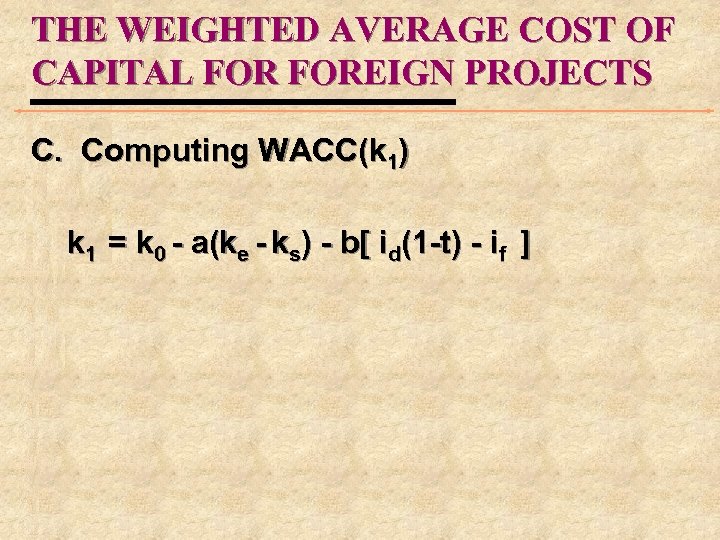 THE WEIGHTED AVERAGE COST OF CAPITAL FOREIGN PROJECTS C. Computing WACC(k 1) k 1 = k 0 - a(ke - ks) - b[ id(1 -t) - if ]
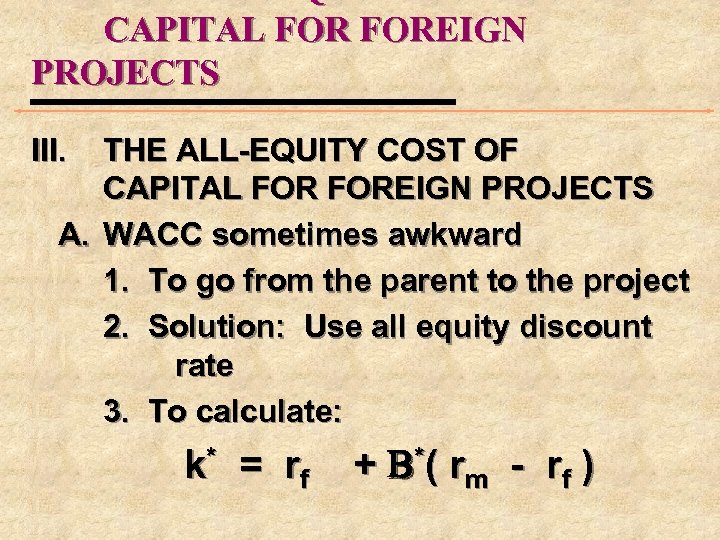 CAPITAL FOREIGN PROJECTS III. THE ALL-EQUITY COST OF CAPITAL FOREIGN PROJECTS A. WACC sometimes awkward 1. To go from the parent to the project 2. Solution: Use all equity discount rate 3. To calculate: k* = r f + *( r m - r f )
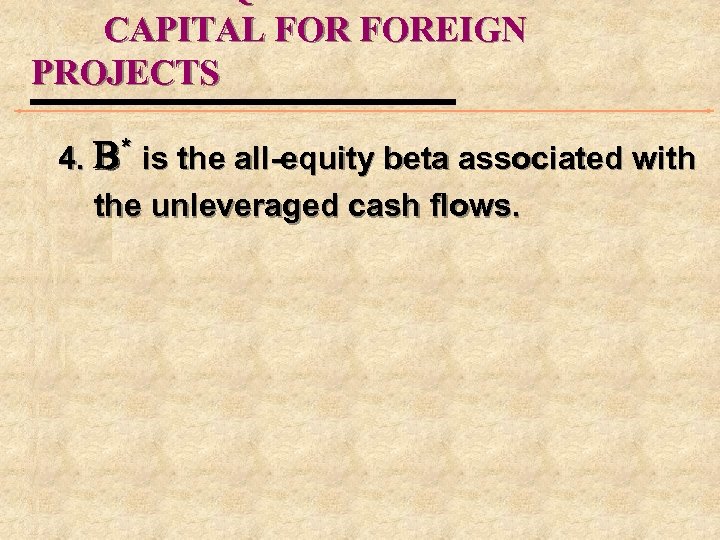 CAPITAL FOREIGN PROJECTS 4. * is the all-equity beta associated with the unleveraged cash flows.
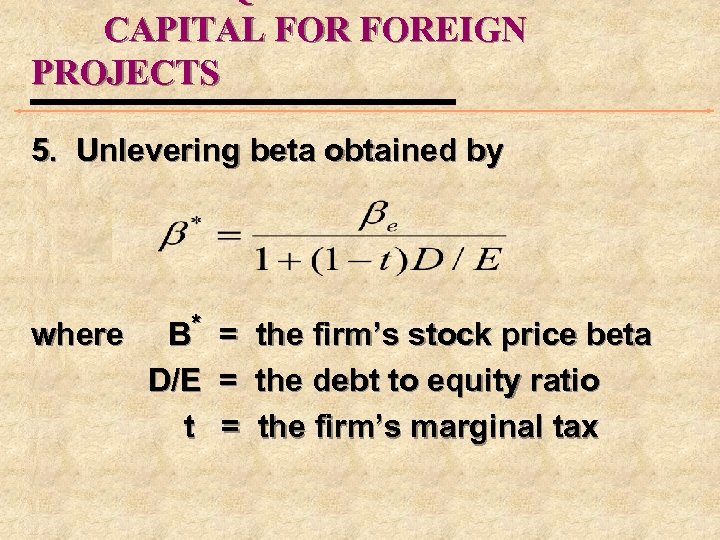 CAPITAL FOREIGN PROJECTS 5. Unlevering beta obtained by where B* D/E t = = = the firm’s stock price beta the debt to equity ratio the firm’s marginal tax
 IV. DISCOUNT RATES FOR FOREIGN PROJECTS A. Systematic Risk 1. Not diversifiable 2. Foreign projects in nonsynchronous economies should be less correlated with domestic markets.
 DISCOUNT RATES FOREIGN PROJECTS 3. Paradox: LDCs have greater political risk but offer higher probability of diversification benefits.
 DISCOUNT RATES FOREIGN PROJECTS B. Key Issues in Estimating Foreign Project Betas -find firms publicly traded that share similar risk characteristics -use the average beta as a proxy
 DISCOUNT RATES FOREIGN PROJECTS 1. Three Issues: a. Should proxies be U. S. or local companies? b. Which is the relevant base portfolio to use? c. Should the market risk premium be based on U. S. or local market?
 DISCOUNT RATES FOREIGN PROJECTS 2. Proxy Companies a. Most desirable to use local firms b. Alternative: find a proxy industry in the local market
 DISCOUNT RATES FOREIGN PROJECTS 3. Relevant Base (Market) Portfolio a. If capital markets are globally integrated, choose world mkt. b. If not, domestic portfolio is best
 DISCOUNT RATES FOREIGN PROJECTS 4. Relevant Market Risk Premium a. Use the U. S. portfolio b. Foreign project: should have no higher than domestic risk and cost of capital.
 V. ESTABLISHING AWORLD WIDE CAPITAL STRUCTURE V. ESTABLISHING A WORLDWIDE CAPITAL STRUCTURE A. MNC Advantage: uses more debt due to diversification
 ESTABLISHING AWORLD WIDE CAPITAL STRUCTURE B. What is proper capital structure? 1. Borrowing in local currency helps to reduce exchange rate risk 2. Allow subsidiary to exceed parent capitalization norm if local mkt. has lower costs.