


 Скачать презентацию Chapter 14 System Testing System Testing
7ff9c30b3388ac84b7bbadcf62e0954e.ppt
- Количество слайдов: 33
 Chapter 14 System Testing
 System Testing • “Intuitively clear” – customer expectations – close to customer acceptance testing • BUT we need a better basis for really understanding system testing • Threads—the subject of system testing • How are they identified? – – ad hoc? from experience? from a possibly incomplete requirements specification? from an executable model? (Model-Based Testing)
 Threads. . . • (not nice clothes. . . ) • An execution time concept • Per the definition, a thread can be understood as a sequence of atomic system functions. • When a system test case executes – a thread occurs, and – can be observed at the port boundary of the system • The BIG Question: where do we find (or how do we identify) threads? • Our approach—Model-Based Testing
 Threads—Several Views • • • A scenario of normal usage A use case A stimulus/response pair Behavior that results from a sequence of system-level inputs An interleaved sequence of port input and output events A sequence of transitions in a state machine description of the system An interleaved sequence of object messages and method executions A sequence of machine instructions A sequence of source instructions A sequence of MM-paths A sequence of atomic system functions (to be defined)
 Some Choices—Threads in an ATM System • Entry of a digit • Entry of a personal identification number (PIN) • A simple transaction: ATM Card Entry, PIN Entry, select transaction type (deposit, withdraw), present account details (checking or savings, amount), conduct the operation, and report the results • An ATM session containing two or more simple transactions • Each of these can be understood as an interleaved sequence of port level inputs and outputs.
 Details of PIN Entry as a Thread • A screen requesting PIN digits. • An interleaved sequence of digit keystrokes and screen responses. • The possibility of cancellation by the customer before the full PIN is entered. • A system disposition: – A customer has three chances to enter the correct PIN. – Once a correct PIN has been entered, the user sees a screen requesting the transaction type. – After three failed PIN Entry attempts, a screen advises the customer that the ATM card will not be returned, and no access to ATM functions is provided.
 Definition: Atomic System Function • Definition: An Atomic System Function (ASF) is an action that is observable at the system level in terms of port input and output events. • About ASFs – characterized by a sequence of port level inputs and outputs – could be just a simple stimulus/response pair (e. g. digit entry) • Sample ASFs in our ATM example – – card entry PIN entry Transaction selection session termination
 More Definitions… • Given a system defined in terms of atomic system functions, the ASF Graph of the system is the directed graph in which nodes are ASFs and edges represent sequential flow. • A source ASF is an Atomic System Function that appears as a source node in the ASF graph of a system. • A sink ASF is an Atomic System Function that appears as a sink node in the ASF graph. • A system thread is a path from a source ASF to a sink ASF in the ASF graph of a system.
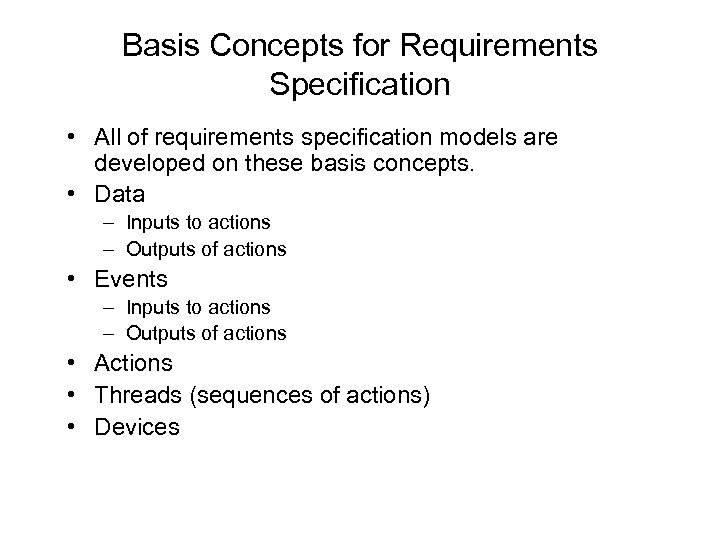 Basis Concepts for Requirements Specification • All of requirements specification models are developed on these basis concepts. • Data – Inputs to actions – Outputs of actions • Events – Inputs to actions – Outputs of actions • Actions • Threads (sequences of actions) • Devices
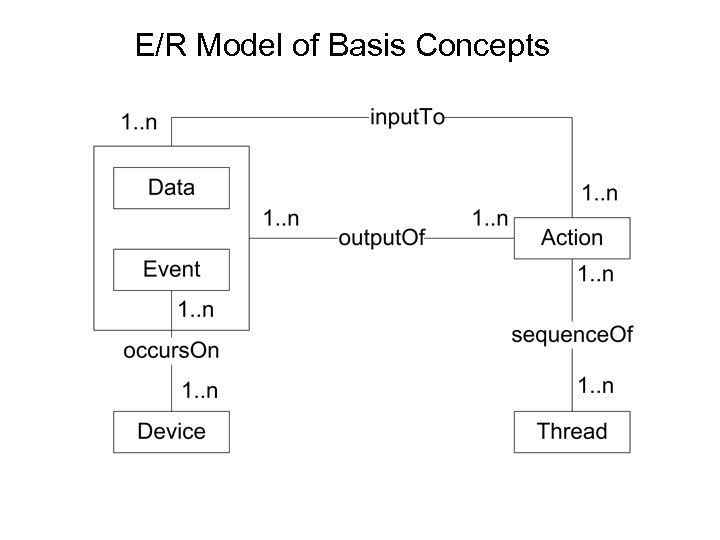 E/R Model of Basis Concepts
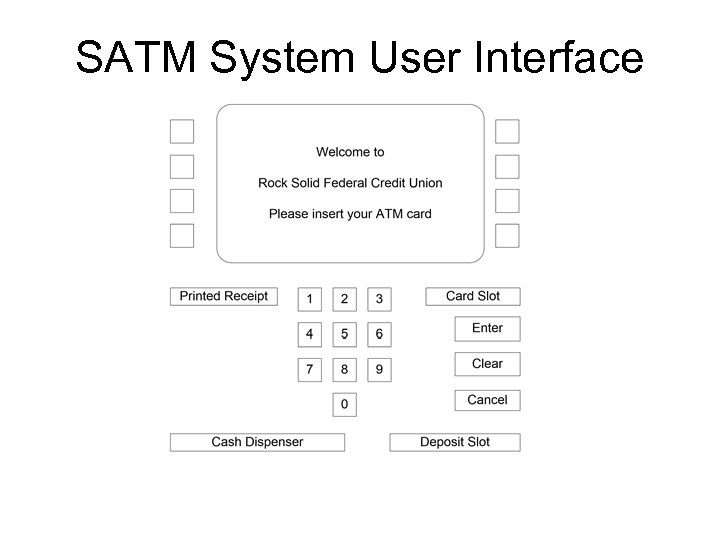 SATM System User Interface
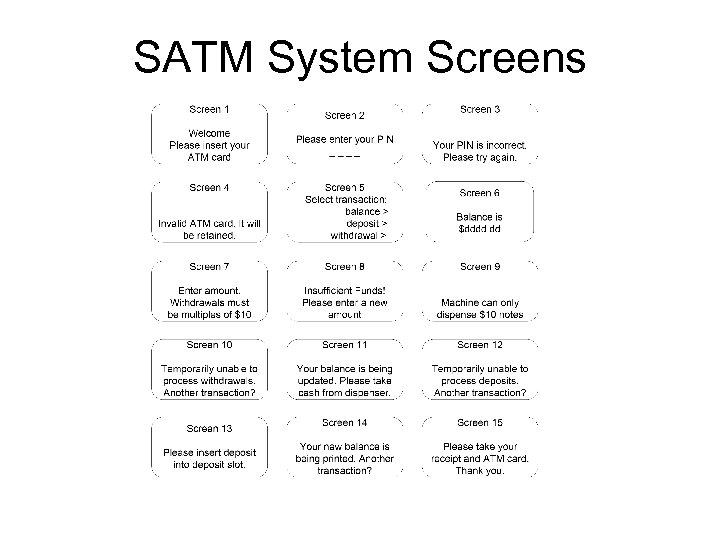 SATM System Screens
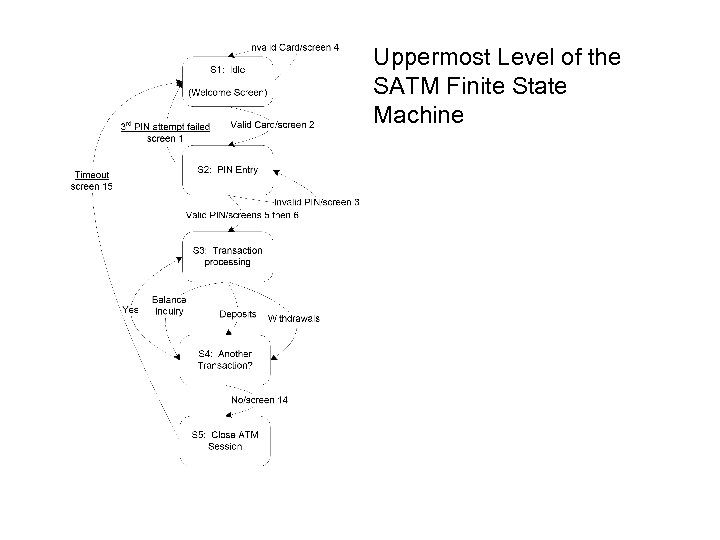 Uppermost Level of the SATM Finite State Machine
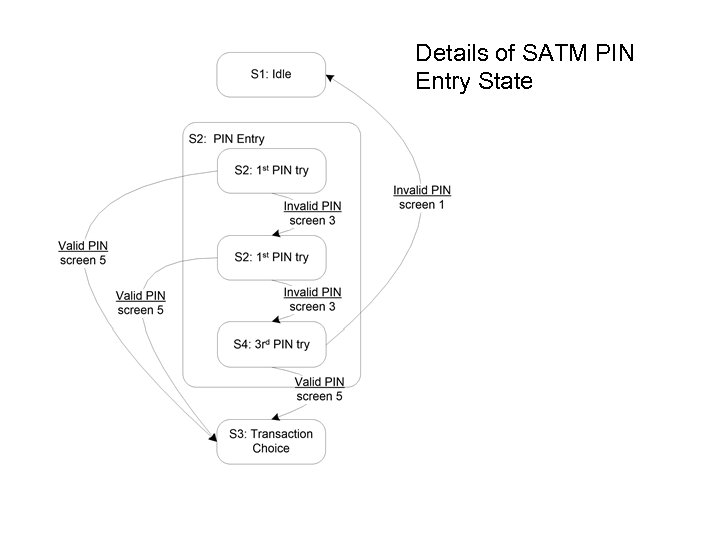 Details of SATM PIN Entry State
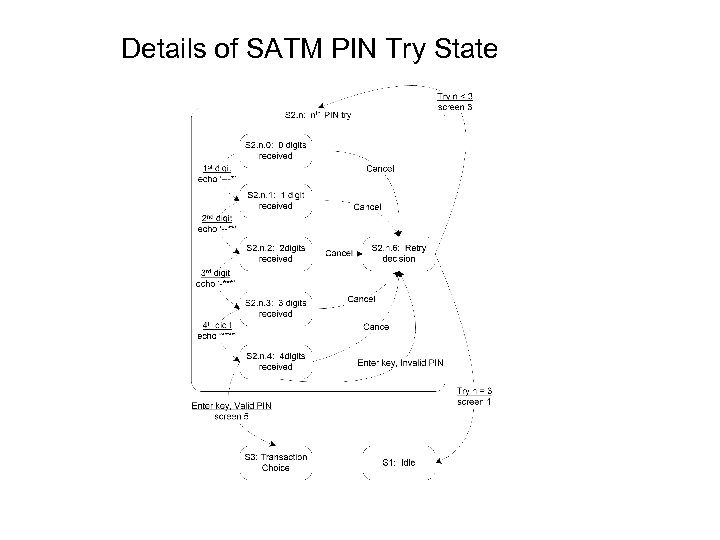 Details of SATM PIN Try State
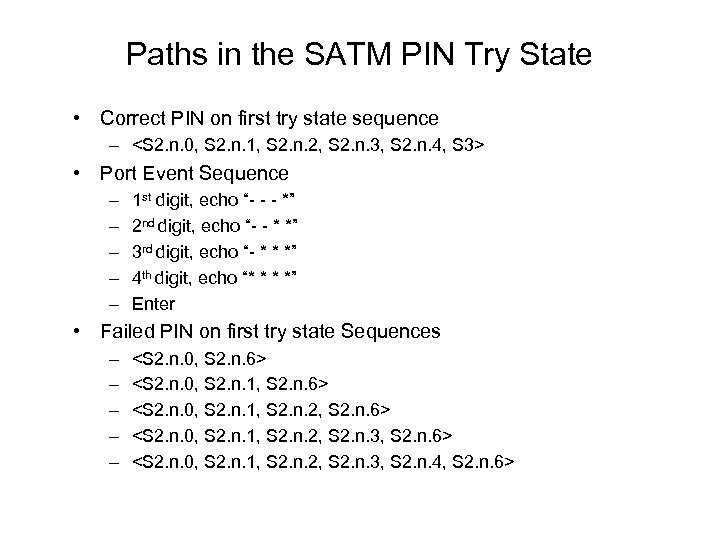 Paths in the SATM PIN Try State • Correct PIN on first try state sequence –
 • Port Event Sequence – – – 1 st digit, echo “- - - *” 2 nd digit, echo “- - * *” 3 rd digit, echo “- * * *” 4 th digit, echo “* * * *” Enter • Failed PIN on first try state Sequences – – –
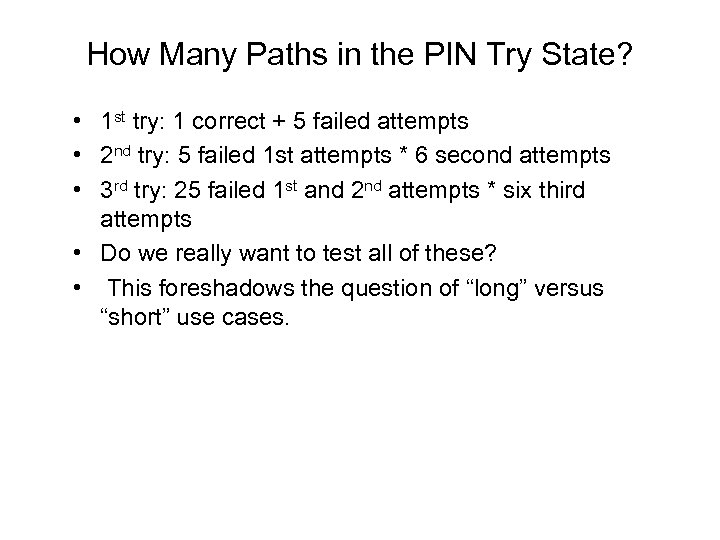 How Many Paths in the PIN Try State? • 1 st try: 1 correct + 5 failed attempts • 2 nd try: 5 failed 1 st attempts * 6 second attempts • 3 rd try: 25 failed 1 st and 2 nd attempts * six third attempts • Do we really want to test all of these? • This foreshadows the question of “long” versus “short” use cases.
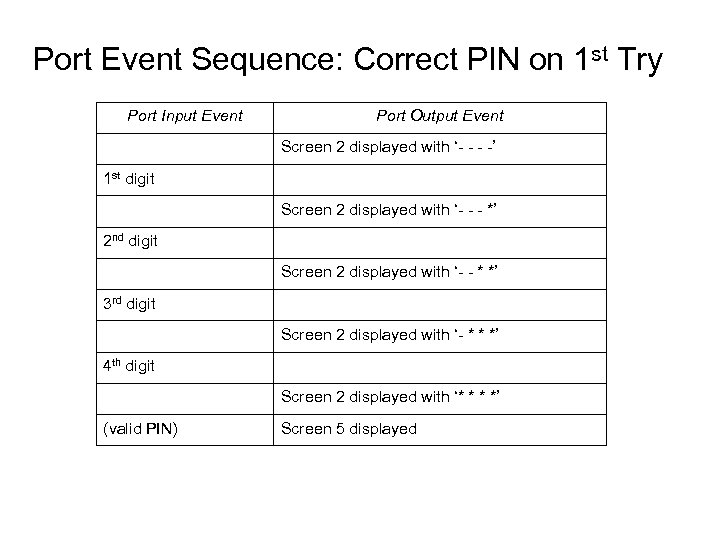 Port Event Sequence: Correct PIN on 1 st Try Port Input Event Port Output Event Screen 2 displayed with ‘- - - -’ 1 st digit Screen 2 displayed with ‘- - - *’ 2 nd digit Screen 2 displayed with ‘- - * *’ 3 rd digit Screen 2 displayed with ‘- * * *’ 4 th digit Screen 2 displayed with ‘* * * *’ (valid PIN) Screen 5 displayed
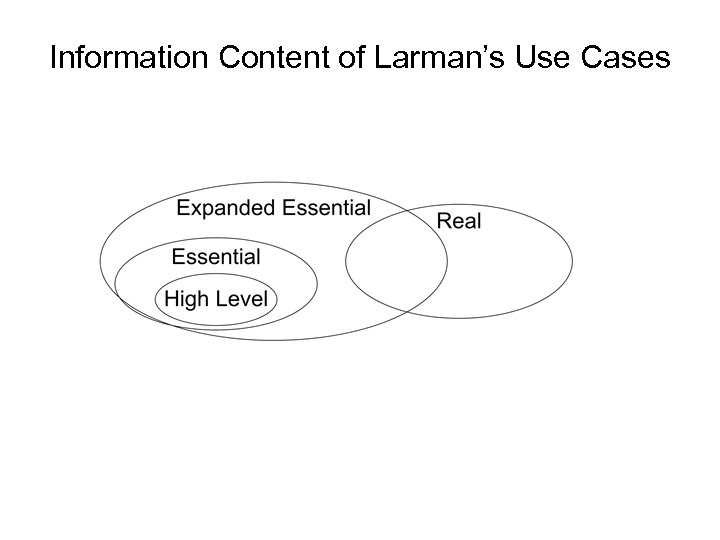 Information Content of Larman’s Use Cases
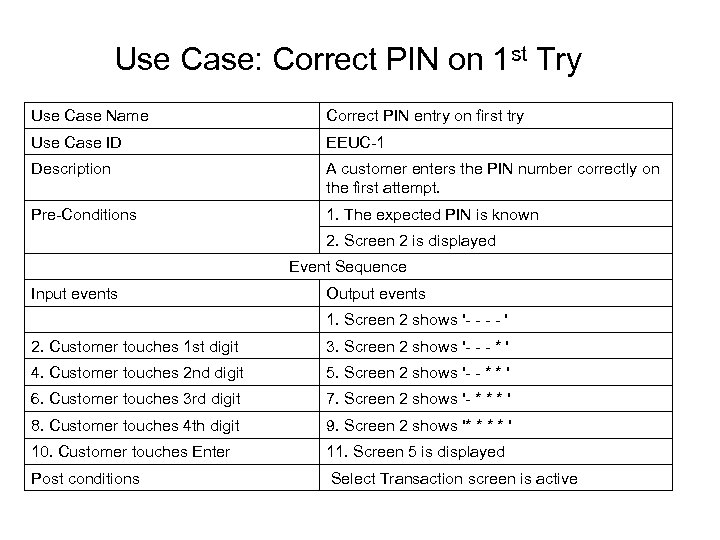 Use Case: Correct PIN on 1 st Try Use Case Name Correct PIN entry on first try Use Case ID EEUC-1 Description A customer enters the PIN number correctly on the first attempt. Pre-Conditions 1. The expected PIN is known 2. Screen 2 is displayed Event Sequence Input events Output events 1. Screen 2 shows '- - ' 2. Customer touches 1 st digit 3. Screen 2 shows '- - - * ' 4. Customer touches 2 nd digit 5. Screen 2 shows '- - * * ' 6. Customer touches 3 rd digit 7. Screen 2 shows '- * * * ' 8. Customer touches 4 th digit 9. Screen 2 shows '* * ' 10. Customer touches Enter 11. Screen 5 is displayed Post conditions Select Transaction screen is active
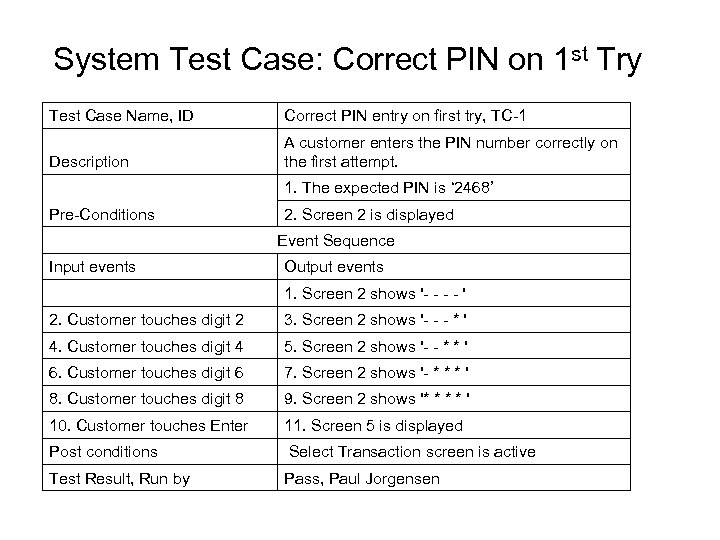 System Test Case: Correct PIN on 1 st Try Test Case Name, ID Correct PIN entry on first try, TC-1 Description A customer enters the PIN number correctly on the first attempt. 1. The expected PIN is ‘ 2468’ Pre-Conditions 2. Screen 2 is displayed Event Sequence Input events Output events 1. Screen 2 shows '- - ' 2. Customer touches digit 2 3. Screen 2 shows '- - - * ' 4. Customer touches digit 4 5. Screen 2 shows '- - * * ' 6. Customer touches digit 6 7. Screen 2 shows '- * * * ' 8. Customer touches digit 8 9. Screen 2 shows '* * ' 10. Customer touches Enter 11. Screen 5 is displayed Post conditions Select Transaction screen is active Test Result, Run by Pass, Paul Jorgensen
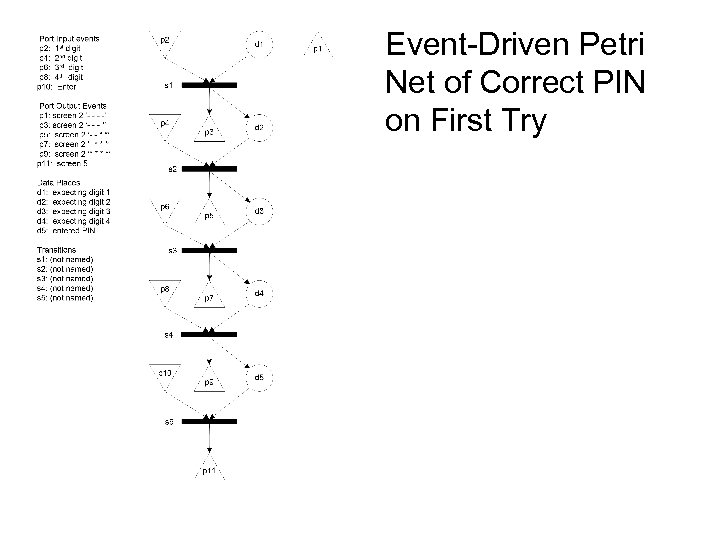 Event-Driven Petri Net of Correct PIN on First Try
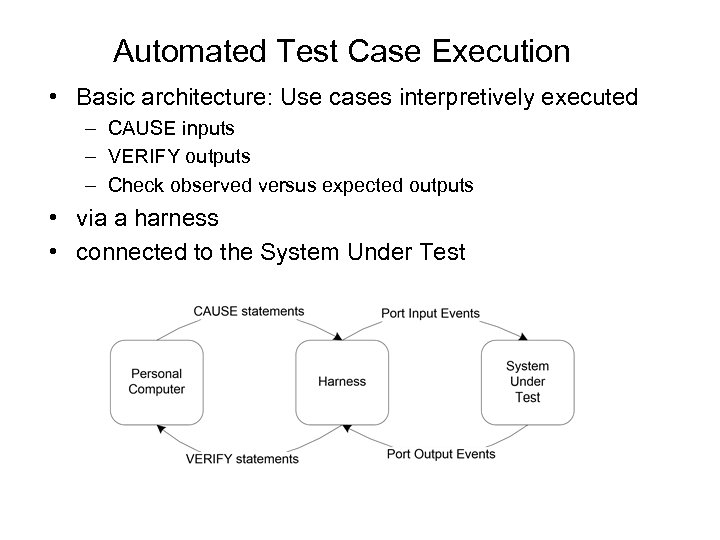 Automated Test Case Execution • Basic architecture: Use cases interpretively executed – CAUSE inputs – VERIFY outputs – Check observed versus expected outputs • via a harness • connected to the System Under Test
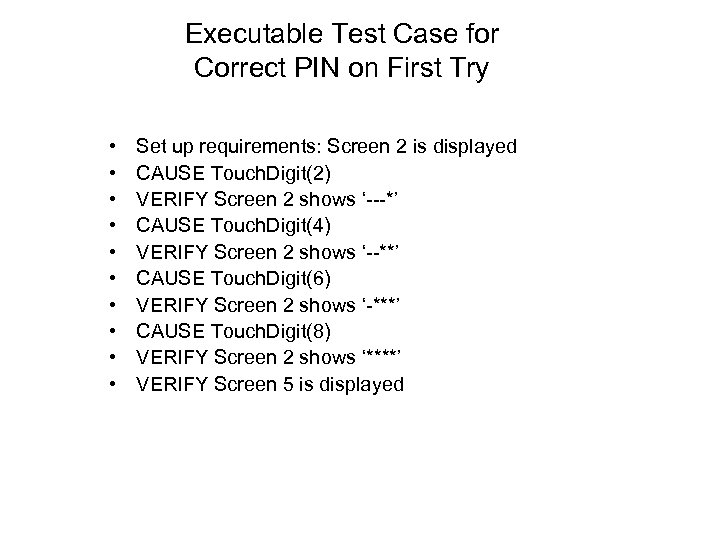 Executable Test Case for Correct PIN on First Try • • • Set up requirements: Screen 2 is displayed CAUSE Touch. Digit(2) VERIFY Screen 2 shows ‘---*’ CAUSE Touch. Digit(4) VERIFY Screen 2 shows ‘--**’ CAUSE Touch. Digit(6) VERIFY Screen 2 shows ‘-***’ CAUSE Touch. Digit(8) VERIFY Screen 2 shows ‘****’ VERIFY Screen 5 is displayed
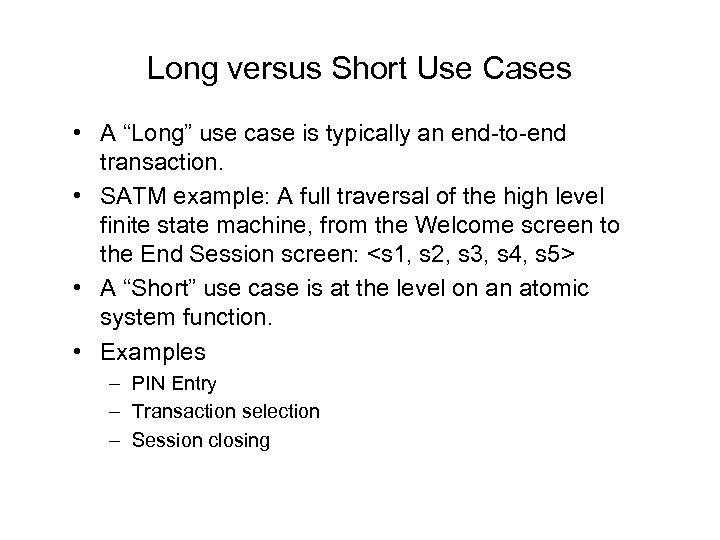 Long versus Short Use Cases • A “Long” use case is typically an end-to-end transaction. • SATM example: A full traversal of the high level finite state machine, from the Welcome screen to the End Session screen:
 • A “Short” use case is at the level on an atomic system function. • Examples – PIN Entry – Transaction selection – Session closing
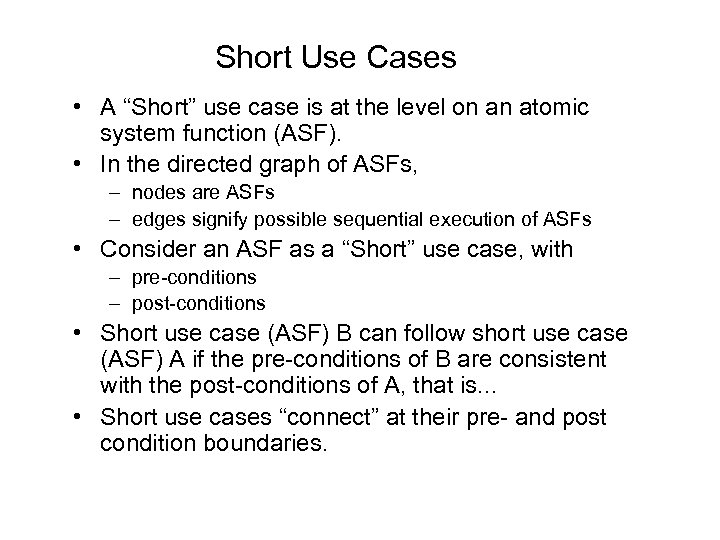 Short Use Cases • A “Short” use case is at the level on an atomic system function (ASF). • In the directed graph of ASFs, – nodes are ASFs – edges signify possible sequential execution of ASFs • Consider an ASF as a “Short” use case, with – pre-conditions – post-conditions • Short use case (ASF) B can follow short use case (ASF) A if the pre-conditions of B are consistent with the post-conditions of A, that is. . . • Short use cases “connect” at their pre- and post condition boundaries.
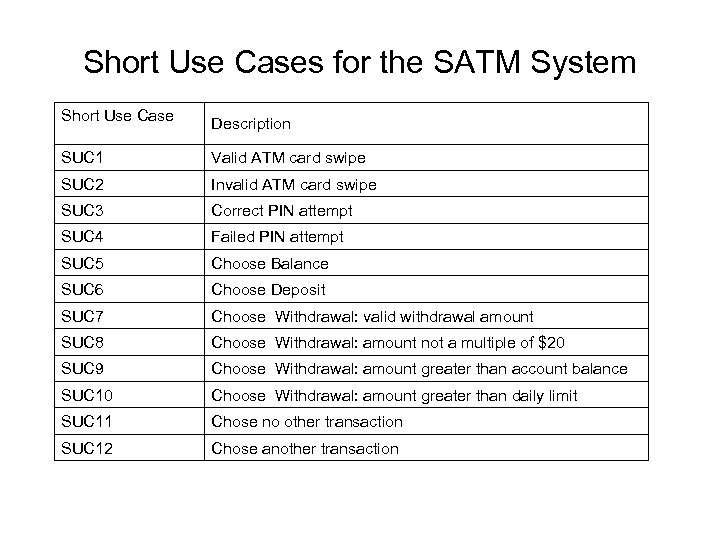 Short Use Cases for the SATM System Short Use Case Description SUC 1 Valid ATM card swipe SUC 2 Invalid ATM card swipe SUC 3 Correct PIN attempt SUC 4 Failed PIN attempt SUC 5 Choose Balance SUC 6 Choose Deposit SUC 7 Choose Withdrawal: valid withdrawal amount SUC 8 Choose Withdrawal: amount not a multiple of $20 SUC 9 Choose Withdrawal: amount greater than account balance SUC 10 Choose Withdrawal: amount greater than daily limit SUC 11 Chose no other transaction SUC 12 Chose another transaction
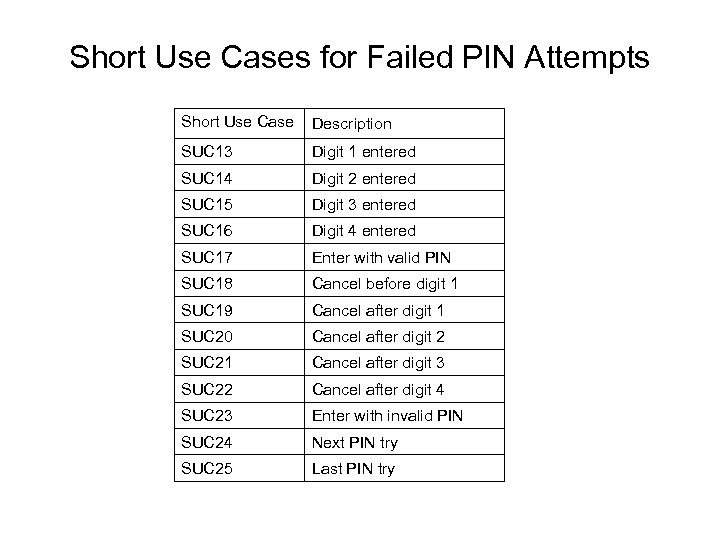 Short Use Cases for Failed PIN Attempts Short Use Case Description SUC 13 Digit 1 entered SUC 14 Digit 2 entered SUC 15 Digit 3 entered SUC 16 Digit 4 entered SUC 17 Enter with valid PIN SUC 18 Cancel before digit 1 SUC 19 Cancel after digit 1 SUC 20 Cancel after digit 2 SUC 21 Cancel after digit 3 SUC 22 Cancel after digit 4 SUC 23 Enter with invalid PIN SUC 24 Next PIN try SUC 25 Last PIN try
 How Many Use Cases? • 1909 “long” use cases • 25 “short” use cases • Ways to determine “how many? – Incidence with input events (cover every input event) – Incidence with output events (cover every output event) – Incidence with classes (need a use case/class incidence matrix) • These lead directly to system testing coverage metrics.
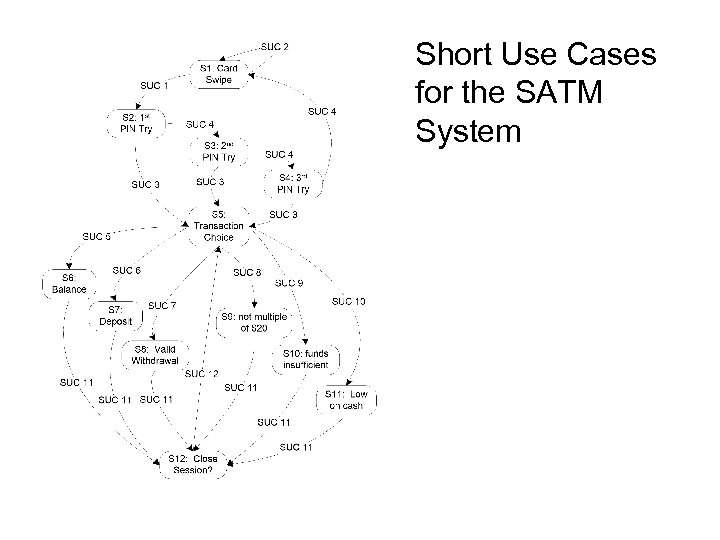 Short Use Cases for the SATM System
 System Testing with Short Use Cases • Basic idea: a short use case is an atomic system function (ASF) • ASFs. . . – begin with a port input event – end is one of possibly several port output events • ASFs can be identified – in source code – in executable models – from short use cases • Example: the integration version of Next. Date – (see text)
 Using Operational Profile when interested in “Effectiveness” • The effectiveness of testing is often measured in terms of problems found versus effort spent or – (# of defects found) / person hours spent – (# of defects found) / number of test cases Not just the number of problems found • Historically, most of the failures also tend to fall in small parts of the system (80% failures occur in 20% of the system - - - e. g. the most heavily traversed threads). – Thus if we can collect the operational profiles of the users, we can identify the most heavily used threads. – This strategy of system testing with operational profile can improve our test efficiency.
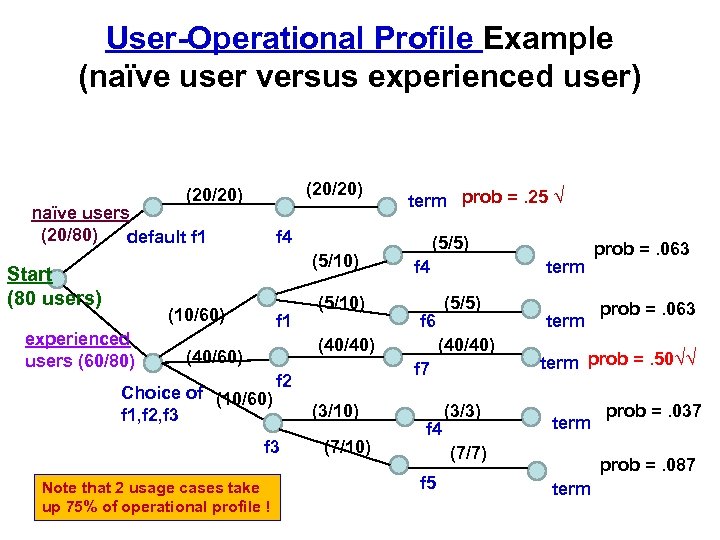 User-Operational Profile Example (naïve user versus experienced user) (20/20) naïve users (20/80) default f 1 f 4 (5/10) Start (80 users) (10/60) experienced users (60/80) term prob =. 25 √ f 1 (5/10) (5/5) f 4 Choice of (10/60) f 1, f 2, f 3 Note that 2 usage cases take up 75% of operational profile ! (40/40) f 7 f 2 f 3 (5/5) f 6 (40/40) (40/60) term (3/10) (7/10) f 4 (3/3) term prob =. 063 term prob =. 50√√ term (7/7) f 5 prob =. 063 prob =. 037 prob =. 087 term