


 Скачать презентацию Chapter 14 Spending Income and GDP 2012
31d8fde33c185851f68956d643c50b22.ppt
- Количество слайдов: 48
 Chapter 14: Spending, Income, and GDP © 2012 The Mc. Graw-Hill Companies, All Rights Reserved 1
 Learning Objectives 1. Explain how economist define and measure an economy's output 2. Use the expenditure method for measuring GDP to analyze economic activity 3. Define and compute nominal GDP and real GDP 4. Discuss the relationships between GDP and economic well-being © 2012 The Mc. Graw-Hill Companies, All Rights Reserved 2
 Macroeconomics n Data on output, employment, prices Ø Vital signs of the economy § Employment, unemployment, average work hours § Stock values and trends § Prices and inflation Ø Reported often in the news n Systematic measurement of economic output developed during World War II Ø Common systems and measured used virtually worldwide © 2012 The Mc. Graw-Hill Companies, All Rights Reserved 3
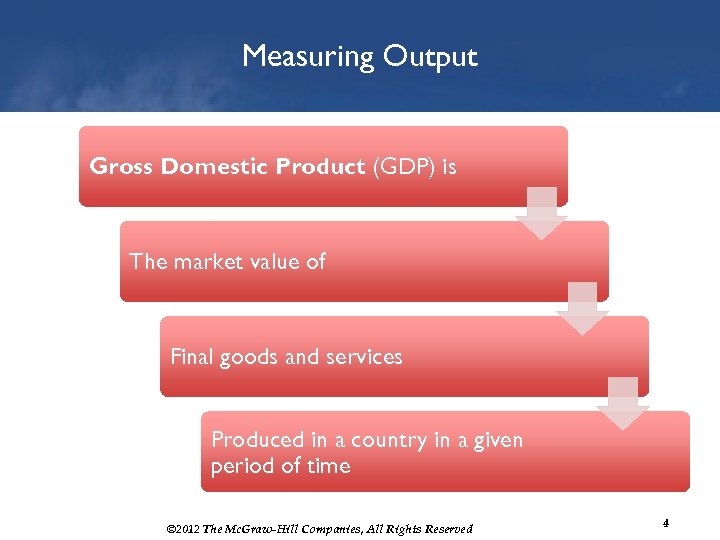 Measuring Output Gross Domestic Product (GDP) is The market value of Final goods and services Produced in a country in a given period of time © 2012 The Mc. Graw-Hill Companies, All Rights Reserved 4
 Market Value n A modern economy produces many different goods and services n Macroeconomists’ goal is to understand the behavior of the economy as a whole Ø This is done through answers to the following questions: § § Has the overall capacity of the economy to produce goods and services increased over time? If so, by how much? n Economists aggregate the quantities of the many different goods and services into a single number © 2012 The Mc. Graw-Hill Companies, All Rights Reserved 5
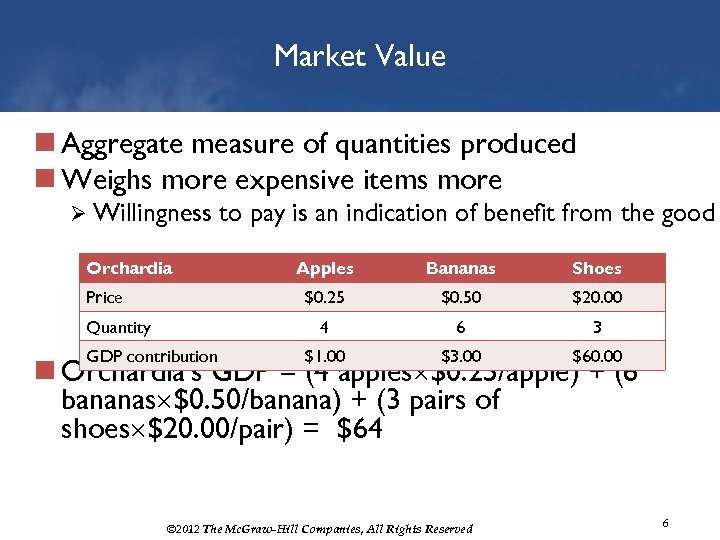 Market Value n Aggregate measure of quantities produced n Weighs more expensive items more Ø Willingness Orchardia to pay is an indication of benefit from the good GDP contribution Shoes $0. 50 $20. 00 4 Quantity Bananas $0. 25 Price Apples 6 3 $1. 00 $3. 00 $60. 00 n Orchardia's GDP = (4 apples $0. 25/apple) + (6 bananas $0. 50/banana) + (3 pairs of shoes $20. 00/pair) = $64 © 2012 The Mc. Graw-Hill Companies, All Rights Reserved 6
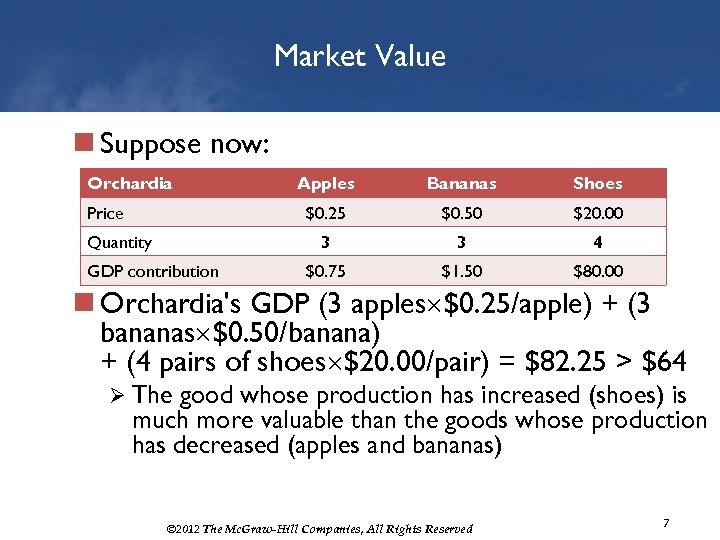 Market Value n Suppose now: Orchardia GDP contribution Shoes $0. 50 $20. 00 3 Quantity Bananas $0. 25 Price Apples 3 4 $0. 75 $1. 50 $80. 00 n Orchardia's GDP (3 apples $0. 25/apple) + (3 bananas $0. 50/banana) + (4 pairs of shoes $20. 00/pair) = $82. 25 > $64 Ø The good whose production has increased (shoes) is much more valuable than the goods whose production has decreased (apples and bananas) © 2012 The Mc. Graw-Hill Companies, All Rights Reserved 7
 Female Labor Force Participation n The percentage of adult women working outside the home has increased dramatically over the past three decades in the Middle East and North Africa Ø Women’s labor force participation: § Egypt: 7% in 1980 to about 26% in 2005 § Morocco: 15% in 1982 to about 30% in 2007 n Still it remains very low relative to other industrialized nations such as the US and the UK (60% and 70%) § If more women join the workforce, how is this change expected to affect measured GDP? © 2012 The Mc. Graw-Hill Companies, All Rights Reserved 8
 Female Labor Force Participation n The entry of more women into the labor market can raise measured GDP in two ways: Ø The goods and services that women produce in their new jobs contribute directly to increasing GDP § Ø Represents a genuine increase in economic activity The fact that paid workers take over previously unpaid housework and childcare duties increases measured GDP by the amount paid to those workers § Reflects a transfer of existing economic activities from the unpaid sector to the market sector n Measured change in GDP overstates actual change © 2012 The Mc. Graw-Hill Companies, All Rights Reserved 9
 Increasing Efficiency n Principle of Comparative Advantage applies to household tasks Ø Produce at lowest opportunity cost Ø Women with high opportunity cost of household tasks find other ways to get the tasks completed n Feminist movement, civil rights concerns, increasing educational attainment, and loosening social constraints moved women into the work force Ø Household tasks performed by paid specialists © 2012 The Mc. Graw-Hill Companies, All Rights Reserved 10
 Some Non-Market Goods Included n Government goods and services are not sold in the market § Protection by the army / transportation / education Ø These goods have value Ø Increase overall output Ø Quantities are known Ø Prices cannot be established n Government production is valued at cost Ø Overstates inefficiency GDP if there is waste and © 2012 The Mc. Graw-Hill Companies, All Rights Reserved 11
 Final Goods and Services n Final goods are consumed by the ultimate user Ø End products of production Ø Included in GDP n Intermediate goods are used up in the production of final goods Ø Not included in GDP § Avoids double counting n A barber's assistant earns $2 per haircut for providing services such as shampooing and sweeping up Ø Barber charges $10 per haircut Ø Haircut's contribution to GDP is $10 © 2012 The Mc. Graw-Hill Companies, All Rights Reserved 12
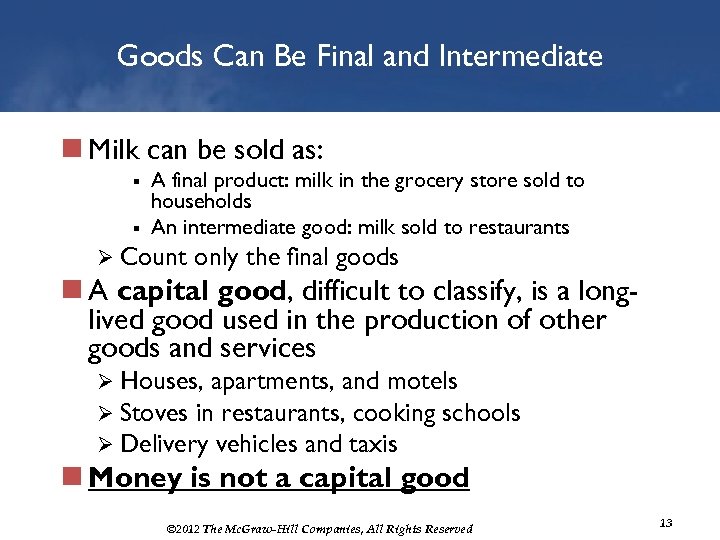 Goods Can Be Final and Intermediate n Milk can be sold as: § § A final product: milk in the grocery store sold to households An intermediate good: milk sold to restaurants Ø Count only the final goods n A capital good, difficult to classify, is a longlived good used in the production of other goods and services Ø Houses, apartments, and motels Ø Stoves in restaurants, cooking schools Ø Delivery vehicles and taxis n Money is not a capital good © 2012 The Mc. Graw-Hill Companies, All Rights Reserved 13
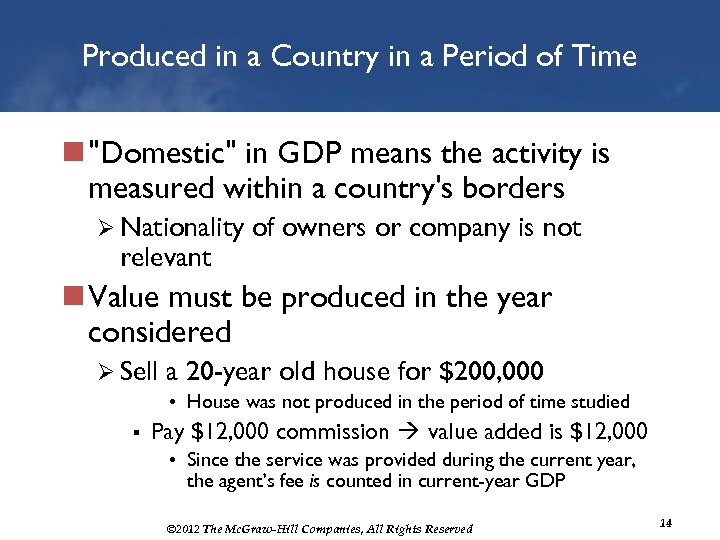 Produced in a Country in a Period of Time n "Domestic" in GDP means the activity is measured within a country's borders Ø Nationality relevant of owners or company is not n Value must be produced in the year considered Ø Sell a 20 -year old house for $200, 000 • House was not produced in the period of time studied § Pay $12, 000 commission value added is $12, 000 • Since the service was provided during the current year, the agent’s fee is counted in current-year GDP © 2012 The Mc. Graw-Hill Companies, All Rights Reserved 14
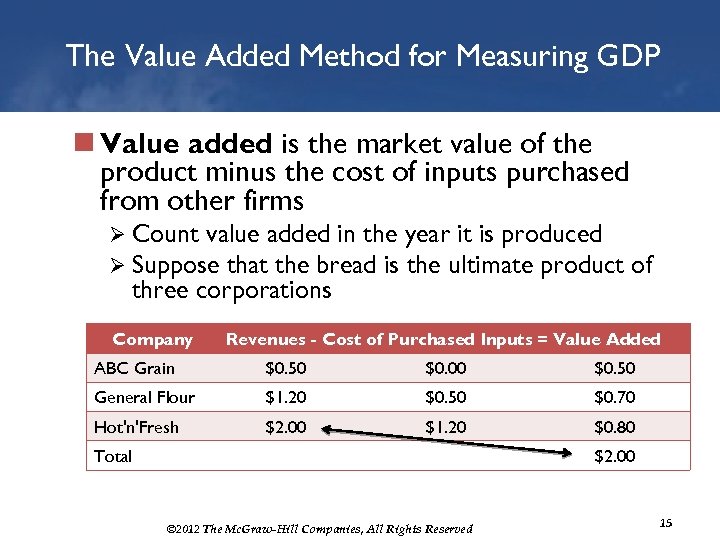 The Value Added Method for Measuring GDP n Value added is the market value of the product minus the cost of inputs purchased from other firms Ø Count value added in the year it is produced Ø Suppose that the bread is the ultimate product three corporations Company of Revenues - Cost of Purchased Inputs = Value Added ABC Grain $0. 50 $0. 00 $0. 50 General Flour $1. 20 $0. 50 $0. 70 Hot'n'Fresh $2. 00 $1. 20 $0. 80 Total $2. 00 © 2012 The Mc. Graw-Hill Companies, All Rights Reserved 15
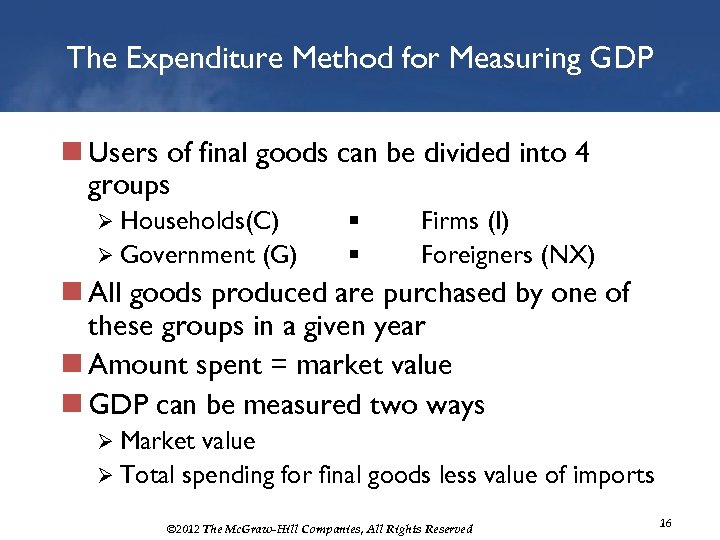 The Expenditure Method for Measuring GDP n Users of final goods can be divided into 4 groups Ø Households(C) ■ Ø Government ■ (G) Firms (I) Foreigners (NX) n All goods produced are purchased by one of these groups in a given year n Amount spent = market value n GDP can be measured two ways Ø Market value Ø Total spending for final goods less value of imports © 2012 The Mc. Graw-Hill Companies, All Rights Reserved 16
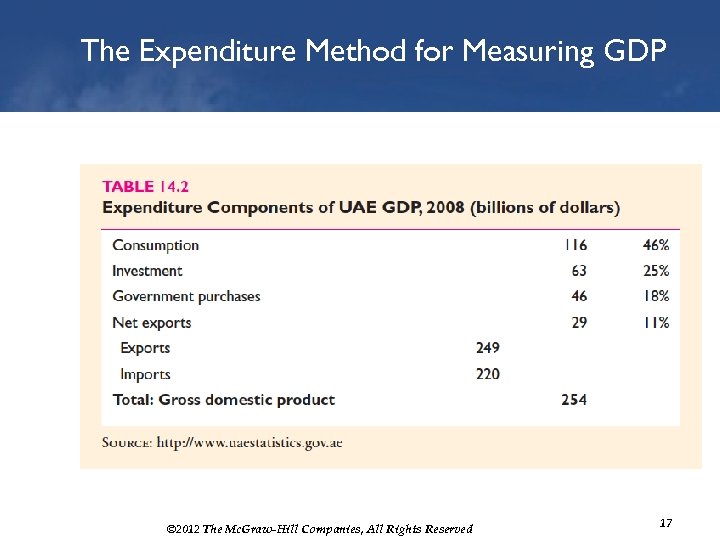 The Expenditure Method for Measuring GDP © 2012 The Mc. Graw-Hill Companies, All Rights Reserved 17
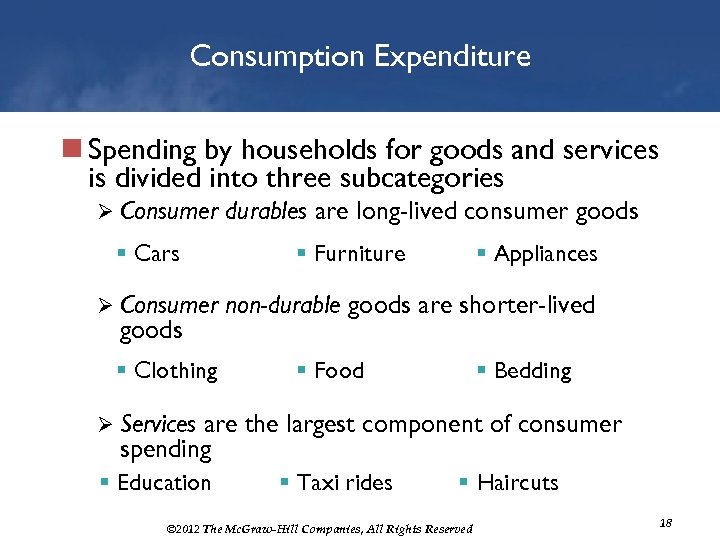 Consumption Expenditure n Spending by households for goods and services is divided into three subcategories Ø Consumer § Cars Ø Consumer goods § Clothing durables are long-lived consumer goods § Furniture § Appliances non-durable goods are shorter-lived § Food § Bedding Ø Services are the largest component of consumer spending § Education § Taxi rides § Haircuts © 2012 The Mc. Graw-Hill Companies, All Rights Reserved 18
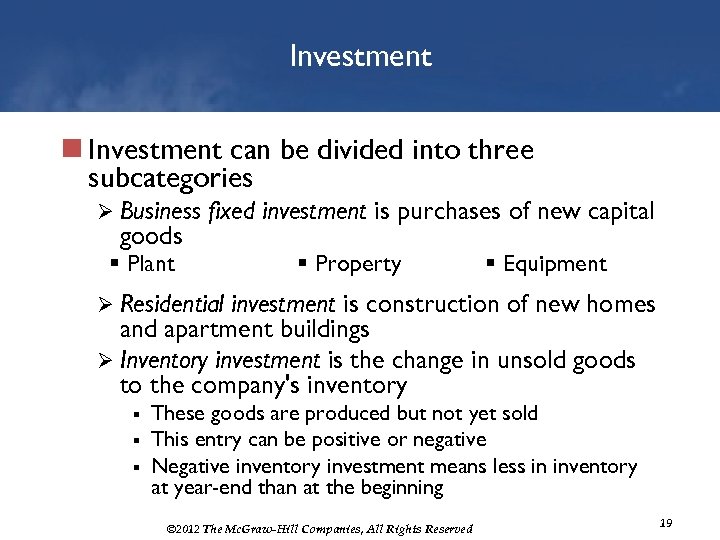 Investment n Investment can be divided into three subcategories Ø Business goods fixed investment is purchases of new capital § Plant § Property § Equipment Ø Residential investment is construction of new homes and apartment buildings Ø Inventory investment is the change in unsold goods to the company's inventory § § § These goods are produced but not yet sold This entry can be positive or negative Negative inventory investment means less in inventory at year-end than at the beginning © 2012 The Mc. Graw-Hill Companies, All Rights Reserved 19
 Economic Investment and Financial Investment n The purchase of stocks and bonds do not represent an investment, as defined in this chapter. Rather, they are referred to as financial investments. n Financial investments include purchases of stocks, bonds, and other financial assets Purchase generally transfers ownership of a portion of the firm's existing capital stock Ø Does not correspond to any increase in physical capital or production capacity, in most cases Ø § New stock issues can be an exception n Economic investment refers to the increase in the capital goods used to produce other goods Ø This value is based on purchase price of the capital goods, not on stock value © 2012 The Mc. Graw-Hill Companies, All Rights Reserved 20
 Government Purchases n Federal, state, and local government purchase final goods and services § Fighter jets § Teaching § Office supplies n Excludes transfer payments Ø Transfer payments are made by government but the government receives no current goods or services § § Pension benefits, unemployment No purchases of final goods and services involved in transfer payments • Spending by recipients is included in GDP n Excludes interest paid on government debt © 2012 The Mc. Graw-Hill Companies, All Rights Reserved 21
 Net Exports n Net exports are exports (X) minus imports (M) Ø Exports are goods and services produced domestically and sold abroad § Exports reduce the amount available to the domestic economy Ø Imports are purchases of goods and services produced abroad § § Imports can be consumption, investment, or government spending Imports increase the amount available to the domestic economy © 2012 The Mc. Graw-Hill Companies, All Rights Reserved 22
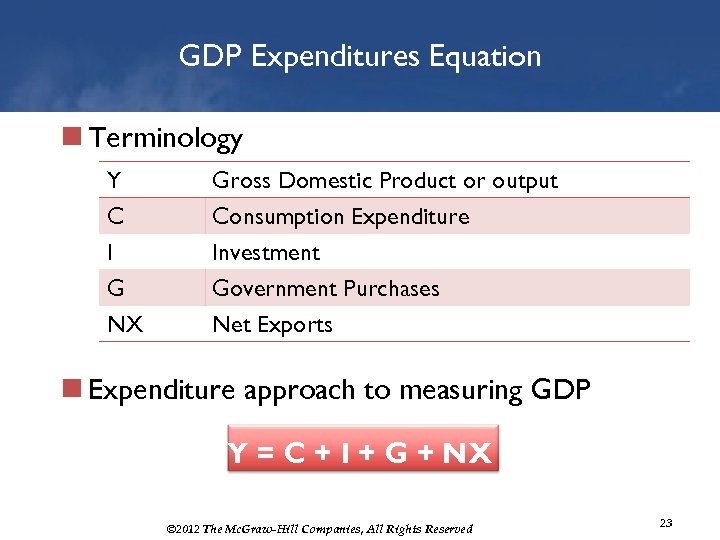 GDP Expenditures Equation n Terminology Y C I G Gross Domestic Product or output Consumption Expenditure Investment Government Purchases NX Net Exports n Expenditure approach to measuring GDP Y = C + I + G + NX © 2012 The Mc. Graw-Hill Companies, All Rights Reserved 23
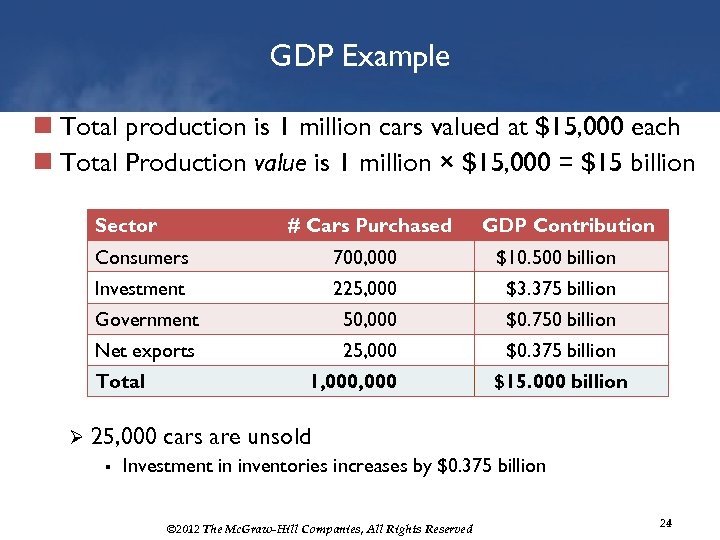 GDP Example n Total production is 1 million cars valued at $15, 000 each n Total Production value is 1 million × $15, 000 = $15 billion Sector # Cars Purchased GDP Contribution Consumers 700, 000 $10. 500 billion Investment Businesses 225, 000 200, 000 $3. 375 $3. 000 billion Government 50, 000 $0. 750 billion Net exports 25, 000 $0. 375 billion Total Ø 1, 000 975, 000 $15. 000 $14. 625 billion 25, 000 cars are unsold § Investment in inventories increases by $0. 375 billion © 2012 The Mc. Graw-Hill Companies, All Rights Reserved 24
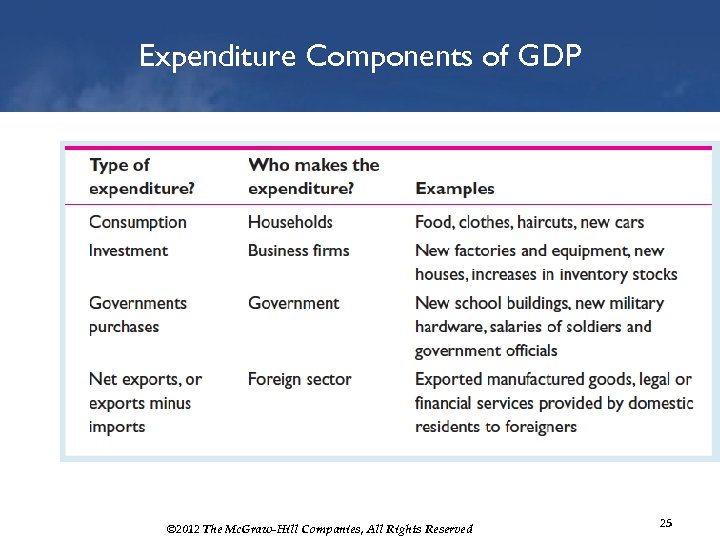 Expenditure Components of GDP © 2012 The Mc. Graw-Hill Companies, All Rights Reserved 25
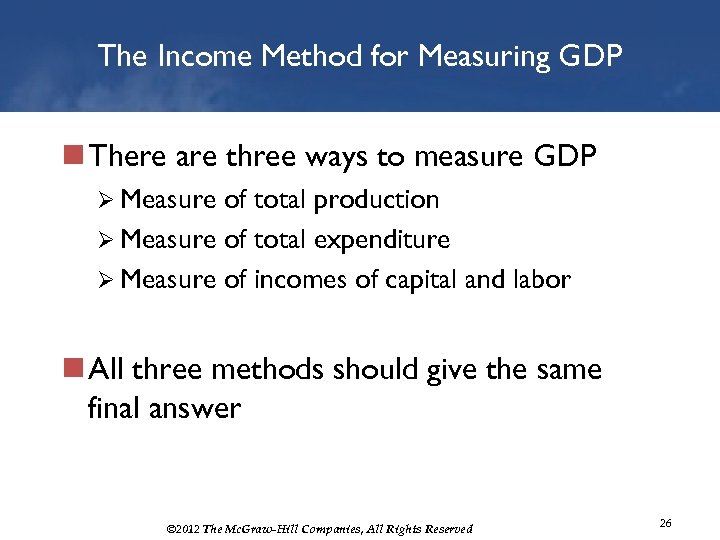 The Income Method for Measuring GDP n There are three ways to measure GDP Ø Measure of total production Ø Measure of total expenditure Ø Measure of incomes of capital and labor n All three methods should give the same final answer © 2012 The Mc. Graw-Hill Companies, All Rights Reserved 26
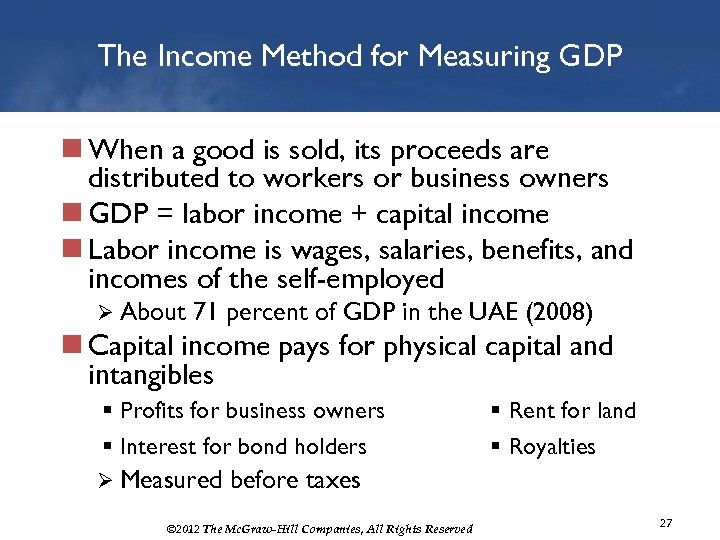 The Income Method for Measuring GDP n When a good is sold, its proceeds are distributed to workers or business owners n GDP = labor income + capital income n Labor income is wages, salaries, benefits, and incomes of the self-employed Ø About 71 percent of GDP in the UAE (2008) n Capital income pays for physical capital and intangibles § Profits for business owners § Interest for bond holders Ø Measured § Rent for land § Royalties before taxes © 2012 The Mc. Graw-Hill Companies, All Rights Reserved 27
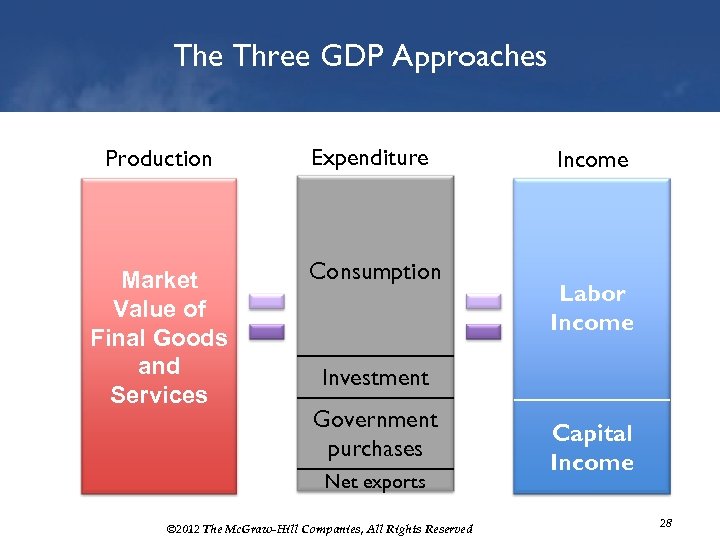 The Three GDP Approaches Production Expenditure Market Value of Final Goods and Services Consumption Income Labor Income Investment Government purchases Net exports © 2012 The Mc. Graw-Hill Companies, All Rights Reserved Capital Income 28
 Nominal GDP versus Real GDP n Compare GDP for different years to see how much output has changed n GDP changes over time because Ø Prices change AND / OR Ø Quantity of output changes n To see how much output has grown, use only the changes in quantities Ø Hold prices constant © 2012 The Mc. Graw-Hill Companies, All Rights Reserved 29
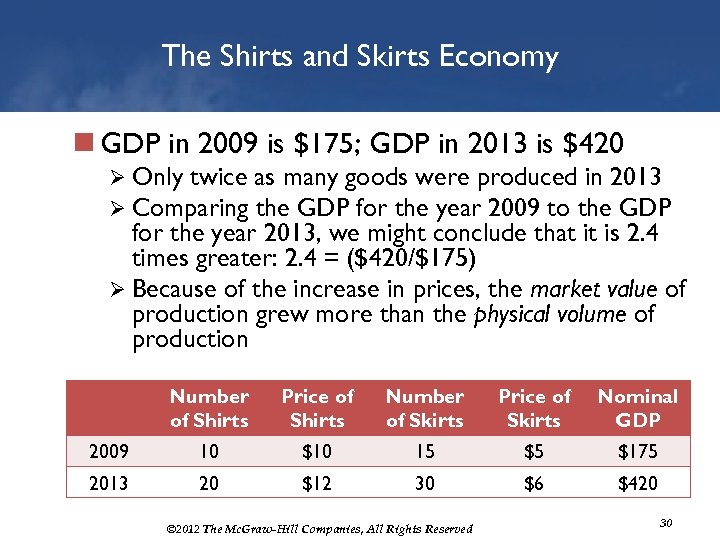 The Shirts and Skirts Economy n GDP in 2009 is $175; GDP in 2013 is $420 Ø Only twice as many goods were produced in 2013 Ø Comparing the GDP for the year 2009 to the GDP for the year 2013, we might conclude that it is 2. 4 times greater: 2. 4 = ($420/$175) Ø Because of the increase in prices, the market value of production grew more than the physical volume of production Number of Shirts Price of Shirts Number of Skirts Price of Skirts Nominal GDP 2009 10 $10 15 $5 $175 2013 20 $12 30 $6 $420 © 2012 The Mc. Graw-Hill Companies, All Rights Reserved 30
 Real GDP and Nominal GDP n Real GDP (RGDP) values output in the current year using the prices from the base year Ø The base year is a reference year that changes infrequently Ø Real GDP measures the physical volume of production n Nominal GDP (NGDP) values output in the current year using prices from the current year Ø Nominal GDP is the current dollar value of production © 2012 The Mc. Graw-Hill Companies, All Rights Reserved 31
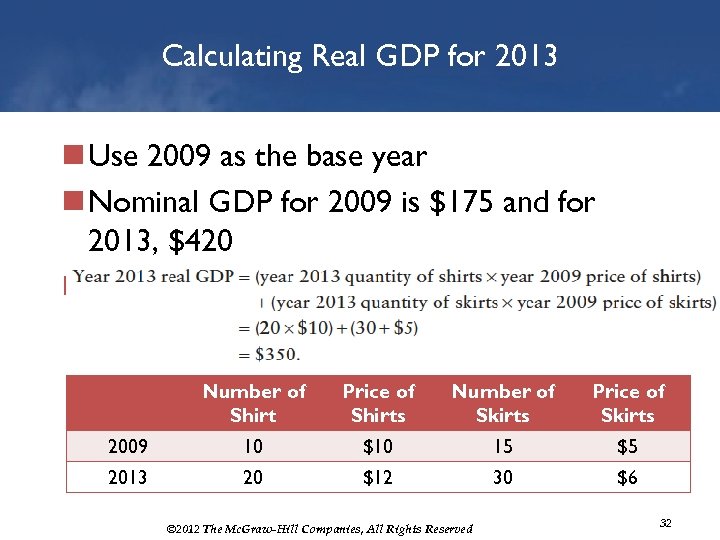 Calculating Real GDP for 2013 n Use 2009 as the base year n Nominal GDP for 2009 is $175 and for 2013, $420 n Calculate real GDP using current year quantities and base year prices Number of Shirt Price of Shirts Number of Skirts Price of Skirts 2009 10 $10 15 $5 2013 20 $12 30 $6 © 2012 The Mc. Graw-Hill Companies, All Rights Reserved 32
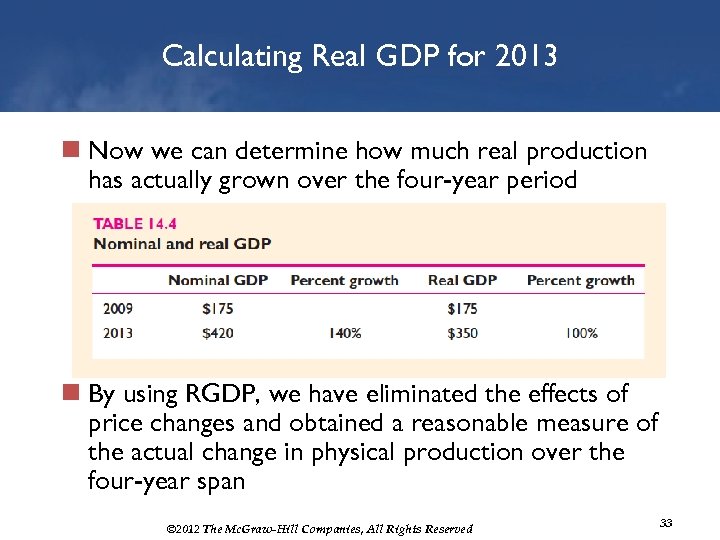 Calculating Real GDP for 2013 n Now we can determine how much real production has actually grown over the four-year period n By using RGDP, we have eliminated the effects of price changes and obtained a reasonable measure of the actual change in physical production over the four-year span © 2012 The Mc. Graw-Hill Companies, All Rights Reserved 33
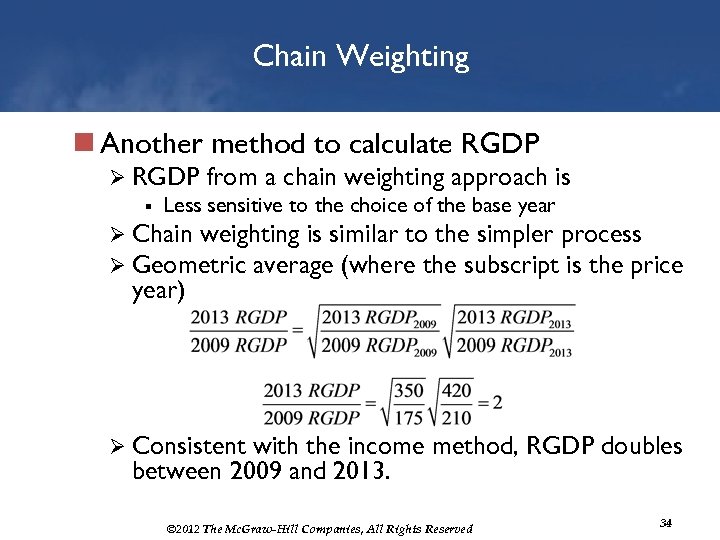 Chain Weighting n Another method to calculate RGDP Ø RGDP from a chain weighting approach is § Less sensitive to the choice of the base year Ø Chain weighting is similar to the simpler process Ø Geometric average (where the subscript is the price year) Ø Consistent with the income method, RGDP doubles between 2009 and 2013. © 2012 The Mc. Graw-Hill Companies, All Rights Reserved 34
 Observations on Real and Nominal GDP n Usually, nominal and real GDP increase each year n Nominal GDP can go up and real GDP go down Fewer goods and services produced AND Ø Prices increase faster than output decreased Ø n Nominal GDP will be smaller than real GDP if the prices in the current year are less than in the base year Ø Usually true for years before the base year n Real GDP could rise and nominal GDP fall, but this is rare Ø Prices are falling faster than output is increasing © 2012 The Mc. Graw-Hill Companies, All Rights Reserved 35
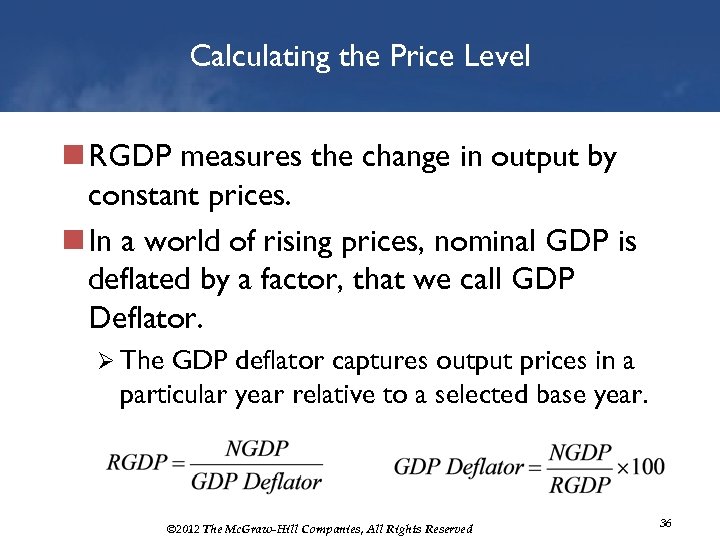 Calculating the Price Level n RGDP measures the change in output by constant prices. n In a world of rising prices, nominal GDP is deflated by a factor, that we call GDP Deflator. Ø The GDP deflator captures output prices in a particular year relative to a selected base year. © 2012 The Mc. Graw-Hill Companies, All Rights Reserved 36
 GDP Deflator n The GDP deflator represents a measure of the overall price level of produced goods and services. n The GDP deflator is equal to 100 in the base year. n It is greater than 100 when the current year’s prices exceed the base year’s prices. n It is less than 100 when the current year’s prices are lower than the base year’s prices. © 2012 The Mc. Graw-Hill Companies, All Rights Reserved 37
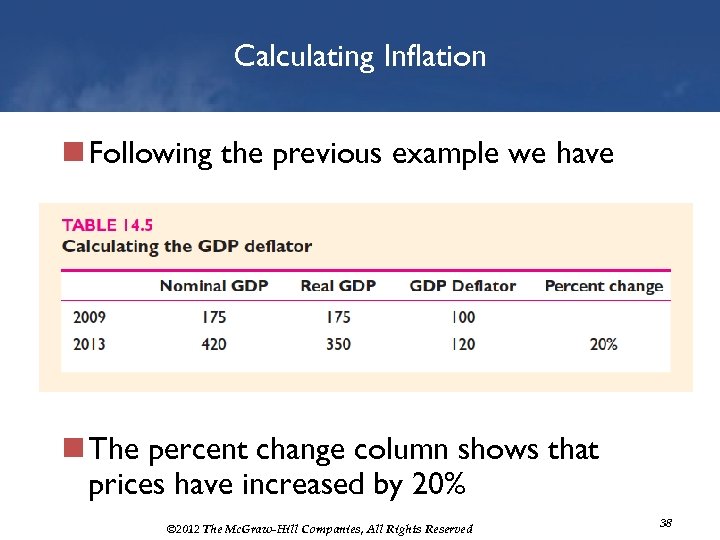 Calculating Inflation n Following the previous example we have n The percent change column shows that prices have increased by 20% © 2012 The Mc. Graw-Hill Companies, All Rights Reserved 38
 Real GDP and Economic Well-Being n Real GDP is a flawed measure of well-being Ø It § values only market transactions Omits illegal transactions, volunteer work, and household production n Maximizing GDP will not necessarily maximize national well-being Ø Whether increases in output increase welfare is a case-by-case issue © 2012 The Mc. Graw-Hill Companies, All Rights Reserved 39
 GDP Does Not Value Leisure n Amount of leisure time has increased in the past 100 years Ø Work weeks are shorter Ø People enter the labor force at an older age Ø People retire earlier n Leisure produces no goods for market Ø GDP places a value of zero on all leisure time Ø Opportunity cost of an hour of leisure is your hourly wage Ø Omission of the value of leisure time makes GDP seem smaller © 2012 The Mc. Graw-Hill Companies, All Rights Reserved 40
 Nonmarket Economic Activities n GDP omits services that are not traded in markets Ø Household production § This is of particular importance to developing countries where services are commonly traded for others Ø Volunteer services n Valuing these services would be difficult n Nonmarket activities are important in poor countries Ø Self-sufficient services households and bartered goods and © 2012 The Mc. Graw-Hill Companies, All Rights Reserved 41
 Underground economy n Underground economy is all unreported transactions, legal and illegal n Casual labor is often paid in cash Ø Failure to report transaction reduces taxes Ø Includes baby sitters, lawn care, home repair, etc. n Some underground activity is illegal ØA service of value is provided Ø Drug dealers, etc n Estimates suggest the underground economy is large regardless of national income level © 2012 The Mc. Graw-Hill Companies, All Rights Reserved 42
 Environmental Quality n Suppose a factory is built in your town Ø People are employed and output is produced § Productive activity is included in GDP n Suppose further that the factory creates pollution Ø Your city hires a company to restore the environment to its initial condition Ø Clean-up activities are included in GDP § Gets environment back to its starting point, not better © 2012 The Mc. Graw-Hill Companies, All Rights Reserved 43
 Resource Depletion n No adjustment is made for the decline in resource availability when mining or other harvesting is done Ø One more barrel of oil on the market means one less barrel for future use n Environmental quality and resource depletion are difficult to value Ø They have value and that value is omitted from GDP © 2012 The Mc. Graw-Hill Companies, All Rights Reserved 44
 Other Quality of Life Considerations n GDP does not account for intangibles people value Ø Crime rates Ø Traffic congestion Ø Civic organizations Ø Open space Ø Sense of community © 2012 The Mc. Graw-Hill Companies, All Rights Reserved 45
 Poverty and Economic Inequality n GDP measures the total quantity of goods and services produced and sold in an economy, but it conveys no information about who gets to enjoy those goods and services n Two countries may have identical GDPs but differ radically in the distribution of economic welfare across the population n GDP does not capture the effects of income inequality Ø Most would prefer living in a relatively equal society to one with a few wealthy and many poor © 2012 The Mc. Graw-Hill Companies, All Rights Reserved 46
 GDP as a Welfare Measure n GDP omits and undervalues some goods and services n GDP per capita is positively associated with several measures of well-being Ø Material standard of living: more goods and services Ø Health and life expectancy § Residents of industrialized countries fare better than residents of developing countries in a range of health measures Ø Education § Literacy and school enrollment rates are higher in highincome countries © 2012 The Mc. Graw-Hill Companies, All Rights Reserved 47
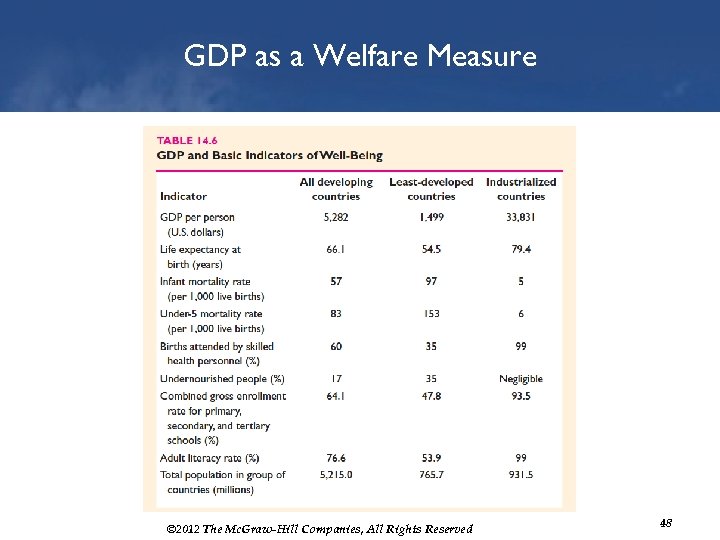 GDP as a Welfare Measure © 2012 The Mc. Graw-Hill Companies, All Rights Reserved 48