


 Скачать презентацию Chapter 14 Performance measurement and governance in purchasing
288e21b459081f9119983fce2fea2431.ppt
- Количество слайдов: 28
 Chapter 14 Performance measurement and governance in purchasing
 Program n n n n Factors influencing purchasing performance measurement Why measure purchasing performance? How to assess purchasing performance? Measuring purchasing performance Purchasing budgets, purchasing savings and other performance measure Sarbanes Oxley and procurement governance Purchasing audit as a management tool
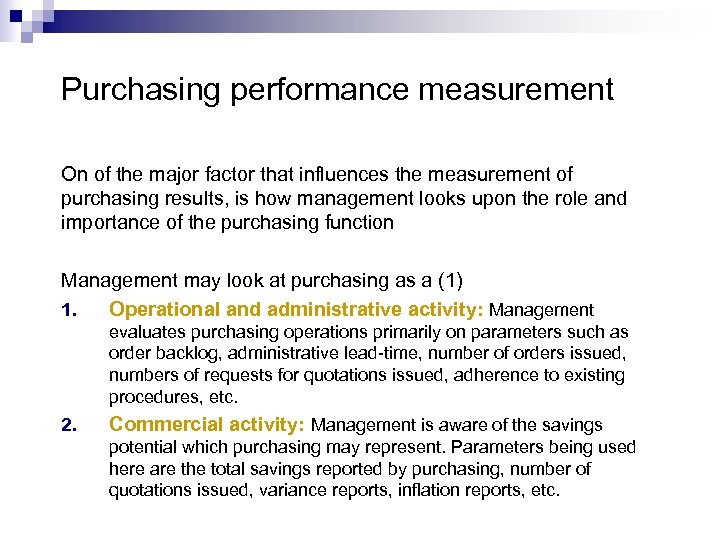 Purchasing performance measurement On of the major factor that influences the measurement of purchasing results, is how management looks upon the role and importance of the purchasing function Management may look at purchasing as a (1) 1. Operational and administrative activity: Management evaluates purchasing operations primarily on parameters such as order backlog, administrative lead-time, number of orders issued, numbers of requests for quotations issued, adherence to existing procedures, etc. 2. Commercial activity: Management is aware of the savings potential which purchasing may represent. Parameters being used here are the total savings reported by purchasing, number of quotations issued, variance reports, inflation reports, etc.
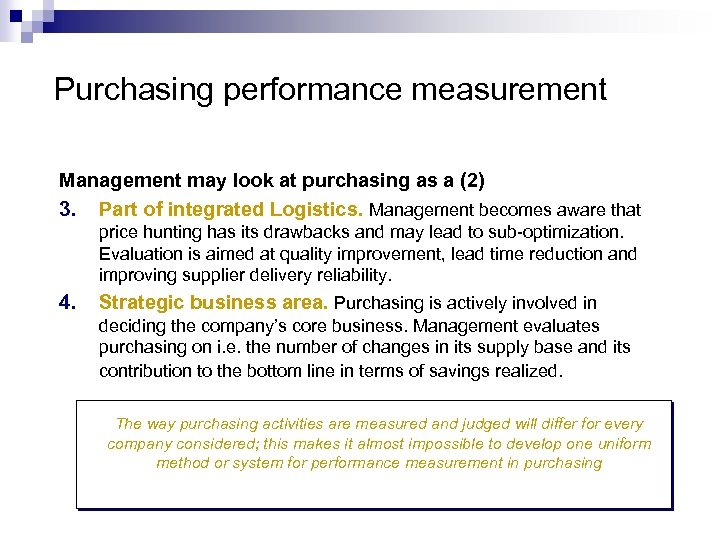 Purchasing performance measurement Management may look at purchasing as a (2) 3. Part of integrated Logistics. Management becomes aware that price hunting has its drawbacks and may lead to sub-optimization. Evaluation is aimed at quality improvement, lead time reduction and improving supplier delivery reliability. 4. Strategic business area. Purchasing is actively involved in deciding the company’s core business. Management evaluates purchasing on i. e. the number of changes in its supply base and its contribution to the bottom line in terms of savings realized. The way purchasing activities are measured and judged will differ for every company considered; this makes it almost impossible to develop one uniform method or system for performance measurement in purchasing
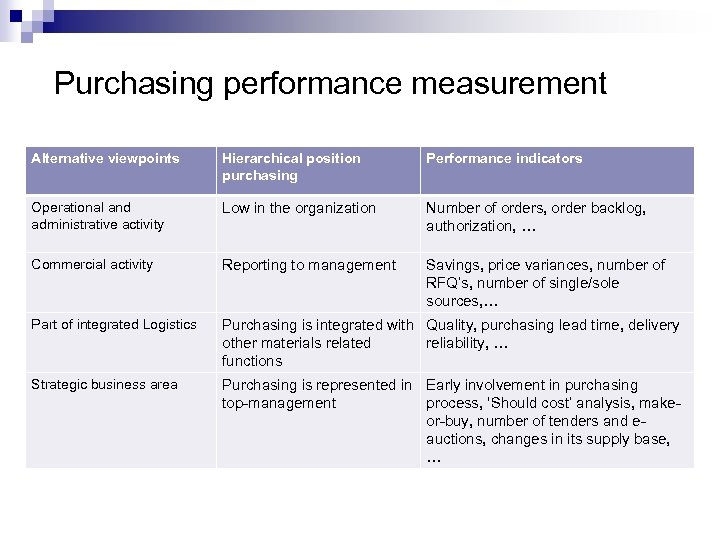 Purchasing performance measurement Alternative viewpoints Hierarchical position purchasing Performance indicators Operational and administrative activity Low in the organization Number of orders, order backlog, authorization, … Commercial activity Reporting to management Savings, price variances, number of RFQ’s, number of single/sole sources, … Part of integrated Logistics Purchasing is integrated with Quality, purchasing lead time, delivery other materials related reliability, … functions Strategic business area Purchasing is represented in Early involvement in purchasing top-management process, ‘Should cost’ analysis, makeor-buy, number of tenders and eauctions, changes in its supply base, …
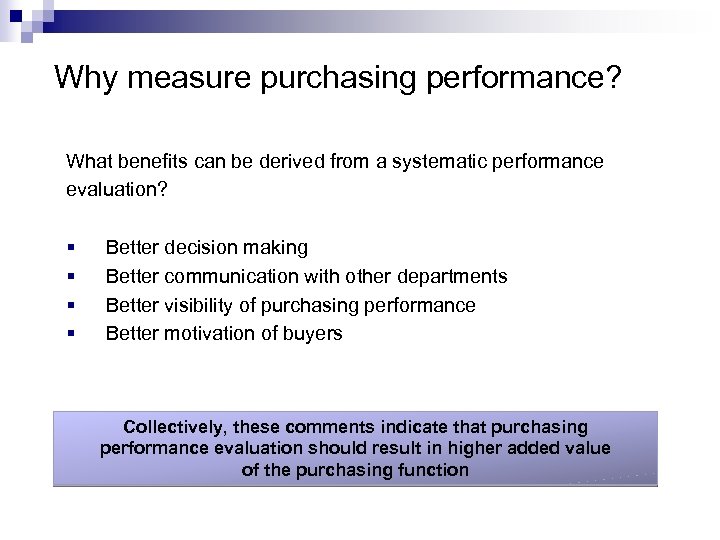 Why measure purchasing performance? What benefits can be derived from a systematic performance evaluation? § § Better decision making Better communication with other departments Better visibility of purchasing performance Better motivation of buyers Collectively, these comments indicate that purchasing performance evaluation should result in higher added value of the purchasing function
 Assessing purchasing performance Purchasing performance is considered to be the result of two elements: § Effectiveness: Results actual / Results planned (e. g. material costs, quality, logistics, innovation. . ) § Efficiency: Cost actual / Cost planned (e. g. administrative lead times, orders per purchaser. . ) Purchasing performance thus can be defined as the extent to which the purchasing function is able to realize its predetermined goals at the sacrifice of a minimum of the company’s resources (i. e. costs)
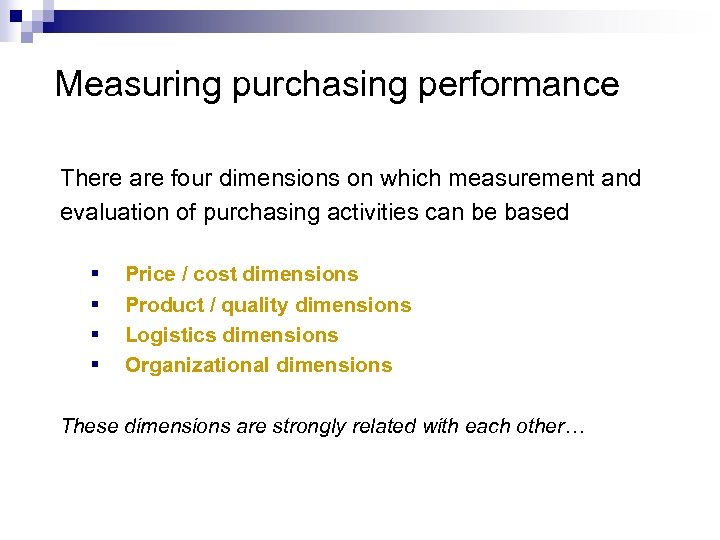 Measuring purchasing performance There are four dimensions on which measurement and evaluation of purchasing activities can be based § § Price / cost dimensions Product / quality dimensions Logistics dimensions Organizational dimensions These dimensions are strongly related with each other…
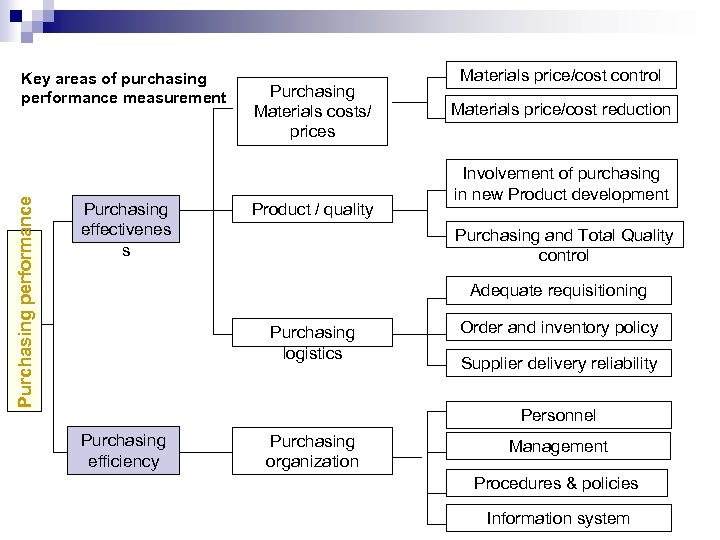 Purchasing performance Key areas of purchasing performance measurement Purchasing effectivenes s Purchasing Materials costs/ prices Product / quality Materials price/cost control Materials price/cost reduction Involvement of purchasing in new Product development Purchasing and Total Quality control Adequate requisitioning Purchasing logistics Order and inventory policy Supplier delivery reliability Personnel Purchasing efficiency Purchasing organization Management Procedures & policies Information system
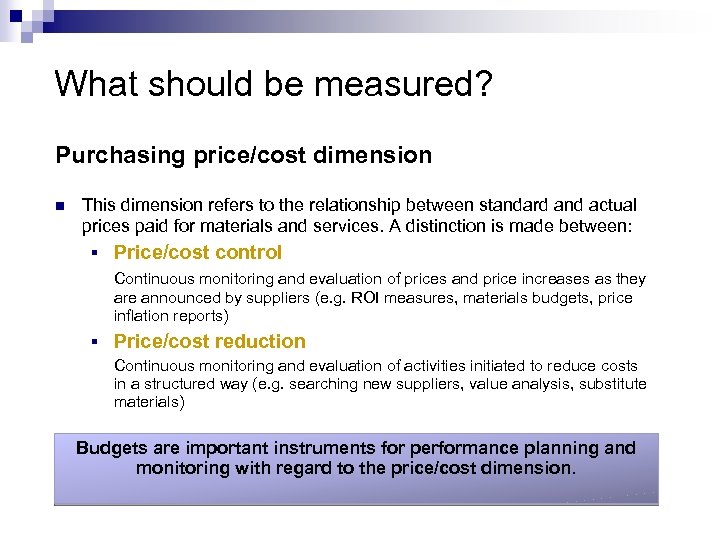 What should be measured? Purchasing price/cost dimension n This dimension refers to the relationship between standard and actual prices paid for materials and services. A distinction is made between: § Price/cost control Continuous monitoring and evaluation of prices and price increases as they are announced by suppliers (e. g. ROI measures, materials budgets, price inflation reports) § Price/cost reduction Continuous monitoring and evaluation of activities initiated to reduce costs in a structured way (e. g. searching new suppliers, value analysis, substitute materials) Budgets are important instruments for performance planning and monitoring with regard to the price/cost dimension.
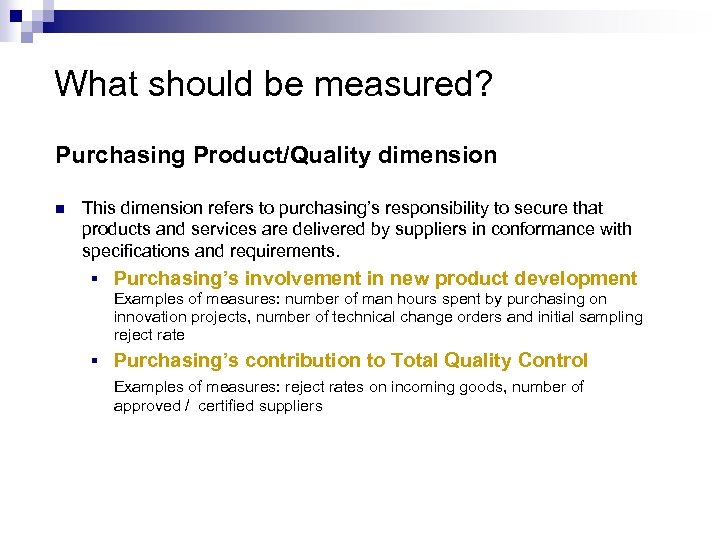 What should be measured? Purchasing Product/Quality dimension n This dimension refers to purchasing’s responsibility to secure that products and services are delivered by suppliers in conformance with specifications and requirements. § Purchasing’s involvement in new product development Examples of measures: number of man hours spent by purchasing on innovation projects, number of technical change orders and initial sampling reject rate § Purchasing’s contribution to Total Quality Control Examples of measures: reject rates on incoming goods, number of approved / certified suppliers
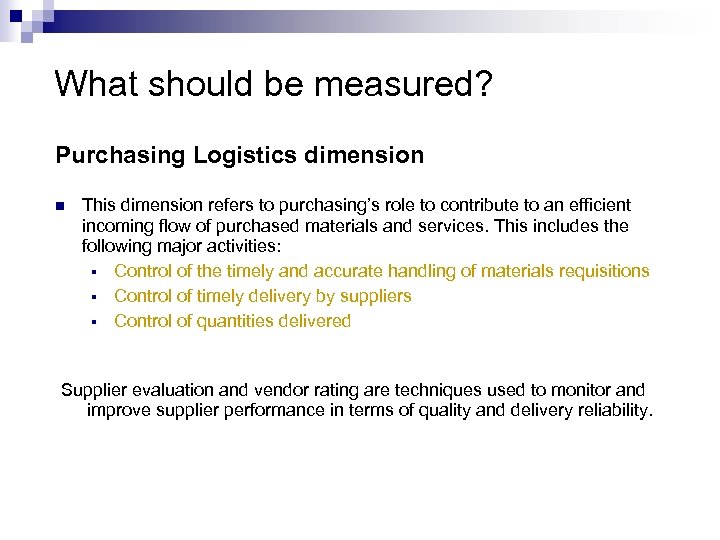 What should be measured? Purchasing Logistics dimension n This dimension refers to purchasing’s role to contribute to an efficient incoming flow of purchased materials and services. This includes the following major activities: § Control of the timely and accurate handling of materials requisitions § Control of timely delivery by suppliers § Control of quantities delivered Supplier evaluation and vendor rating are techniques used to monitor and improve supplier performance in terms of quality and delivery reliability.
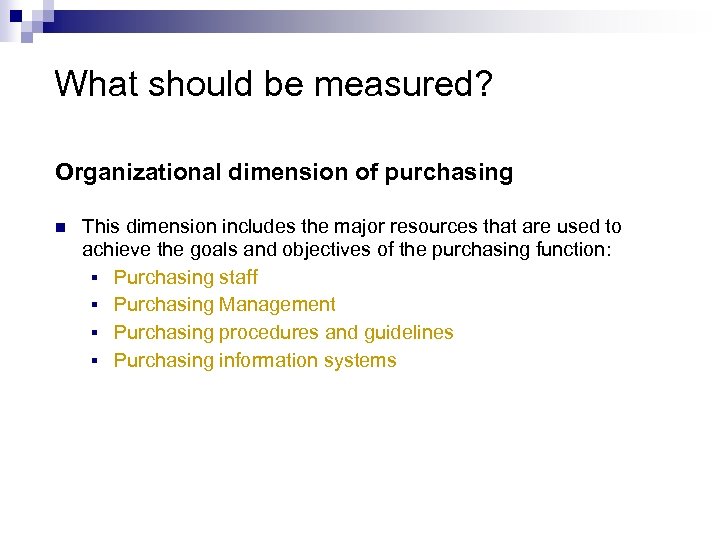 What should be measured? Organizational dimension of purchasing n This dimension includes the major resources that are used to achieve the goals and objectives of the purchasing function: § Purchasing staff § Purchasing Management § Purchasing procedures and guidelines § Purchasing information systems
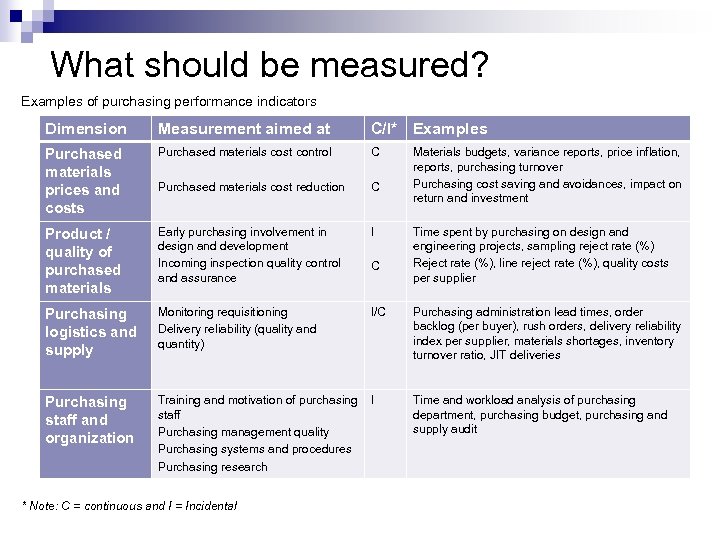 What should be measured? Examples of purchasing performance indicators Dimension Measurement aimed at C/I* Examples Purchased materials prices and costs Purchased materials cost control C Purchased materials cost reduction C Product / quality of purchased materials Early purchasing involvement in design and development Incoming inspection quality control and assurance I Purchasing logistics and supply Monitoring requisitioning Delivery reliability (quality and quantity) I/C Purchasing administration lead times, order backlog (per buyer), rush orders, delivery reliability index per supplier, materials shortages, inventory turnover ratio, JIT deliveries Purchasing staff and organization Training and motivation of purchasing staff Purchasing management quality Purchasing systems and procedures Purchasing research I Time and workload analysis of purchasing department, purchasing budget, purchasing and supply audit * Note: C = continuous and I = Incidental C Materials budgets, variance reports, price inflation, reports, purchasing turnover Purchasing cost saving and avoidances, impact on return and investment Time spent by purchasing on design and engineering projects, sampling reject rate (%) Reject rate (%), line reject rate (%), quality costs per supplier
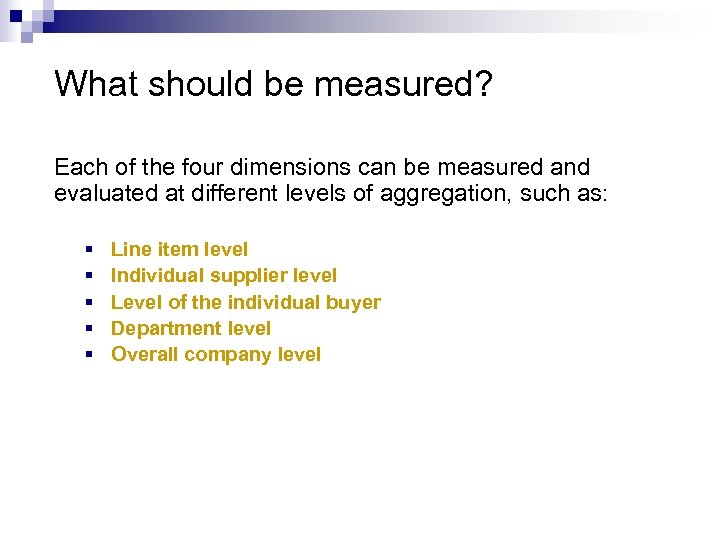 What should be measured? Each of the four dimensions can be measured and evaluated at different levels of aggregation, such as: § § § Line item level Individual supplier level Level of the individual buyer Department level Overall company level
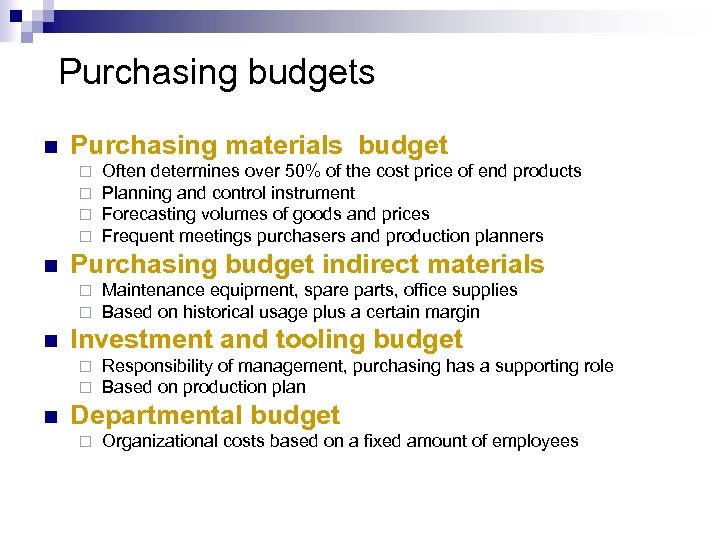 Purchasing budgets n Purchasing materials budget ¨ ¨ n Purchasing budget indirect materials ¨ ¨ n Maintenance equipment, spare parts, office supplies Based on historical usage plus a certain margin Investment and tooling budget ¨ ¨ n Often determines over 50% of the cost price of end products Planning and control instrument Forecasting volumes of goods and prices Frequent meetings purchasers and production planners Responsibility of management, purchasing has a supporting role Based on production plan Departmental budget ¨ Organizational costs based on a fixed amount of employees
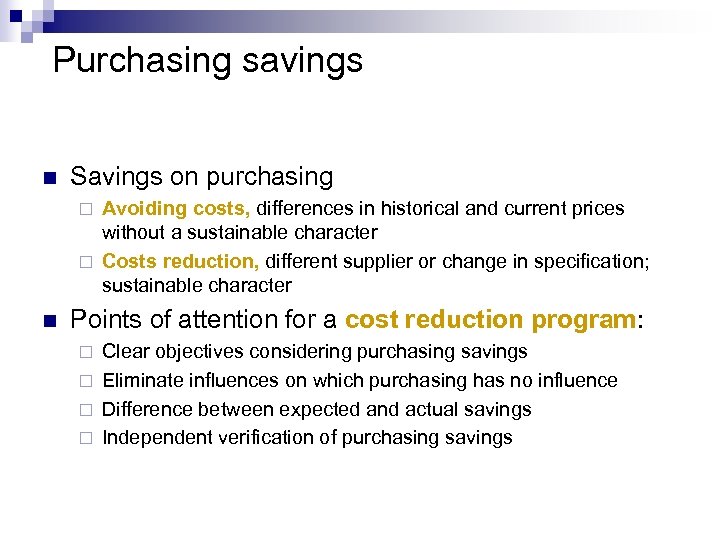 Purchasing savings n Savings on purchasing Avoiding costs, differences in historical and current prices without a sustainable character ¨ Costs reduction, different supplier or change in specification; sustainable character ¨ n Points of attention for a cost reduction program: Clear objectives considering purchasing savings ¨ Eliminate influences on which purchasing has no influence ¨ Difference between expected and actual savings ¨ Independent verification of purchasing savings ¨
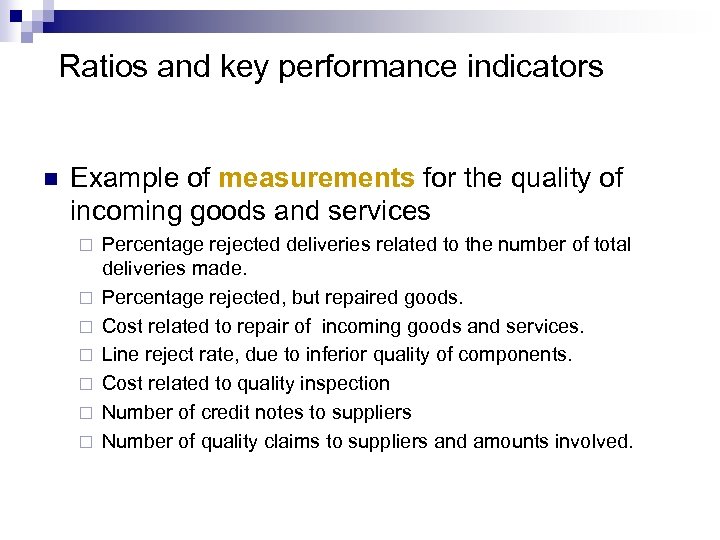 Ratios and key performance indicators n Example of measurements for the quality of incoming goods and services ¨ ¨ ¨ ¨ Percentage rejected deliveries related to the number of total deliveries made. Percentage rejected, but repaired goods. Cost related to repair of incoming goods and services. Line reject rate, due to inferior quality of components. Cost related to quality inspection Number of credit notes to suppliers Number of quality claims to suppliers and amounts involved.
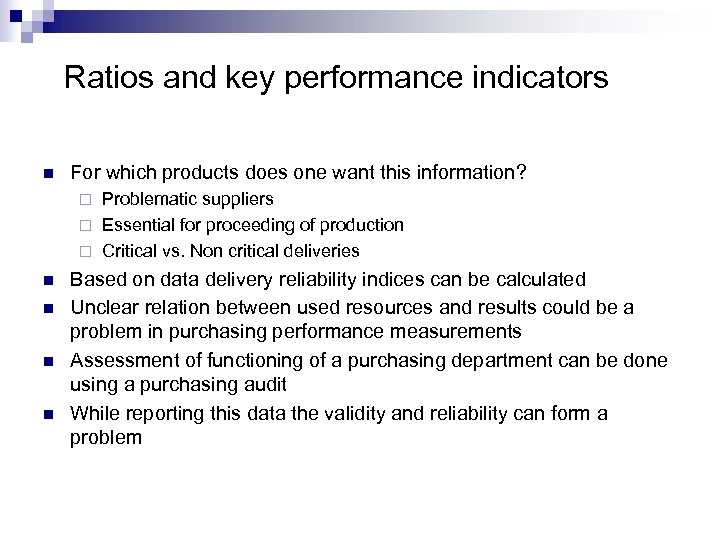 Ratios and key performance indicators n For which products does one want this information? Problematic suppliers ¨ Essential for proceeding of production ¨ Critical vs. Non critical deliveries ¨ n n Based on data delivery reliability indices can be calculated Unclear relation between used resources and results could be a problem in purchasing performance measurements Assessment of functioning of a purchasing department can be done using a purchasing audit While reporting this data the validity and reliability can form a problem
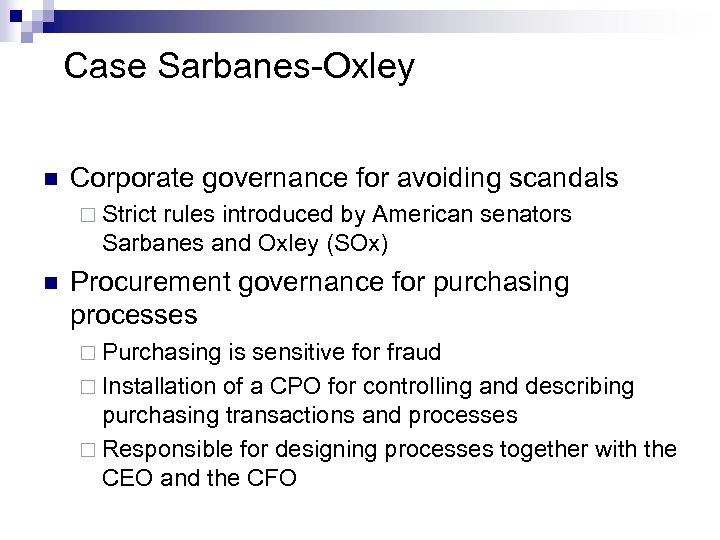 Case Sarbanes-Oxley n Corporate governance for avoiding scandals ¨ Strict rules introduced by American senators Sarbanes and Oxley (SOx) n Procurement governance for purchasing processes ¨ Purchasing is sensitive for fraud ¨ Installation of a CPO for controlling and describing purchasing transactions and processes ¨ Responsible for designing processes together with the CEO and the CFO
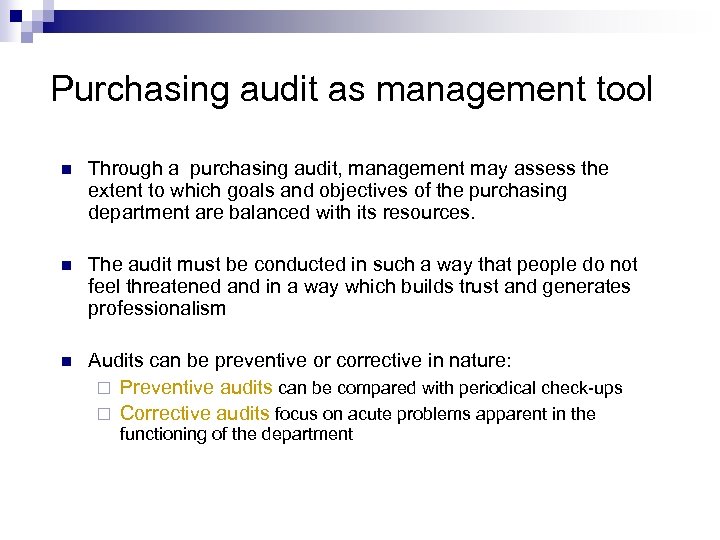 Purchasing audit as management tool n Through a purchasing audit, management may assess the extent to which goals and objectives of the purchasing department are balanced with its resources. n The audit must be conducted in such a way that people do not feel threatened and in a way which builds trust and generates professionalism n Audits can be preventive or corrective in nature: ¨ Preventive audits can be compared with periodical check-ups ¨ Corrective audits focus on acute problems apparent in the functioning of the department
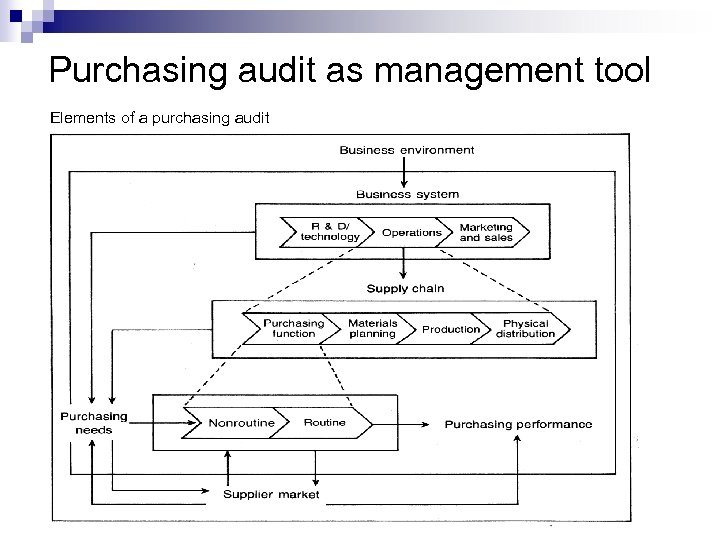 Purchasing audit as management tool Elements of a purchasing audit
 Purchasing audit as management tool Factors that influence final purchasing performance: Requirements that the corporate system lays down for the purchasing function § Changes in the supply chain of the company § Opportunities provided by the supplier market to fulfill the materials requirements §
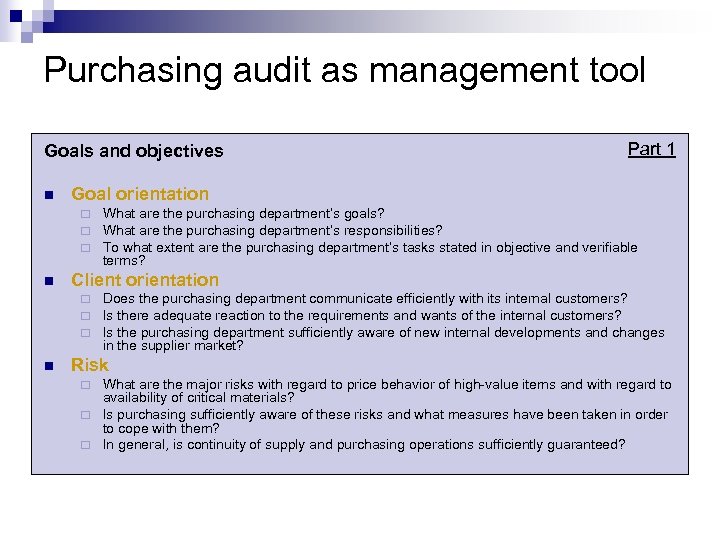 Purchasing audit as management tool Goals and objectives n Goal orientation ¨ ¨ ¨ n What are the purchasing department’s goals? What are the purchasing department’s responsibilities? To what extent are the purchasing department’s tasks stated in objective and verifiable terms? Client orientation ¨ ¨ ¨ n Part 1 Does the purchasing department communicate efficiently with its internal customers? Is there adequate reaction to the requirements and wants of the internal customers? Is the purchasing department sufficiently aware of new internal developments and changes in the supplier market? Risk What are the major risks with regard to price behavior of high-value items and with regard to availability of critical materials? ¨ Is purchasing sufficiently aware of these risks and what measures have been taken in order to cope with them? ¨ In general, is continuity of supply and purchasing operations sufficiently guaranteed? ¨
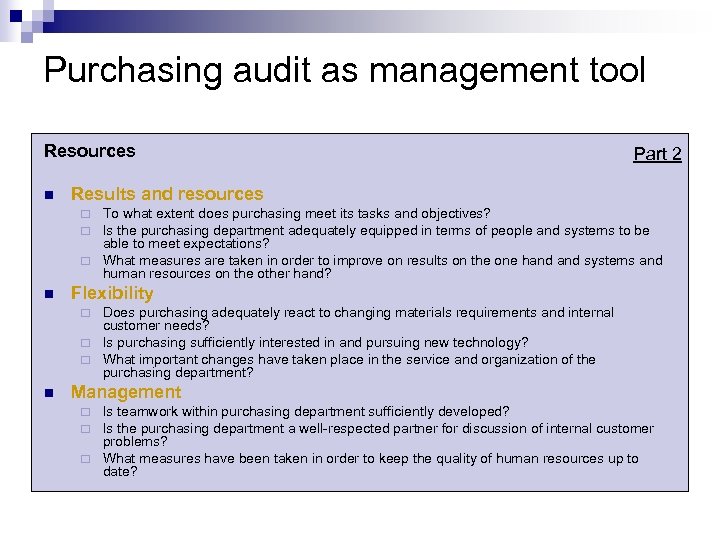 Purchasing audit as management tool Resources n Part 2 Results and resources To what extent does purchasing meet its tasks and objectives? Is the purchasing department adequately equipped in terms of people and systems to be able to meet expectations? ¨ What measures are taken in order to improve on results on the one hand systems and human resources on the other hand? ¨ ¨ n Flexibility Does purchasing adequately react to changing materials requirements and internal customer needs? ¨ Is purchasing sufficiently interested in and pursuing new technology? ¨ What important changes have taken place in the service and organization of the purchasing department? ¨ n Management Is teamwork within purchasing department sufficiently developed? Is the purchasing department a well-respected partner for discussion of internal customer problems? ¨ What measures have been taken in order to keep the quality of human resources up to date? ¨ ¨
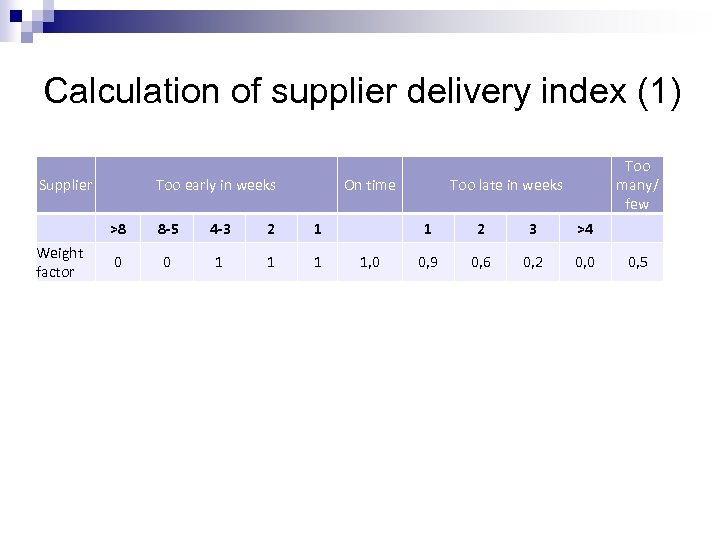 Calculation of supplier delivery index (1) Supplier Too early in weeks On time >8 Weight factor 8 -5 4 -3 2 1 0 0 1 1 1 Too many/ few Too late in weeks 1 1, 0 2 3 >4 0, 9 0, 6 0, 2 0, 0 0, 5
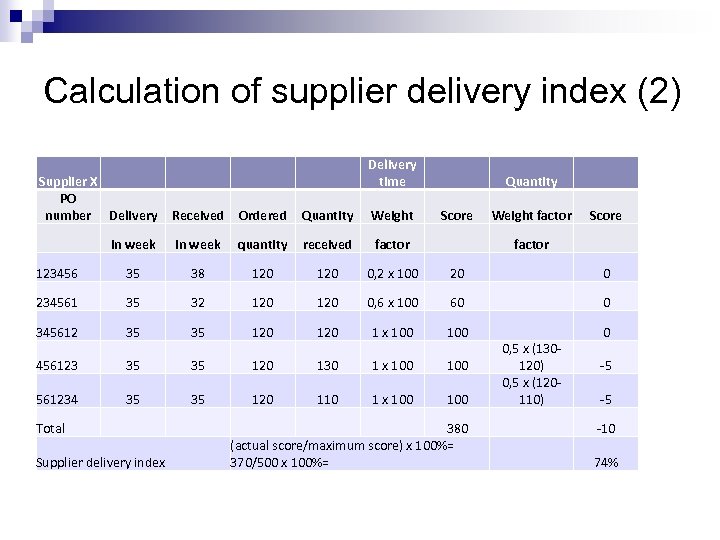 Calculation of supplier delivery index (2) Delivery time Supplier X PO number Delivery Received Ordered Quantity Weight in week quantity received factor 123456 35 38 120 0, 2 x 100 20 0 234561 35 32 120 0, 6 x 100 60 0 345612 35 35 120 1 x 100 0 456123 35 35 120 130 1 x 100 561234 35 35 120 110 1 x 100 Total Supplier delivery index Quantity Score Weight factor Score factor 380 (actual score/maximum score) x 100%= 370/500 x 100%= 0, 5 x (130120) 0, 5 x (120110) -5 -5 -10 74%
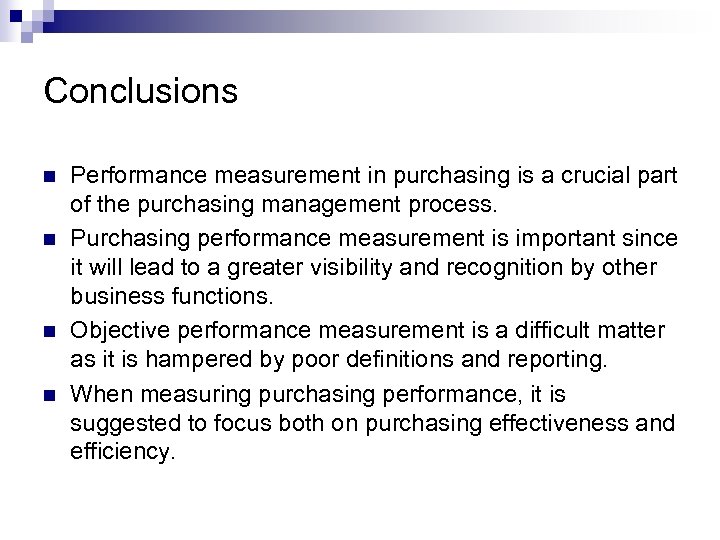 Conclusions n n Performance measurement in purchasing is a crucial part of the purchasing management process. Purchasing performance measurement is important since it will lead to a greater visibility and recognition by other business functions. Objective performance measurement is a difficult matter as it is hampered by poor definitions and reporting. When measuring purchasing performance, it is suggested to focus both on purchasing effectiveness and efficiency.