 Скачать презентацию Chapter 14 Money Banking and Financial Institutions Mc
d4d6f8a7a4b74020a48b9c44b7f7f1f1.ppt
- Количество слайдов: 39



Chapter 14 Money, Banking, and Financial Institutions Mc. Graw-Hill/Irwin Copyright © 2014 by The Mc. Graw-Hill Companies, Inc. All rights reserved 1 -1 14 -1
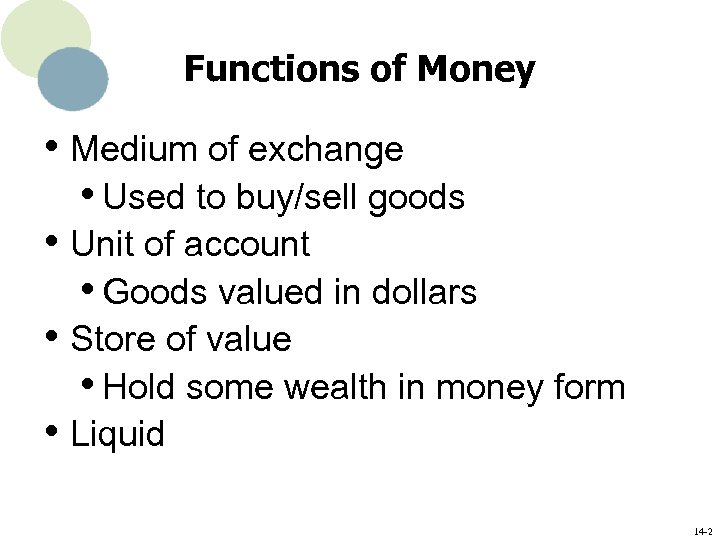
Functions of Money • Medium of exchange • Used to buy/sell goods • Unit of account • Goods valued in dollars • Store of value • Hold some wealth in money form • Liquid 14 -2
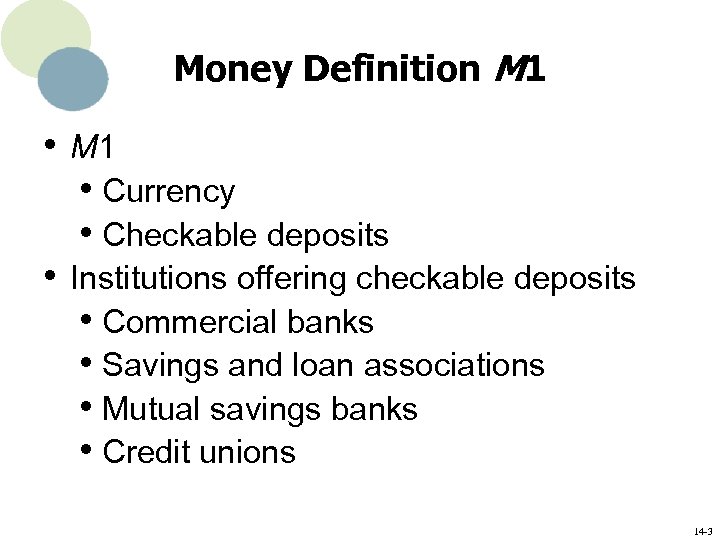
Money Definition M 1 • M 1 • Currency • Checkable deposits • Institutions offering checkable deposits • Commercial banks • Savings and loan associations • Mutual savings banks • Credit unions 14 -3
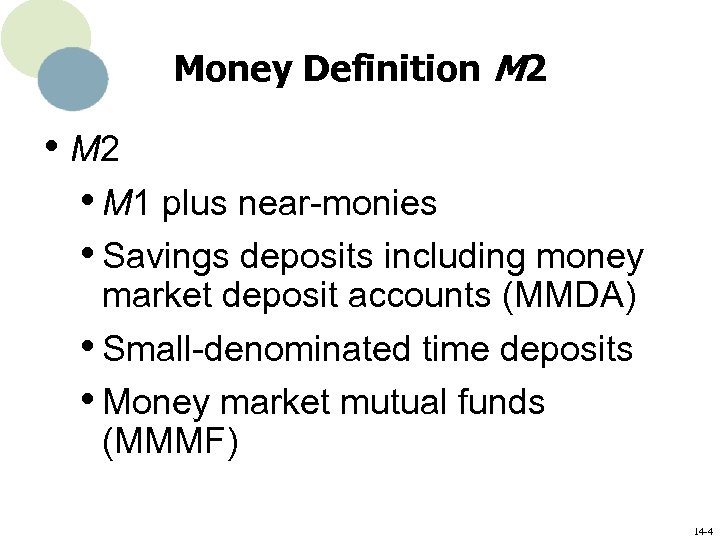
Money Definition M 2 • M 2 • M 1 plus near-monies • Savings deposits including money market deposit accounts (MMDA) • Small-denominated time deposits • Money market mutual funds (MMMF) 14 -4
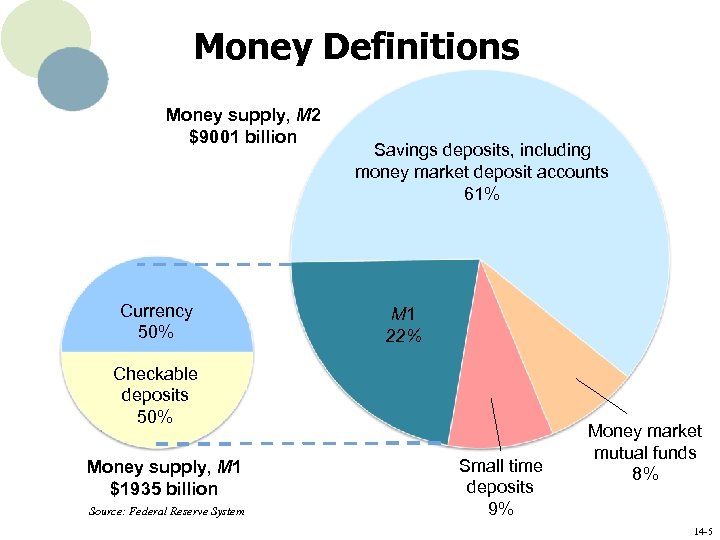
Money Definitions Money supply, M 2 $9001 billion Currency 50% Savings deposits, including money market deposit accounts 61% M 1 22% Checkable deposits 50% Money supply, M 1 $1935 billion Source: Federal Reserve System Small time deposits 9% Money market mutual funds 8% 14 -5
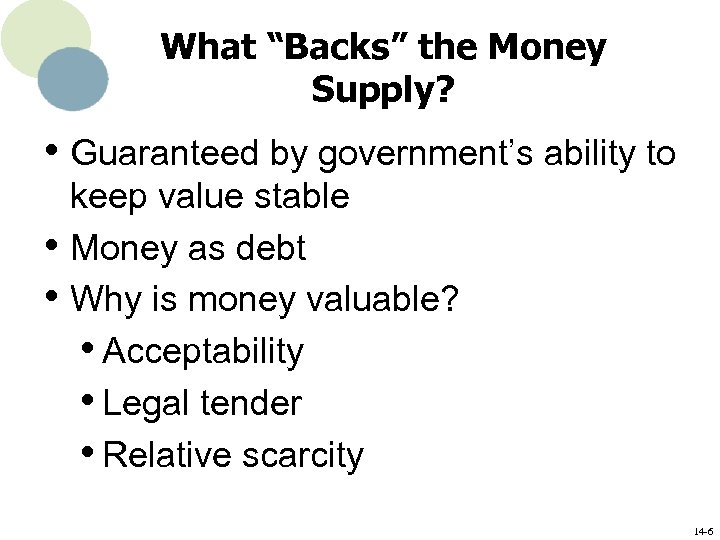
What “Backs” the Money Supply? • Guaranteed by government’s ability to • • keep value stable Money as debt Why is money valuable? • Acceptability • Legal tender • Relative scarcity 14 -6
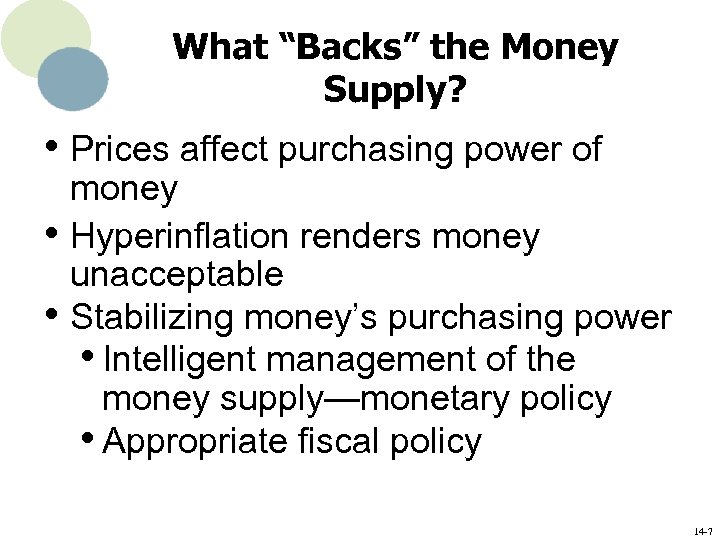
What “Backs” the Money Supply? • Prices affect purchasing power of • • money Hyperinflation renders money unacceptable Stabilizing money’s purchasing power • Intelligent management of the money supply—monetary policy • Appropriate fiscal policy 14 -7
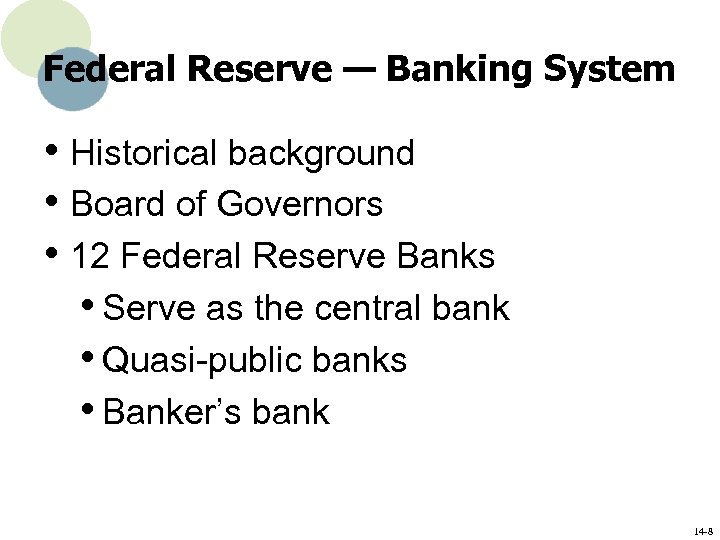
Federal Reserve — Banking System • Historical background • Board of Governors • 12 Federal Reserve Banks • Serve as the central bank • Quasi-public banks • Banker’s bank 14 -8
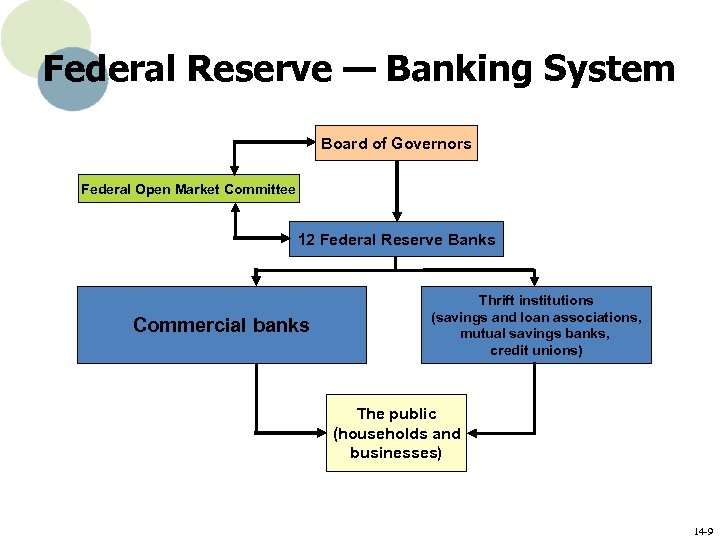
Federal Reserve — Banking System Board of Governors Federal Open Market Committee 12 Federal Reserve Banks Commercial banks Thrift institutions (savings and loan associations, mutual savings banks, credit unions) The public (households and businesses) 14 -9
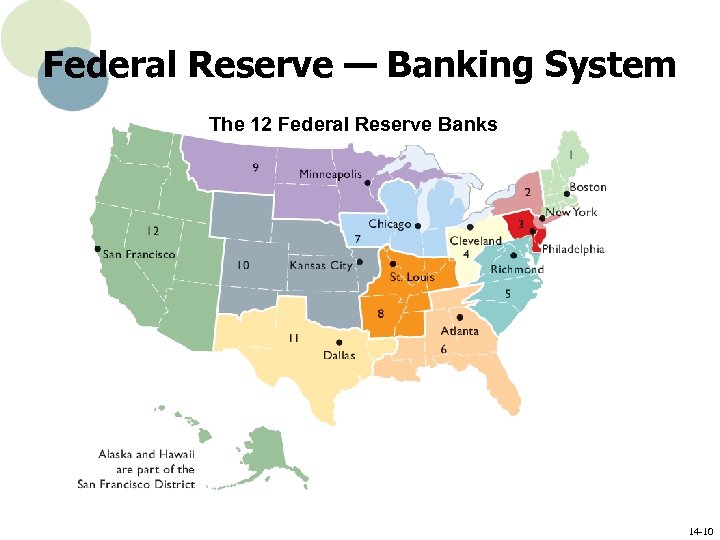
Federal Reserve — Banking System The 12 Federal Reserve Banks 14 -10
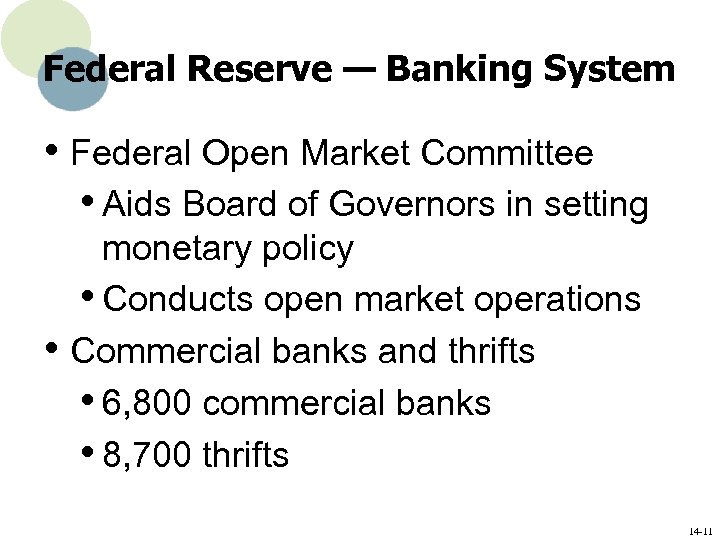
Federal Reserve — Banking System • Federal Open Market Committee • Aids Board of Governors in setting • monetary policy • Conducts open market operations Commercial banks and thrifts • 6, 800 commercial banks • 8, 700 thrifts 14 -11
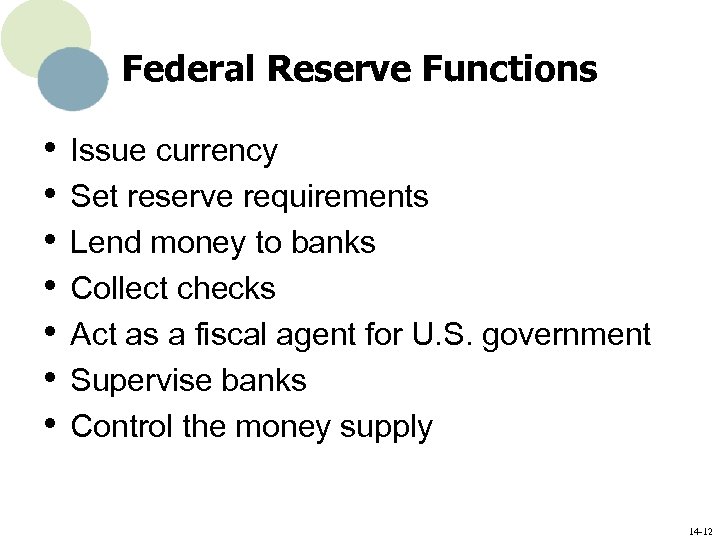
Federal Reserve Functions • • Issue currency Set reserve requirements Lend money to banks Collect checks Act as a fiscal agent for U. S. government Supervise banks Control the money supply 14 -12
Federal Reserve Independence • Established by Congress as an • • independent agency Protects the Fed from political pressures Enables the Fed to take actions to increase interest rates in order to stem inflation as needed 14 -13
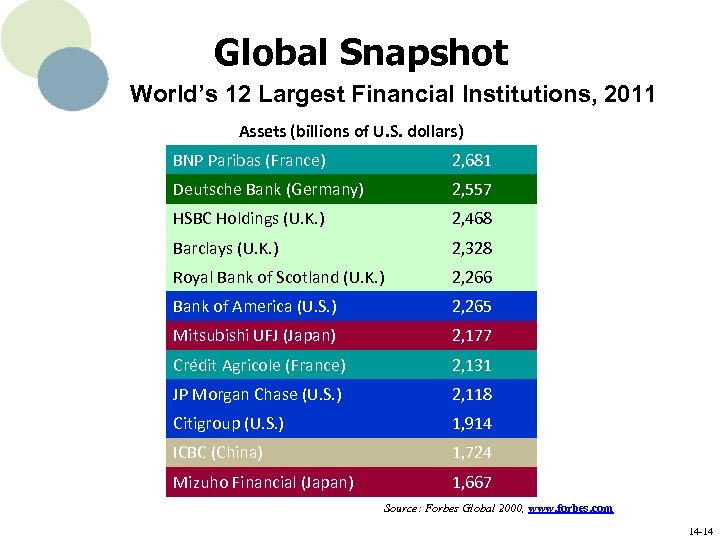
Global Snapshot World’s 12 Largest Financial Institutions, 2011 Assets (billions of U. S. dollars) BNP Paribas (France) 2, 681 Deutsche Bank (Germany) 2, 557 HSBC Holdings (U. K. ) 2, 468 Barclays (U. K. ) 2, 328 Royal Bank of Scotland (U. K. ) 2, 266 Bank of America (U. S. ) 2, 265 Mitsubishi UFJ (Japan) 2, 177 Crédit Agricole (France) 2, 131 JP Morgan Chase (U. S. ) 2, 118 Citigroup (U. S. ) 1, 914 ICBC (China) 1, 724 Mizuho Financial (Japan) 1, 667 Source: Forbes Global 2000, www. forbes. com 14 -14
The Financial Crisis of 2007 and 2008 • Mortgage default crisis • Many causes • Government programs that encouraged home ownership • Declining real estate values • Bad incentives provided by mortgage-backed bonds 14 -15
The Financial Crisis of 2007 and 2008 • Securitization — the process of slicing • • LO 5 up and bundling groups of loans into new securities As loans defaulted, the system collapsed “Underwater” homeowners abandoned homes and mortgages 14 -16
The Financial Crisis of 2007 and 2008 • Failures and near-failures of financial • firms • Countrywide: second largest lender • Washington Mutual: largest lender • Wachovia Other firms came close 14 -17
The Financial Crisis of 2007 and 2008 • Troubled Asset Relief Program (TARP) • Allocated $700 billion to make emergency loans • Saved several institutions from failure 14 -18
Postcrisis U. S. Financial Services • Major categories of financial institutions • Commercial banks • Thrifts • Insurance companies • Mutual Fund companies • Pension funds • Securities firms • Investment banks 14 -19
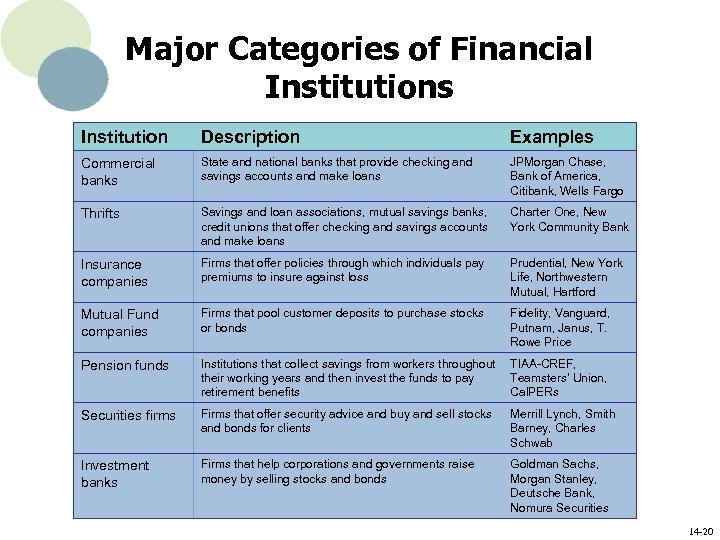
Major Categories of Financial Institutions Institution Description Examples Commercial banks State and national banks that provide checking and savings accounts and make loans JPMorgan Chase, Bank of America, Citibank, Wells Fargo Thrifts Savings and loan associations, mutual savings banks, credit unions that offer checking and savings accounts and make loans Charter One, New York Community Bank Insurance companies Firms that offer policies through which individuals pay premiums to insure against loss Prudential, New York Life, Northwestern Mutual, Hartford Mutual Fund companies Firms that pool customer deposits to purchase stocks or bonds Fidelity, Vanguard, Putnam, Janus, T. Rowe Price Pension funds Institutions that collect savings from workers throughout their working years and then invest the funds to pay retirement benefits TIAA-CREF, Teamsters’ Union, Cal. PERs Securities firms Firms that offer security advice and buy and sell stocks and bonds for clients Merrill Lynch, Smith Barney, Charles Schwab Investment banks Firms that help corporations and governments raise money by selling stocks and bonds Goldman Sachs, Morgan Stanley, Deutsche Bank, Nomura Securities 14 -20
Postcrisis U. S. Financial Services • Wall Street Reform and Consumer Protection Act • Passed to help prevent many of the practices that led to the crisis • Critics say it adds heavy regulatory costs 14 -21
Fractional Reserve System • The goldsmiths • Stored gold and gave a receipt • Receipts used as money by public • Made loans by issuing receipts • Characteristics: • Banks create money through lending • Banks are subject to “panics” 14 -22
Fractional Reserve System • Balance sheet • Assets = Liabilities + Net worth • Both sides balance • Necessary transactions • Create a bank • Accept deposits • Lend excess reserves 14 -23
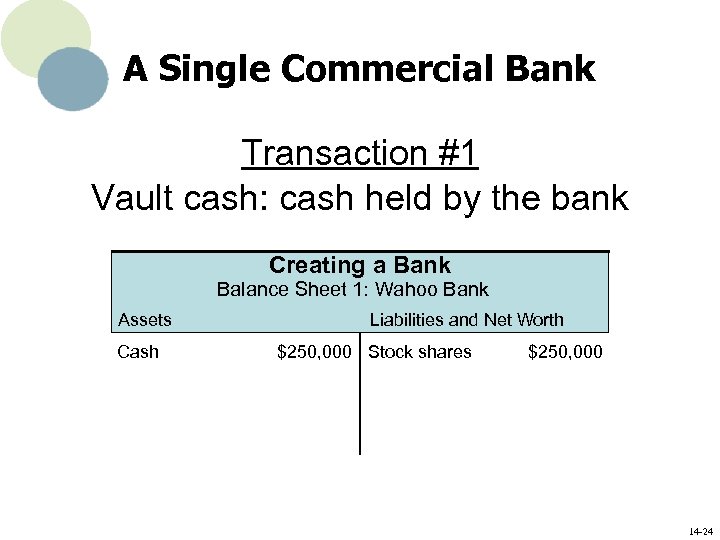
A Single Commercial Bank Transaction #1 Vault cash: cash held by the bank Creating a Bank Balance Sheet 1: Wahoo Bank Assets Cash Liabilities and Net Worth $250, 000 Stock shares $250, 000 14 -24
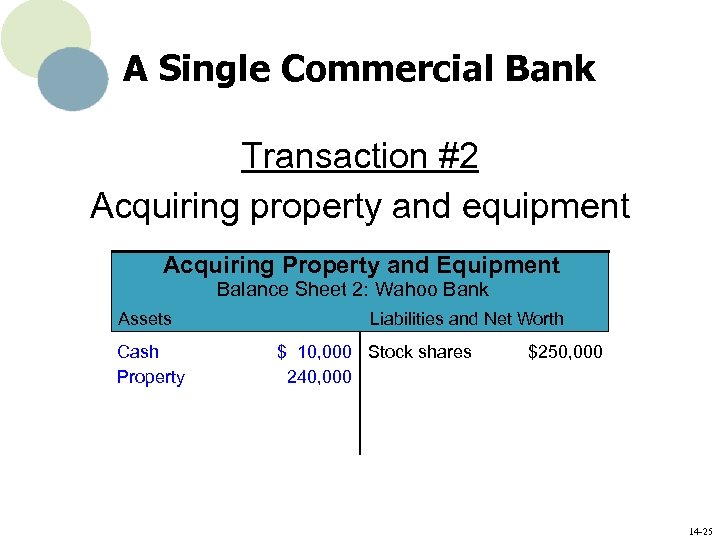
A Single Commercial Bank Transaction #2 Acquiring property and equipment Acquiring Property and Equipment Balance Sheet 2: Wahoo Bank Assets Cash Property Liabilities and Net Worth $ 10, 000 Stock shares 240, 000 $250, 000 14 -25
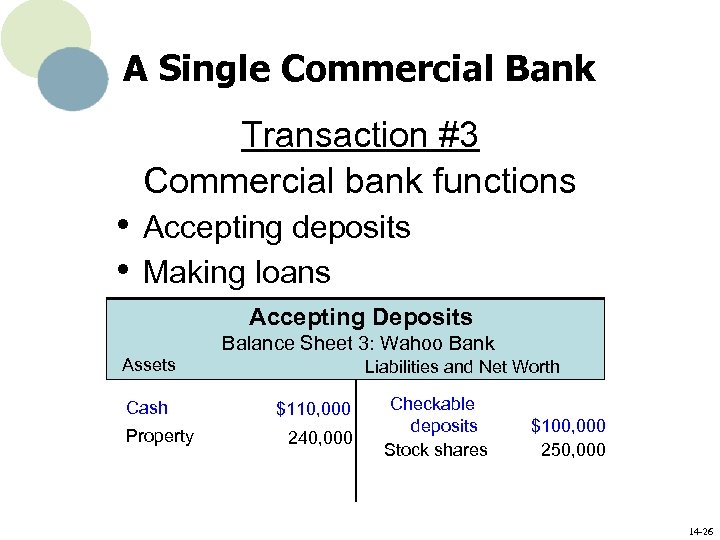
A Single Commercial Bank Transaction #3 Commercial bank functions • • Accepting deposits Making loans Accepting Deposits Balance Sheet 3: Wahoo Bank Assets Cash Property Liabilities and Net Worth $110, 000 240, 000 Checkable deposits Stock shares $100, 000 250, 000 14 -26
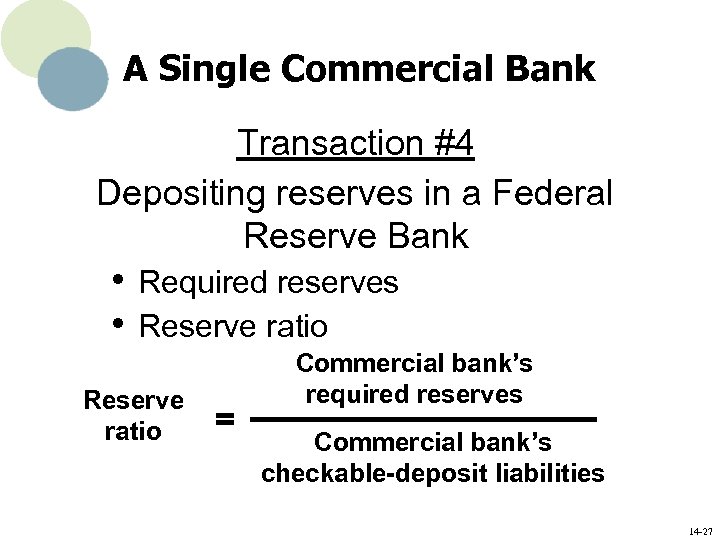
A Single Commercial Bank Transaction #4 Depositing reserves in a Federal Reserve Bank • • Required reserves Reserve ratio = Commercial bank’s required reserves Commercial bank’s checkable-deposit liabilities 14 -27
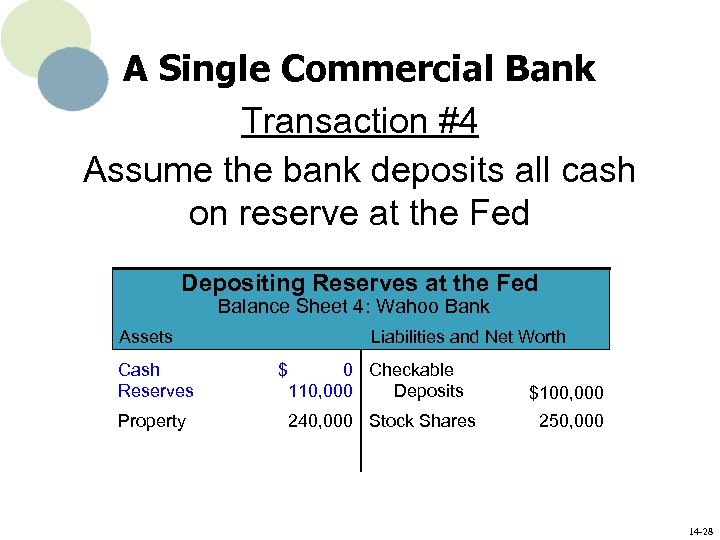
A Single Commercial Bank Transaction #4 Assume the bank deposits all cash on reserve at the Fed Depositing Reserves at the Fed Balance Sheet 4: Wahoo Bank Assets Cash Reserves Property Liabilities and Net Worth $ 0 Checkable 110, 000 Deposits 240, 000 Stock Shares $100, 000 250, 000 14 -28
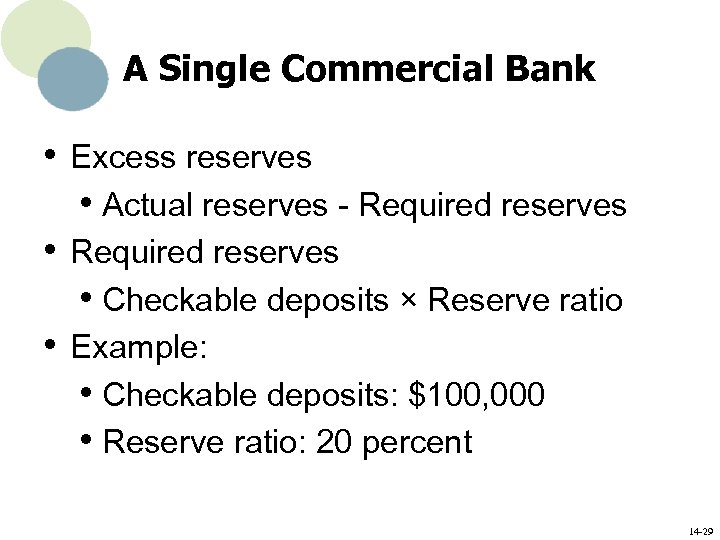
A Single Commercial Bank • Excess reserves • Actual reserves - Required reserves • Checkable deposits × Reserve ratio • Example: • Checkable deposits: $100, 000 • Reserve ratio: 20 percent 14 -29
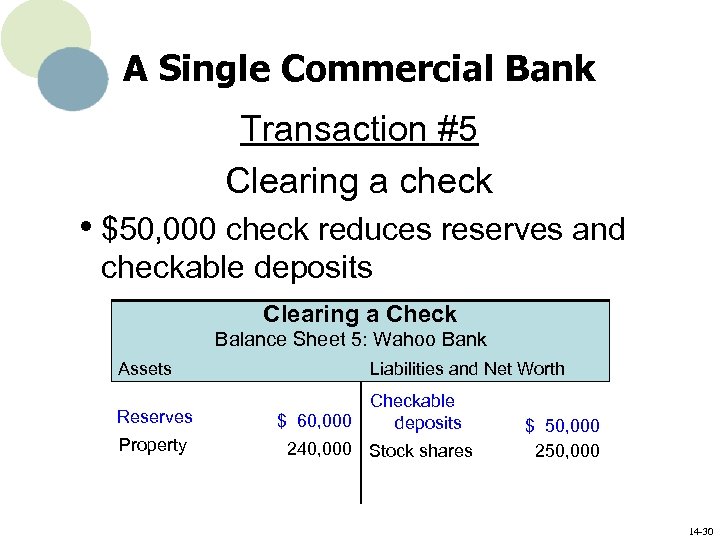
A Single Commercial Bank Transaction #5 Clearing a check • $50, 000 check reduces reserves and checkable deposits Clearing a Check Balance Sheet 5: Wahoo Bank Assets Reserves Property Liabilities and Net Worth Checkable $ 60, 000 deposits 240, 000 Stock shares $ 50, 000 250, 000 14 -30
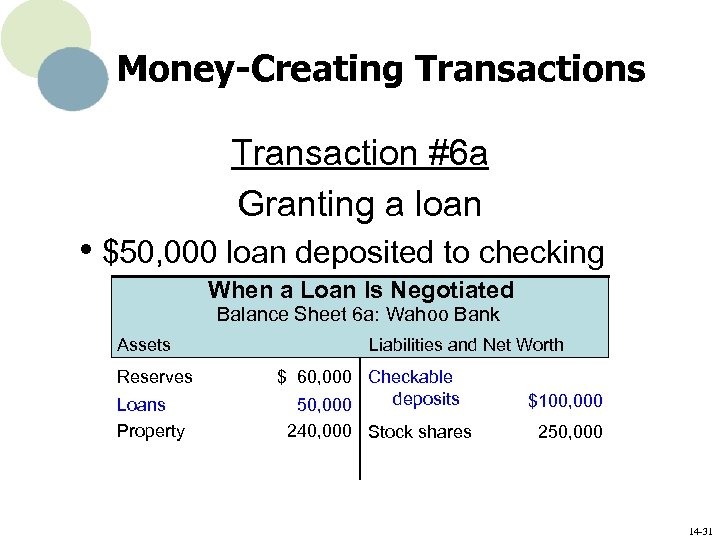
Money-Creating Transactions Transaction #6 a Granting a loan • $50, 000 loan deposited to checking When a Loan Is Negotiated Balance Sheet 6 a: Wahoo Bank Assets Reserves Loans Property Liabilities and Net Worth $ 60, 000 Checkable deposits 50, 000 240, 000 Stock shares $100, 000 250, 000 14 -31
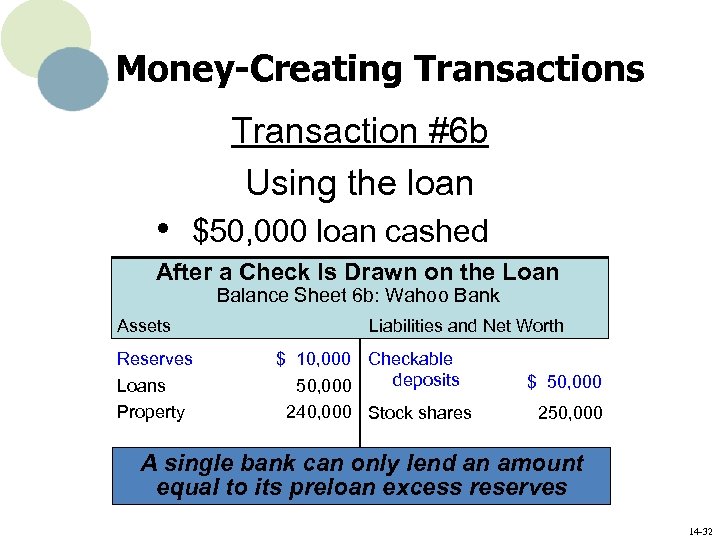
Money-Creating Transactions Transaction #6 b Using the loan • $50, 000 loan cashed After a Check Is Drawn on the Loan Balance Sheet 6 b: Wahoo Bank Assets Reserves Loans Property Liabilities and Net Worth $ 10, 000 Checkable deposits 50, 000 240, 000 Stock shares $ 50, 000 250, 000 A single bank can only lend an amount equal to its preloan excess reserves 14 -32
The Banking System • Multiple-deposit expansion • Assumptions: • 20 percent required reserves • All banks “loaned up” • Banks lend all of their excess • • reserves A $100 bill is found and deposited Multiple deposits can be created 14 -33
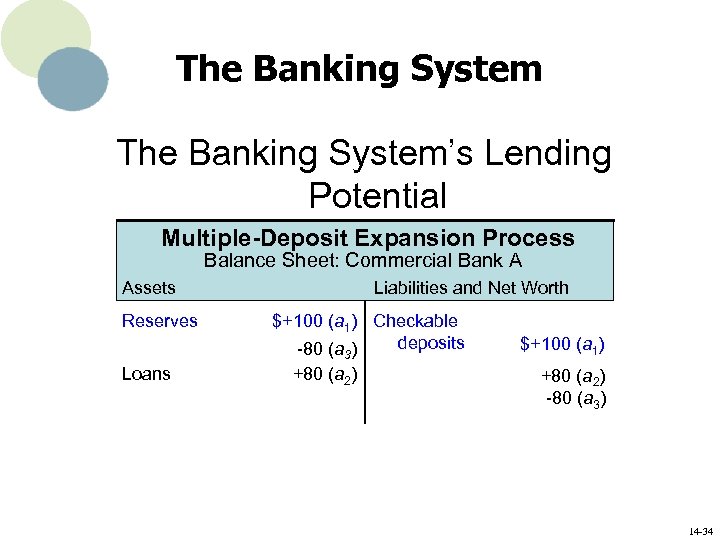
The Banking System’s Lending Potential Multiple-Deposit Expansion Process Balance Sheet: Commercial Bank A Assets Reserves Liabilities and Net Worth $+100 (a 1) Checkable deposits -80 (a ) 3 Loans +80 (a 2) $+100 (a 1) +80 (a 2) -80 (a 3) 14 -34
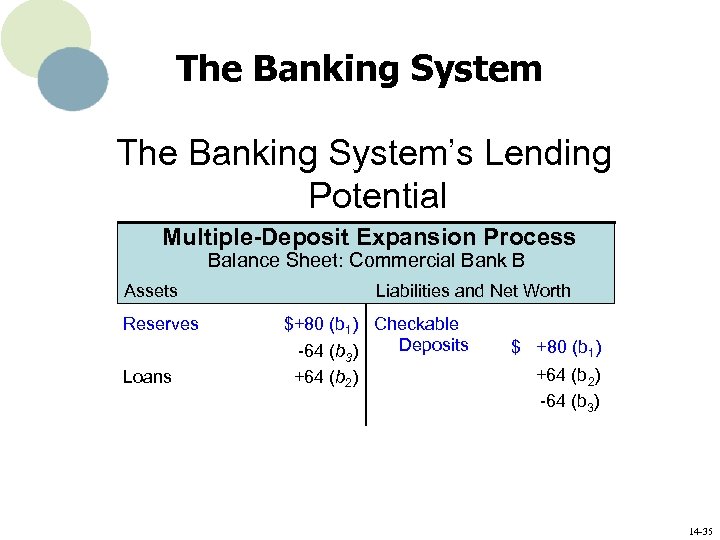
The Banking System’s Lending Potential Multiple-Deposit Expansion Process Balance Sheet: Commercial Bank B Assets Reserves Liabilities and Net Worth $+80 (b 1) Checkable Deposits -64 (b ) 3 Loans +64 (b 2) $ +80 (b 1) +64 (b 2) -64 (b 3) 14 -35
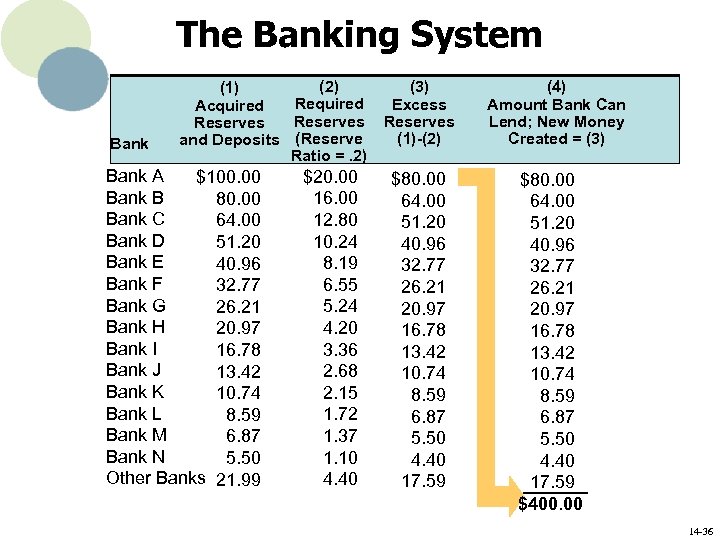
The Banking System Bank (2) (1) Required Acquired Reserves and Deposits (Reserve Ratio =. 2) Bank A $100. 00 Bank B 80. 00 Bank C 64. 00 Bank D 51. 20 Bank E 40. 96 Bank F 32. 77 Bank G 26. 21 Bank H 20. 97 Bank I 16. 78 Bank J 13. 42 Bank K 10. 74 Bank L 8. 59 Bank M 6. 87 Bank N 5. 50 Other Banks 21. 99 $20. 00 16. 00 12. 80 10. 24 8. 19 6. 55 5. 24 4. 20 3. 36 2. 68 2. 15 1. 72 1. 37 1. 10 4. 40 (3) Excess Reserves (1)-(2) $80. 00 64. 00 51. 20 40. 96 32. 77 26. 21 20. 97 16. 78 13. 42 10. 74 8. 59 6. 87 5. 50 4. 40 17. 59 (4) Amount Bank Can Lend; New Money Created = (3) $80. 00 64. 00 51. 20 40. 96 32. 77 26. 21 20. 97 16. 78 13. 42 10. 74 8. 59 6. 87 5. 50 4. 40 17. 59 $400. 00 14 -36
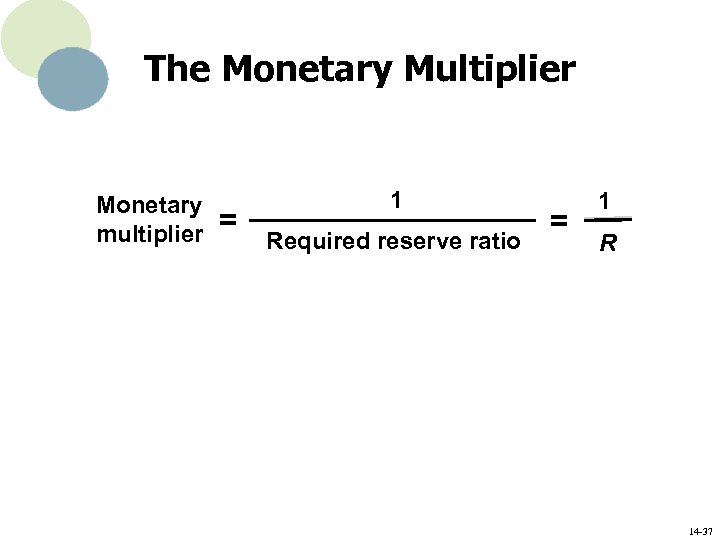
The Monetary Multiplier Monetary multiplier = 1 Required reserve ratio = 1 R 14 -37
The Monetary Multiplier • Maximum amount of new money • • created by a single dollar of excess reserves Higher R, lower m Reversibility • Making loans creates money • Loan repayment destroys money 14 -38
Bank Panics of 1930– 1933 • Before deposit insurance • Bank failure led to mass withdrawals • Forced loan reduction • 25 -33 percent decline in money supply • 1933 national bank holiday to evaluate all • • banks Contributed to the Great Depression Regulation protects the system today 14 -39
Скачать презентацию Chapter 14 Money Banking and Financial Institutions Mc
d4d6f8a7a4b74020a48b9c44b7f7f1f1.ppt