 Скачать презентацию Chapter 14 Graph class design Bjarne Stroustrup www
0ff233b3000ccf422b2443fd3f34e9a6.ppt
- Количество слайдов: 26



Chapter 14 Graph class design Bjarne Stroustrup www. stroustrup. com/Programming
Abstract n n We have discussed classes in previous lectures Here, we discuss design of classes Library design considerations n Class hierarchies (object-oriented programming) n Data hiding n Stroustrup/Programming 2
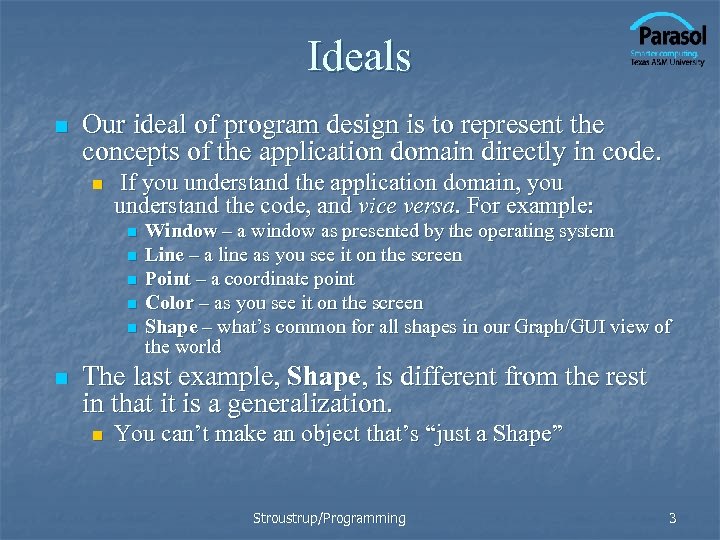
Ideals n Our ideal of program design is to represent the concepts of the application domain directly in code. n If you understand the application domain, you understand the code, and vice versa. For example: n n n Window – a window as presented by the operating system Line – a line as you see it on the screen Point – a coordinate point Color – as you see it on the screen Shape – what’s common for all shapes in our Graph/GUI view of the world The last example, Shape, is different from the rest in that it is a generalization. n You can’t make an object that’s “just a Shape” Stroustrup/Programming 3
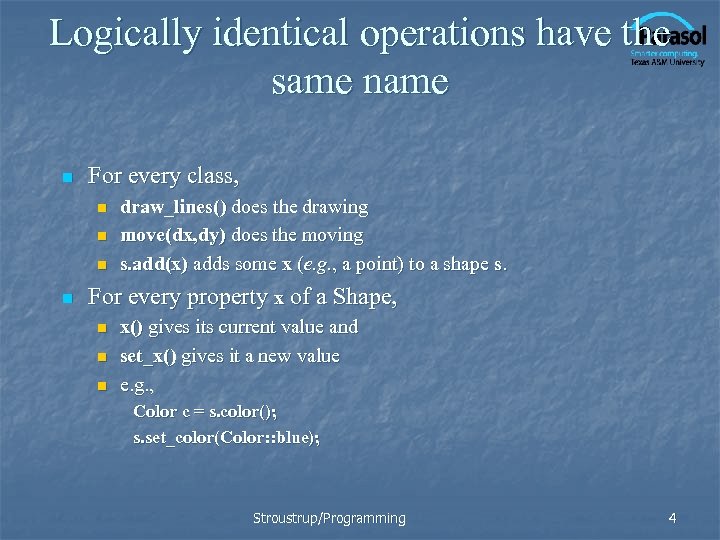
Logically identical operations have the same n For every class, n n draw_lines() does the drawing move(dx, dy) does the moving s. add(x) adds some x (e. g. , a point) to a shape s. For every property x of a Shape, n n n x() gives its current value and set_x() gives it a new value e. g. , Color c = s. color(); s. set_color(Color: : blue); Stroustrup/Programming 4
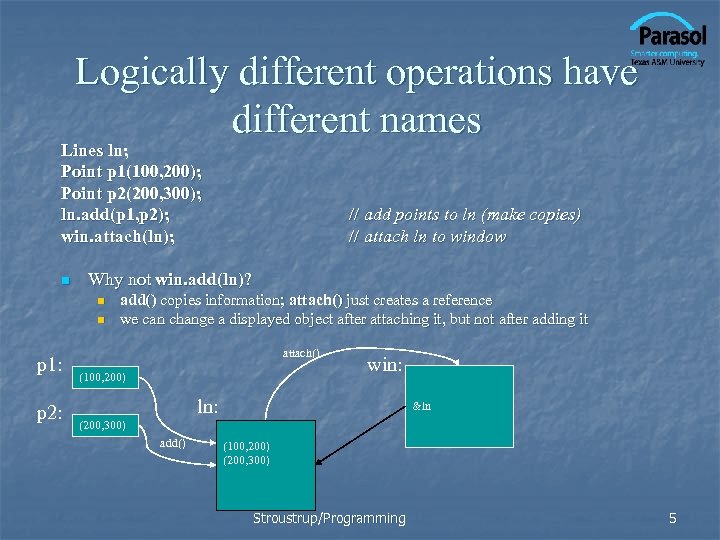
Logically different operations have different names Lines ln; Point p 1(100, 200); Point p 2(200, 300); ln. add(p 1, p 2); win. attach(ln); n Why not win. add(ln)? n n p 1: p 2: // add points to ln (make copies) // attach ln to window add() copies information; attach() just creates a reference we can change a displayed object after attaching it, but not after adding it attach() (100, 200) win: ln: &ln (200, 300) add() (100, 200) (200, 300) Stroustrup/Programming 5
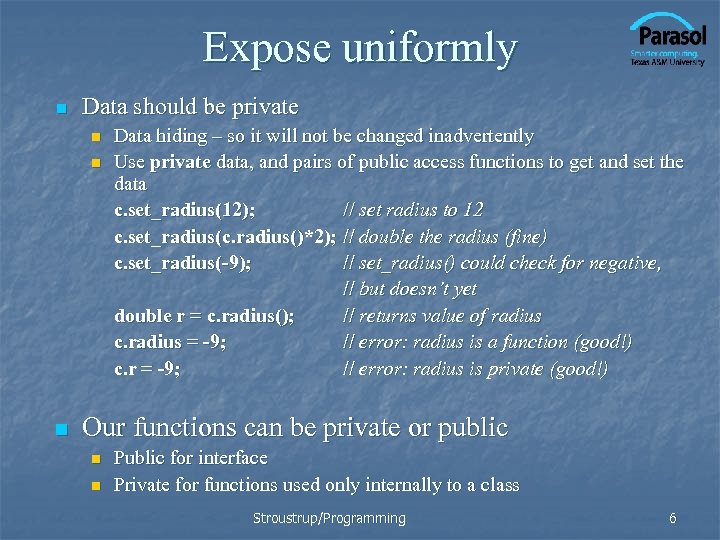
Expose uniformly n Data should be private n n n Data hiding – so it will not be changed inadvertently Use private data, and pairs of public access functions to get and set the data c. set_radius(12); // set radius to 12 c. set_radius(c. radius()*2); // double the radius (fine) c. set_radius(-9); // set_radius() could check for negative, // but doesn’t yet double r = c. radius(); // returns value of radius c. radius = -9; // error: radius is a function (good!) c. r = -9; // error: radius is private (good!) Our functions can be private or public n n Public for interface Private for functions used only internally to a class Stroustrup/Programming 6
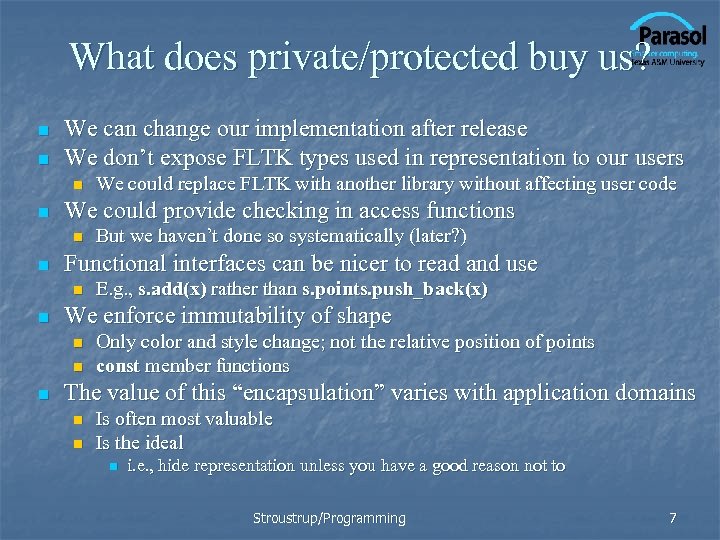
What does private/protected buy us? n n We can change our implementation after release We don’t expose FLTK types used in representation to our users n n We could provide checking in access functions n n E. g. , s. add(x) rather than s. points. push_back(x) We enforce immutability of shape n n n But we haven’t done so systematically (later? ) Functional interfaces can be nicer to read and use n n We could replace FLTK with another library without affecting user code Only color and style change; not the relative position of points const member functions The value of this “encapsulation” varies with application domains n n Is often most valuable Is the ideal n i. e. , hide representation unless you have a good reason not to Stroustrup/Programming 7
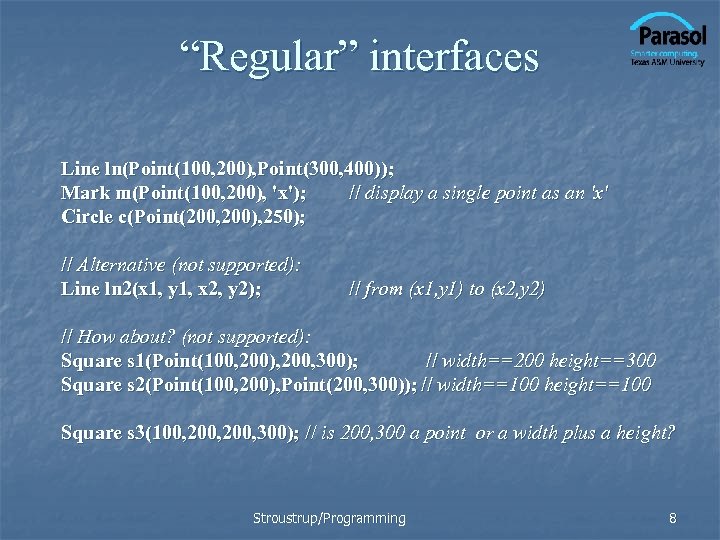
“Regular” interfaces Line ln(Point(100, 200), Point(300, 400)); Mark m(Point(100, 200), 'x'); // display a single point as an 'x' Circle c(Point(200, 200), 250); // Alternative (not supported): Line ln 2(x 1, y 1, x 2, y 2); // from (x 1, y 1) to (x 2, y 2) // How about? (not supported): Square s 1(Point(100, 200), 200, 300); // width==200 height==300 Square s 2(Point(100, 200), Point(200, 300)); // width==100 height==100 Square s 3(100, 200, 300); // is 200, 300 a point or a width plus a height? Stroustrup/Programming 8
A library n A collection of classes and functions meant to be used together n n n A good library models some aspect of a domain n As building blocks for applications To build more such “building blocks” It doesn’t try to do everything Our library aims at simplicity and small size for graphing data and for very simple GUI We can’t define each library class and function in isolation n A good library exhibits a uniform style (“regularity”) Stroustrup/Programming 9
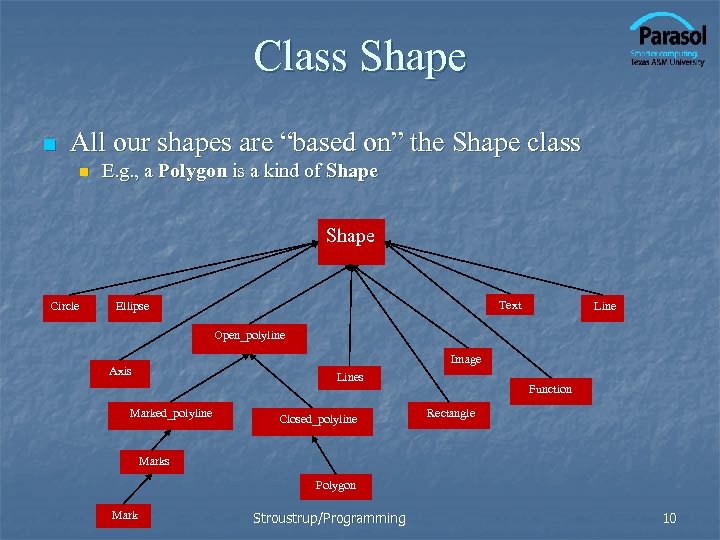
Class Shape n All our shapes are “based on” the Shape class n E. g. , a Polygon is a kind of Shape Circle Text Ellipse Line Open_polyline Image Axis Lines Marked_polyline Closed_polyline Function Rectangle Marks Polygon Mark Stroustrup/Programming 10
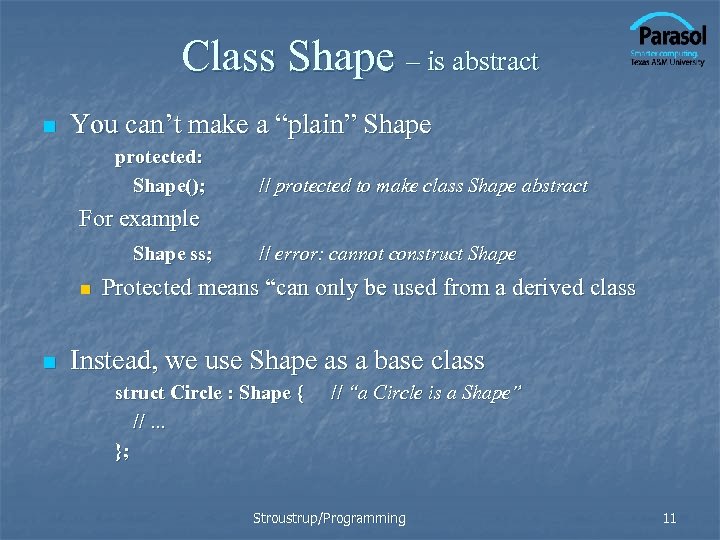
Class Shape – is abstract n You can’t make a “plain” Shape protected: Shape(); // protected to make class Shape abstract For example Shape ss; n n // error: cannot construct Shape Protected means “can only be used from a derived class Instead, we use Shape as a base class struct Circle : Shape { // … }; // “a Circle is a Shape” Stroustrup/Programming 11
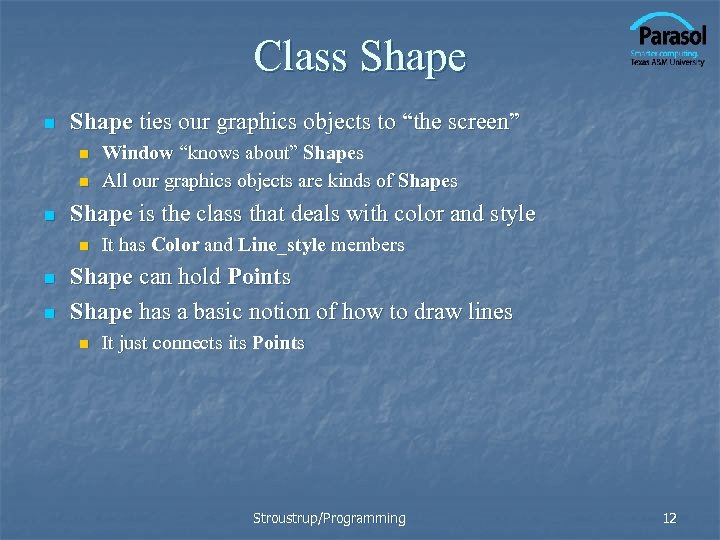
Class Shape n Shape ties our graphics objects to “the screen” n n n Shape is the class that deals with color and style n n n Window “knows about” Shapes All our graphics objects are kinds of Shapes It has Color and Line_style members Shape can hold Points Shape has a basic notion of how to draw lines n It just connects its Points Stroustrup/Programming 12
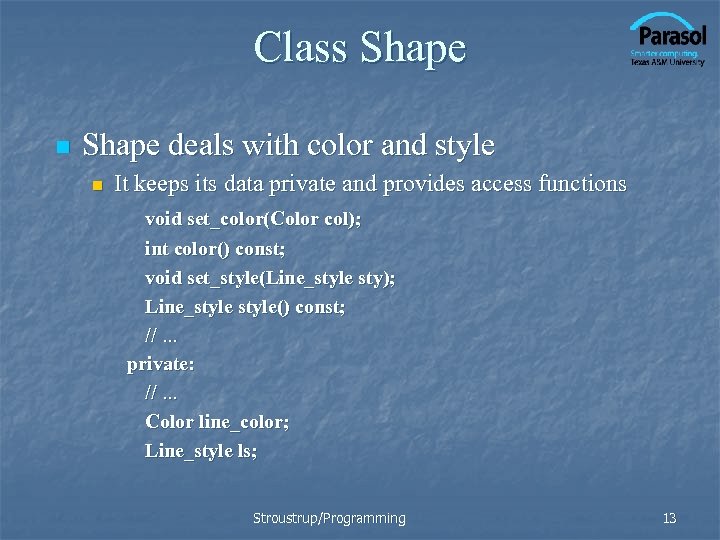
Class Shape n Shape deals with color and style n It keeps its data private and provides access functions void set_color(Color col); int color() const; void set_style(Line_style sty); Line_style() const; // … private: // … Color line_color; Line_style ls; Stroustrup/Programming 13
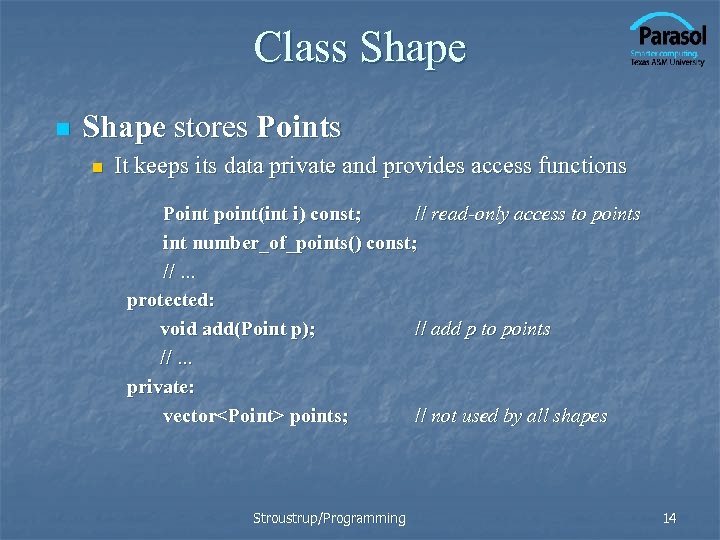
Class Shape n Shape stores Points n It keeps its data private and provides access functions Point point(int i) const; // read-only access to points int number_of_points() const; // … protected: void add(Point p); // add p to points // … private: vector<Point> points; // not used by all shapes Stroustrup/Programming 14
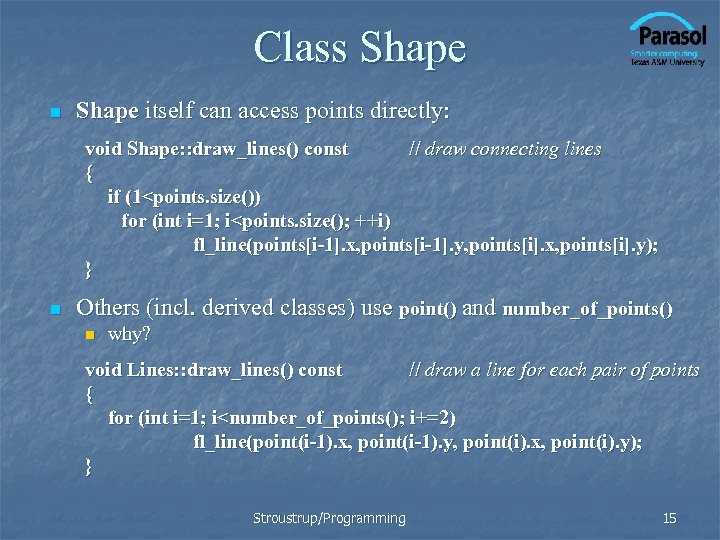
Class Shape n Shape itself can access points directly: void Shape: : draw_lines() const // draw connecting lines { if (1<points. size()) for (int i=1; i<points. size(); ++i) fl_line(points[i-1]. x, points[i-1]. y, points[i]. x, points[i]. y); } n Others (incl. derived classes) use point() and number_of_points() n why? void Lines: : draw_lines() const // draw a line for each pair of points { for (int i=1; i<number_of_points(); i+=2) fl_line(point(i-1). x, point(i-1). y, point(i). x, point(i). y); } Stroustrup/Programming 15
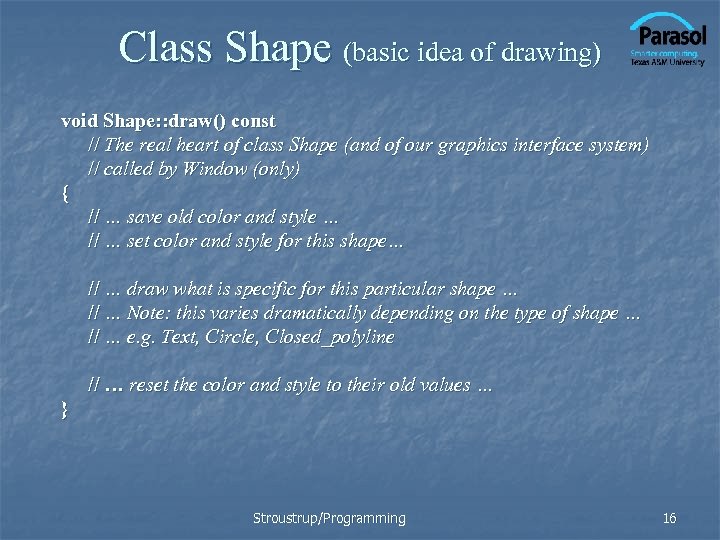
Class Shape (basic idea of drawing) void Shape: : draw() const // The real heart of class Shape (and of our graphics interface system) // called by Window (only) { // … save old color and style … // … set color and style for this shape… // … draw what is specific for this particular shape … // … Note: this varies dramatically depending on the type of shape … // … e. g. Text, Circle, Closed_polyline // … reset the color and style to their old values … } Stroustrup/Programming 16
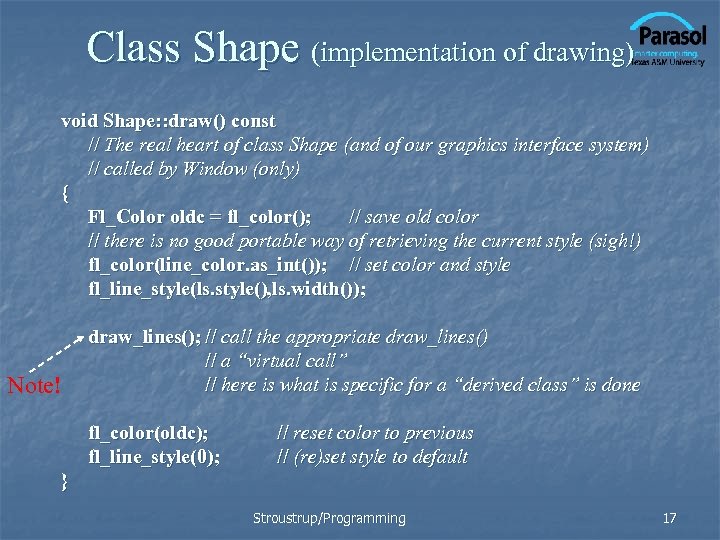
Class Shape (implementation of drawing) void Shape: : draw() const // The real heart of class Shape (and of our graphics interface system) // called by Window (only) { Fl_Color oldc = fl_color(); // save old color // there is no good portable way of retrieving the current style (sigh!) fl_color(line_color. as_int()); // set color and style fl_line_style(ls. style(), ls. width()); Note! draw_lines(); // call the appropriate draw_lines() // a “virtual call” // here is what is specific for a “derived class” is done fl_color(oldc); fl_line_style(0); // reset color to previous // (re)set style to default } Stroustrup/Programming 17
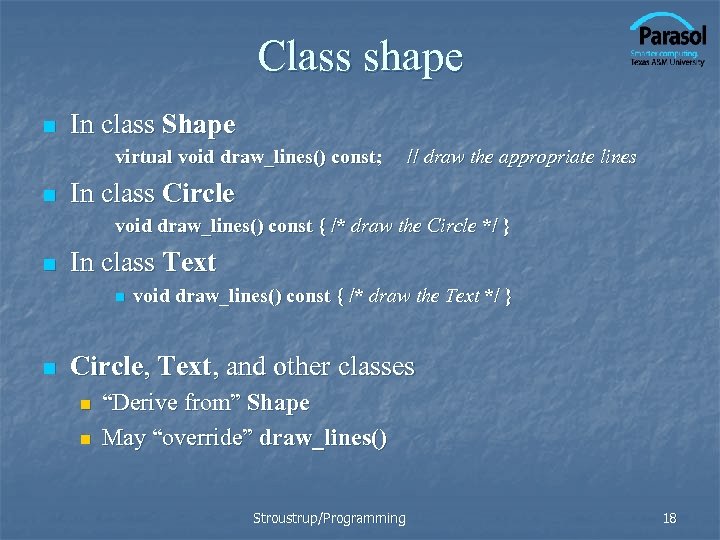
Class shape n In class Shape virtual void draw_lines() const; n // draw the appropriate lines In class Circle void draw_lines() const { /* draw the Circle */ } n In class Text n n void draw_lines() const { /* draw the Text */ } Circle, Text, and other classes n n “Derive from” Shape May “override” draw_lines() Stroustrup/Programming 18
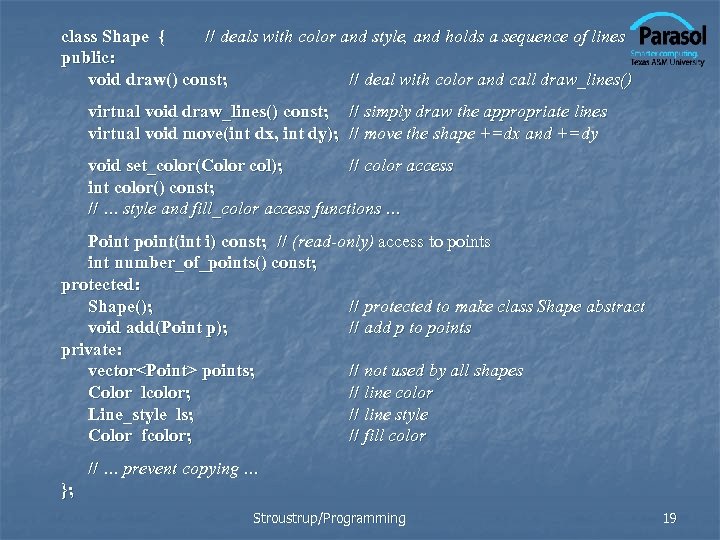
class Shape { // deals with color and style, and holds a sequence of lines public: void draw() const; // deal with color and call draw_lines() virtual void draw_lines() const; // simply draw the appropriate lines virtual void move(int dx, int dy); // move the shape +=dx and +=dy void set_color(Color col); // color access int color() const; // … style and fill_color access functions … Point point(int i) const; // (read-only) access to points int number_of_points() const; protected: Shape(); // protected to make class Shape abstract void add(Point p); // add p to points private: vector<Point> points; // not used by all shapes Color lcolor; // line color Line_style ls; // line style Color fcolor; // fill color // … prevent copying … }; Stroustrup/Programming 19
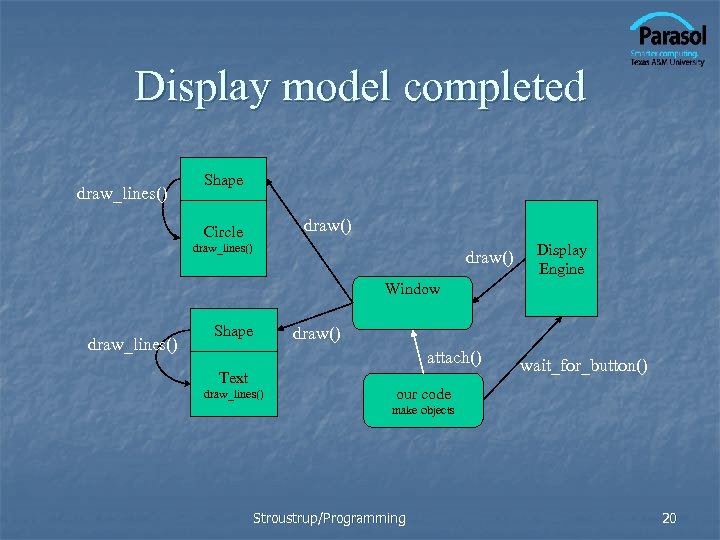
Display model completed draw_lines() Shape draw() Circle draw_lines() draw() Display Engine Window draw_lines() Shape draw() attach() Text draw_lines() wait_for_button() our code make objects Stroustrup/Programming 20
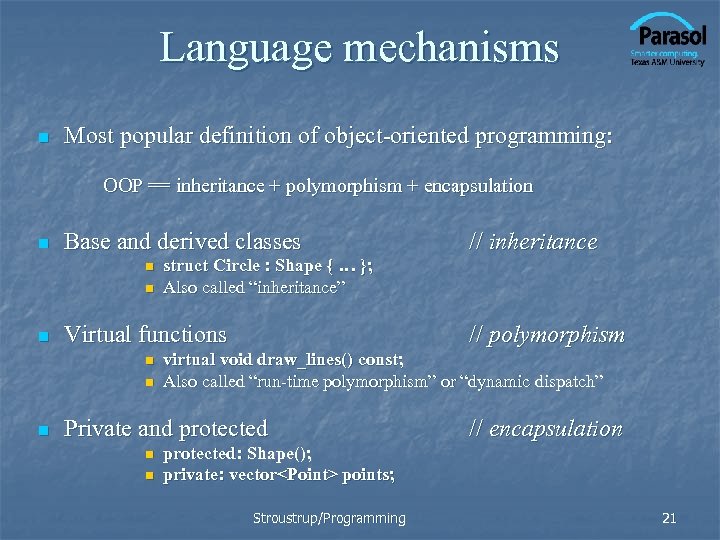
Language mechanisms n Most popular definition of object-oriented programming: OOP == inheritance + polymorphism + encapsulation n Base and derived classes n n n struct Circle : Shape { … }; Also called “inheritance” Virtual functions n // polymorphism virtual void draw_lines() const; Also called “run-time polymorphism” or “dynamic dispatch” Private and protected n n // inheritance // encapsulation protected: Shape(); private: vector<Point> points; Stroustrup/Programming 21
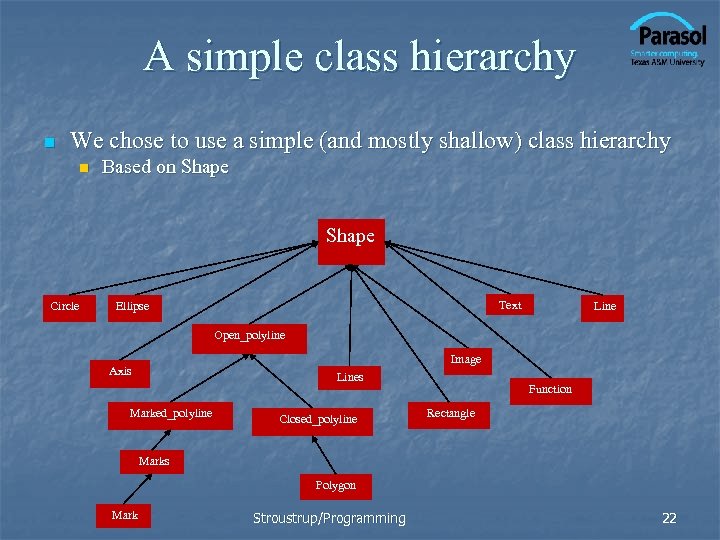
A simple class hierarchy n We chose to use a simple (and mostly shallow) class hierarchy n Based on Shape Circle Text Ellipse Line Open_polyline Image Axis Lines Marked_polyline Closed_polyline Function Rectangle Marks Polygon Mark Stroustrup/Programming 22
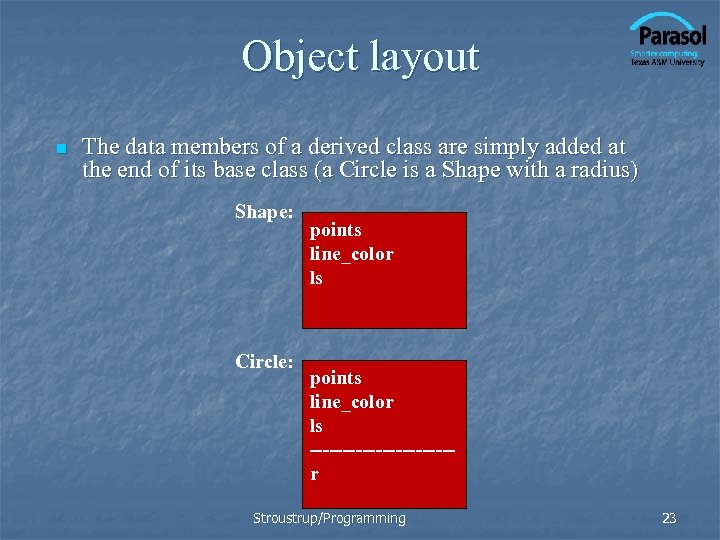
Object layout n The data members of a derived class are simply added at the end of its base class (a Circle is a Shape with a radius) Shape: Circle: points line_color ls -----------r Stroustrup/Programming 23
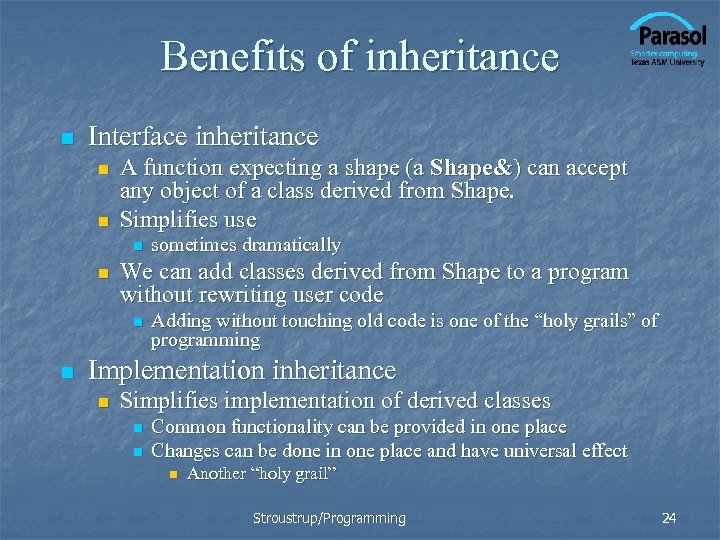
Benefits of inheritance n Interface inheritance n n A function expecting a shape (a Shape&) can accept any object of a class derived from Shape. Simplifies use n n We can add classes derived from Shape to a program without rewriting user code n n sometimes dramatically Adding without touching old code is one of the “holy grails” of programming Implementation inheritance n Simplifies implementation of derived classes n n Common functionality can be provided in one place Changes can be done in one place and have universal effect n Another “holy grail” Stroustrup/Programming 24
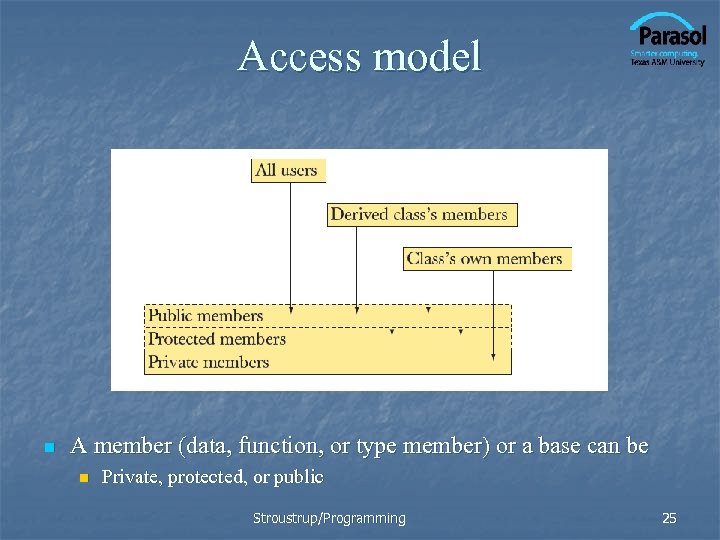
Access model n A member (data, function, or type member) or a base can be n Private, protected, or public Stroustrup/Programming 25
Next lecture n Graphing functions and data Stroustrup/Programming 26
Скачать презентацию Chapter 14 Graph class design Bjarne Stroustrup www
0ff233b3000ccf422b2443fd3f34e9a6.ppt