 Скачать презентацию Chapter 14 Foreign Direct Investment and Collaborative Ventures
46236211418360ba8002fa5825e627d6.ppt
- Количество слайдов: 26




Chapter 14 Foreign Direct Investment and Collaborative Ventures International Business Strategy, Management & the New Realities by Cavusgil, Knight & Riesenberger International Business: Strategy, Management, and the New Realities 1
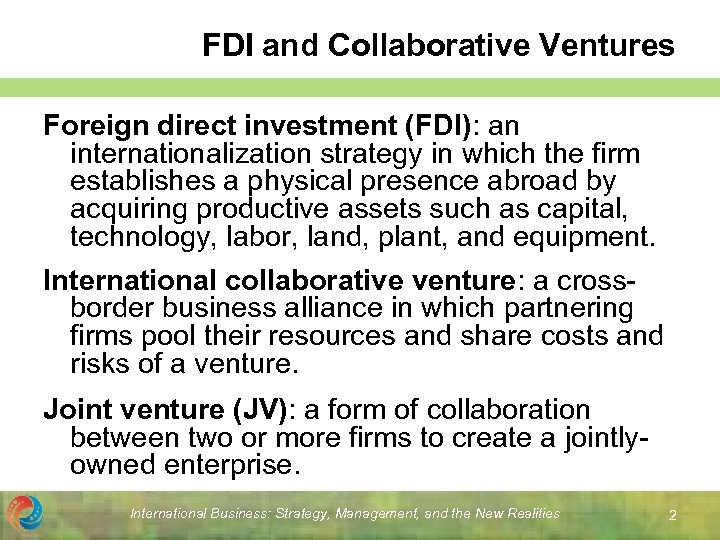
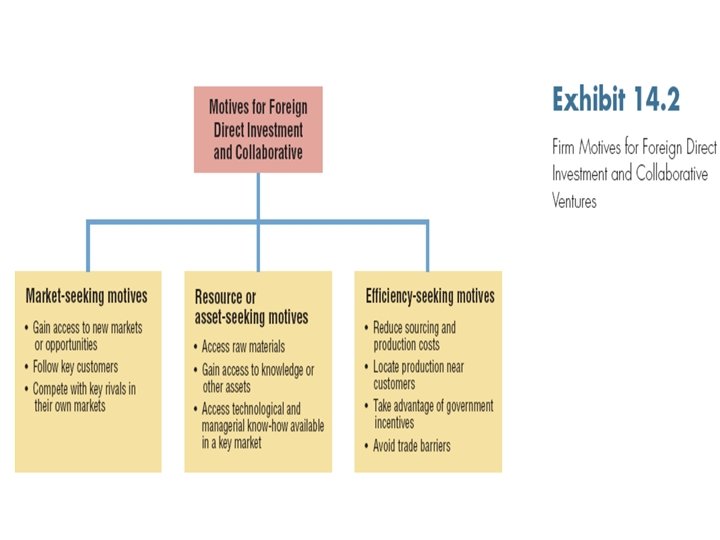
FDI and Collaborative Ventures Foreign direct investment (FDI): an internationalization strategy in which the firm establishes a physical presence abroad by acquiring productive assets such as capital, technology, labor, land, plant, and equipment. International collaborative venture: a crossborder business alliance in which partnering firms pool their resources and share costs and risks of a venture. Joint venture (JV): a form of collaboration between two or more firms to create a jointlyowned enterprise. International Business: Strategy, Management, and the New Realities 2
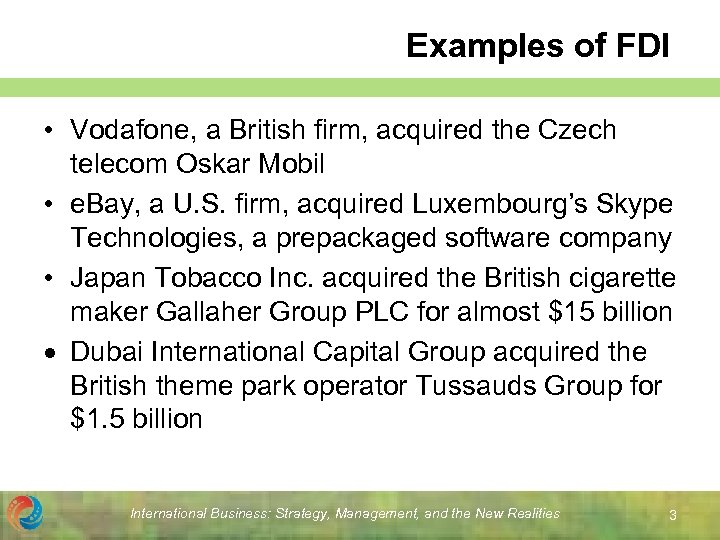
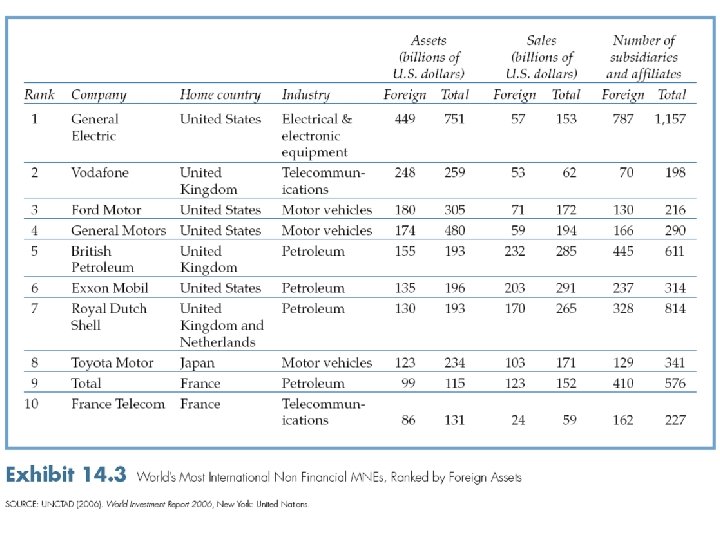
Examples of FDI • Vodafone, a British firm, acquired the Czech telecom Oskar Mobil • e. Bay, a U. S. firm, acquired Luxembourg’s Skype Technologies, a prepackaged software company • Japan Tobacco Inc. acquired the British cigarette maker Gallaher Group PLC for almost $15 billion Dubai International Capital Group acquired the British theme park operator Tussauds Group for $1. 5 billion International Business: Strategy, Management, and the New Realities 3
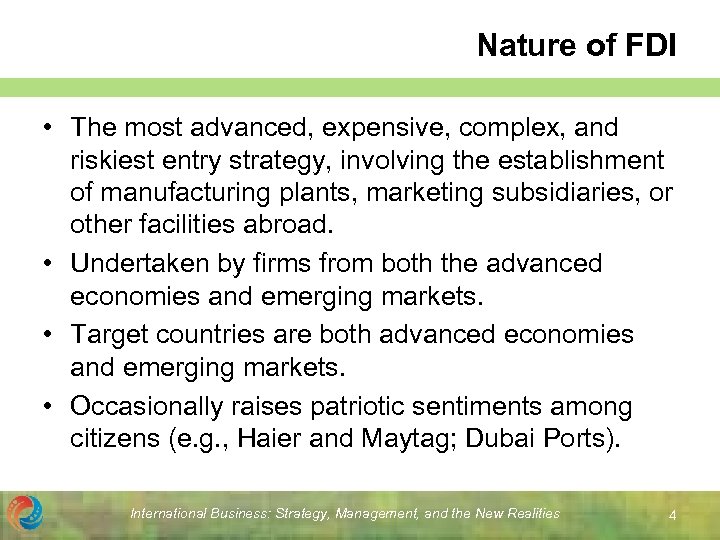
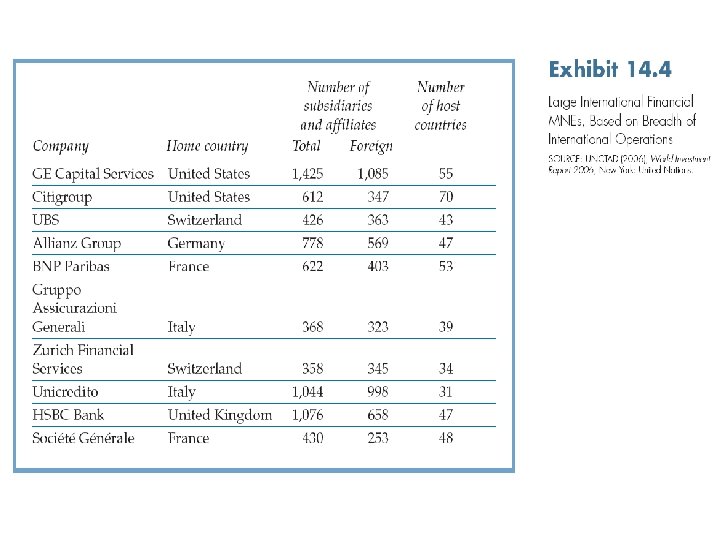
Nature of FDI • The most advanced, expensive, complex, and riskiest entry strategy, involving the establishment of manufacturing plants, marketing subsidiaries, or other facilities abroad. • Undertaken by firms from both the advanced economies and emerging markets. • Target countries are both advanced economies and emerging markets. • Occasionally raises patriotic sentiments among citizens (e. g. , Haier and Maytag; Dubai Ports). International Business: Strategy, Management, and the New Realities 4
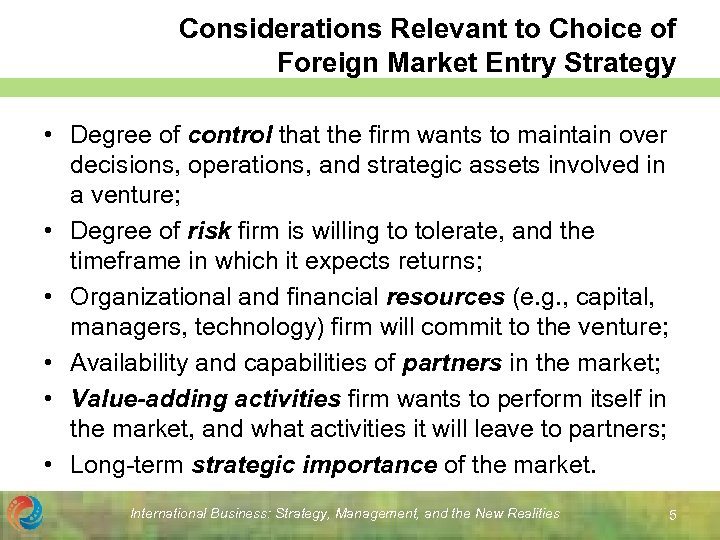
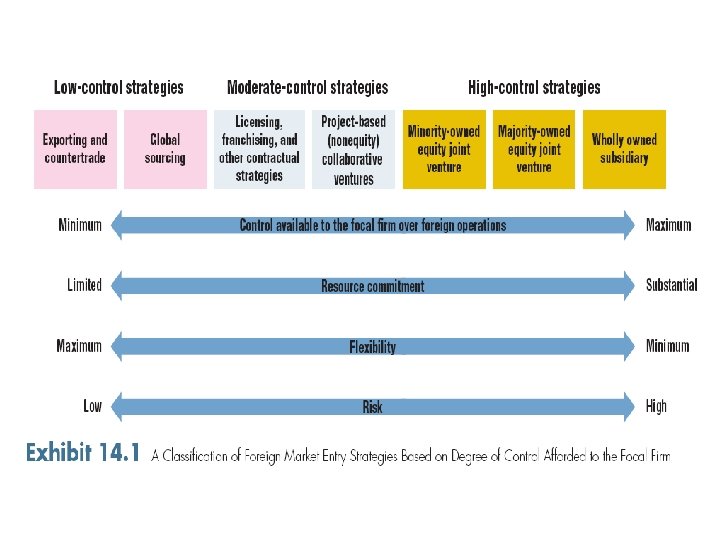
Considerations Relevant to Choice of Foreign Market Entry Strategy • Degree of control that the firm wants to maintain over decisions, operations, and strategic assets involved in a venture; • Degree of risk firm is willing to tolerate, and the timeframe in which it expects returns; • Organizational and financial resources (e. g. , capital, managers, technology) firm will commit to the venture; • Availability and capabilities of partners in the market; • Value-adding activities firm wants to perform itself in the market, and what activities it will leave to partners; • Long-term strategic importance of the market. International Business: Strategy, Management, and the New Realities 5
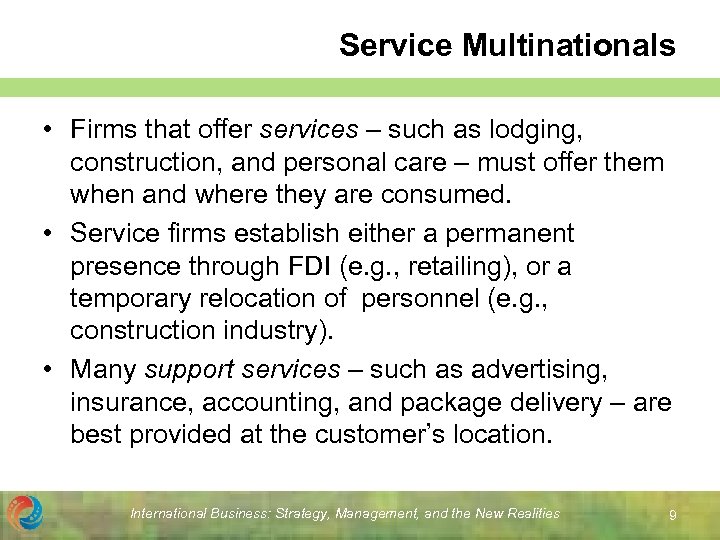
Service Multinationals • Firms that offer services – such as lodging, construction, and personal care – must offer them when and where they are consumed. • Service firms establish either a permanent presence through FDI (e. g. , retailing), or a temporary relocation of personnel (e. g. , construction industry). • Many support services – such as advertising, insurance, accounting, and package delivery – are best provided at the customer’s location. International Business: Strategy, Management, and the New Realities 9
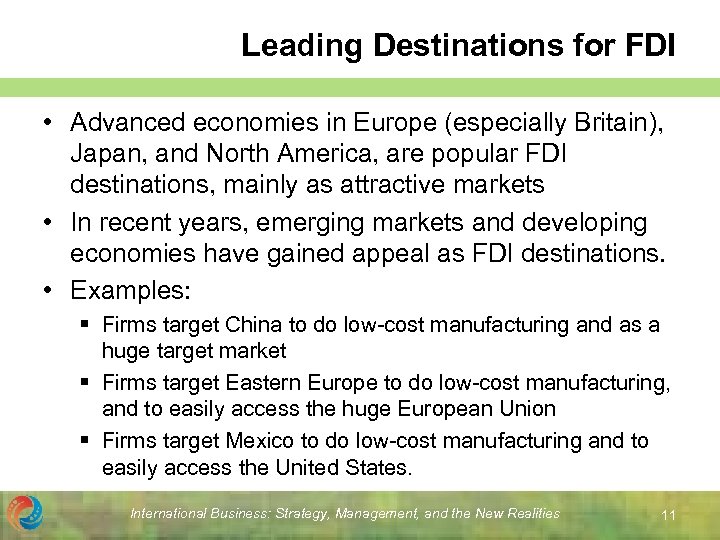
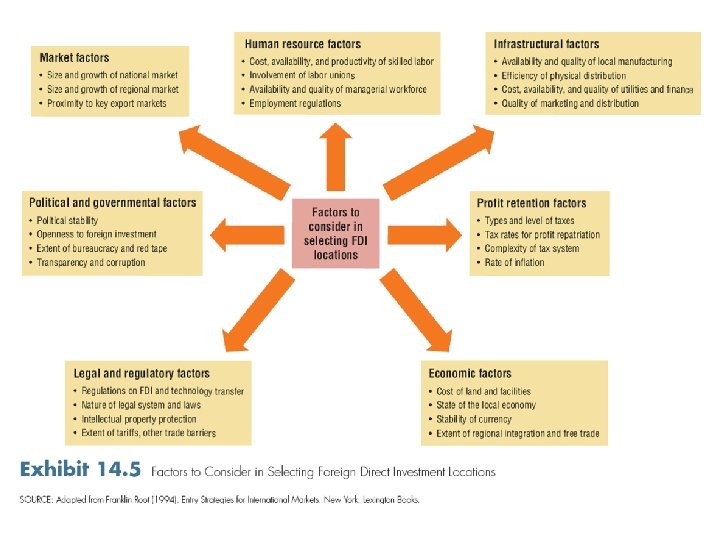
Leading Destinations for FDI • Advanced economies in Europe (especially Britain), Japan, and North America, are popular FDI destinations, mainly as attractive markets • In recent years, emerging markets and developing economies have gained appeal as FDI destinations. • Examples: § Firms target China to do low-cost manufacturing and as a huge target market § Firms target Eastern Europe to do low-cost manufacturing, and to easily access the huge European Union § Firms target Mexico to do low-cost manufacturing and to easily access the United States. International Business: Strategy, Management, and the New Realities 11

Types of FDI • Greenfield investment vs. mergers and acquisitions • The nature of ownership: Wholly owned direct investment vs. equity joint venture • Level of integration: Vertical vs. horizontal FDI International Business: Strategy, Management, and the New Realities 13

Greenfield Investment vs. M&As • Greenfield investment: firm invests to build a new manufacturing, marketing or administrative facility, as opposed to acquiring existing facilities. • Acquisition : direct investment or purchase an existing company or facility. • Merger: special type of acquisition in which two firms join to form a new, larger company. International Business: Strategy, Management, and the New Realities 14
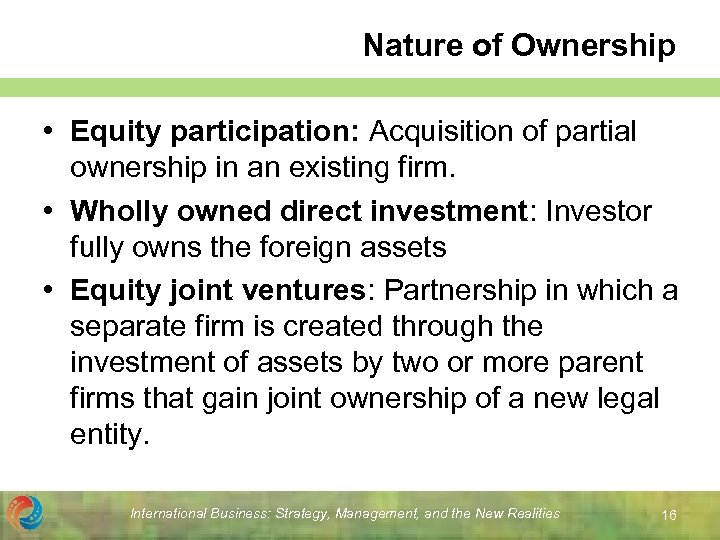
Nature of Ownership • Equity participation: Acquisition of partial ownership in an existing firm. • Wholly owned direct investment: Investor fully owns the foreign assets • Equity joint ventures: Partnership in which a separate firm is created through the investment of assets by two or more parent firms that gain joint ownership of a new legal entity. International Business: Strategy, Management, and the New Realities 16
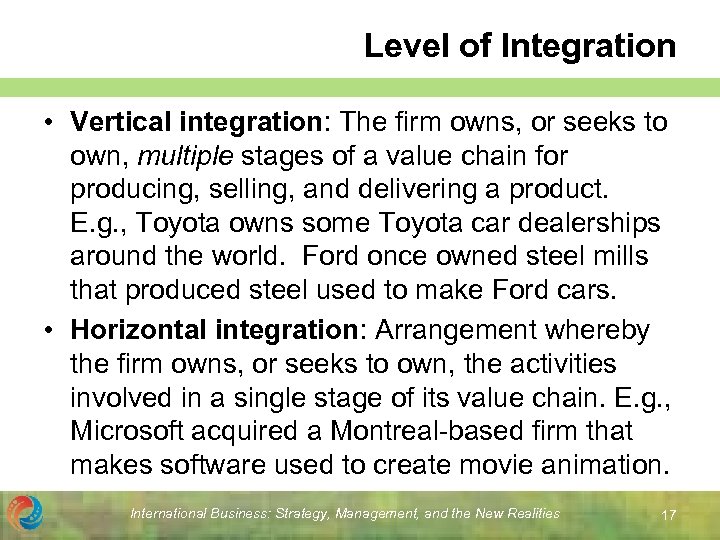
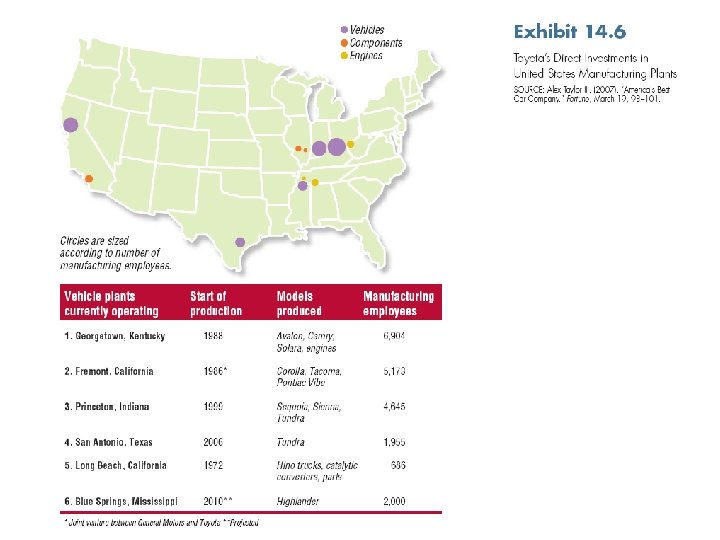
Level of Integration • Vertical integration: The firm owns, or seeks to own, multiple stages of a value chain for producing, selling, and delivering a product. E. g. , Toyota owns some Toyota car dealerships around the world. Ford once owned steel mills that produced steel used to make Ford cars. • Horizontal integration: Arrangement whereby the firm owns, or seeks to own, the activities involved in a single stage of its value chain. E. g. , Microsoft acquired a Montreal-based firm that makes software used to create movie animation. International Business: Strategy, Management, and the New Realities 17
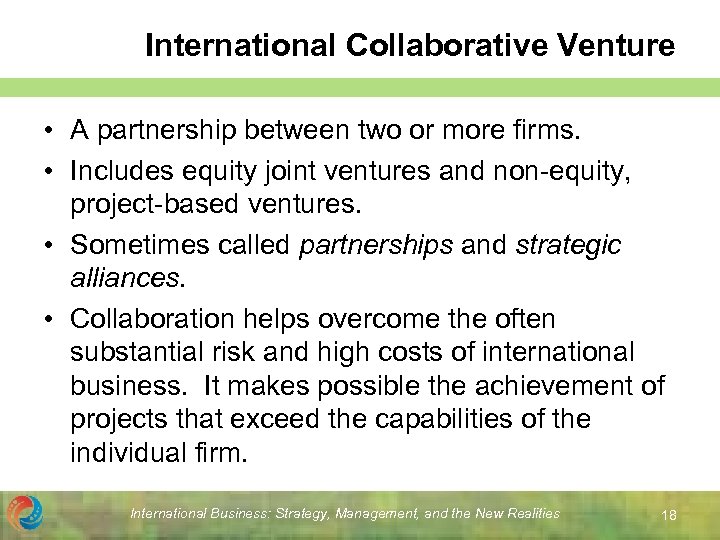
International Collaborative Venture • A partnership between two or more firms. • Includes equity joint ventures and non-equity, project-based ventures. • Sometimes called partnerships and strategic alliances. • Collaboration helps overcome the often substantial risk and high costs of international business. It makes possible the achievement of projects that exceed the capabilities of the individual firm. International Business: Strategy, Management, and the New Realities 18
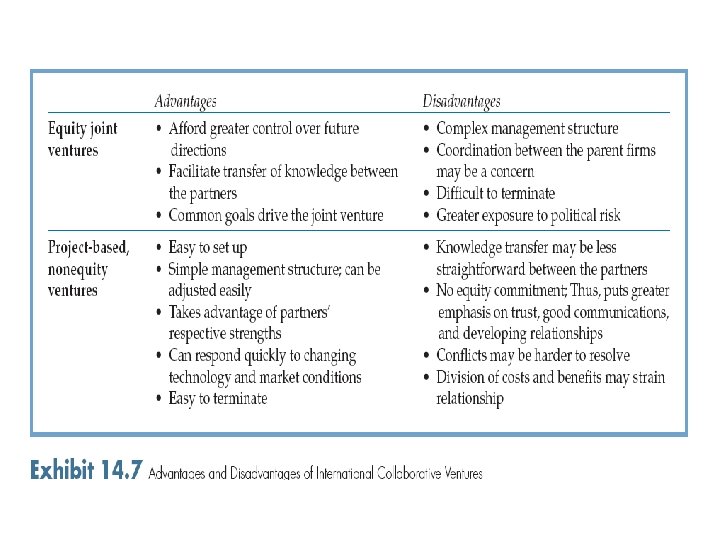
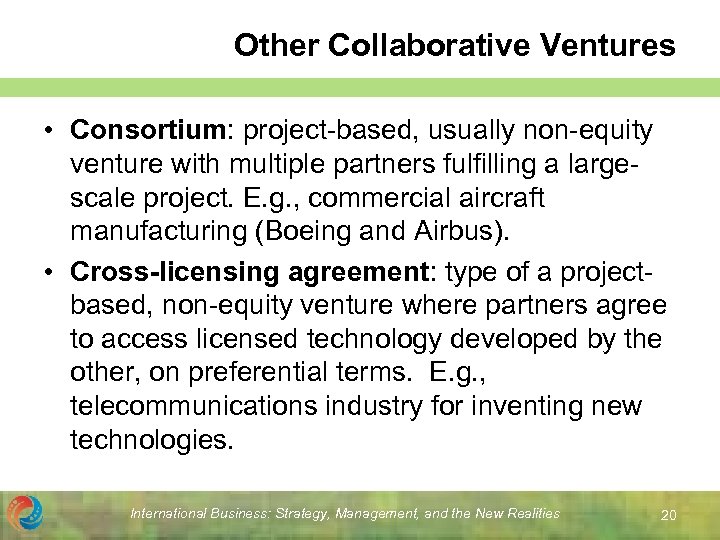
Other Collaborative Ventures • Consortium: project-based, usually non-equity venture with multiple partners fulfilling a largescale project. E. g. , commercial aircraft manufacturing (Boeing and Airbus). • Cross-licensing agreement: type of a projectbased, non-equity venture where partners agree to access licensed technology developed by the other, on preferential terms. E. g. , telecommunications industry for inventing new technologies. International Business: Strategy, Management, and the New Realities 20
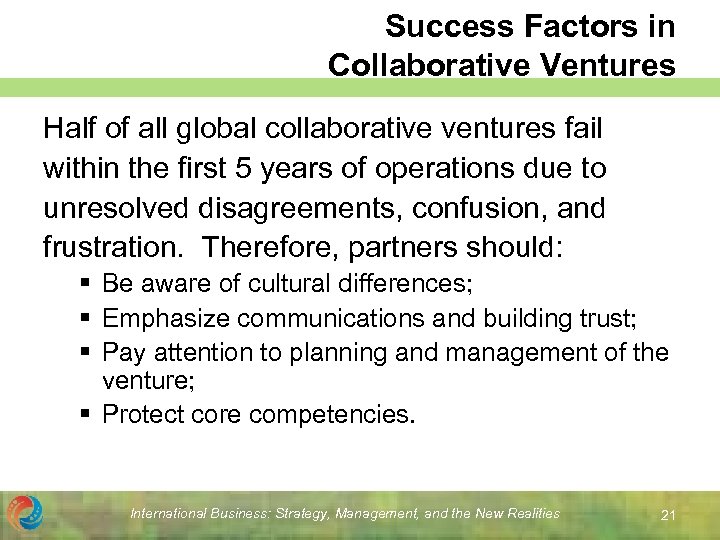
Success Factors in Collaborative Ventures Half of all global collaborative ventures fail within the first 5 years of operations due to unresolved disagreements, confusion, and frustration. Therefore, partners should: § Be aware of cultural differences; § Emphasize communications and building trust; § Pay attention to planning and management of the venture; § Protect core competencies. International Business: Strategy, Management, and the New Realities 21
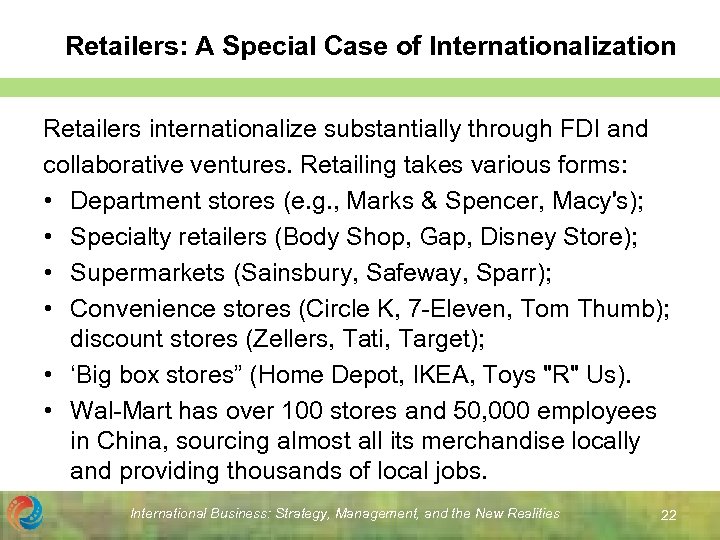
Retailers: A Special Case of Internationalization Retailers internationalize substantially through FDI and collaborative ventures. Retailing takes various forms: • Department stores (e. g. , Marks & Spencer, Macy's); • Specialty retailers (Body Shop, Gap, Disney Store); • Supermarkets (Sainsbury, Safeway, Sparr); • Convenience stores (Circle K, 7 -Eleven, Tom Thumb); discount stores (Zellers, Tati, Target); • ‘Big box stores” (Home Depot, IKEA, Toys "R" Us). • Wal-Mart has over 100 stores and 50, 000 employees in China, sourcing almost all its merchandise locally and providing thousands of local jobs. International Business: Strategy, Management, and the New Realities 22
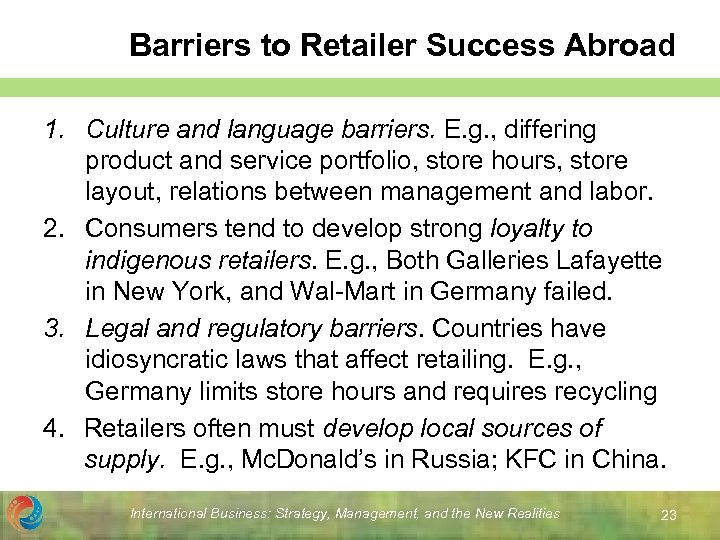
Barriers to Retailer Success Abroad 1. Culture and language barriers. E. g. , differing product and service portfolio, store hours, store layout, relations between management and labor. 2. Consumers tend to develop strong loyalty to indigenous retailers. E. g. , Both Galleries Lafayette in New York, and Wal-Mart in Germany failed. 3. Legal and regulatory barriers. Countries have idiosyncratic laws that affect retailing. E. g. , Germany limits store hours and requires recycling 4. Retailers often must develop local sources of supply. E. g. , Mc. Donald’s in Russia; KFC in China. International Business: Strategy, Management, and the New Realities 23
Corporate Social Responsibility (CSR) • Refers to operating a business in a manner that meets or exceeds the ethical, legal, commercial, and public expectations of stakeholders (customers, shareholders, employees, and communities). • Represents a set of core values that includes avoiding human rights abuses; upholding the right to join or form labor unions; elimination of compulsory and child labor; avoiding workplace discrimination; protecting the natural environment; and guarding against corruption, including extortion and bribery. International Business: Strategy, Management, and the New Realities 24
Relativism vs. Normativism in CSR • Some believe it is sufficient to simply follow the laws and regulations in each country. However, many countries have weak legal and regulatory systems, and much corruption. • Relativism: A belief that ethical truths are relative to the groups that hold them. Akin to the advice: “When in Rome, do as the Romans do. ” Accordingly, a Japanese MNE that believes bribery is wrong might pay bribes in countries where the practice is customary. • Normativism : A belief in universal behavioral standards that firms and individuals should uphold. Accordingly, the Japanese MNE that believes bribery is wrong will enforce this standard everywhere in the world. • The U. N. and other CSR proponents encourage companies to follow a normative approach. International Business: Strategy, Management, and the New Realities 26
Скачать презентацию Chapter 14 Foreign Direct Investment and Collaborative Ventures
46236211418360ba8002fa5825e627d6.ppt