 Скачать презентацию Chapter 14 Bodie Kane Marcus Perrakis Ryan INVESTMENTS
9f5530a99af892883e6adf9e12b55bb9.ppt
- Количество слайдов: 35



Chapter 14 Bodie Kane Marcus Perrakis Ryan INVESTMENTS, Fourth Canadian Edition Security Analysis Slide 14 -1 Copyright © Mc. Graw-Hill Ryerson Limited, 2003
Bodie Kane Marcus Perrakis Ryan INVESTMENTS, Fourth Canadian Edition Chapter Summary w Objective: Introduction to fundamental stock analysis. This chapter introduces different types of valuation models and shows how economic conditions affect the results. n n Slide 14 -2 Dividend discount models Price-Earnings ratios Other methods and issues Macroeconomic analysis Copyright © Mc. Graw-Hill Ryerson Limited, 2003
Bodie Kane Marcus Perrakis Ryan INVESTMENTS, Fourth Canadian Edition Fundamental Analysis: Models of Equity Valuation w Basic Types of Models n n n Balance Sheet Models Dividend Discount Models Price/Earning Ratios w Estimating Growth Rates and Opportunities Slide 14 -3 Copyright © Mc. Graw-Hill Ryerson Limited, 2003
Bodie Kane Marcus Perrakis Ryan INVESTMENTS, Fourth Canadian Edition Intrinsic Value and Market Price w Intrinsic Value n n Self assigned Value Variety of models are used for estimation w Market Price n Consensus value of all potential traders w Trading Signal n n n Slide 14 -4 IV > MP Buy IV < MP Sell or Short Sell IV = MP Hold or Fairly Priced Copyright © Mc. Graw-Hill Ryerson Limited, 2003
Bodie Kane Marcus Perrakis Ryan INVESTMENTS, Fourth Canadian Edition Summary Reminder w Objective: Introduction to fundamental stock analysis. This chapter introduces different types of valuation models and shows how economic conditions affect the results. n n Slide 14 -5 Dividend discount models Price-Earnings ratios Other methods and issues Macroeconomic analysis Copyright © Mc. Graw-Hill Ryerson Limited, 2003
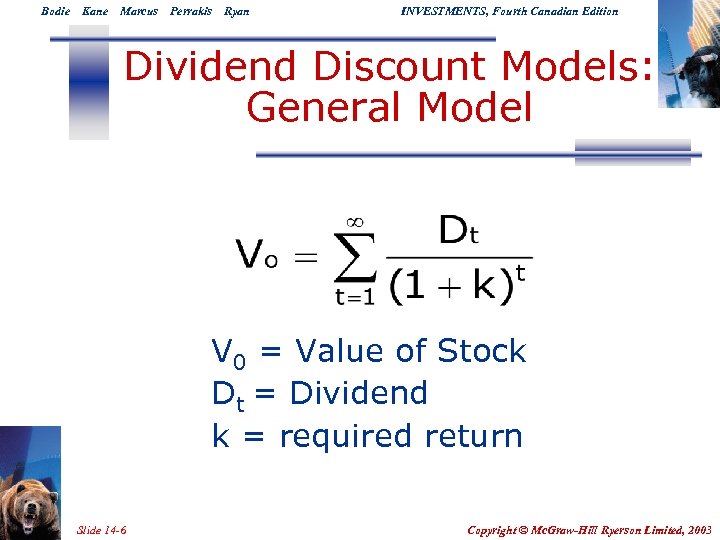
Bodie Kane Marcus Perrakis Ryan INVESTMENTS, Fourth Canadian Edition Dividend Discount Models: General Model V 0 = Value of Stock Dt = Dividend k = required return Slide 14 -6 Copyright © Mc. Graw-Hill Ryerson Limited, 2003
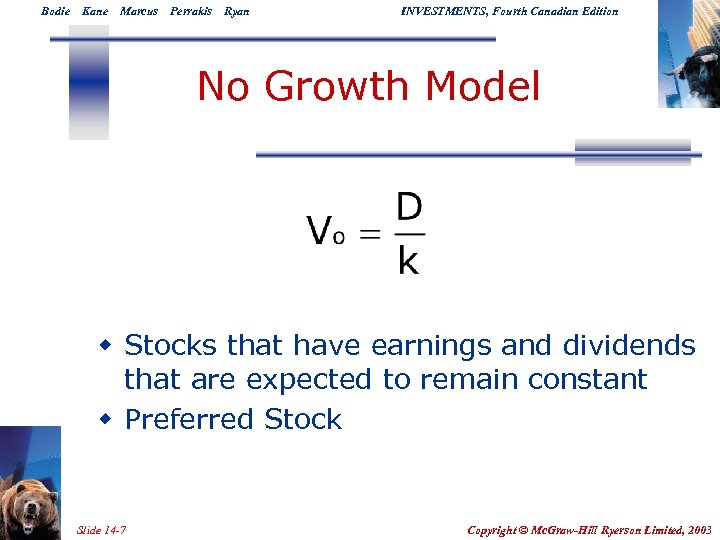
Bodie Kane Marcus Perrakis Ryan INVESTMENTS, Fourth Canadian Edition No Growth Model w Stocks that have earnings and dividends that are expected to remain constant w Preferred Stock Slide 14 -7 Copyright © Mc. Graw-Hill Ryerson Limited, 2003
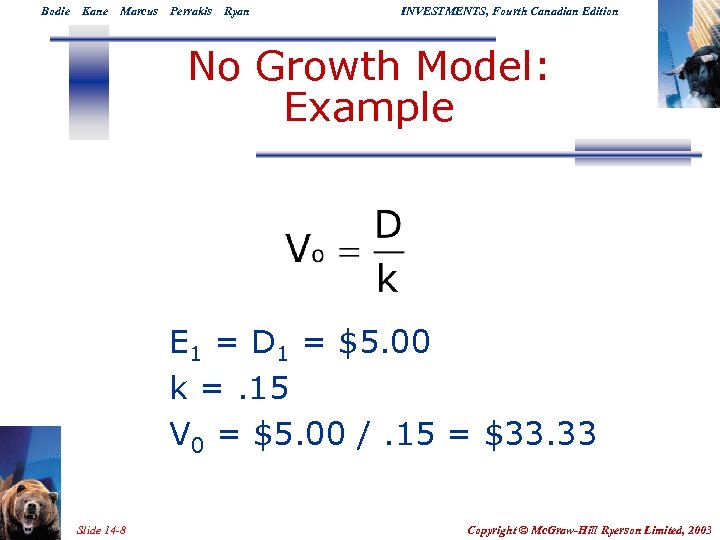
Bodie Kane Marcus Perrakis Ryan INVESTMENTS, Fourth Canadian Edition No Growth Model: Example E 1 = D 1 = $5. 00 k =. 15 V 0 = $5. 00 /. 15 = $33. 33 Slide 14 -8 Copyright © Mc. Graw-Hill Ryerson Limited, 2003
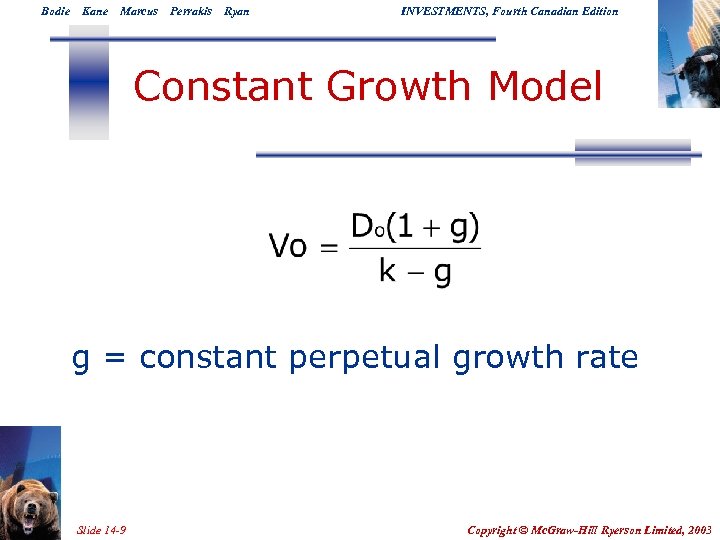
Bodie Kane Marcus Perrakis Ryan INVESTMENTS, Fourth Canadian Edition Constant Growth Model g = constant perpetual growth rate Slide 14 -9 Copyright © Mc. Graw-Hill Ryerson Limited, 2003
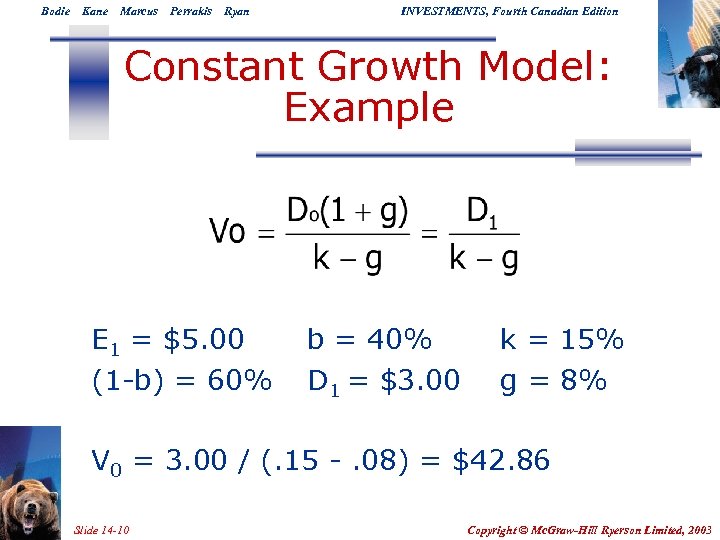
Bodie Kane Marcus Perrakis Ryan INVESTMENTS, Fourth Canadian Edition Constant Growth Model: Example E 1 = $5. 00 (1 -b) = 60% b = 40% D 1 = $3. 00 k = 15% g = 8% V 0 = 3. 00 / (. 15 -. 08) = $42. 86 Slide 14 -10 Copyright © Mc. Graw-Hill Ryerson Limited, 2003
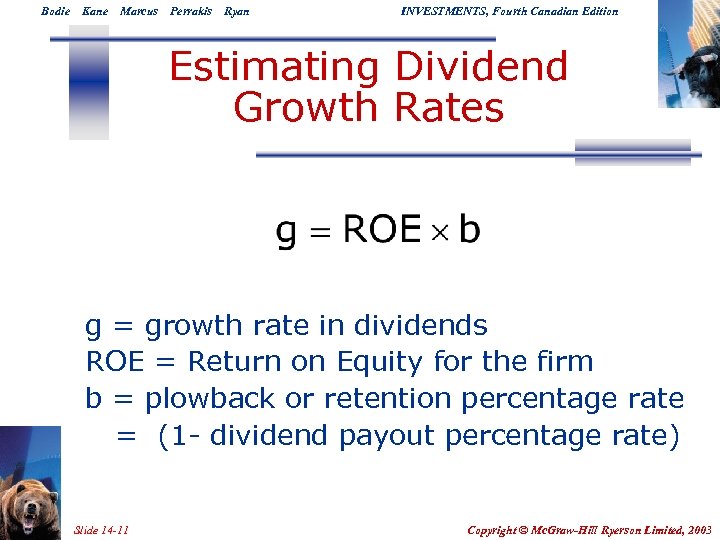
Bodie Kane Marcus Perrakis Ryan INVESTMENTS, Fourth Canadian Edition Estimating Dividend Growth Rates g = growth rate in dividends ROE = Return on Equity for the firm b = plowback or retention percentage rate = (1 - dividend payout percentage rate) Slide 14 -11 Copyright © Mc. Graw-Hill Ryerson Limited, 2003
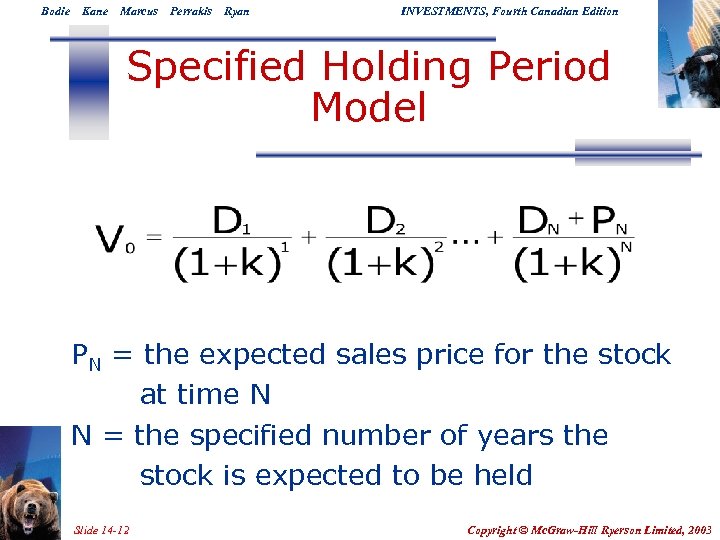
Bodie Kane Marcus Perrakis Ryan INVESTMENTS, Fourth Canadian Edition Specified Holding Period Model PN = the expected sales price for the stock at time N N = the specified number of years the stock is expected to be held Slide 14 -12 Copyright © Mc. Graw-Hill Ryerson Limited, 2003
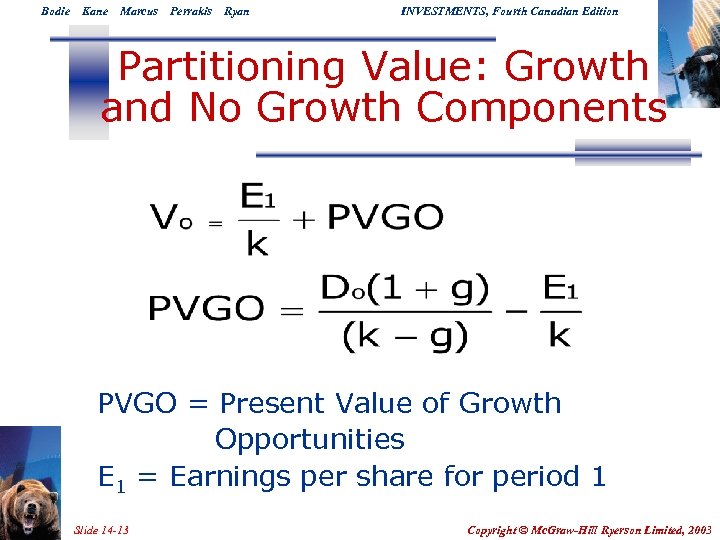
Bodie Kane Marcus Perrakis Ryan INVESTMENTS, Fourth Canadian Edition Partitioning Value: Growth and No Growth Components PVGO = Present Value of Growth Opportunities E 1 = Earnings per share for period 1 Slide 14 -13 Copyright © Mc. Graw-Hill Ryerson Limited, 2003
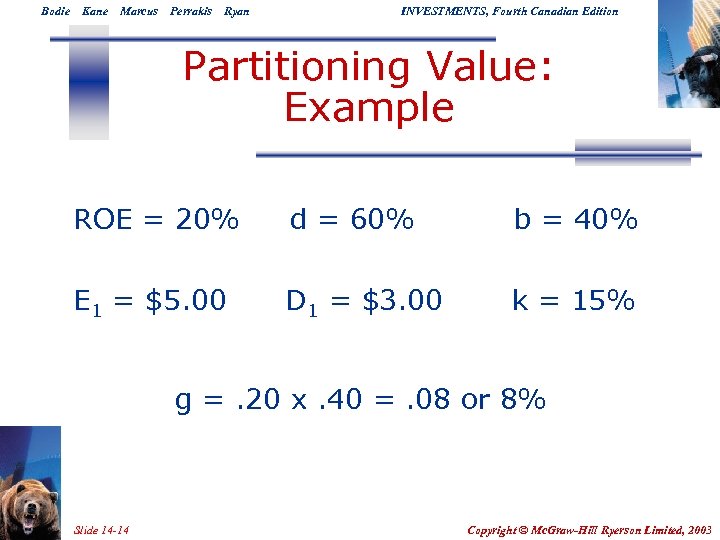
Bodie Kane Marcus Perrakis Ryan INVESTMENTS, Fourth Canadian Edition Partitioning Value: Example ROE = 20% d = 60% b = 40% E 1 = $5. 00 D 1 = $3. 00 k = 15% g =. 20 x. 40 =. 08 or 8% Slide 14 -14 Copyright © Mc. Graw-Hill Ryerson Limited, 2003
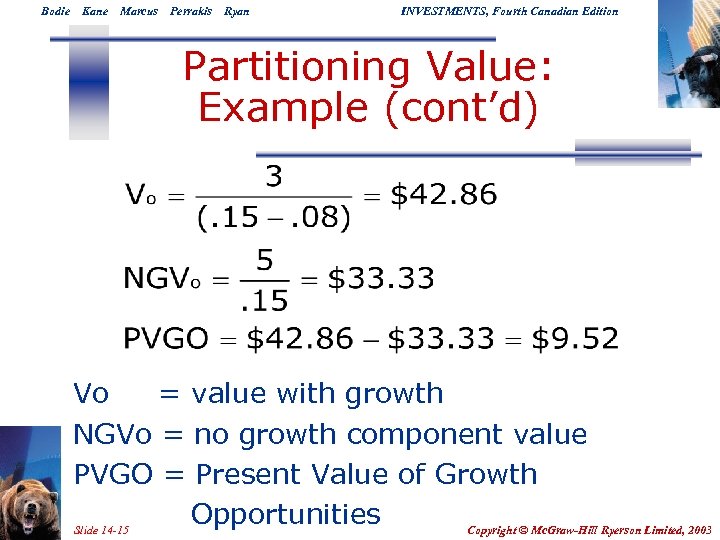
Bodie Kane Marcus Perrakis Ryan INVESTMENTS, Fourth Canadian Edition Partitioning Value: Example (cont’d) Vo = value with growth NGVo = no growth component value PVGO = Present Value of Growth Opportunities Slide 14 -15 Copyright © Mc. Graw-Hill Ryerson Limited, 2003
Bodie Kane Marcus Perrakis Ryan INVESTMENTS, Fourth Canadian Edition Summary Reminder w Objective: Introduction to fundamental stock analysis. This chapter introduces different types of valuation models and shows how economic conditions affect the results. n n Slide 14 -16 Dividend discount models Price-Earnings ratios Other methods and issues Macroeconomic analysis Copyright © Mc. Graw-Hill Ryerson Limited, 2003
Bodie Kane Marcus Perrakis Ryan INVESTMENTS, Fourth Canadian Edition Earnings, Growth and Price-Earnings Ratios w P/E Ratios are a function of two factors n n Required Rates of Return (k) Expected growth in Dividends w Uses n n Slide 14 -17 Relative valuation Extensive Use in industry Copyright © Mc. Graw-Hill Ryerson Limited, 2003
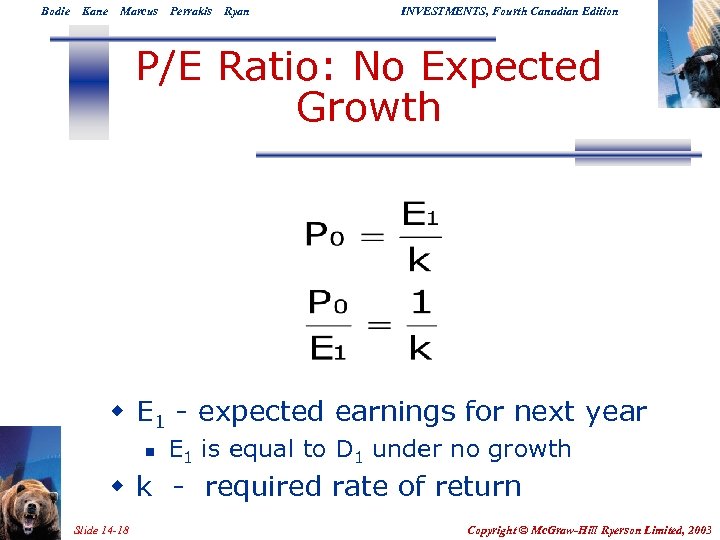
Bodie Kane Marcus Perrakis Ryan INVESTMENTS, Fourth Canadian Edition P/E Ratio: No Expected Growth w E 1 - expected earnings for next year n E 1 is equal to D 1 under no growth w k - required rate of return Slide 14 -18 Copyright © Mc. Graw-Hill Ryerson Limited, 2003
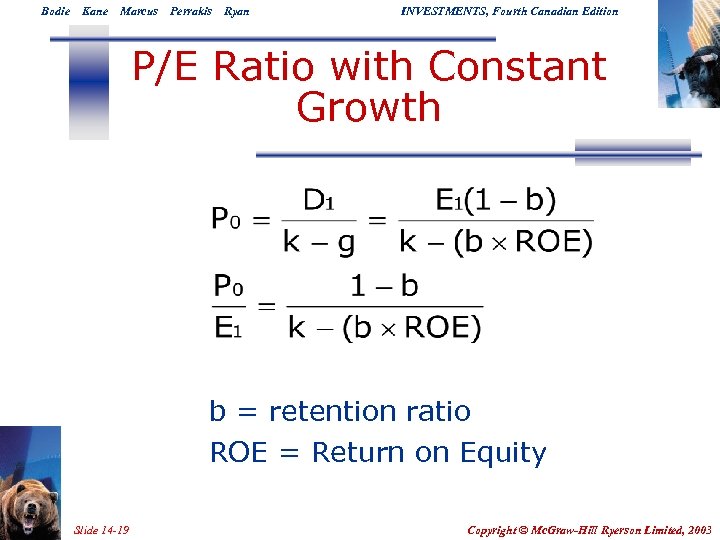
Bodie Kane Marcus Perrakis Ryan INVESTMENTS, Fourth Canadian Edition P/E Ratio with Constant Growth b = retention ratio ROE = Return on Equity Slide 14 -19 Copyright © Mc. Graw-Hill Ryerson Limited, 2003
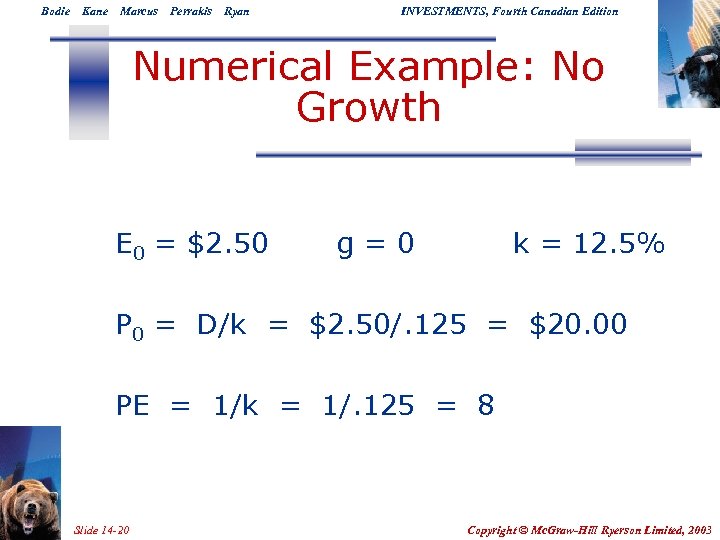
Bodie Kane Marcus Perrakis Ryan INVESTMENTS, Fourth Canadian Edition Numerical Example: No Growth E 0 = $2. 50 g=0 k = 12. 5% P 0 = D/k = $2. 50/. 125 = $20. 00 PE = 1/k = 1/. 125 = 8 Slide 14 -20 Copyright © Mc. Graw-Hill Ryerson Limited, 2003
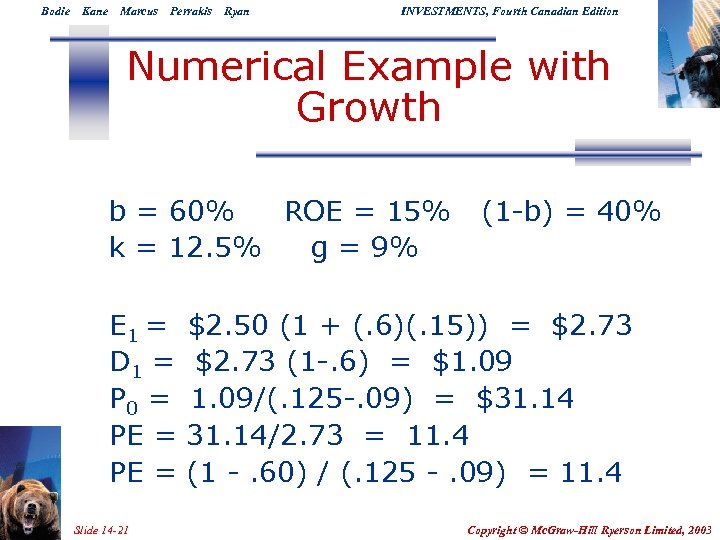
Bodie Kane Marcus Perrakis Ryan INVESTMENTS, Fourth Canadian Edition Numerical Example with Growth b = 60% ROE = 15% k = 12. 5% g = 9% E 1 = D 1 = P 0 = PE = Slide 14 -21 (1 -b) = 40% $2. 50 (1 + (. 6)(. 15)) = $2. 73 (1 -. 6) = $1. 09/(. 125 -. 09) = $31. 14/2. 73 = 11. 4 (1 -. 60) / (. 125 -. 09) = 11. 4 Copyright © Mc. Graw-Hill Ryerson Limited, 2003
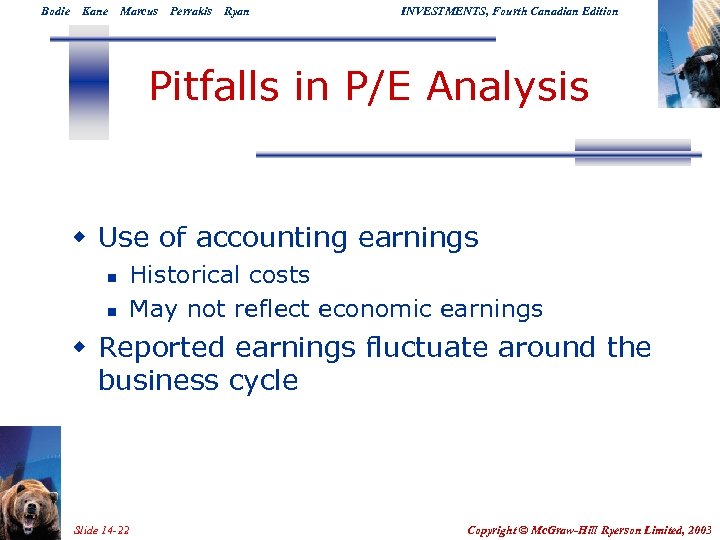
Bodie Kane Marcus Perrakis Ryan INVESTMENTS, Fourth Canadian Edition Pitfalls in P/E Analysis w Use of accounting earnings n n Historical costs May not reflect economic earnings w Reported earnings fluctuate around the business cycle Slide 14 -22 Copyright © Mc. Graw-Hill Ryerson Limited, 2003
Bodie Kane Marcus Perrakis Ryan INVESTMENTS, Fourth Canadian Edition Summary Reminder w Objective: Introduction to fundamental stock analysis. This chapter introduces different types of valuation models and shows how economic conditions affect the results. n n Slide 14 -23 Dividend discount models Price-Earnings ratios Other methods and issues Macroeconomic analysis Copyright © Mc. Graw-Hill Ryerson Limited, 2003
Bodie Kane Marcus Perrakis Ryan INVESTMENTS, Fourth Canadian Edition Other Valuation Ratios w Price-to-Book w Price-to-Cash-Flow w Price-to-Sales Slide 14 -24 Copyright © Mc. Graw-Hill Ryerson Limited, 2003
Bodie Kane Marcus Perrakis Ryan INVESTMENTS, Fourth Canadian Edition The Free Cash-Flow Approach w Fundamental idea: the intrinsic value of a firm is the present value of all its net cash-flows to shareholders w Estimate the value of the firm as a whole n It equals the present value of cash-flows, assuming all-equity financing plus the net present value of tax shields created by using debt; w Derive the value of equity by subtracting the market value of all non-equity claims Slide 14 -25 Copyright © Mc. Graw-Hill Ryerson Limited, 2003
Bodie Kane Marcus Perrakis Ryan INVESTMENTS, Fourth Canadian Edition Inflation and Equity Valuation w Inflation has an impact on equity valuations w Historical costs underestimate economic costs w Empirical research shows that inflation has an adverse effect on equity values n Slide 14 -26 Research shows that real rates of return are lower with high rates of inflation Copyright © Mc. Graw-Hill Ryerson Limited, 2003
Bodie Kane Marcus Perrakis Ryan INVESTMENTS, Fourth Canadian Edition Potential Causes of Lower Equity Values with Inflation w Shocks cause expectation of lower earnings by market participants w Returns are viewed as being riskier with higher rates of inflation w Real dividends are lower because of taxes Slide 14 -27 Copyright © Mc. Graw-Hill Ryerson Limited, 2003
Bodie Kane Marcus Perrakis Ryan INVESTMENTS, Fourth Canadian Edition Growth or Value Investing w Growth Investing – picking companies that are considered to have superior growth prospects w Value Investing – choosing companies for which fundamental analysis reveals unrecognized value w The Graham technique Slide 14 -28 Copyright © Mc. Graw-Hill Ryerson Limited, 2003
Bodie Kane Marcus Perrakis Ryan INVESTMENTS, Fourth Canadian Edition Summary Reminder w Objective: Introduction to fundamental stock analysis. This chapter introduces different types of valuation models and shows how economic conditions affect the results. n n Slide 14 -29 Dividend discount models Price-Earnings ratios Other methods and issues Macroeconomic analysis Copyright © Mc. Graw-Hill Ryerson Limited, 2003
Bodie Kane Marcus Perrakis Ryan INVESTMENTS, Fourth Canadian Edition Global Economic Considerations w Performance in countries and regions is highly variable w Political risk w Exchange rate risk n n n Slide 14 -30 Sales Profits Stock returns Copyright © Mc. Graw-Hill Ryerson Limited, 2003
Bodie Kane Marcus Perrakis Ryan INVESTMENTS, Fourth Canadian Edition Key Economic Variables w w w Slide 14 -31 Gross domestic product (GDP) Unemployment rates Interest rates & inflation International measures Consumer sentiment Copyright © Mc. Graw-Hill Ryerson Limited, 2003
Bodie Kane Marcus Perrakis Ryan INVESTMENTS, Fourth Canadian Edition Government Policy w Fiscal Policy - Government spending and taxing actions w Monetary Policy - manipulation of the money supply to influence economic activity w Tools of monetary policy n n n Slide 14 -32 Open market operations Discount rate Reserve requirements Copyright © Mc. Graw-Hill Ryerson Limited, 2003
Bodie Kane Marcus Perrakis Ryan INVESTMENTS, Fourth Canadian Edition Demand Supply Shocks w Demand shock - an event that affects demand for goods and services in the economy n n Tax rate cut Increases in government spending w Supply shock - an event that influences production capacity or production costs n n Slide 14 -33 Commodity price changes Educational level of economic participants Copyright © Mc. Graw-Hill Ryerson Limited, 2003
Bodie Kane Marcus Perrakis Ryan INVESTMENTS, Fourth Canadian Edition Business Cycles w Business Cycle n n Peak Trough w Industry relationship to business cycles n n Slide 14 -34 Cyclical Defensive Copyright © Mc. Graw-Hill Ryerson Limited, 2003
Bodie Kane Marcus Perrakis Ryan INVESTMENTS, Fourth Canadian Edition Cyclical Indicators w Leading Indicators - tend to rise and fall in advance of the economy. Examples: n n Average work week New orders - durables Residential construction Stock Prices w Lagging Indicators - indicators that tend to follow the lag economic performance Slide 14 -35 Copyright © Mc. Graw-Hill Ryerson Limited, 2003
Скачать презентацию Chapter 14 Bodie Kane Marcus Perrakis Ryan INVESTMENTS
9f5530a99af892883e6adf9e12b55bb9.ppt