 Скачать презентацию Chapter 14 Biotechnology and Society Chapter 14 Human
f227c20b2f7d84f4ae8813d0a2d7a76f.ppt
- Количество слайдов: 43



Chapter 14 Biotechnology and Society Chapter 14 Human Heredity by Michael Cummings © 2006 Brooks/Cole-Thomson Learning
Biotechnology • Uses recombinant DNA technology to produce goods or services • It is used in – Agriculture – Medicine – Evolutionary studies – Identification – Criminal investigations Chapter 14 Human Heredity by Michael Cummings © 2006 Brooks/Cole-Thomson Learning
Biopharming • Production of medical molecules in other organisms • Examples – Human insulin (1982) – Growth hormone (1980 s) – Factor VIII (1990 s) Chapter 14 Human Heredity by Michael Cummings © 2006 Brooks/Cole-Thomson Learning
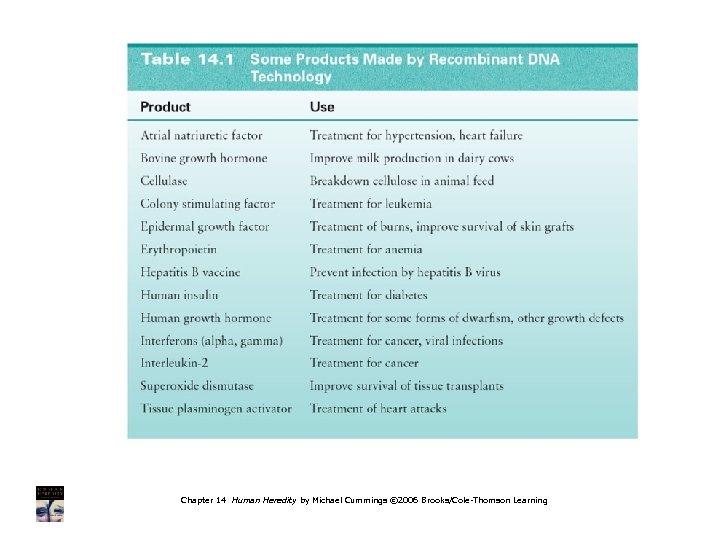
Chapter 14 Human Heredity by Michael Cummings © 2006 Brooks/Cole-Thomson Learning
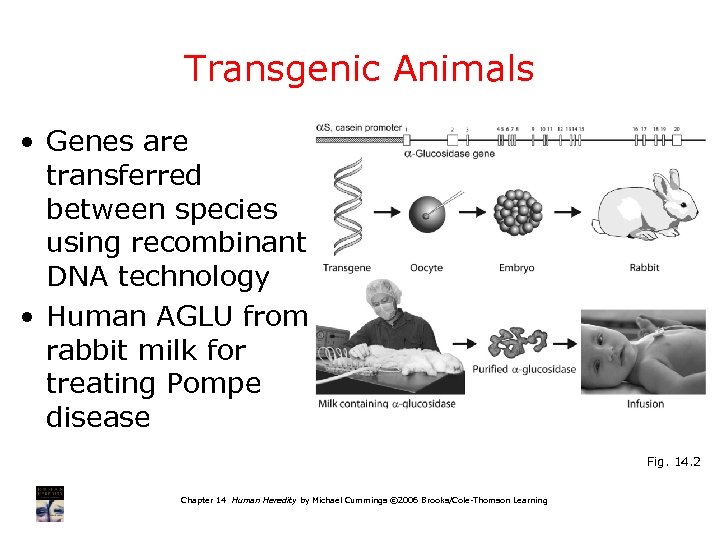
Transgenic Animals • Genes are transferred between species using recombinant DNA technology • Human AGLU from rabbit milk for treating Pompe disease Fig. 14. 2 Chapter 14 Human Heredity by Michael Cummings © 2006 Brooks/Cole-Thomson Learning
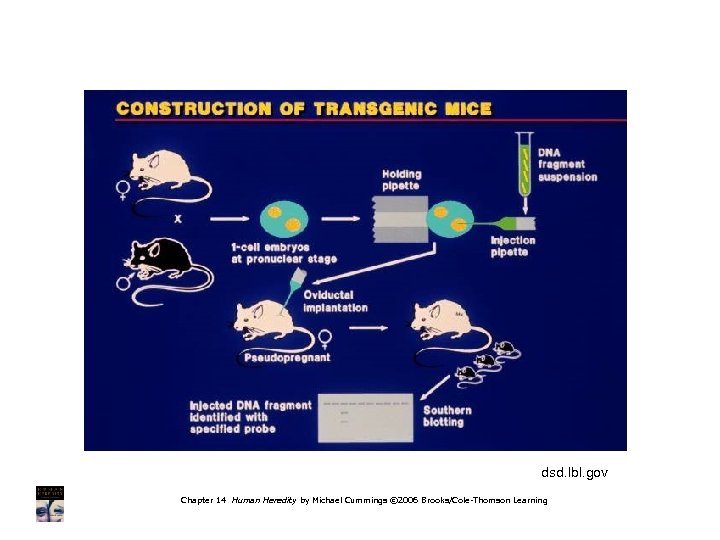
dsd. lbl. gov Chapter 14 Human Heredity by Michael Cummings © 2006 Brooks/Cole-Thomson Learning
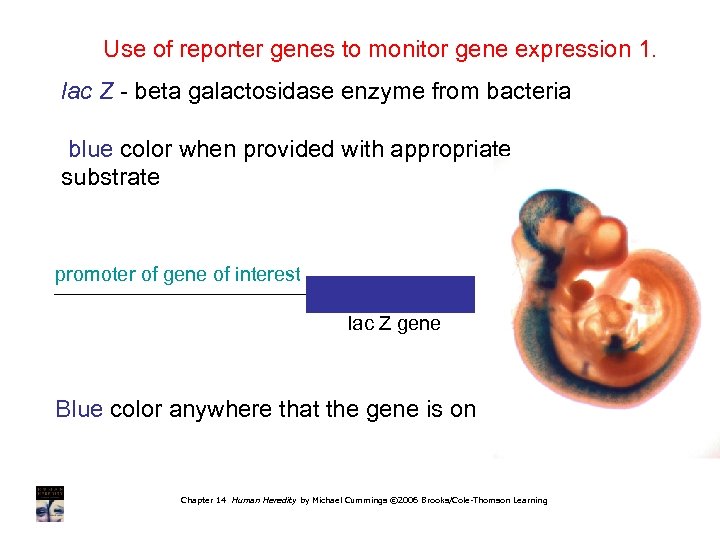
Use of reporter genes to monitor gene expression 1. lac Z - beta galactosidase enzyme from bacteria blue color when provided with appropriate substrate promoter of gene of interest lac Z gene Blue color anywhere that the gene is on Chapter 14 Human Heredity by Michael Cummings © 2006 Brooks/Cole-Thomson Learning
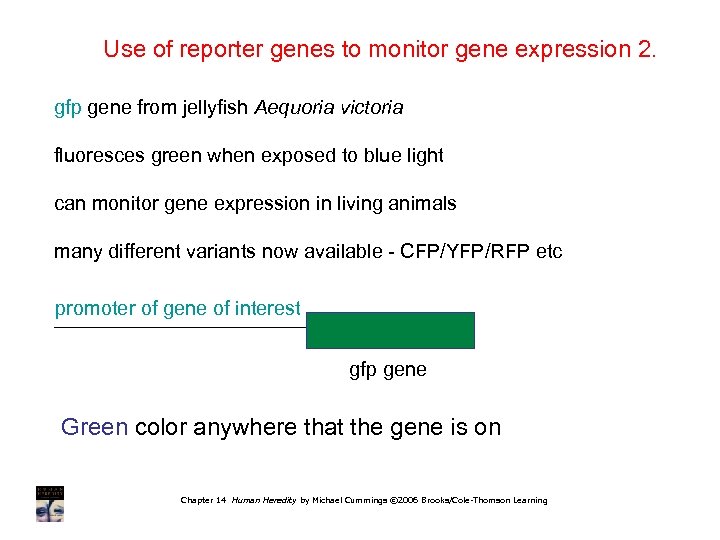
Use of reporter genes to monitor gene expression 2. gfp gene from jellyfish Aequoria victoria fluoresces green when exposed to blue light can monitor gene expression in living animals many different variants now available - CFP/YFP/RFP etc promoter of gene of interest gfp gene Green color anywhere that the gene is on Chapter 14 Human Heredity by Michael Cummings © 2006 Brooks/Cole-Thomson Learning
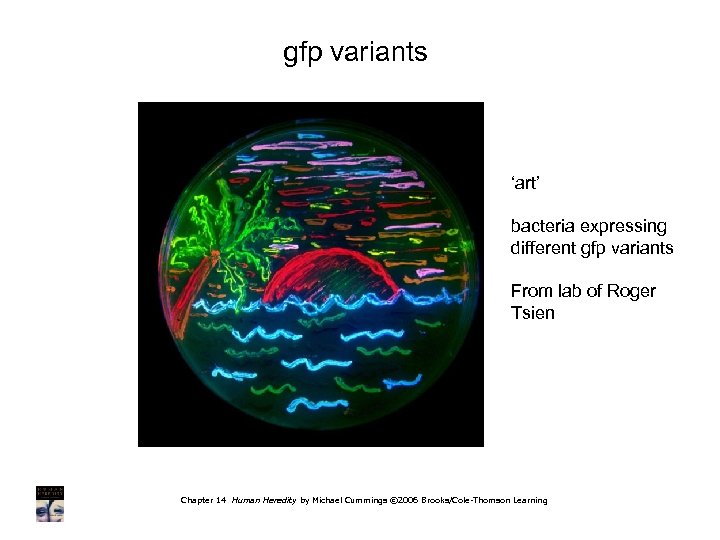
gfp variants ‘art’ bacteria expressing different gfp variants From lab of Roger Tsien Chapter 14 Human Heredity by Michael Cummings © 2006 Brooks/Cole-Thomson Learning
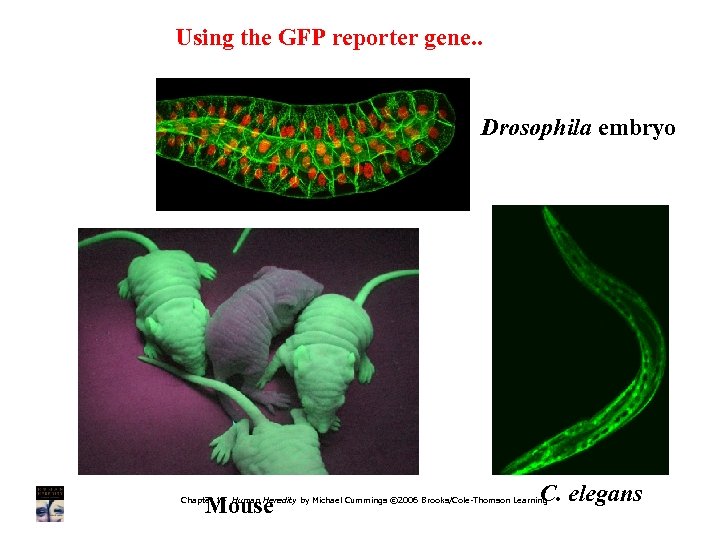
Using the GFP reporter gene. . Drosophila embryo Mouse C. elegans Chapter 14 Human Heredity by Michael Cummings © 2006 Brooks/Cole-Thomson Learning
Biopharming • Edible vaccines – Still in development • Genetically modified foods – Transgenic crop plants with new characteristics • Transgenic crops – Resistance to herbicides and disease • Enhancement of nutritional value • Concerns Chapter 14 Human Heredity by Michael Cummings © 2006 Brooks/Cole-Thomson Learning
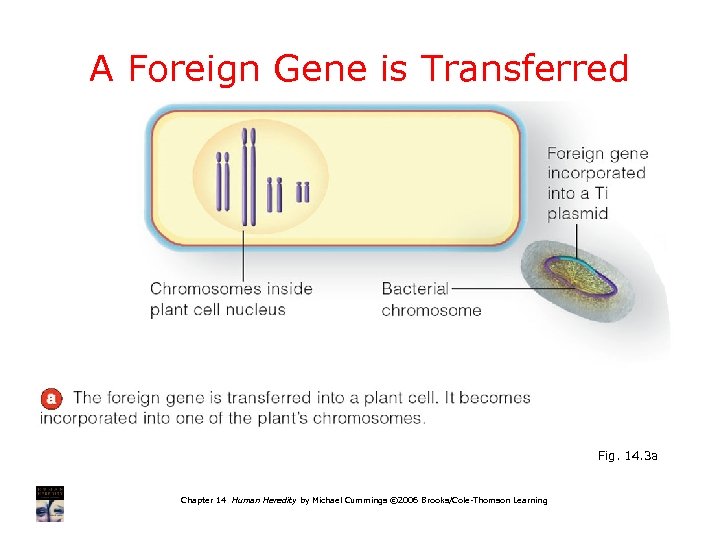
A Foreign Gene is Transferred Fig. 14. 3 a Chapter 14 Human Heredity by Michael Cummings © 2006 Brooks/Cole-Thomson Learning
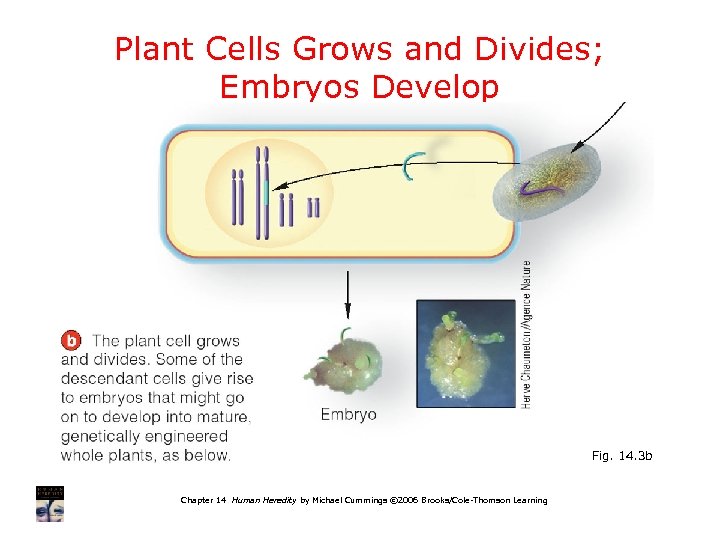
Plant Cells Grows and Divides; Embryos Develop Fig. 14. 3 b Chapter 14 Human Heredity by Michael Cummings © 2006 Brooks/Cole-Thomson Learning
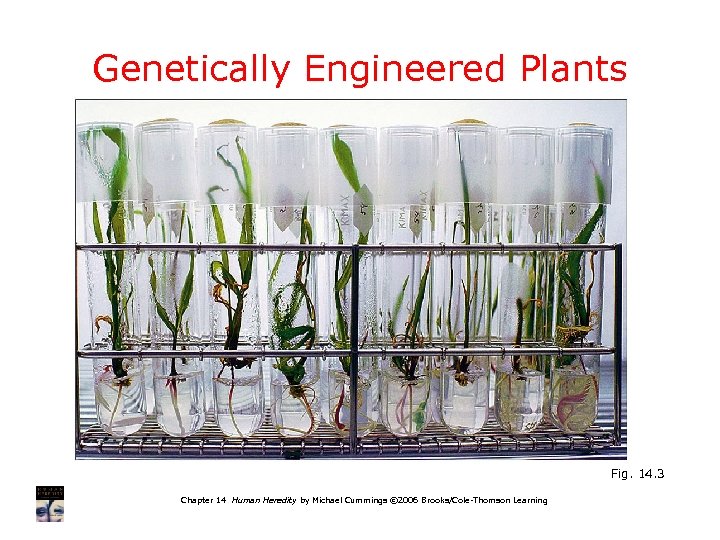
Genetically Engineered Plants Fig. 14. 3 Chapter 14 Human Heredity by Michael Cummings © 2006 Brooks/Cole-Thomson Learning
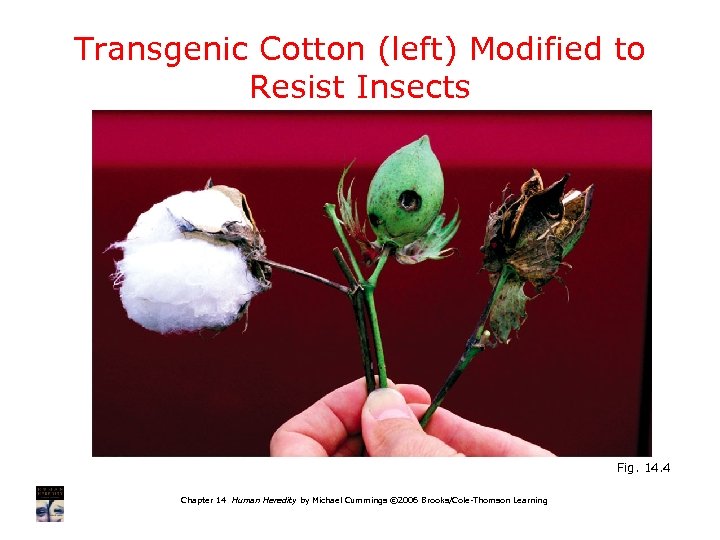
Transgenic Cotton (left) Modified to Resist Insects Fig. 14. 4 Chapter 14 Human Heredity by Michael Cummings © 2006 Brooks/Cole-Thomson Learning
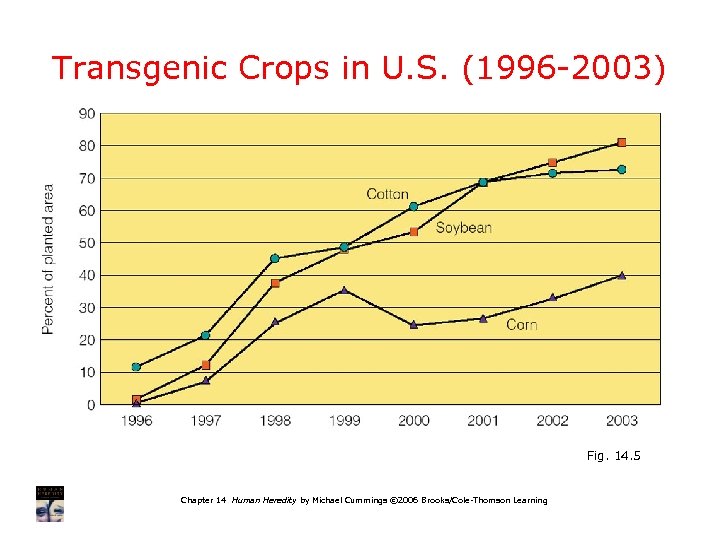
Transgenic Crops in U. S. (1996 -2003) Fig. 14. 5 Chapter 14 Human Heredity by Michael Cummings © 2006 Brooks/Cole-Thomson Learning
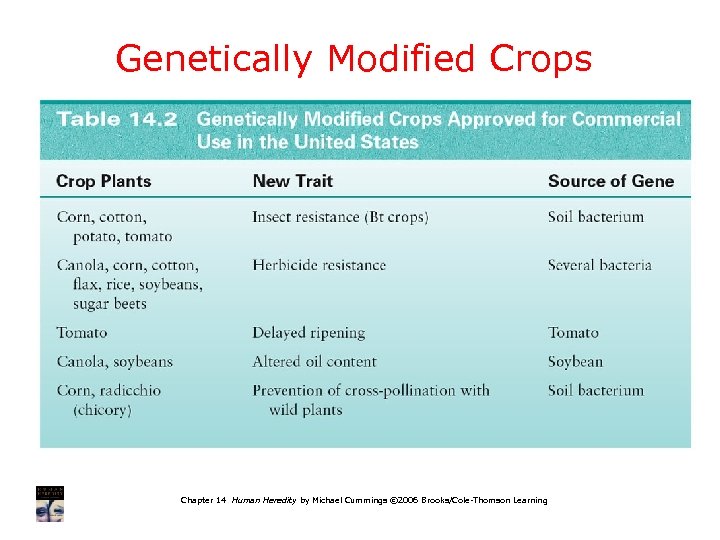
Genetically Modified Crops Chapter 14 Human Heredity by Michael Cummings © 2006 Brooks/Cole-Thomson Learning
Enhancement of Nutritional Value Golden Rice • Vitamin A deficiency is a serious health issue • Modified the rice, a food staple • Two genes from daffodils and one from bacteria were inserted into rice • With added genes rice plants synthesize beta-carotene • When the rice is eaten it is converted to Vitamin A Chapter 14 Human Heredity by Michael Cummings © 2006 Brooks/Cole-Thomson Learning
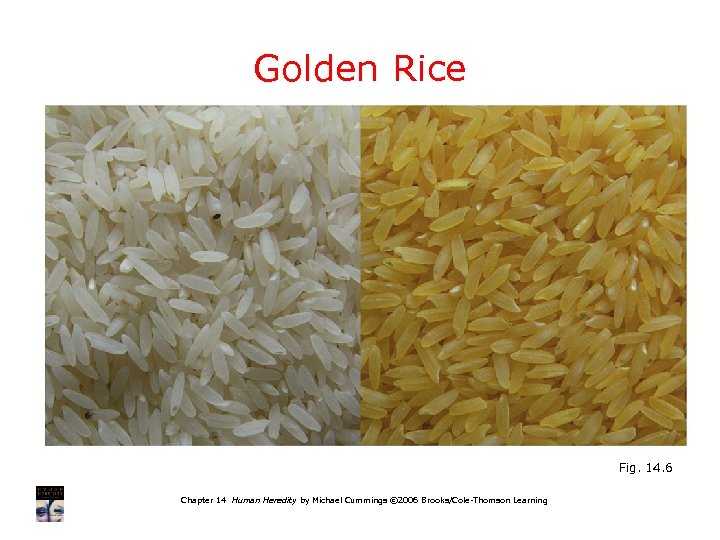
Golden Rice Fig. 14. 6 Chapter 14 Human Heredity by Michael Cummings © 2006 Brooks/Cole-Thomson Learning
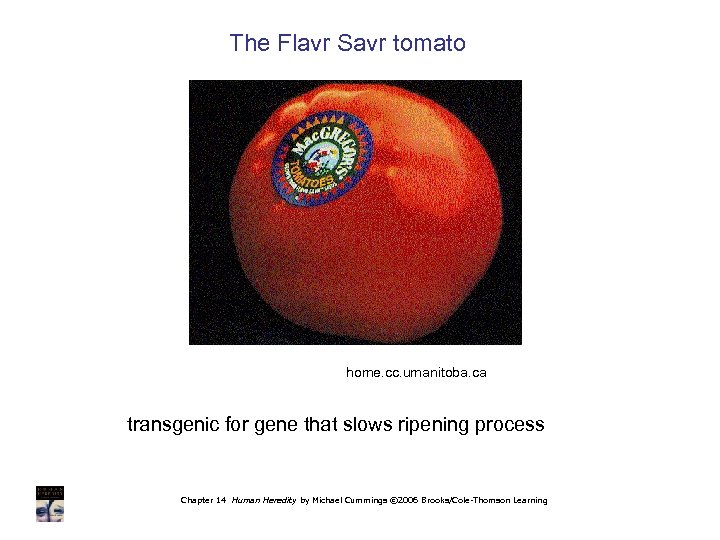
The Flavr Savr tomato home. cc. umanitoba. ca transgenic for gene that slows ripening process Chapter 14 Human Heredity by Michael Cummings © 2006 Brooks/Cole-Thomson Learning
Concerns • Transgenic crops have created controversy • Safety issues • Environmental issues Chapter 14 Human Heredity by Michael Cummings © 2006 Brooks/Cole-Thomson Learning
Transgenic Models of Human Disease • 90% of human genes are also present in the mouse • Excellent model of human disease • Transgenic models have several goals – Produce an animal with symptoms that mirror those in humans – Use the model to study the development and progress of the disease – Test treatments that hopefully will cure the model organisms of human disease Chapter 14 Human Heredity by Michael Cummings © 2006 Brooks/Cole-Thomson Learning
Producing the Transgenic Model • A copy of Human HD gene was cloned into a vector • Vector carrying the HD gene was microinjected into the nucleus of a fertilized egg • Injected eggs transplanted into a foster mother • After pups were born tail tip DNA was analyzed for the presence and expression of HD gene Chapter 14 Human Heredity by Michael Cummings © 2006 Brooks/Cole-Thomson Learning
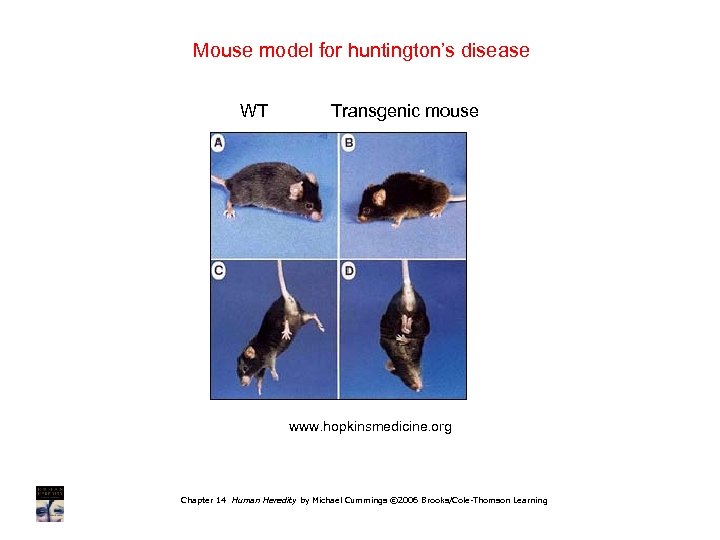
Mouse model for huntington’s disease WT Transgenic mouse www. hopkinsmedicine. org Chapter 14 Human Heredity by Michael Cummings © 2006 Brooks/Cole-Thomson Learning
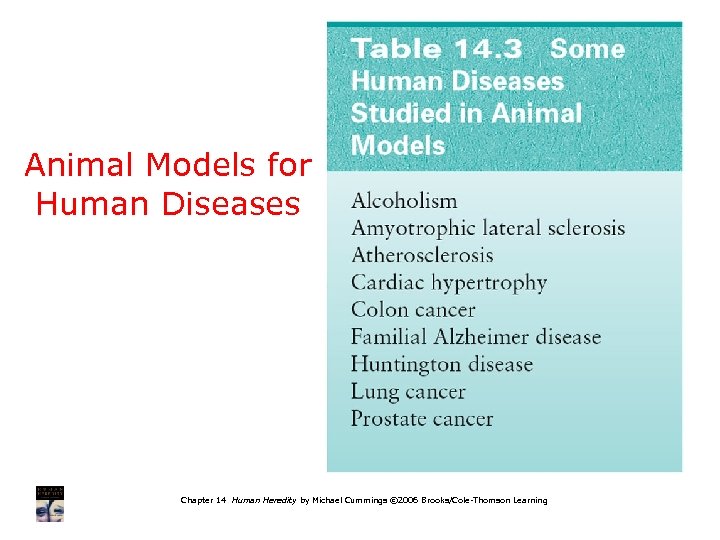
Animal Models for Human Diseases Chapter 14 Human Heredity by Michael Cummings © 2006 Brooks/Cole-Thomson Learning
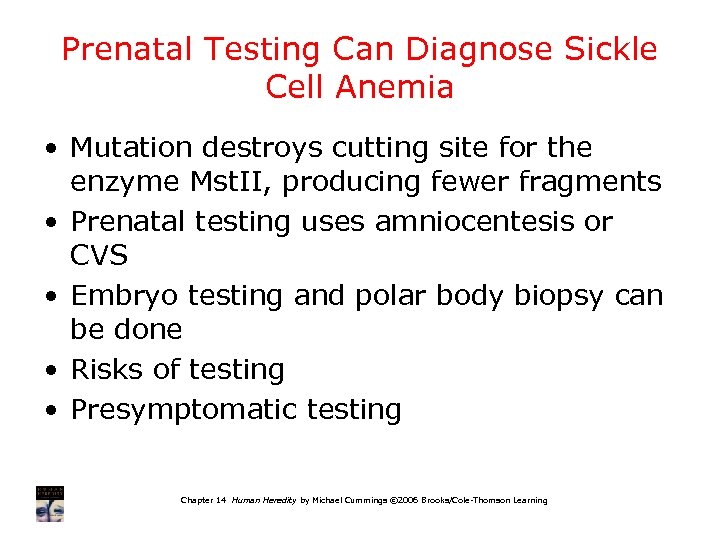
Prenatal Testing Can Diagnose Sickle Cell Anemia • Mutation destroys cutting site for the enzyme Mst. II, producing fewer fragments • Prenatal testing uses amniocentesis or CVS • Embryo testing and polar body biopsy can be done • Risks of testing • Presymptomatic testing Chapter 14 Human Heredity by Michael Cummings © 2006 Brooks/Cole-Thomson Learning
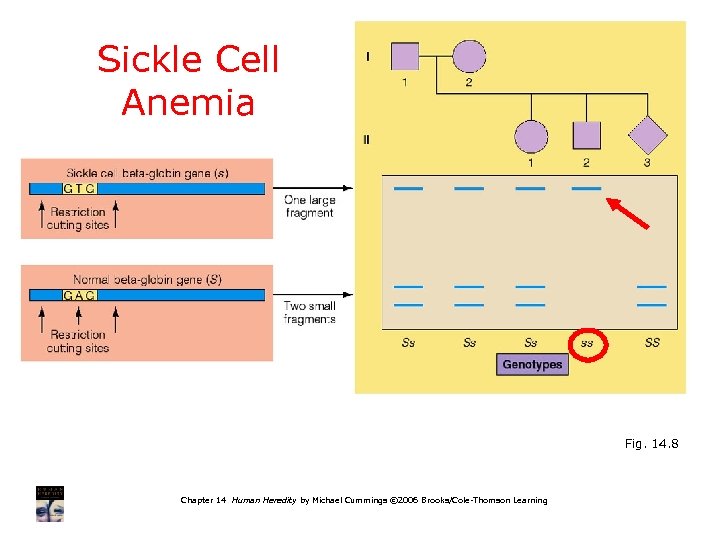
Sickle Cell Anemia Fig. 14. 8 Chapter 14 Human Heredity by Michael Cummings © 2006 Brooks/Cole-Thomson Learning
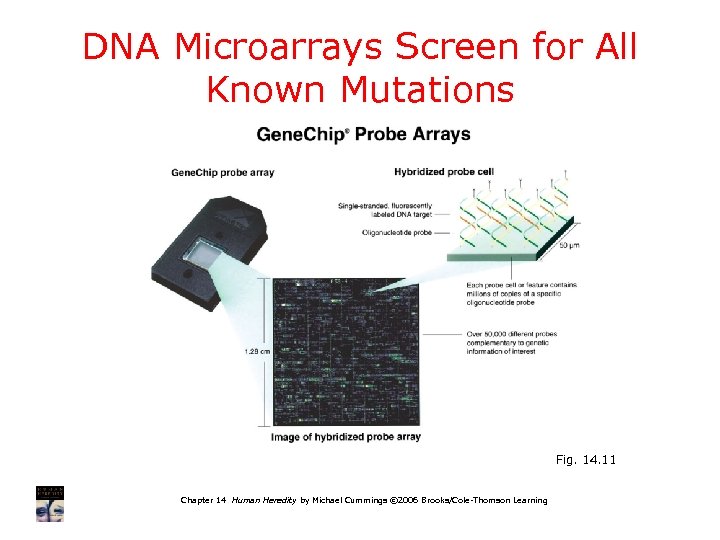
DNA Microarrays Screen for All Known Mutations Fig. 14. 11 Chapter 14 Human Heredity by Michael Cummings © 2006 Brooks/Cole-Thomson Learning
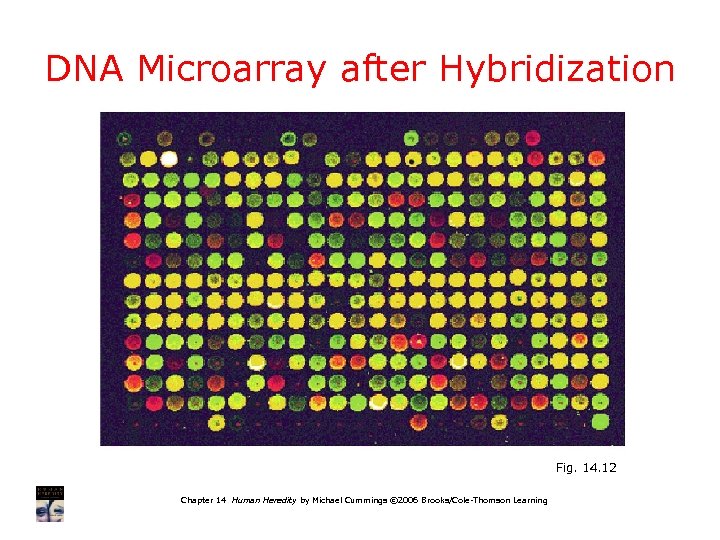
DNA Microarray after Hybridization Fig. 14. 12 Chapter 14 Human Heredity by Michael Cummings © 2006 Brooks/Cole-Thomson Learning
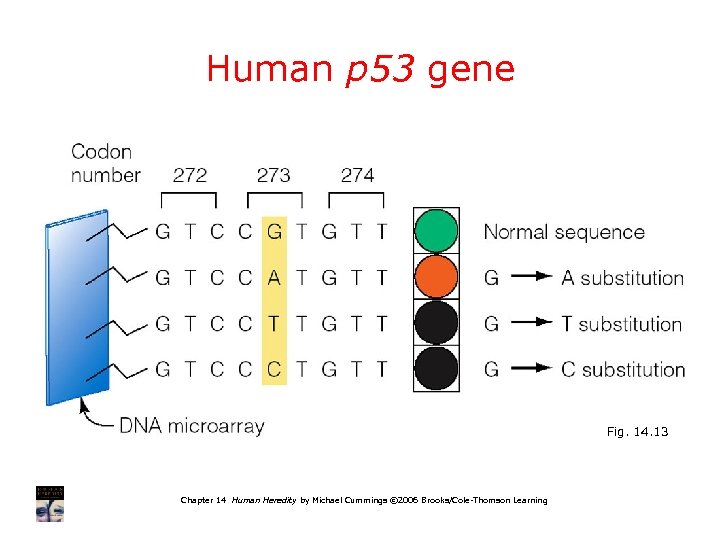
Human p 53 gene Fig. 14. 13 Chapter 14 Human Heredity by Michael Cummings © 2006 Brooks/Cole-Thomson Learning
DNA for Identification • Technology developed in the 1980 s • Alec Jefferys and colleagues discovered variation in 14– 100 base pair DNA sequences located at many different chromosomal sites called microsatellites • A DNA fingerprint or profile of an individuals is produced by evaluating the variation in the microsatellites or shorter short tandem repeats (STR) Chapter 14 Human Heredity by Michael Cummings © 2006 Brooks/Cole-Thomson Learning
DNA Profiles • Short tandem repeats (STRs) Short sequences ranging from 2– 9 base pairs in length, for example: CC TTCCC TTC • DNA profiles are based on variation in the copy number of DNA sequences • DNA profile is unique to an individual or their monozygotic twin Chapter 14 Human Heredity by Michael Cummings © 2006 Brooks/Cole-Thomson Learning
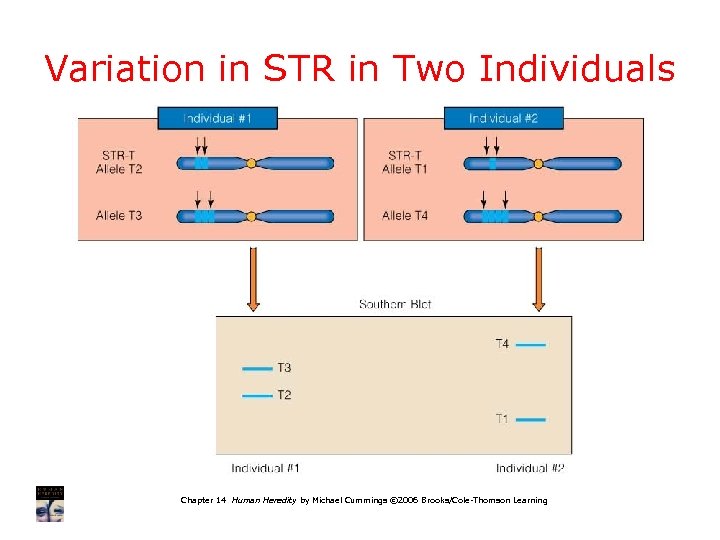
Variation in STR in Two Individuals Chapter 14 Human Heredity by Michael Cummings © 2006 Brooks/Cole-Thomson Learning
Uses of DNA profiles • Criminal investigations • Identification of remains • Identification of species • Identifying family members • Biohistorical information • Paternity testing in humans and animals Chapter 14 Human Heredity by Michael Cummings © 2006 Brooks/Cole-Thomson Learning
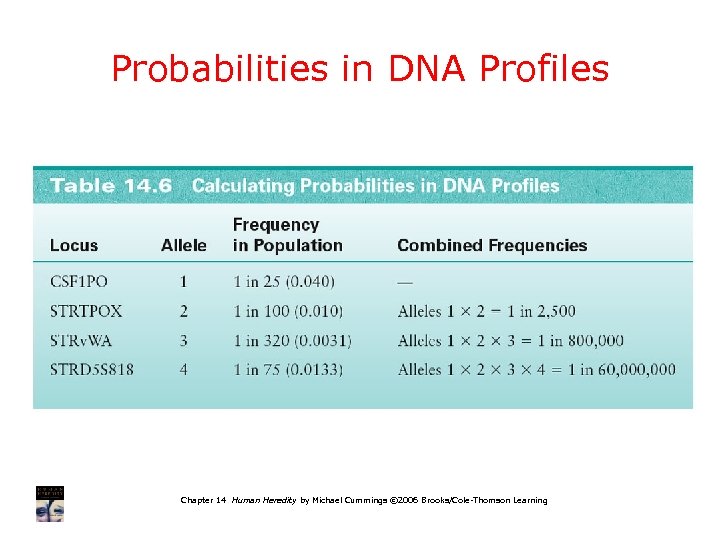
Probabilities in DNA Profiles Chapter 14 Human Heredity by Michael Cummings © 2006 Brooks/Cole-Thomson Learning
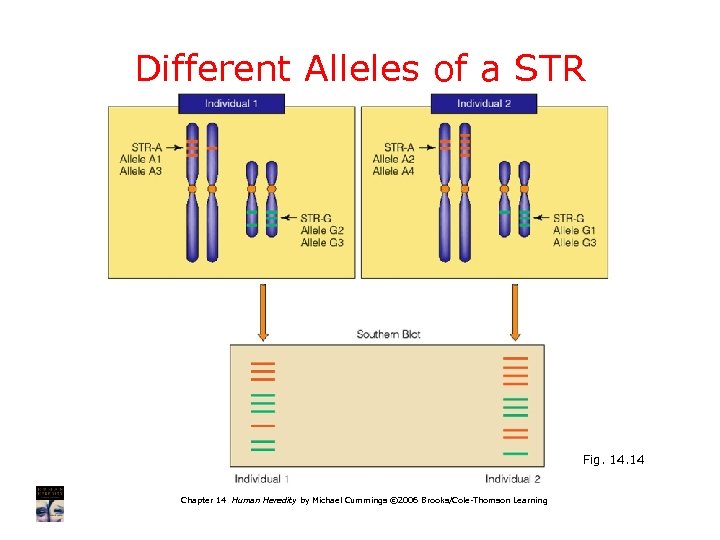
Different Alleles of a STR Fig. 14 Chapter 14 Human Heredity by Michael Cummings © 2006 Brooks/Cole-Thomson Learning
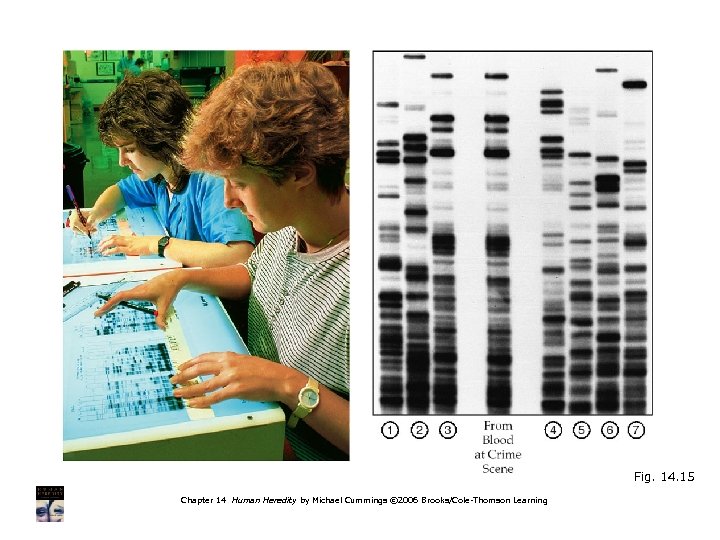
Analyzing DNA Profiles Fig. 14. 15 Chapter 14 Human Heredity by Michael Cummings © 2006 Brooks/Cole-Thomson Learning
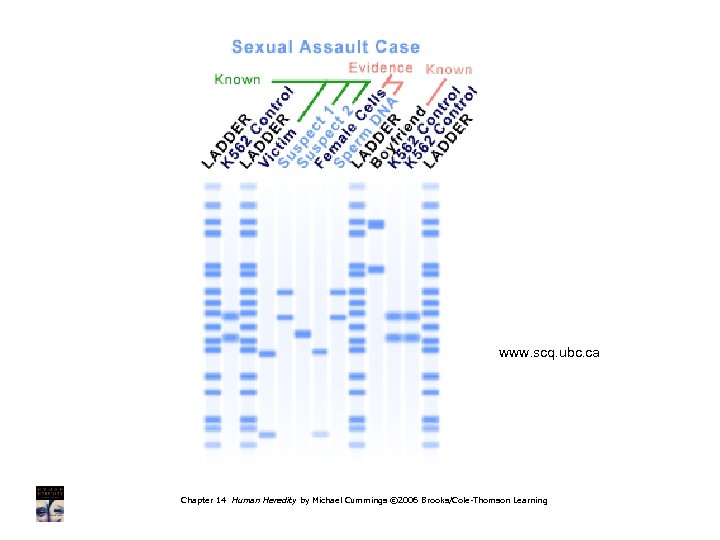
www. scq. ubc. ca Chapter 14 Human Heredity by Michael Cummings © 2006 Brooks/Cole-Thomson Learning
Chapter 14 Human Heredity by Michael Cummings © 2006 Brooks/Cole-Thomson Learning
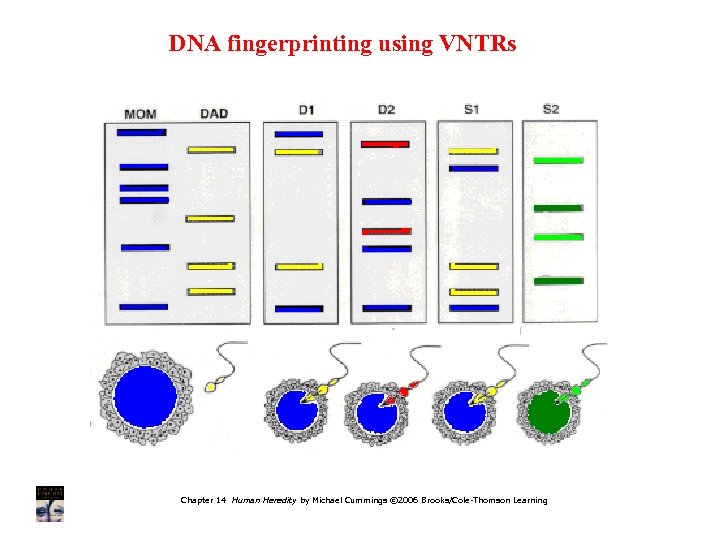
DNA fingerprinting using VNTRs Chapter 14 Human Heredity by Michael Cummings © 2006 Brooks/Cole-Thomson Learning
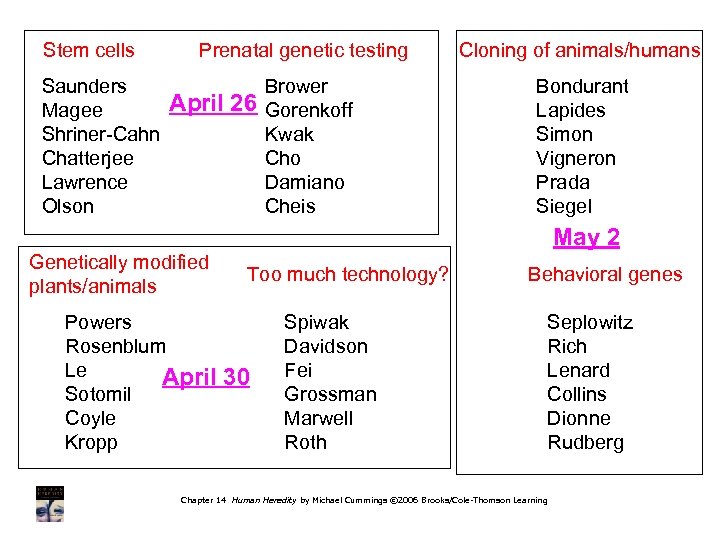
Stem cells Saunders Magee Shriner-Cahn Chatterjee Lawrence Olson Prenatal genetic testing Cloning of animals/humans Brower Gorenkoff Kwak Cho Damiano Cheis Bondurant Lapides Simon Vigneron Prada Siegel April 26 May 2 Genetically modified plants/animals Powers Rosenblum Le April Sotomil Coyle Kropp Too much technology? 30 Spiwak Davidson Fei Grossman Marwell Roth Behavioral genes Seplowitz Rich Lenard Collins Dionne Rudberg Chapter 14 Human Heredity by Michael Cummings © 2006 Brooks/Cole-Thomson Learning
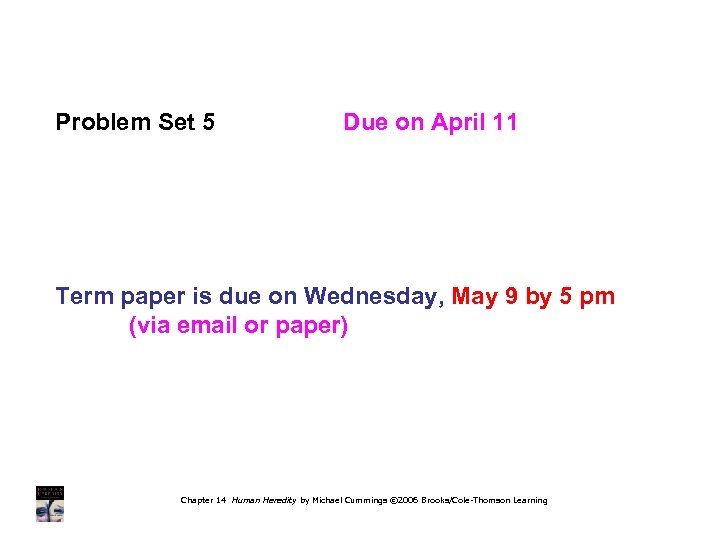
Problem Set 5 Due on April 11 Term paper is due on Wednesday, May 9 by 5 pm (via email or paper) Chapter 14 Human Heredity by Michael Cummings © 2006 Brooks/Cole-Thomson Learning
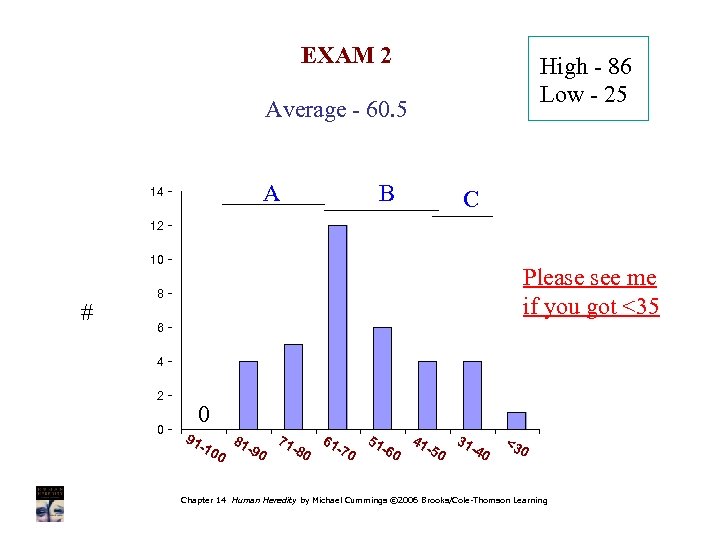
EXAM 2 High - 86 Low - 25 Average - 60. 5 A 14 B C 12 10 # Please see me if you got <35 8 6 4 2 0 0 91 -10 7 6 5 4 3 81 -90 1 -80 1 -70 1 -60 1 -50 1 -40 0 <3 0 Chapter 14 Human Heredity by Michael Cummings © 2006 Brooks/Cole-Thomson Learning
Скачать презентацию Chapter 14 Biotechnology and Society Chapter 14 Human
f227c20b2f7d84f4ae8813d0a2d7a76f.ppt