


 Скачать презентацию Chapter 13 Traffic and Congestion Control in ATM
6715c16b616d87a8571720ebe393b089.ppt
- Количество слайдов: 87
 Chapter 13 Traffic and Congestion Control in ATM Networks 1
 Introduction Control needed to prevent switch buffer overflow l High speed and small cell size gives different problems from other networks l Limited number of overhead bits l ITU-T specified restricted initial set l – I. 371 l ATM forum Traffic Management Specification 41 Chapter 13 Traffic and Congestion Control in ATM Networks 2
 Overview l l Congestion problem Framework adopted by ITU-T and ATM forum – Control schemes for delay sensitive traffic l Voice & video – Not suited to bursty traffic – Traffic control – Congestion control l Bursty traffic – Available Bit Rate (ABR) – Guaranteed Frame Rate (GFR) Chapter 13 Traffic and Congestion Control in ATM Networks 3
 Requirements for ATM Traffic and Congestion Control l Most packet switched and frame relay networks carry non-real-time bursty data – No need to replicate timing at exit node – Simple statistical multiplexing – User Network Interface capacity slightly greater than average of channels l Congestion control tools from these technologies do not work in ATM Chapter 13 Traffic and Congestion Control in ATM Networks 4
 Problems with ATM Congestion Control l Most traffic not amenable to flow control – Voice & video can not stop generating l Feedback slow – Small cell transmission time v propagation delay l Wide range of applications – From few kbps to hundreds of Mbps – Different traffic patterns – Different network services l High speed switching and transmission – Volatile congestion and traffic control Chapter 13 Traffic and Congestion Control in ATM Networks 5
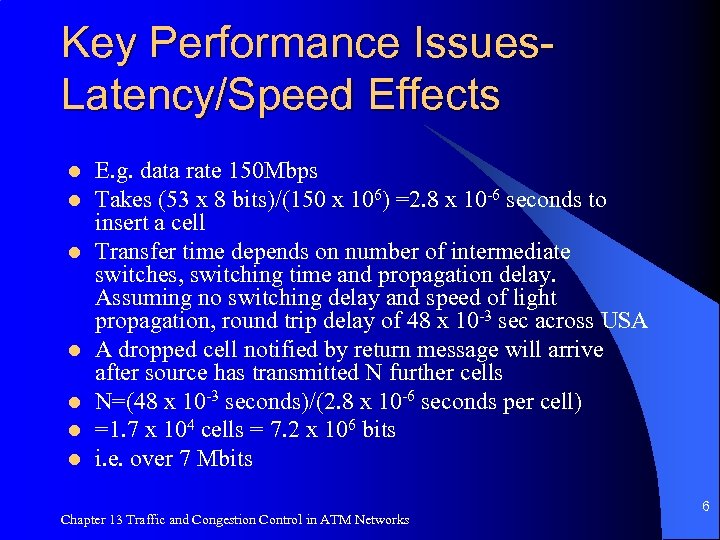 Key Performance Issues. Latency/Speed Effects l l l l E. g. data rate 150 Mbps Takes (53 x 8 bits)/(150 x 106) =2. 8 x 10 -6 seconds to insert a cell Transfer time depends on number of intermediate switches, switching time and propagation delay. Assuming no switching delay and speed of light propagation, round trip delay of 48 x 10 -3 sec across USA A dropped cell notified by return message will arrive after source has transmitted N further cells N=(48 x 10 -3 seconds)/(2. 8 x 10 -6 seconds per cell) =1. 7 x 10⁴ cells = 7. 2 x 106 bits i. e. over 7 Mbits Chapter 13 Traffic and Congestion Control in ATM Networks 6
 Key Performance Issues. Cell Delay Variation l l l For digitized voice delay across network must be small Rate of delivery must be constant Variations will occur Dealt with by Time Reassembly of CBR cells (see next slide) Results in cells delivered at CBR with occasional gaps due to dropped cells Subscriber requests minimum cell delay variation from network provider – Increase data rate at UNI relative to load – Increase resources within network Chapter 13 Traffic and Congestion Control in ATM Networks 7
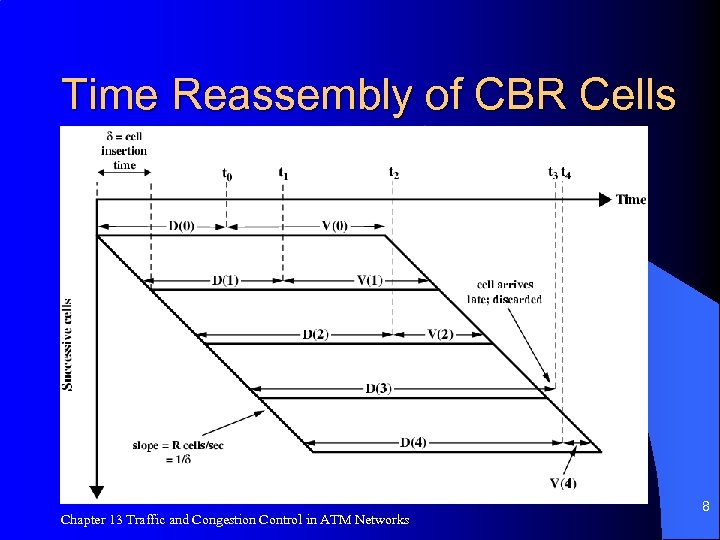 Time Reassembly of CBR Cells Chapter 13 Traffic and Congestion Control in ATM Networks 8
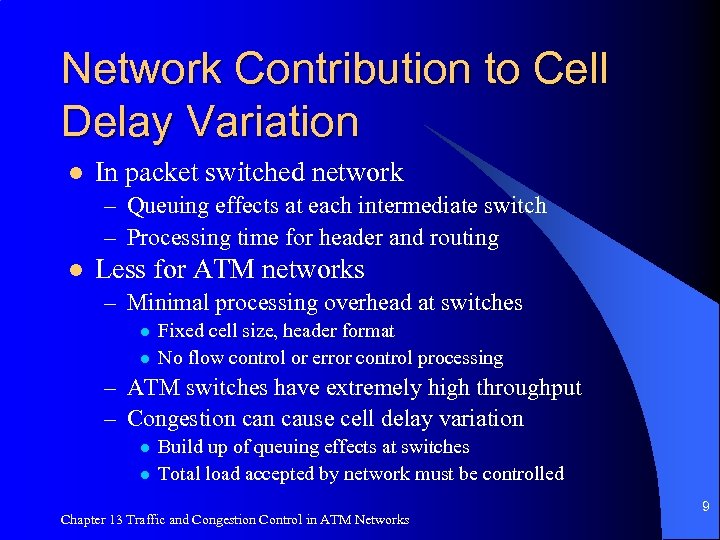 Network Contribution to Cell Delay Variation l In packet switched network – Queuing effects at each intermediate switch – Processing time for header and routing l Less for ATM networks – Minimal processing overhead at switches l l Fixed cell size, header format No flow control or error control processing – ATM switches have extremely high throughput – Congestion cause cell delay variation l l Build up of queuing effects at switches Total load accepted by network must be controlled Chapter 13 Traffic and Congestion Control in ATM Networks 9
 Cell Delay Variation at UNI l Caused by processing in three layers of ATM model – See next slide for details None of these delays can be predicted l None follow repetitive pattern l So, random element exists in time interval between reception by ATM stack and transmission l Chapter 13 Traffic and Congestion Control in ATM Networks 10
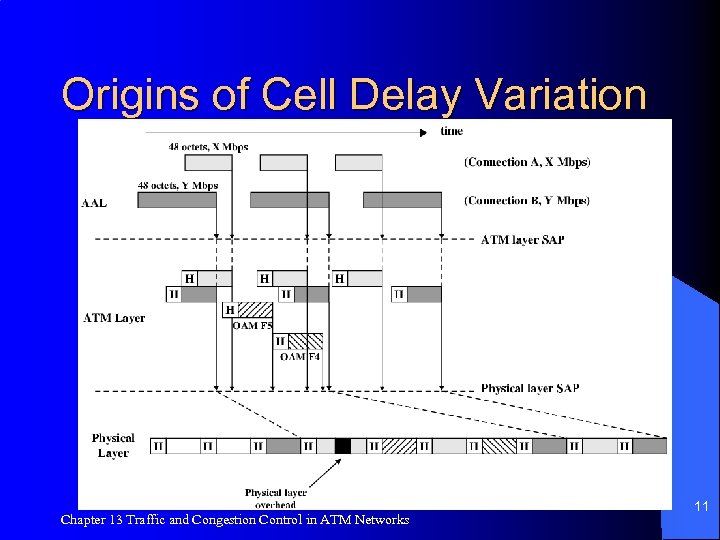 Origins of Cell Delay Variation Chapter 13 Traffic and Congestion Control in ATM Networks 11
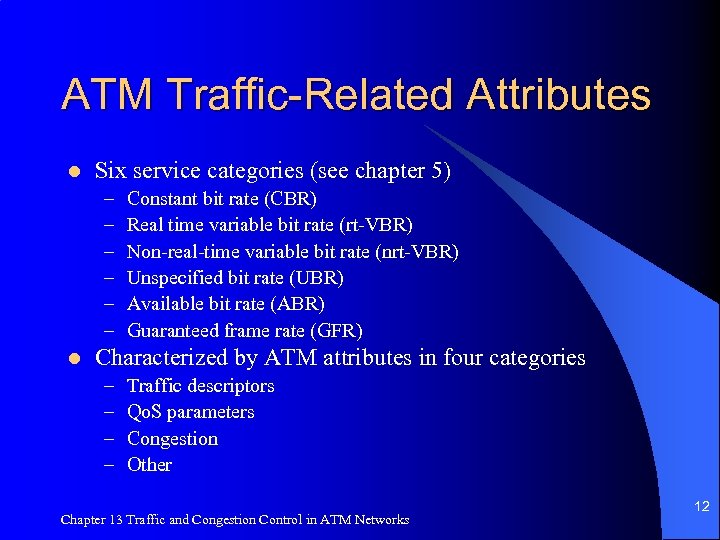 ATM Traffic-Related Attributes l Six service categories (see chapter 5) – – – l Constant bit rate (CBR) Real time variable bit rate (rt-VBR) Non-real-time variable bit rate (nrt-VBR) Unspecified bit rate (UBR) Available bit rate (ABR) Guaranteed frame rate (GFR) Characterized by ATM attributes in four categories – – Traffic descriptors Qo. S parameters Congestion Other Chapter 13 Traffic and Congestion Control in ATM Networks 12
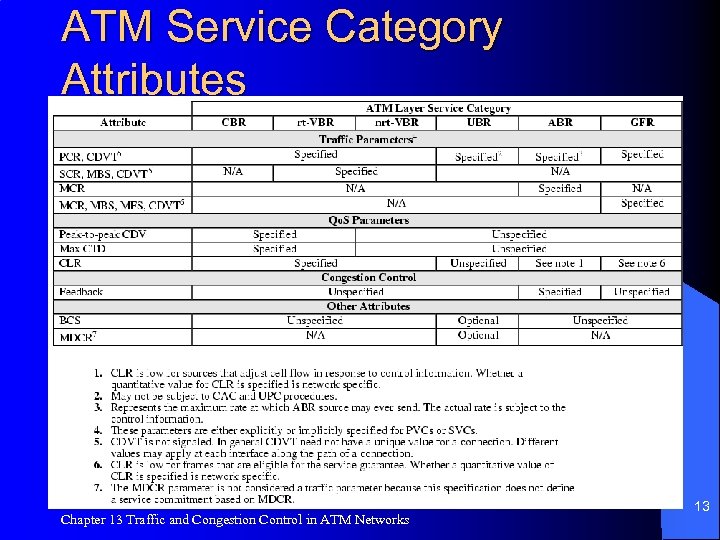 ATM Service Category Attributes Chapter 13 Traffic and Congestion Control in ATM Networks 13
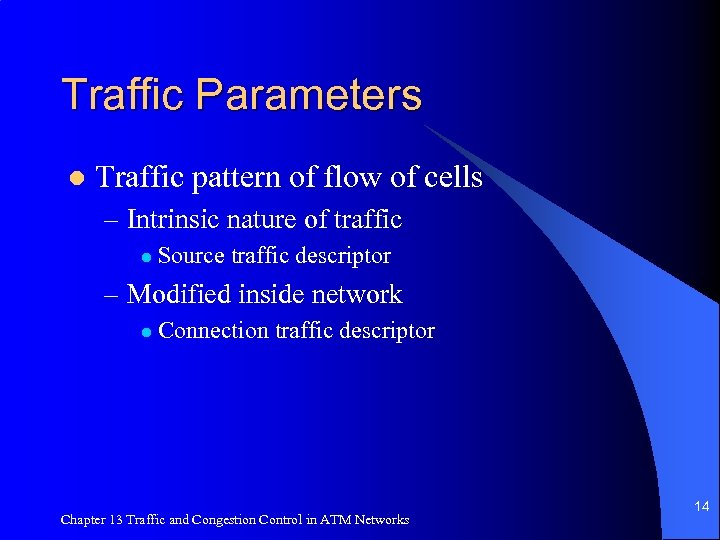 Traffic Parameters l Traffic pattern of flow of cells – Intrinsic nature of traffic l Source traffic descriptor – Modified inside network l Connection traffic descriptor Chapter 13 Traffic and Congestion Control in ATM Networks 14
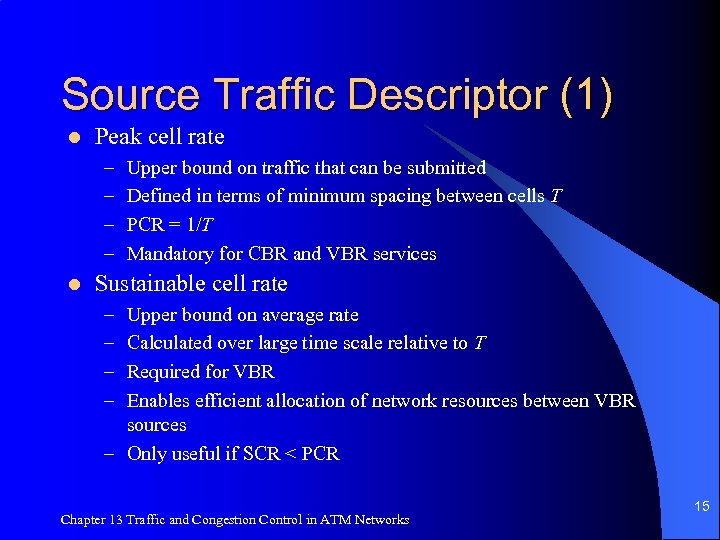 Source Traffic Descriptor (1) l Peak cell rate – – l Upper bound on traffic that can be submitted Defined in terms of minimum spacing between cells T PCR = 1/T Mandatory for CBR and VBR services Sustainable cell rate – – Upper bound on average rate Calculated over large time scale relative to T Required for VBR Enables efficient allocation of network resources between VBR sources – Only useful if SCR < PCR Chapter 13 Traffic and Congestion Control in ATM Networks 15
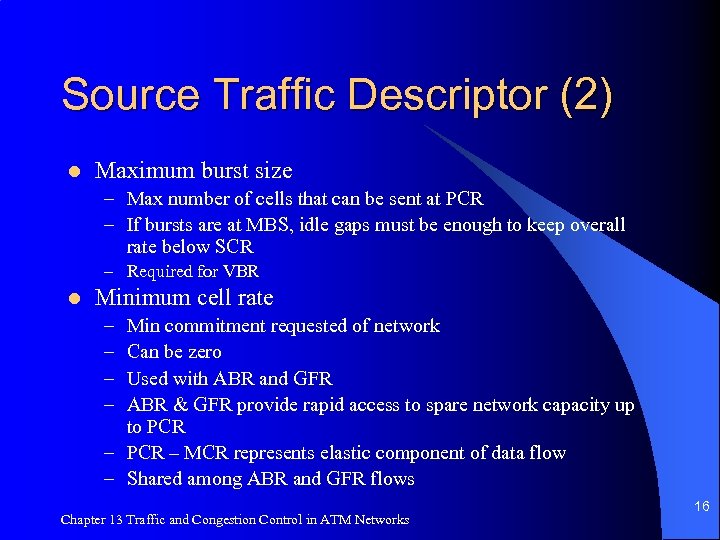 Source Traffic Descriptor (2) l Maximum burst size – Max number of cells that can be sent at PCR – If bursts are at MBS, idle gaps must be enough to keep overall rate below SCR – Required for VBR l Minimum cell rate – – Min commitment requested of network Can be zero Used with ABR and GFR ABR & GFR provide rapid access to spare network capacity up to PCR – MCR represents elastic component of data flow – Shared among ABR and GFR flows Chapter 13 Traffic and Congestion Control in ATM Networks 16
 Source Traffic Descriptor (3) l Maximum frame size – Max number of cells in frame that can be carried over GFR connection – Only relevant in GFR Chapter 13 Traffic and Congestion Control in ATM Networks 17
 Connection Traffic Descriptor l l Includes source traffic descriptor plus: Cell delay variation tolerance – Amount of variation in cell delay introduced by network interface and UNI – Bound on delay variability due to slotted nature of ATM, physical layer overhead and layer functions (e. g. cell multiplexing) – Represented by time variable τ l Conformance definition – Specify conforming cells of connection at UNI – Enforced by dropping or marking cells over definition Chapter 13 Traffic and Congestion Control in ATM Networks 18
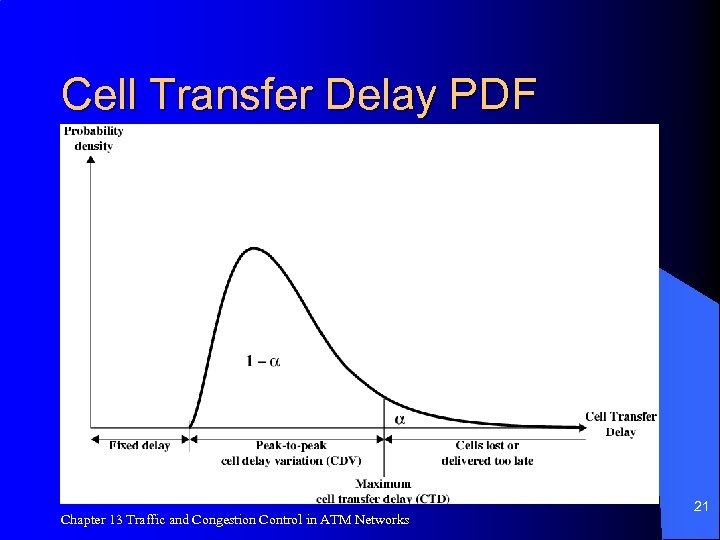
 Quality of Service Parametersmax. CTD l Cell transfer delay (CTD) – Time between transmission of first bit of cell at source and reception of last bit at destination – Typically has probability density function (see next slide) – Fixed delay due to propagation etc. – Cell delay variation due to buffering and scheduling – Maximum cell transfer delay (max. CTD)is max requested delay for connection – Fraction α of cells exceed threshold l Discarded or delivered late Chapter 13 Traffic and Congestion Control in ATM Networks 19
 Quality of Service Parameters. Peak-to-peak CDV & CLR l Peak-to-peak Cell Delay Variation – Remaining (1 -α) cells within Qo. S – Delay experienced by these cells is between fixed delay and max. CTD – This is peak-to-peak CDV – CDVT is an upper bound on CDV l Cell loss ratio – Ratio of cells lost to cells transmitted Chapter 13 Traffic and Congestion Control in ATM Networks 20
 Cell Transfer Delay PDF Chapter 13 Traffic and Congestion Control in ATM Networks 21
 Congestion Control Attributes l Only feedback is defined – ABR and GFR – Actions taken by network and end systems to regulate traffic submitted l ABR flow control – Adaptively share available bandwidth Chapter 13 Traffic and Congestion Control in ATM Networks 22
 Other Attributes l Behaviour class selector (BCS) – Support for IP differentiated services (chapter 16) – Provides different service levels among UBR connections – Associate each connection with a behaviour class – May include queuing and scheduling l Minimum desired cell rate Chapter 13 Traffic and Congestion Control in ATM Networks 23
 Traffic Management Framework l Objectives of ATM layer traffic and congestion control – Support Qo. S for all foreseeable services – Not rely on network specific AAL protocols nor higher layer application specific protocols – Minimize network and end system complexity – Maximize network utilization Chapter 13 Traffic and Congestion Control in ATM Networks 24
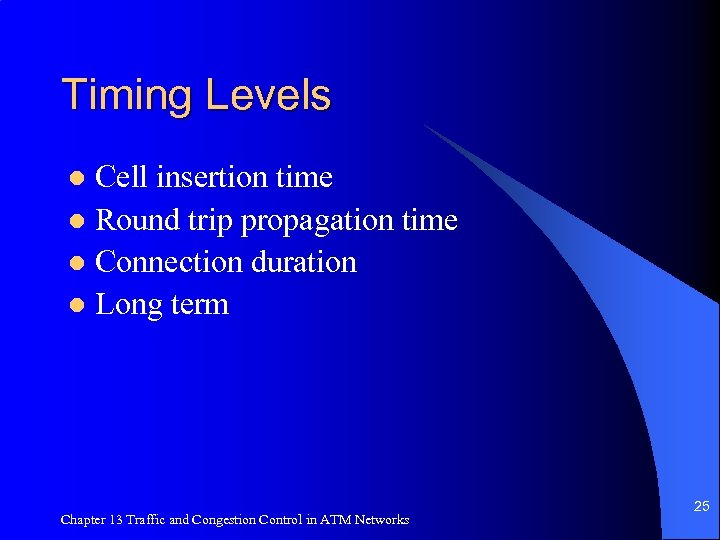 Timing Levels Cell insertion time l Round trip propagation time l Connection duration l Long term l Chapter 13 Traffic and Congestion Control in ATM Networks 25
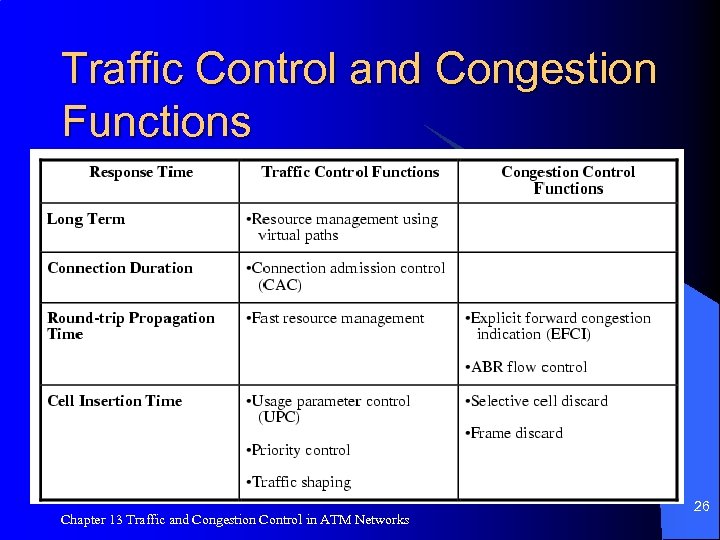 Traffic Control and Congestion Functions Chapter 13 Traffic and Congestion Control in ATM Networks 26
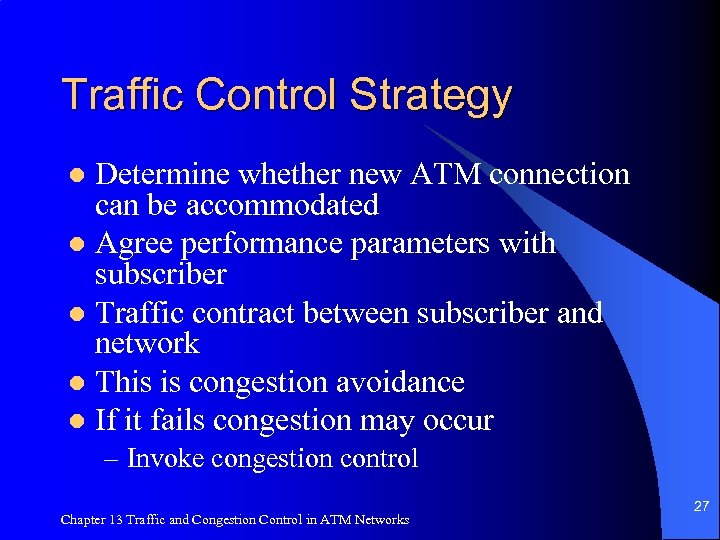 Traffic Control Strategy Determine whether new ATM connection can be accommodated l Agree performance parameters with subscriber l Traffic contract between subscriber and network l This is congestion avoidance l If it fails congestion may occur l – Invoke congestion control Chapter 13 Traffic and Congestion Control in ATM Networks 27
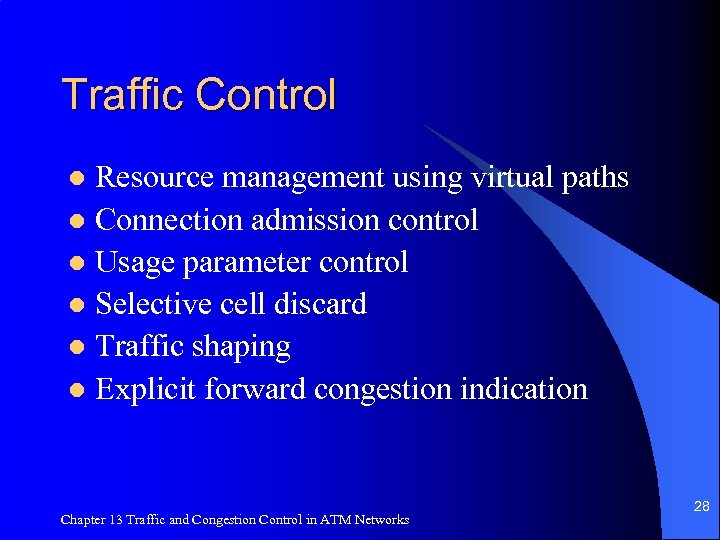 Traffic Control Resource management using virtual paths l Connection admission control l Usage parameter control l Selective cell discard l Traffic shaping l Explicit forward congestion indication l Chapter 13 Traffic and Congestion Control in ATM Networks 28
 Resource Management Using Virtual Paths Allocate resources so that traffic is separated according to service characteristics l Virtual path connection (VPC) are groupings of virtual channel connections (VCC) l Chapter 13 Traffic and Congestion Control in ATM Networks 29
 Applications l User-to-user applications – VPC between UNI pair – No knowledge of Qo. S for individual VCC – User checks that VPC can take VCCs’ demands l User-to-network applications – VPC between UNI and network node – Network aware of and accommodates Qo. S of VCCs l Network-to-network applications – VPC between two network nodes – Network aware of and accommodates Qo. S of VCCs Chapter 13 Traffic and Congestion Control in ATM Networks 30
 Resource Management Concerns l l l Cell loss ratio Max cell transfer delay Peak to peak cell delay variation All affected by resources devoted to VPC If VCC goes through multiple VPCs, performance depends on consecutive VPCs and on node performance – VPC performance depends on capacity of VPC and traffic characteristics of VCCs – VCC related function depends on switching/processing speed and priority Chapter 13 Traffic and Congestion Control in ATM Networks 31
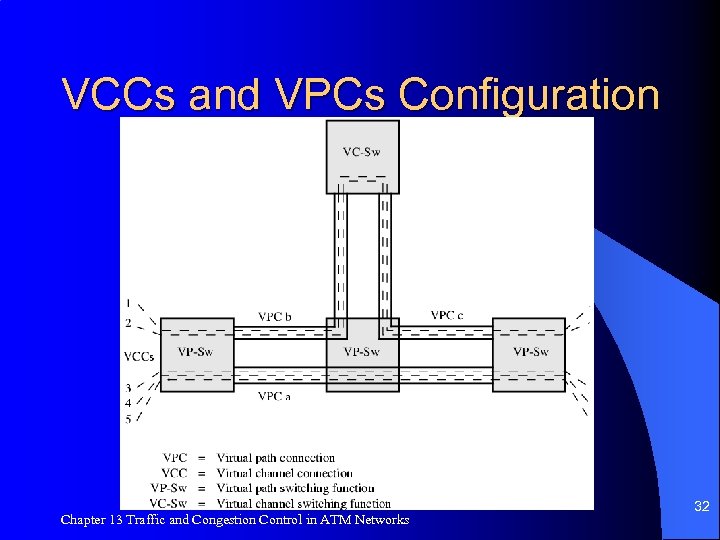 VCCs and VPCs Configuration Chapter 13 Traffic and Congestion Control in ATM Networks 32
 Allocation of Capacity to VPC l Aggregate peak demand – May set VPC capacity (data rate) to total of VCC peak rates l l l Each VCC can give Qo. S to accommodate peak demand VPC capacity may not be fully used Statistical multiplexing – VPC capacity >= average data rate of VCCs but < aggregate peak demand – Greater CDV and CTD – May have greater CLR – More efficient use of capacity – For VCCs requiring lower Qo. S – Group VCCs of similar traffic together Chapter 13 Traffic and Congestion Control in ATM Networks 33
 Connection Admission Control l User must specify service required in both directions – Category – Connection traffic descriptor l l l Source traffic descriptor CDVT Requested conformance definition – Qo. S parameter requested and acceptable value l Network accepts connection only if it can commit resources to support requests Chapter 13 Traffic and Congestion Control in ATM Networks 34
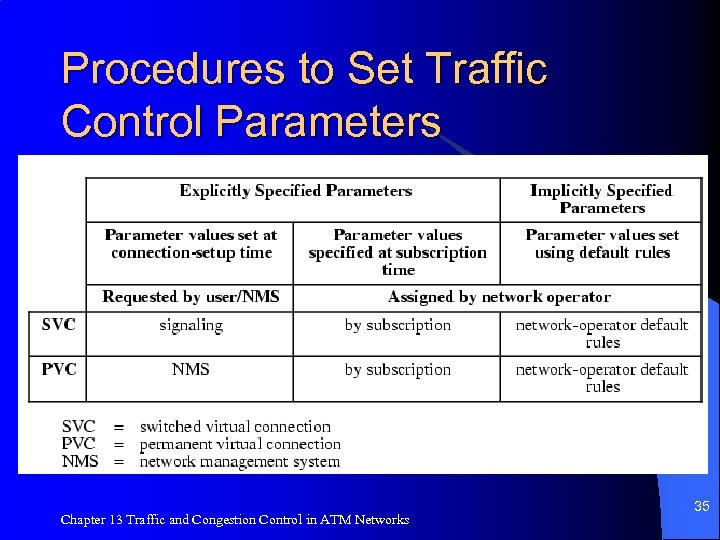 Procedures to Set Traffic Control Parameters Chapter 13 Traffic and Congestion Control in ATM Networks 35
 Cell Loss Priority l Two levels requested by user – Priority for individual cell indicated by CLP bit in header – If two levels are used, traffic parameters for both flows specified High priority CLP = 0 l All traffic CLP = 0 + 1 l – May improve network resource allocation Chapter 13 Traffic and Congestion Control in ATM Networks 36
 Usage Parameter Control UPC l Monitors connection for conformity to traffic contract l Protect network resources from overload on one connection l Done at VPC or VCC level l VPC level more important l – Network resources allocated at this level Chapter 13 Traffic and Congestion Control in ATM Networks 37
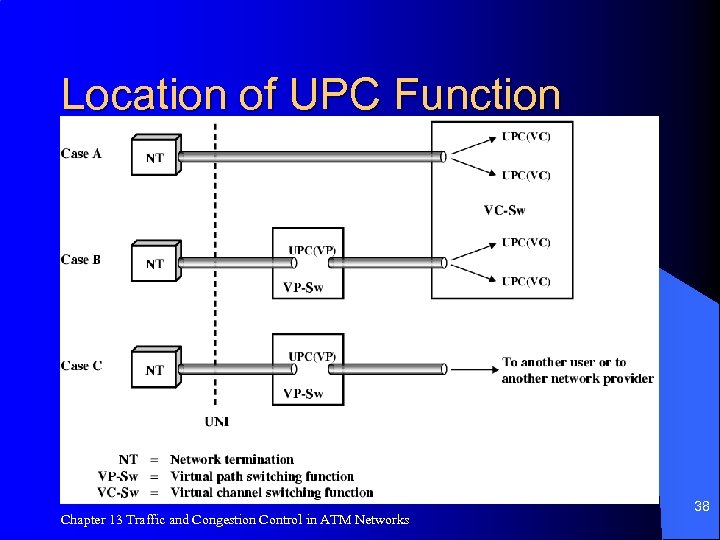 Location of UPC Function Chapter 13 Traffic and Congestion Control in ATM Networks 38
 Peak Cell Rate Algorithm How UPC determines whether user is complying with contract l Control of peak cell rate and CDVT l – Complies if peak does not exceed agreed peak – Subject to CDV within agreed bounds – Generic cell rate algorithm – Leaky bucket algorithm Chapter 13 Traffic and Congestion Control in ATM Networks 39
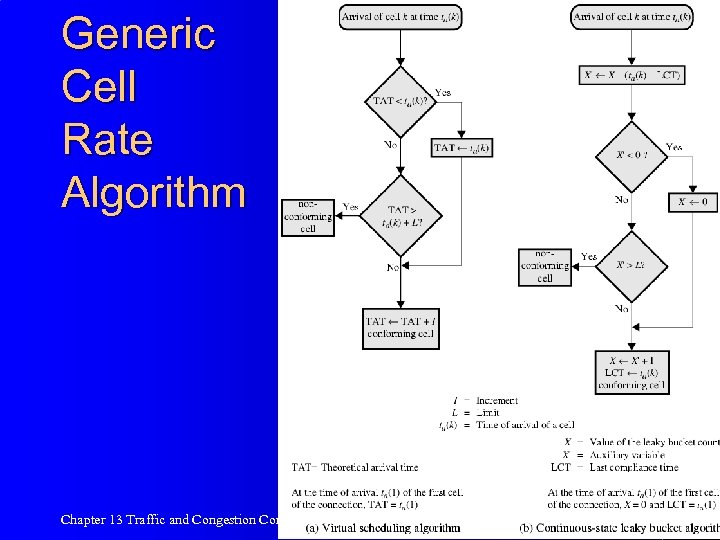 Generic Cell Rate Algorithm Chapter 13 Traffic and Congestion Control in ATM Networks 40
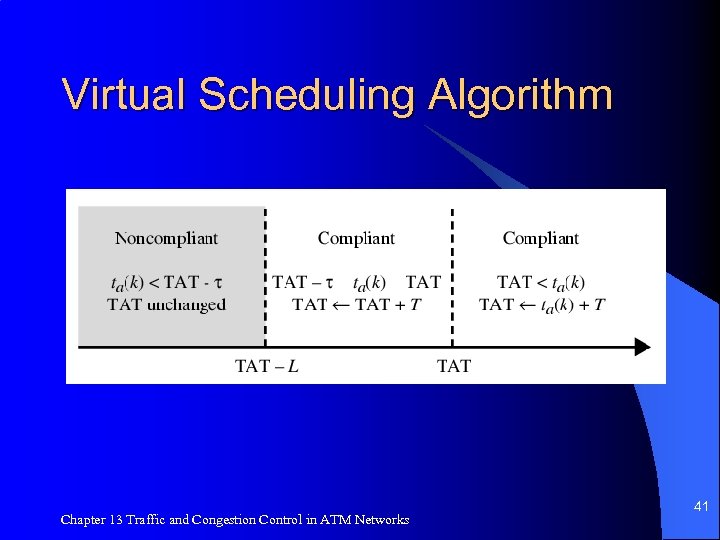 Virtual Scheduling Algorithm Chapter 13 Traffic and Congestion Control in ATM Networks 41
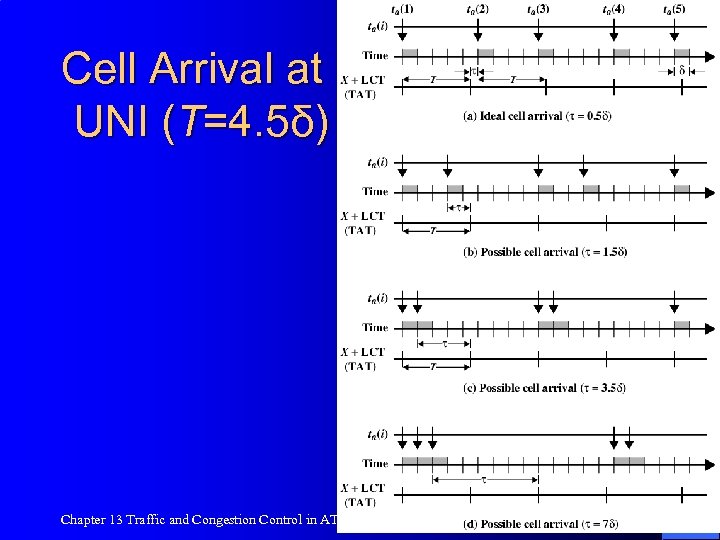 Cell Arrival at UNI (T=4. 5δ) Chapter 13 Traffic and Congestion Control in ATM Networks 42
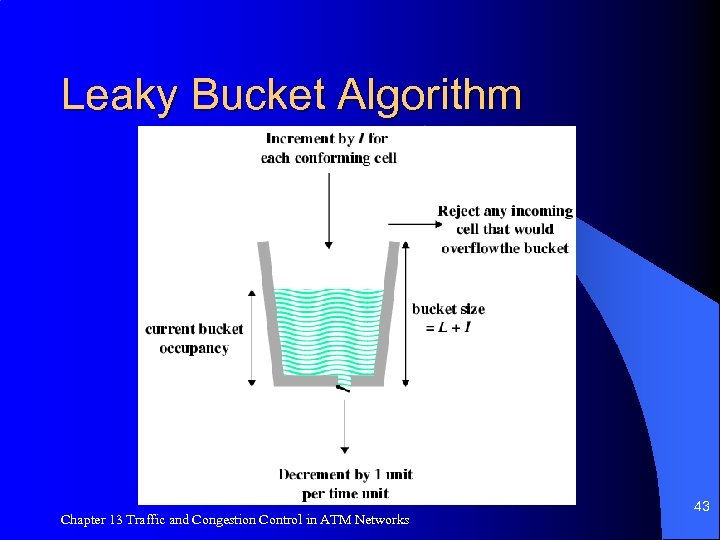 Leaky Bucket Algorithm Chapter 13 Traffic and Congestion Control in ATM Networks 43
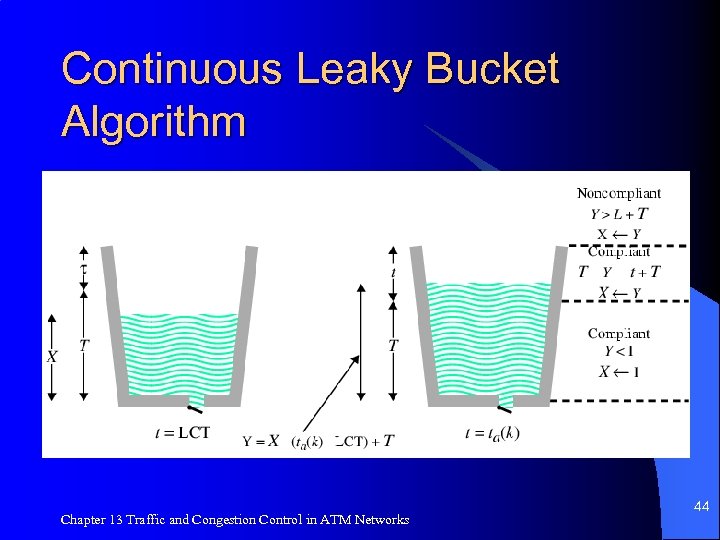 Continuous Leaky Bucket Algorithm Chapter 13 Traffic and Congestion Control in ATM Networks 44
 Sustainable Cell Rate Algorithm Operational definition of relationship between sustainable cell rate and burst tolerance l Used by UPC to monitor compliance l Same algorithm as peak cell rate l Chapter 13 Traffic and Congestion Control in ATM Networks 45
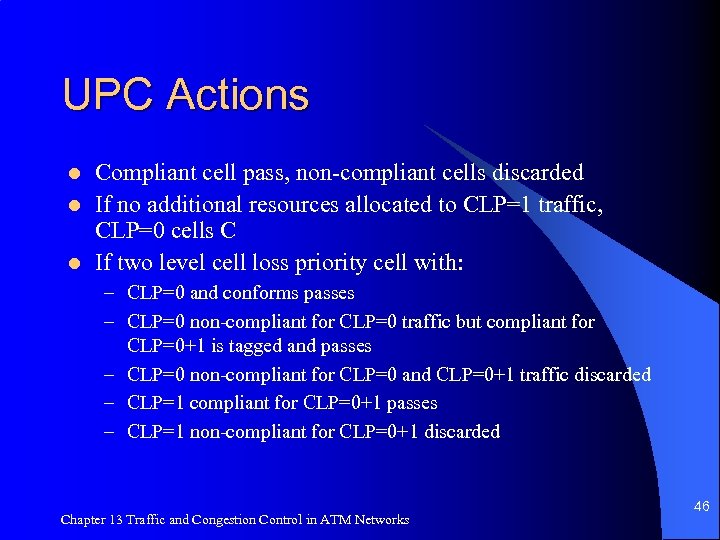 UPC Actions l l l Compliant cell pass, non-compliant cells discarded If no additional resources allocated to CLP=1 traffic, CLP=0 cells C If two level cell loss priority cell with: – CLP=0 and conforms passes – CLP=0 non-compliant for CLP=0 traffic but compliant for CLP=0+1 is tagged and passes – CLP=0 non-compliant for CLP=0 and CLP=0+1 traffic discarded – CLP=1 compliant for CLP=0+1 passes – CLP=1 non-compliant for CLP=0+1 discarded Chapter 13 Traffic and Congestion Control in ATM Networks 46
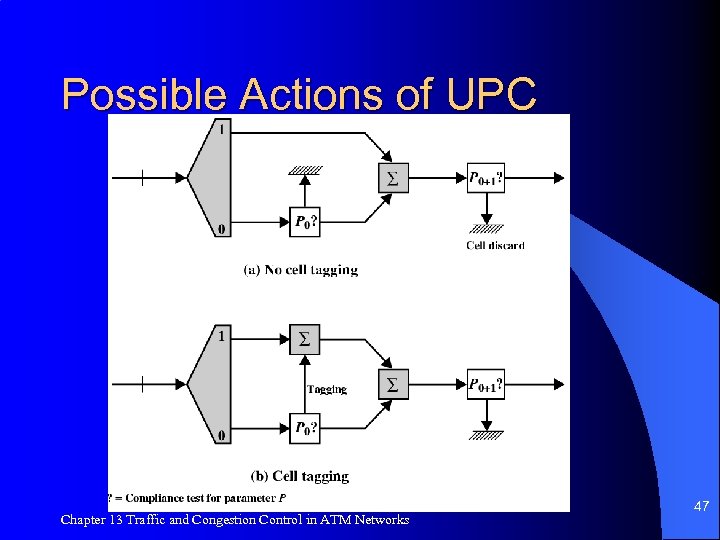 Possible Actions of UPC Chapter 13 Traffic and Congestion Control in ATM Networks 47
 Selective Cell Discard Starts when network, at point beyond UPC, discards CLP=1 cells l Discard low priority cells to protect high priority cells l No distinction between cells labelled low priority by source and those tagged by UPC l Chapter 13 Traffic and Congestion Control in ATM Networks 48
 Traffic Shaping l GCRA is a form of traffic policing – Flow of cells regulated – Cells exceeding performance level tagged or discarded l Traffic shaping used to smooth traffic flow – Reduce cell clumping – Fairer allocation of resources – Reduced average delay Chapter 13 Traffic and Congestion Control in ATM Networks 49
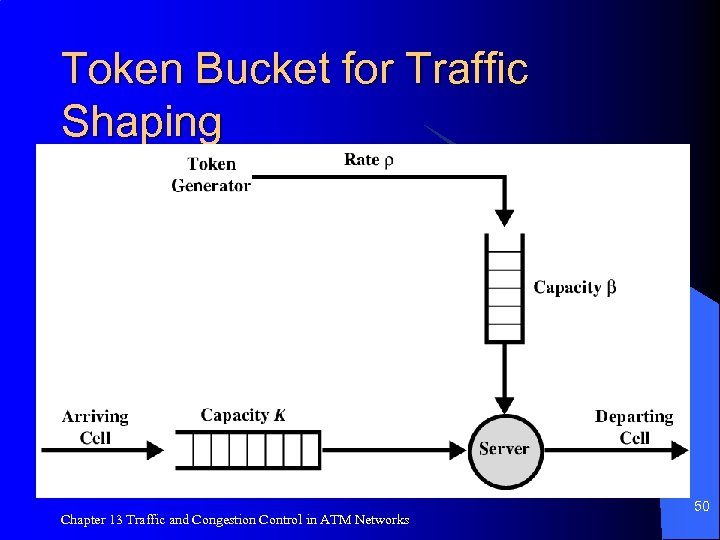 Token Bucket for Traffic Shaping Chapter 13 Traffic and Congestion Control in ATM Networks 50
 Explicit Forward Congestion Indication Essentially same as frame relay l If node experiencing congestion, set forward congestion indication is cell headers l – Tells users that congestion avoidance should be initiated in this direction – User may take action at higher level Chapter 13 Traffic and Congestion Control in ATM Networks 51
 ABR Traffic Management l l Qo. S for CBR, VBR based on traffic contract and UPC described previously No congestion feedback to source Open-loop control Not suited to non-real-time applications – File transfer, web access, RPC, distributed file systems – No well defined traffic characteristics except PCR – PCR not enough to allocate resources l Use best efforts or closed-loop control Chapter 13 Traffic and Congestion Control in ATM Networks 52
 Best Efforts Share unused capacity between applications l As congestion goes up: l – Cells are lost – Sources back off and reduce rate – Fits well with TCP techniques (chapter 12) – Inefficient l Cells dropped causing re-transmission Chapter 13 Traffic and Congestion Control in ATM Networks 53
 Closed-Loop Control Sources share capacity not used by CBR and VBR l Provide feedback to sources to adjust load l Avoid cell loss l Share capacity fairly l Used for ABR l Chapter 13 Traffic and Congestion Control in ATM Networks 54
 Characteristics of ABR l ABR connections share available capacity – Access instantaneous capacity unused by CBR/VBR – Increases utilization without affecting CBR/VBR Qo. S l Share used by single ABR connection is dynamic – Varies between agreed MCR and PCR l Network gives feedback to ABR sources – ABR flow limited to available capacity – Buffers absorb excess traffic prior to arrival of feedback l Low cell loss – Major distinction from UBR Chapter 13 Traffic and Congestion Control in ATM Networks 55
 Feedback Mechanisms (1) l Cell transmission rate characterized by: – Allowable cell rate l Current rate – Minimum cell rate Min for ACR l May be zero l – Peak cell rate l Max for ACR – Initial cell rate Chapter 13 Traffic and Congestion Control in ATM Networks 56
 Feedback Mechanisms (2) Start with ACR=ICR l Adjust ACR based on feedback l Feedback in resource management (RM) cells l – Cell contains three fields for feedback Congestion indicator bit (CI) l No increase bit (NI) l Explicit cell rate field (ER) l Chapter 13 Traffic and Congestion Control in ATM Networks 57
 Source Reaction to Feedback l If CI=1 – Reduce ACR by amount proportional to current ACR but not less than CR l Else if NI=0 – Increase ACR by amount proportional to PCR but not more than PCR l If ACR>ER set ACR<-max[ER, MCR] Chapter 13 Traffic and Congestion Control in ATM Networks 58
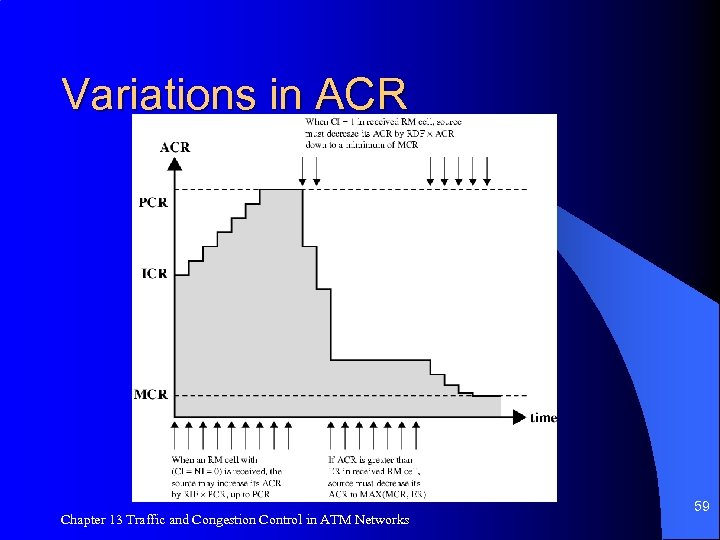 Variations in ACR Chapter 13 Traffic and Congestion Control in ATM Networks 59
 Cell Flow on ABR l Two types of cell – Data & resource management (RM) l Source receives regular RM cells – Feedback l Bulk of RM cells initiated by source – One forward RM cell (FRM) per (Nrm-1) data cells l Nrm preset – usually 32 – Each FRM is returned by destination as backwards RM (BRM) cell – FRM typically CI=0, NI=0 or 1 ER desired transmission rate in range ICR<=ER<=PCR – Any field may be changed by switch or destination before return Chapter 13 Traffic and Congestion Control in ATM Networks 60
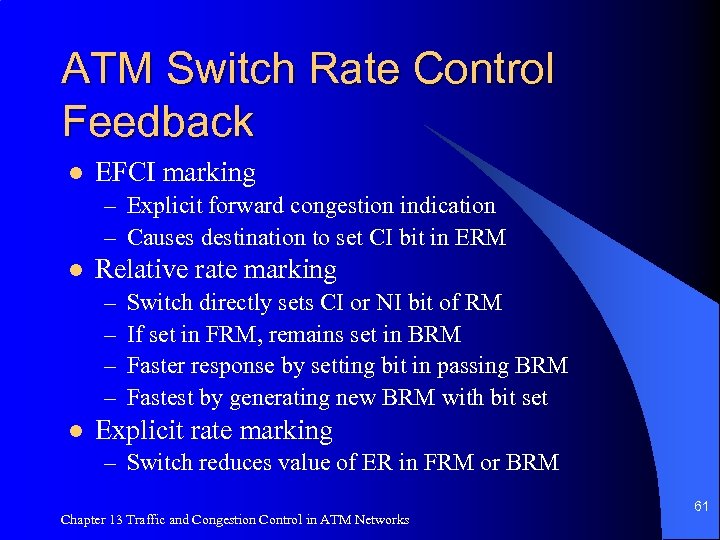 ATM Switch Rate Control Feedback l EFCI marking – Explicit forward congestion indication – Causes destination to set CI bit in ERM l Relative rate marking – – l Switch directly sets CI or NI bit of RM If set in FRM, remains set in BRM Faster response by setting bit in passing BRM Fastest by generating new BRM with bit set Explicit rate marking – Switch reduces value of ER in FRM or BRM Chapter 13 Traffic and Congestion Control in ATM Networks 61
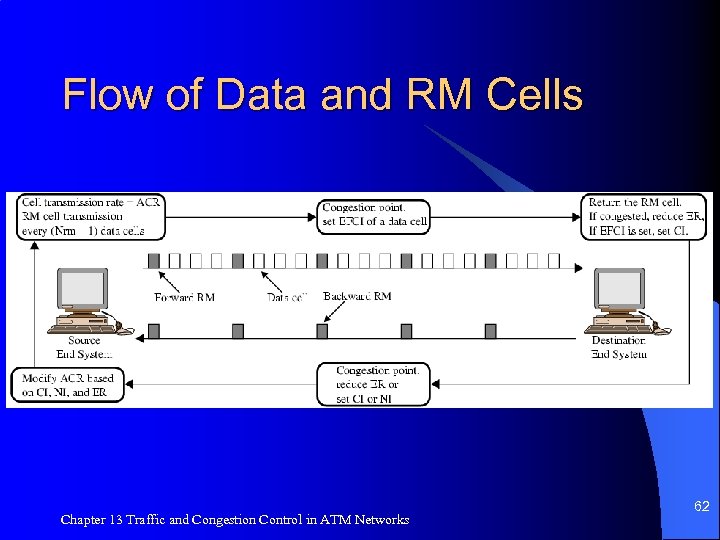 Flow of Data and RM Cells Chapter 13 Traffic and Congestion Control in ATM Networks 62
 ARB Feedback v TCP ACK l ABR feedback controls rate of transmission – Rate control l TCP feedback controls window size – Credit control ARB feedback from switches or destination l TCP feedback from destination only l Chapter 13 Traffic and Congestion Control in ATM Networks 63
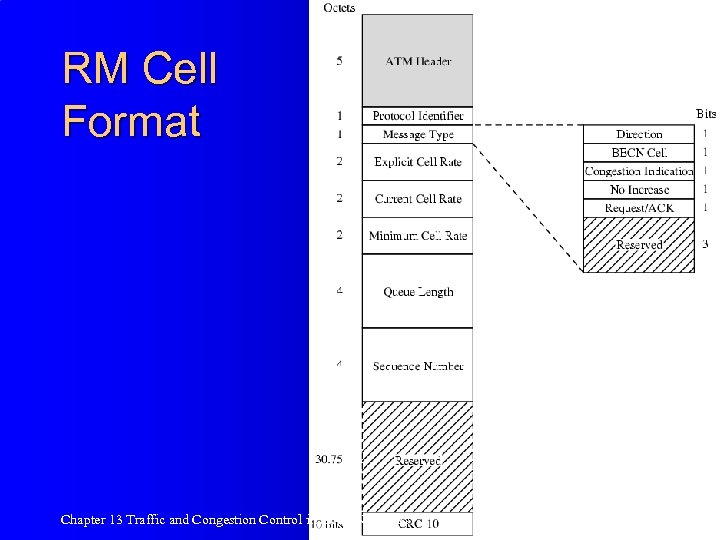 RM Cell Format Chapter 13 Traffic and Congestion Control in ATM Networks 64
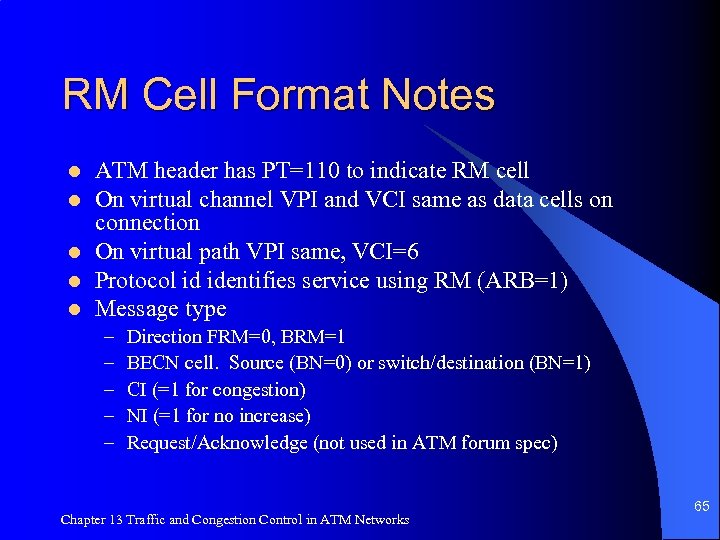 RM Cell Format Notes l l l ATM header has PT=110 to indicate RM cell On virtual channel VPI and VCI same as data cells on connection On virtual path VPI same, VCI=6 Protocol id identifies service using RM (ARB=1) Message type – – – Direction FRM=0, BRM=1 BECN cell. Source (BN=0) or switch/destination (BN=1) CI (=1 for congestion) NI (=1 for no increase) Request/Acknowledge (not used in ATM forum spec) Chapter 13 Traffic and Congestion Control in ATM Networks 65
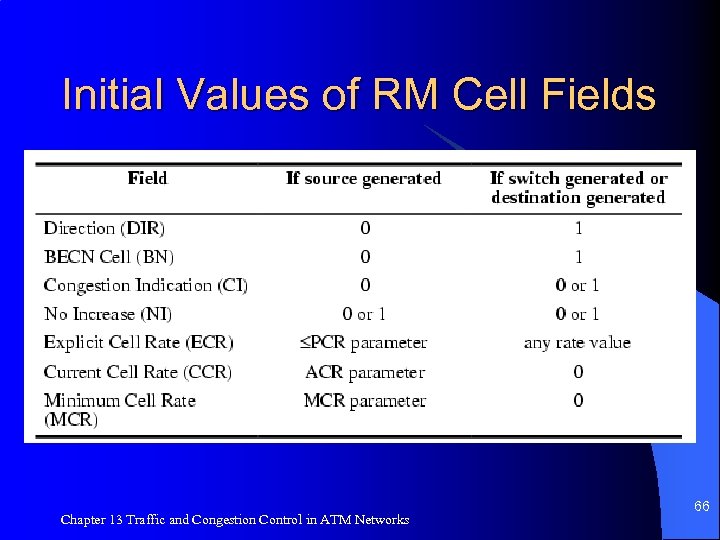 Initial Values of RM Cell Fields Chapter 13 Traffic and Congestion Control in ATM Networks 66
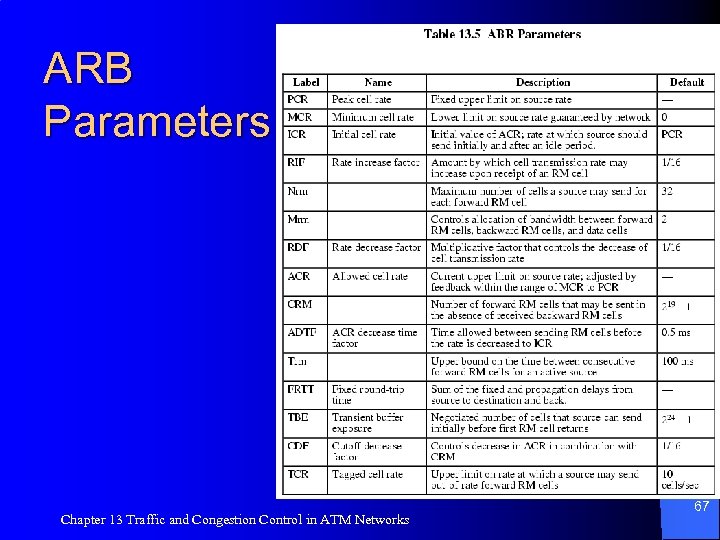 ARB Parameters Chapter 13 Traffic and Congestion Control in ATM Networks 67
 ARB Capacity Allocation l ATM switch must perform: – Congestion control l Monitor queue length – Fair capacity allocation l Throttle back connections using more than fair share ATM rate control signals are explicit l TCP are implicit l – Increasing delay and cell loss Chapter 13 Traffic and Congestion Control in ATM Networks 68
 Congestion Control Algorithms. Binary Feedback l l l Use only EFCI, CI and NI bits Switch monitors buffer utilization When congestion approaches, binary notification – Set EFCI on forward data cells or CI or NI on FRM or BRM l Three approaches to which to notify – Single FIFO queue – Multiple queues – Fair share notification Chapter 13 Traffic and Congestion Control in ATM Networks 69
 Single FIFO Queue l When buffer use exceeds threshold (e. g. 80%) – Switch starts issuing binary notifications – Continues until buffer use falls below threshold – Can have two thresholds l l One for start and one for stop Stops continuous on/off switching – Biased against connections passing through more switches Chapter 13 Traffic and Congestion Control in ATM Networks 70
 Multiple Queues l l l Separate queue for each VC or group of VCs Separate threshold on each queue Only connections with long queues get binary notifications – Fair – Badly behaved source does not affect other VCs – Delay and loss behaviour of individual VCs separated l Can have different Qo. S on different VCs Chapter 13 Traffic and Congestion Control in ATM Networks 71
 Fair Share Selective feedback or intelligent marking l Try to allocate capacity dynamically l E. g. l l fairshare =(target rate)/(number of connections) l Mark any cells where CCR>fairshare Chapter 13 Traffic and Congestion Control in ATM Networks 72
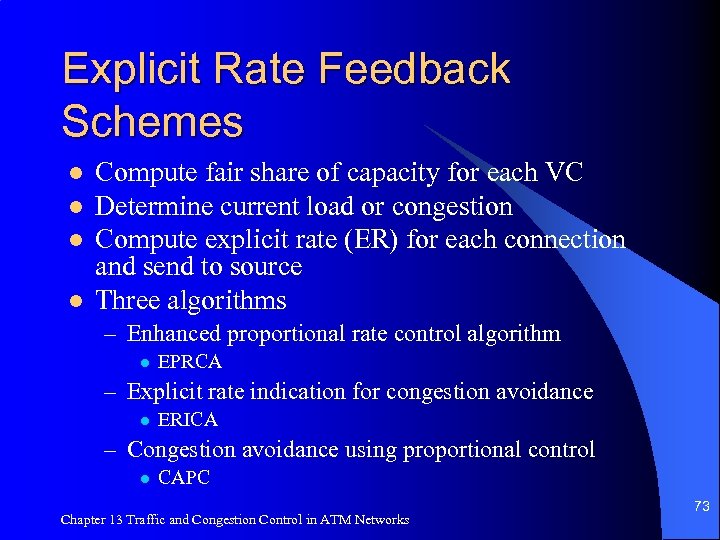 Explicit Rate Feedback Schemes l l Compute fair share of capacity for each VC Determine current load or congestion Compute explicit rate (ER) for each connection and send to source Three algorithms – Enhanced proportional rate control algorithm l EPRCA – Explicit rate indication for congestion avoidance l ERICA – Congestion avoidance using proportional control l CAPC Chapter 13 Traffic and Congestion Control in ATM Networks 73
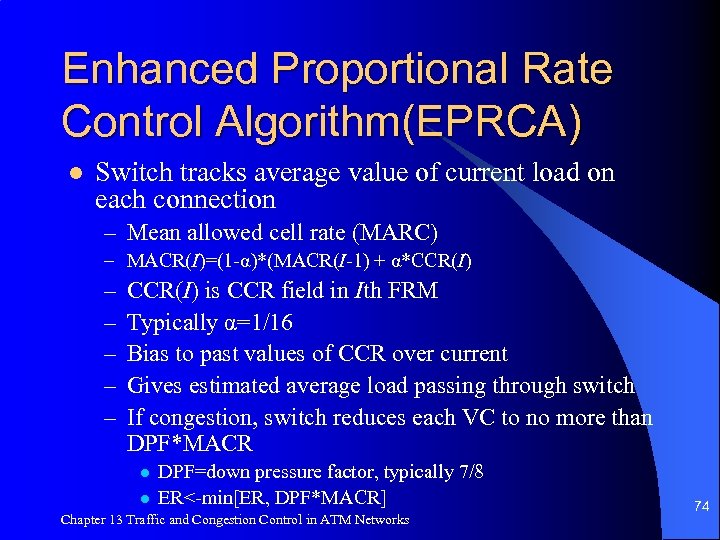 Enhanced Proportional Rate Control Algorithm(EPRCA) l Switch tracks average value of current load on each connection – Mean allowed cell rate (MARC) – MACR(I)=(1 -α)*(MACR(I-1) + α*CCR(I) – – – CCR(I) is CCR field in Ith FRM Typically α=1/16 Bias to past values of CCR over current Gives estimated average load passing through switch If congestion, switch reduces each VC to no more than DPF*MACR l DPF=down pressure factor, typically 7/8 ER<-min[ER, DPF*MACR] l Chapter 13 Traffic and Congestion Control in ATM Networks 74
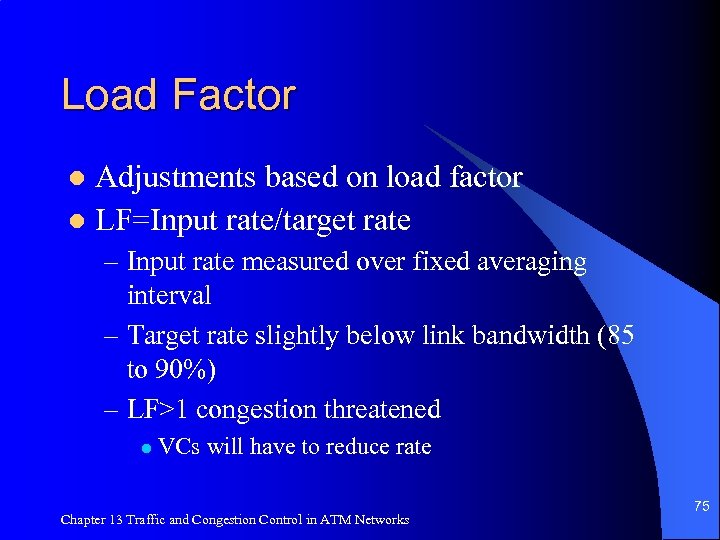 Load Factor Adjustments based on load factor l LF=Input rate/target rate l – Input rate measured over fixed averaging interval – Target rate slightly below link bandwidth (85 to 90%) – LF>1 congestion threatened l VCs will have to reduce rate Chapter 13 Traffic and Congestion Control in ATM Networks 75
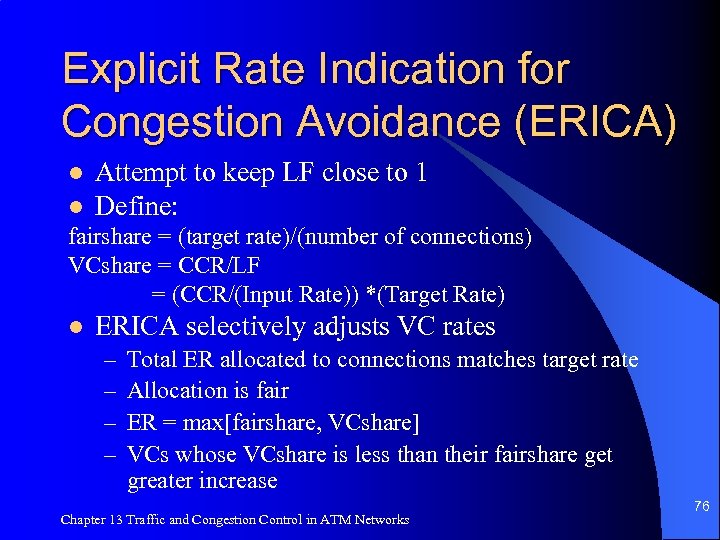 Explicit Rate Indication for Congestion Avoidance (ERICA) l l Attempt to keep LF close to 1 Define: fairshare = (target rate)/(number of connections) VCshare = CCR/LF = (CCR/(Input Rate)) *(Target Rate) l ERICA selectively adjusts VC rates – – Total ER allocated to connections matches target rate Allocation is fair ER = max[fairshare, VCshare] VCs whose VCshare is less than their fairshare get greater increase Chapter 13 Traffic and Congestion Control in ATM Networks 76
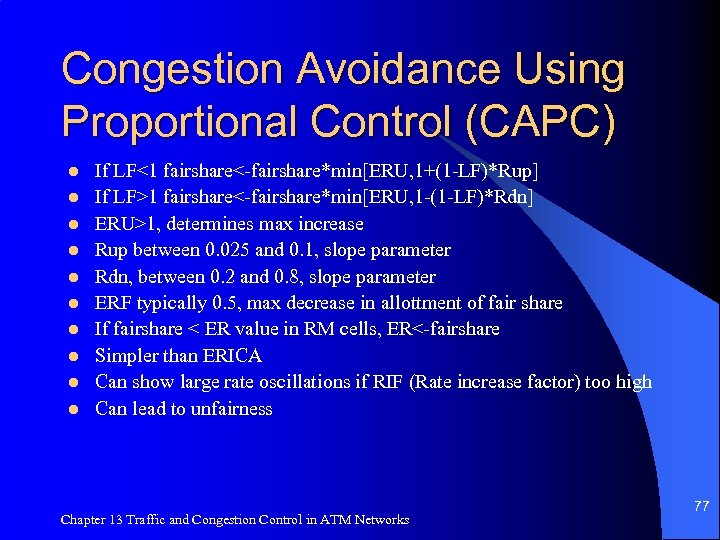 Congestion Avoidance Using Proportional Control (CAPC) l l l l l If LF<1 fairshare<-fairshare*min[ERU, 1+(1 -LF)*Rup] If LF>1 fairshare<-fairshare*min[ERU, 1 -(1 -LF)*Rdn] ERU>1, determines max increase Rup between 0. 025 and 0. 1, slope parameter Rdn, between 0. 2 and 0. 8, slope parameter ERF typically 0. 5, max decrease in allottment of fair share If fairshare < ER value in RM cells, ER<-fairshare Simpler than ERICA Can show large rate oscillations if RIF (Rate increase factor) too high Can lead to unfairness Chapter 13 Traffic and Congestion Control in ATM Networks 77
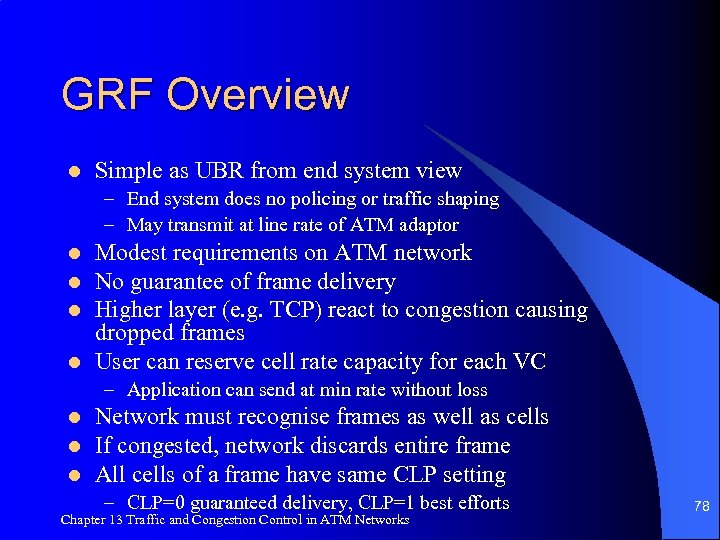 GRF Overview l Simple as UBR from end system view – End system does no policing or traffic shaping – May transmit at line rate of ATM adaptor l l Modest requirements on ATM network No guarantee of frame delivery Higher layer (e. g. TCP) react to congestion causing dropped frames User can reserve cell rate capacity for each VC – Application can send at min rate without loss l l l Network must recognise frames as well as cells If congested, network discards entire frame All cells of a frame have same CLP setting – CLP=0 guaranteed delivery, CLP=1 best efforts Chapter 13 Traffic and Congestion Control in ATM Networks 78
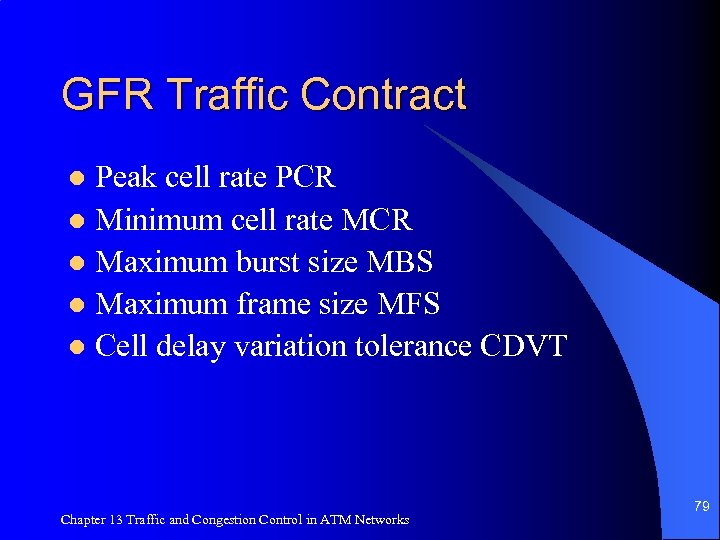 GFR Traffic Contract Peak cell rate PCR l Minimum cell rate MCR l Maximum burst size MBS l Maximum frame size MFS l Cell delay variation tolerance CDVT l Chapter 13 Traffic and Congestion Control in ATM Networks 79
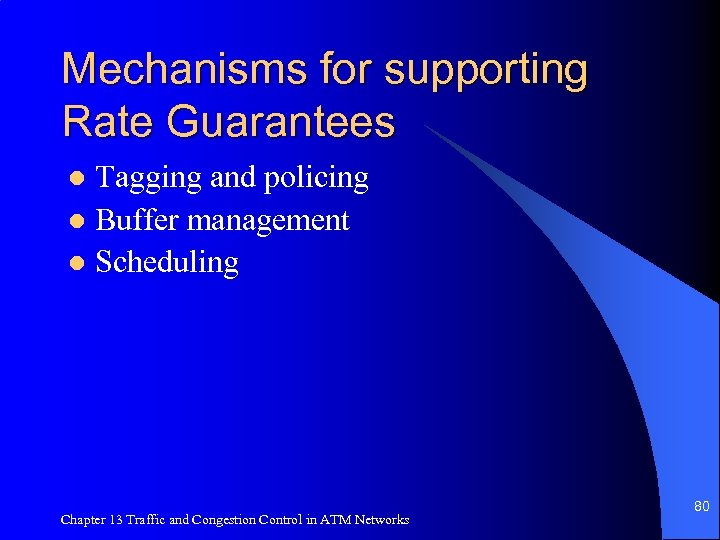 Mechanisms for supporting Rate Guarantees Tagging and policing l Buffer management l Scheduling l Chapter 13 Traffic and Congestion Control in ATM Networks 80
 Tagging and Policing l Tagging identifies frames that conform to contract and those that don’t – CLP=1 for those that don’t l l Set by network element doing conformance check May be network element or source showing less important frames – Get lower Qo. S in buffer management and scheduling – Tagged cells can be discarded at ingress to ATM network or subsequent switch – Discarding is a policing function Chapter 13 Traffic and Congestion Control in ATM Networks 81
 Buffer Management l l l Treatment of cells in buffers or when arriving and requiring buffering If congested (high buffer occupancy) tagged cells discarded in preference to untagged Discard tagged cell to make room for untagged cell May buffer per-VC Discards may be based on per queue thresholds Chapter 13 Traffic and Congestion Control in ATM Networks 82
 Scheduling l l Give preferential treatment to untagged cells Separate queues for each VC – Per VC scheduling decisions – E. g. FIFO modified to give CLP=0 cells higher priority l Scheduling between queues controls outgoing rate of VCs – Individual cells get fair allocation while meeting traffic contract Chapter 13 Traffic and Congestion Control in ATM Networks 83
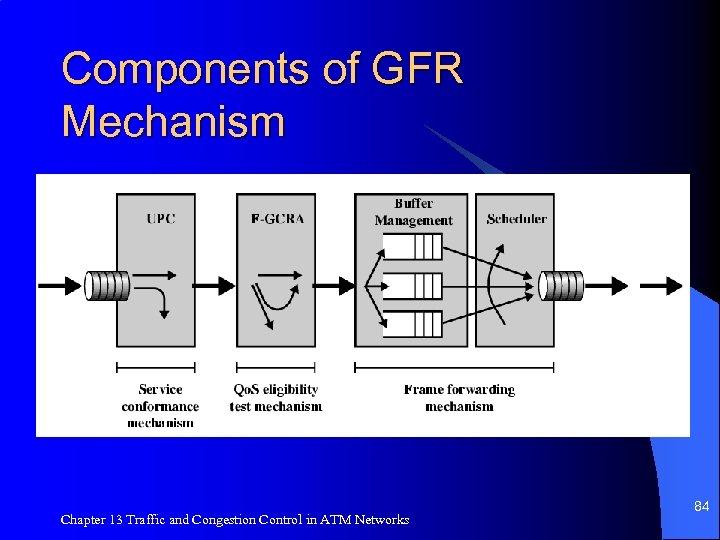 Components of GFR Mechanism Chapter 13 Traffic and Congestion Control in ATM Networks 84
 GFR Conformance Definition l UPC function – UPC monitors VC for traffic conformance – Tag or discard non-conforming cells l Frame conforms if all cells in frame conform – Rate of cells within contract l Generic cell rate algorithm PCR and CDVT specified for connection – All cells have same CLP – Within maximum frame size (MFS) Chapter 13 Traffic and Congestion Control in ATM Networks 85
 Qo. S Eligibility Test l Test for contract conformance – Discard or tag non-conforming cells l Looking at upper bound on traffic – Determine frames eligible for Qo. S guarantee l l l Under GFR contract for VC Looking at lower bound for traffic Frames are one of: – Nonconforming: cells tagged or discarded – Conforming ineligible: best efforts – Conforming eligible: guaranteed delivery Chapter 13 Traffic and Congestion Control in ATM Networks 86
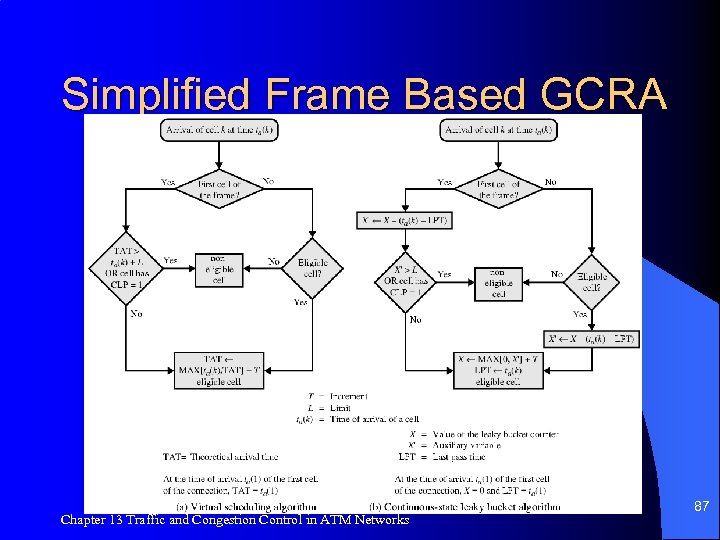 Simplified Frame Based GCRA Chapter 13 Traffic and Congestion Control in ATM Networks 87