


 Скачать презентацию Chapter 13 Tax Issues in Investing Income
99d862468ef41c1c542385815ca978ff.ppt
- Количество слайдов: 55
 Chapter 13 Tax Issues in Investing
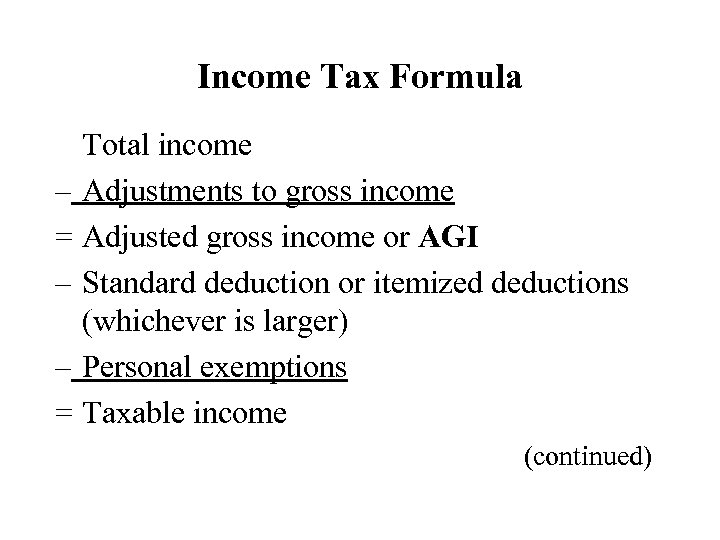 Income Tax Formula Total income – Adjustments to gross income = Adjusted gross income or AGI – Standard deduction or itemized deductions (whichever is larger) – Personal exemptions = Taxable income (continued)
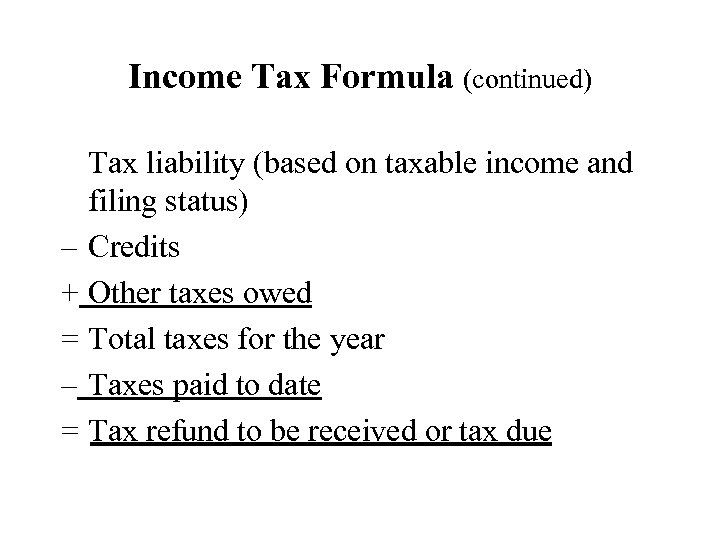 Income Tax Formula (continued) Tax liability (based on taxable income and filing status) – Credits + Other taxes owed = Total taxes for the year – Taxes paid to date = Tax refund to be received or tax due
 Adjustments to Gross Income • IRA contribution • self-employed SEP, SIMPLE, and qualified plans • penalty on early withdrawal of savings
 Interest Expense Deduction • Mortgages (with limits) • Margin loans – Interest payments on nonbusiness loan incurred in course of investment activity are referred to as investment interest. – Deductions for investment interest expenses allowed but limited to taxpayer’s “net investment income” for year
 Net Investment Income • Investment income after deduction of investment expenses • Ordinary dividends clearly count • Qualified dividends do not (those subject to special marginal tax rates) • Unused investment interest can be carried forward to next year
 Average tax rate • Total amount of income tax paid divided by total income • Person’s average tax rate always lower than his or her marginal tax rate Marginal tax rate (MTR) • Rate at which incremental income is taxed • Only relevant rate for investment decision making purposes
 Alternative Minimum Tax • AMT rate = 26% on first $175, 000, then 28% (for MFJ) • Few people affected by it at first • With inflation, more taxpayers included each year • Some income that would otherwise be tax exempt is now be taxable
 Tax Credits • Foreign tax credit – If less than $600 on joint return ($300 on single) can deduct automatically. – If exceed this amount, must prorate using Form 1116 • Retirement savings contributions credit – Only for people with income less than $50, 000 joint ($25, 000 single) – Up to 50% tax credit for contributions
 Other Taxes • Premature distribution from a tax-qualified account (10%) • Excess contributions to IRAs & others • Distribution taken from a Coverdell ESA or qualified tuition program not spent appropriately • Shortfall in MRD
 People with Substantive Nonwage Income • Make estimated payments during the year. • Adjust the amounts withheld by employers on wage income. • Elect to have 20 percent of their investment income withheld for taxes.
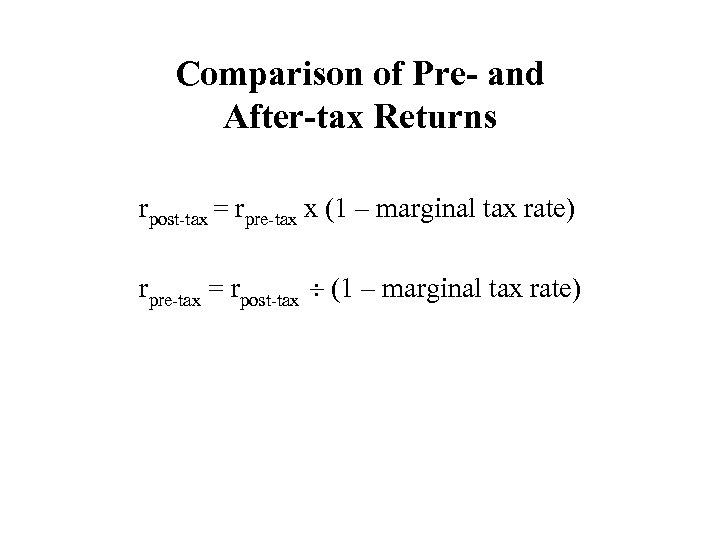 Comparison of Pre- and After-tax Returns rpost-tax = rpre-tax x (1 – marginal tax rate) rpre-tax = rpost-tax (1 – marginal tax rate)
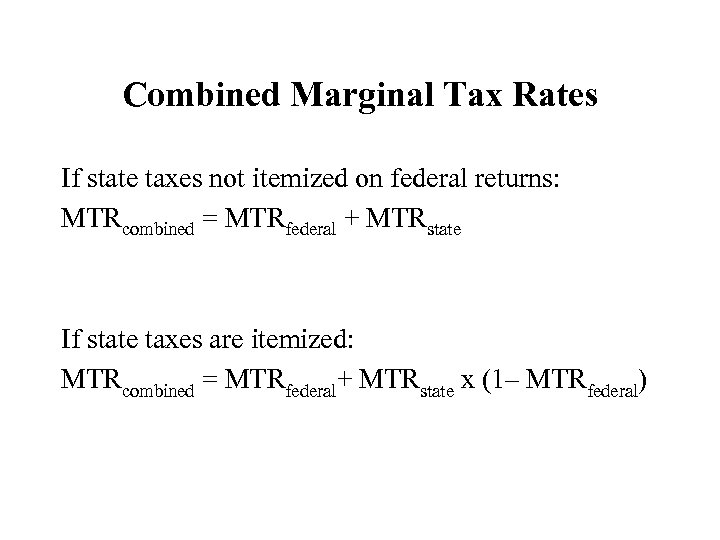 Combined Marginal Tax Rates If state taxes not itemized on federal returns: MTRcombined = MTRfederal + MTRstate If state taxes are itemized: MTRcombined = MTRfederal+ MTRstate x (1– MTRfederal)
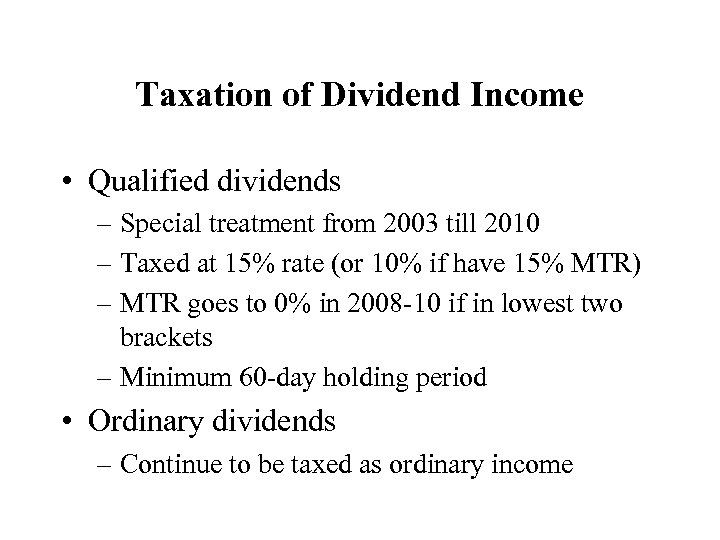 Taxation of Dividend Income • Qualified dividends – Special treatment from 2003 till 2010 – Taxed at 15% rate (or 10% if have 15% MTR) – MTR goes to 0% in 2008 -10 if in lowest two brackets – Minimum 60 -day holding period • Ordinary dividends – Continue to be taxed as ordinary income
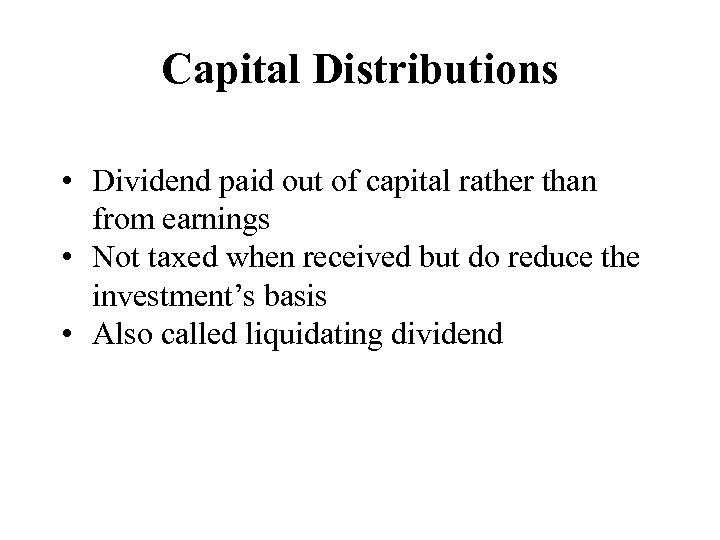 Capital Distributions • Dividend paid out of capital rather than from earnings • Not taxed when received but do reduce the investment’s basis • Also called liquidating dividend
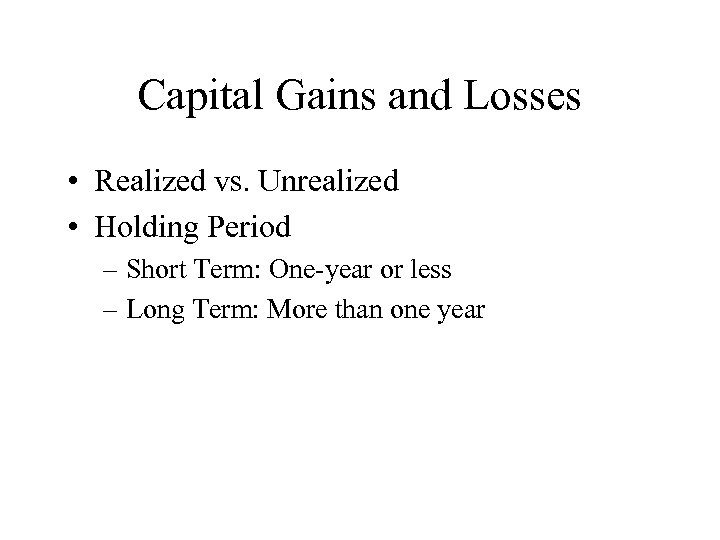 Capital Gains and Losses • Realized vs. Unrealized • Holding Period – Short Term: One-year or less – Long Term: More than one year
 Cost Basis • Purchase price of asset, plus any commissions paid to acquire it. Selling Price • Proceeds from sale of asset, less commissions paid to sell it.
 Tax Treatment of Each Category • Short-Term Capital Gains (STCG): Ordinary Income • Long-Term Capital Gains (LTCG): 15% MTR – Unless MTR is 15%, then LTCG is 10% • STCL and LTCL: First, offset Capital gains, then can deduct $3, 000 per year and carry unused portion forward
 Tax-Loss Harvesting • Recognize at least up to $3, 000 in capital losses each year if have them – Savings on income taxes – Allows recognition of some capital gains without a tax bill, and/or – Opportunity to rebalance portfolio
 Tax-Efficient Investing • Avoidance of taking of capital gains on which one would have to pay capital gains tax – Can eventually lead to a concentrated portfolio – Gives appearance of failure to manage portfolio
 Wash Sale Rule • Loss sustained on sale of security not allowed if investor purchases “substantially identical” security within period beginning 30 days before sale and ending 30 days after sale. – Cannot substitute options for stock – Cannot move to substantially identical convertibles
 Substantially Identical Convertibles 1. 2. 3. 4. Convertible into common stock Has same voting rights as common stock Subject to same dividend restrictions Trades at prices that do not vary significantly from conversion ratio 5. Unrestricted as to convertibility
 Restricted Stock • Compensation package for top management – Limitations on tax-deduction of salaries over $1, 000 – Sell the employee restricted stock – Lend the money to purchase the stock – Later, forgive the loan – If company bought out, employee gets LTCG
 Stock Splits/Dividends • Nontaxable event • Prorate old cost basis to new shares
 Warrants • Selling stock and buying warrants on same subject to wash rule • Selling warrants and buying stock NOT subject to wash rule as long as not substantially identical • Cost basis of stock bought through exercise – Cost of warrants plus exercise price
 Rights and Taxes • Must allocate part of cost basis of stock to rights if value of rights at least 15% of value of stock holding • Cost basis of stock bought through exercise – Cost of rights plus exercise price
 Short Sales and Taxes • Normal tax rules, except sale date precedes the purchase date • Must be short at least one year to obtain long-term tax treatment
 Liquidations • Partial liquidation treated as capital distribution • If liquidation in multiple payments and purchases were in multiple batches, then must prorate sales over each batch.
 Taxation of Bond Interest • Municipals normally exempt from federal taxation • Treasury bonds & federal agency bonds exempt from state & local taxation • Bonds of gov’t sponsored corporations not exempt from state & local taxation • Some states tax only income from dividends and interest
 Cost Basis of Bonds • Cost of bonds + commission • Accrued interest paid will be an offset to interest income for the year.
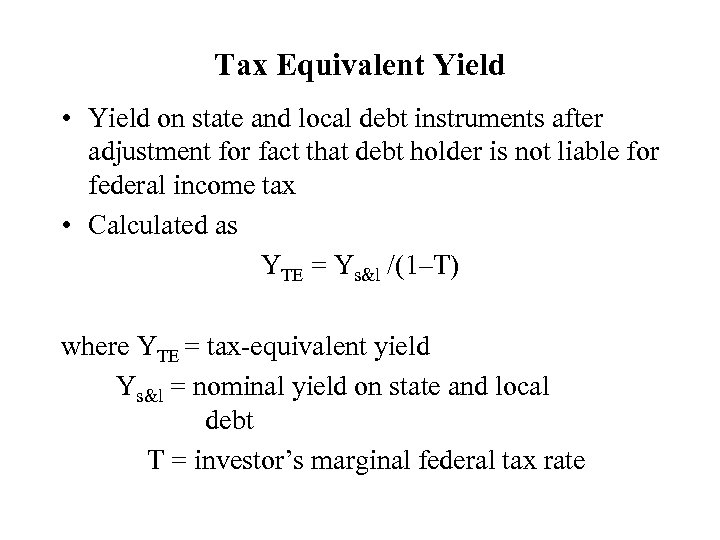 Tax Equivalent Yield • Yield on state and local debt instruments after adjustment for fact that debt holder is not liable for federal income tax • Calculated as YTE = Ys&l /(1–T) where YTE = tax-equivalent yield Ys&l = nominal yield on state and local debt T = investor’s marginal federal tax rate
 Tax-Coupon Effect • Deep discount bonds sell at lower YTM than higher coupon bonds of same term to maturity because more of profit is taxed at CG rates rather than ordinary income
 Convertible Bonds • Conversion is a non-tax event – Exchange of like assets • Cost basis of shares acquired equals the cost basis of the bonds
 Zero-Coupon Bonds • Imputed interest based on YTM at time bonds were initially sold • Best held in tax qualified account so that don’t have to declare income
 OIDs • Original-issue discount bonds • Still have some imputed interest
 TIPS and Savings Bonds • TIPS: taxed on increase in principal, even though this is not received until maturity • Savings bonds: – Exempt from state & local taxes – Exempt if used to pay college tuition (subject to income limits) – With EE & I, can report interest income each year on accrued value basis, or postpone until declaration until maturity
 Wash Rule for Bonds • Easier to apply • Only one characteristic has to be different to avoid wash rule – Example: maturity
 Investment Companies • Capital gain distributions paid after 12/31 – ST & LT nature of gains holds • In down markets, investors cannot benefit from capital losses – After a down market, can buy a tax-shelter • In up markets, new purchases usually involve “buying taxes” • Tax-friendly funds (portfolio turnover ratio)
 Determination of Cost Basis for Investment Companies • Can be extremely complex – Specific share identification – First-in, first-out – Average cost basis • Single category method • Double category method
 Unit Investment Trusts • For bond UITs, maturing bonds are a return of principal • For equity UITs, pay CG tax even if roll over to another equity UIT – Exception: if the successor portfolio has the same securities as the terminating portfolio, the cost basis of those particular securities may be carried forward
 Wash Rule and Investment Companies • Can be judgment call when selling one index fund and buying another index fund • Otherwise, little chance of a wash rule problem
 Taxes and Options • Capital transaction if underlying asset is a capital asset • Ordinary income if asset not cap. asset • If option expires as worthless: CG to writer or CL to buyer • If option exercised, premium becomes part of cost basis or sale price
 Annuities & Taxes • Part of each payment is return of principal and rest is investment income. • If all principal received, full payment becomes investment income
 Partnerships and Taxes • Profit or loss of business is passed through to owners as in proprietorships • Schedule K-1 • Major benefit when business incurs loss, the operating loss can reduce ordinary income
 Futures Contracts • Capital assets • Any positions that are open as of December 31 of each year are treated as if they are closed out on this date – the gains and losses are arbitrarily allocated to being 60 percent long term and 40 percent short term – Exception for a tax straddle
 Investment Strategies • Hold securites with high current income— such as bonds—in tax-qualified accounts • Hold securities which produce capital gains and ability to defer recognition in taxable accounts • Rules should not override desired asset allocation decision
 Net Unrealized Appreciation (NUA) • Withdrawals from qualified plans such as ESOPs, 401(k)s, and qualified pensions may be made in one of two ways – Cash – Securities • Cash can be rolled into an IRA & becomes fully taxable as ordinary income upon withdrawal (continued)
 Net Unrealized Appreciation (NUA) (continued) • If take securities – can treat cost basis of stock as ordinary income at time of distribution – Can treat NUA as LTCG when stock evenually sold – Subsequent price appreciation is then treated as CG
 Roth IRA Accounts • Maximum contribution is $4, 000/year – Extra $500/year (over 50 & qualify) – Contributions never deductible • Full contribution rquires one’s adjusted AGI not exceed $160, 000 (MFJ), $110, 000 (S) • Principal withdrawal tax-exempt anytime – Profit withdrawal tax-exempt after 5 years & at least age 59 ½
 Tax Deduction for IRA Losses • All IRAs of same type must be liquidted that year – Deduction based on combined loss – Deduction subject to the 2% AGI rule • Early withdrawal penalty waived
 IRA Conversions • • Traditional to a Roth Profits taxed as current income Requires AGI < $100 K Three methods to rollover – Withdraw & transfer within 60 days – Trustee-to-trustee – Same trustee
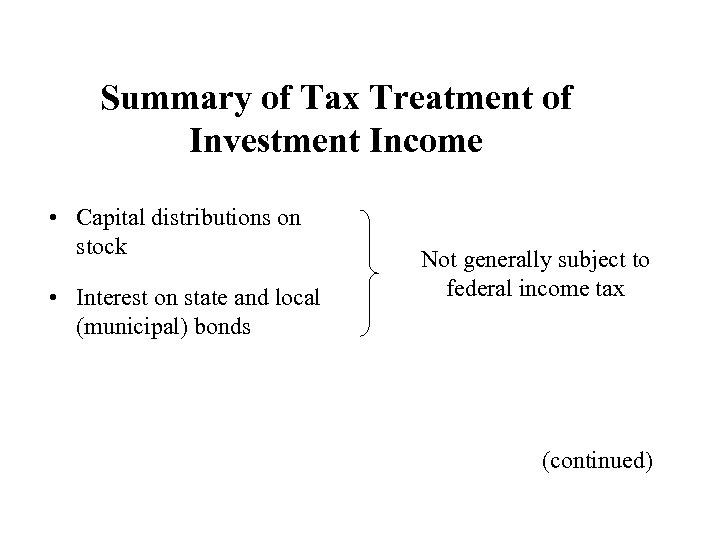 Summary of Tax Treatment of Investment Income • Capital distributions on stock • Interest on state and local (municipal) bonds Not generally subject to federal income tax (continued)
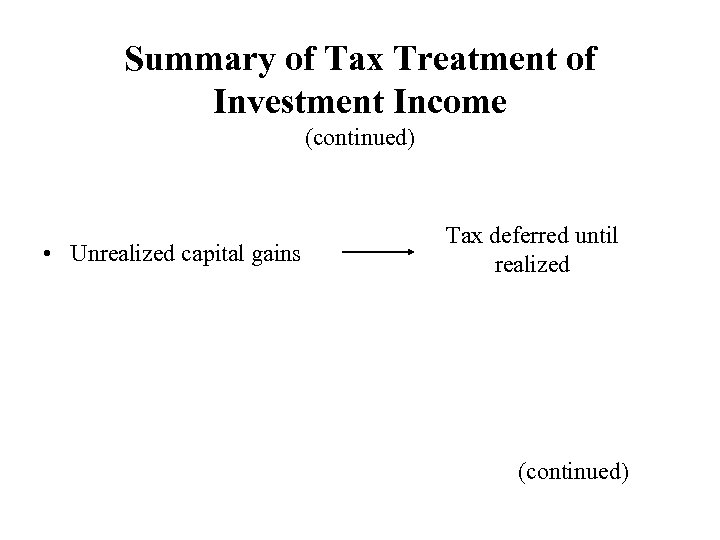 Summary of Tax Treatment of Investment Income (continued) • Unrealized capital gains Tax deferred until realized (continued)
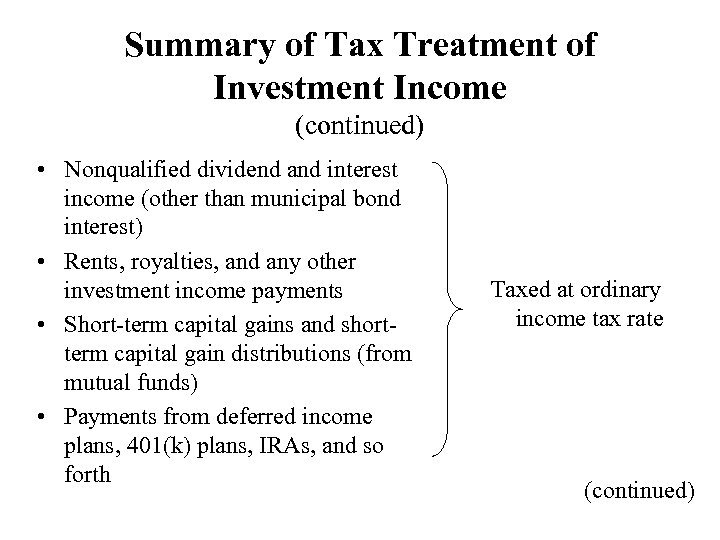 Summary of Tax Treatment of Investment Income (continued) • Nonqualified dividend and interest income (other than municipal bond interest) • Rents, royalties, and any other investment income payments • Short-term capital gains and shortterm capital gain distributions (from mutual funds) • Payments from deferred income plans, 401(k) plans, IRAs, and so forth Taxed at ordinary income tax rate (continued)
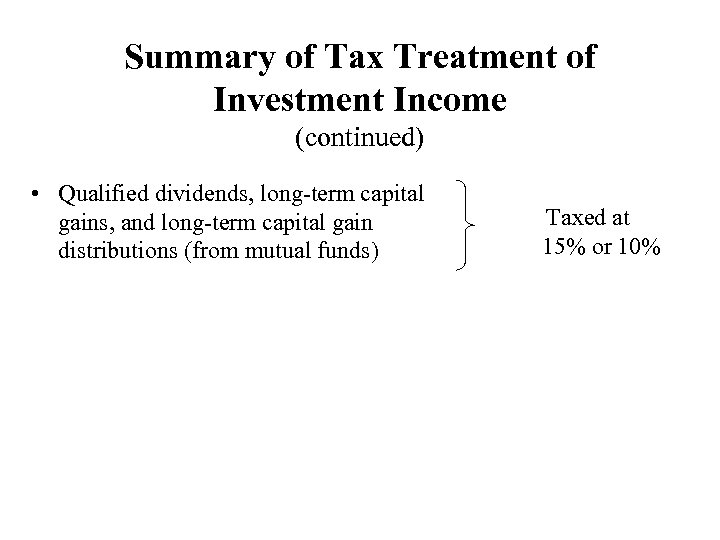 Summary of Tax Treatment of Investment Income (continued) • Qualified dividends, long-term capital gains, and long-term capital gain distributions (from mutual funds) Taxed at 15% or 10%