


 Скачать презентацию Chapter 13 Personal Financial Management Copyright 2015
9abee08c6785894e9f0a7626e91627fc.ppt
- Количество слайдов: 36
 Chapter 13 Personal Financial Management Copyright © 2015, 2011, and 2007 Pearson Education, Inc.
 Chapter 13: Personal Financial Management 13. 1 13. 2 13. 3 13. 4 The Time Value of Money Consumer Credit Truth in Lending The Costs and Advantages of Home Ownership 13. 5 Financial Investments Copyright © 2016, 2012, and 2008 Pearson Education, Inc. 2
 Section 13 -5 Financial Investments Copyright © 2016, 2012, and 2008 Pearson Education, Inc. 3
 Financial Investments • • • Become familiar with stocks. Become familiar with bonds. Become familiar with mutual funds. Evaluate investment returns. Explore strategies for building a nest egg. Copyright © 2016, 2012, and 2008 Pearson Education, Inc. 4
 Stocks Buying stock in a corporation makes you a part owner of the corporation. You then share in any profits the company makes, and your share of the profits is called a dividend. The profit you make by selling for more than you paid is called a capital gain. A negative gain, or capital loss, results if you sell for less than you paid. Copyright © 2016, 2012, and 2008 Pearson Education, Inc. 5
 Stocks By return on investment, we mean the net difference between what you receive (including any dividends) and what you paid (purchase price plus any other expenses of buying and selling the stock). The price of a share of stock is determined by the law of supply and demand at institutions called stock exchanges. Copyright © 2016, 2012, and 2008 Pearson Education, Inc. 6
 Example: Return on Stock You buy 100 shares of stock in Company X on February 2, 2016, paying $28. 50 per share. On February 2, 2017, you receive a dividend of $0. 60 per share and the stock price had risen to $29. 75 per share. Find the following. a) Your total cost for the stock b) The total dividend amount c) The capital gain if you sold the stock d) The total return and percentage return for one year of ownership of this stock Copyright © 2016, 2012, and 2008 Pearson Education, Inc. 7
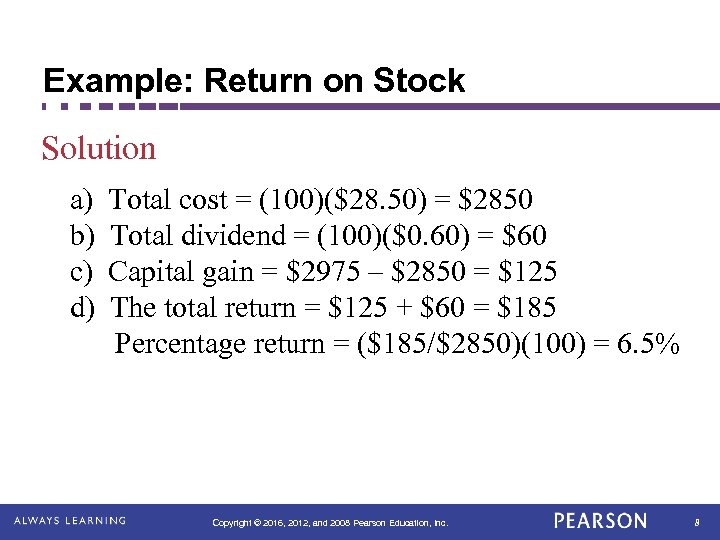 Example: Return on Stock Solution a) b) c) d) Total cost = (100)($28. 50) = $2850 Total dividend = (100)($0. 60) = $60 Capital gain = $2975 – $2850 = $125 The total return = $125 + $60 = $185 Percentage return = ($185/$2850)(100) = 6. 5% Copyright © 2016, 2012, and 2008 Pearson Education, Inc. 8
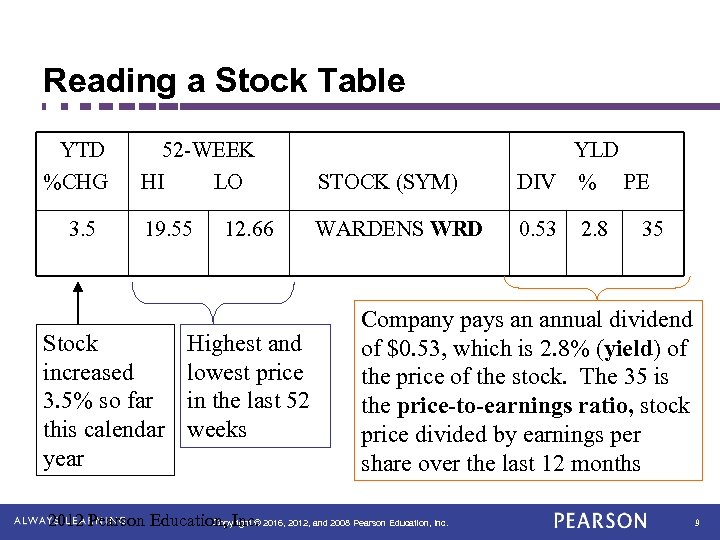 Reading a Stock Table YTD %CHG 3. 5 52 -WEEK HI LO STOCK (SYM) YLD DIV % PE 19. 55 WARDENS WRD 0. 53 Stock increased 3. 5% so far this calendar year 12. 66 Highest and lowest price in the last 52 weeks 2. 8 35 Company pays an annual dividend of $0. 53, which is 2. 8% (yield) of the price of the stock. The 35 is the price-to-earnings ratio, stock price divided by earnings per share over the last 12 months 2012 Pearson Education, Inc. Copyright © 2016, 2012, and 2008 Pearson Education, Inc. 9
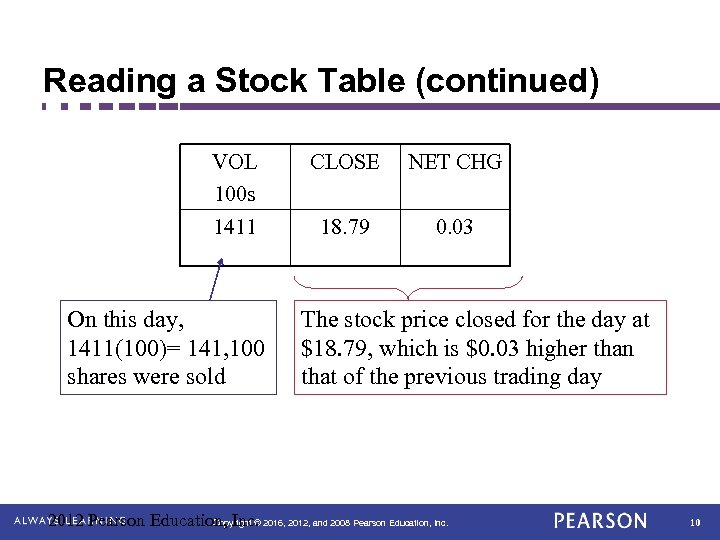 Reading a Stock Table (continued) VOL 100 s CLOSE NET CHG 1411 18. 79 0. 03 On this day, 1411(100)= 141, 100 shares were sold The stock price closed for the day at $18. 79, which is $0. 03 higher than that of the previous trading day 2012 Pearson Education, Inc. Copyright © 2016, 2012, and 2008 Pearson Education, Inc. 10
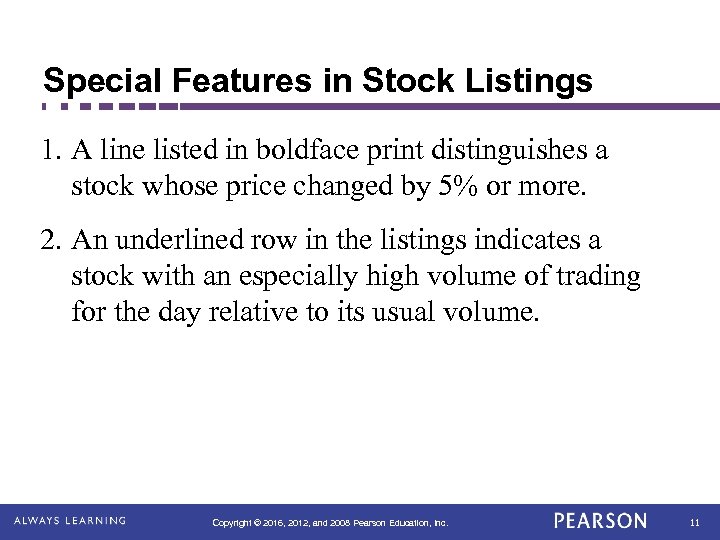 Special Features in Stock Listings 1. A line listed in boldface print distinguishes a stock whose price changed by 5% or more. 2. An underlined row in the listings indicates a stock with an especially high volume of trading for the day relative to its usual volume. Copyright © 2016, 2012, and 2008 Pearson Education, Inc. 11
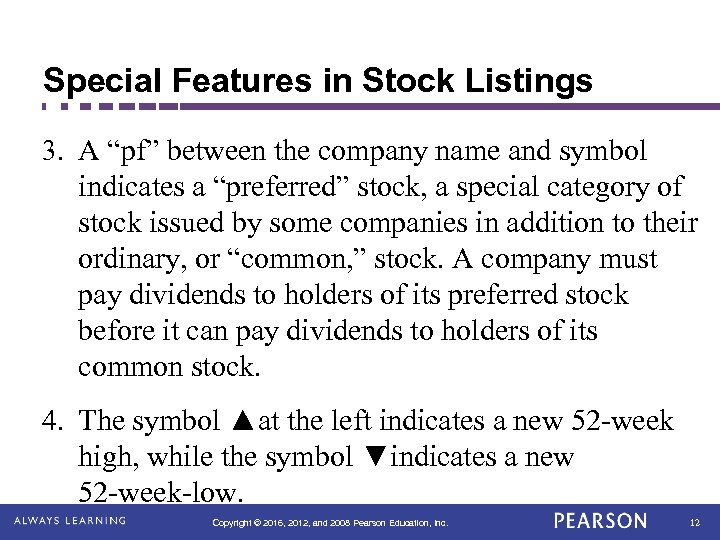 Special Features in Stock Listings 3. A “pf” between the company name and symbol indicates a “preferred” stock, a special category of stock issued by some companies in addition to their ordinary, or “common, ” stock. A company must pay dividends to holders of its preferred stock before it can pay dividends to holders of its common stock. 4. The symbol ▲at the left indicates a new 52 -week high, while the symbol ▼indicates a new 52 -week-low. Copyright © 2016, 2012, and 2008 Pearson Education, Inc. 12
 Brokers To buy or sell a stock, generally it is necessary to use a broker. A broker has representatives at the stock exchange who will execute a buy or sell order. The broker will charge a commission (broker’s fee). Full-service brokers, who offer research, professional opinions, and various other services, tend to charge the highest commissions. Discount brokers buy and sell stock for clients and offer little in the way of additional services. Copyright © 2016, 2012, and 2008 Pearson Education, Inc. 13
 Commissions will normally be some percentage of the value of a purchase or sale (called the principal). Rates may depend on whether the order is for a round lot of shares (a multiple of 100) or an odd lot. On the odd-lot portion, you may be charged an odd-lot differential. Also, it is possible to place a limit order, where the broker is instructed to buy or sell if the stock reaches a predesignated price. An example of a commission structure is shown on the next two slides. Copyright © 2016, 2012, and 2008 Pearson Education, Inc. 14
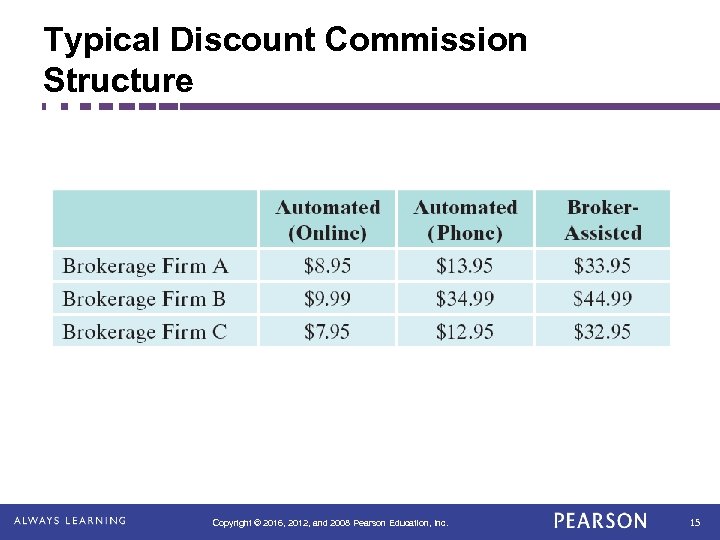 Typical Discount Commission Structure Copyright © 2016, 2012, and 2008 Pearson Education, Inc. 15
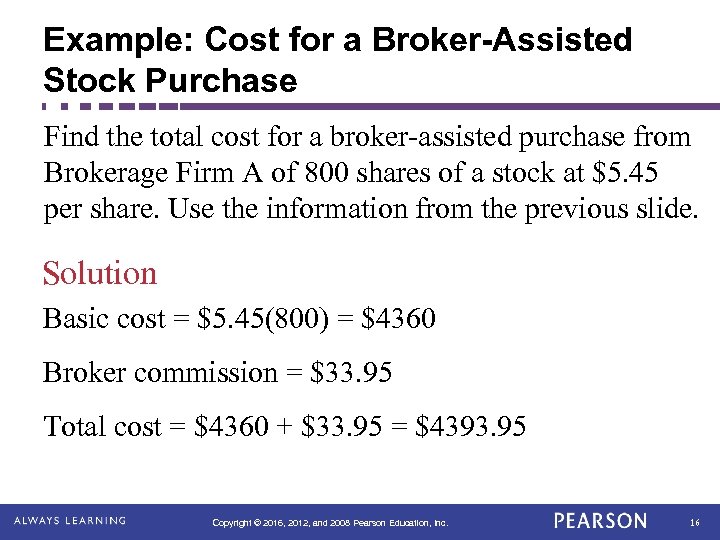 Example: Cost for a Broker-Assisted Stock Purchase Find the total cost for a broker-assisted purchase from Brokerage Firm A of 800 shares of a stock at $5. 45 per share. Use the information from the previous slide. Solution Basic cost = $5. 45(800) = $4360 Broker commission = $33. 95 Total cost = $4360 + $33. 95 = $4393. 95 Copyright © 2016, 2012, and 2008 Pearson Education, Inc. 16
 Bonds You may lend money to a company, receiving an agreed-upon rate of interest for the use of your money. In this case you would buy a bond from the company. The bond (loan) is issued with a stated term (life span), after which the bond “matures” and the principal (or face value) is paid back to you. Copyright © 2016, 2012, and 2008 Pearson Education, Inc. 17
 Example: Return on a Bond $5000 in invested in a 10 -year corporate bond paying 7. 5% annual interest, paid semiannually. Find the total return on the investment if it is held to maturity. Solution We use the simple interest formula: I = Prt = $5000(0. 075)(10) = $3750. Copyright © 2016, 2012, and 2008 Pearson Education, Inc. 18
 Mutual Funds A mutual fund is a pool of money collected by an investment company from individuals and/or institutions and invested in many stocks, bonds, or money market instruments. Copyright © 2016, 2012, and 2008 Pearson Education, Inc. 19
 Mutual Funds Versus Stocks and Bonds – Advantages of Mutual Funds 1. Simplicity Someone else does the work. 2. Diversification You own interests in many different stocks, which decreases vulnerability to large losses in one particular stock. 3. Access to New Issues The large assets of fund managers give them more clout to get initial public offerings (IPOs), which can be profitable. Copyright © 2016, 2012, and 2008 Pearson Education, Inc. 20
 Mutual Funds Versus Stocks and Bonds – Advantages of Mutual Funds 4. Economies of Sale Expenses are shared by large numbers of investors. 5. Professional Management 6. Indexing An index fund can mimic a popular index (like the S&P 500). This way individual investors can achieve returns close to those of the index. Copyright © 2016, 2012, and 2008 Pearson Education, Inc. 21
 Mutual Funds Versus Stocks and Bonds – Disadvantages of Mutual Funds 1. Impact of One-Time Charges and Recurring Fees Sales charges, management fees, “ 12 b-1” fees, and fund expenses can mount. 2. Hidden Cost of Brokerage Recurring fees and expenses are added to give the expense ratio of a fund. But commissions paid by the fund for stock purchases and sales are in addition to the expense ratio. Copyright © 2016, 2012, and 2008 Pearson Education, Inc. 22
 Mutual Funds Versus Stocks and Bonds – Disadvantages of Mutual Funds 3. Hidden Risks of Fund Ownership Getting out of a fund in a market crash may mean accepting securities rather than cash. Managers may stray from stated strategies of the fund. Since tax liability is passed on to fund investors, and depends on purchases and sales made by fund managers, investors may be unable to avoid inheriting unwanted tax basis. Source: Forbes Guide to the Markets, John Wiley & Sons, Inc. Copyright © 2016, 2012, and 2008 Pearson Education, Inc. 23
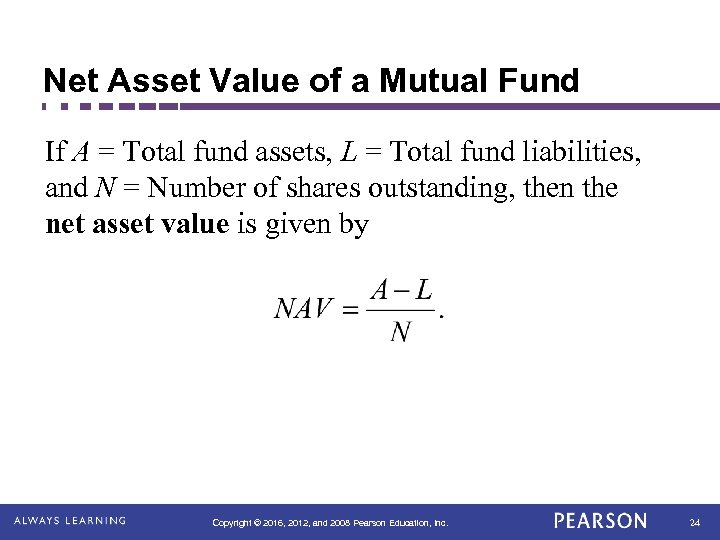 Net Asset Value of a Mutual Fund If A = Total fund assets, L = Total fund liabilities, and N = Number of shares outstanding, then the net asset value is given by Copyright © 2016, 2012, and 2008 Pearson Education, Inc. 24
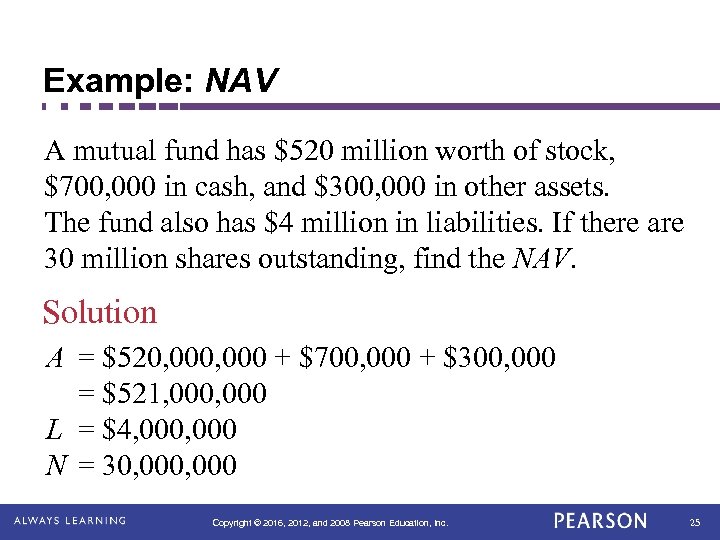 Example: NAV A mutual fund has $520 million worth of stock, $700, 000 in cash, and $300, 000 in other assets. The fund also has $4 million in liabilities. If there are 30 million shares outstanding, find the NAV. Solution A = $520, 000 + $700, 000 + $300, 000 = $521, 000 L = $4, 000 N = 30, 000 Copyright © 2016, 2012, and 2008 Pearson Education, Inc. 25
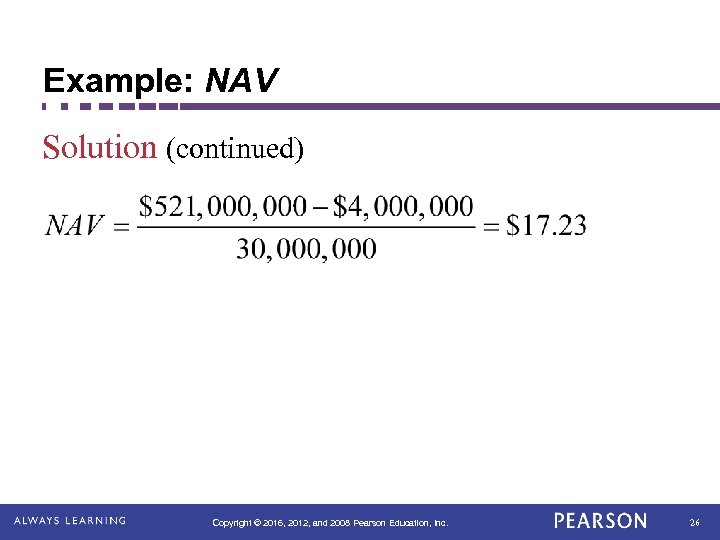 Example: NAV Solution (continued) Copyright © 2016, 2012, and 2008 Pearson Education, Inc. 26
 Evaluating Investment Returns It is important to be able to accurately evaluate and compare returns (profits or losses). Even though past performance is never a guarantee of future returns, it is crucial information. A wealth of information on stock and bond markets and mutual funds is available though publications and internet resources. The most important measure of an investment is the annual rate of return. It is not the same as percentage return because it depends on the time period involved. Copyright © 2016, 2012, and 2008 Pearson Education, Inc. 27
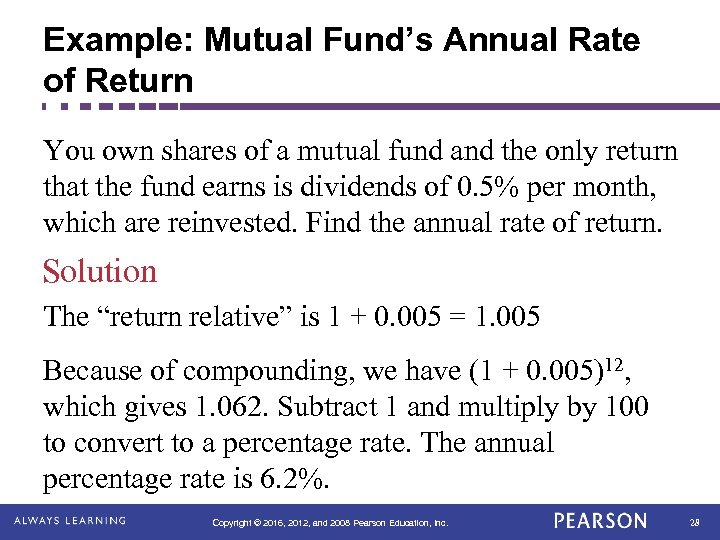 Example: Mutual Fund’s Annual Rate of Return You own shares of a mutual fund and the only return that the fund earns is dividends of 0. 5% per month, which are reinvested. Find the annual rate of return. Solution The “return relative” is 1 + 0. 005 = 1. 005 Because of compounding, we have (1 + 0. 005)12, which gives 1. 062. Subtract 1 and multiply by 100 to convert to a percentage rate. The annual percentage rate is 6. 2%. Copyright © 2016, 2012, and 2008 Pearson Education, Inc. 28
 Building a Nest Egg The most important function of investing, for most people, is to build an account for some future use, probably for retirement living. The remainder of the slides goes over a few topics associated with retirement accounts. Copyright © 2016, 2012, and 2008 Pearson Education, Inc. 29
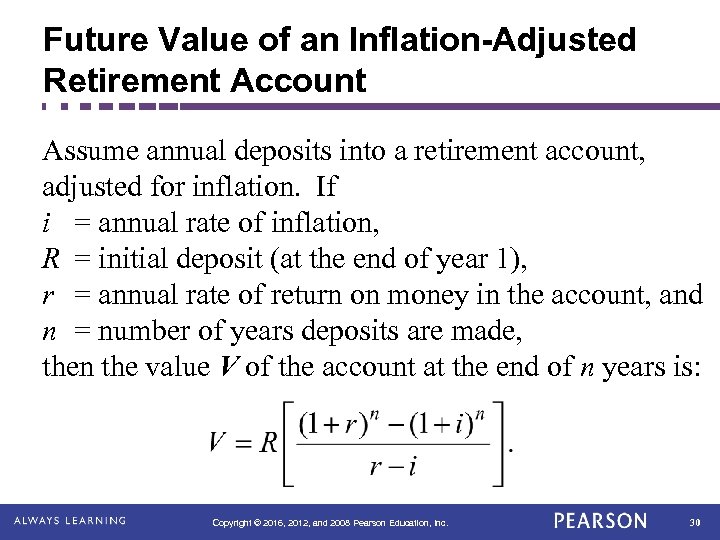 Future Value of an Inflation-Adjusted Retirement Account Assume annual deposits into a retirement account, adjusted for inflation. If i = annual rate of inflation, R = initial deposit (at the end of year 1), r = annual rate of return on money in the account, and n = number of years deposits are made, then the value V of the account at the end of n years is: Copyright © 2016, 2012, and 2008 Pearson Education, Inc. 30
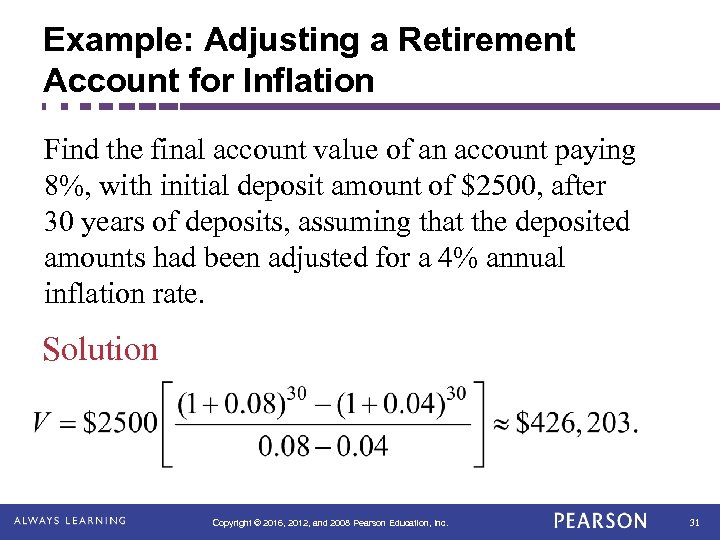 Example: Adjusting a Retirement Account for Inflation Find the final account value of an account paying 8%, with initial deposit amount of $2500, after 30 years of deposits, assuming that the deposited amounts had been adjusted for a 4% annual inflation rate. Solution Copyright © 2016, 2012, and 2008 Pearson Education, Inc. 31
 Tax-Deferred Versus Taxable Retirement Accounts In both cases, R = amount withheld annually from salary, r = annual rate of return on money in the account, t = marginal tax rate of account holder, n = number of years contributions are made, V = final value of the account, following all accumulations and payment of all taxes. Copyright © 2016, 2012, and 2008 Pearson Education, Inc. 32
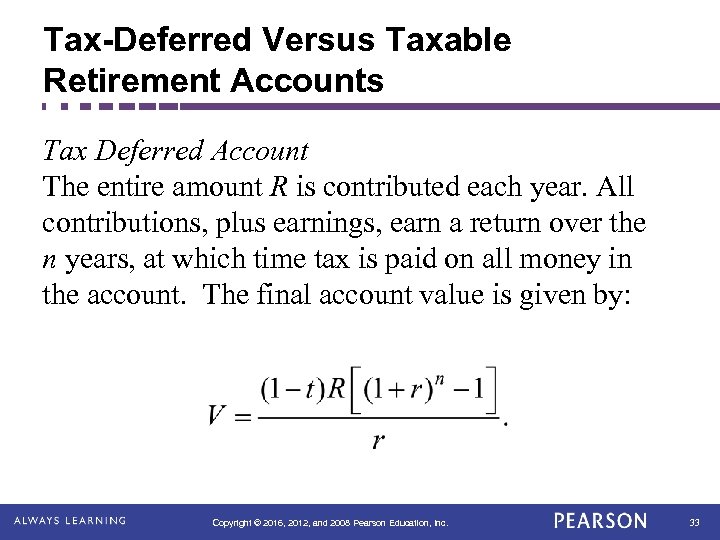 Tax-Deferred Versus Taxable Retirement Accounts Tax Deferred Account The entire amount R is contributed each year. All contributions, plus earnings, earn a return over the n years, at which time tax is paid on all money in the account. The final account value is given by: Copyright © 2016, 2012, and 2008 Pearson Education, Inc. 33
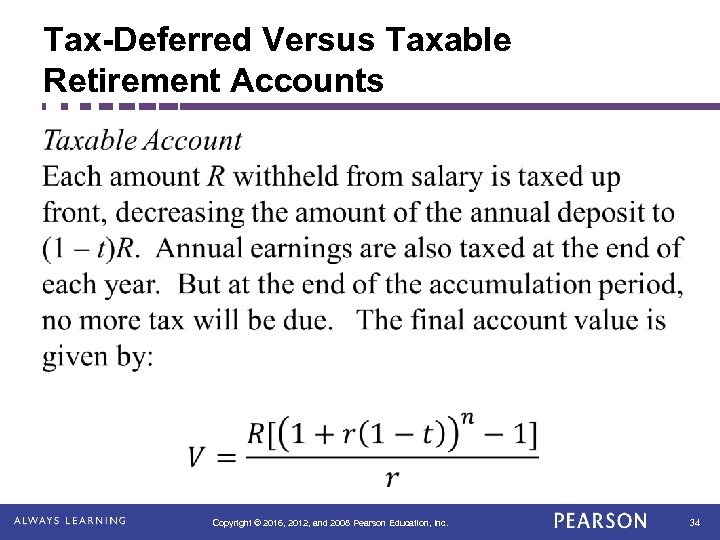 Tax-Deferred Versus Taxable Retirement Accounts Copyright © 2016, 2012, and 2008 Pearson Education, Inc. 34
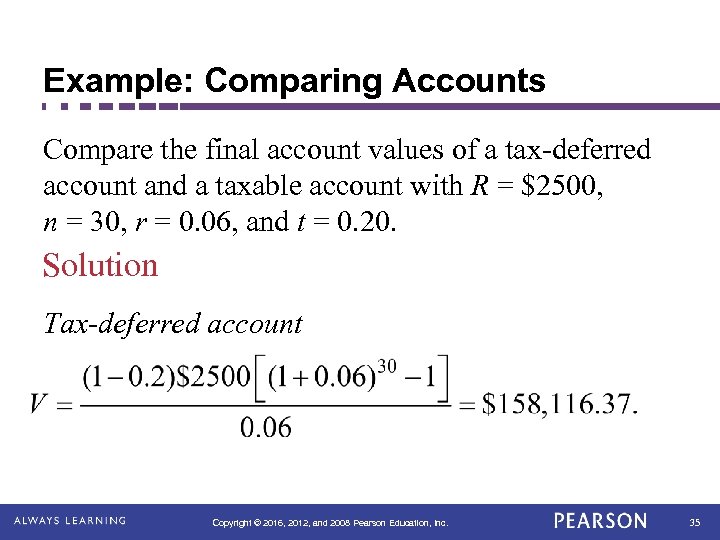 Example: Comparing Accounts Compare the final account values of a tax-deferred account and a taxable account with R = $2500, n = 30, r = 0. 06, and t = 0. 20. Solution Tax-deferred account Copyright © 2016, 2012, and 2008 Pearson Education, Inc. 35
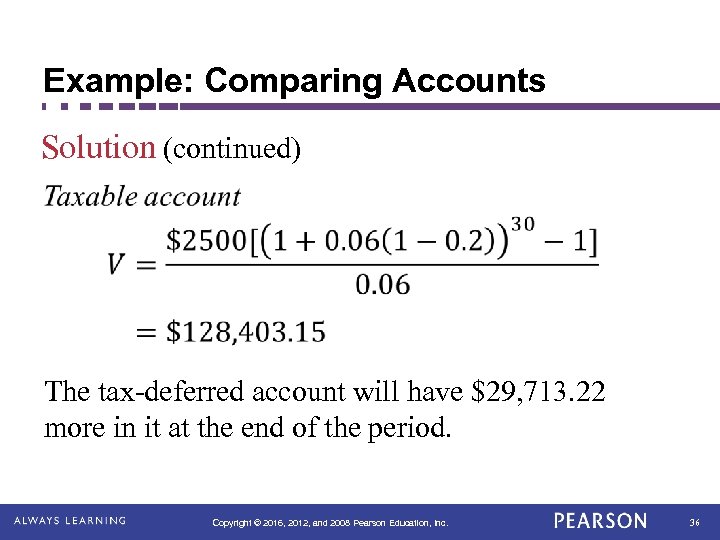 Example: Comparing Accounts Solution (continued) The tax-deferred account will have $29, 713. 22 more in it at the end of the period. Copyright © 2016, 2012, and 2008 Pearson Education, Inc. 36