


 Скачать презентацию Chapter 13 Inventory Management Mc Graw-Hill Irwin Copyright
8173a1ac36607d9b0ee2169bdc9b8457.ppt
- Количество слайдов: 31
 Chapter 13 Inventory Management Mc. Graw-Hill/Irwin Copyright © 2012 by The Mc. Graw-Hill Companies, Inc. All rights reserved.
 Chapter 13: Learning Objectives You should be able to: 1. Define the term inventory, list the major reasons for holding inventories, and list the main requirements for effective inventory management 2. Discuss the nature and importance of service inventories 3. Explain periodic and perpetual review systems 4. Explain the objectives of inventory management 5. Describe the A-B-C approach and explain how it is useful 6. Describe the basic EOQ model and its assumptions and solve typical problems 7. Describe the economic production quantity model and solve typical problems 8. Describe the quantity discount model and solve typical problems 9. Describe reorder point models and solve typical problems Instructor Slides 13 -2
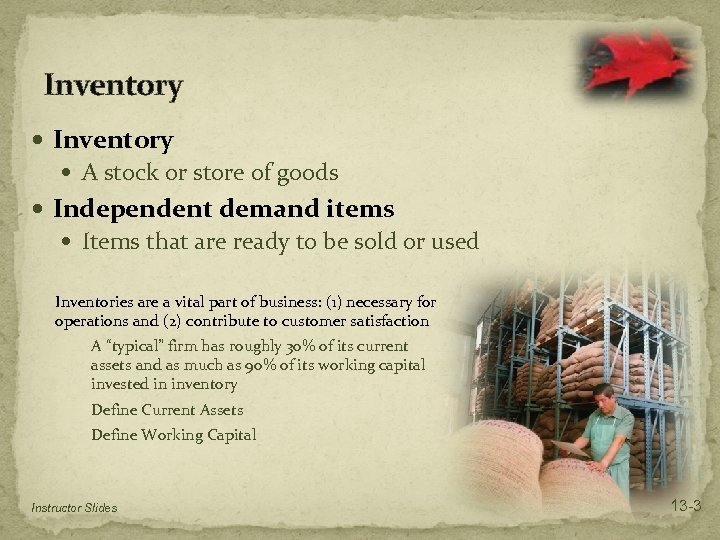 Inventory A stock or store of goods Independent demand items Items that are ready to be sold or used Inventories are a vital part of business: (1) necessary for operations and (2) contribute to customer satisfaction A “typical” firm has roughly 30% of its current assets and as much as 90% of its working capital invested in inventory Define Current Assets Define Working Capital Instructor Slides 13 -3
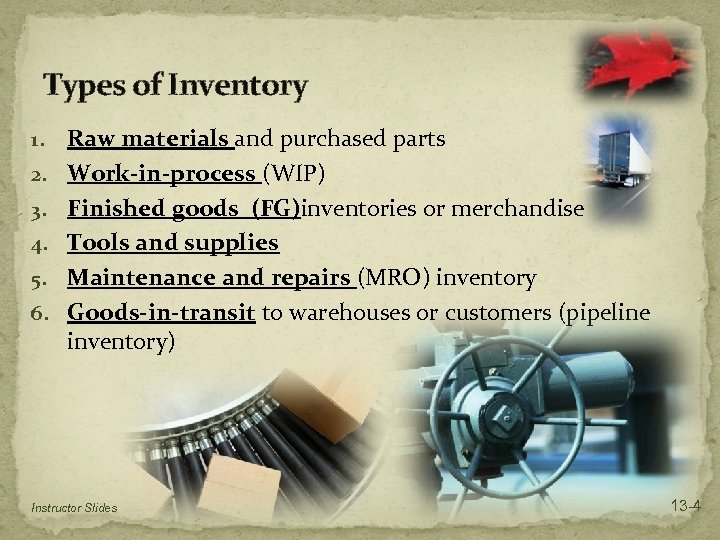 Types of Inventory 1. 2. 3. 4. 5. 6. Raw materials and purchased parts Work-in-process (WIP) Finished goods (FG)inventories or merchandise Tools and supplies Maintenance and repairs (MRO) inventory Goods-in-transit to warehouses or customers (pipeline inventory) Instructor Slides 13 -4
 Inventory Functions Inventories serve a number of functions such as: 1. To meet anticipated customer demand 2. To smooth production requirements – what demand patterns would need smoothing? 3. To decouple operations – Bottlenecks? 4. To protect against stockouts – safety stock 5. To take advantage of order cycles 6. To hedge against price increases 7. To permit operations - WIP 8. To take advantage of quantity discounts – Sam’s Club idea 12 -5
 Objectives of Inventory Control Inventory management has two main concerns: 1. Level of customer service Having the right goods available in the right quantity in the right place at the right time 2. Costs of ordering and carrying inventories The overall objective of inventory management is to achieve satisfactory levels of customer service while keeping inventory costs within reasonable bounds 1. Measures of performance 2. Customer satisfaction Number and quantity of backorders Customer complaints 3. Inventory turnover Instructor Slides 13 -6
 Inventory Management has two basic functions concerning inventory: Establish a system for tracking items in inventory 2. Make decisions about 1. When to order How much to order Instructor Slides 13 -7
 Effective Inventory Management Requires: 1. A system keep track of inventory 2. A reliable forecast of demand 3. Knowledge of lead time and lead time variability 4. Reasonable estimates of holding costs ordering costs shortage costs 5. A classification system for inventory items Instructor Slides 13 -8
 Inventory Counting Systems Periodic System Physical count of items in inventory made at periodic intervals Perpetual Inventory System that keeps track of removals from inventory continuously, thus monitoring current levels of each item An order is placed when inventory drops to a predetermined minimum level Two-bin system Two containers of inventory; reorder when the first is empty Instructor Slides 13 -9
 Inventory Counting Technologies Universal product code (UPC) Bar code printed on a label that has information about the item to which it is attached Radio frequency identification (RFID) tags A technology that uses radio waves to identify objects, such as goods in supply chains 12 -10
 Demand Forecasts and Lead Time Forecasts Inventories are necessary to satisfy customer demands, so it is important to have a reliable estimates of the amount and timing of demand Point-of-sale (POS) systems A system that electronically records actual sales Such demand information is very useful for enhancing forecasting and inventory management Lead time Time interval between ordering and receiving the order Instructor Slides 13 -11
 Inventory Costs Purchase cost The amount paid to buy the inventory Holding (carrying) costs Cost to carry an item in inventory for a length of time, usually a year Ordering costs Costs of ordering and receiving inventory Setup costs The costs involved in preparing equipment for a job Analogous to ordering costs Shortage costs Costs resulting when demand exceeds the supply of inventory; often unrealized profit per unit Instructor Slides 13 -12
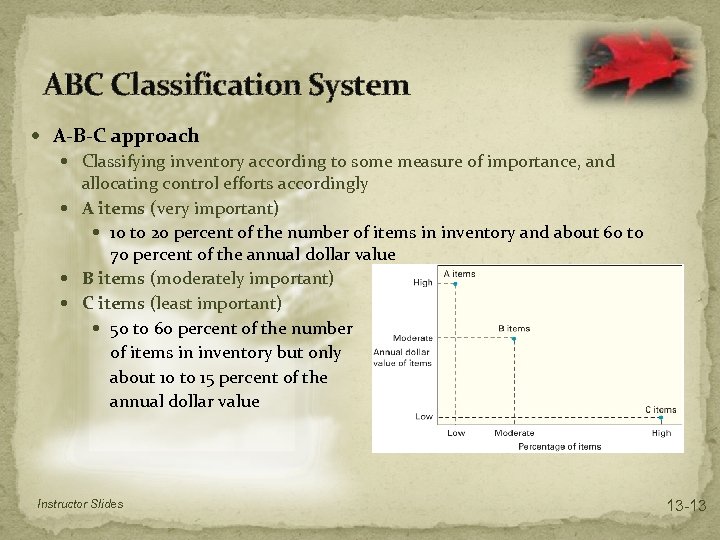 ABC Classification System A-B-C approach Classifying inventory according to some measure of importance, and allocating control efforts accordingly A items (very important) 10 to 20 percent of the number of items in inventory and about 60 to 70 percent of the annual dollar value B items (moderately important) C items (least important) 50 to 60 percent of the number of items in inventory but only about 10 to 15 percent of the annual dollar value Instructor Slides 13 -13
 How Much to Order: EOQ Models Economic order quantity models identify the optimal order quantity by minimizing the sum of annual costs that vary with order size and frequency 1. 2. 3. The basic economic order quantity model The economic production quantity model The quantity discount model Instructor Slides 13 -14
 Basic EOQ Model The basic EOQ model is used to find a fixed order quantity that will minimize total annual inventory costs Assumptions: 1. 2. 3. 4. 5. 6. Only one product is involved Annual demand requirements are known Demand is even throughout the year Lead time does not vary Each order is received in a single delivery There are no quantity discounts Instructor Slides 13 -15
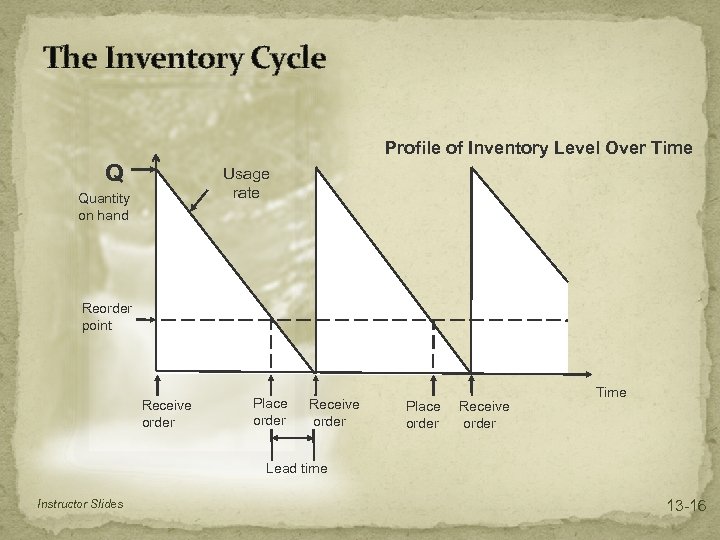 The Inventory Cycle Profile of Inventory Level Over Time Q Usage rate Quantity on hand Reorder point Receive order Place order Receive order Time Lead time Instructor Slides 13 -16
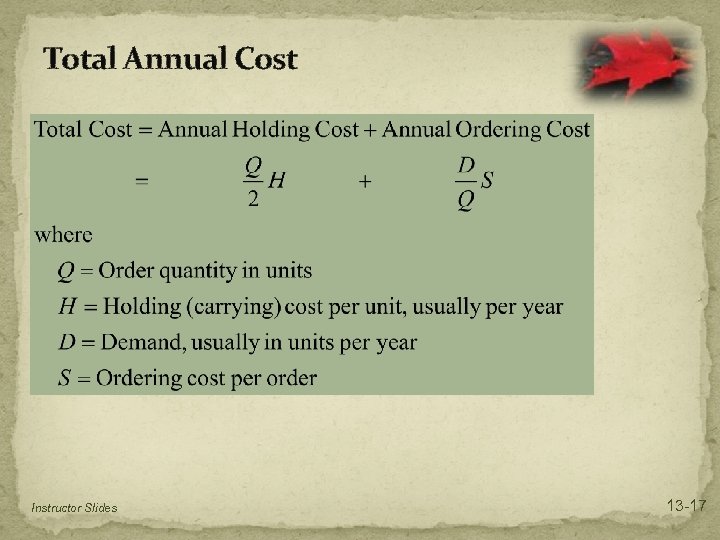 Total Annual Cost Instructor Slides 13 -17
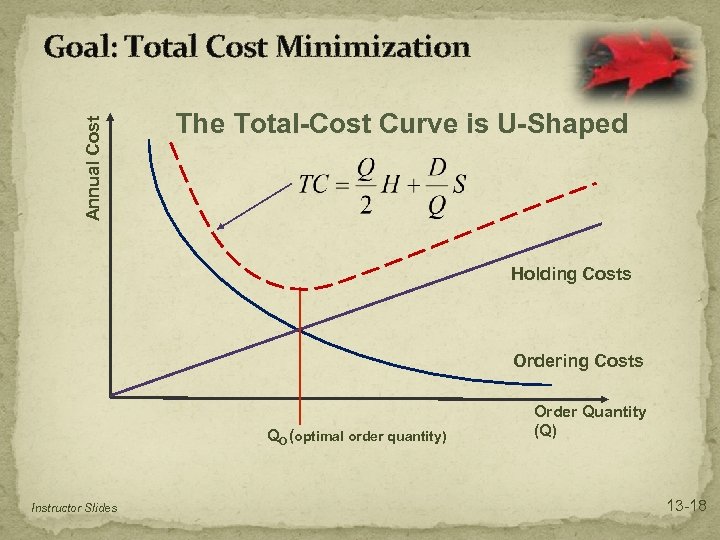 Annual Cost Goal: Total Cost Minimization The Total-Cost Curve is U-Shaped Holding Costs Ordering Costs QO (optimal order quantity) Instructor Slides Order Quantity (Q) 13 -18
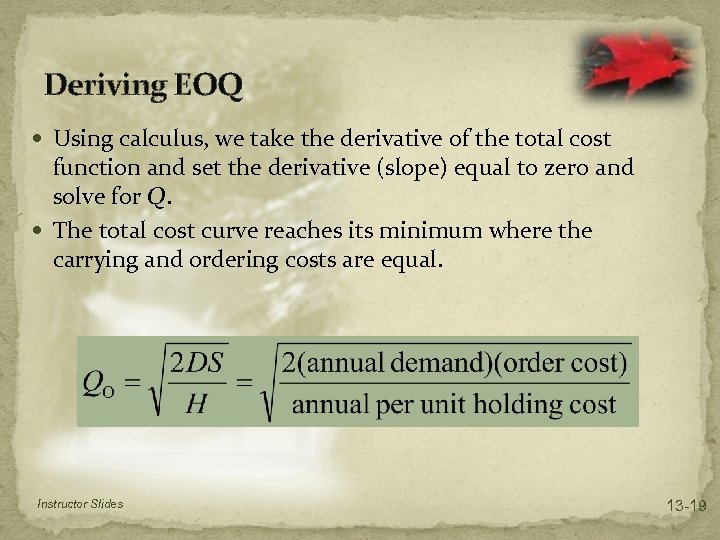 Deriving EOQ Using calculus, we take the derivative of the total cost function and set the derivative (slope) equal to zero and solve for Q. The total cost curve reaches its minimum where the carrying and ordering costs are equal. Instructor Slides 13 -19
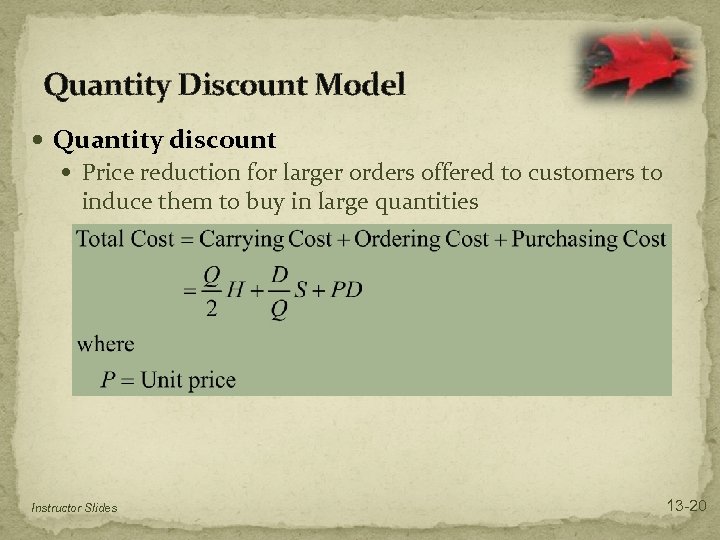 Quantity Discount Model Quantity discount Price reduction for larger orders offered to customers to induce them to buy in large quantities Instructor Slides 13 -20
 When to Reorder point When the quantity on hand of an item drops to this amount, the item is reordered. Determinants of the reorder point 1. The rate of demand 2. The lead time 3. The extent of demand and/or lead time variability 4. The degree of stockout risk acceptable to management Instructor Slides 13 -21
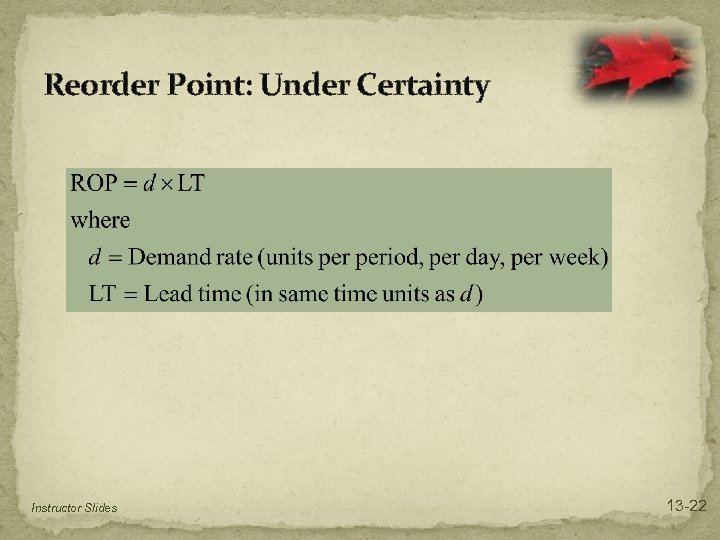 Reorder Point: Under Certainty Instructor Slides 13 -22
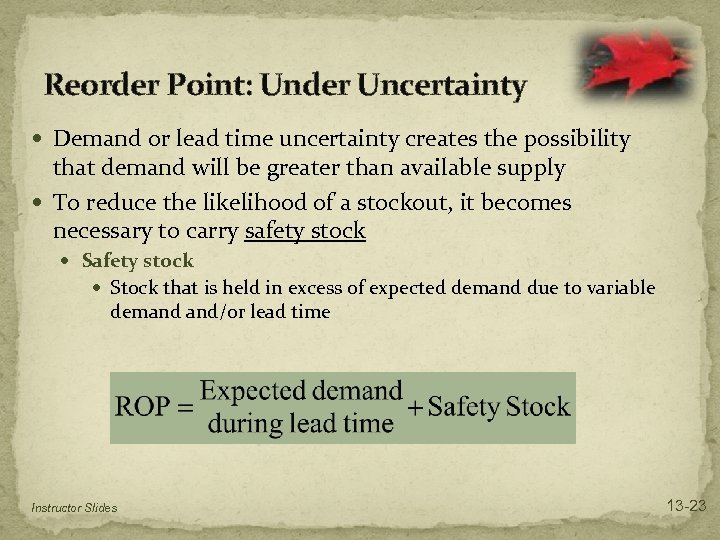 Reorder Point: Under Uncertainty Demand or lead time uncertainty creates the possibility that demand will be greater than available supply To reduce the likelihood of a stockout, it becomes necessary to carry safety stock Stock that is held in excess of expected demand due to variable demand and/or lead time Instructor Slides 13 -23
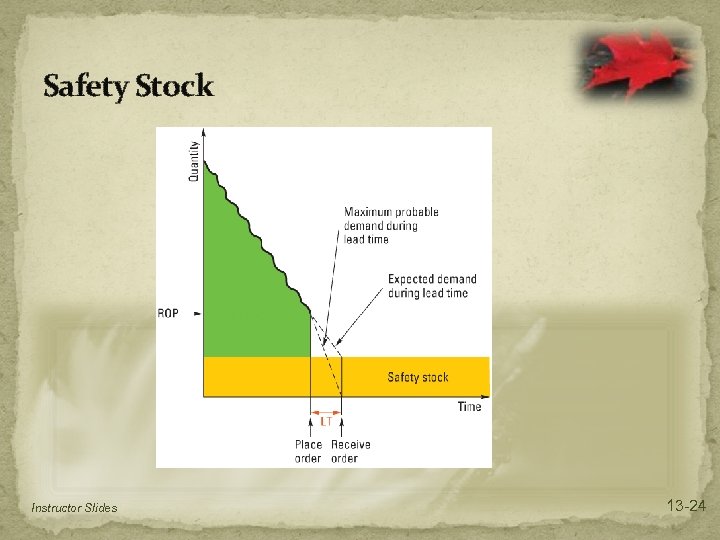 Safety Stock Instructor Slides 13 -24
 Safety Stock? As the amount of safety stock carried increases, the risk of stockout decreases. This improves customer service level Service level The probability that demand will not exceed supply during lead time Service level = 100% - Stockout risk Instructor Slides 13 -25
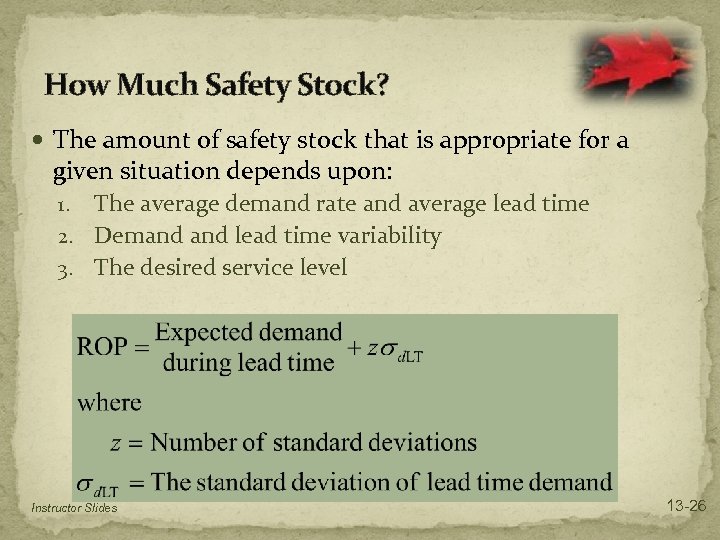 How Much Safety Stock? The amount of safety stock that is appropriate for a given situation depends upon: The average demand rate and average lead time 2. Demand lead time variability 3. The desired service level 1. Instructor Slides 13 -26
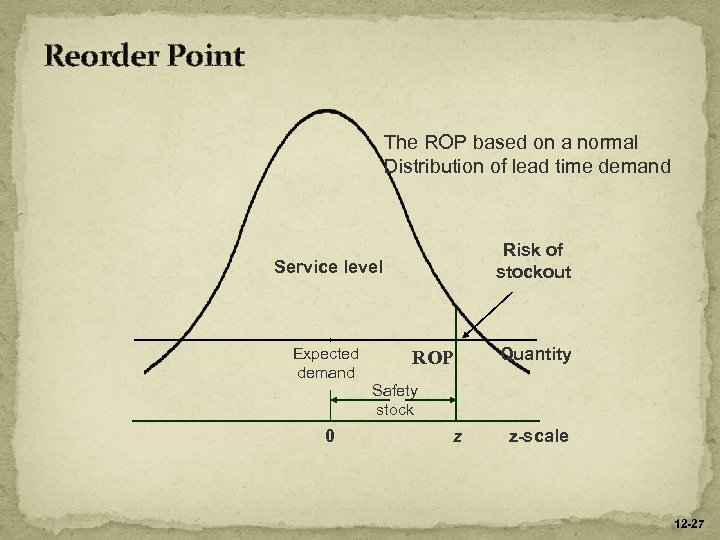 Reorder Point The ROP based on a normal Distribution of lead time demand Risk of stockout Service level Expected demand 0 ROP Quantity Safety stock z z-scale 12 -27
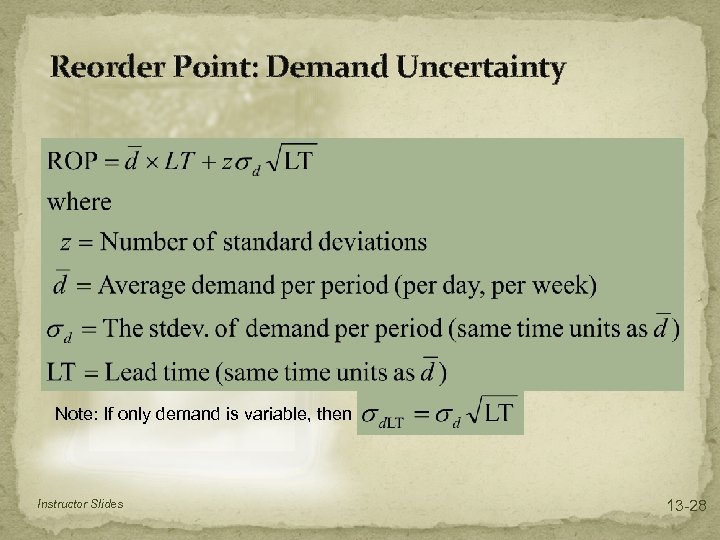 Reorder Point: Demand Uncertainty Note: If only demand is variable, then Instructor Slides 13 -28
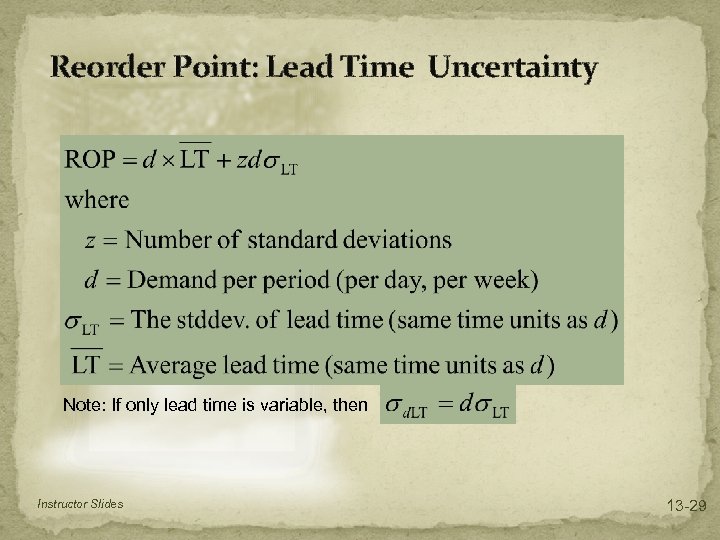 Reorder Point: Lead Time Uncertainty Note: If only lead time is variable, then Instructor Slides 13 -29
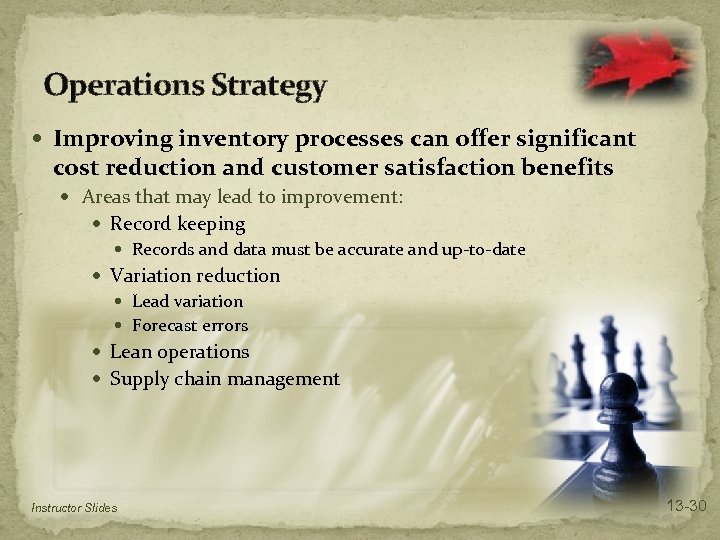 Operations Strategy Improving inventory processes can offer significant cost reduction and customer satisfaction benefits Areas that may lead to improvement: Record keeping Records and data must be accurate and up-to-date Variation reduction Lead variation Forecast errors Lean operations Supply chain management Instructor Slides 13 -30
 Homework for Chapter 13 Problem 1, page 602/362 EOQ ( basic or common) embedded in notes EOQ with quantity discounts, embedded in notes. ROP with stockout risks, embedded in notes.