


 Скачать презентацию Chapter 13 ACCOUNTING FOR CORPORATIONS Power Point Authors
a2f8d57aeb4e7551d37352097093d8d6.ppt
- Количество слайдов: 43
 Chapter 13 ACCOUNTING FOR CORPORATIONS Power. Point Authors: Susan Coomer Galbreath, Ph. D. , CPA Charles W. Caldwell, D. B. A. , CMA Jon A. Booker, Ph. D. , CPA, CIA Cynthia J. Rooney, Ph. D. , CPA Mc. Graw-Hill/Irwin Copyright © 2011 by The Mc. Graw-Hill Companies, Inc. All rights reserved.
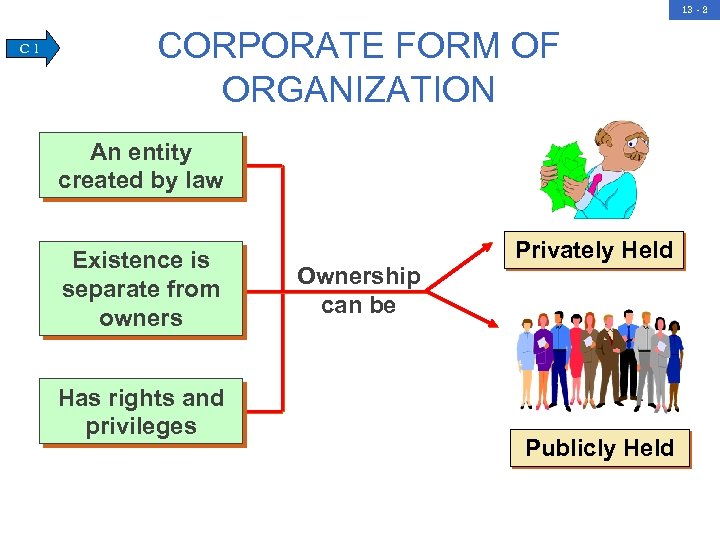 13 - 2 C 1 CORPORATE FORM OF ORGANIZATION An entity created by law Existence is separate from owners Has rights and privileges Ownership can be Privately Held Publicly Held
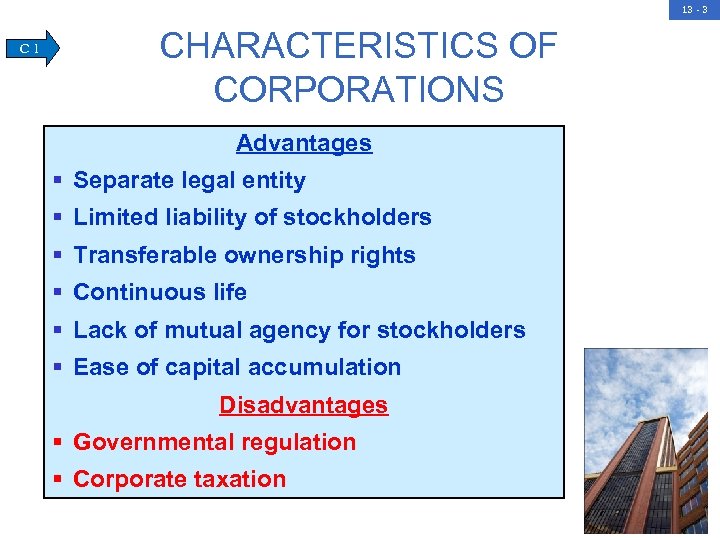 13 - 3 C 1 CHARACTERISTICS OF CORPORATIONS Advantages § Separate legal entity § Limited liability of stockholders § Transferable ownership rights § Continuous life § Lack of mutual agency for stockholders § Ease of capital accumulation Disadvantages § Governmental regulation § Corporate taxation
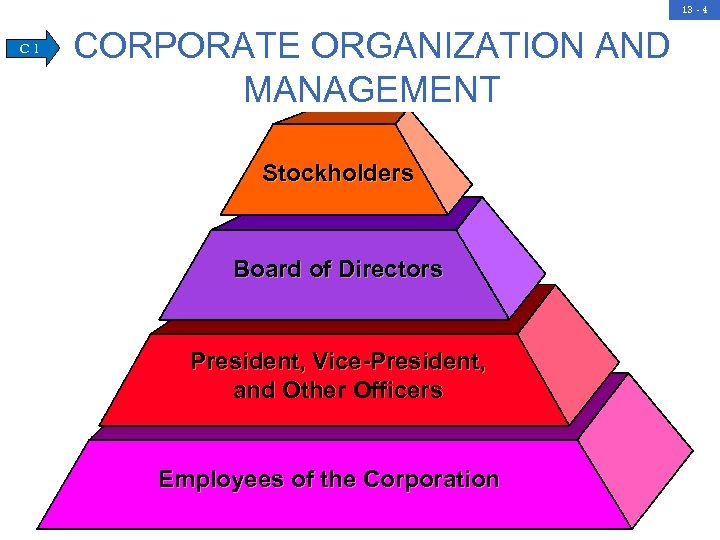 13 - 4 C 1 CORPORATE ORGANIZATION AND MANAGEMENT Stockholders Board of Directors President, Vice-President, and Other Officers Employees of the Corporation
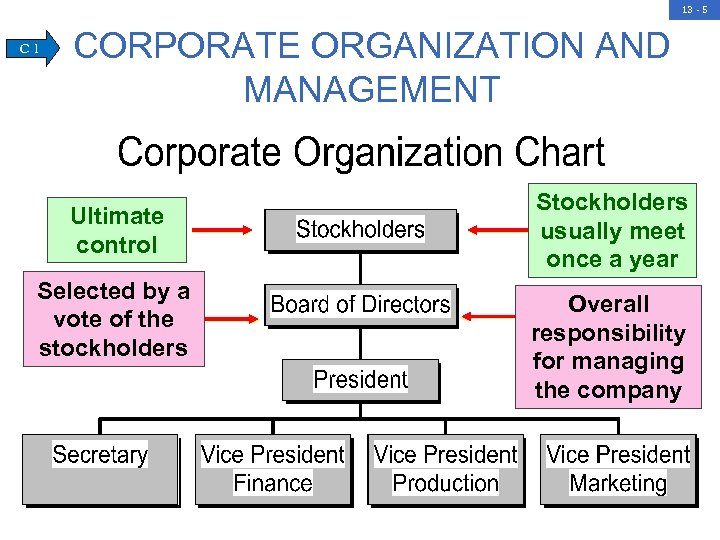 13 - 5 C 1 CORPORATE ORGANIZATION AND MANAGEMENT Ultimate control Selected by a vote of the stockholders Stockholders usually meet once a year Overall responsibility for managing the company
 13 - 6 C 1 RIGHTS OF STOCKHOLDERS Œ Vote at stockholders’ meetings Sell stock Ž Purchase additional shares of stock Receive dividends, if any Share equally in any assets remaining after creditors are paid in a liquidation
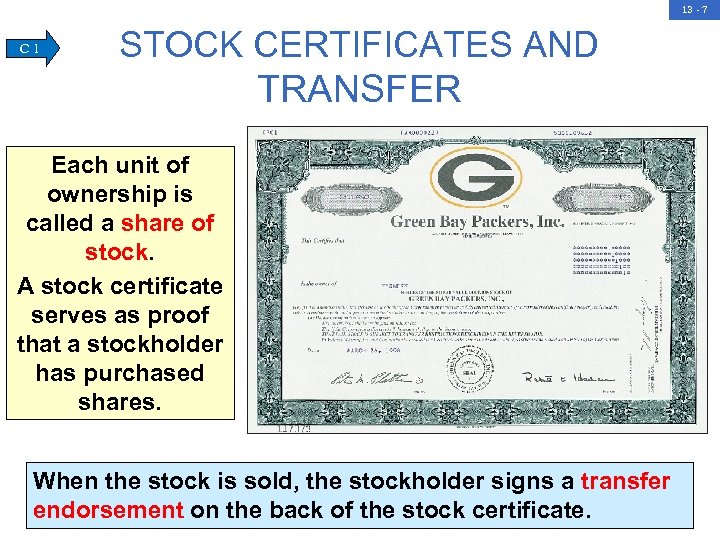 13 - 7 C 1 STOCK CERTIFICATES AND TRANSFER Each unit of ownership is called a share of stock. A stock certificate serves as proof that a stockholder has purchased shares. When the stock is sold, the stockholder signs a transfer endorsement on the back of the stock certificate.
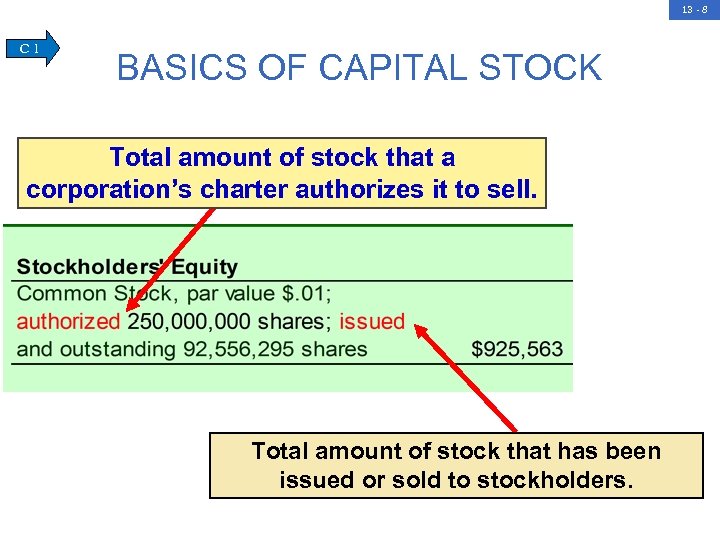 13 - 8 C 1 BASICS OF CAPITAL STOCK Total amount of stock that a corporation’s charter authorizes it to sell. Total amount of stock that has been issued or sold to stockholders.
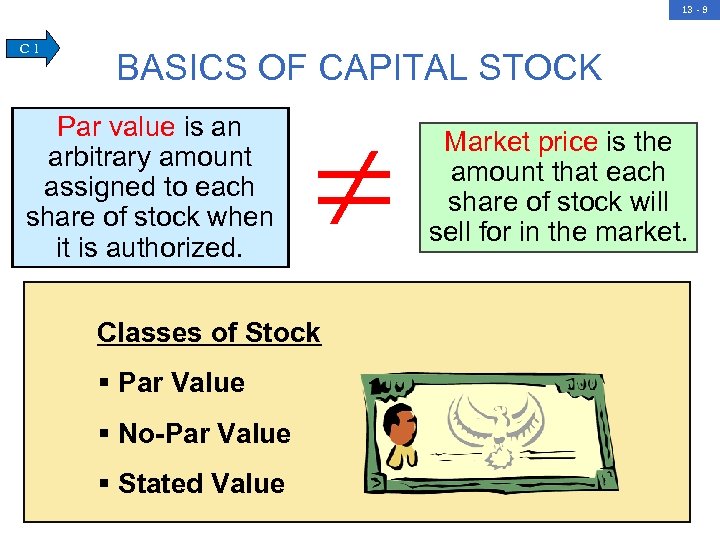 13 - 9 C 1 BASICS OF CAPITAL STOCK Par value is an arbitrary amount assigned to each share of stock when it is authorized. Classes of Stock § Par Value § No-Par Value § Stated Value Market price is the amount that each share of stock will sell for in the market.
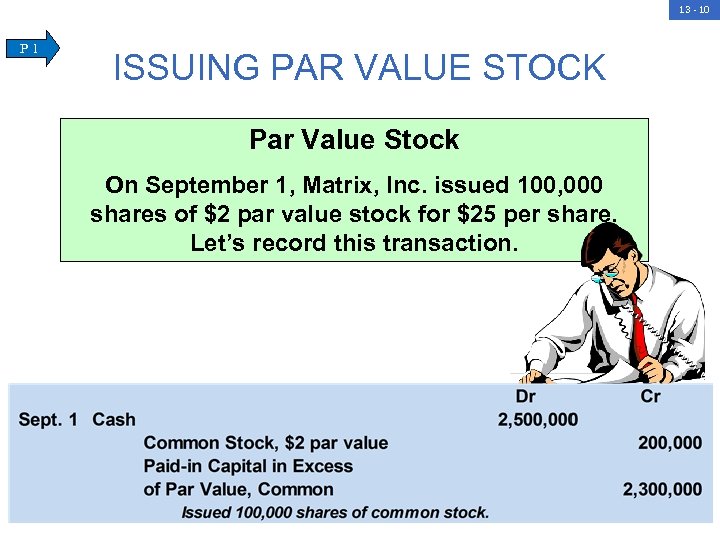 13 - 10 P 1 ISSUING PAR VALUE STOCK Par Value Stock On September 1, Matrix, Inc. issued 100, 000 shares of $2 par value stock for $25 per share. Let’s record this transaction.
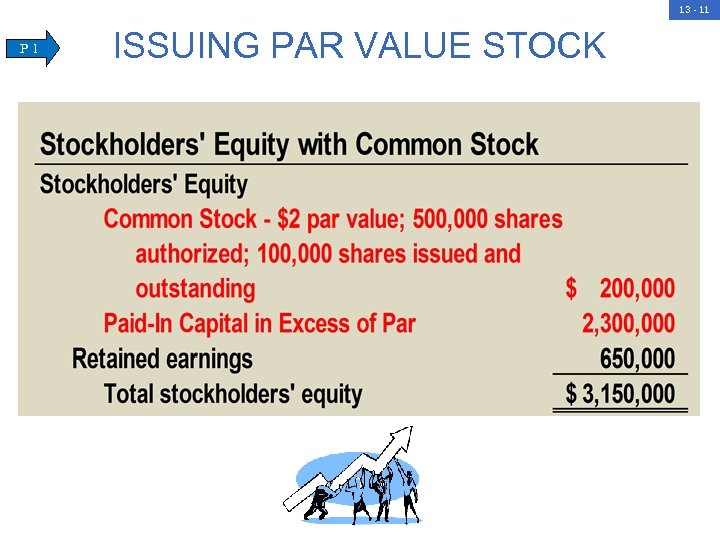 13 - 11 P 1 ISSUING PAR VALUE STOCK
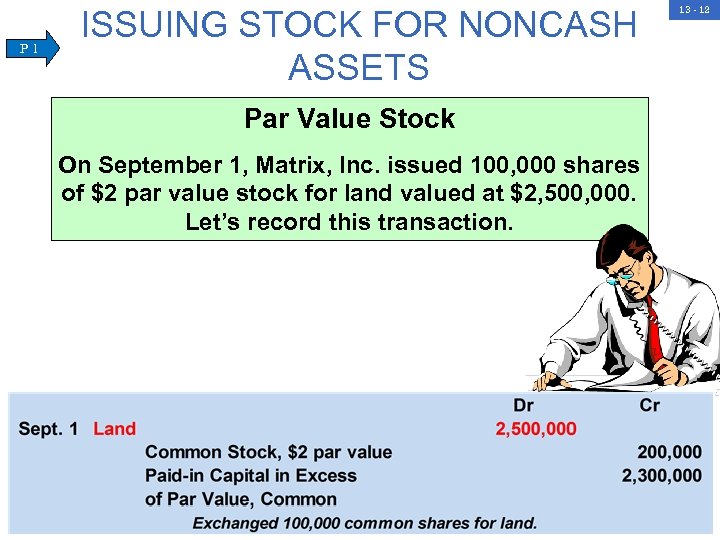 P 1 ISSUING STOCK FOR NONCASH ASSETS Par Value Stock On September 1, Matrix, Inc. issued 100, 000 shares of $2 par value stock for land valued at $2, 500, 000. Let’s record this transaction. 13 - 12
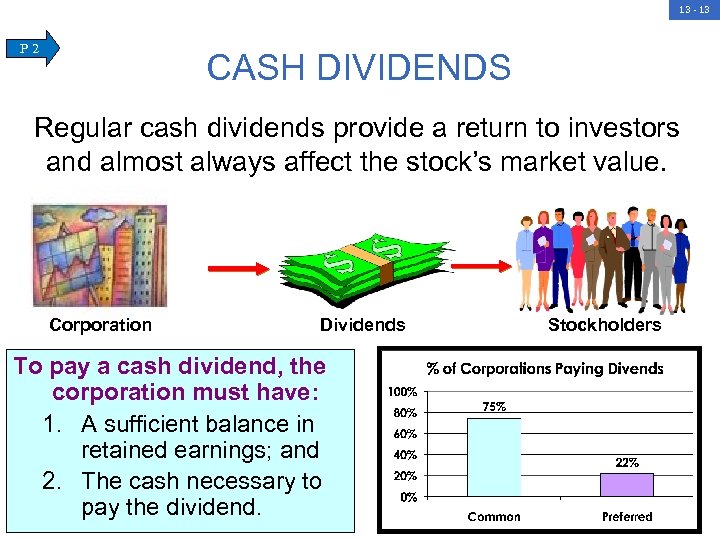 13 - 13 P 2 CASH DIVIDENDS Regular cash dividends provide a return to investors and almost always affect the stock’s market value. Corporation Dividends To pay a cash dividend, the corporation must have: 1. A sufficient balance in retained earnings; and 2. The cash necessary to pay the dividend. Stockholders
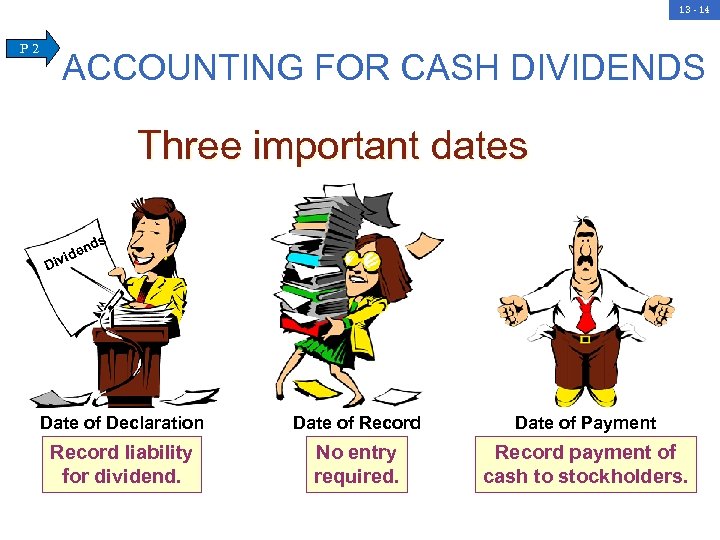 13 - 14 P 2 ACCOUNTING FOR CASH DIVIDENDS Three important dates D ds den ivi Date of Declaration Date of Record Date of Payment Record liability for dividend. No entry required. Record payment of cash to stockholders.
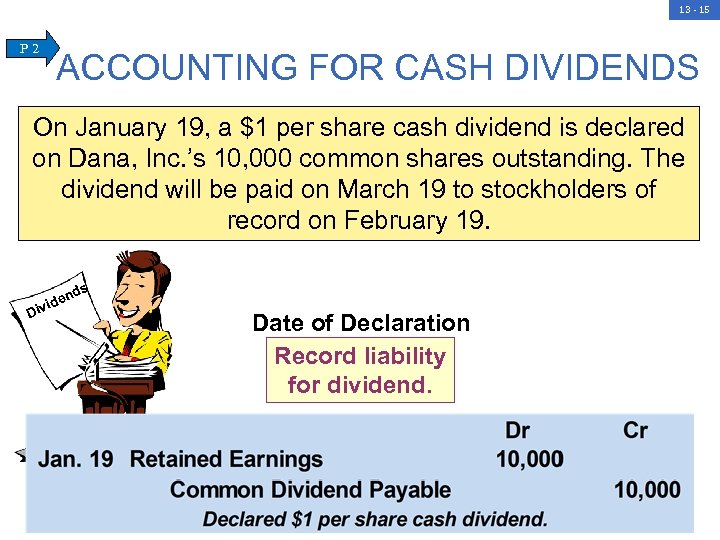 13 - 15 P 2 ACCOUNTING FOR CASH DIVIDENDS On January 19, a $1 per share cash dividend is declared on Dana, Inc. ’s 10, 000 common shares outstanding. The dividend will be paid on March 19 to stockholders of record on February 19. s D nd ide iv Date of Declaration Record liability for dividend.
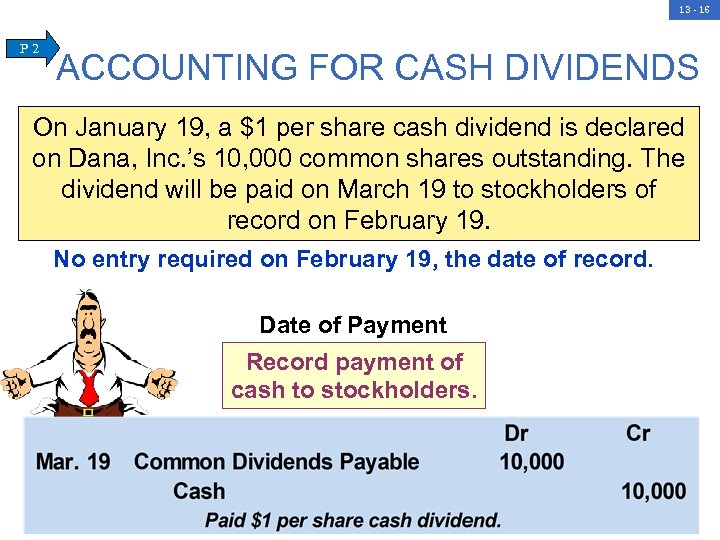 13 - 16 P 2 ACCOUNTING FOR CASH DIVIDENDS On January 19, a $1 per share cash dividend is declared on Dana, Inc. ’s 10, 000 common shares outstanding. The dividend will be paid on March 19 to stockholders of record on February 19. No entry required on February 19, the date of record. Date of Payment Record payment of cash to stockholders.
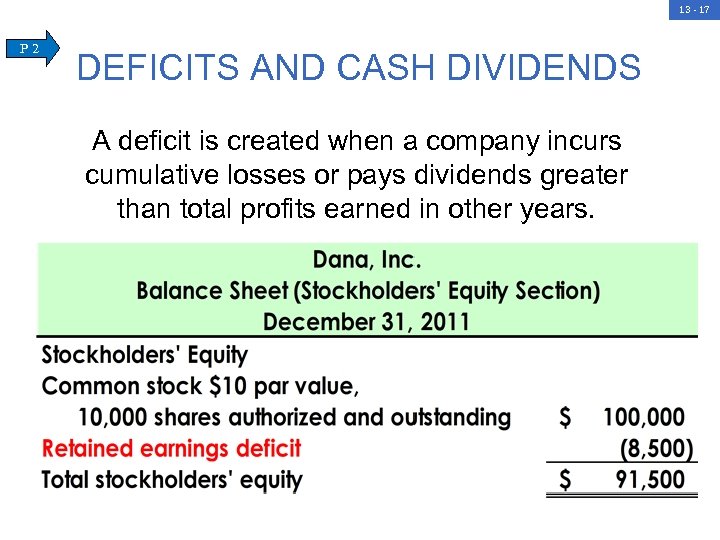 13 - 17 P 2 DEFICITS AND CASH DIVIDENDS A deficit is created when a company incurs cumulative losses or pays dividends greater than total profits earned in other years.
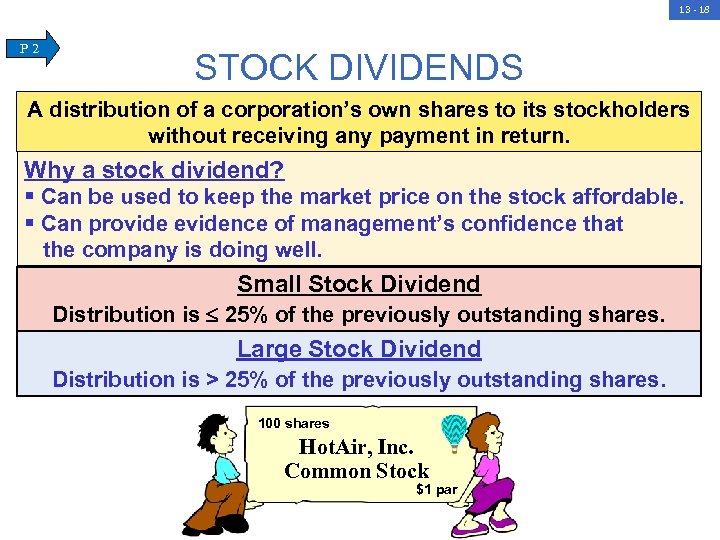 13 - 18 P 2 STOCK DIVIDENDS A distribution of a corporation’s own shares to its stockholders without receiving any payment in return. Why a stock dividend? § Can be used to keep the market price on the stock affordable. § Can provide evidence of management’s confidence that the company is doing well. Small Stock Dividend Distribution is £ 25% of the previously outstanding shares. Large Stock Dividend Distribution is > 25% of the previously outstanding shares. 100 shares Hot. Air, Inc. Common Stock $1 par
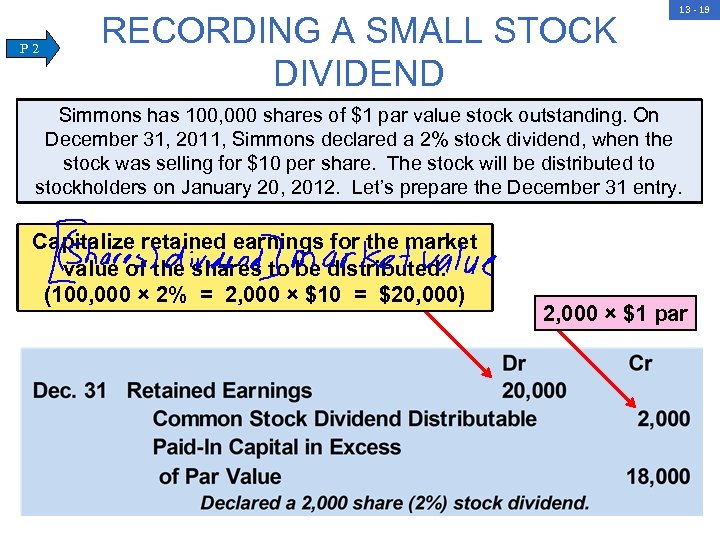 P 2 RECORDING A SMALL STOCK DIVIDEND 13 - 19 Simmons has 100, 000 shares of $1 par value stock outstanding. On December 31, 2011, Simmons declared a 2% stock dividend, when the stock was selling for $10 per share. The stock will be distributed to stockholders on January 20, 2012. Let’s prepare the December 31 entry. Capitalize retained earnings for the market value of the shares to be distributed. (100, 000 × 2% = 2, 000 × $10 = $20, 000) 2, 000 × $1 par
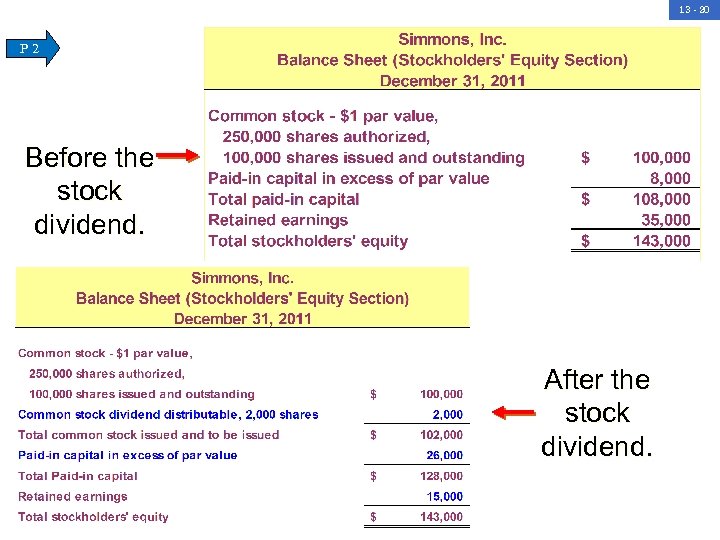 13 - 20 P 2 Before the stock dividend. After the stock dividend.
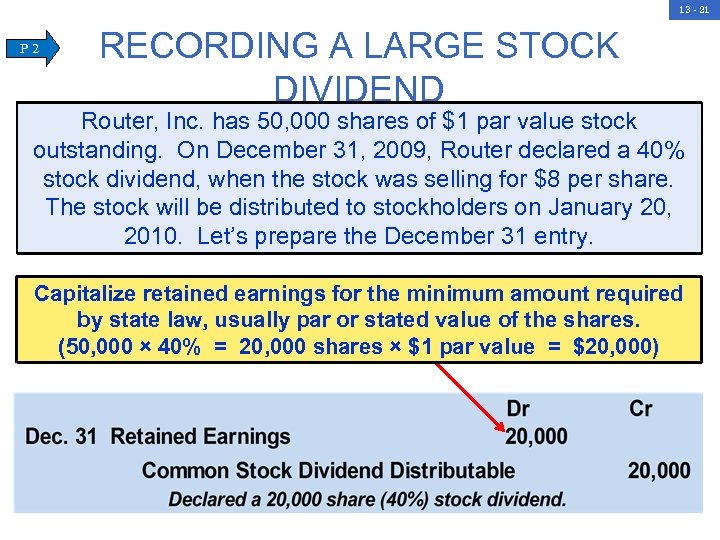 13 - 21 P 2 RECORDING A LARGE STOCK DIVIDEND Router, Inc. has 50, 000 shares of $1 par value stock outstanding. On December 31, 2009, Router declared a 40% stock dividend, when the stock was selling for $8 per share. The stock will be distributed to stockholders on January 20, 2010. Let’s prepare the December 31 entry. Capitalize retained earnings for the minimum amount required by state law, usually par or stated value of the shares. (50, 000 × 40% = 20, 000 shares × $1 par value = $20, 000)
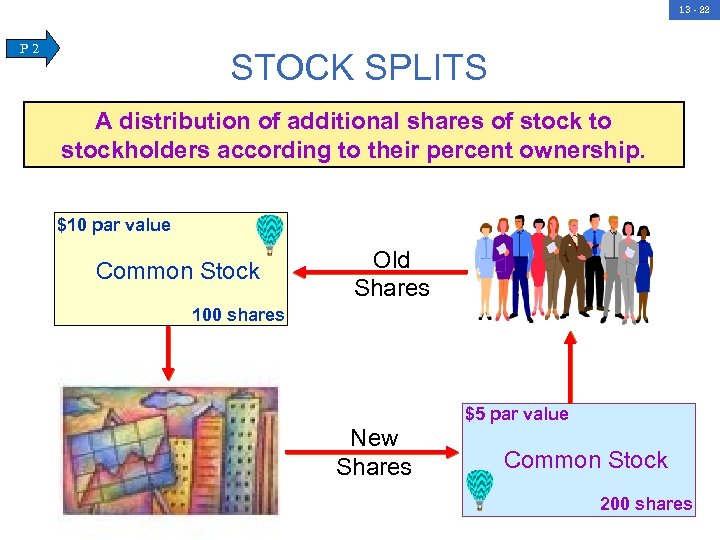 13 - 22 P 2 STOCK SPLITS A distribution of additional shares of stock to stockholders according to their percent ownership. $10 par value Common Stock Old Shares 100 shares $5 par value New Shares Common Stock 200 shares
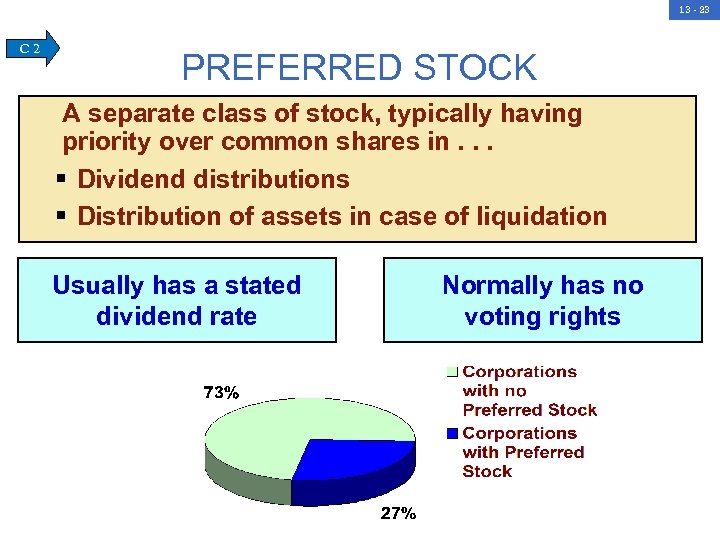 13 - 23 C 2 PREFERRED STOCK A separate class of stock, typically having priority over common shares in. . . § Dividend distributions § Distribution of assets in case of liquidation Usually has a stated dividend rate Normally has no voting rights
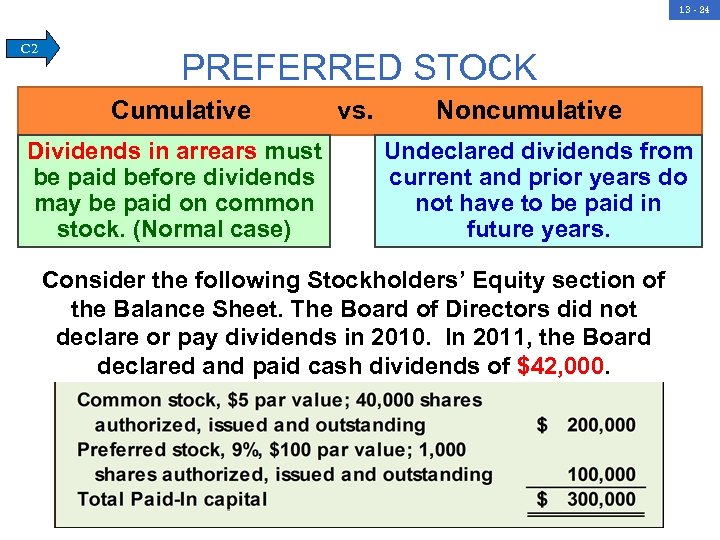 13 - 24 C 2 PREFERRED STOCK Cumulative Dividends in arrears must be paid before dividends may be paid on common stock. (Normal case) vs. Noncumulative Undeclared dividends from current and prior years do not have to be paid in future years. Consider the following Stockholders’ Equity section of the Balance Sheet. The Board of Directors did not declare or pay dividends in 2010. In 2011, the Board declared and paid cash dividends of $42, 000.
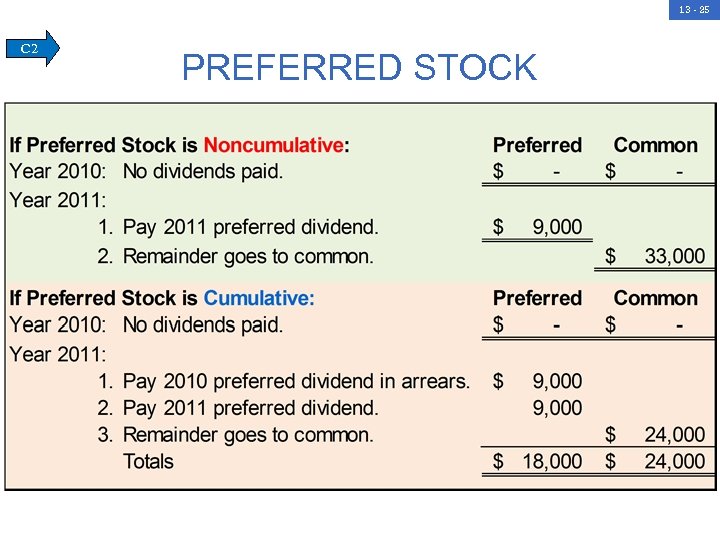 13 - 25 C 2 PREFERRED STOCK
 13 - 26 C 2 PREFERRED STOCK Participating Dividends may exceed a stated amount once common stockholders receive a dividend equal to the preferred stated rate. vs. Nonparticipating Dividends are limited to a maximum amount each year. The maximum is usually the stated dividend rate. (Normal case) Reasons for Issuing Preferred Stock § To raise capital without sacrificing control § To boost the return earned by common stockholders through financial leverage § To appeal to investors who may believe the common stock is too risky or that the expected return on common stock is too low
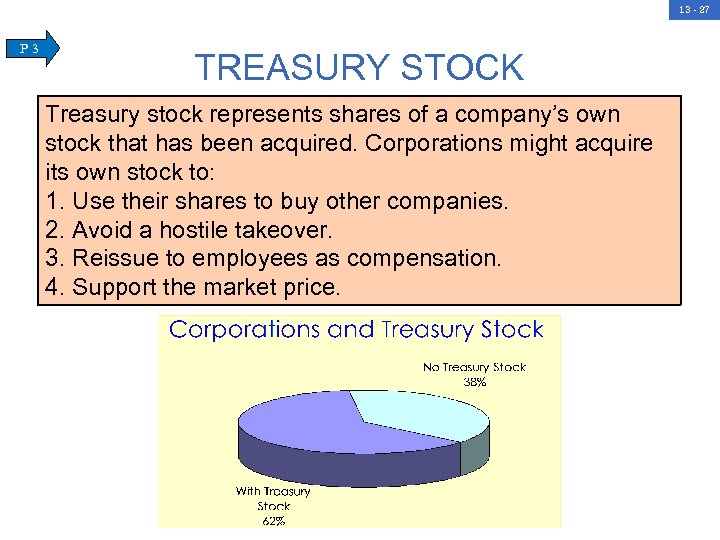 13 - 27 P 3 TREASURY STOCK Treasury stock represents shares of a company’s own stock that has been acquired. Corporations might acquire its own stock to: 1. Use their shares to buy other companies. 2. Avoid a hostile takeover. 3. Reissue to employees as compensation. 4. Support the market price.
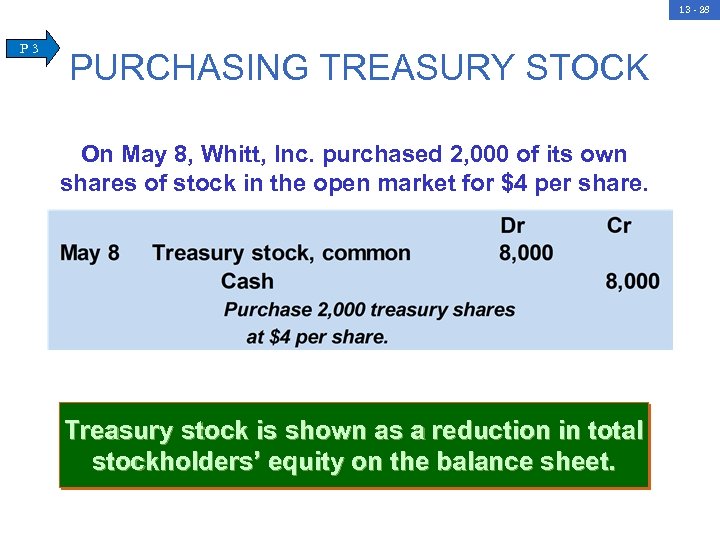 13 - 28 P 3 PURCHASING TREASURY STOCK On May 8, Whitt, Inc. purchased 2, 000 of its own shares of stock in the open market for $4 per share. Treasury stock is shown as a reduction in total stockholders’ equity on the balance sheet.
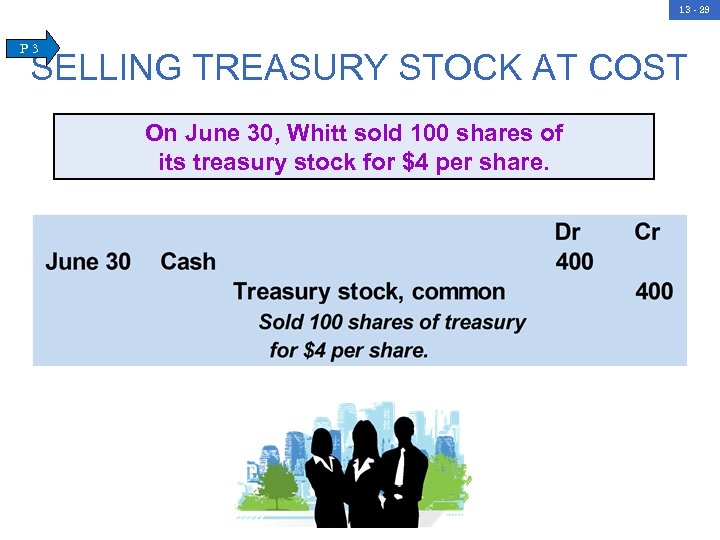 13 - 29 P 3 SELLING TREASURY STOCK AT COST On June 30, Whitt sold 100 shares of its treasury stock for $4 per share.
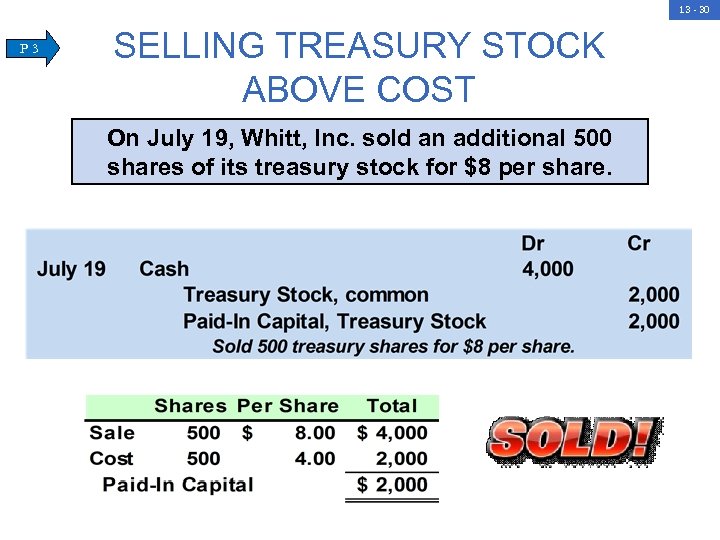 13 - 30 P 3 SELLING TREASURY STOCK ABOVE COST On July 19, Whitt, Inc. sold an additional 500 shares of its treasury stock for $8 per share.
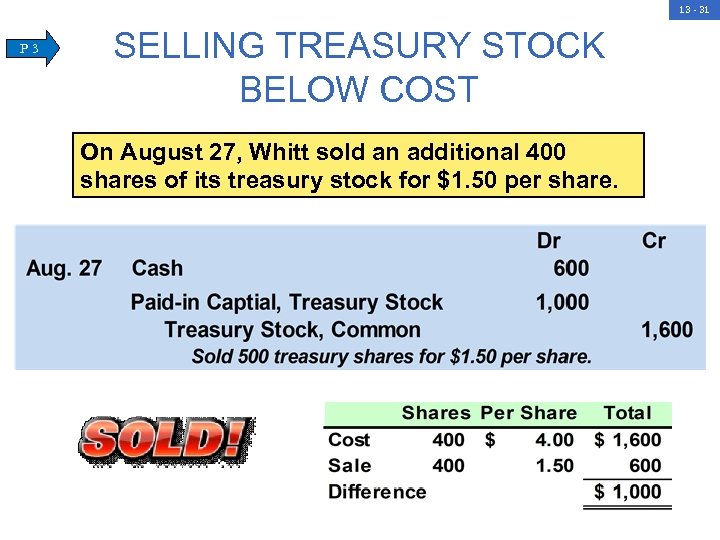 13 - 31 P 3 SELLING TREASURY STOCK BELOW COST On August 27, Whitt sold an additional 400 shares of its treasury stock for $1. 50 per share.
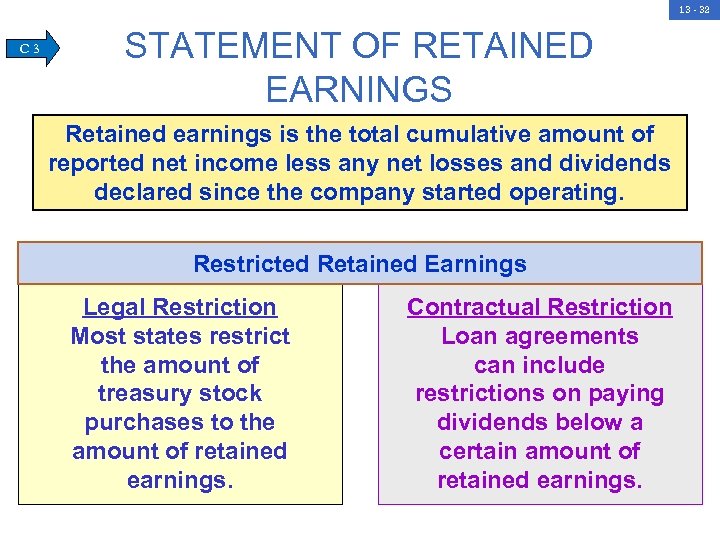 13 - 32 C 3 STATEMENT OF RETAINED EARNINGS Retained earnings is the total cumulative amount of reported net income less any net losses and dividends declared since the company started operating. Restricted Retained Earnings Legal Restriction Most states restrict the amount of treasury stock purchases to the amount of retained earnings. Contractual Restriction Loan agreements can include restrictions on paying dividends below a certain amount of retained earnings.
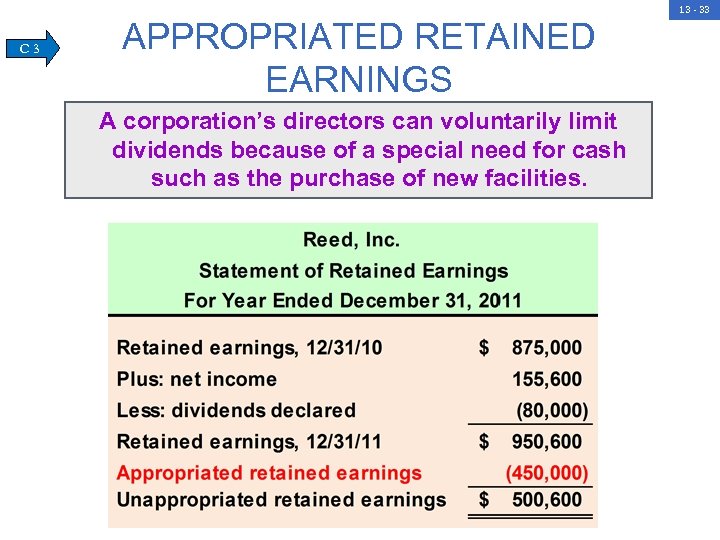 13 - 33 C 3 APPROPRIATED RETAINED EARNINGS A corporation’s directors can voluntarily limit dividends because of a special need for cash such as the purchase of new facilities.
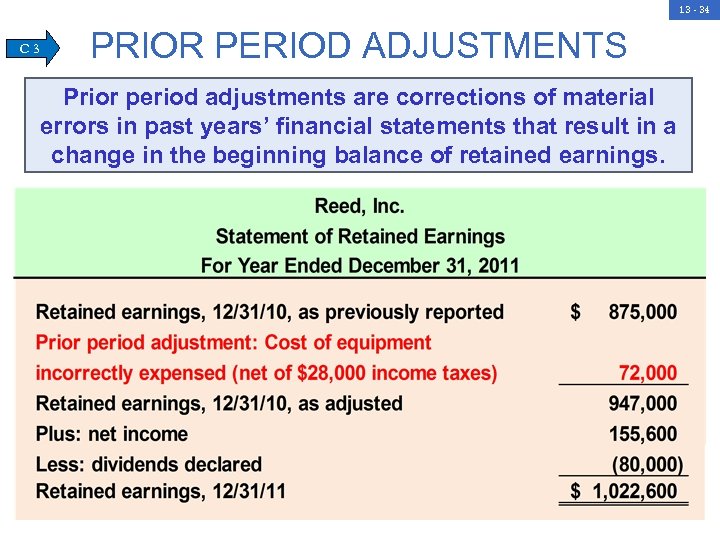 13 - 34 C 3 PRIOR PERIOD ADJUSTMENTS Prior period adjustments are corrections of material errors in past years’ financial statements that result in a change in the beginning balance of retained earnings.
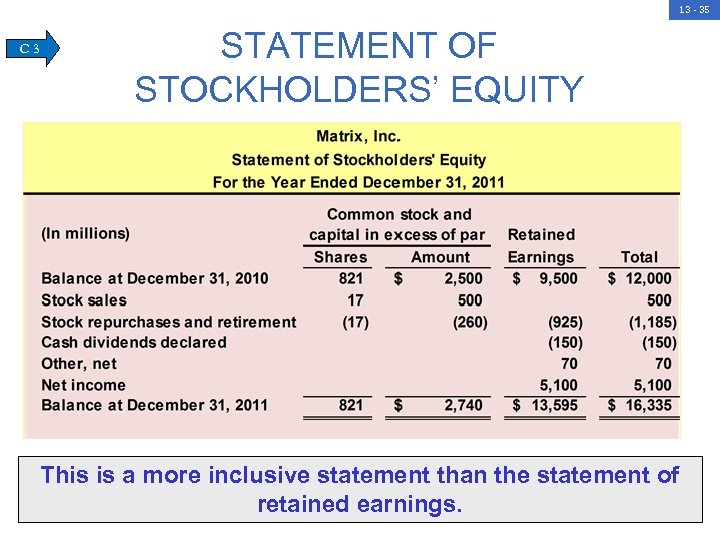 13 - 35 C 3 STATEMENT OF STOCKHOLDERS’ EQUITY This is a more inclusive statement than the statement of retained earnings.
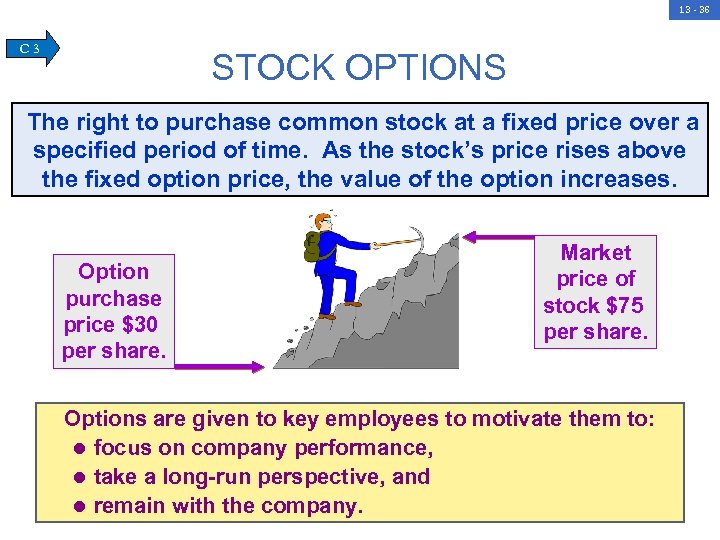 13 - 36 C 3 STOCK OPTIONS The right to purchase common stock at a fixed price over a specified period of time. As the stock’s price rises above the fixed option price, the value of the option increases. Option purchase price $30 per share. Market price of stock $75 per share. Options are given to key employees to motivate them to: l focus on company performance, l take a long-run perspective, and l remain with the company.
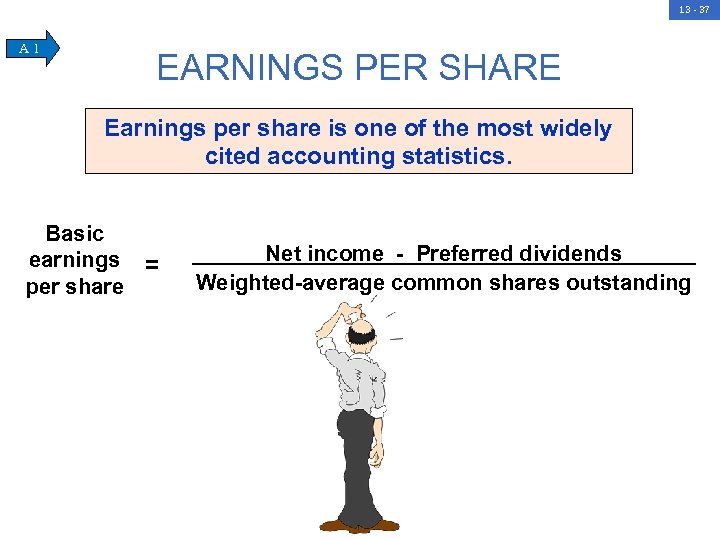 13 - 37 A 1 EARNINGS PER SHARE Earnings per share is one of the most widely cited accounting statistics. Basic earnings = per share Net income - Preferred dividends Weighted-average common shares outstanding
 13 - 38 A 2 PRICE–EARNINGS RATIO This ratio reveals information about the stock market’s expectations for a company’s future growth in earnings, dividends, and opportunities. Price– Earnings Ratio = Market value per share Earnings per share If earnings go up, will the market price of my stock follow?
 13 - 39 A 3 DIVIDEND YIELD Tells us the annual amount of cash dividends distributed to common stockholders relative to the stock’s market price. Dividend Yield = Annual cash dividends per share Market value per share
 13 - 40 A 4 BOOK VALUE PER SHARE–COMMON Reflects the amount of stockholders’ equity applicable to common shares on a per share basis. Stockholders’ equity applicable Book value per to common shares = common share Number of common shares outstanding
 13 - 41 A 4 BOOK VALUE PER SHARE– PREFERRED Reflects the amount of stockholders’ equity applicable to preferred shares on a per share basis. Book value per = preferred share Stockholders’ equity applicable to preferred shares Number of preferred shares outstanding
 13 - 42 GLOBAL VIEW U. S. GAAP and IFRS have similar procedures for issuing common stock at par, at a premium, at a discount, and for noncash assets. Accounting for and reporting cash dividends, stock dividends, and stock splits, are consistent under both U. S. GAAP and IFRS. Accounting for treasury stock is consistent under both U. S. GAAP and IFRS. Companies do not report gains or losses on transactions involving their own stock. Preferred stock that is redeemable at the option of the preferred stockholder is reported between liabilities and equity under U. S. GAAP, but it is reported as a liability under IFRS. Also, the issue price of convertible preferred stock (and bonds) is recorded entirely under preferred stock (or bonds), and none to the conversion feature under U. S. GAAP. However, IFRS requires that a portion of the issue price be allocated to the conversion feature.
 13 - 43 END OF CHAPTER 13