 Скачать презентацию Chapter 12 Web Hacking Revised 12 -30 -08
409fe0699f4694927ab3dc8e10e5bbe4.ppt
- Количество слайдов: 49



Chapter 12 Web Hacking Revised 12 -30 -08
Web Server Hacking
Popular Web Servers Microsoft IIS/ASP. NET LAMP (Linux/Apache/My. SQL/PHP) Oracle Web. Logic – Link Ch 12 j IBM Web. Sphere – Link Ch 12 k
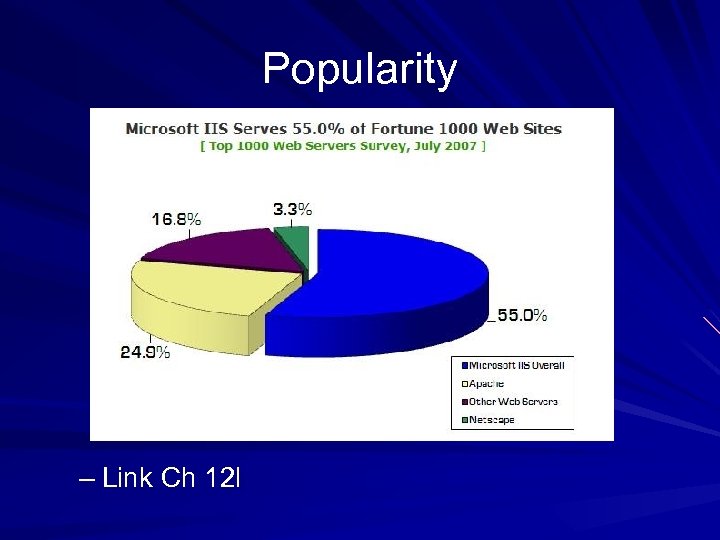
Popularity – Link Ch 12 l
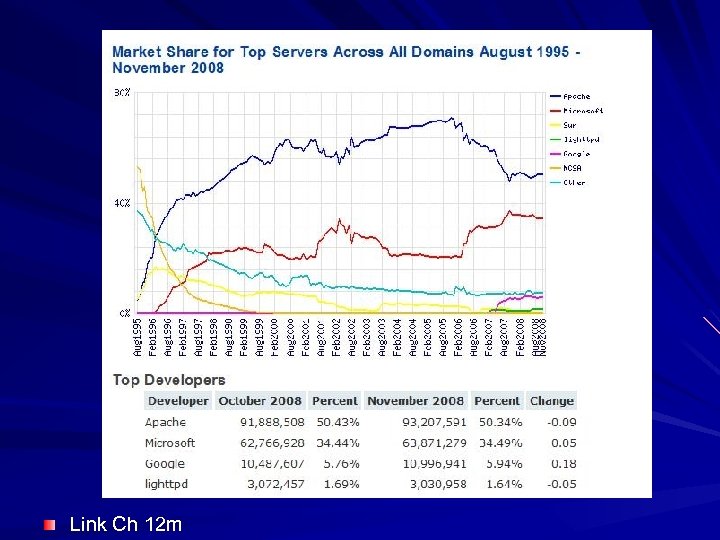
Link Ch 12 m
Attacking Web Server Vulnerabilities An attacker with the right set of tools and ready-made exploits can bring down a vulnerable web server in minutes Some of the most devastating Internet worms have historically exploited these kinds of vulnerabilities – Code Red and Nimda attacked IIS vulnerabilities
Why the Risk is Decreasing The risk of such attacks is decreasing, because: – Newer versions of Web servers are less vulnerable – System administrators are better at configuring the platforms – Vendor's "best practices" documents are better – Patches come out more rapidly
Why the Risk is Decreasing Countermeasures are available, such as: – Sanctum/Watchfire's App. Shield A Web application firewall (link Ch_12 n) Microsoft's URLScan – Built in to IIS 6 and IIS 7 Link Ch_12 o Automated vulnerability-scanning products and tools are available
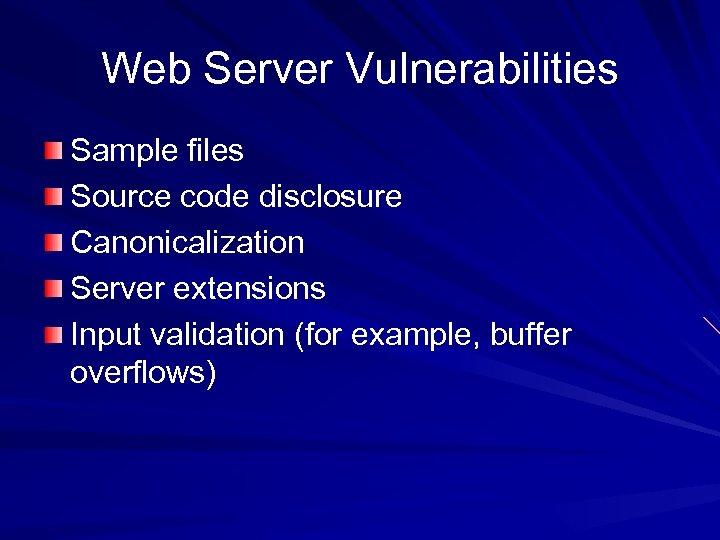
Web Server Vulnerabilities Sample files Source code disclosure Canonicalization Server extensions Input validation (for example, buffer overflows)
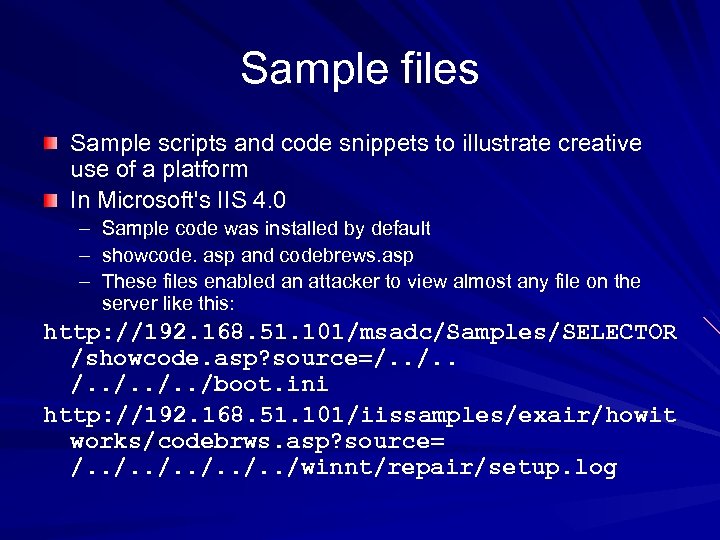
Sample files Sample scripts and code snippets to illustrate creative use of a platform In Microsoft's IIS 4. 0 – – – Sample code was installed by default showcode. asp and codebrews. asp These files enabled an attacker to view almost any file on the server like this: http: //192. 168. 51. 101/msadc/Samples/SELECTOR /showcode. asp? source=/. . /boot. ini http: //192. 168. 51. 101/iissamples/exair/howit works/codebrws. asp? source= /. . /winnt/repair/setup. log
Sample Files Countermeasure Remove sample files from production webservers If you need the sample files, you can get patches to improve them – Cold. Fusion Expression Evaluator patch – Link Ch 12 p
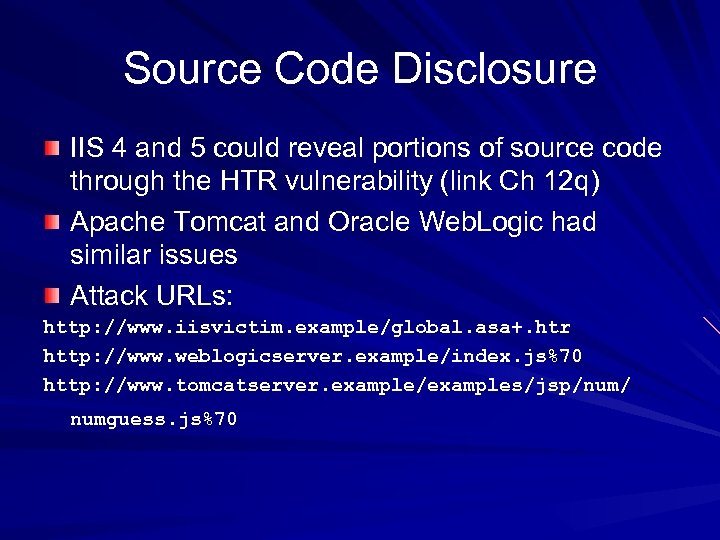
Source Code Disclosure IIS 4 and 5 could reveal portions of source code through the HTR vulnerability (link Ch 12 q) Apache Tomcat and Oracle Web. Logic had similar issues Attack URLs: http: //www. iisvictim. example/global. asa+. htr http: //www. weblogicserver. example/index. js%70 http: //www. tomcatserver. example/examples/jsp/num/ numguess. js%70
Source Code Disclosure Countermeasures Apply patches (these vulnerabilities were patched long ago) Remove unneeded sample files Never put sensitive data in source code of files – You can never be sure source code is hidden
Canonicalization Attacks There are many ways to refer to the same file C: text. txt. . text. txt \computerC$text. txt The process of resolving a resource to a standard (canonical) name is called canonicalization
ASP: : $DATA Vulnerability Affected IIS 4 and earlier versions Just adding : : DATA to the end of an ASP page's URL revealed the source code http: //xyz/myasp. asp: : $DATA Link Ch 12 r
Unicode/Double Decode Vulnerabilities Strings like %c 0%af could be used to sneak characters like past URL filters Attack URL example: http: //10. 1. 1. 3/scripts/. . %c 0%af. . /winnt/system 32/cmd. exe? /c+dir Exploited by the Nimda worm
Canonicalization Attack Countermeasures Patch your Web platform Compartmentalize your application directory structure – Limit access of Web Application user to minimal required Clean URLs with URLScan and similar products – Remove Unicode or double-hex-encoded characters before they reach the server
New IIS 7 Security Measures (not in book) Application Pool Isolation – Each Web application runs as a process named w 3 wp. exe, and under the user identity IUSRS – But a different SID is injected into the w 3 wp. exe process for each Web application – NTFS permissions allow each Web application process access to only its own files and folders
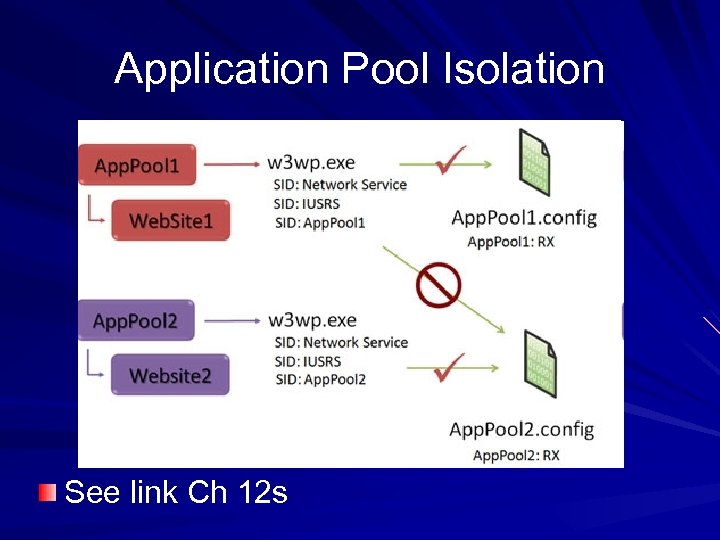
Application Pool Isolation See link Ch 12 s
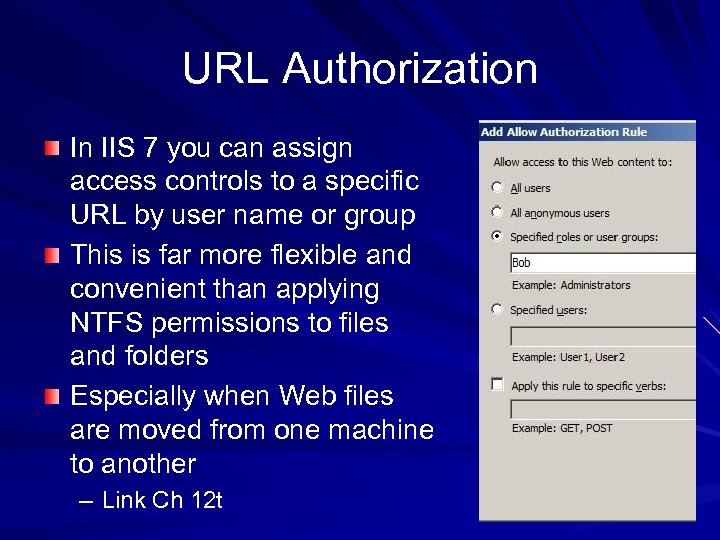
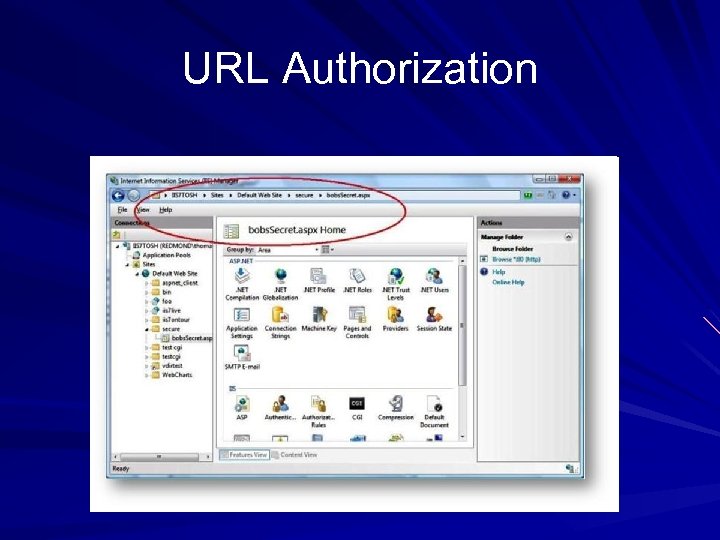
URL Authorization In IIS 7 you can assign access controls to a specific URL by user name or group This is far more flexible and convenient than applying NTFS permissions to files and folders Especially when Web files are moved from one machine to another – Link Ch 12 t
URL Authorization
Server Extensions Code libraries tacked on to the core HTTP engine to provide extra features – Dynamic script execution (for example, Microsoft ASP) – Site indexing – Internet Printing Protocol – Web Distributed Authoring and Versioning (Web. DAV) – Secure Sockets Layer (SSL)
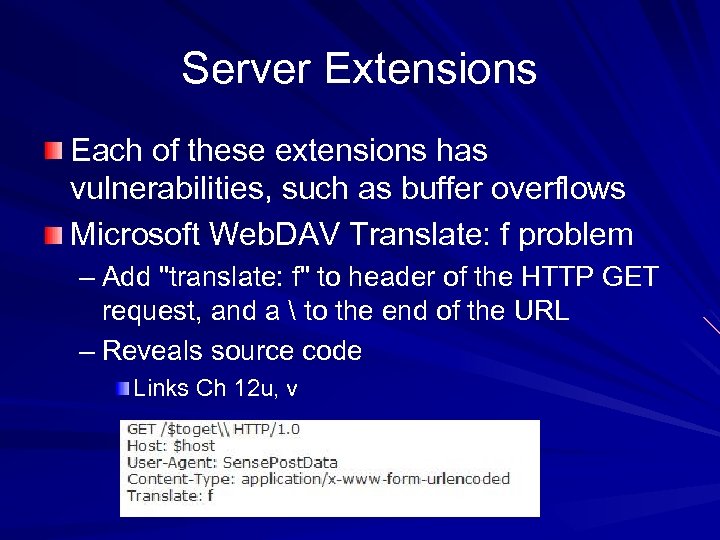
Server Extensions Each of these extensions has vulnerabilities, such as buffer overflows Microsoft Web. DAV Translate: f problem – Add "translate: f" to header of the HTTP GET request, and a to the end of the URL – Reveals source code Links Ch 12 u, v
Server Extensions Exploitation Countermeasures Patch or disable vulnerable extensions – The Translate: f problem was patched long ago
Buffer Overflows Web servers, like all other computers, can be compromised by buffer overflows The Web server is easy to find, and connected to the Internet, so it is a common target
Famous Buffer Overflows IIS HTR Chunked Encoding Transfer Heap Overflow – Affects Microsoft IIS 4. 0, 5. 0, and 5. 1 – Leads to remote denial of service or remote code execution at the IWAM_ MACHINENAME privilege level IIS's Indexing Service extension (idq. dll) – A buffer overflow used by the infamous Code Red worm Internet Printing Protocol (IPP) vulnerability
Famous Buffer Overflows Apache mod_ssl vulnerability – Also known as the Slapper worm – Affects all versions up to and including Apache 2. 0. 40 – Results in remote code execution at the super-user level Apache also suffered from a vulnerability in the way it handled HTTP requests encoded with chunked encoding – Resulted in a worm dubbed "Scalper" – Thought to be the first Apache worm
Buffer Overflow Countermeasures Apply software patches Scan your server with a vulnerability scanner
Web Server Vulnerability Scanners Nikto checks for common Web server vulnerabilities – It is not subtle—it leaves obvious traces in log files – Link Ch 12 z 01 Whisker is another Web server vulnerability scanner – Nikto version 2 uses Lib. Whisker 2, so it may replace Whisker
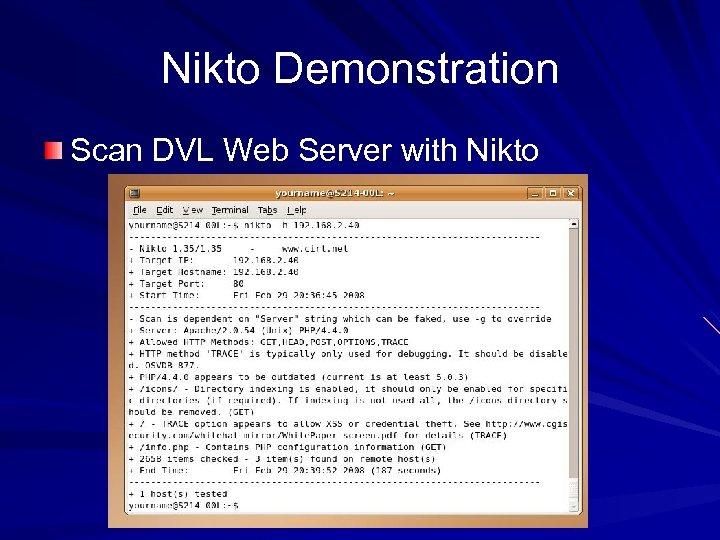
Nikto Demonstration Scan DVL Web Server with Nikto
Web Application Hacking Attacks on applications themselves, as opposed to the web server software upon which these applications run The same techniques – Input-validation attacks – Source code disclosure attacks – etc.
Finding Vulnerable Web Apps with Google You can find unprotected directories with searches like this: – – – "Index of /admin" "Index of /password" "Index of /mail" You can find password hints, vulnerable Web servers with Front. Page, MRTG traffic analysis pages, . NET information, improperly configured Outlook Web Access (OWA) servers… And many more – Link Ch 1 a
Web Crawling Examine a Web site carefully for Low Hanging Fruit – Local path information – Backend server names and IP addresses – SQL query strings with passwords – Informational comments Look in static and dynamic pages, include and other support files, source code
Web-Crawling Tools wget is a simple command-line tool to download a page, and can be used in scripts – Available for Linux and Windows – Link Ch 12 z 03 Offline Explorer Pro – Commercial Win 32 product
Web Application Assessment Once the target application content has been crawled and thoroughly analyzed Probe the features of the application – Authentication – Session management – Database interaction – Generic input validation
Tools for Web Application Assessment Achilles proxy server – Allows user to intercept and alter HTTP and HTTPS traffic – Runs on Windows Paros proxy server – Requires Java Runtime Engine (JRE) – Scans for vulnerabilities – Spiders sites – Runs on Windows or Linux/Unix Link Ch 12 z 04
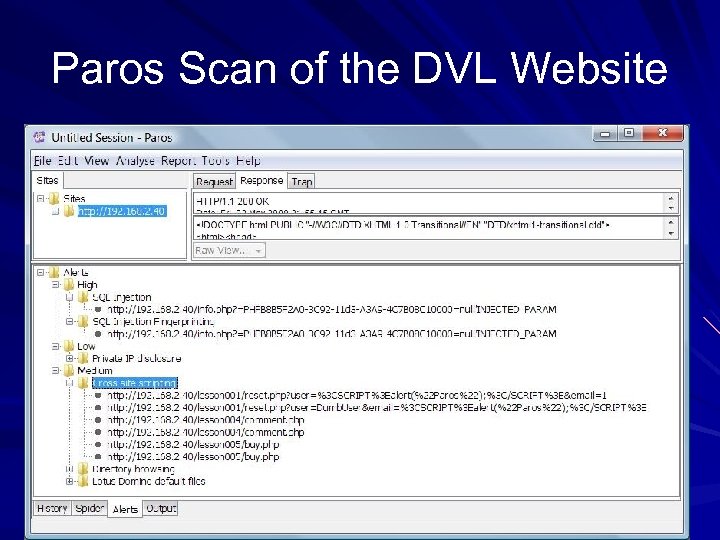
Paros Scan of the DVL Website
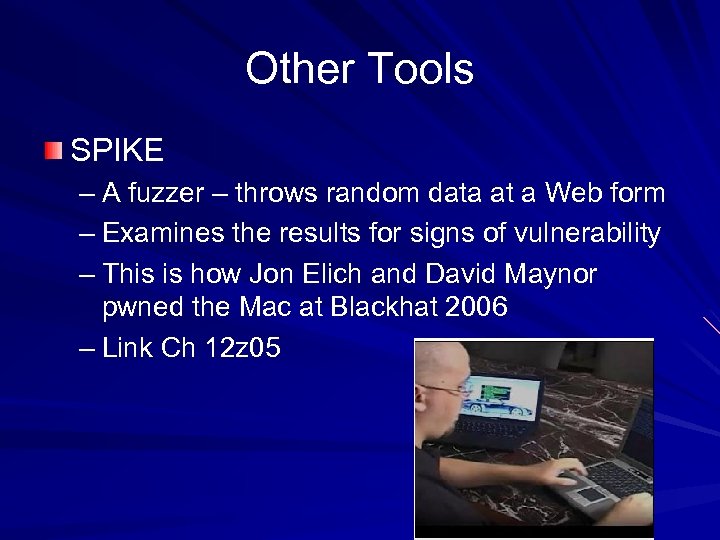
Other Tools SPIKE – A fuzzer – throws random data at a Web form – Examines the results for signs of vulnerability – This is how Jon Elich and David Maynor pwned the Mac at Blackhat 2006 – Link Ch 12 z 05
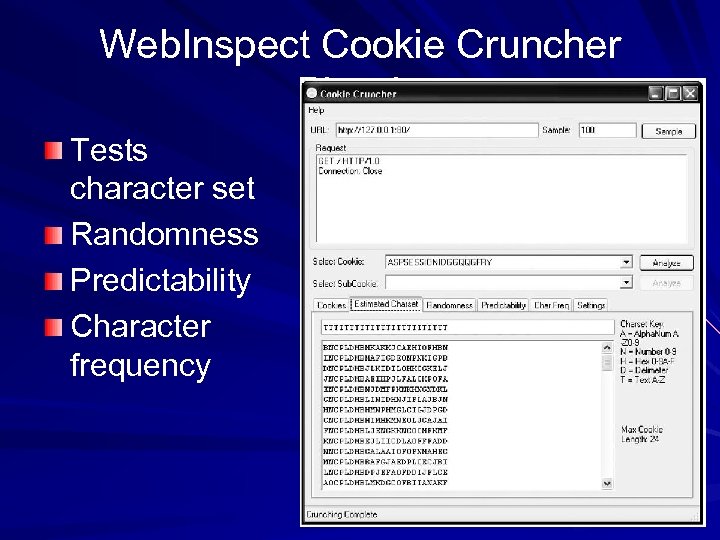
Web. Inspect Cookie Cruncher Plug-In Tests character set Randomness Predictability Character frequency
Common Web Application Vulnerabilities
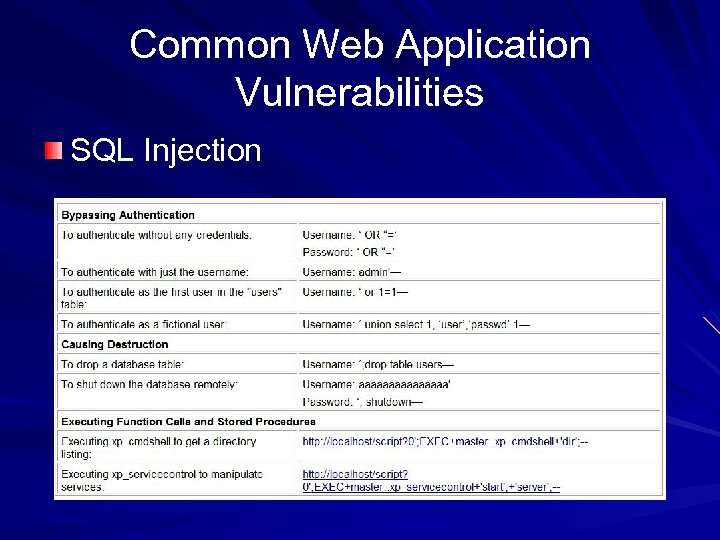
Common Web Application Vulnerabilities SQL Injection
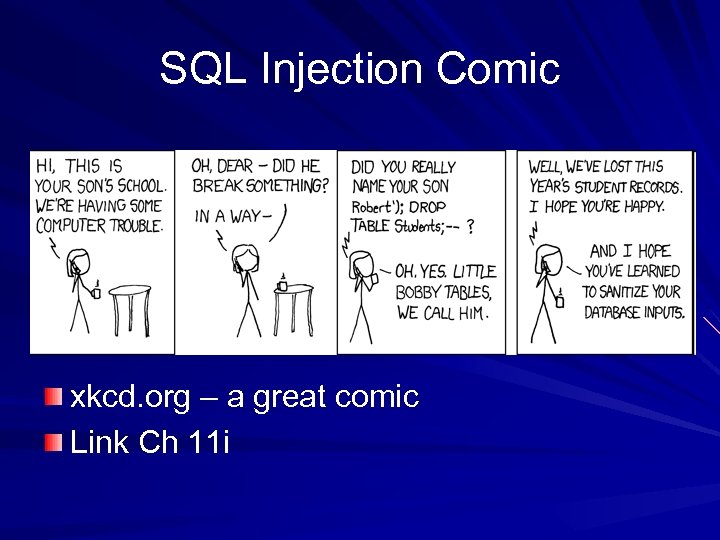
SQL Injection Comic xkcd. org – a great comic Link Ch 11 i
Automated SQL Injection Tools Wpoison – Runs on Linux SPIKE Proxy mieliekoek. pl – SQL insertion crawler that tests all forms on a website for possible SQL insertion problems SPI Dynamics' SPI Toolkit – Contains SQL Injector that automates SQL injection testing
SQL Injection Countermeasures Perform strict input validation Replace direct SQL statements with stored procedures, prepared statements, or ADO command objects – That way they can't be modified Implement default error handling – Use a general error message for all errors
SQL Injection Countermeasures Lock down ODBC – Disable messaging to clients. Don't let regular SQL statements through. This ensures that no client, not just the web application, can execute arbitrary SQL. Lock down the database server configuration – Specify users, roles, and permissions, so even if SQL statements are injected, they can't do any harm
Cross-Site Scripting (XSS) Attacks One user injects code that attacks another user Common on guestbooks, comment pages, forums, etc. Caused by failure to filter out HTML tags – These characters < > ( ) # & – Also watch out for hex-encoded versions %3 c instead of < %3 e instead of > %22 instead of "
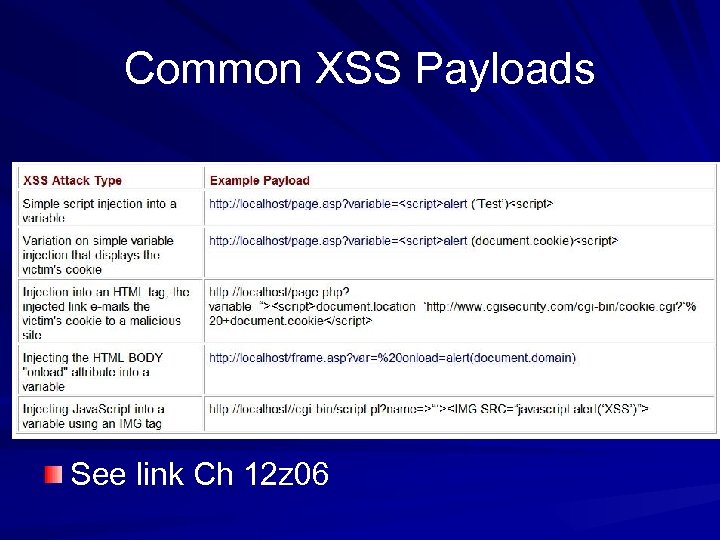
Common XSS Payloads See link Ch 12 z 06
Cross-Site Scripting Countermeasures Filter out < > ( ) # & and the variants of them HTML-encode output, so a character like < becomes < -- that will stop scripts from running In IE 6 SP 1 or later, an application can set Http. Only Cookies, which prevents them from being accessed by scripts – Although the TRACE method can defeat this security measure
Cross-Site Scripting Countermeasures Analyze your applications for XSS vulnerabilities – Fix the errors you find
Скачать презентацию Chapter 12 Web Hacking Revised 12 -30 -08
409fe0699f4694927ab3dc8e10e5bbe4.ppt