


 Скачать презентацию Chapter 12 Uncertainty 1 Uncertainty is Pervasive
4fced1f68b2ad4314befb392754d9665.ppt
- Количество слайдов: 57
 Chapter 12 Uncertainty 1
 Uncertainty is Pervasive What is uncertainty in economic systems? 2 tomorrow’s prices future wealth future availability of commodities present and future actions of other people.
 Uncertainty is Pervasive What are rational responses to uncertainty? 3 A portfolio of contingent consumption goods. E. g. , buying insurance (health, life, auto)
 12. 1 Contingent consumption 或有消費 states of nature: different outcomes of a random event “car accident” (a) “no car accident” (na). Accident occurs with probability a, does not with probability na ; a + na = 1. Accident causes a loss of $L. 4
 Contingencies A state-contingent consumption plan is a specification of what will be consumed in different sates of nature. E. g. the insurer pays only if there is an accident. 5
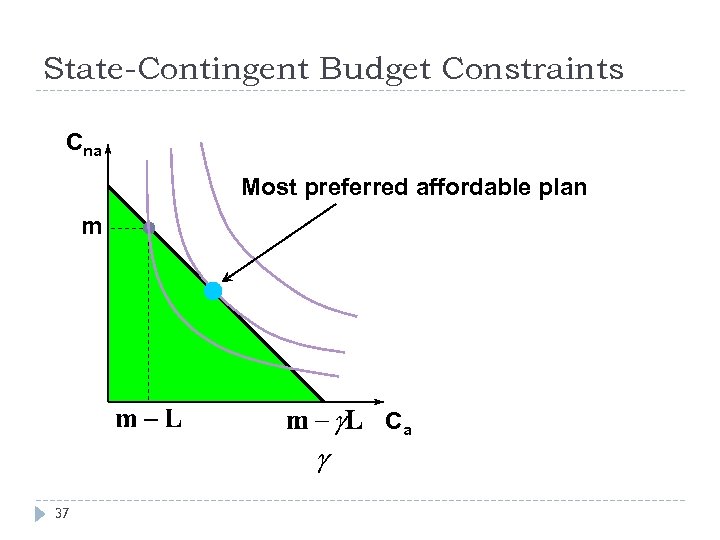
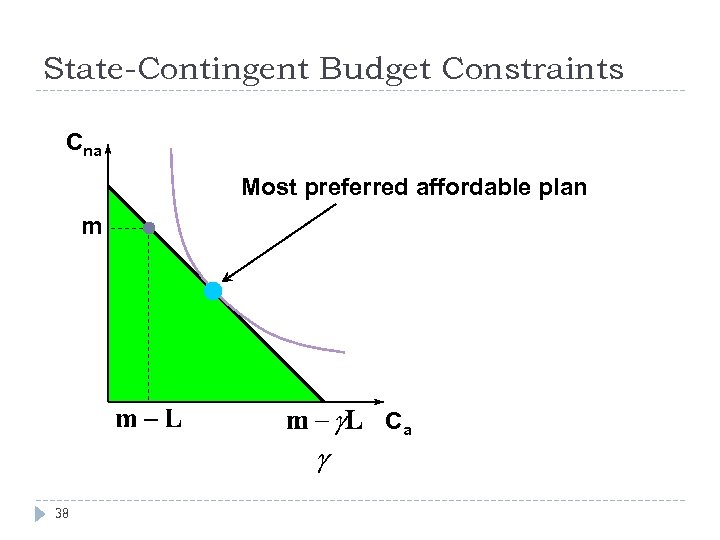
 12. 2 State-Contingent Budget Constraints Each $1 of accident insurance costs . Consumer has $m of wealth. Cna is consumption value in the no-accident state. Ca is consumption value in the accident state. 6
 State-Contingent Budget Constraints Cna Ca 7
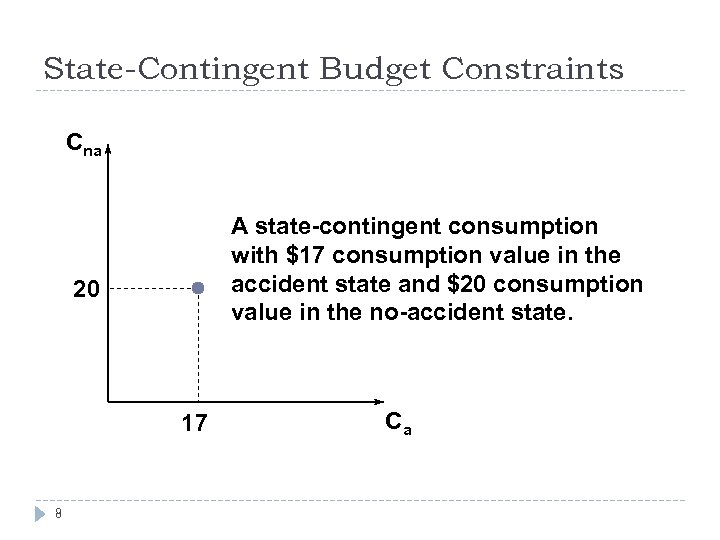 State-Contingent Budget Constraints Cna A state-contingent consumption with $17 consumption value in the accident state and $20 consumption value in the no-accident state. 20 17 8 Ca
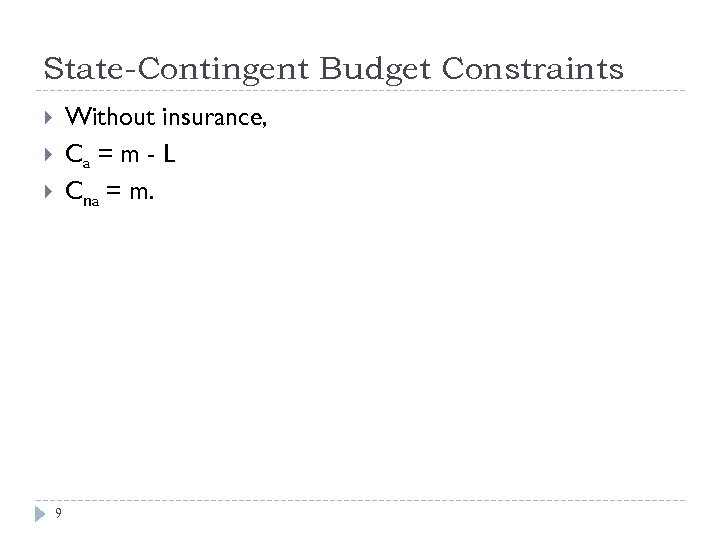 State-Contingent Budget Constraints Without insurance, Ca = m - L Cna = m. 9
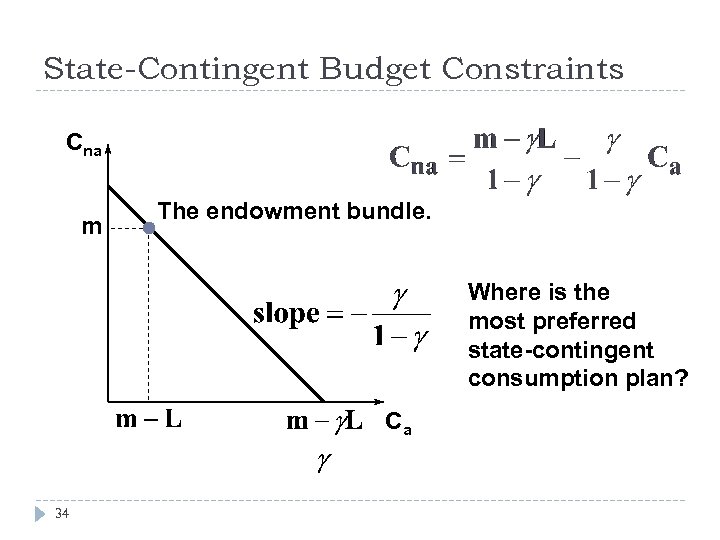
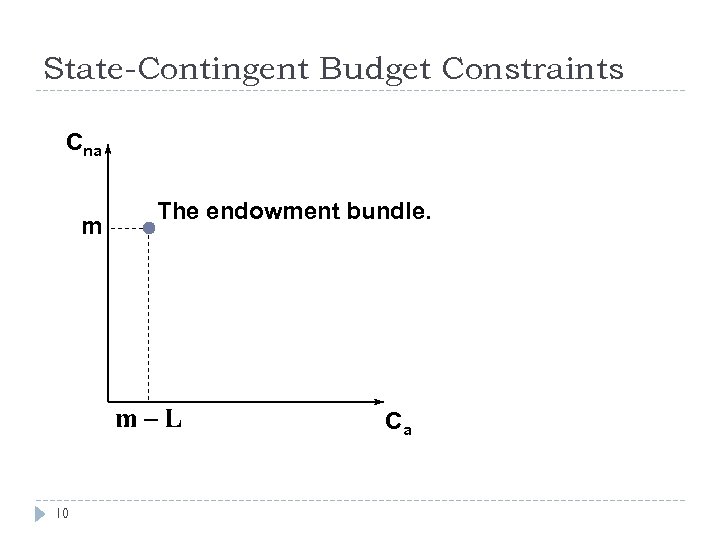 State-Contingent Budget Constraints Cna m The endowment bundle. Ca 10
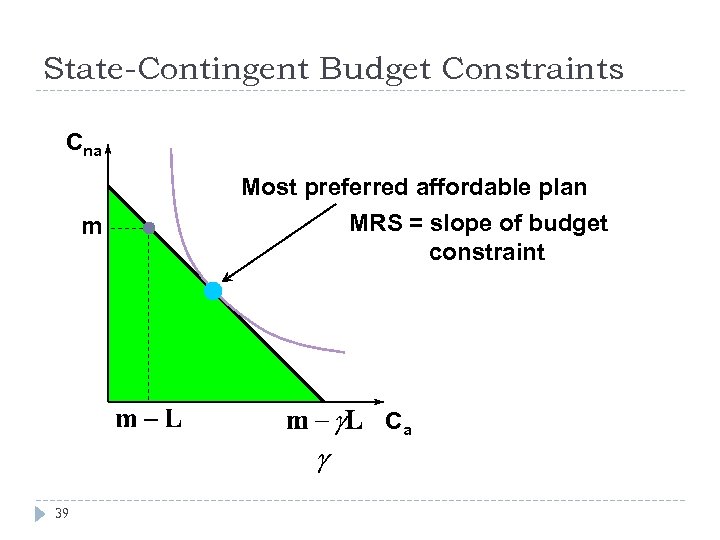
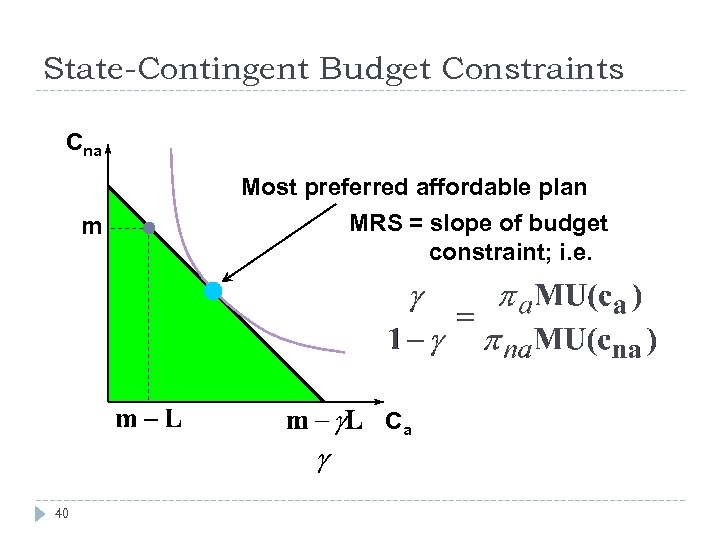
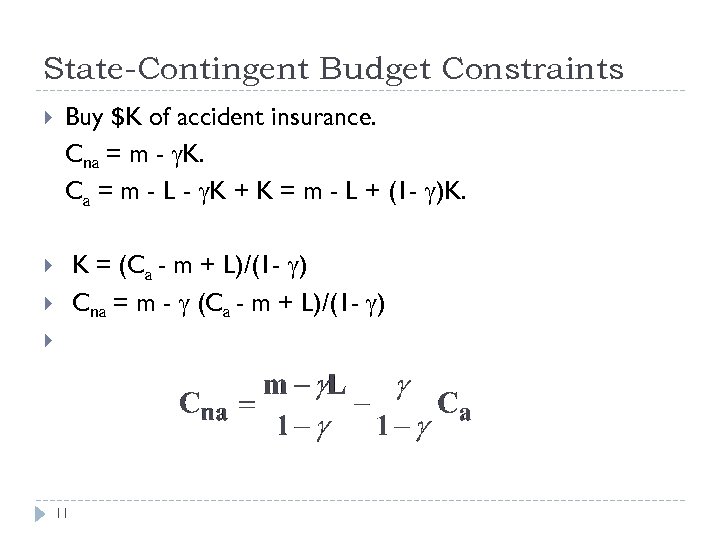 State-Contingent Budget Constraints Buy $K of accident insurance. Cna = m - K. Ca = m - L - K + K = m - L + (1 - )K. K = (Ca - m + L)/(1 - ) Cna = m - (Ca - m + L)/(1 - ) 11
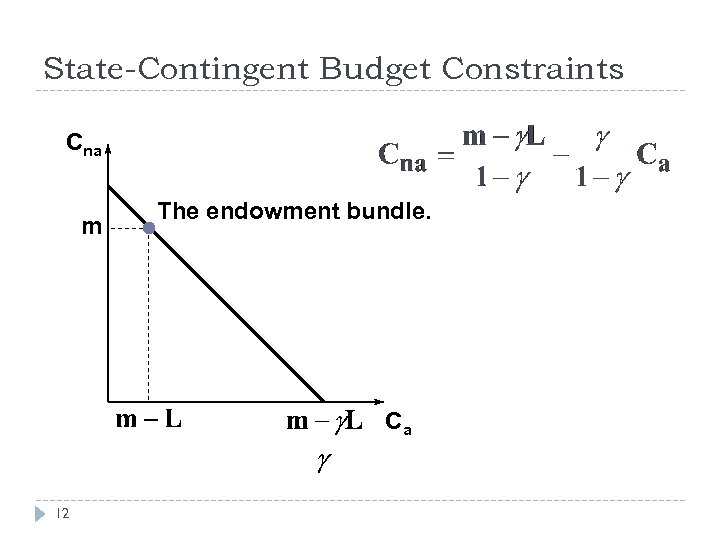 State-Contingent Budget Constraints Cna m The endowment bundle. Ca 12
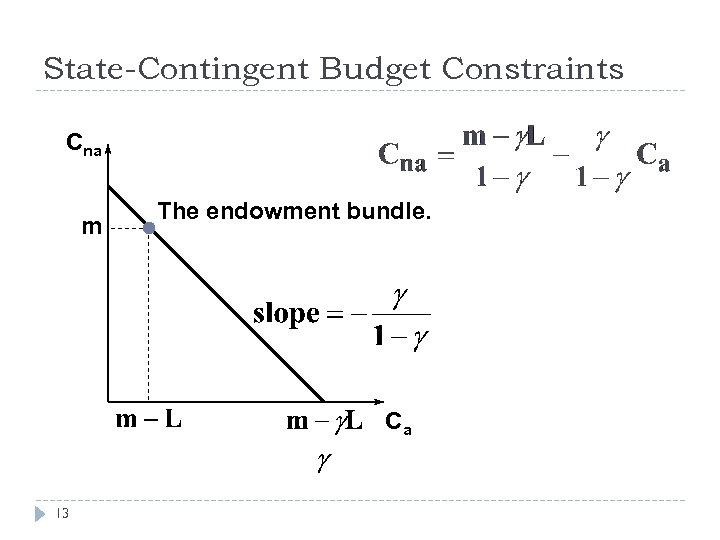 State-Contingent Budget Constraints Cna m The endowment bundle. Ca 13
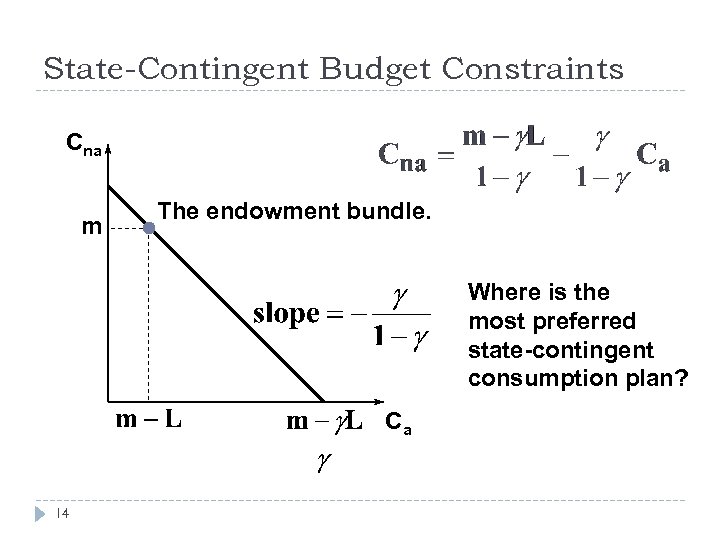 State-Contingent Budget Constraints Cna m The endowment bundle. Where is the most preferred state-contingent consumption plan? Ca 14
 12. 3 Preferences Under Uncertainty Think of a lottery. Win $400 with probability 1/2 and $0 with probability 1/2. Will you prefer participating the lottery or getting $200 for sure? 15
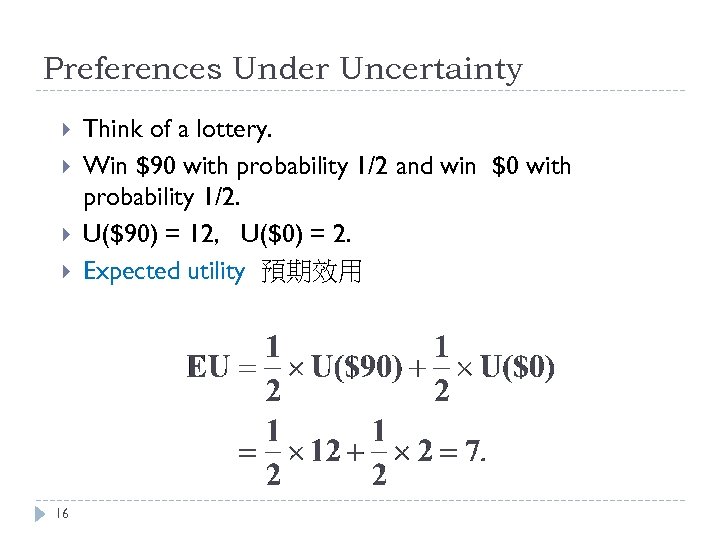 Preferences Under Uncertainty 16 Think of a lottery. Win $90 with probability 1/2 and win $0 with probability 1/2. U($90) = 12, U($0) = 2. Expected utility 預期效用
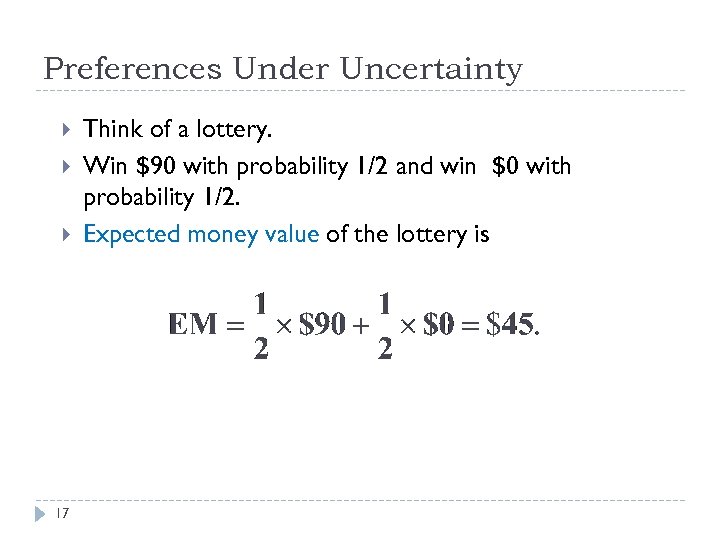 Preferences Under Uncertainty 17 Think of a lottery. Win $90 with probability 1/2 and win $0 with probability 1/2. Expected money value of the lottery is
 Preferences Under Uncertainty EU = 7 and EM = $45. U($45) > 7 $45 for sure is preferred to the lottery risk-aversion. 風險驅避 U($45) < 7 the lottery is preferred to $45 for sure risk-loving. 風險愛好 U($45) = 7 the lottery is preferred equally to $45 for sure risk-neutrality. 風險中立 18
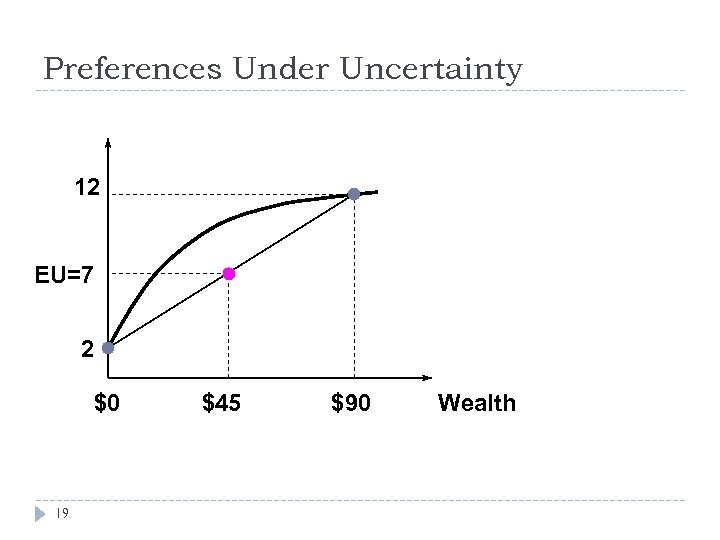 Preferences Under Uncertainty 12 EU=7 2 $0 19 $45 $90 Wealth
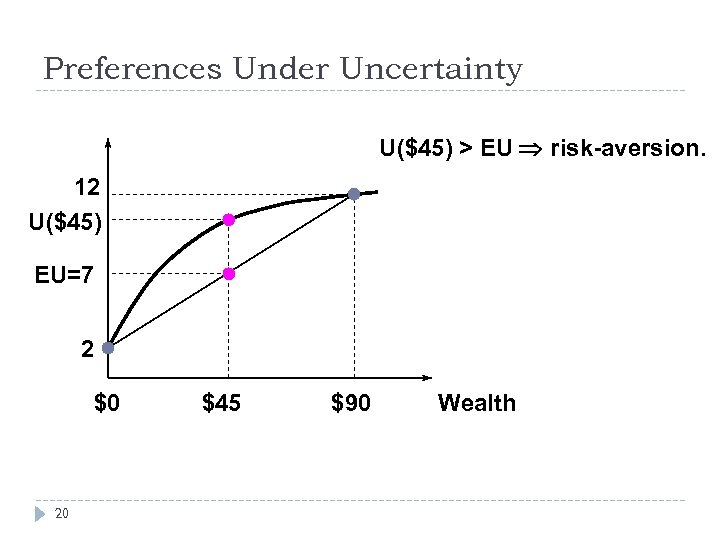 Preferences Under Uncertainty U($45) > EU risk-aversion. 12 U($45) EU=7 2 $0 20 $45 $90 Wealth
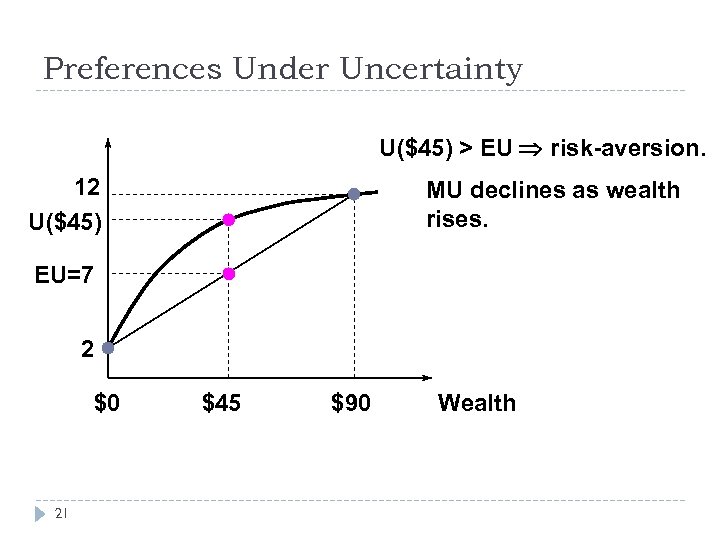 Preferences Under Uncertainty U($45) > EU risk-aversion. 12 U($45) MU declines as wealth rises. EU=7 2 $0 21 $45 $90 Wealth
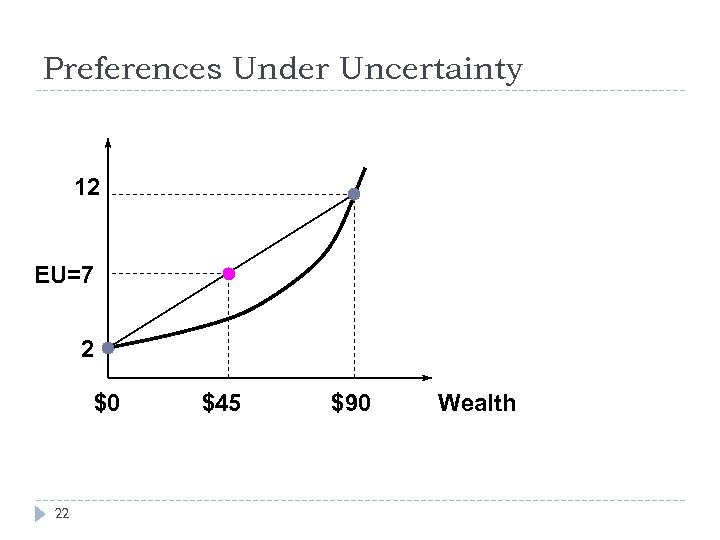 Preferences Under Uncertainty 12 EU=7 2 $0 22 $45 $90 Wealth
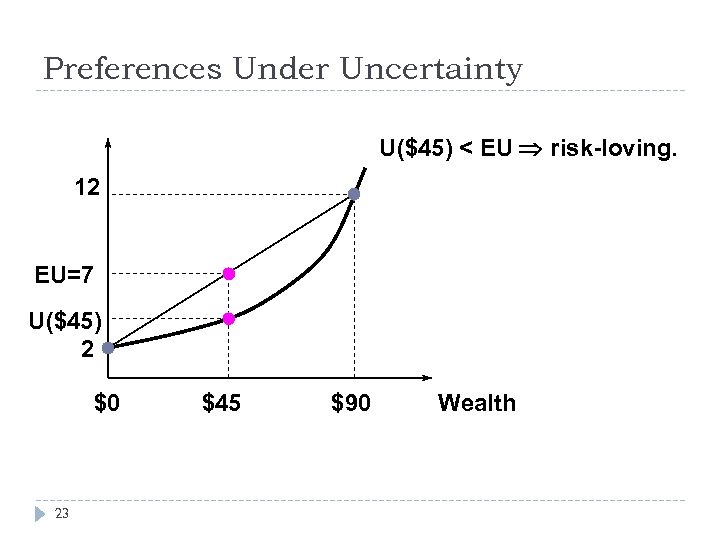 Preferences Under Uncertainty U($45) < EU risk-loving. 12 EU=7 U($45) 2 $0 23 $45 $90 Wealth
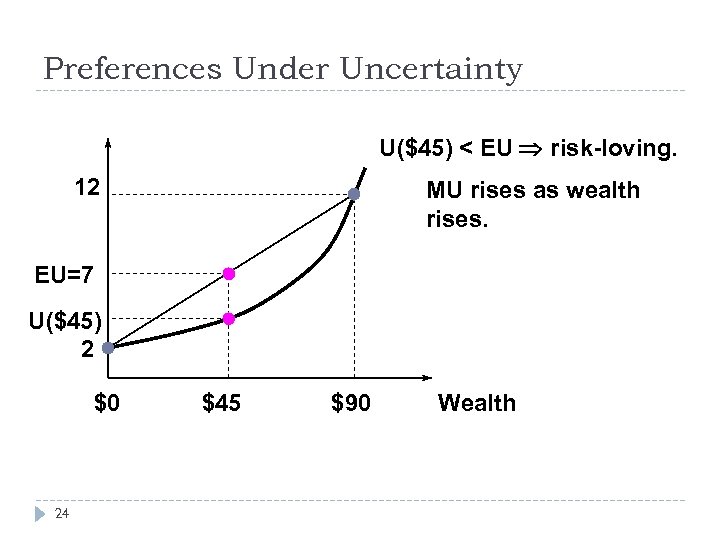 Preferences Under Uncertainty U($45) < EU risk-loving. 12 MU rises as wealth rises. EU=7 U($45) 2 $0 24 $45 $90 Wealth
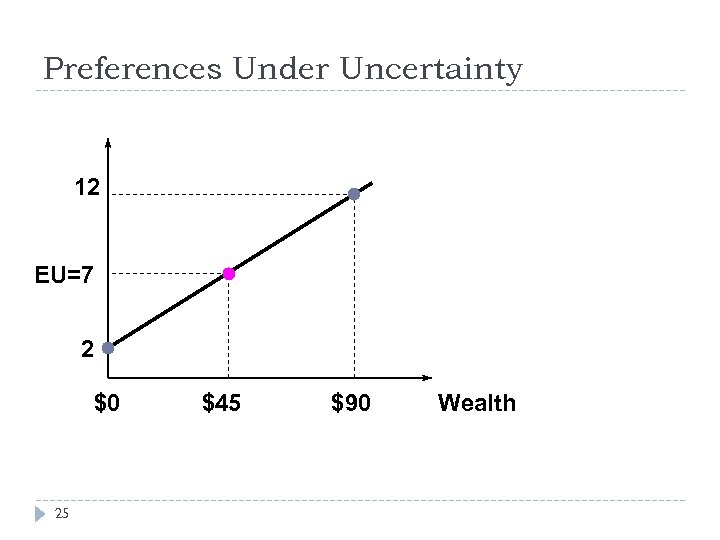 Preferences Under Uncertainty 12 EU=7 2 $0 25 $45 $90 Wealth
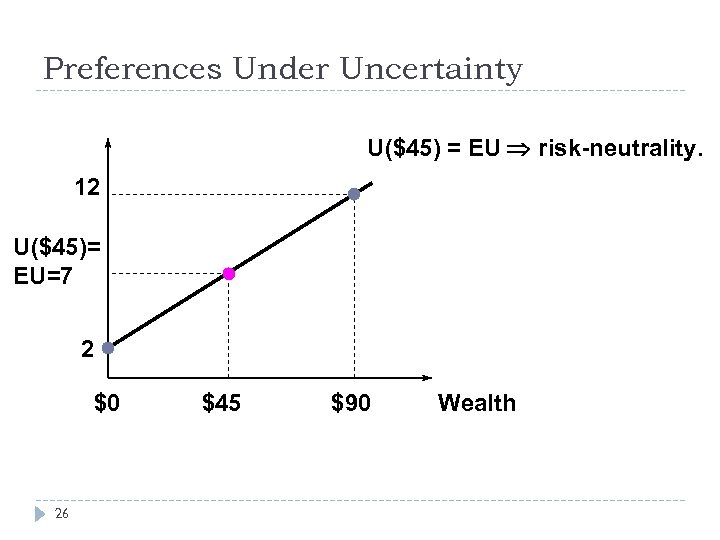 Preferences Under Uncertainty U($45) = EU risk-neutrality. 12 U($45)= EU=7 2 $0 26 $45 $90 Wealth
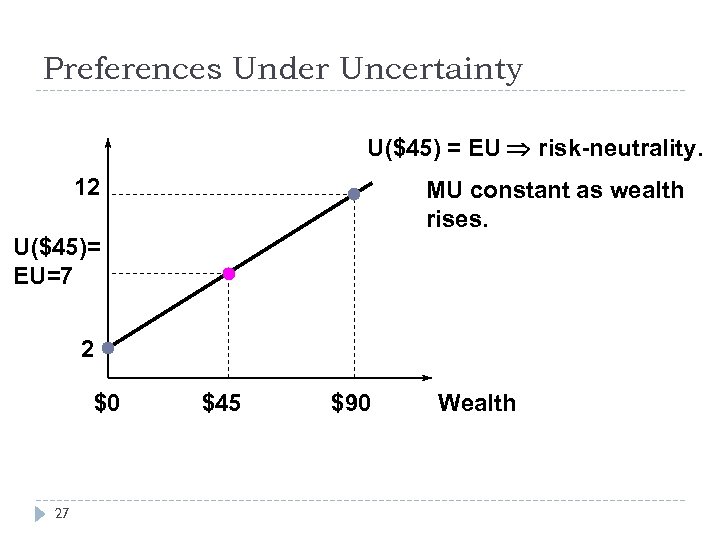 Preferences Under Uncertainty U($45) = EU risk-neutrality. 12 MU constant as wealth rises. U($45)= EU=7 2 $0 27 $45 $90 Wealth
 Preferences Under Uncertainty State-contingent consumption plans that give equal expected utility are equally preferred. 28
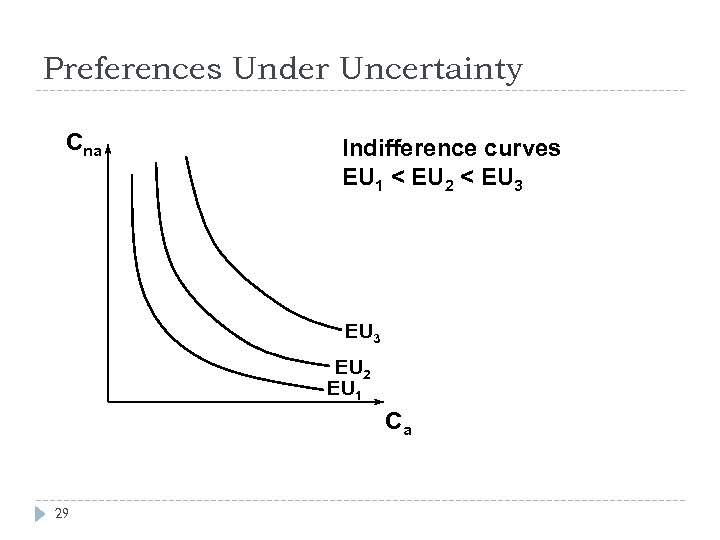 Preferences Under Uncertainty Cna Indifference curves EU 1 < EU 2 < EU 3 EU 2 EU 1 Ca 29
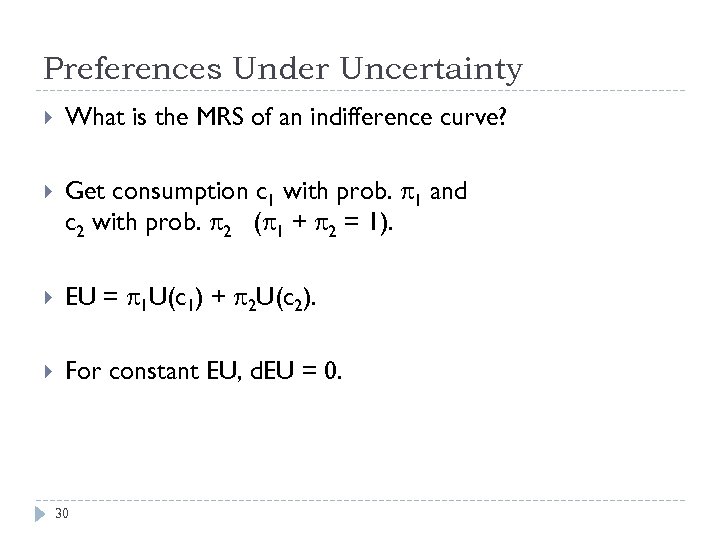 Preferences Under Uncertainty What is the MRS of an indifference curve? Get consumption c 1 with prob. 1 and c 2 with prob. 2 ( 1 + 2 = 1). EU = 1 U(c 1) + 2 U(c 2). For constant EU, d. EU = 0. 30
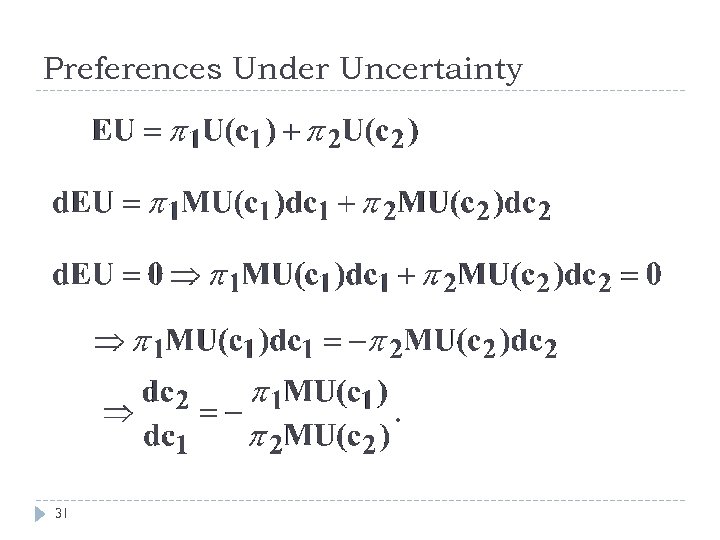 Preferences Under Uncertainty 31
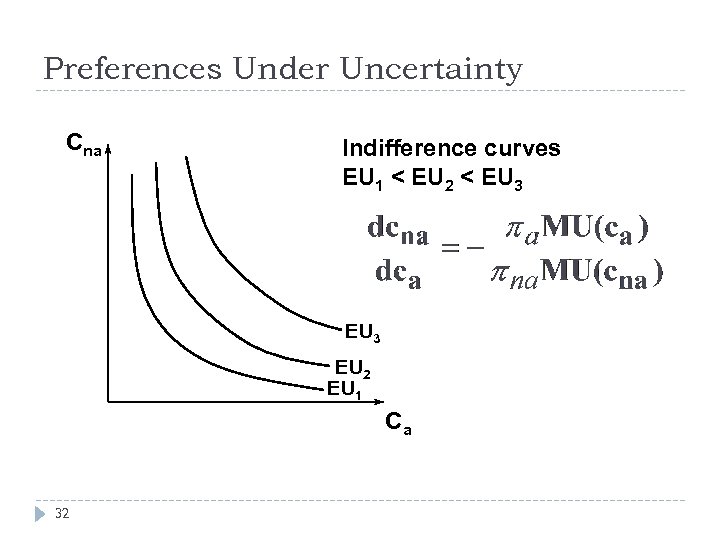 Preferences Under Uncertainty Cna Indifference curves EU 1 < EU 2 < EU 3 EU 2 EU 1 Ca 32
 Choice Under Uncertainty Q: How is a rational choice made under uncertainty? A: Choose the most preferred affordable state-contingent consumption plan. 33
 State-Contingent Budget Constraints Cna m The endowment bundle. Where is the most preferred state-contingent consumption plan? Ca 34
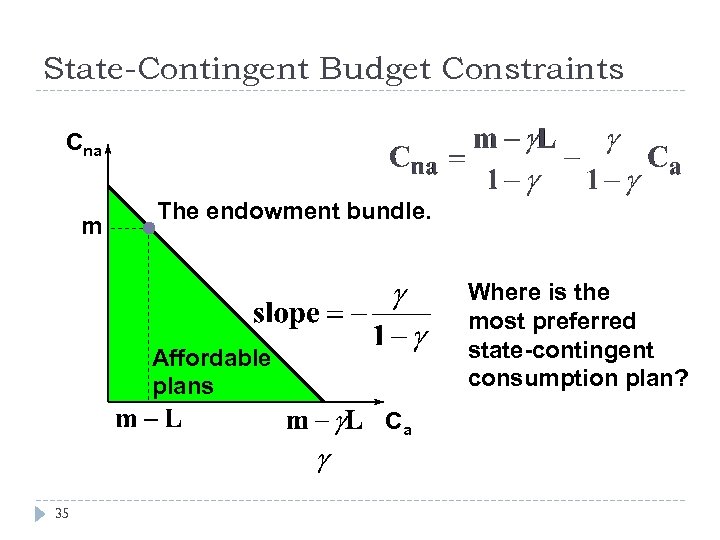 State-Contingent Budget Constraints Cna m The endowment bundle. Where is the most preferred state-contingent consumption plan? Affordable plans Ca 35
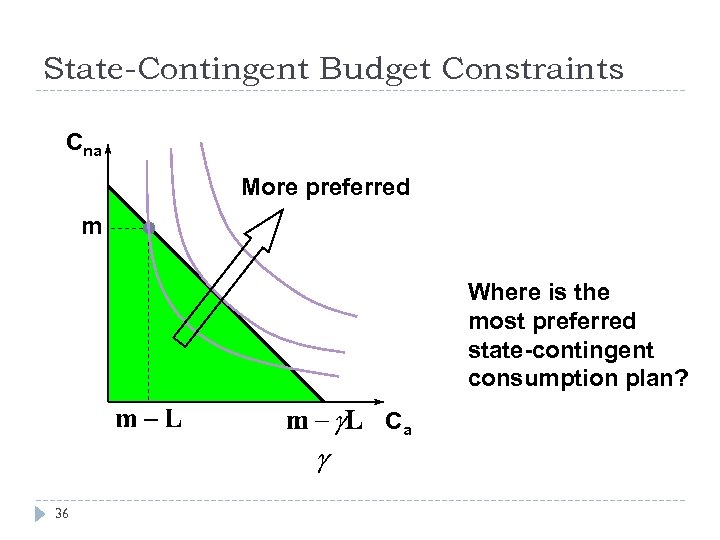 State-Contingent Budget Constraints Cna More preferred m Where is the most preferred state-contingent consumption plan? Ca 36
 State-Contingent Budget Constraints Cna Most preferred affordable plan m Ca 37
 State-Contingent Budget Constraints Cna Most preferred affordable plan m Ca 38
 State-Contingent Budget Constraints Cna m Most preferred affordable plan MRS = slope of budget constraint Ca 39
 State-Contingent Budget Constraints Cna m Most preferred affordable plan MRS = slope of budget constraint; i. e. Ca 40
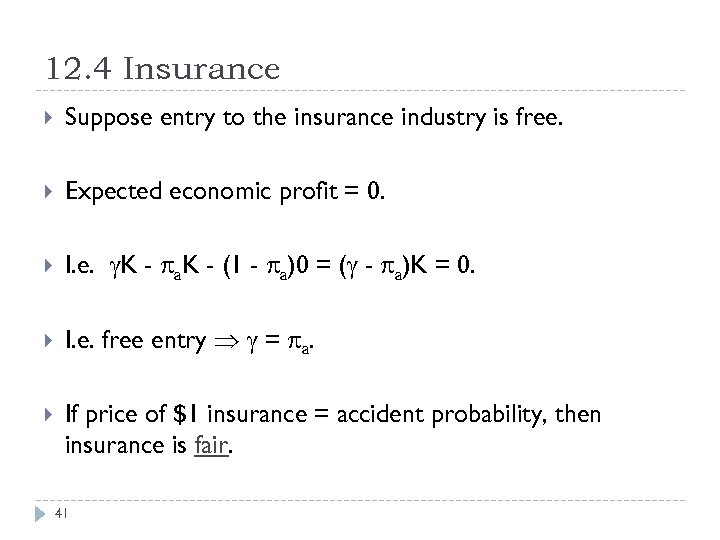 12. 4 Insurance Suppose entry to the insurance industry is free. Expected economic profit = 0. I. e. K - a. K - (1 - a)0 = ( - a)K = 0. I. e. free entry = a. If price of $1 insurance = accident probability, then insurance is fair. 41
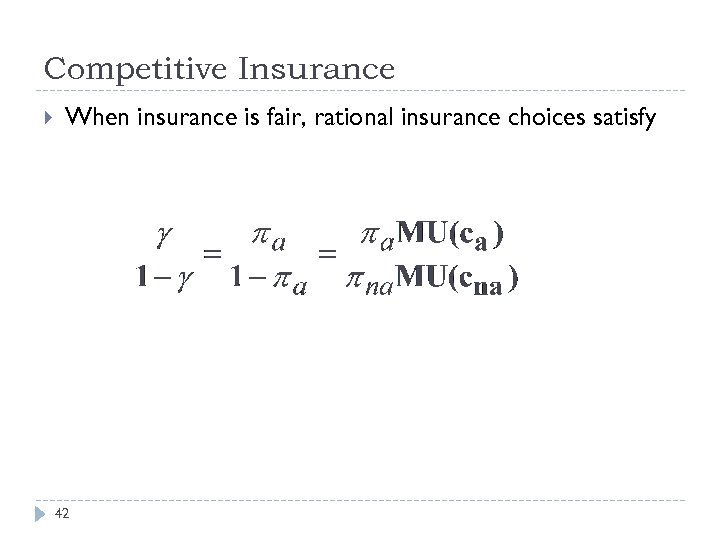 Competitive Insurance When insurance is fair, rational insurance choices satisfy 42
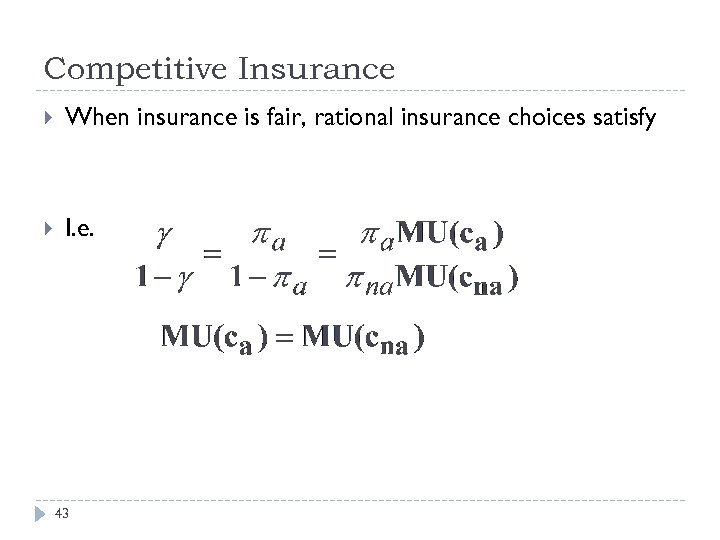 Competitive Insurance When insurance is fair, rational insurance choices satisfy I. e. 43
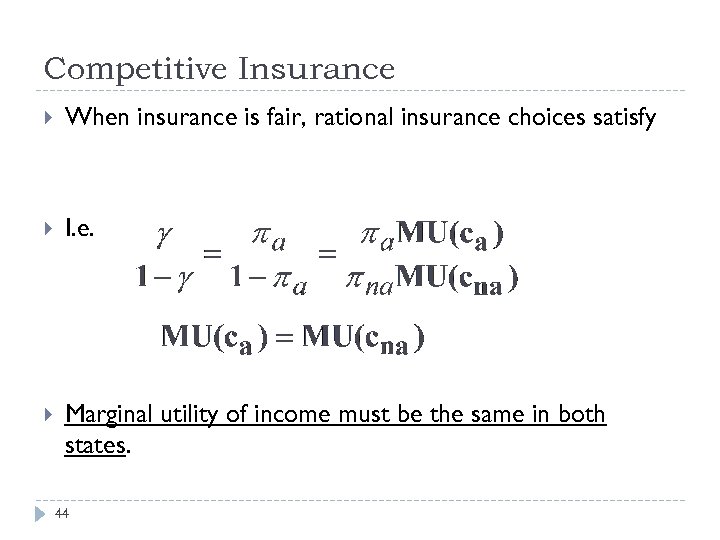 Competitive Insurance When insurance is fair, rational insurance choices satisfy I. e. Marginal utility of income must be the same in both states. 44
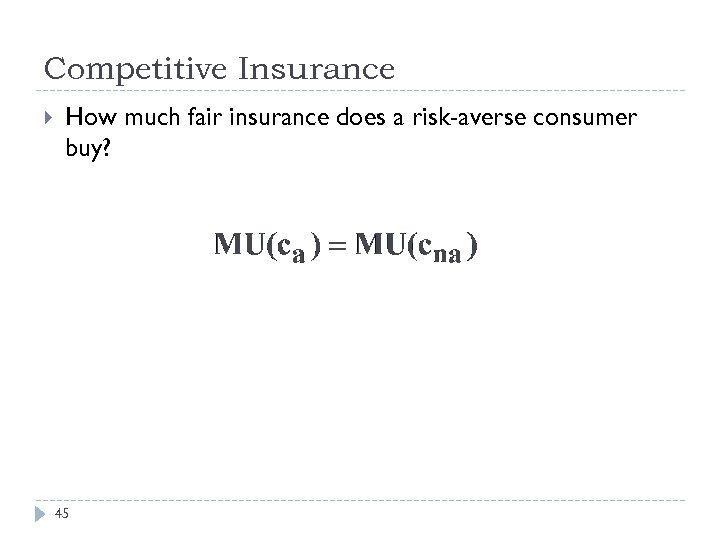 Competitive Insurance How much fair insurance does a risk-averse consumer buy? 45
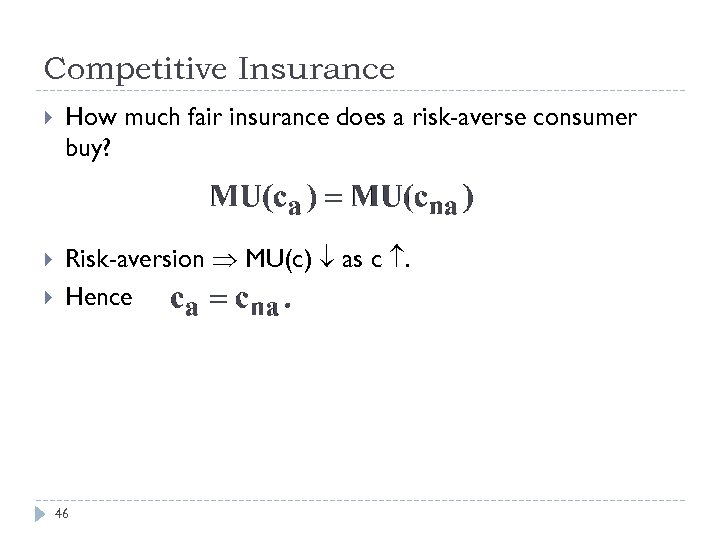 Competitive Insurance How much fair insurance does a risk-averse consumer buy? Risk-aversion MU(c) as c . Hence 46
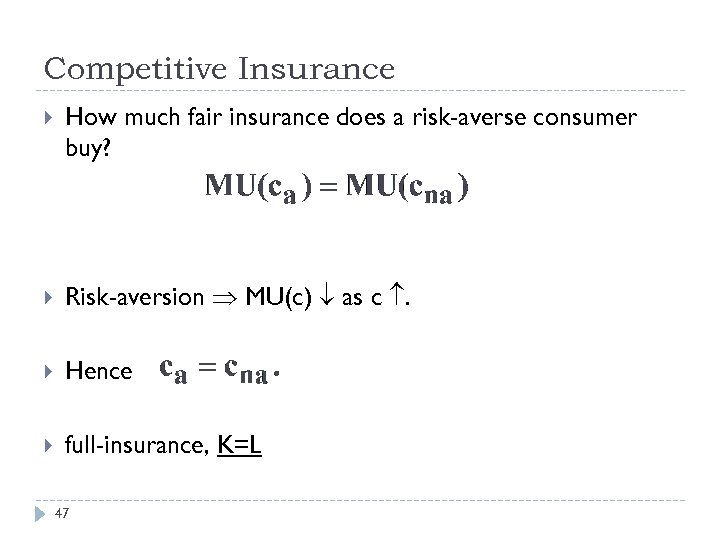 Competitive Insurance How much fair insurance does a risk-averse consumer buy? Risk-aversion MU(c) as c . Hence full-insurance, K=L 47
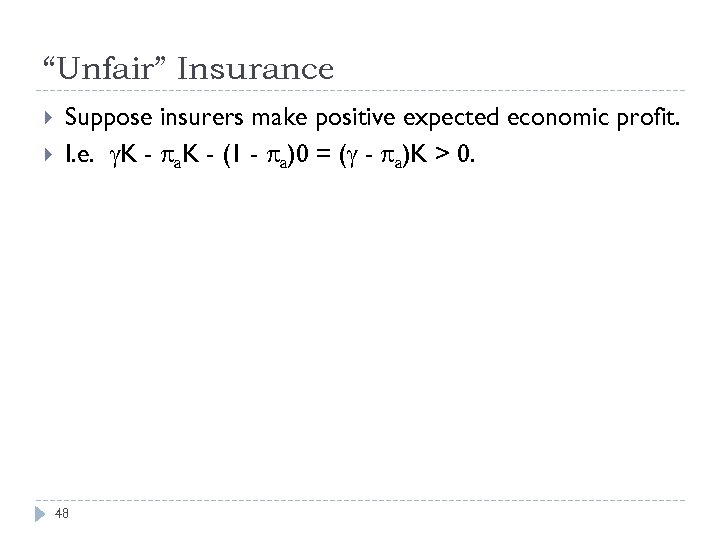 “Unfair” Insurance Suppose insurers make positive expected economic profit. I. e. K - a. K - (1 - a)0 = ( - a)K > 0. 48
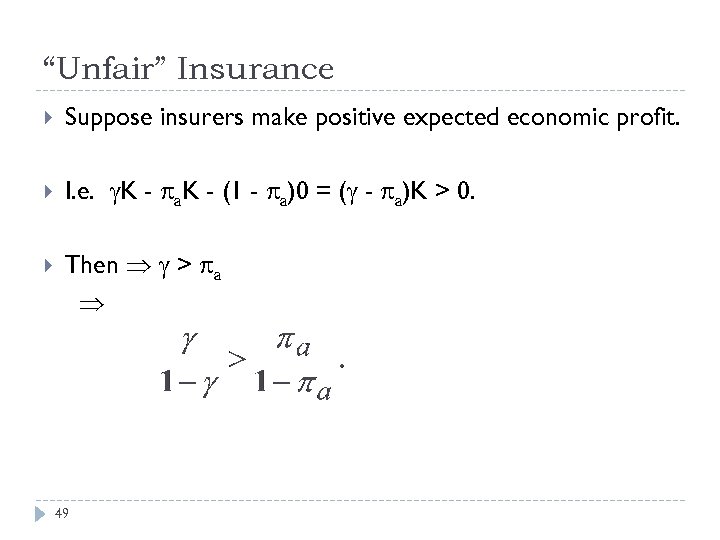 “Unfair” Insurance Suppose insurers make positive expected economic profit. I. e. K - a. K - (1 - a)0 = ( - a)K > 0. Then > a 49
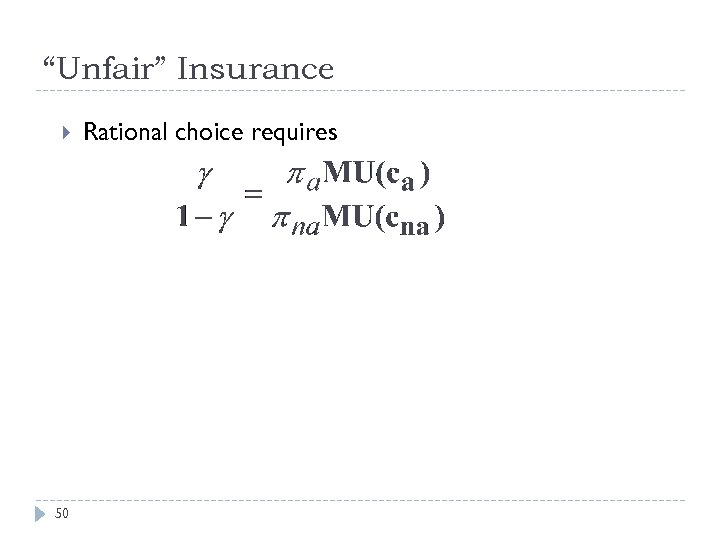 “Unfair” Insurance 50 Rational choice requires
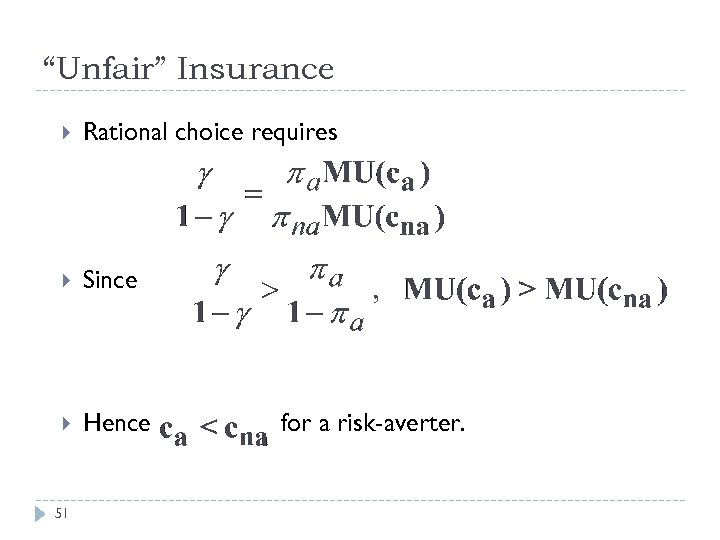 “Unfair” Insurance Rational choice requires Since Hence 51 for a risk-averter.
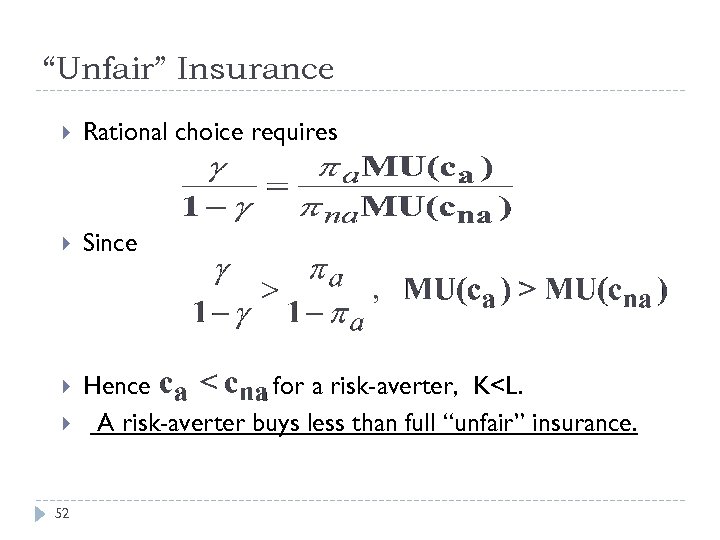 “Unfair” Insurance Rational choice requires Since Hence for a risk-averter, K
 12. 5 Diversification Two firms, A and B. Shares cost $10. With prob. 1/2 A’s profit is $100 and B’s profit is $20. With prob. 1/2 A’s profit is $20 and B’s profit is $100. You have $100 to invest. How? 53
 Diversification 54 Buy only firm A’s stock? $100/10 = 10 shares. You earn $1000 with prob. 1/2 and $200 with prob. 1/2. Expected earning: $500 + $100 = $600
 Diversification 55 Buy only firm B’s stock? $100/10 = 10 shares. You earn $1000 with prob. 1/2 and $200 with prob. 1/2. Expected earning: $500 + $100 = $600
 Diversification 56 Buy 5 shares in each firm? You earn $600 for sure. Diversification has maintained expected earning and lowered risk.
 Diversification 57 Buy 5 shares in each firm? You earn $600 for sure. Diversification has maintained expected earning and lowered risk. Typically, diversification lowers expected earnings in exchange for lowered risk.