


 Скачать презентацию Chapter 12 The Hellenistic World Words Terms and
55b2f9403da76d04493e89ac7da45177.ppt
- Количество слайдов: 34
 Chapter 12 The Hellenistic World Words, Terms and People to Know u Euclid u Alliance u Factories u Ptolemies u Hellenes u Archimedes u Xerxes u Phalanx u King Philip u Barbaroi u Chaeronea u Breakwaters u Indus River u Orator u Alexandria u Hostage u Eratosthenes 1
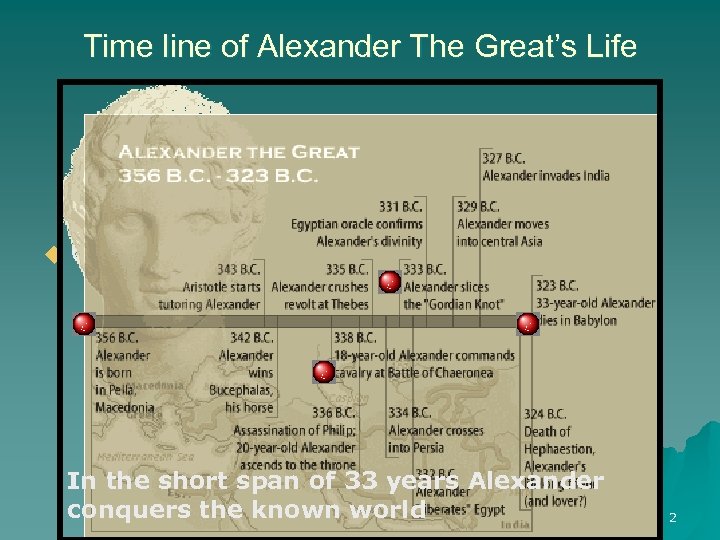 Time line of Alexander The Great’s Life u Or…What have you done lately? In the short span of 33 years Alexander conquers the known world 2
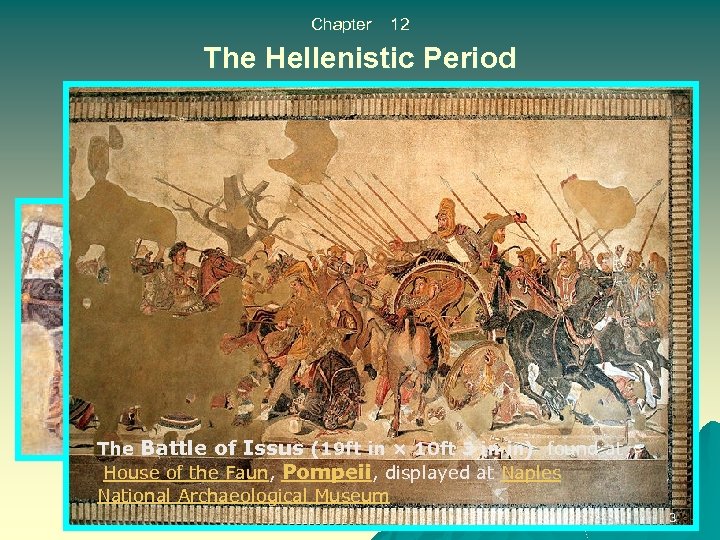 Chapter 12 The Hellenistic Period 335 B. C. – 145 B. C. pages 192– 201 u Hellenic: of or relating to the ancient Hellenes, their language, or their history; Greek u Hellenistic: relating to or characteristic of the classical Greek civilization-”Greek like” The Battle of Issus (19 ft in × 10 ft 3 in in) found at House of the Faun, Pompeii, displayed at Naples National Archaeological Museum 3
 Alexander the Great and the Gordian Knot: or how an man of action handles problems On the night before the marriage was consummated, the bride (Olympias, Alexander’s mother) dreamed that there was a crash of thunder, that her womb was struck by a thunderbolt, and that there followed a blinding flash from which a great sheet of flame blazed up and spread far and wide before it finally died away. Plutarch, Life of Alexander, 4
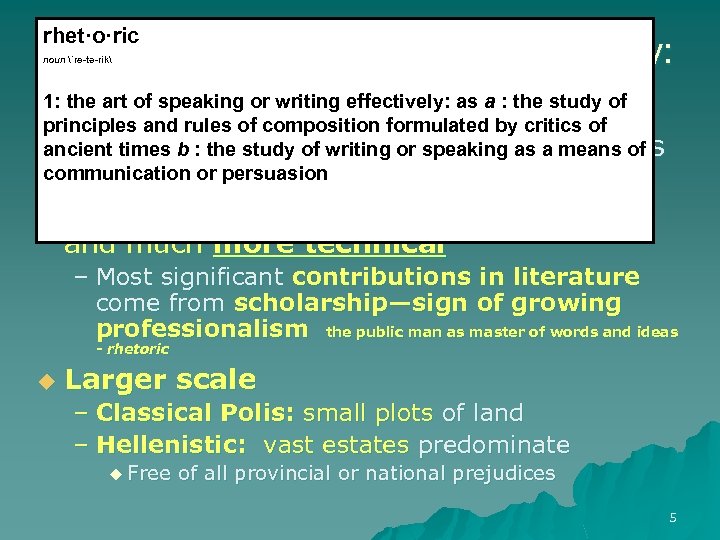 rhet·o·ric Hellenistic Period is Characterized By: noun ˈre-tə-rik 1: the art of speaking or writing effectively: as a : the study of u Broadening of thought principles and rules of composition formulated by critics of u Movement away of writing or speaking as The polis ancient times b : the study from the polis. a means of communication orto the cosmopolis gives way persuasion u More individualism, less imagination, and much more technical – Most significant contributions in literature come from scholarship—sign of growing professionalism the public man as master of words and ideas - rhetoric u Larger scale – Classical Polis: small plots of land – Hellenistic: vast estates predominate u Free of all provincial or national prejudices 5
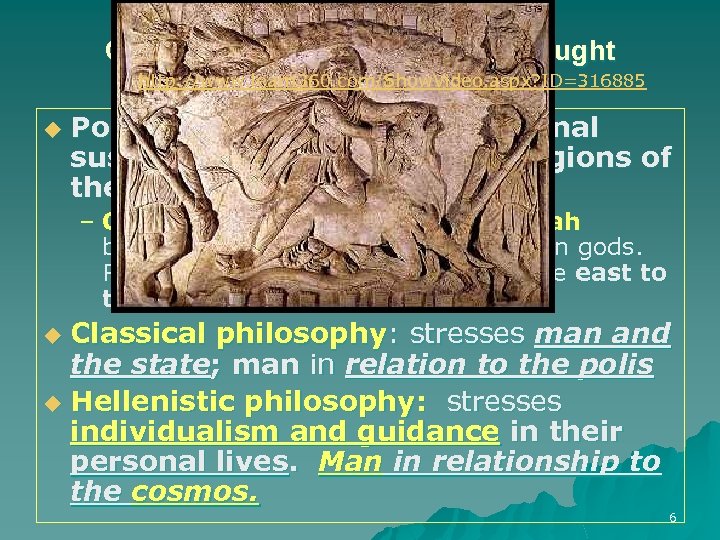 Greek Gods Give Way--Greek Thought http: //www. learn 360. com/Show. Video. aspx? ID=316885 Changes u Poor seek spiritual and emotional sustenance in the mystery religions of the east – Cults: Mithras Persian diety, Jehovah becomes most accepted of the eastern gods. Religious influences now flow from the east to the west (later Christianity). Classical philosophy: stresses man and the state; man in relation to the polis u Hellenistic philosophy: stresses individualism and guidance in their personal lives. Man in relationship to the cosmos. u 6
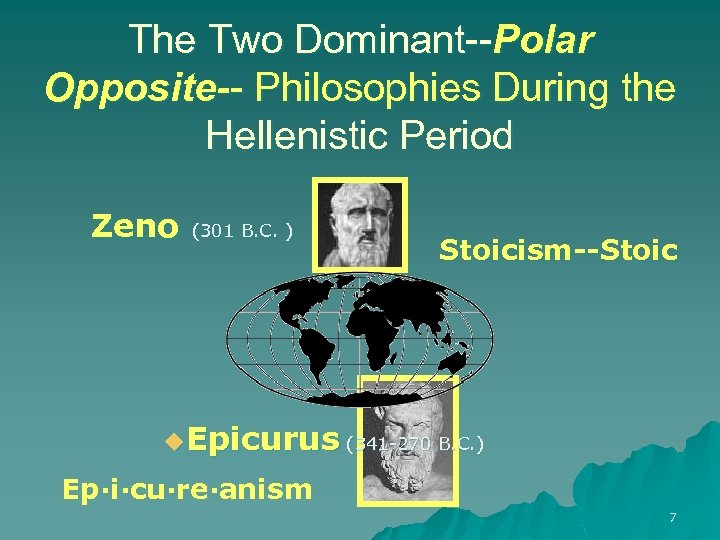 The Two Dominant--Polar Opposite-- Philosophies During the Hellenistic Period Zeno (301 B. C. ) Stoicism--Stoic u. Epicurus (341 -270 B. C. ) Ep·i·cu·re·anism 7
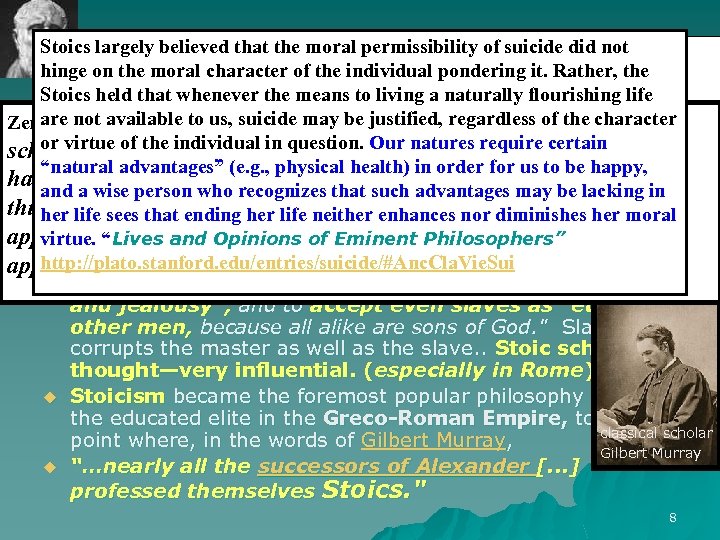 Stoics largely believed that the moral permissibility of suicide did not Sto·ic (stk) hinge on the moral character of the individual pondering it. Rather, the n. 1. One who that whenever the means to living a grief, pleasure, or pain. Stoics held is seemingly indifferent to or unaffected by joy, naturally flourishing life 2. Stoic A member of an originally Greek school of philosophy, founded by Zeno about 308 b. c. , believing are notaround 264 BC. Laërtius reports about his death: "Asthe acceptance Zeno that God determined everything for the best. Its later Roman form advocated the calm characterof all died available to us, suicide may be justified, regardless of he left the occurrences as the unavoidable result of or of the natural order. or virtue of the individual )singledivine will. Hitting the ground with his u Zeno (301 B. C. broke a toe. natures require certain divine school, he tripped, fell andin question. Our plan. Be patient in “natural advantages” (e. g. , physical health) in order for us to be happy, adversity. Tolerance is a virtue hand, hewise person who recognizes that such. Brotherhood of me cited words of Niobe: "I am coming, why do you lacking call andmankind. “Man conquers the world by conquering in a advantages may be thus? ". Since that endingsagelife neither enhances nor diminishes her moral her himself" Stoic her was expected to always do what was life sees the appropriate (kathekon) and Zeno. Eminent Philosophers” he with virtue. “Livesconsists in a will which is in agreement felt it u "Virtue and Opinions of was very old at the time, Nature. " This consequently strangled himself. http: //plato. stanford. edu/entries/suicide/#Anc. Cla. Vie. Sui appropriate to die andprinciple also applies to the realm of interpersonal relationships; "to be free from anger, envy, and jealousy", and to accept even slaves as "equals of other men, because all alike are sons of God. " Slavery corrupts the master as well as the slave. . Stoic school of thought—very influential. (especially in Rome) u Stoicism became the foremost popular philosophy among the educated elite in the Greco-Roman Empire, to the classical scholar point where, in the words of Gilbert Murray, Gilbert Murray u “…nearly all the successors of Alexander [. . . ] professed themselves Stoics. " Hellenistic Philosophers 8
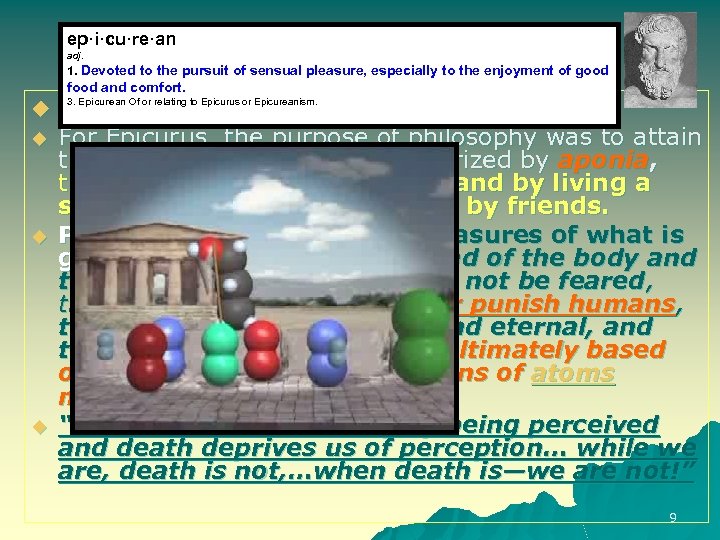 ep·i·cu·re·an adj. Another view of life 1. Devoted to the pursuit of sensual pleasure, especially to the enjoyment of good food and comfort. u u Epicurus (341 -270 B. C. ) 3. Epicurean Of or relating to Epicurus or Epicureanism. For Epicurus, the purpose of philosophy was to attain the happy, tranquil life, characterized by aponia, the absence of pain and fear, and by living a self-sufficient life surrounded by friends. Pleasure and pain are the measures of what is good and bad. Death is the end of the body and the soul and should therefore not be feared, that the gods do not reward or punish humans, that the universe is infinite and eternal, and that events in the world are ultimately based on the motions and interactions of atoms moving in empty space. “Good and bad exist only by being perceived and death deprives us of perception… while we are, death is not, …when death is—we are not!” 9
 Hellenism Triumphs u Alexander conquers a world he can not hold. u Hellenism does what Alexander can not—it binds a divergent world together. u Greek becomes the universal language and the conduit through which divergent cultures interact. u The world becomes more Greek and the Greeks open to new possibilities even as Greece suffers and declines. 10
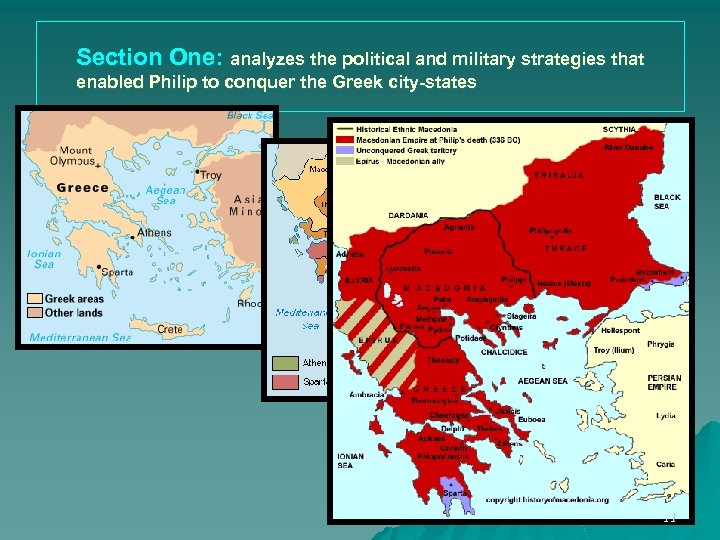 Section One: analyzes the political and military strategies that enabled Philip to conquer the Greek city-states 371 B. C 11
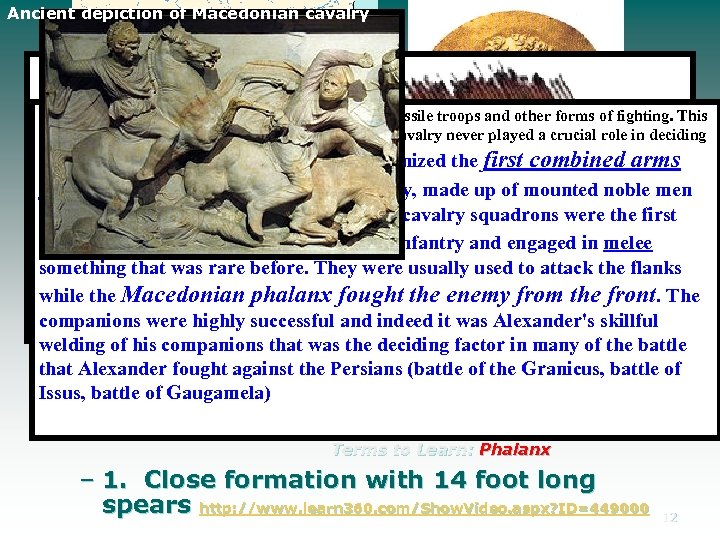 Ancient depiction of Macedonian cavalry I. Philip II of Macedonia Greek armies before Philip largely had disdain for missile troops and other forms of fighting. This u People to Know: Philip of Macedonia added to the hilly topography of Greece meant that cavalry never played a crucial role in deciding A. Learned to love Greek culture arms changed all this when he organized the first combined while a hostage in Thebes. army. He organized the companion cavalry, made up of mounted noble men armed with lances and swords. These elite cavalry squadrons were the first Macedonian kings were of Greek truedescent and admired their culturemelee use of shock cavalry, they charged infantry and engaged in something that was rare before. They were usually used to attack the flanks u B. Believed it to be his destiny to unify while the Macedonian phalanx fought the enemy from the front. The the Greek city-states maps companions were highly successful and indeed it was Alexander's skillful welding of his companions that was the deciding factor in many of the battle u C. Created a year-round, well that Alexander fought against the Persians (battle of the Granicus, battle of organized professional army Issus, battle of Gaugamela) u D. Develops the phalanx Terms to Learn: Phalanx u battles. Philip – 1. Close formation with 14 foot long spears http: //www. learn 360. com/Show. Video. aspx? ID=449000 12
 All speech is vain and empty unless it be accompanied by action. Demosthenes ". . . not only no Greek, nor related Beware lest in your anxiety to avoid war you obtain a master. to the Greeks, but not even a barbarian from any He who confers a favor should at once forget it, if he is not to show a sordid place that can be named with honors, but a ungenerous spirit. To remind a man of a kindness conferred and to talk of it, is pestilent knave from Macedonia, whence it was little different from reproach. Demosthenes never yet possible to buy a decent slave. " I. Continued Demosthenes –Small opportunities are often the beginning of great enterprises. Demosthenes 2. Philip’s army included slingsmen Demosthenes calvary and bowmen who could fight Philippic, 31 The easiest thing of all is to deceive one's self; for what a man wishes he Third in generally believes to be true. hilly Demosthenes areas Terms to Learn: Alliances The fact speak for themselves. – 3. Used tactic of divide and conquer Demosthenes u (a. ) married 6 -7 times to form political alliances u The man who has received a benefit ought always to remember it, but he who has granted it ought to forget the fact at once. E. Demosthenes tries to warn the Greeks about Philip There is a great deal of wishful thinking in such cases; it is quotes Demosthenes, First Olynthiac the easiest thing of all to deceive one’s self. speaking People to Know: Demosthenes Terms to Know Demosthenes, Olynthiac: Orator: person noted for skill in public Nothing is easier than self-deceit. For what each man wishes, that he also believes to be true. Demosthenes, Third Olynthiac You cannot have a proud and chivalrous spirit if your conduct is mean and paltry; for whatever a man's actions 13 are, such must be his spirit.
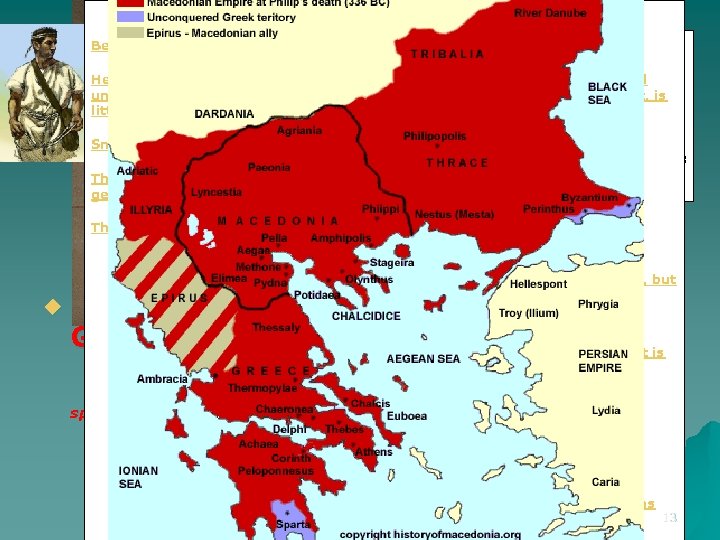
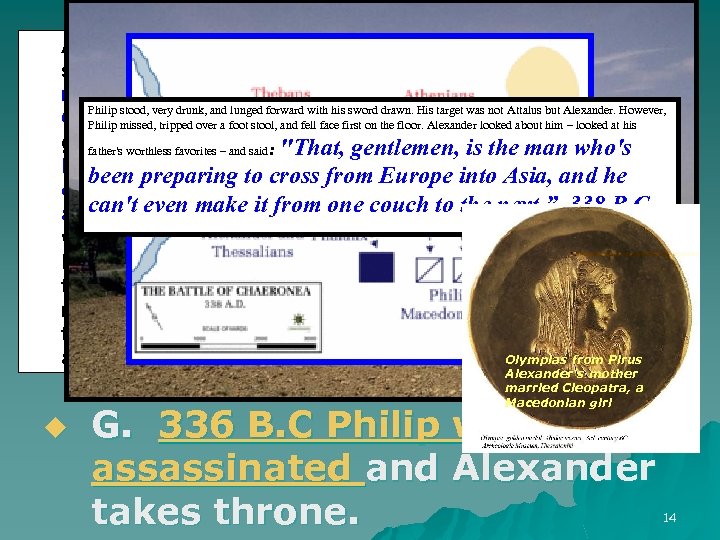 According to Polyaenus, the Macedonians used a stratagem. The right wing of their army slowly moved backwards, and the Athenians (on the Philip stood, very drunk, and lunged forward with his sword drawn. His target was not Attalus but Alexander. However, Greek left wing) moved forwards. This created a at his Philip missed, tripped over a foot stool, and fell face first on the floor. Alexander looked about him – looked gap in the Greek lines. When this gap opened, the father's worthless favorites – and said : "That, gentlemen, is the man who's Macedonian crown prince Alexander, who u been preparing to cross from Europe into Asia, and he commanded the left wing, immediately charged can't even make it from one couch to the next. ” 338 and broke through. He attacked the Greek right B. C. wing, which was occupied by the Theban "Sacred Band", which was massacred. This was the end of the battle - and the beginning of the spectacular military career of Alexander. The story is also told by Diodorus of Sicily, who stresses different Olympias from Pirus aspects of the fight More I. F. Greek army defeated at the battle of Chaeronea Alexander’s mother married Cleopatra, a Macedonian girl u G. 336 B. C Philip was assassinated and Alexander takes throne. 14
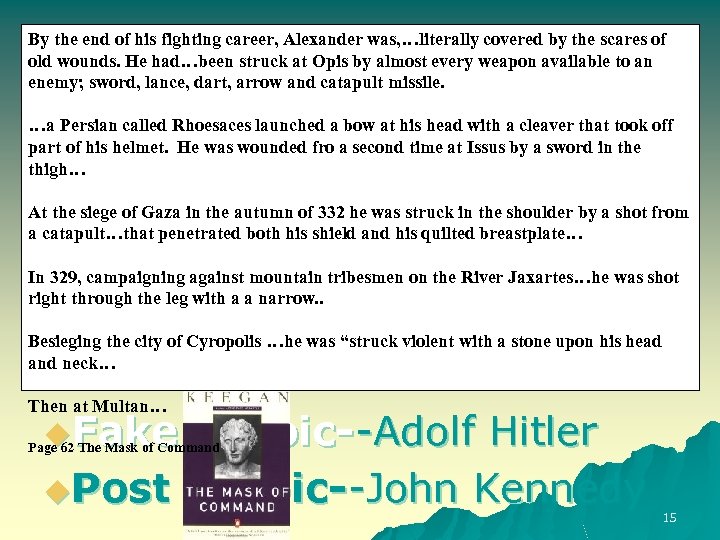 John Keegan and types of leadership By the end of his fighting career, Alexander was, …literally covered by the scares of old wounds. He had…been struck at Opis by almost every weapon available to an enemy; sword, lance, dart, arrow and catapult missile. u. Heroic—Alexander the Great —personal greatness u …a Persian called Rhoesaces launched a bow at his head with a cleaver that took off part of his helmet. He was wounded fro a second time at Issus by a sword in the thigh… u “The Man Who Would Not Drink Alone” p. 657 Book of Virtues At the siege of Gaza in the autumn of 332 he was struck in the shoulder by a shot from a catapult…that penetrated both his shield and his quilted breastplate… u. Anti-heroic--Duke of Wellington --tool of the state In 329, campaigning against mountain tribesmen on the River Jaxartes…he was shot right through the leg with a a narrow. . Unheroic –U. S. Grant-familiar Besieging the city of Cyropolis …he was “struck violent with a stone upon his head u and neck… reverence Then at Multan… u. Fake Heroic--Adolf Hitler u. Post Heroic--John Kennedy Page 62 The Mask of Command 15
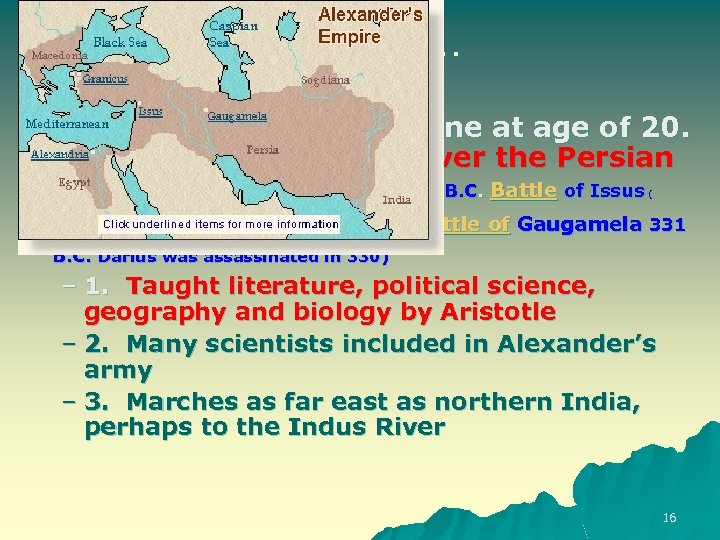 Still More… u H. Alexander takes throne at age of 20. First great victory was over the Persian Empire. (Battle of Granicus 334 B. C. Battle of Issus ( captures Darius's wife, mother, and three children) 333 BC. Battle of Gaugamela 331 B. C. Darius was assassinated in 330) – 1. Taught literature, political science, geography and biology by Aristotle – 2. Many scientists included in Alexander’s army – 3. Marches as far east as northern India, perhaps to the Indus River 16
 Alexander the Great was the son of the Macedonian king. Learn how Alexander became a great commander after his father's death. See how he built his empire without losing a battle. 4: 06 17
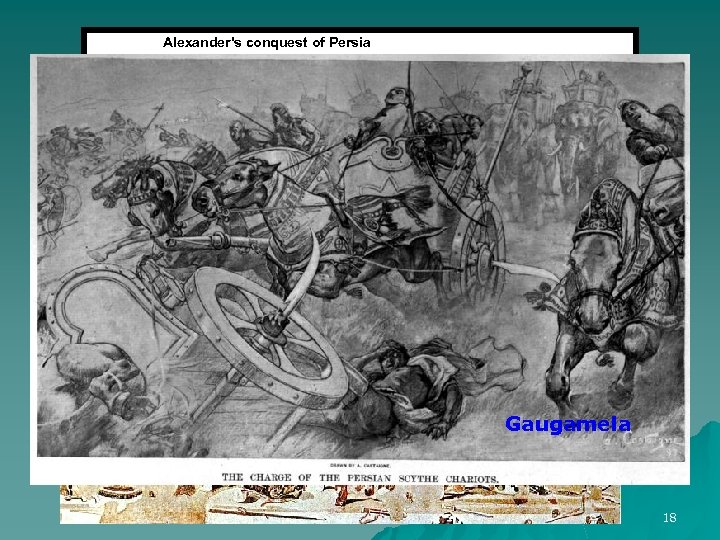 Alexander's conquest of Persia In 334 BC the Macedonian king Alexander III (reigned 336 -323 BC) led his forces into Asia. At the River Granicus he routed a Persian army before capturing the coastal cities of western Anatolia. Moving inland in 333 BC he reached Gordian and continued towards Syria where, at the Battle of Issus, the Persian forces under Darius III (reigned 336 -332/330 BC) were defeated. Alexander advanced along the Mediterranean coast in 332 BC capturing the Phoenician cities before moving into Egypt where he was crowned as Pharaoh. The following year Alexander returned to the Levant and into north Mesopotamia. At Gaugamela he again defeated Darius III and advanced to Babylon and Susa. Gaugamela 18
 The Battle of the Persian Gates and the Sack of Perseopolis Alexander's army had been reinforced in a level of about 80 thousand. This army traveled south along the plains at the foot of the Zagros Mountains. It was winter and Alexander stopped at Sussian Rocks. Here he split out 20 thousand to follow him through the mountains to Persepolis. The rest of the army under Parmenion, a trusted general from Philip's time, were to take the long route to the south around the mountains. Alexander's route was uneventful until they came to the defile leading out of the mountains. This was called the Persian Gates. The Persians had fortified the exit. Alexander's army was trapped. But again Alexander was resourceful. From a local shepherd he found that there was another trail out. The shepherd did not think it was passable by an army but Alexander took the chance and what is more amazing he took the trail at night. 19
 Alexander's emerged behind above the Persian guarding the fortification at the Persian Gates. The Persians were overwhelmed. Some five thousand managed to escape but the rest of the Persians were slaughtered. The city of Persepolis was now defenseless. Alexander's army occupied Persepolis and took possession of the Persian treasury there. The gold Alexander acquired was sufficient to finance any campaign he chose to launch. After a period of drinking binges at Persepolis Alexander decided to leave and torched the palace. Although Alexander has been known as The Great to Europeans, to Persians his image was more like that of Attila the Hun among Western Europeans. Interestingly enough within the territories ruled by Attila he image is that a wise and benevolent monarch. Alexander's image is further complicated because there is reference to him in the Holy Koran. The Arabic version of Alexander is Iskandar and it is a not uncommon name throughout the Middle East. Incidentally the name of the Afghan city of Kandihar is basically 20 Alexandria.
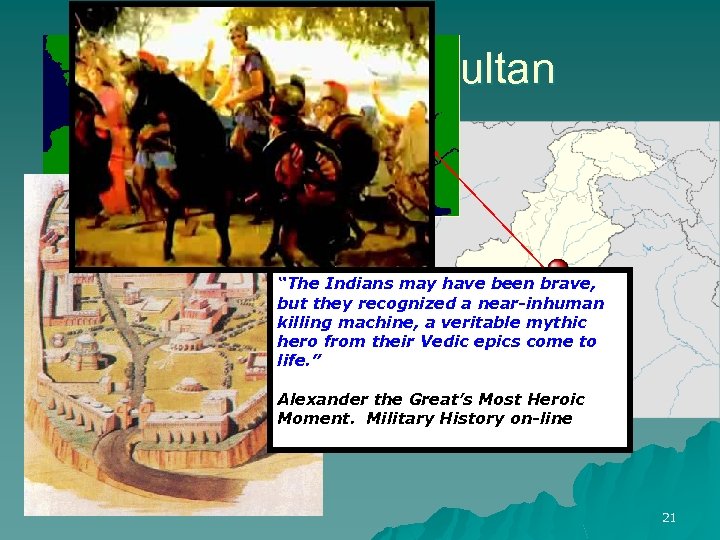 Alexander at Multan “The Indians may have been brave, but they recognized a near-inhuman killing machine, a veritable mythic hero from their Vedic epics come to life. ” Alexander the Great’s Most Heroic Moment. Military History on-line 21
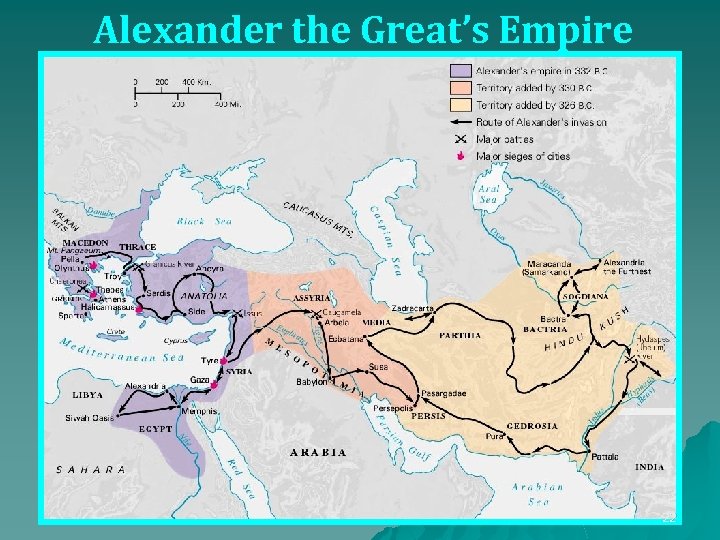 Alexander the Great’s Empire 22
 Alexander the Great was a wise, strict commander who never lost a battle. Learn how this Macedonian led his army to create a huge empire. Discover how bringing together Greece and the Middle East started the Hellenistic Age 22 min. 23
 Section 2: Discuss how Alexander attempted to bring unity to his empire, and describes how Alexander’s empire changed after his death u II. Alexander’ Empire – A. Dreamed of bringing all people together in peace to achieve his goal was to unite Macedonians, Greeks and Persians. Extends as far east as the Indus River – B. invites Persians into his army and he and his soldiers marry Persian women. – C. Alexander begins to claim he is a god p. 196 – D. Greeks object to equal treatment of Persians – E. Greeks looked down upon people who did not speak Greek or follow Greek customs calling them barbaroi--barbarians Term to know: Barbaroi – F. Alexander not successful in uniting the various people 24
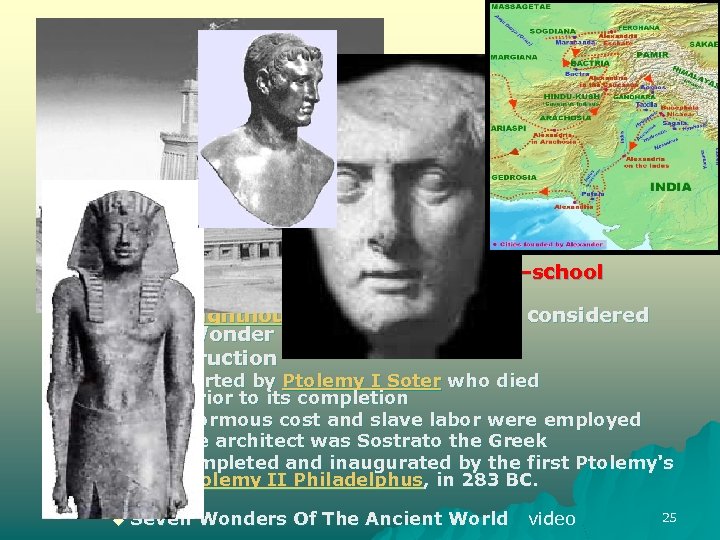 More II. u G. Alexandria – 1. Alexander founds more than 70 cities, 16 bear his name. – 2. encouraged Greeks and Macedonians to settle in the new cities – 3. Alexanderia had 2 great harbors protected by breakwaters. – 4. palace and a school with a library—school known as the Museum – 5. This Lighthouse of Alexandria was considered the 7 th Wonder of the ancient world – 6. Construction a. ) Started by Ptolemy I Soter who died prior to its completion u b. ) Enormous cost and slave labor were employed u C. ) The architect was Sostrato the Greek u d. ) Completed and inaugurated by the first Ptolemy's son, Ptolemy II Philadelphus, in 283 BC. u u Seven Wonders Of The Ancient World video 25
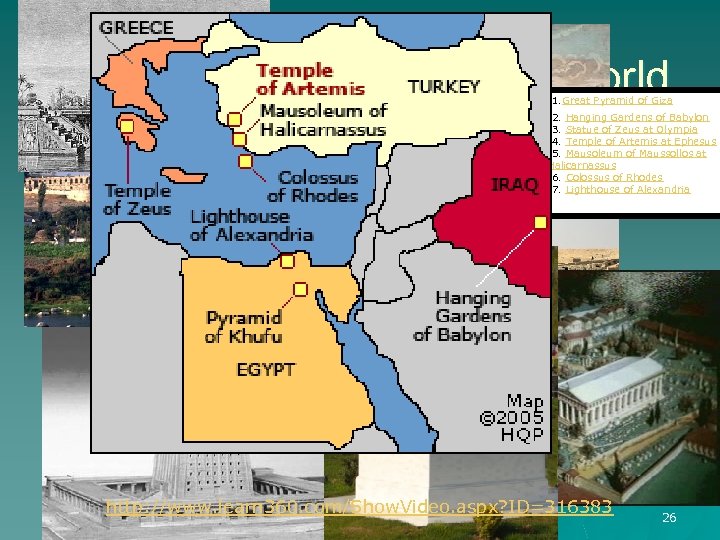 7 Wonders of the Ancient World · 1. Great Pyramid of Giza · 2. Hanging Gardens of Babylon · 3. Statue of Zeus at Olympia · 4. Temple of Artemis at Ephesus · 5. Mausoleum of Maussollos at Halicarnassus · 6. Colossus of Rhodes · 7. Lighthouse of Alexandria http: //www. learn 360. com/Show. Video. aspx? ID=316383 26
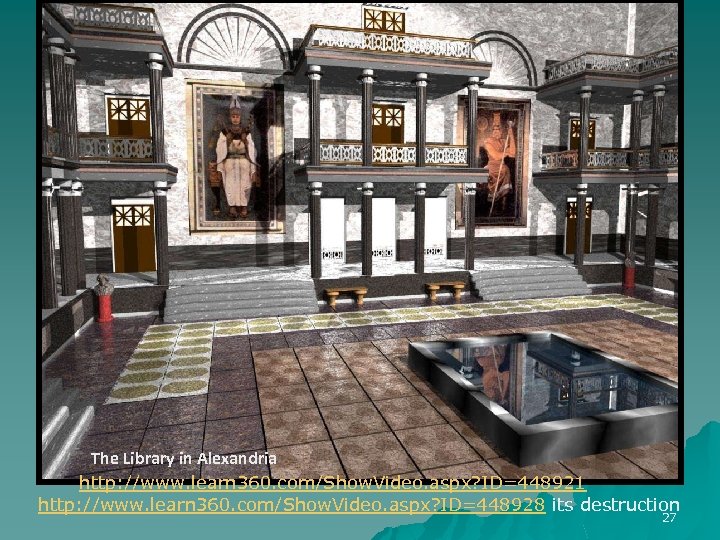 II. continued H. The lighthouse was reached from Alexandria's harbor through an approach that extended 3. 5 km and connected the city with Pharos Island. it consisted of a monumental edifice with three tiers, consisting of a lower quadrangular one, surmounted by an octagonal layer and topped by a cylindrical section. The approach to its entrance was by way of a long ramp with vaulted arcades. Within, a large spiral ramp led to some fifty service rooms in the third tier were wood was used to burn a fire that acted as the light source, which could be seen from almost 100 miles out to sea u I. Library had largest collection of books in ancient times u J. becomes the cultural and intellectual center of empire u K. Euclid wrote his geometry book there u L. Eratosthenes reasoned a ship could reach India by sailing west while in the library u M. Archimedes and Hero invented many useful machines there. The Library in Alexandria http: //www. learn 360. com/Show. Video. aspx? ID=448921 http: //www. learn 360. com/Show. Video. aspx? ID=448928 its destruction u 27
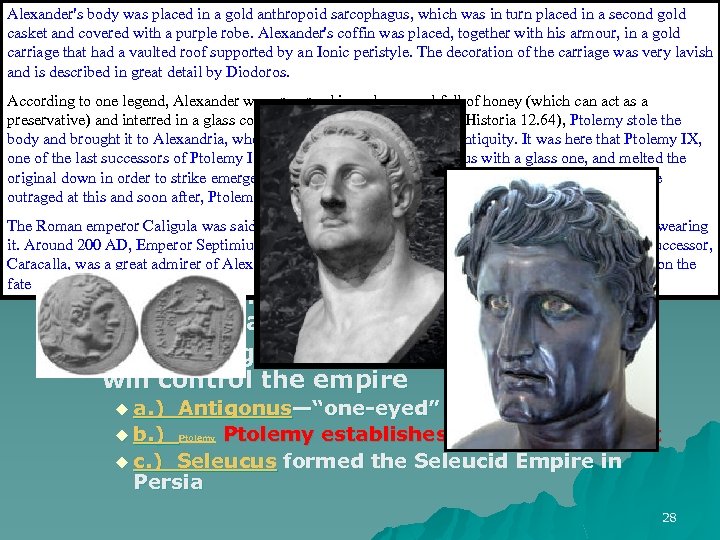 Alexander's body was placed in a gold anthropoid sarcophagus, which was in turn placed in a second gold casket and covered with a purple robe. Alexander's coffin was placed, together with his armour, in a gold carriage that had a vaulted roof supported by an Ionic peristyle. The decoration of the carriage was very lavish and is described in great detail by Diodoros. II. Continued According to one legend, Alexander was preserved in a clay vessel full of honey (which can act as a preservative) and interred in a glass coffin. According to Aelian (Varia Historia 12. 64), Ptolemy stole the u body and brought it to Alexandria, where it was on display until Late Antiquity. It was here that Ptolemy IX, – 1. 323 B. C. Alexander becomes ill in one of the last successors of Ptolemy I, replaced Alexander's sarcophagus with a glass one, and melted the original down in order to strike emergency gold issues of his coinage. The citizens of Alexandria were Babylon and dies at 33 writings outraged at this and soon after, Ptolemy IX was killed. N. End of the Empire – 2. His empire extended 22, 000 miles from The Roman emperor Caligula was said to have looted the tomb, stealing Alexander's breastplate, and wearing it. Around 200 the Nile to the Indus AD, Emperor Septimius Severus closed Alexander's tomb to the public. His son and successor, Caracalla, was a great admirer of Alexander, and visited the tomb in his own reign. After this, details on the – 3. Body wrapped in gold and placed in a fate of the tomb are sketchy. glass coffin in the Royal Tombs of Alexanderia – 4. Fighting breaks out to determine who will control the empire u a. ) Antigonus—“one-eyed” king of Macedonia u b. ) Ptolemy establishes a dynasty in Egypt u c. ) Seleucus formed the Seleucid Empire in Persia 28
 After eleven years of battle, Alexander the Great had created a huge empire. Explore the steps he took to unify his territory and the people under his power. Observe how his untimely death affected control in his empire. 3: 29 29
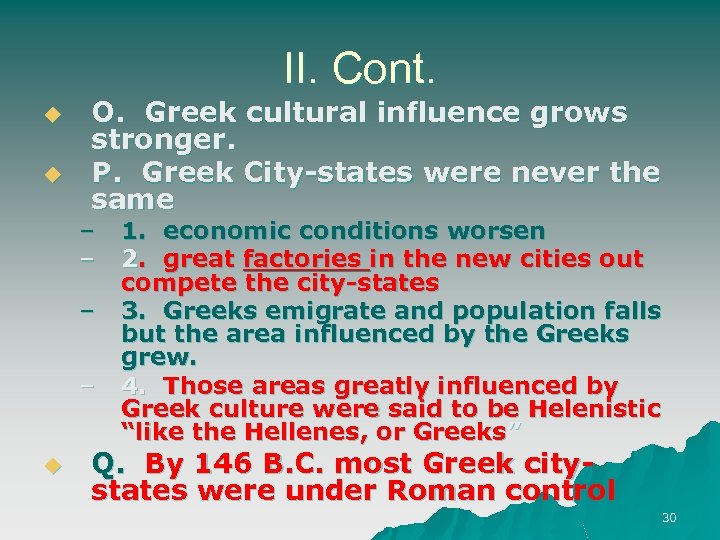 II. Cont. u u O. Greek cultural influence grows stronger. P. Greek City-states were never the same – – u 1. economic conditions worsen 2. great factories in the new cities out compete the city-states 3. Greeks emigrate and population falls but the area influenced by the Greeks grew. 4. Those areas greatly influenced by Greek culture were said to be Helenistic “like the Hellenes, or Greeks” Q. By 146 B. C. most Greek citystates were under Roman control 30
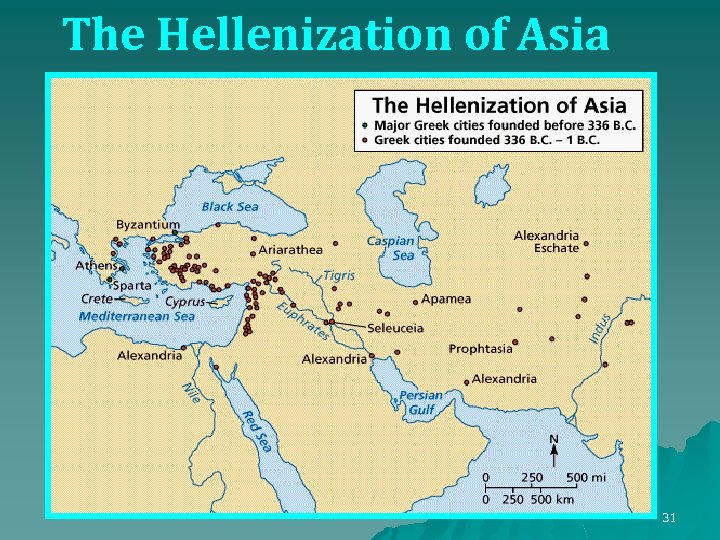 The Hellenization of Asia 31
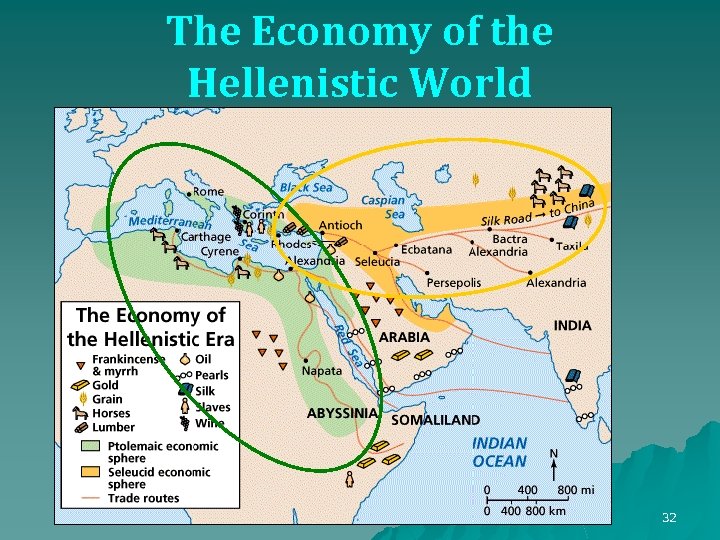 The Economy of the Hellenistic World 32
 33
33
 Pick one of the following to write on for tomorrow’s test u u 1. Although Alexander the Great created the largest empire in the ancient world he was never able to achieve unity among its various people. Why do you think Alexander was unable to achieve unity among the people of his vast empire? 2. Explain how Philip II of Macedonia gained control of Greece. 34