


 Скачать презентацию Chapter 12 Sport Communication Research Lecture 13 Date
719bc2c365fe8037a8746f59d2bbc8a7.ppt
- Количество слайдов: 33
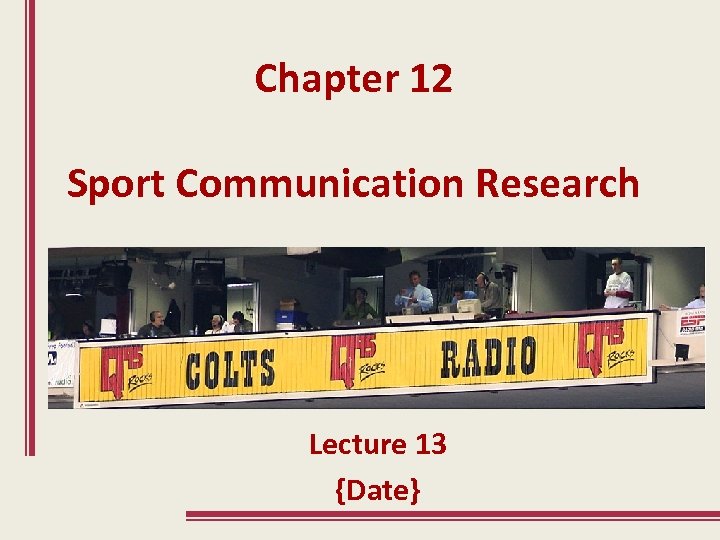 Chapter 12 Sport Communication Research Lecture 13 {Date}
 Learning Objectives • Recognize the functions of research in the practical and theoretical arenas associated with sport • Learn about the historical growth of research in industry and academia • Consider the uses of ratings and other forms of research in the media and sport communication industries • Consider diverse options for researchers in sport communication and understand steps in the research process • Understand the significance of research in the evolving field of sport communication
 Profile of a Sport Communicator: Eric Wright VP for research and development at Joyce Julius Wright joined firm in 1991 after MSU 30 employees, 20 conduct research Conducting entertainment marketing research services – Promotions, product placements, and theater surveys – Case study research, market research, and sponsorship studies – Analyzes print, radio, TV, and the Internet: TV makes up 70% of its business • Sport communication research is highly technical and valued • •
 Introduction • Two research perspectives: Industry practitioner and academic researcher • Knowledge is power, and research enables practitioners to do their jobs better and investigators in a more theoretical arena to provoke inquiry in important areas and to bolster sport communication’s legitimacy in academia • Because sport is a microcosm of society, it’s important to study in both the practical and theoretical arenas (continued)
 Introduction (continued) • Should study the sport media because of its impact on sport and society • Research can elucidate factors and implications within the media, media workers, and the audience • Sport communication research is the process by which sport communication practitioners and scholars initiate, discover, and expand knowledge of sport communication texts, audiences, and institutions
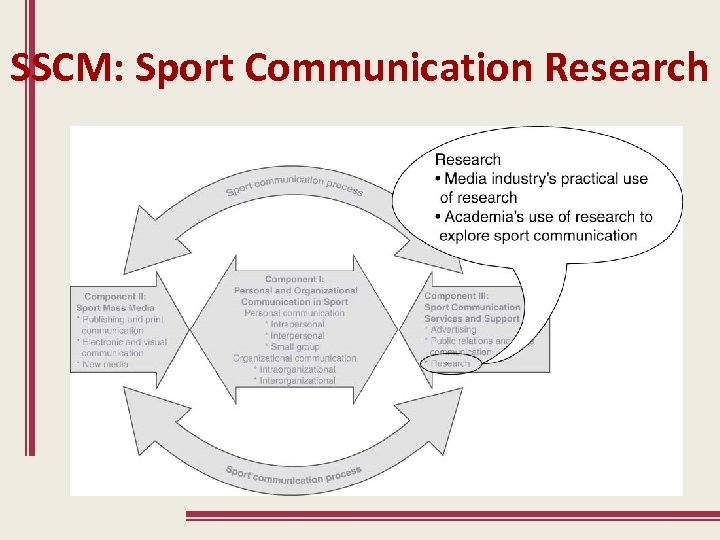 SSCM: Sport Communication Research
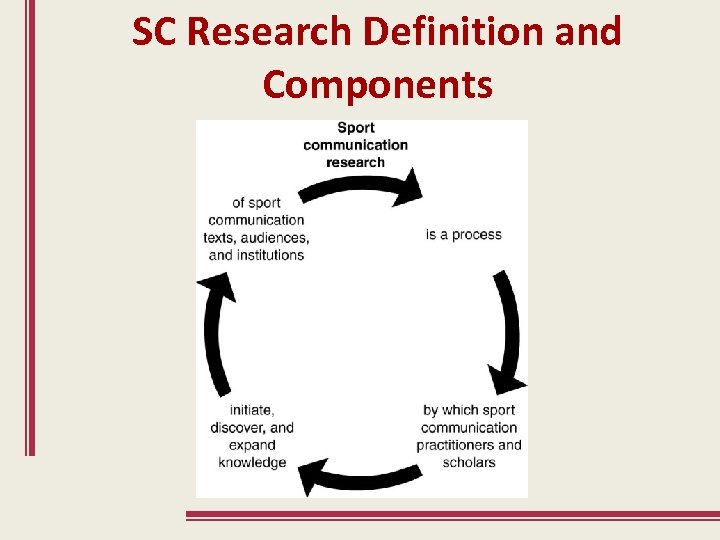 SC Research Definition and Components
 Media Industry’s Practical Use of Research • Media management uses research – To determine audiences’ programming preferences – To determine advertising costs – To decide what news and information choices to offer audiences • Research – Shows what advertisers will spend in a specific medium – Gives media organizations valuable info for planning purposes (continued)
 Practical Use (continued) • Newspapers – Audit Bureau of Circulations (ABC) measures circulation – Need for precision journalism – Use computer-assisted reporting (CAR) • TV and radio – A. C. Nielsen Company and Arbitron provide statistics – Advertisers, networks seek demographic statistics – TV stations distribute anchor tapes to determine audience preferences • New media research number of unique visitors on sites and revenue spent online • Movie companies use research to test various endings to determine audience preferences • Companies seek research mostly for monetary reasons
 A. C. Nielsen Company • Advertisers, agencies, networks, stations, cable operators, and programs purchase research to learn more about all audiences • Nielsen Media Research – Provides Nielsen TV ratings – Official national measurement service of the television industry – Does not provide a qualitative measurement – Simply measures how many people watched a specific program or station
 Sampling Techniques • Nielsen conducts a representative sample – 5, 000 houses with more than 13, 000 people participating in national ratings studies – Everyone in the population has an equal chance of being selected • Random sampling • Often viewed as the most representative sample • Other common sampling techniques in research – Stratified random sampling – Cluster sampling – Systematic sampling
 Nielsen’s Research Approach • • • Studies amount of TV usage on every set in a sample household Provides info on homes, TVs, programs, and commercials TV meters monitor when TVs are on and the stations they are on Monitors programs through program listings Identifies commercials by a signal identification technology Uses “people meter” to measure people watching programs Evaluates national audiences and programs Studies local television markets by television diaries Uses set-tuning meters Conducts telephone coincidentals
 Uses for Data • Nielsen offers programmers, advertisers, and agencies crucial info on the TV audience • Data are integrated to obtain circulation or the number of people watching or listening • Media buyers then use this info to work with ad agencies in formulating an appropriate media strategy • The amount advertisers charge is a negotiated rate per thousand viewers multiplied by audience estimate • Cost per thousand (CPM) equates to the amount an advertiser must spend to reach 1, 000 audience members • Additional research by Media. Mark (MRI) and Simmons Market Research Bureau (SMRB) • Noncommercial stations use research to make program decisions
 Research Challenges It is difficult to measure across media Each research method has limitations One new options is Arbitron’s “portable people meter” (PPM) Studies of Web use – Relevant Knowledge, Jupiter. Research, Media Metrix, Nielsen/Net Ratings – A disparity of opinion on which method is most effective – Individuals’ varying uses of the Internet complicate the picture – Research is conducted on use of instant messaging, Web phones, media players, online games, and other features • Three aspects of media research – Reliability – Validity – Economy • •
 Effect of TV Ratings on Sport Communication • TV delivers results like no other media outlet • Companies continue to spend millions yearly on sport programming – Expansive reach – Powerful influence • Sport enables a company to center its message on the audience it wants to persuade
 Importance of Ratings • With audiences, size counts • Networks and advertisers compute CPM, which measures the cost and value of advertisements • Networks also calculate cost per point (CPP), or how much it costs to reach 1% of the entire audience • In addition to audience size, the total aggregate of houses/viewers tuning in over time is important • Reach, or cume – Denotes the total aggregate of different viewers tuning in over time – Calculates true audience for sports broadcasts • Sponsors look for this before agreeing to ad contracts • Advertisers also care about an audience’s demographic
 Super Bowl Ratings • Super Bowl remains the top sporting event in the U. S. – Consistent ratings – Advertising revenue • Ratings show the % of every TV on a certain show in a specific market • Share is the % of TVs on at a certain time or certain show or certain market • Average cost of a Super Bowl 30 -second spot is over $2. 5 M
 NFL Research • NFL examines the ratings • League also seeks and values other practical research – Fan. Links obtains not only sport data but also buying habits, an example of how leagues are obtaining more precise and sophisticated information about consumers – Turnkey Sports and Nielsen Media Research conduct research on 32 teams • Give teams new marketing services • Help teams conduct fan and sponsor research at local level • Nielsen analyzes sponsors’ exposure • Turnkey provides surveys for season ticket holders
 Networks and Research • Sport coverage provides a return on objective (ROO) – ROO is based on the client’s objectives – Client and network develop goals and assess the impact of sponsorship in sport • ESPN and ABC participate in customized research efforts – Use focus groups and other methods – ESPN uses Nielsen Sports’ Web-based sponsorship scorecard, which helps measure the return on on-air sport sponsorships (continued)
 Networks and Research (continued) • ESPN/ABC also use Joyce Julius to measure product placement and the number of times a brand is cited • Joyce Julius – Offered sport research since 1985 – Provides clients with “Sponsors Report” • National television impression value analysis (NTIV) • Survey analyses using quantitative and qualitative methods to evaluate sponsorship value • Other ways to measure ROO – Econometric modeling – Case studies – Tracking behavior through Ti. Vo • Research enables viewers to offer insight on programs
 Challenges Associated With Ratings • Sponsors must ensure they do not annoy their consumers: Top three annoyances are telephone marketing, Internet pop-ups, junk e-mail • Some believe sport organizations and marketers place too much emphasis on demographics, should pursue more psychographic research • Ratings calculations took place for TV viewing inside the home – Therefore, sport TV has been underreported – Many fans watch TV at sports bars, restaurants, gyms – Nielsen/Arbitron are testing the portable people meter (PPM); if implemented, • Ratings will most likely increase • Will result in increases in sport properties’ values and advertising costs and revenue
 Academia’s Use of Research • Sport is relatively new as a topic of academic inquiry • Research in this area is crucial for fully understanding how sport intersects social, cultural, economic, and political arenas • Theory and research – Inextricably linked – Should be considered more as a continuum rather than as separate entities of inquiry
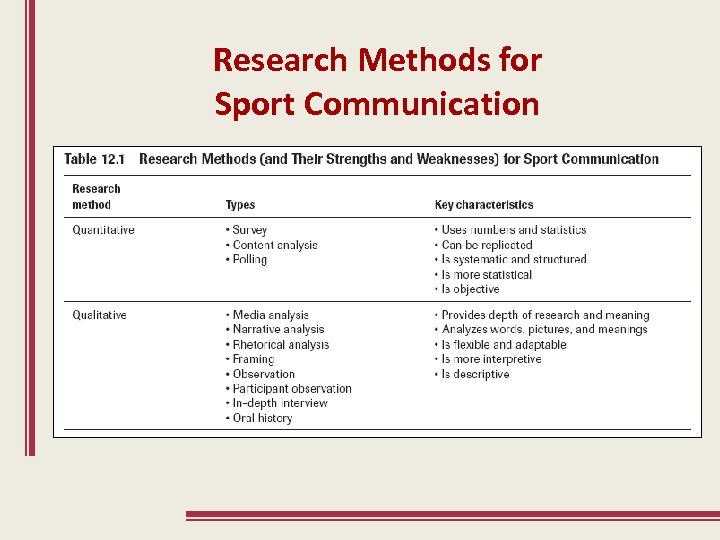 Research Methods for Sport Communication
 Types and Approaches • Research – Exploratory – Descriptive – Explanatory – Predictive • Philosophical approaches to research – Positivists – Interpretivists – Naturalists • Qualitative research • Quantitative research • Triangulation
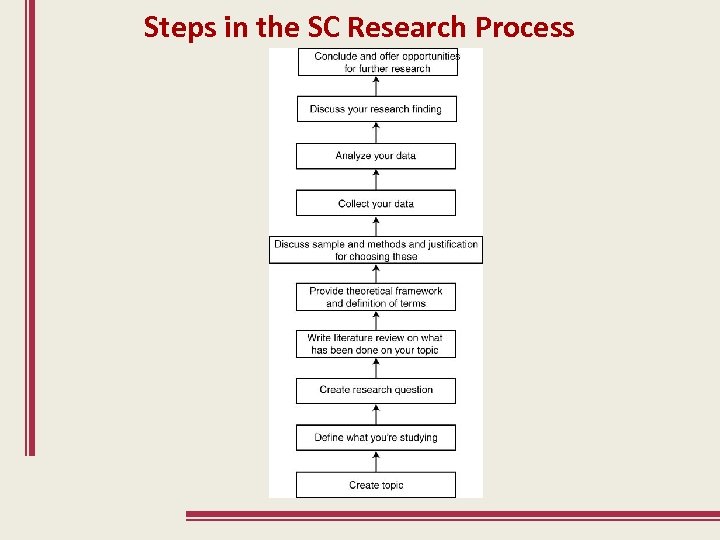 Steps in the SC Research Process
 Considerations for SC Researchers • Consider all parts of the communication process: – Who communicates to whom? (sources and receivers) – Why communicate? (functions and purposes) – How does communication take place? (channels, languages, codes) – What about? (content, references, types of information) – What are the consequences of communication (intended or unintended)? • Approaches to communication research – Structural – Behavioral – Cultural
 Research Procedures • • • Determine the research question Define and operationalize terms and concepts Engage in a literature review Investigate how to conduct the method Write proposal and outline to guide research – Research question – Definition of the object of analysis – Description of primary sources – Overview of secondary sources – Literature review – Time frame for the work – Sample instrument, such as a survey – Explanation of what the research anticipates finding – Bibliography
 History of Research on Sport • As media gained prominence, more academics focused on media and sport • Scholars recognize importance of understanding history and sociology of relationship between media and sport • 1934: 1 st published article about sport in Journalism Quarterly • 1975: Journal of Communication published Real’s Super Bowl piece • 1980 s – Journal of Broadcasting published sport articles – Critical Studies in Mass Communication and the Quarterly Journal of Speech also published works on sport • Wenner’s Media. Sport set the agenda for research in this field • 2006: Journal of Sports Media • 2008: International Journal of Sport Communication
 Overview of Research Methodologies • Research studies can be conducted on texts, media industry, or audience analysis • Researchers can study newspapers, magazines, television audiences, or media professionals • Areas of need for research – All facets of sport communication – Areas of production as well as the audience – Sport advertising, commercialization of sport, drugs and athletes, teamwork as shown in media texts – Emerging technologies, sports talk radio, policy recommendations in media sport
 Research on Media Texts • Content analysis • Narrative analysis • Other methodologies used to study texts – Rhetorical criticism – Semiotics – Textual analysis – Qualitative document analysis
 Research on Media Industry • • Archival research Interview Participant observation Oral history
 Research on Audiences • Communication research on audience effects – 1930 s: All-powerful effects (hypodermic needle theory) – 1940 s: Limited effects – 1970 s: Powerful but contingent hierarchy of media effects, agenda-setting research, knowledge gap, uses and gratifications research – 1980 s: Powerful, content and contextual effects • The most effective methodologies for studying audiences – Surveys – Interviews – Focus groups – Oral histories
 Discussion Questions • What are some topics for research studying the legal and economic areas of sport communication? • How would you trace the development of audience research? • How do ratings companies such as Nielsen and Arbitron work? • How do ratings fit into the SSCM? • What is the research process? • Where would you find sources for your research proposal? • What types of resources would you use for a research project? • What are some topics for research on social areas of sport communication? • What are methodologies for studying sport comm. audiences? • What are the strengths and weaknesses of some of the methodologies used to study sport communication audiences?