


 Скачать презентацию Chapter 12 Services The Cultural Landscape An Introduction
78890cc018cf8f0d1a1b1a210f9a3437.ppt
- Количество слайдов: 28
 Chapter 12: Services The Cultural Landscape: An Introduction to Human Geography © 2011 Pearson Education, Inc.
 Services • Service = any activity that fulfills a human want or need • Services are located in settlements – Location of services is important for profitability – Affluent regions tend to offer more services – Local diversity is evident in the provision of services © 2011 Pearson Education, Inc.
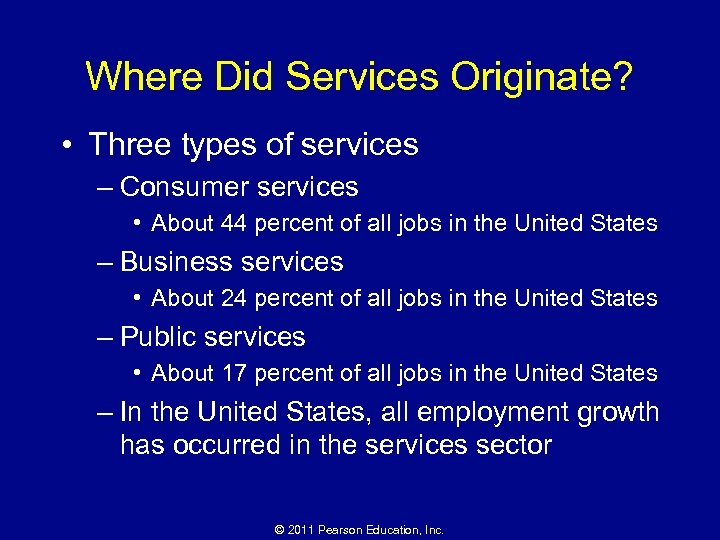 Where Did Services Originate? • Three types of services – Consumer services • About 44 percent of all jobs in the United States – Business services • About 24 percent of all jobs in the United States – Public services • About 17 percent of all jobs in the United States – In the United States, all employment growth has occurred in the services sector © 2011 Pearson Education, Inc.
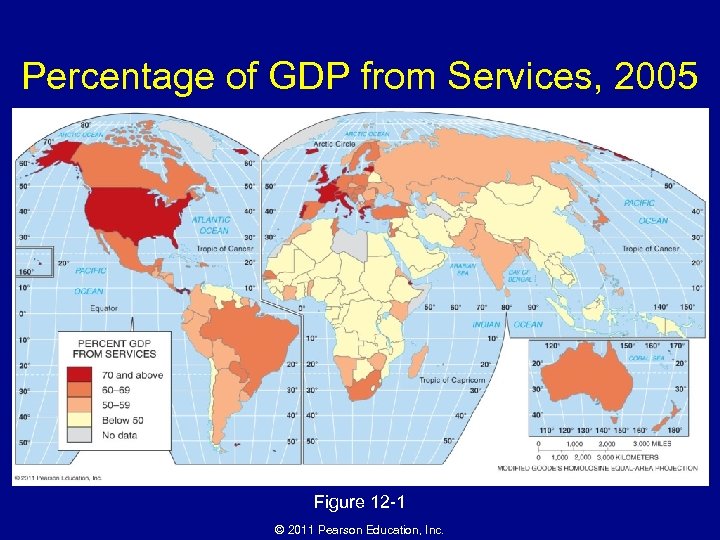 Percentage of GDP from Services, 2005 Figure 12 -1 © 2011 Pearson Education, Inc.
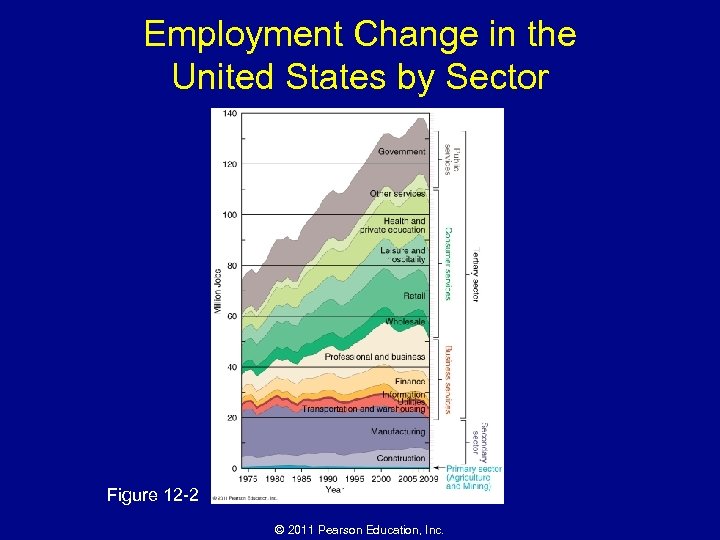 Employment Change in the United States by Sector Figure 12 -2 © 2011 Pearson Education, Inc.
 Where Did Services Originate? • Services in early rural settlements – Early consumer services met societal needs • Examples = burial of the dead, religious centers, manufacturing centers – Early public services probably followed religious activities – Early business services to distribute and store food © 2011 Pearson Education, Inc.
 Where Did Services Originate? • Services in early urban settlements – Services in ancient cities • Earliest urban settlements (e. g. , Ur), Athens, Rome – Services in medieval cities • Largest settlements were in Asia • European cities developed with feudalism © 2011 Pearson Education, Inc.
 Where Are Contemporary Services Located? • Services in rural settlements – Half of the world’s population lives in rural settlements – Two types • Clustered rural settlements – Circular or linear – Clustered settlements in Colonial America • Dispersed rural settlements – In the United States – In Great Britain » Enclosure movement © 2011 Pearson Education, Inc.
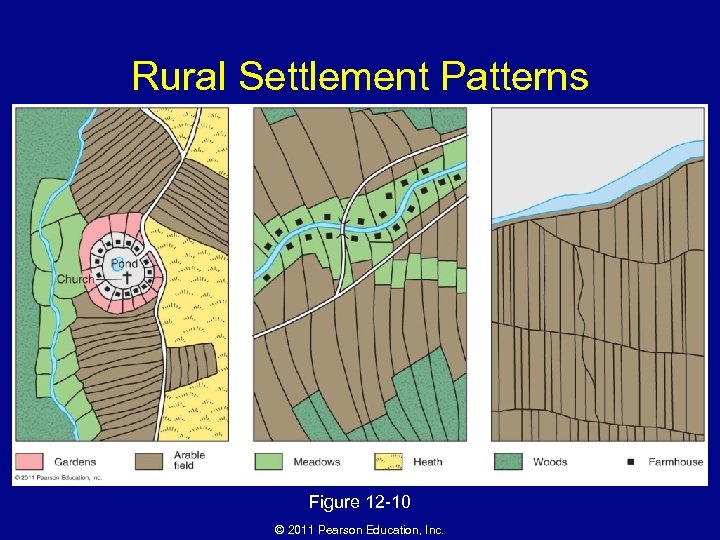 Rural Settlement Patterns Figure 12 -10 © 2011 Pearson Education, Inc.
 Where Are Contemporary Services Located? • Services in urban settlements – Differences between urban and rural settlements • Large size • High density • Social heterogeneity – Increasing percentage of people in cities – Increasing number of people in cities © 2011 Pearson Education, Inc.
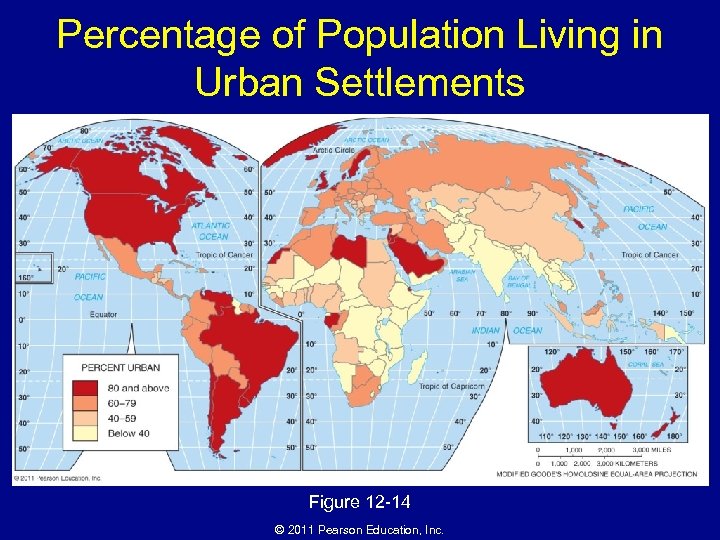 Percentage of Population Living in Urban Settlements Figure 12 -14 © 2011 Pearson Education, Inc.
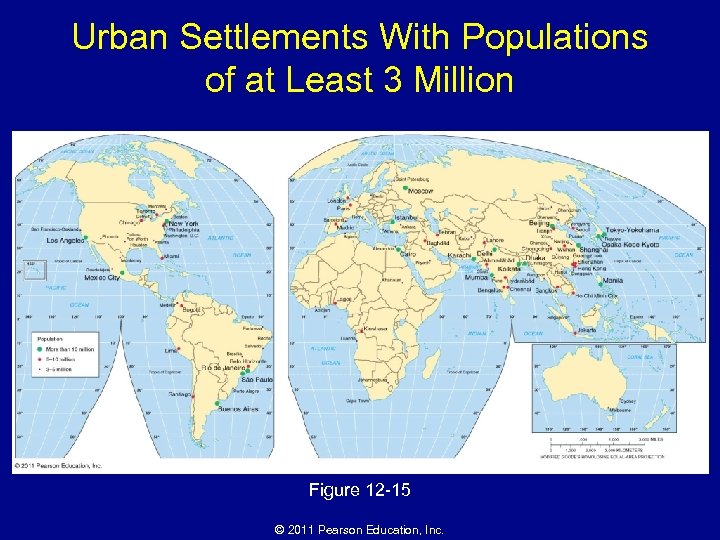 Urban Settlements With Populations of at Least 3 Million Figure 12 -15 © 2011 Pearson Education, Inc.
 Why Are Consumer Services Distributed in a Regular Pattern? • Central place theory – First proposed by Walter Christaller (1930 s) – Characteristics • A central place has a market area (or hinterland) – Size of a market area • Range • Threshold © 2011 Pearson Education, Inc.
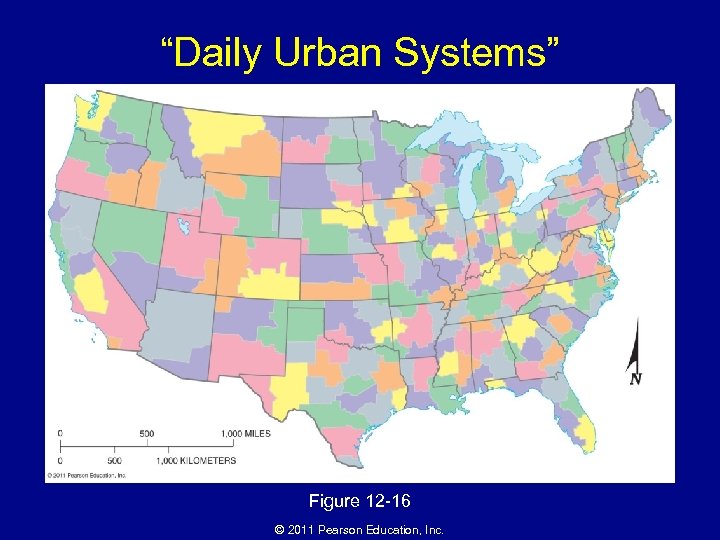 “Daily Urban Systems” Figure 12 -16 © 2011 Pearson Education, Inc.
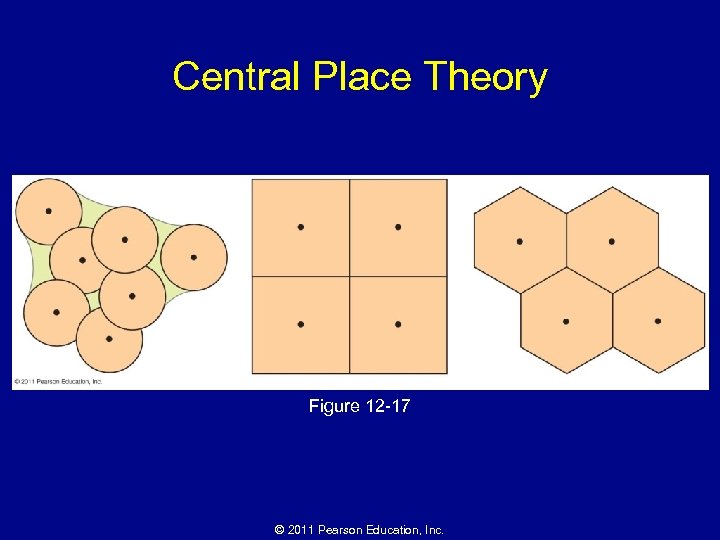 Central Place Theory Figure 12 -17 © 2011 Pearson Education, Inc.
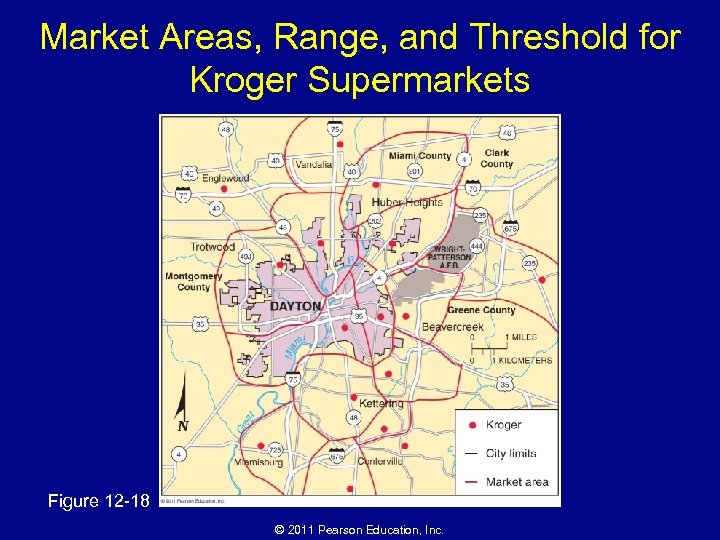 Market Areas, Range, and Threshold for Kroger Supermarkets Figure 12 -18 © 2011 Pearson Education, Inc.
 Why Are Consumer Services Distributed in a Regular Pattern? • Market-area analysis – Profitability of a location • Compute the range • Compute threshold • Draw the market area – Optimal location within a market • Best location in a linear settlement • Best location in a nonlinear settlement © 2011 Pearson Education, Inc.
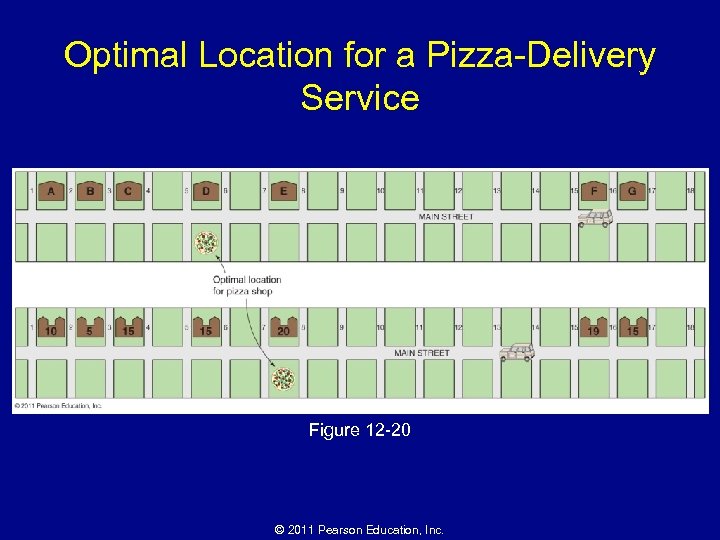 Optimal Location for a Pizza-Delivery Service Figure 12 -20 © 2011 Pearson Education, Inc.
 Why Are Consumer Services Distributed in a Regular Pattern? • Hierarchy of services and settlements – Nesting • Market areas in MDCs = a series of hexagons of various sizes – Rank-size distribution of settlements • Primate city rule – Primate cities – Periodic markets © 2011 Pearson Education, Inc.
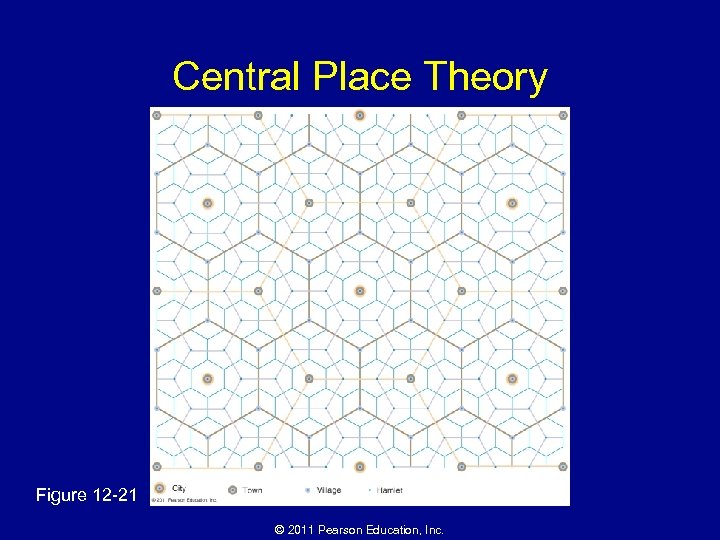 Central Place Theory Figure 12 -21 © 2011 Pearson Education, Inc.
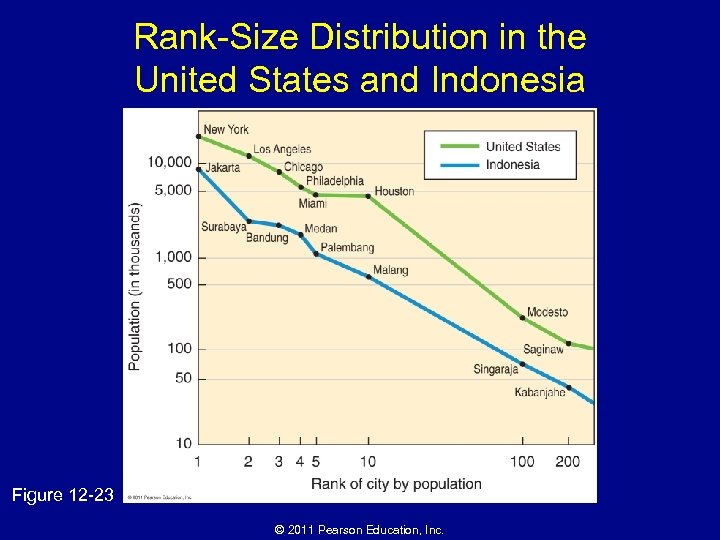 Rank-Size Distribution in the United States and Indonesia Figure 12 -23 © 2011 Pearson Education, Inc.
 Why Do Business Services Cluster in Large Settlements? • Hierarchy of business services – Services in world cities • Business: clustering of services is a product of the Industrial Revolution • Consumer: retail services with extensive market areas – May include leisure services of national importance due to large thresholds, large ranges, and the presence of wealthy patrons. • Public: world cities are often the center of national or international political power © 2011 Pearson Education, Inc.
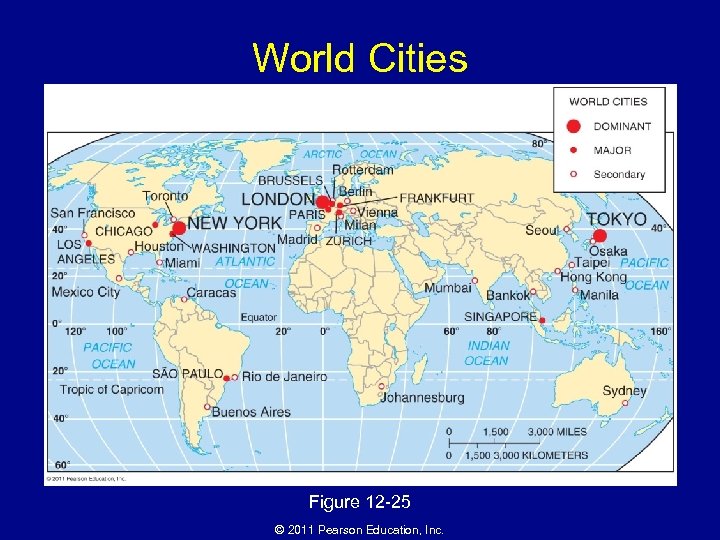 World Cities Figure 12 -25 © 2011 Pearson Education, Inc.
 Why Do Business Services Cluster in Large Settlements? • Business services in LDCs – Offshore financial services • Two functions: – Taxes – Privacy – Back offices • LDCs are attractive because of: – Low wages – Ability to speak English © 2011 Pearson Education, Inc.
 Why Do Business Services Cluster in Large Settlements? • Economic base of settlements – Two types: • Basic industries • Nonbasic industries – Specialization of cities in different services – Distribution of talent © 2011 Pearson Education, Inc.
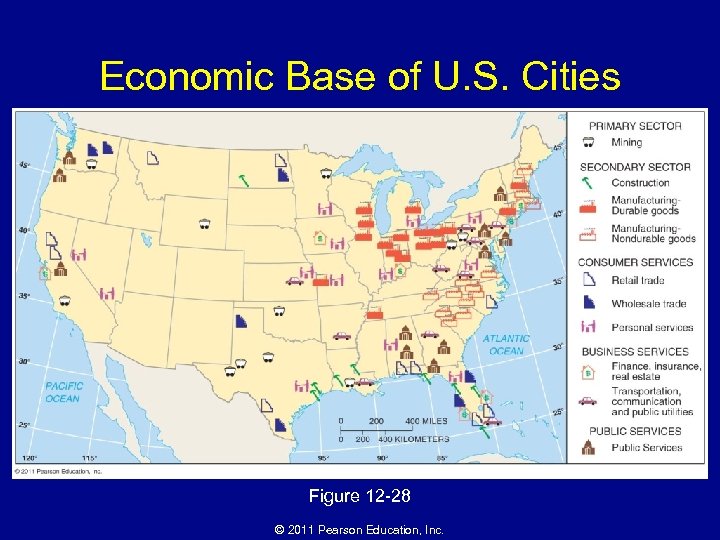 Economic Base of U. S. Cities Figure 12 -28 © 2011 Pearson Education, Inc.
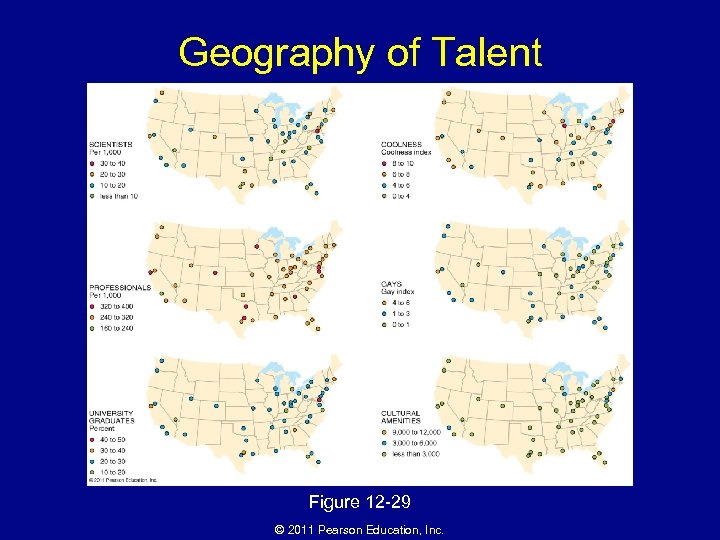 Geography of Talent Figure 12 -29 © 2011 Pearson Education, Inc.
 The End. Up next: Urban Patterns © 2011 Pearson Education, Inc.