


 Скачать презентацию Chapter 12 Section World Geography Chapter 12
bc43570e1f570ebd077a5b0df9696c88.ppt
- Количество слайдов: 16
 Chapter 12 , Section World Geography Chapter 12 Brazil Copyright © 2003 by Pearson Education, Inc. , publishing as Prentice Hall, Upper Saddle River, NJ. All rights reserved.
 Chapter 12 , Section World Geography Chapter 12: Brazil Section 1: The Land Its Regions Section 2: Brazil's Quest for Economic Growth Copyright © 2003 by Pearson Education, Inc. , publishing as Prentice Hall, Upper Saddle River, NJ. All rights reserved.
 Chapter 12 , Section 1 The Land Its Regions • What environmental and economic challenges exist in the northeast? • How has urbanization affected the southeast region? • Why has the government encouraged urban growth and economic development in the Brazilian Highlands? • What are the main characteristics of the Amazon River basin ecosystem?
 Chapter 12 , Section 1 Northeast Region • ___________on the coastal plain have made Brazil the world’s largest exporter of sugar. • The ______, or interior plateau, has hard soils and bakes through yearlong droughts. • _________is short because of low incomes and poor nutrition.
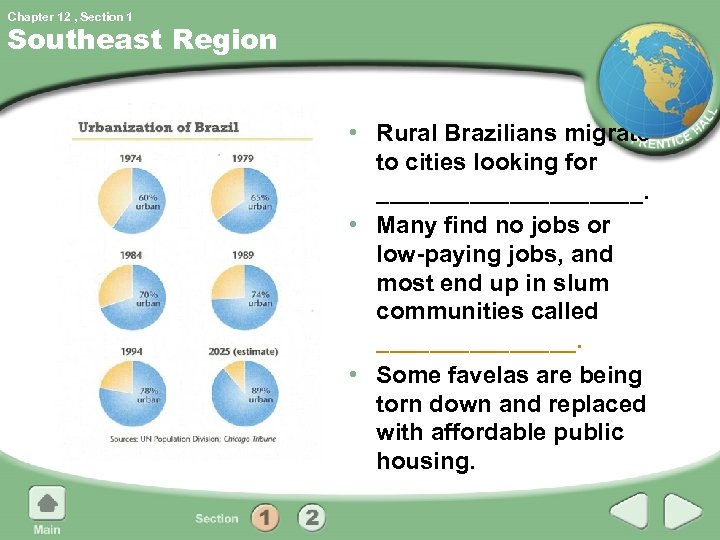 Chapter 12 , Section 1 Southeast Region • Rural Brazilians migrate to cities looking for __________. • Many find no jobs or low-paying jobs, and most end up in slum communities called ________. • Some favelas are being torn down and replaced with affordable public housing.
 Chapter 12 , Section 1 Brazilian Highlands • The national government hoped to boost development of the ______ region. • The Brazilian government also hoped to draw people away from the crowded coastal cities. • The new capital of ________, located 600 miles inland, was officially “inaugurated” in 1960.
 Chapter 12 , Section 1 Amazon River Region The Amazon River basin is the largest and least explored region in Brazil. The ______ basin spreads across more than half of Brazil. The region receives heavy rainfall: more than ____ inches (200 cm) per year. Temperatures are constant at 80º F (27º C) or higher. The rain forest is home to a wide variety of plants and animals.
 Chapter 12 , Section 1 Review The sertão is a) a river valley. b) a mineral-rich mountain range. c) an interior plateau with poor soil. d) a coastal area in the south. What are favelas? a) villages in the sertão b) wealthy neighborhoods in the large cities c) large commercial farms d) slum communities in the large cities Want to connect to the World Geography link for this section? Click Here!
 Chapter 12 , Section 1 Review The sertão is a) a river valley. b) a mineral-rich mountain range. c) an interior plateau with poor soil. d) a coastal area in the south. What are favelas? a) villages in the sertão b) wealthy neighborhoods in the large cities c) large commercial farms d) slum communities in the large cities Want to connect to the World Geography link for this section? Click Here!
 Chapter 12 , Section 2 Brazil’s Quest for Economic Growth • What economic challenges are faced by the urban and rural poor? • How have Brazilian government policies affected the economy? • What effects has economic growth had on the labor force in Brazil? • How has economic development contributed to environmental change?
 Chapter 12 , Section 2 Economic Challenges Most of Brazil’s poorest live in urban favelas or the rural northeast. • Many parents in favelas cannot afford to feed or house their children. • Homeless children work in menial jobs or _________. • Many people in rural areas work on ________ or become subsistence farmers. • The harsh conditions of the sertão contribute to the poverty of farmers living there.
 Chapter 12 , Section 2 Government Policies Economic Activities • During the 1940 s and 1950 s, the Brazilian government began building steel mills, oil refineries, and ___________. • Brazil’s economy grew tremendously in ______ as manufacturing increased and Brazilians began to move from rural to urban areas. Patterns of Settlement • The government began a program to develop the interior, “planting” Brasília in the Brazilian Highlands. • A massive ______ project, with Brasília at its center, connected many areas of the country. • New roads and land grants drew many settlers to the Brazilian Highlands and ______ regions.
 Chapter 12 , Section 2 Economic Growth • Brazil ranks among the world’s leading industrial nations. • The development of ________, a mixture of gasoline and alcohol made from sugar cane that is used as fuel, meant Brazil no longer needed to import expensive foreign oil. • The majority of the work force has moved from agriculture to manufacturing and _______ industries. • Brazil now has a growing skilled, educated ________.
 Chapter 12 , Section 2 Environmental Changes Challenges and Opportunities • Settlers moving to the Amazon region found that only the thick vegetation kept the soil from ___________. • In order to continue farming, farmers needed to clear more land. New Efforts • _______ threatens the biological diversity of the Amazon region. • The Brazilian government is working to combat deforestation and to promote ecotourism, tourism that encourages environmental awareness.
 Chapter 12 , Section 2 Review How did land grants and new roads affect Brazil? a) Settlers moved into the Highlands and Amazon regions. b) Industry stagnated and declined. c) More people migrated into the cities in the southeast. d) The sertão became depopulated. Brazil is combating deforestation by a) removing woodlands. b) promoting ecotourism and encouraging maintenance of the forest. c) expanding industry and building hydroelectric dams. d) encouraging people to migrate to the cities. Want to connect to the World Geography link for this section? Click Here!
 Chapter 12 , Section 2 Review How did land grants and new roads affect Brazil? a) Settlers moved into the Highlands and Amazon regions. b) Industry stagnated and declined. c) More people migrated into the cities in the southeast. d) The sertão became depopulated. Brazil is combating deforestation by a) removing woodlands. b) promoting ecotourism and encouraging maintenance of the forest. c) expanding industry and building hydroelectric dams. d) encouraging people to migrate to the cities. Want to connect to the World Geography link for this section? Click Here!