


 Скачать презентацию Chapter 12 Personality Assessment Procedures for Counselors and
83fd212b9216428026e42d1f719d2ab3.ppt
- Количество слайдов: 32
 Chapter 12 Personality Assessment Procedures for Counselors and Helping Professionals, 7 e © 2010 Pearson Education, Inc. All rights reserved.
 What is Personality? Personality is the reasonably stable pattern of thoughts, emotions and behavior that distinguish one person from another. Assessment Procedures for Counselors and Helping Professionals, 7 e Drummond/Jones 11 -2 © 2010 Pearson Education, Inc. All rights reserved.
 Key Terms of Personality n Traits - the distinguishing characteristics or qualities possessed by an individual n States - the transitory exhibition of some trait n Types - the clustering of various states. If traits can be considered specific characteristics of an individual, types can be regarded as a general description of a person Assessment Procedures for Counselors and Helping Professionals, 7 e Drummond/Jones 11 -3 © 2010 Pearson Education, Inc. All rights reserved.
 Personality Inventories n n Personality inventories can be used to measure personality traits/types. Personality inventories can also be used to increase self-awareness. Assessment Procedures for Counselors and Helping Professionals, 7 e Drummond/Jones 11 -4 © 2010 Pearson Education, Inc. All rights reserved.
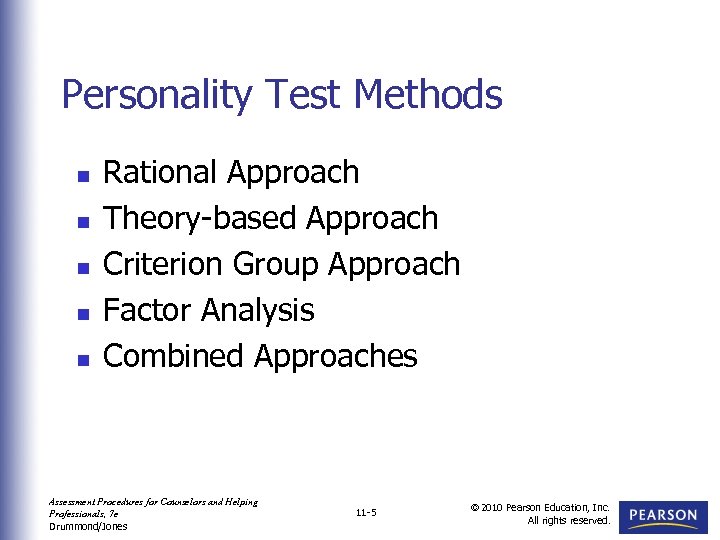 Personality Test Methods n n n Rational Approach Theory-based Approach Criterion Group Approach Factor Analysis Combined Approaches Assessment Procedures for Counselors and Helping Professionals, 7 e Drummond/Jones 11 -5 © 2010 Pearson Education, Inc. All rights reserved.
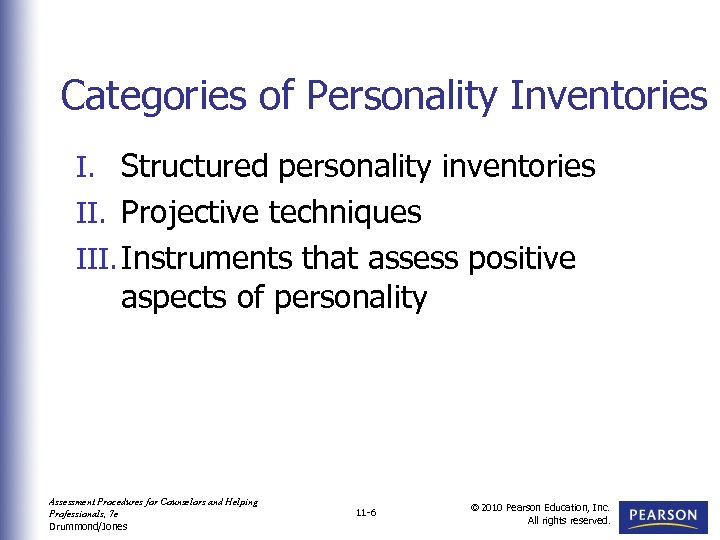 Categories of Personality Inventories I. Structured personality inventories II. Projective techniques III. Instruments that assess positive aspects of personality Assessment Procedures for Counselors and Helping Professionals, 7 e Drummond/Jones 11 -6 © 2010 Pearson Education, Inc. All rights reserved.
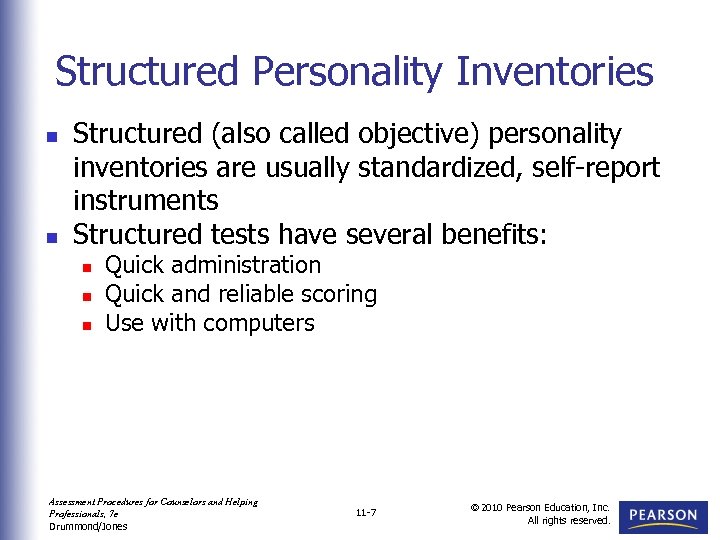 Structured Personality Inventories n n Structured (also called objective) personality inventories are usually standardized, self-report instruments Structured tests have several benefits: n n n Quick administration Quick and reliable scoring Use with computers Assessment Procedures for Counselors and Helping Professionals, 7 e Drummond/Jones 11 -7 © 2010 Pearson Education, Inc. All rights reserved.
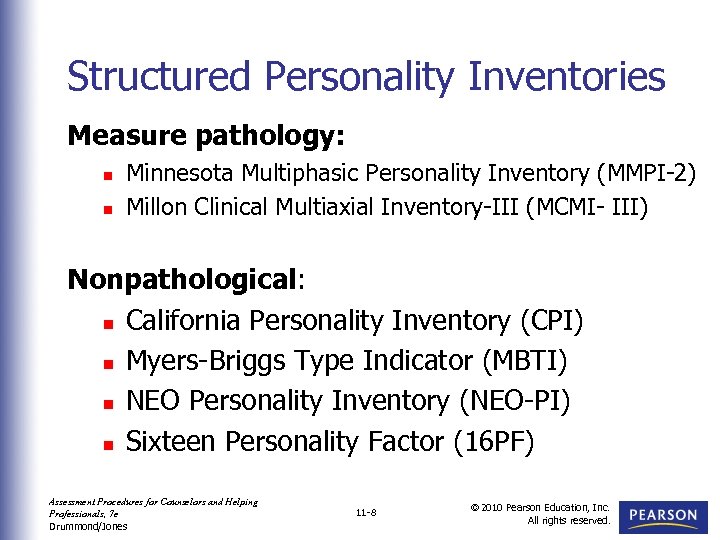 Structured Personality Inventories Measure pathology: n n Minnesota Multiphasic Personality Inventory (MMPI-2) Millon Clinical Multiaxial Inventory-III (MCMI- III) Nonpathological: n California Personality Inventory (CPI) n Myers-Briggs Type Indicator (MBTI) n NEO Personality Inventory (NEO-PI) n Sixteen Personality Factor (16 PF) Assessment Procedures for Counselors and Helping Professionals, 7 e Drummond/Jones 11 -8 © 2010 Pearson Education, Inc. All rights reserved.
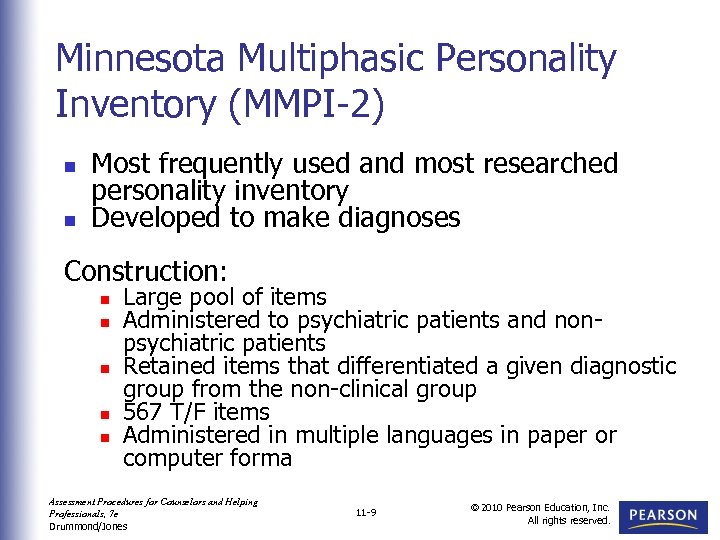 Minnesota Multiphasic Personality Inventory (MMPI-2) n n Most frequently used and most researched personality inventory Developed to make diagnoses Construction: n n n Large pool of items Administered to psychiatric patients and nonpsychiatric patients Retained items that differentiated a given diagnostic group from the non-clinical group 567 T/F items Administered in multiple languages in paper or computer forma Assessment Procedures for Counselors and Helping Professionals, 7 e Drummond/Jones 11 -9 © 2010 Pearson Education, Inc. All rights reserved.
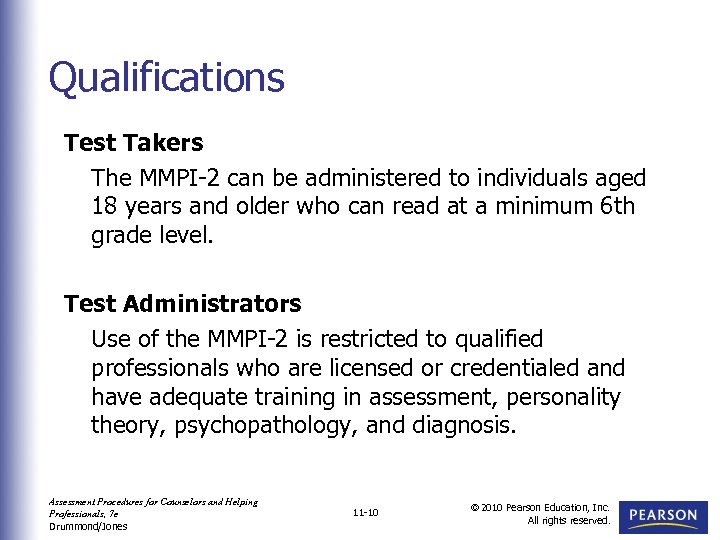 Qualifications Test Takers The MMPI-2 can be administered to individuals aged 18 years and older who can read at a minimum 6 th grade level. Test Administrators Use of the MMPI-2 is restricted to qualified professionals who are licensed or credentialed and have adequate training in assessment, personality theory, psychopathology, and diagnosis. Assessment Procedures for Counselors and Helping Professionals, 7 e Drummond/Jones 11 -10 © 2010 Pearson Education, Inc. All rights reserved.
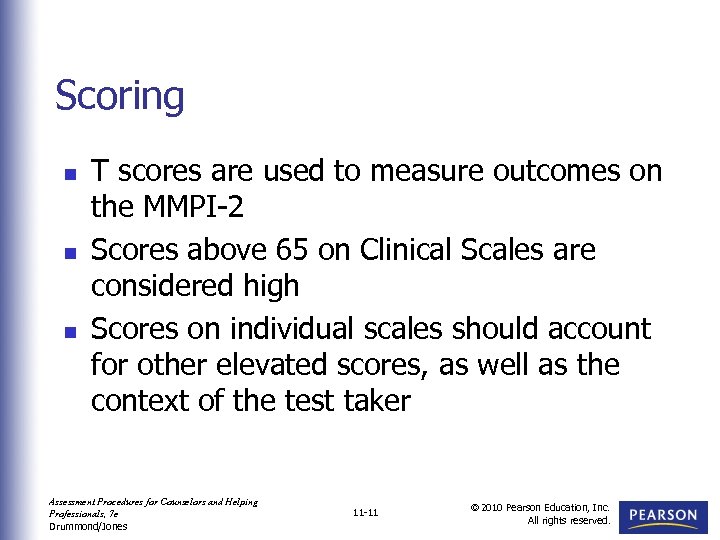 Scoring n n n T scores are used to measure outcomes on the MMPI-2 Scores above 65 on Clinical Scales are considered high Scores on individual scales should account for other elevated scores, as well as the context of the test taker Assessment Procedures for Counselors and Helping Professionals, 7 e Drummond/Jones 11 -11 © 2010 Pearson Education, Inc. All rights reserved.
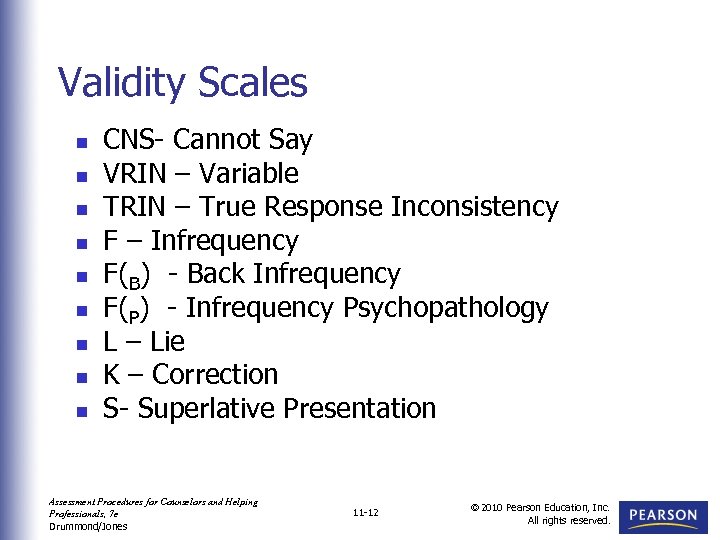 Validity Scales n n n n n CNS- Cannot Say VRIN – Variable TRIN – True Response Inconsistency F – Infrequency F(B) - Back Infrequency F(P) - Infrequency Psychopathology L – Lie K – Correction S- Superlative Presentation Assessment Procedures for Counselors and Helping Professionals, 7 e Drummond/Jones 11 -12 © 2010 Pearson Education, Inc. All rights reserved.
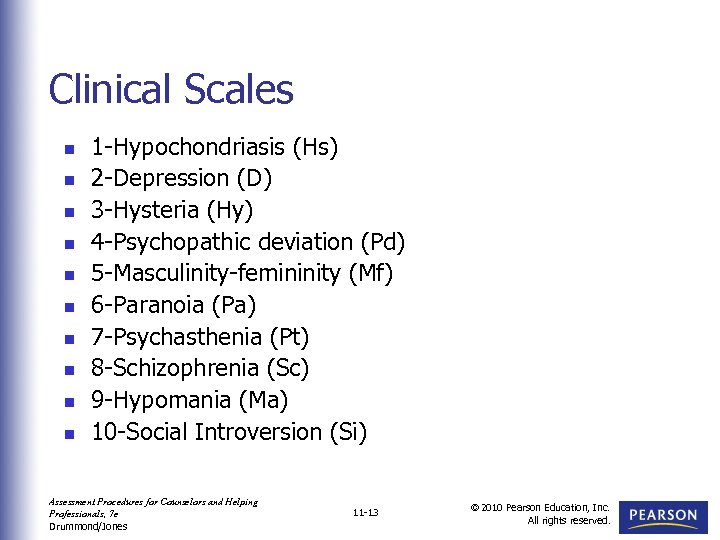 Clinical Scales n n n n n 1 -Hypochondriasis (Hs) 2 -Depression (D) 3 -Hysteria (Hy) 4 -Psychopathic deviation (Pd) 5 -Masculinity-femininity (Mf) 6 -Paranoia (Pa) 7 -Psychasthenia (Pt) 8 -Schizophrenia (Sc) 9 -Hypomania (Ma) 10 -Social Introversion (Si) Assessment Procedures for Counselors and Helping Professionals, 7 e Drummond/Jones 11 -13 © 2010 Pearson Education, Inc. All rights reserved.
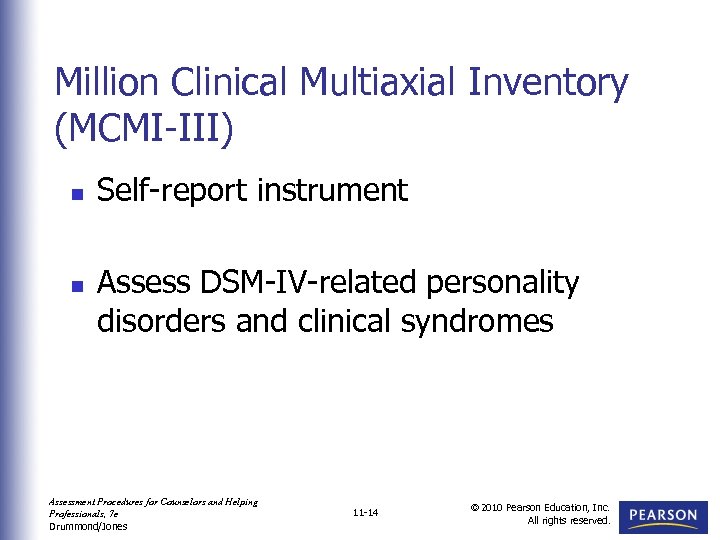 Million Clinical Multiaxial Inventory (MCMI-III) n n Self-report instrument Assess DSM-IV-related personality disorders and clinical syndromes Assessment Procedures for Counselors and Helping Professionals, 7 e Drummond/Jones 11 -14 © 2010 Pearson Education, Inc. All rights reserved.
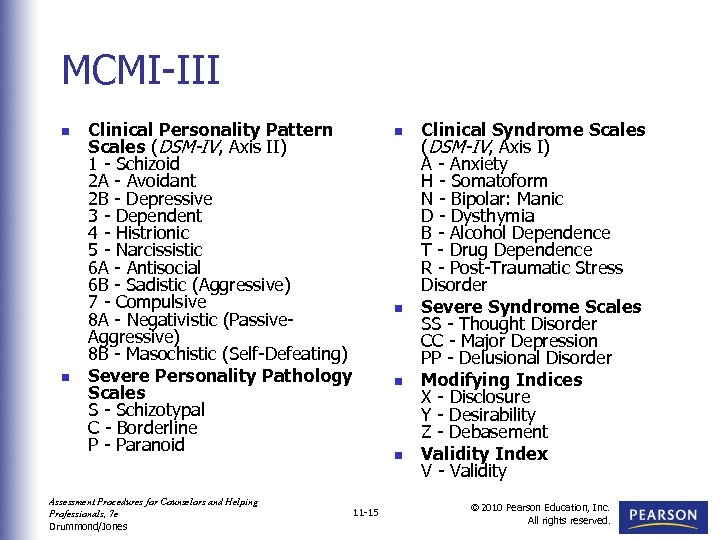 MCMI-III n n Clinical Personality Pattern Scales (DSM-IV, Axis II) 1 - Schizoid 2 A - Avoidant 2 B - Depressive 3 - Dependent 4 - Histrionic 5 - Narcissistic 6 A - Antisocial 6 B - Sadistic (Aggressive) 7 - Compulsive 8 A - Negativistic (Passive. Aggressive) 8 B - Masochistic (Self-Defeating) Severe Personality Pathology Scales S - Schizotypal C - Borderline P - Paranoid Assessment Procedures for Counselors and Helping Professionals, 7 e Drummond/Jones n n 11 -15 Clinical Syndrome Scales (DSM-IV, Axis I) A - Anxiety H - Somatoform N - Bipolar: Manic D - Dysthymia B - Alcohol Dependence T - Drug Dependence R - Post-Traumatic Stress Disorder Severe Syndrome Scales SS - Thought Disorder CC - Major Depression PP - Delusional Disorder Modifying Indices X - Disclosure Y - Desirability Z - Debasement Validity Index V - Validity © 2010 Pearson Education, Inc. All rights reserved.
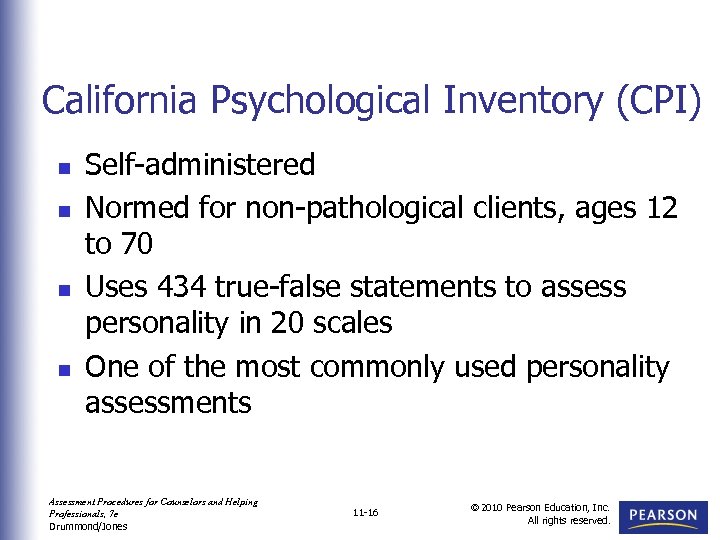 California Psychological Inventory (CPI) n n Self-administered Normed for non-pathological clients, ages 12 to 70 Uses 434 true-false statements to assess personality in 20 scales One of the most commonly used personality assessments Assessment Procedures for Counselors and Helping Professionals, 7 e Drummond/Jones 11 -16 © 2010 Pearson Education, Inc. All rights reserved.
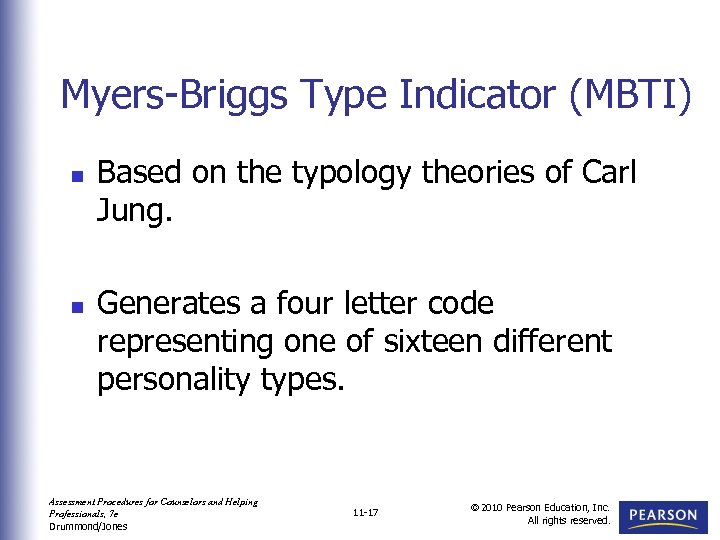 Myers-Briggs Type Indicator (MBTI) n n Based on the typology theories of Carl Jung. Generates a four letter code representing one of sixteen different personality types. Assessment Procedures for Counselors and Helping Professionals, 7 e Drummond/Jones 11 -17 © 2010 Pearson Education, Inc. All rights reserved.
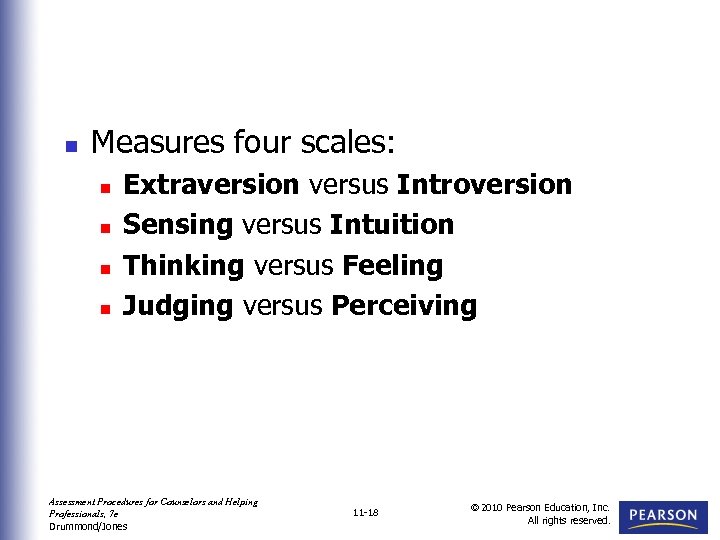 n Measures four scales: n n Extraversion versus Introversion Sensing versus Intuition Thinking versus Feeling Judging versus Perceiving Assessment Procedures for Counselors and Helping Professionals, 7 e Drummond/Jones 11 -18 © 2010 Pearson Education, Inc. All rights reserved.
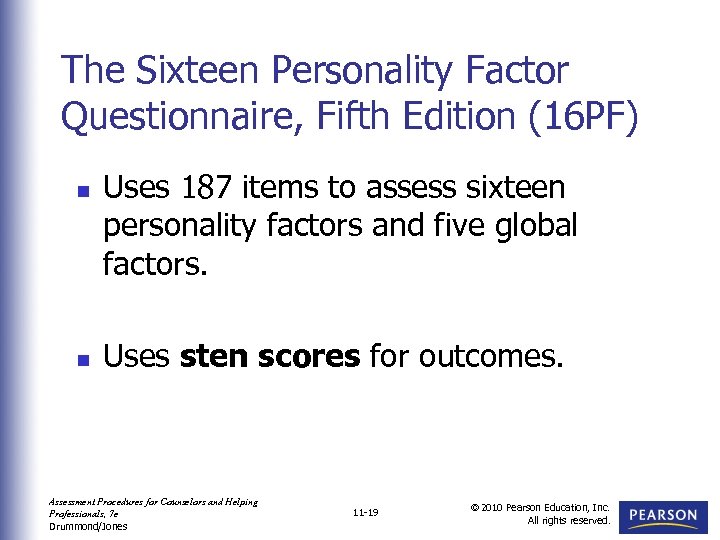 The Sixteen Personality Factor Questionnaire, Fifth Edition (16 PF) n n Uses 187 items to assess sixteen personality factors and five global factors. Uses sten scores for outcomes. Assessment Procedures for Counselors and Helping Professionals, 7 e Drummond/Jones 11 -19 © 2010 Pearson Education, Inc. All rights reserved.
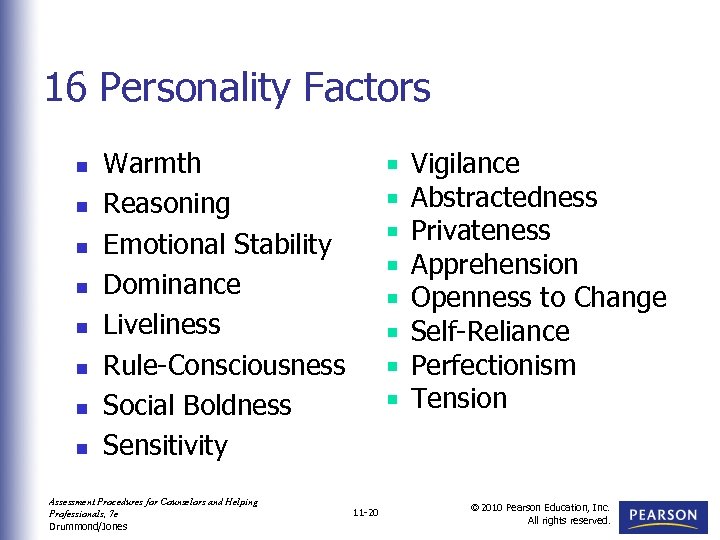 16 Personality Factors n n n n Warmth Reasoning Emotional Stability Dominance Liveliness Rule-Consciousness Social Boldness Sensitivity Assessment Procedures for Counselors and Helping Professionals, 7 e Drummond/Jones 11 -20 Vigilance Abstractedness Privateness Apprehension Openness to Change Self-Reliance Perfectionism Tension © 2010 Pearson Education, Inc. All rights reserved.
 Five Global Factors n n n Extraversion Anxiety Tough-Mindedness Independence Self-Control Assessment Procedures for Counselors and Helping Professionals, 7 e Drummond/Jones 11 -21 © 2010 Pearson Education, Inc. All rights reserved.
 Projective Instruments and Techniques n n n Uses test taker responses to ambiguous test items to reveal personal characteristics about the test taker to the test administrator. Projective tests are tied to psychodynamic theories emphasizing unconscious processes. There are some questions as to the validity and reliability of projective tests. Assessment Procedures for Counselors and Helping Professionals, 7 e Drummond/Jones 11 -22 © 2010 Pearson Education, Inc. All rights reserved.
 The Rorschach n n n 10 cards Printed inkblots, symmetrical right to left 5 black/white, 5 colored Each card presented individually Record examinees response verbatim Inquiry—what prompted each response? Assessment Procedures for Counselors and Helping Professionals, 7 e Drummond/Jones 11 -23 © 2010 Pearson Education, Inc. All rights reserved.
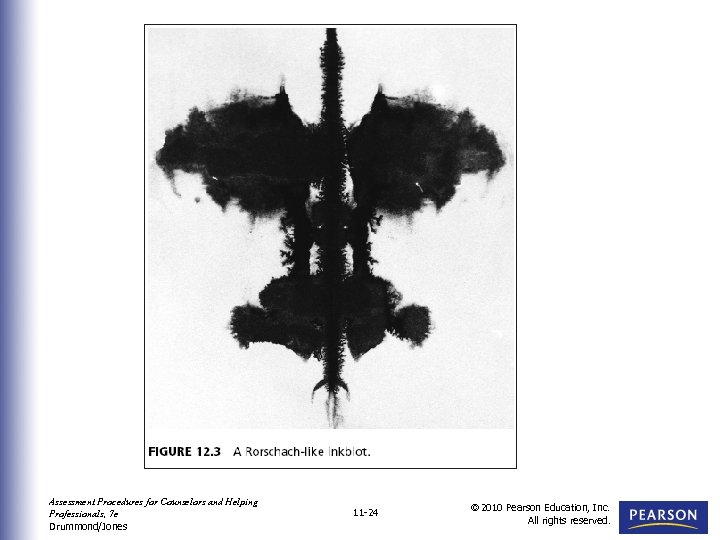 Assessment Procedures for Counselors and Helping Professionals, 7 e Drummond/Jones 11 -24 © 2010 Pearson Education, Inc. All rights reserved.
 The Thematic Apperception Test (TAT) n n n Uses a series of black-and-white cards with pictures of situations, objects, and characters Examinees instructed to tell a story about the picture. Who are the people? What are they thinking and feeling? What came before this scene and how will it turn out? Not well-researched; difficult to evaluate reliability and validity Assessment Procedures for Counselors and Helping Professionals, 7 e Drummond/Jones 11 -25 © 2010 Pearson Education, Inc. All rights reserved.
 Verbal Projective Techniques n Projective Questions n n n Rotter Incomplete Sentences Blank n n n “If you had three wishes, what would you wish for? ” “If you had a magic wand, what would you change about your life? ” “I like …”; “What annoys me …” Story Completion Assessment Procedures for Counselors and Helping Professionals, 7 e Drummond/Jones 11 -26 © 2010 Pearson Education, Inc. All rights reserved.
 Projective Drawings n n n Projective drawings typically involve test takers drawing a picture. Test givers then explore the meaning of the drawing with the test taker. Projective drawings often tie specific meanings to various dimensions of drawings. Assessment Procedures for Counselors and Helping Professionals, 7 e Drummond/Jones 11 -27 © 2010 Pearson Education, Inc. All rights reserved.
 Projective Drawing Assessments n n n Draw-a-Person House-Tree-Person Technique Kinetic Family Drawing Assessment Procedures for Counselors and Helping Professionals, 7 e Drummond/Jones 11 -28 © 2010 Pearson Education, Inc. All rights reserved.
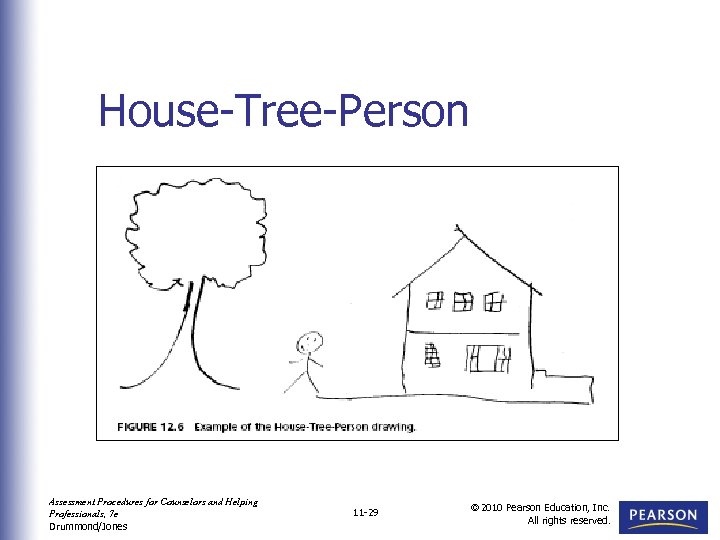 House-Tree-Person Assessment Procedures for Counselors and Helping Professionals, 7 e Drummond/Jones 11 -29 © 2010 Pearson Education, Inc. All rights reserved.
 Personality Inventories with a Positive Focus n n n Based on positive psychology Assess positive aspects of personality, such as life satisfaction, self-efficacy, resiliency, coping skills, well-being. Examples: n n n Quality of Life Inventory Coopersmith Self-Esteem Inventory Pier-Harris Children’s Self-Concept Scale Assessment Procedures for Counselors and Helping Professionals, 7 e Drummond/Jones 11 -30 © 2010 Pearson Education, Inc. All rights reserved.
 Response Styles in Personality Assessment n n Some test takers may have response styles that do not represent the test takers actual personality. Some personality assessments, such as the MMPI-2, attempt to detect problems with response styles. Assessment Procedures for Counselors and Helping Professionals, 7 e Drummond/Jones 11 -31 © 2010 Pearson Education, Inc. All rights reserved.
 Response Styles n n n Social desirability: choosing the response that bests presents self in a favorable light. Acquiescent: tendency of the test taker to accept or agree with statements regardless of the item content (i. e. , answering all items as “true” or “yes”). Nonacquiescence: disagreeing with whatever item is presented (i. e. , answering all items as “false” or “no”). Deviance: making unusual or uncommon responses. Extreme: choosing extreme, rather than middle, ratings on a rating scale. Gambling/cautiousness: guessing, or not guessing, when in doubt about the answer. Assessment Procedures for Counselors and Helping Professionals, 7 e Drummond/Jones 11 -32 © 2010 Pearson Education, Inc. All rights reserved.