


 Скачать презентацию Chapter 12 Perfect Competition Parkin Microeconomics Ninth Edition
6 Perfect competition.ppt
- Количество слайдов: 17
 Chapter 12: Perfect Competition Parkin Microeconomics, Ninth Edition © 2010 Pearson Addison-Wesley. All rights reserved.
 The demand for wheat from farm A is perfectly elastic because wheat from farm A is A. B. C. D. a perfect complement for wheat from farm B. a normal good. a perfect substitute for wheat from farm B. an inferior good. Parkin Microeconomics, Ninth Edition © 2010 Pearson Addison-Wesley. All rights reserved.
 Which of the following four firms would most likely be part of a perfectly competitive market? A. Village Pizza sells NY style pizza and hard-to -find microbrews in a college town B. The Wave. House is the only place in San Diego where you can ride an indoor 10 foot wave C. Mark sells his tomatoes he grew in his backyard at the local farmers market D. Amara Massage specializes in pre- and postnatal massage Parkin Microeconomics, Ninth Edition © 2010 Pearson Addison-Wesley. All rights reserved.
 A perfectly competitive firm will shut down if its A. B. C. D. total revenue is less than average fixed cost. total revenue is less than fixed cost. price is less than average variable cost. price is less than total variable cost. Parkin Microeconomics, Ninth Edition © 2010 Pearson Addison-Wesley. All rights reserved.
 Because of a decrease in the wage rate it must pay, a perfectly competitive firm’s marginal costs decrease but its demand curve stays the same. As a result, the firm A. decreases the amount of output it produces and raises its price. B. increases the amount of output it produces and lowers it price. C. increases the amount of output it produces and does not change its price. D. decreases the amount of output it produces and lowers its price. Parkin Microeconomics, Ninth Edition © 2010 Pearson Addison-Wesley. All rights reserved.
 If there are 1, 000 rutabaga farms, all perfectly competitive, an increase in the price of fertilizer used for growing rutabagas will A. have no effect on the total quantity of rutabagas supplied, because no farm has enough market power to raise the price. B. have no effect on the total quantity of rutabagas supplied, because each farm’s supply curve is a vertical line. C. decrease the total quantity of rutabagas supplied, because each farm’s supply curve shifts leftward. D. reduce the total quantity of rutabagas supplied, because each farm’s supply curve is a horizontal line and will shift upward. Parkin Microeconomics, Ninth Edition © 2010 Pearson Addison-Wesley. All rights reserved.
 Scotland has seen its biggest population increase since the “baby boom” created by demobilized soldiers returning from the Second World War, figures in August 2008 revealed. In the short run for a perfectly competitive good, what is true if Scotland’s population is increasing? A. The price individual firms receive will decrease B. The total cost curve for individual firms will shift upward C. The demand curve for individual firms will shift upward D. The marginal cost curve for individual firms will shift downward Parkin Microeconomics, Ninth Edition © 2010 Pearson Addison-Wesley. All rights reserved.
 Suppose firms in a perfectly competitive industry are suffering an economic loss. Over time, A. other firms enter the industry, so the price rises and the economic loss decreases. B. some firms leave the industry, so the price rises and the economic loss decreases. C. other firms enter the industry, so the price falls and the economic loss decreases. D. some firms leave the industry, so the price falls and the economic loss decreases. Parkin Microeconomics, Ninth Edition © 2010 Pearson Addison-Wesley. All rights reserved.
 A worldwide hops (a flowers used in brewing) shortage will make stouts, ales and other specialty microbrews more pricy in 2008. Gayle Goshie, a hops farmer, blames overproduction for hops’ previously cheap place on the agricultural market. The glut pushed many hop farmers out business, which gradually helped hop prices recover. Suppose farming hops is a perfectly competitive market. Why would some hop farmers go out of business? A. B. C. D. Because the price of hops was below the minimum of average fixed cost Because the price of hops was lower than the minimum of average variable cost Because the price of hops was higher than the minimum of average variable cost Because the price of hops was lower than the minimum of average total cost Parkin Microeconomics, Ninth Edition © 2010 Pearson Addison-Wesley. All rights reserved.
 The USDA maintains ethanol has an impact on food prices, even if it is an indirect link. “Higher ethanol production definitely and directly raises the price of corn, ” said USDA economist Ephraim Leibtag. In the short run in the corn market, what is true if the production of ethanol increases? A. Individual corn farmers will suffer an economic loss in the short run and will shut down B. Individual corn farmers will earn an economic profit in the short run C. Individual corn farmers will suffer an economic loss in the short run, but they will still produce D. Individual corn farmers will earn a normal profit in the short run Parkin Microeconomics, Ninth Edition © 2010 Pearson Addison-Wesley. All rights reserved.
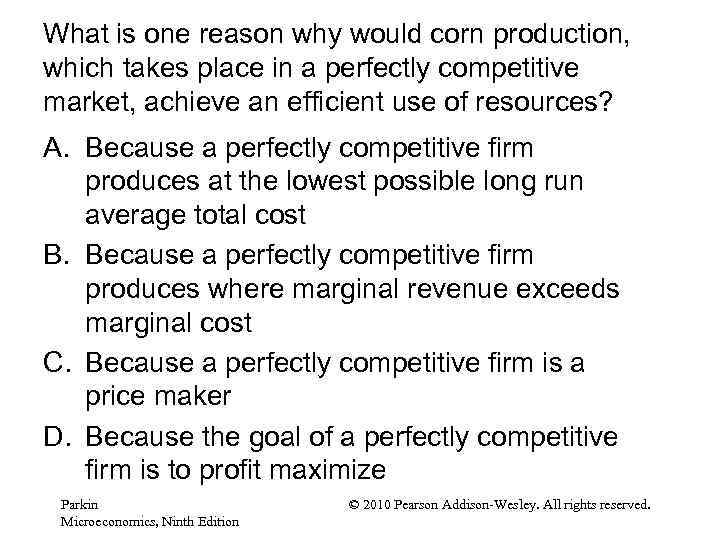 What is one reason why would corn production, which takes place in a perfectly competitive market, achieve an efficient use of resources? A. Because a perfectly competitive firm produces at the lowest possible long run average total cost B. Because a perfectly competitive firm produces where marginal revenue exceeds marginal cost C. Because a perfectly competitive firm is a price maker D. Because the goal of a perfectly competitive firm is to profit maximize Parkin Microeconomics, Ninth Edition © 2010 Pearson Addison-Wesley. All rights reserved.
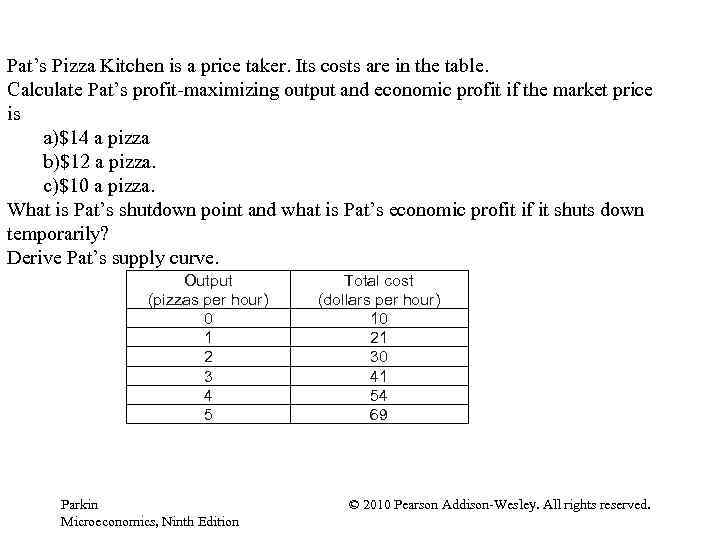 Pat’s Pizza Kitchen is a price taker. Its costs are in the table. Calculate Pat’s profit-maximizing output and economic profit if the market price is a)$14 a pizza b)$12 a pizza. c)$10 a pizza. What is Pat’s shutdown point and what is Pat’s economic profit if it shuts down temporarily? Derive Pat’s supply curve. Output (pizzas per hour) 0 1 2 3 4 5 Parkin Microeconomics, Ninth Edition Total cost (dollars per hour) 10 21 30 41 54 69 © 2010 Pearson Addison-Wesley. All rights reserved.
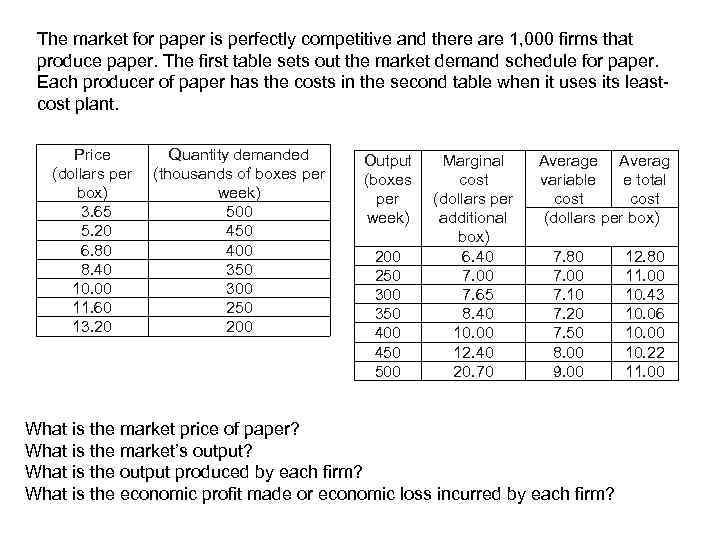 The market for paper is perfectly competitive and there are 1, 000 firms that produce paper. The first table sets out the market demand schedule for paper. Each producer of paper has the costs in the second table when it uses its leastcost plant. Price (dollars per box) 3. 65 5. 20 6. 80 8. 40 10. 00 11. 60 13. 20 Quantity demanded (thousands of boxes per week) 500 450 400 350 300 250 200 Output (boxes per week) 200 250 300 350 400 450 500 Marginal cost (dollars per additional box) 6. 40 7. 00 7. 65 8. 40 10. 00 12. 40 20. 70 Average Averag variable e total cost (dollars per box) 7. 80 7. 00 7. 10 7. 20 7. 50 8. 00 9. 00 What is the market price of paper? What is the market’s output? What is the output produced by each firm? What is the economic profit made or economic loss incurred by each firm? 12. 80 11. 00 10. 43 10. 06 10. 00 10. 22 11. 00
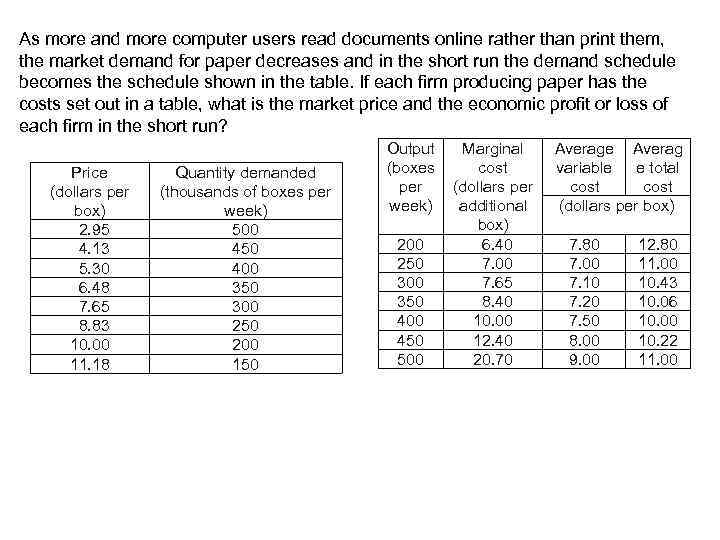 As more and more computer users read documents online rather than print them, the market demand for paper decreases and in the short run the demand schedule becomes the schedule shown in the table. If each firm producing paper has the costs set out in a table, what is the market price and the economic profit or loss of each firm in the short run? Price (dollars per box) 2. 95 4. 13 5. 30 6. 48 7. 65 8. 83 10. 00 11. 18 Quantity demanded (thousands of boxes per week) 500 450 400 350 300 250 200 150 Output (boxes per week) 200 250 300 350 400 450 500 Marginal cost (dollars per additional box) 6. 40 7. 00 7. 65 8. 40 10. 00 12. 40 20. 70 Average Averag variable e total cost (dollars per box) 7. 80 7. 00 7. 10 7. 20 7. 50 8. 00 9. 00 12. 80 11. 00 10. 43 10. 06 10. 00 10. 22 11. 00
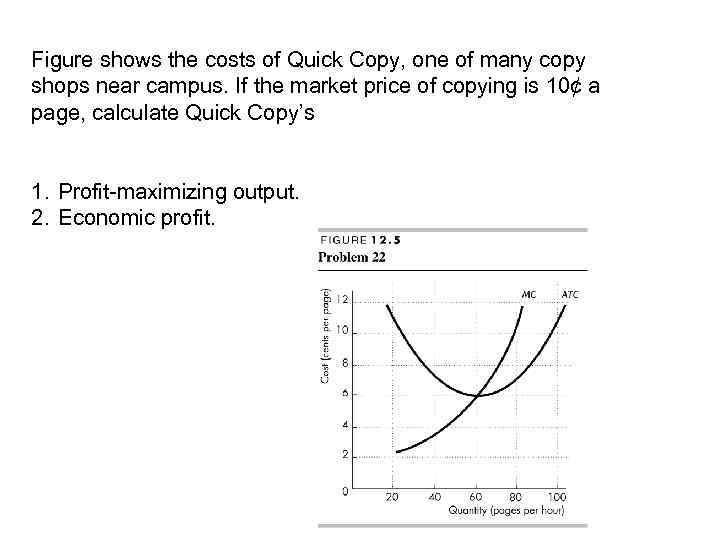 Figure shows the costs of Quick Copy, one of many copy shops near campus. If the market price of copying is 10¢ a page, calculate Quick Copy’s 1. Profit-maximizing output. 2. Economic profit.
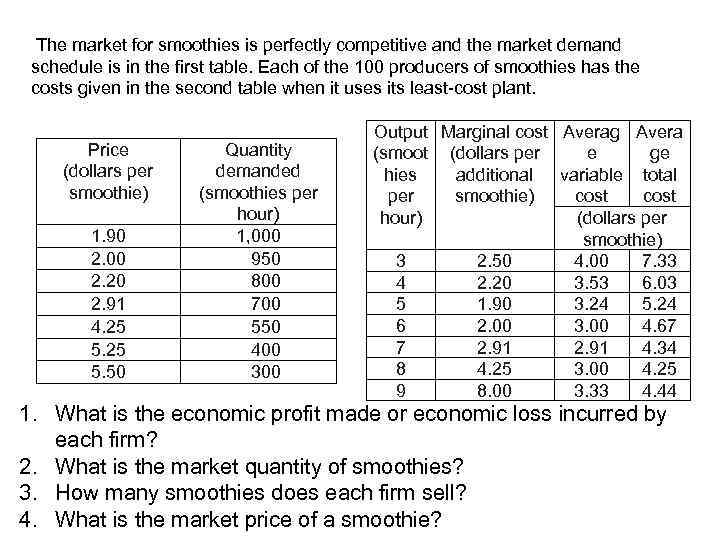 The market for smoothies is perfectly competitive and the market demand schedule is in the first table. Each of the 100 producers of smoothies has the costs given in the second table when it uses its least-cost plant. Price (dollars per smoothie) 1. 90 2. 00 2. 20 2. 91 4. 25 5. 50 Quantity demanded (smoothies per hour) 1, 000 950 800 700 550 400 300 Output Marginal cost Averag Avera (smoot (dollars per e ge hies additional variable total per smoothie) cost (dollars per hour) smoothie) 3 2. 50 4. 00 7. 33 4 2. 20 3. 53 6. 03 5 1. 90 3. 24 5. 24 6 2. 00 3. 00 4. 67 7 2. 91 4. 34 8 4. 25 3. 00 4. 25 9 8. 00 3. 33 4. 44 1. What is the economic profit made or economic loss incurred by each firm? 2. What is the market quantity of smoothies? 3. How many smoothies does each firm sell? 4. What is the market price of a smoothie?
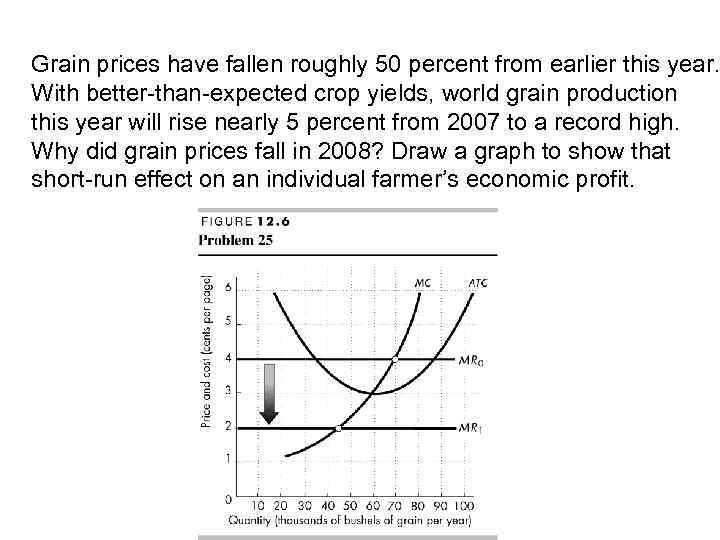 Grain prices have fallen roughly 50 percent from earlier this year. With better-than-expected crop yields, world grain production this year will rise nearly 5 percent from 2007 to a record high. Why did grain prices fall in 2008? Draw a graph to show that short-run effect on an individual farmer’s economic profit.