


 Скачать презентацию CHAPTER 12 Managing Environmental Issues Mc Graw-Hill Irwin Copyright
ce36dfc08cf55a7b38fb14ae9f9a92ef.ppt
- Количество слайдов: 16
 CHAPTER 12 Managing Environmental Issues Mc. Graw-Hill/Irwin Copyright © 2008 The Mc. Graw-Hill Companies, All Rights Reserved.
 Ch. 12: Key Learning Objectives Ø Knowing the main features of environmental laws in the United States and other nations Ø Understanding the advantages and disadvantages of different regulatory approaches Ø Assessing the costs and benefits of environmental regulation Ø Defining an ecologically sustainable organization and the stages through which firms progress as they become more sustainable Ø Understanding how businesses can best manage environmental issues Ø Analyzing how effective environmental management makes firms more competitive 12 - 2
 Role of Government Ø In many nations government regulates business activity in order to protect the environment Ø By setting common standards, governments can take cost of pollution control out of competition Ø Governments can also provide economic incentives and offer systems for resolving disputes 3
 U. S. Environmental Regulation Ø Environmental Protection Agency (EPA), main agency charged with pollution control, was established in 1970 Major areas of regulation Ø § § § Air pollution Water pollution Land pollution 4
 Major Areas of Environmental Regulation Ø Air pollution § Occurs when more pollutants are emitted into the atmosphere than can safely be absorbed and diluted by natural processes • Special issue: Acid Rain (see Exhibit 12. A) Ø Water pollution § Occurs when more wastes are dumped into waterways than can be naturally diluted and carried away 5
 Major Areas of Environmental Regulation Ø Land pollution § The contamination of land by both solid and hazardous waste § Movement for environmental justice – efforts to prevent overexposure to hazardous risks in disadvantaged communities § Superfund or CERCLA legislation passed in 198 • Established fund to clean up the most dangerous toxic waste sites in the U. S. • Of 1, 200 sites put on National Priority List, by 2006 only 309 of them had been cleaned • As many of 10, 000 other sites might need clean-up • Program is regarded as public policy failure 6
 Alternative Policy Approaches Ø Environmental standards § Standard allowable levels of various pollutants are established by legislation or regulatory action § Also called command-control § Can be environmental-quality standard or emission standard Ø Market-based mechanisms § Based on the idea that the market is a better control than extensive standards that specify precisely what companies must do § Tradable permits - allows businesses to buy and sell the right to pollute § Emissions charges or fees § Government incentives 7
 Alternative Policy Approaches Ø Information disclosure § The government encourages companies to pollute less by publishing information about the amount of pollutants individual companies emit each year § Also called regulation by publicity or regulation by embarrassment Ø Civil and criminal enforcement § The threat of fines or even prison can be an effective deterrent to corporate outlaws who would otherwise degrade the environment § European regulators have actively pursued environmental criminals § U. S. Sentencing Commission has established guidelines for sentencing environmental wrongdoers 8
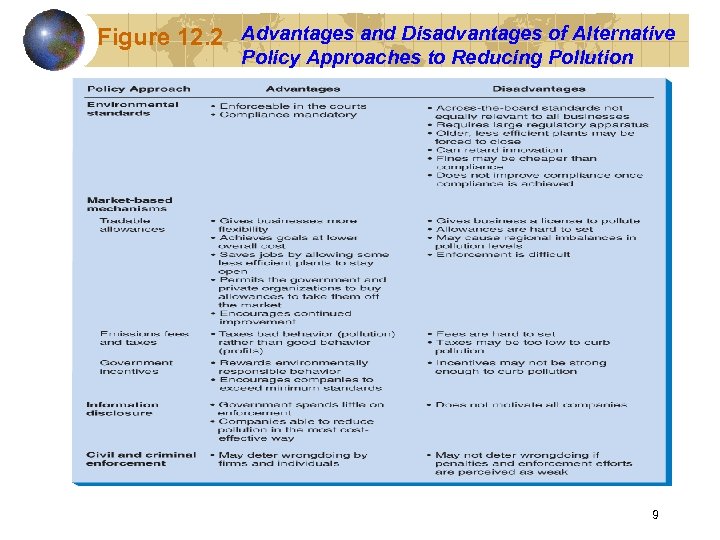 Figure 12. 2 Advantages and Disadvantages of Alternative Policy Approaches to Reducing Pollution 9
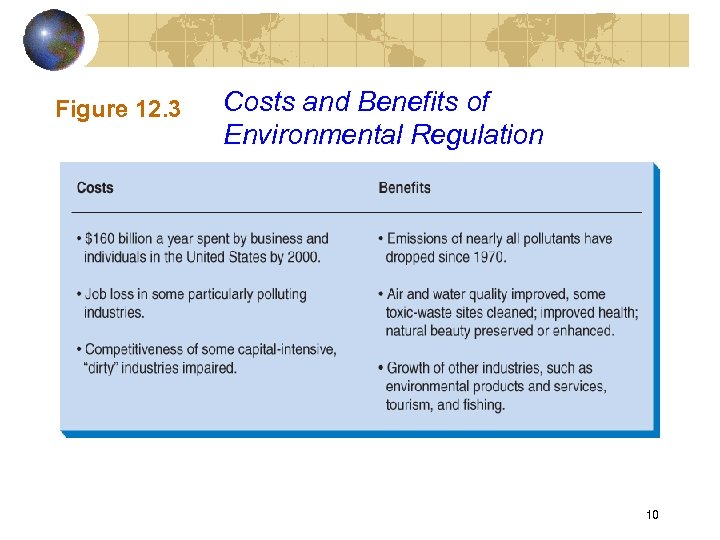 Figure 12. 3 Costs and Benefits of Environmental Regulation 10
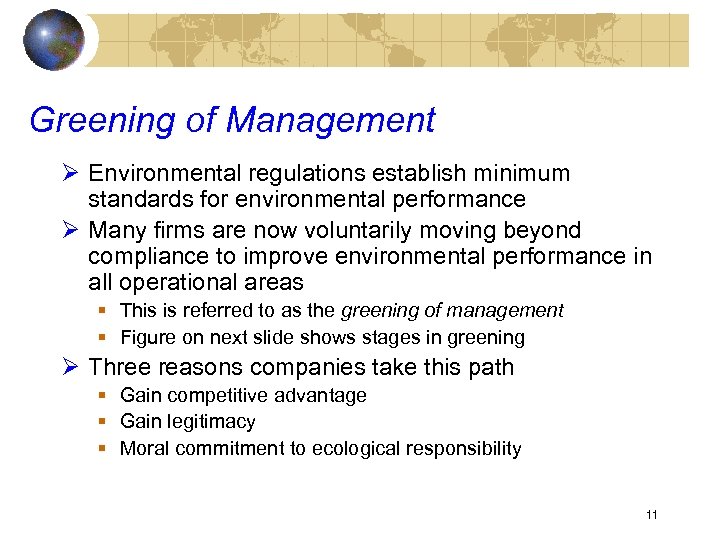 Greening of Management Ø Environmental regulations establish minimum standards for environmental performance Ø Many firms are now voluntarily moving beyond compliance to improve environmental performance in all operational areas § This is referred to as the greening of management § Figure on next slide shows stages in greening Ø Three reasons companies take this path § Gain competitive advantage § Gain legitimacy § Moral commitment to ecological responsibility 11
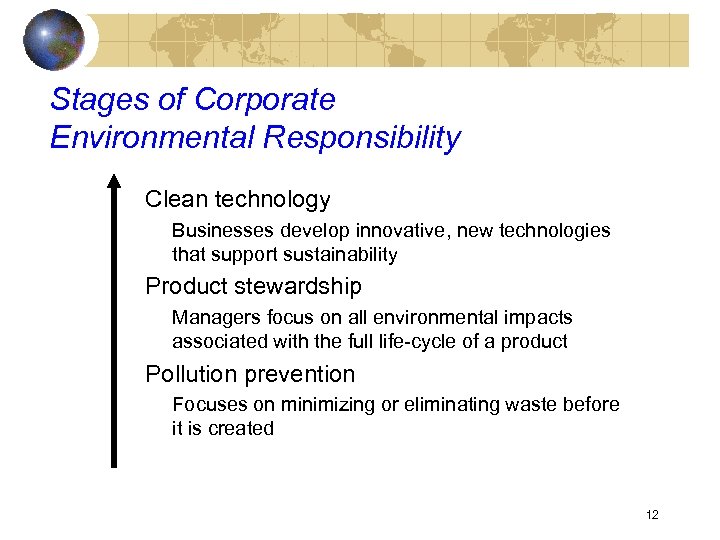 Stages of Corporate Environmental Responsibility Clean technology Businesses develop innovative, new technologies that support sustainability Product stewardship Managers focus on all environmental impacts associated with the full life-cycle of a product Pollution prevention Focuses on minimizing or eliminating waste before it is created 12
 Ecologically Sustainable Organization Ø Companies that operate consistently with principles of sustainable development Ø Is an “ideal, ” absolute standard against which real organizations can be measured Ø Some visionary companies are trying to achieve this Ø Supportive government policies and widespread movement among many businesses and other social institutions will be needed for ESO’s 13
 Environmental Management in Practice Ø Organizational elements of many proactive green companies § § § § Top management involvement in sustainability Line manager involvement Codes of environmental conduct Cross-functional teams Rewards and incentives Track performance through environmental audits Publish combined “sustainability reports” integrating social, economic and environmental performance 14
 Environmental Management as a Competitive Advantage Ø Cost savings § Companies that reduce pollution and hazardous waste, reuse or recycle materials, and operate with greater energy efficiency can reap significant cost savings Ø Product differentiation § Companies that develop a reputation for environmental excellence and that produce and deliver products and services with concern for their sustainability can attract environmentally aware customers 15
 Environmental Management as a Competitive Advantage Ø Technological innovation § Technological innovation can lead to imaginative new methods for reducing pollution and increasing efficiency Ø Strategic planning § Companies that cultivate a vision of sustainability must adopt sophisticated strategic planning techniques 16