 Скачать презентацию Chapter 12 Investing in Stocks Evaluating Stocks Buying
e06c061edd86d3b59f4d183f24bede3f.ppt
- Количество слайдов: 158




Chapter 12 Investing in Stocks Evaluating Stocks Buying and Selling Stock © South-Western Educational Publishing
INVESTING IN STOCKS GOALS Chapter 12 © South-Western Educational Publishing
Terms to Know Stockholders Dividends Capital gain Common stock Proxy Preferred stock Income stocks Growth stocks Blue chip stocks © South-Western Educational Publishing Par value Market value Earnings per share Bull market Bear market Leverage Short selling Stock split Direct investment Dividend reinvestment
Why Learn About Stocks The stock market is the core of America’s economic system Stock is a share of ownership in the assets and earnings of a company Bond is a type of debt that a company issues to investors for a specified amount of time. Stock market is a general term used to describe all transactions involving the buying and selling of stocks and bonds © South-Western Educational Publishing issued by a company
Why Companies Issue Stock When a company would like to grow, it issues stocks to raise funds and pay for ongoing business activities It is popular because: The company does not have to repay the money Paying dividends is optional Dividends are distributions of earnings paid to stockholders © South-Western Educational Publishing
Risk vs. Return On average, stocks have a high rate of return The increase or decrease in the original purchase price of an investment Higher rate of return = greater risk Uncertainty about the outcome of an investment Stocks provide portfolio diversification Money invested in a variety of investment tools © South-Western Educational Publishing
Investing © South-Western Educational Publishing
Why invest in stocks? ? © South-Western Educational Publishing
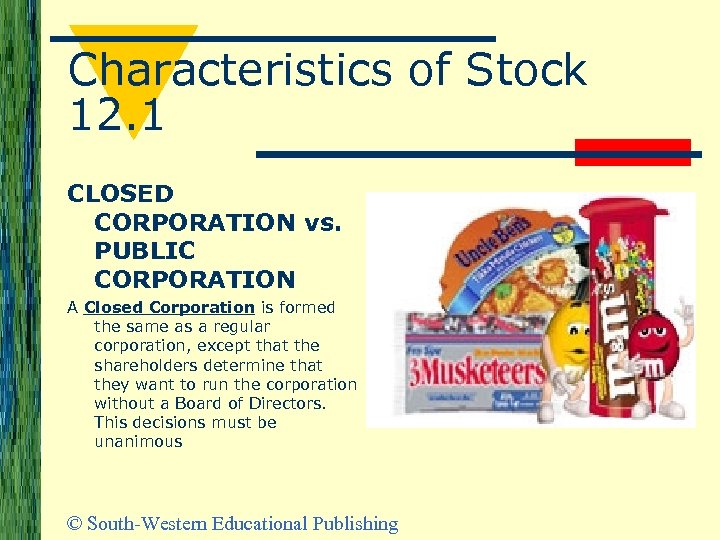
Characteristics of Stock 12. 1 CLOSED CORPORATION vs. PUBLIC CORPORATION A Closed Corporation is formed the same as a regular corporation, except that the shareholders determine that they want to run the corporation without a Board of Directors. This decisions must be unanimous © South-Western Educational Publishing
Closed Corporation vs. Public Corporation A Public Corporation is a company whose stock is traded openly on stock markets © South-Western Educational Publishing
Stockholders Another name Shareholders What does it mean to be a stockholder? You OWN a part of the company !! © South-Western Educational Publishing
HOW DO I BUY STOCK? Yahoo Finance © South-Western Educational Publishing
Stock Obtain a price for one (1) share of Old Navy stock © South-Western Educational Publishing
Gap subsidiaries: Banana Republic Old Navy Piperlime Athleta © South-Western Educational Publishing
Price for Berkshire Hathaway BRKa per share? © South-Western Educational Publishing
Stock Selection – please return to your seats for instructions & demo! © South-Western Educational Publishing
Lesson 12. 1 Evaluating Stocks GOALS Describe the features of common stock and compare it to preferred stock. Discuss stock investing classifications and why you would choose one over another. Explain how stock values are determined. Discuss factors that affect a stock’s price. © South-Western Educational Publishing
Stockholder - part owner of company Dividend – portion of corporation’s profits that are paid to stockholders Capital gain – selling stock for more than you paid for it Price goes down? Capital Loss © South-Western Educational Publishing
Stock How much can a stockholder lose? as much as he/she had invested Traded in: ROUND LOTS – (100 shrs. ) ODD LOTS – (fewer than 100 shrs. ) 60/40 – 2 transactions © South-Western Educational Publishing
There are two types of stock: Common Preferred © South-Western Educational Publishing
Common Stock Variable dividend Voting rights - elect Board of Directors (decides to give shareholders Dividends) - issue additional stock, sell company, change Board of Directors 1 share = 1 vote Proxy – stockholder’s written authorization to transfer his/her voting rights to someone else (company mgr. ) © South-Western Educational Publishing
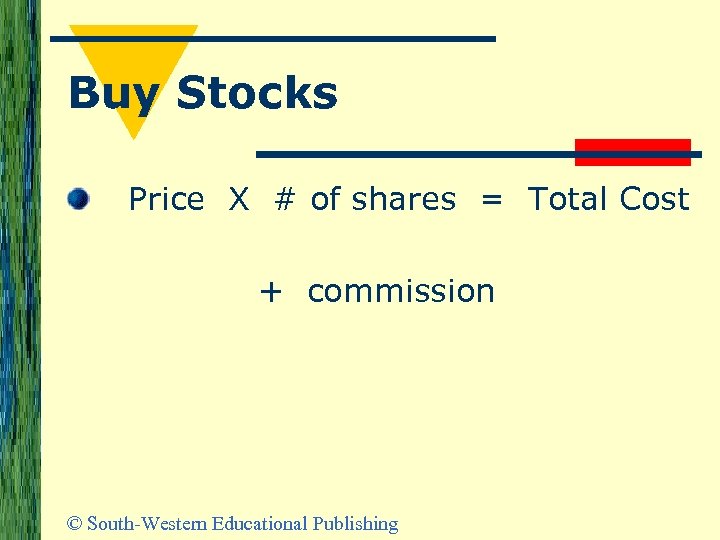
Buy Stocks Price X # of shares = Total Cost + commission © South-Western Educational Publishing
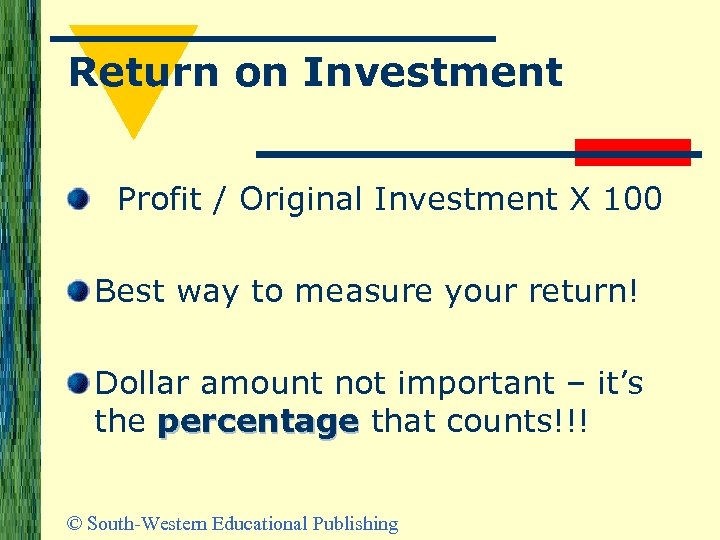
Return on Investment Profit / Original Investment X 100 Best way to measure your return! Dollar amount not important – it’s the percentage that counts!!! percentage © South-Western Educational Publishing
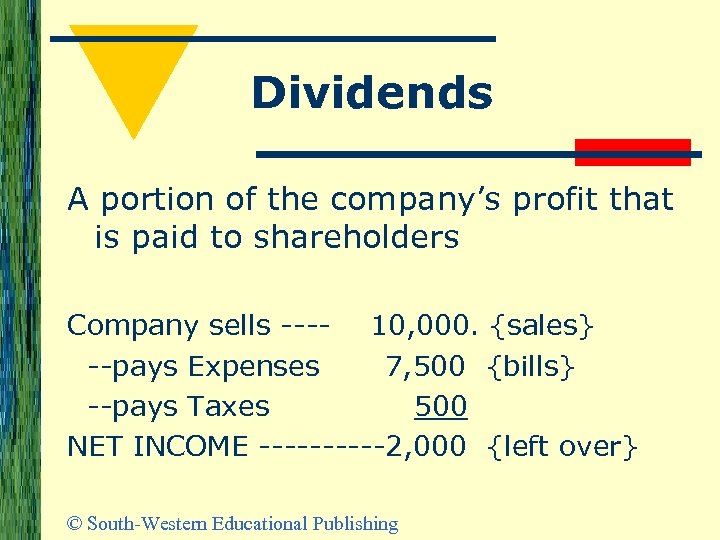
Dividends A portion of the company’s profit that is paid to shareholders Company sells ---- 10, 000. {sales} --pays Expenses 7, 500 {bills} --pays Taxes 500 NET INCOME -----2, 000 {left over} © South-Western Educational Publishing
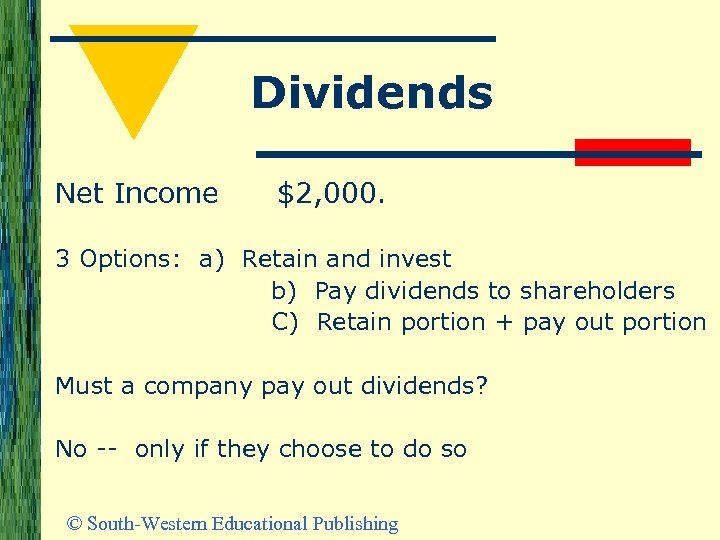
Dividends Net Income $2, 000. 3 Options: a) Retain and invest b) Pay dividends to shareholders C) Retain portion + pay out portion Must a company pay out dividends? No -- only if they choose to do so © South-Western Educational Publishing
Dividends Who decides whether or not to pay dividends? Company Board of Directors Does a shareholder pay taxes on dividends? Yes, both Federal & State © South-Western Educational Publishing
Dividends When are dividends usually paid? usually Quarterly (but can be annual) Are dividends always paid in the form of cash? No {Cash or additional Stock} © South-Western Educational Publishing
Important Dividend Dates TRADE Date - Day on which the trade is executed Declaration Date – Day on which a corporation’s board of directors meets, decides on the amount of the dividend, and makes the public announcement Ex-Dividend Date - Normally set for stocks TWO business days before the record date If you purchase a stock ON its ex-dividend date OR AFTER, you will NOT receive the next dividend payment Purchase before the ex-dividend date, you get the dividend © South-Western Educational Publishing
Dividend Dates Record Date – Date established by an issuer of a security for the purpose of determining the holders who are entitled to receive a dividend or distribution Payment Date - Day on which the corporation makes payment of the dividend to previously determined holders of record © South-Western Educational Publishing
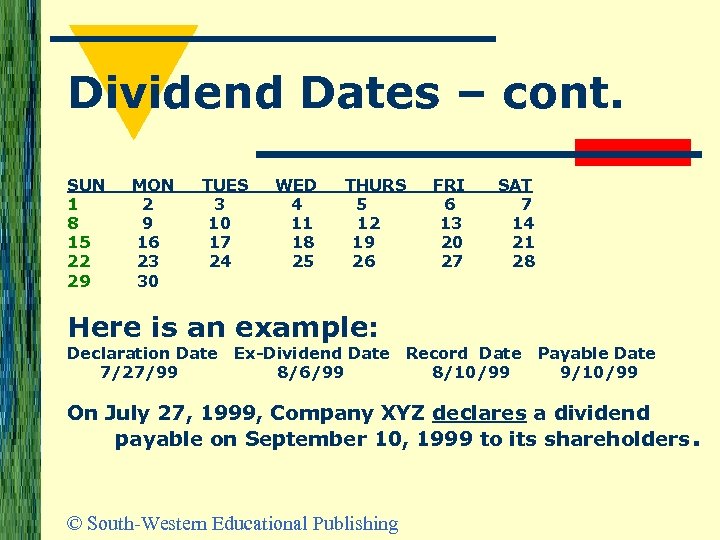
Dividend Dates – cont. SUN 1 8 15 22 29 MON 2 9 16 23 30 TUES 3 10 17 24 WED 4 11 18 25 THURS 5 12 19 26 Here is an example: Declaration Date 7/27/99 Ex-Dividend Date 8/6/99 FRI 6 13 20 27 SAT 7 14 21 28 Record Date 8/10/99 Payable Date 9/10/99 On July 27, 1999, Company XYZ declares a dividend payable on September 10, 1999 to its shareholders. © South-Western Educational Publishing
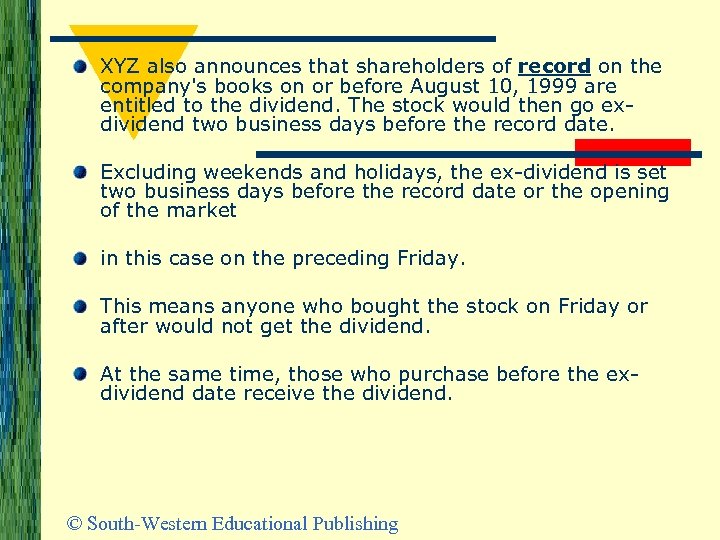
XYZ also announces that shareholders of record on the company's books on or before August 10, 1999 are entitled to the dividend. The stock would then go exdividend two business days before the record date. Excluding weekends and holidays, the ex-dividend is set two business days before the record date or the opening of the market in this case on the preceding Friday. This means anyone who bought the stock on Friday or after would not get the dividend. At the same time, those who purchase before the exdividend date receive the dividend. © South-Western Educational Publishing
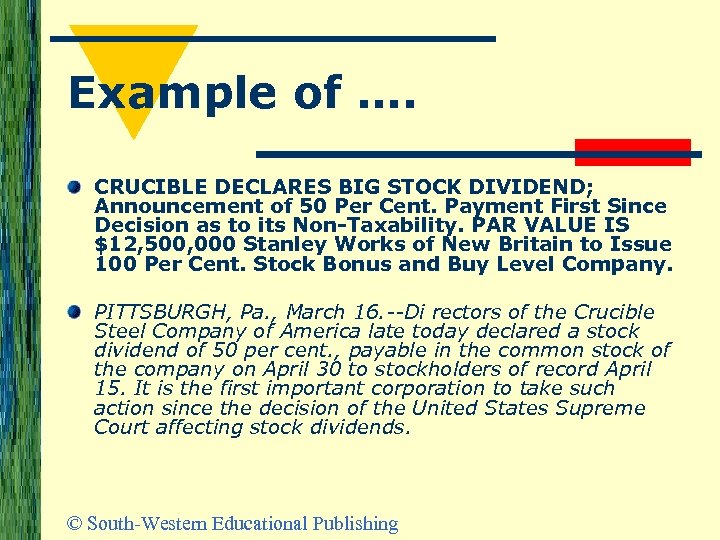
Example of …. CRUCIBLE DECLARES BIG STOCK DIVIDEND; Announcement of 50 Per Cent. Payment First Since Decision as to its Non-Taxability. PAR VALUE IS $12, 500, 000 Stanley Works of New Britain to Issue 100 Per Cent. Stock Bonus and Buy Level Company. PITTSBURGH, Pa. , March 16. --Di rectors of the Crucible Steel Company of America late today declared a stock dividend of 50 per cent. , payable in the common stock of the company on April 30 to stockholders of record April 15. It is the first important corporation to take such action since the decision of the United States Supreme Court affecting stock dividends. © South-Western Educational Publishing
How Stocks are Traded Stock Trades © South-Western Educational Publishing
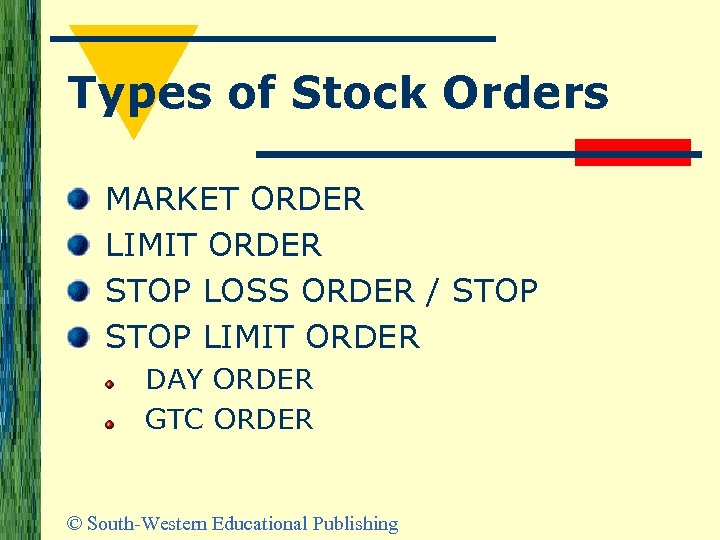
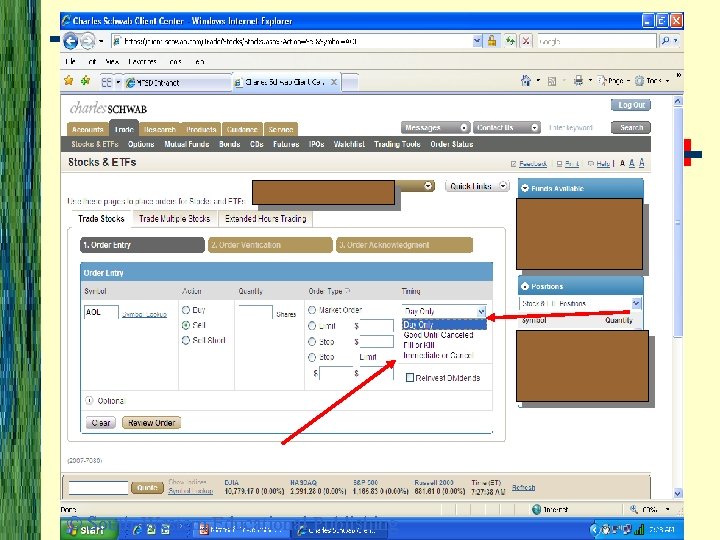
Types of Stock Orders MARKET ORDER LIMIT ORDER STOP LOSS ORDER / STOP LIMIT ORDER DAY ORDER GTC ORDER © South-Western Educational Publishing
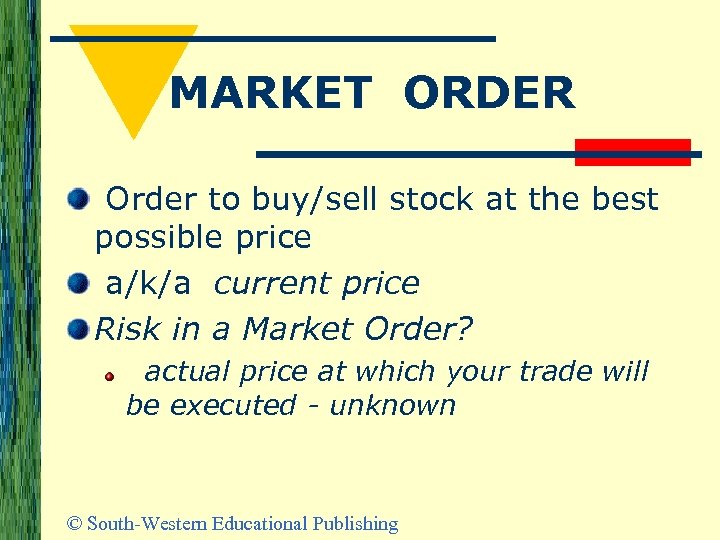
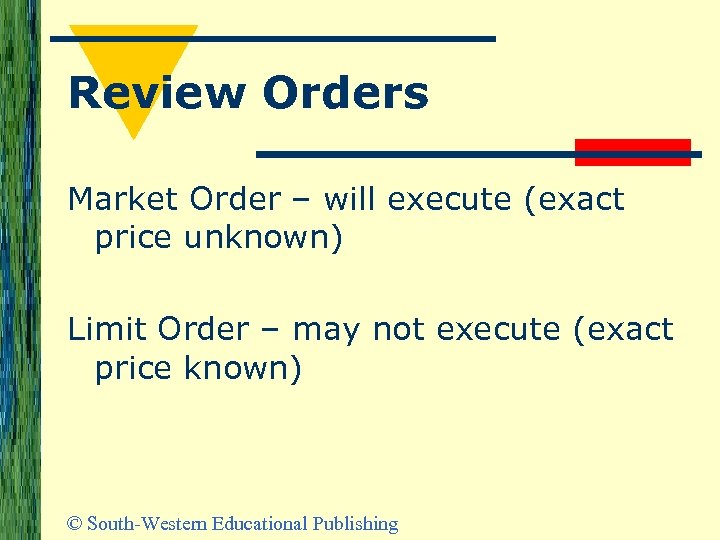
MARKET ORDER Order to buy/sell stock at the best possible price a/k/a current price Risk in a Market Order? actual price at which your trade will be executed - unknown © South-Western Educational Publishing
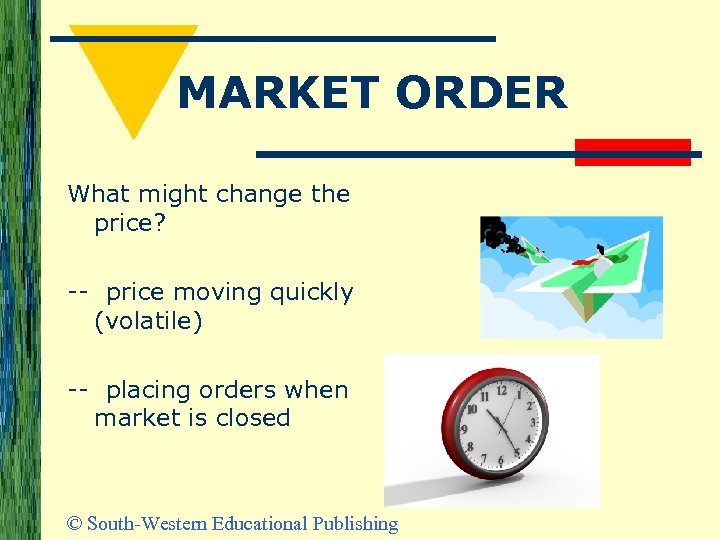
MARKET ORDER What might change the price? -- price moving quickly (volatile) -- placing orders when market is closed © South-Western Educational Publishing
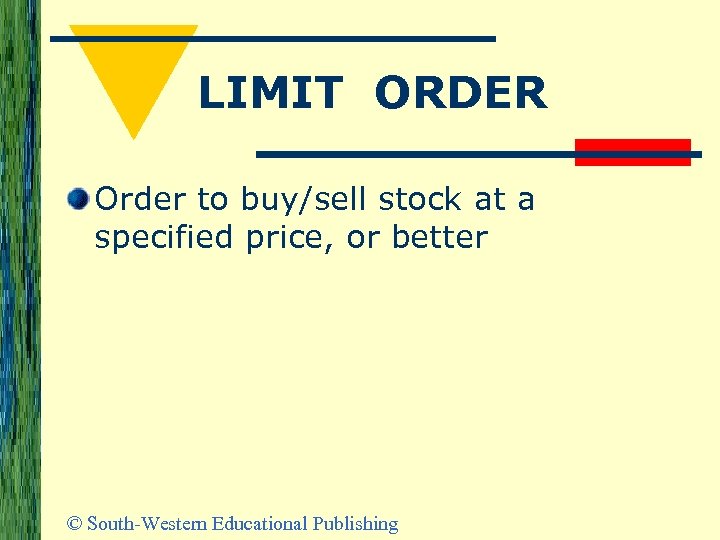
LIMIT ORDER Order to buy/sell stock at a specified price, or better © South-Western Educational Publishing
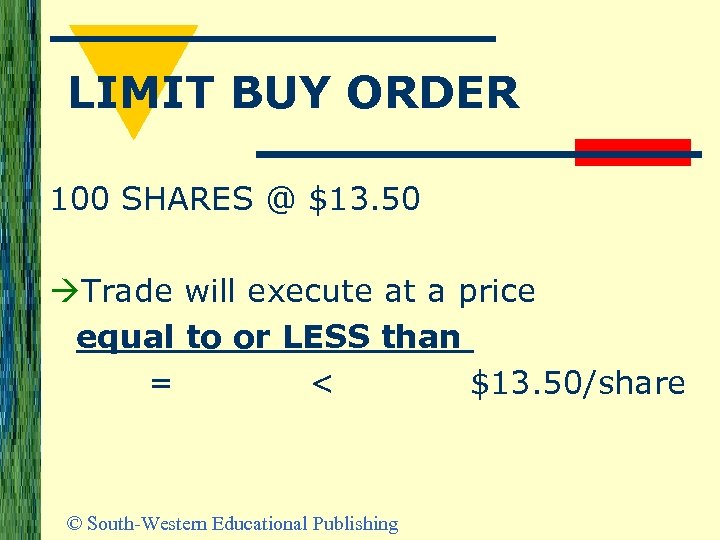
LIMIT BUY ORDER 100 SHARES @ $13. 50 Trade will execute at a price equal to or LESS than = < $13. 50/share © South-Western Educational Publishing
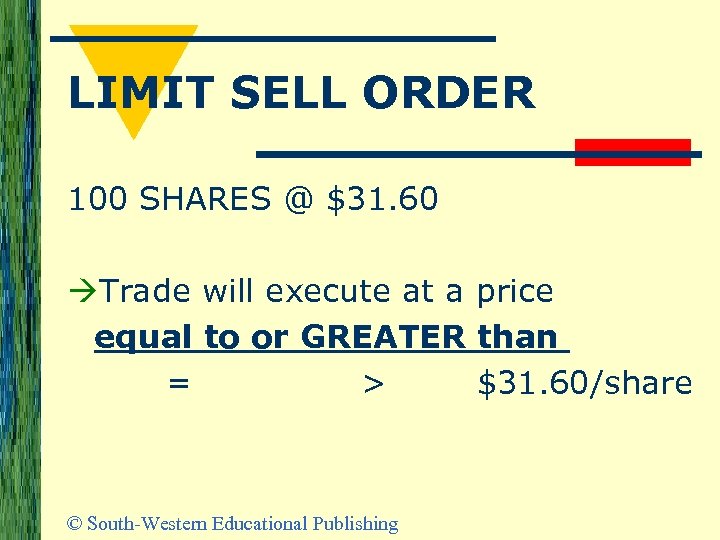
LIMIT SELL ORDER 100 SHARES @ $31. 60 Trade will execute at a price equal to or GREATER than = > $31. 60/share © South-Western Educational Publishing
LIMIT DAY ORDER Execute buy/sell order some time during that trading day No execution order is automatically cancelled © South-Western Educational Publishing
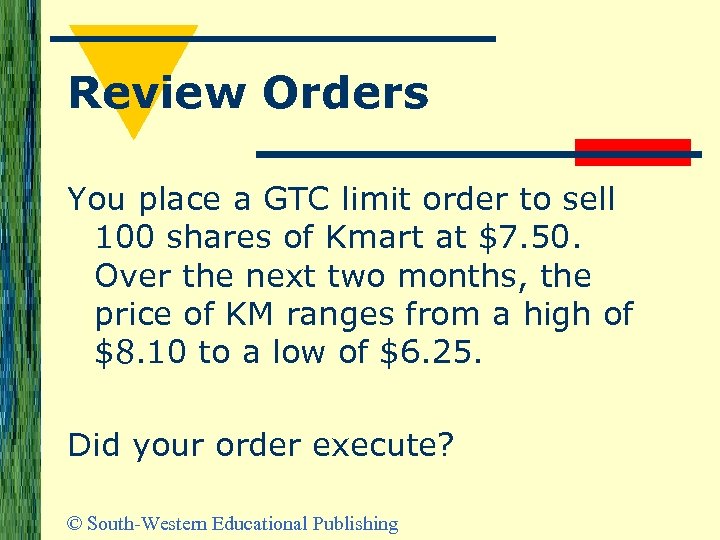
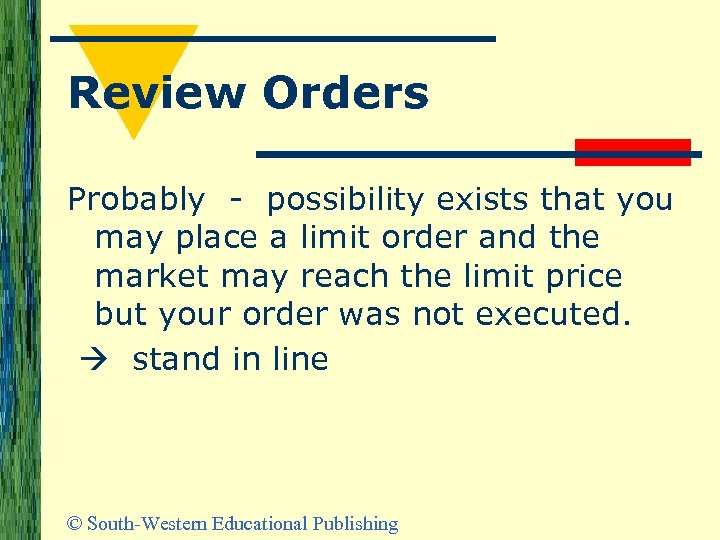
GTC (Good’til Cancelled) Order stands until it is filled or until investor cancels it Broker policy – may automatically cancel GTC orders after 60/90 days -- may or may not renew a cancelled GTC order for you © South-Western Educational Publishing
© South-Western Educational Publishing
Review Orders Market Order – will execute (exact price unknown) Limit Order – may not execute (exact price known) © South-Western Educational Publishing
Review Orders You place a GTC limit order to sell 100 shares of Kmart at $7. 50. Over the next two months, the price of KM ranges from a high of $8. 10 to a low of $6. 25. Did your order execute? © South-Western Educational Publishing
Review Orders Probably - possibility exists that you may place a limit order and the market may reach the limit price but your order was not executed. stand in line © South-Western Educational Publishing
Protecting a profit –or. Limiting a loss STOP LOSS ORDER © South-Western Educational Publishing
STOP LOSS ORDER Order to sell a stock at the market price if the price falls to the requested stop loss price -- place order, stop loss price should be below the current market price © South-Western Educational Publishing
STOP LOSS ORDER -- if the value of the stock declines to the stop loss price, the stop loss order converts to a market order -- hence, the actual value of the stock at execution may be less than or more than the requested stop loss price © South-Western Educational Publishing
STOP LOSS ORDER i. e. Stock price = $31. 75 Stop loss order = $25. Stock falls to $22. 50 -- converted to market order at $25. -- may execute at $25 or lower © South-Western Educational Publishing
STOP LIMIT ORDER Order to sell your shares at a specified price if the market falls to that price -- place order, should be less than current market price -- guarantees price, not execution © South-Western Educational Publishing
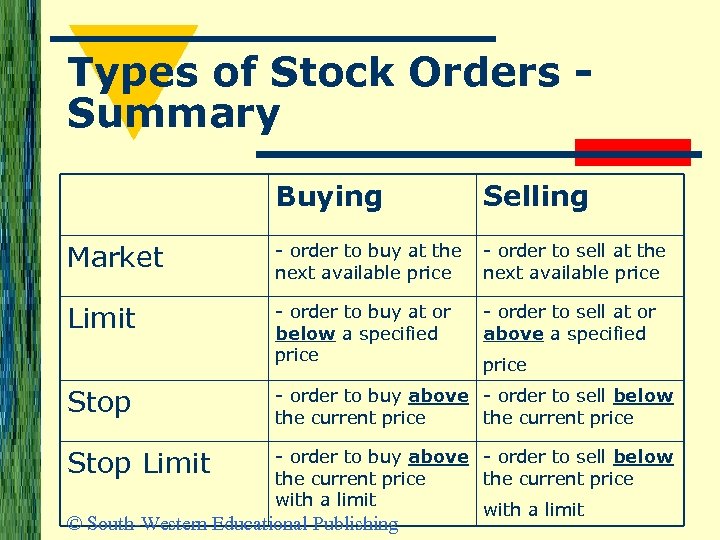
Types of Stock Orders Summary Buying Selling Market - order to buy at the - order to sell at the next available price Limit - order to buy at or below a specified price - order to sell at or above a specified price Stop - order to buy above - order to sell below the current price Stop Limit - order to buy above - order to sell below the current price with a limit © South-Western Educational Publishing
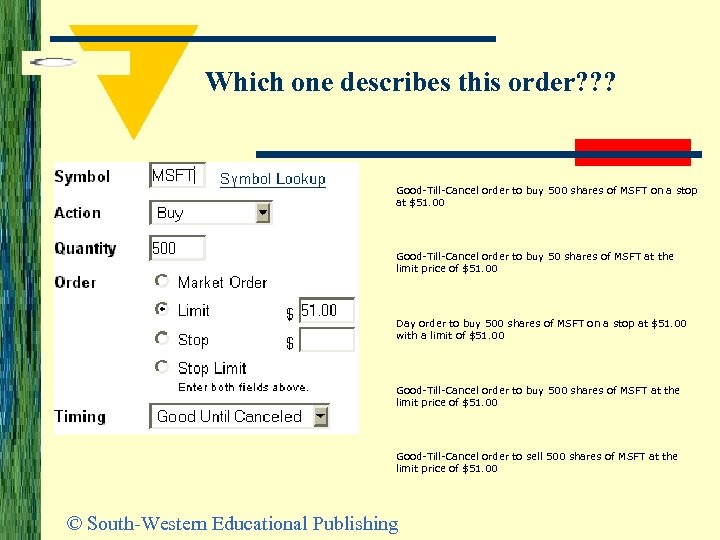
Which one describes this order? ? ? Good-Till-Cancel order to buy 500 shares of MSFT on a stop at $51. 00 Good-Till-Cancel order to buy 50 shares of MSFT at the limit price of $51. 00 Day order to buy 500 shares of MSFT on a stop at $51. 00 with a limit of $51. 00 Good-Till-Cancel order to buy 500 shares of MSFT at the limit price of $51. 00 Good-Till-Cancel order to sell 500 shares of MSFT at the limit price of $51. 00 © South-Western Educational Publishing
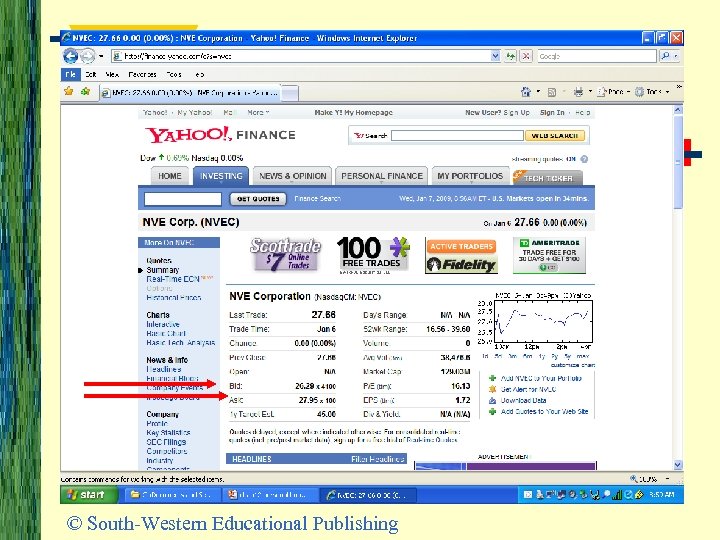
Bid / Ask Prices The bid is the price that someone is willing to pay for the stock you are selling. The ask is the price that someone is willing to sell to you the stock that you are interested in buying. © South-Western Educational Publishing
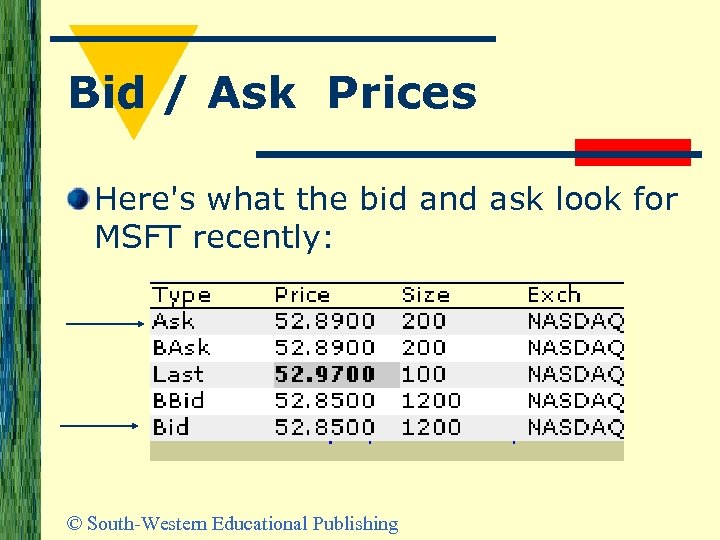
Bid / Ask Prices Here's what the bid and ask look for MSFT recently: © South-Western Educational Publishing
© South-Western Educational Publishing
Bid / Ask Prices The bid/ask spread is simply the difference between those two prices. Typically the asking price will be higher than the bidding price. © South-Western Educational Publishing
Preferred Stock Fixed dividend – less risky than common (less return) No voting rights Preferred stock is often purchased by corporations because of tax breaks they offer companies © South-Western Educational Publishing
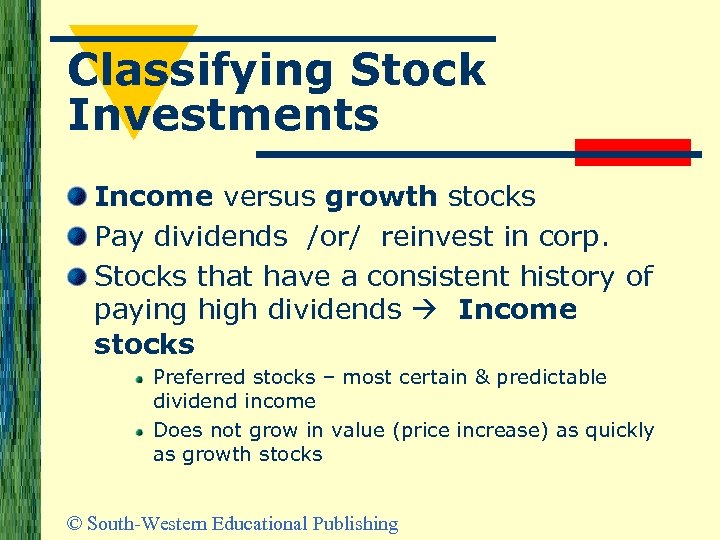
Classifying Stock Investments Income versus growth stocks Pay dividends /or/ reinvest in corp. Stocks that have a consistent history of paying high dividends Income stocks Preferred stocks – most certain & predictable dividend income Does not grow in value (price increase) as quickly as growth stocks © South-Western Educational Publishing
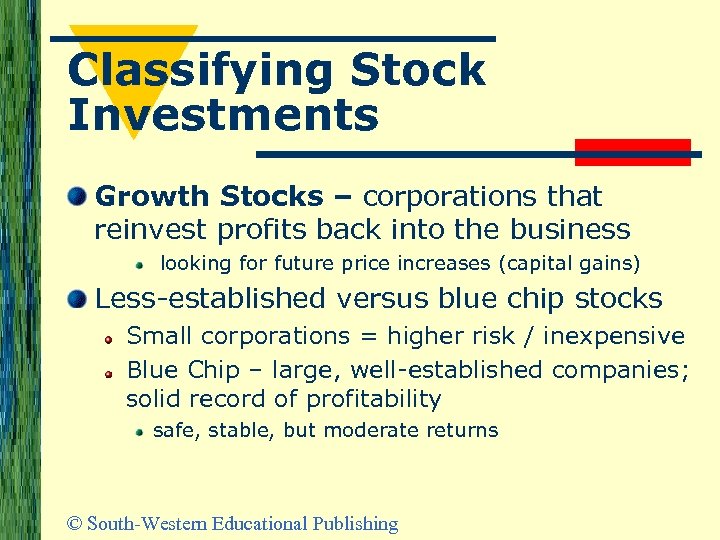
Classifying Stock Investments Growth Stocks – corporations that reinvest profits back into the business looking for future price increases (capital gains) Less-established versus blue chip stocks Small corporations = higher risk / inexpensive Blue Chip – large, well-established companies; solid record of profitability safe, stable, but moderate returns © South-Western Educational Publishing
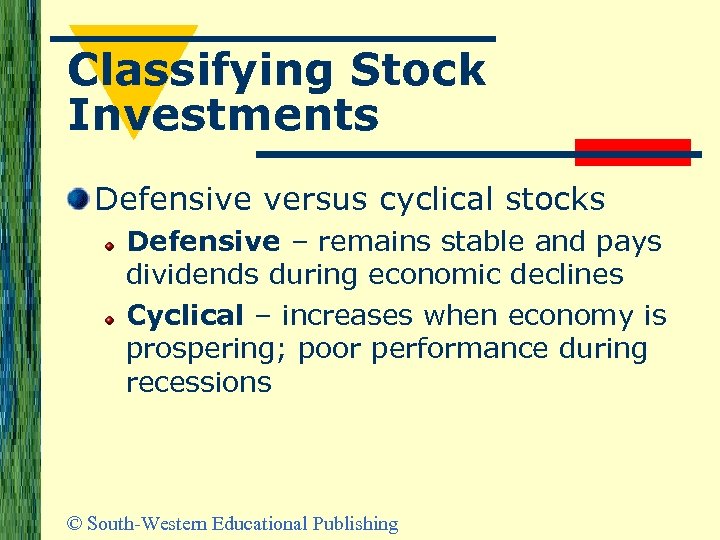
Classifying Stock Investments Defensive versus cyclical stocks Defensive – remains stable and pays dividends during economic declines Cyclical – increases when economy is prospering; poor performance during recessions © South-Western Educational Publishing
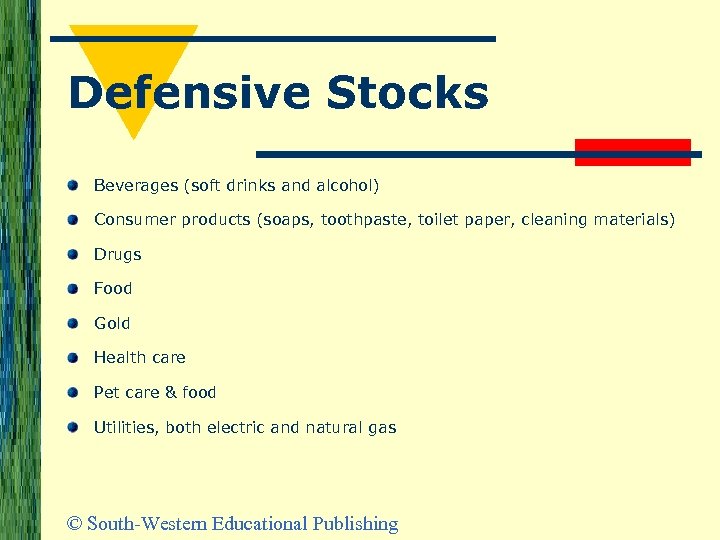
Defensive Stocks Beverages (soft drinks and alcohol) Consumer products (soaps, toothpaste, toilet paper, cleaning materials) Drugs Food Gold Health care Pet care & food Utilities, both electric and natural gas © South-Western Educational Publishing
Cyclical Stocks Automobile manufacturers Airlines Furniture Steel Paper Heavy machinery Hotel Expensive restaurants --are the best examples. © South-Western Educational Publishing
GOALS Margin Buying © South-Western Educational Publishing
What is “Buying on Margin? ” Buying stock on credit Margin increases your b u y i n g power. © South-Western Educational Publishing
APPLY You must sign a “Margin Agreement” with your broker. You must be “Approved” to Buy on Margin” © South-Western Educational Publishing
When you buy on margin, how much of the purchase price must you put up? Initially --- 50% 50% 50% © South-Western Educational Publishing
Who determines the percentage? The Federal Reserve Bank a/k/a The “FED” Skip to © South-Western Educational Publishing
Why do you think there is a limit on the amount of money that brokers can lend? If brokers lend too much money, losses could be great High losses on margin accounts were one reason the stock market crashed in 1929 Stock owners received margin call and could not meet them © South-Western Educational Publishing
Who’s Calling? Did You Know? If a customer can’t provide additional cash, a broker can sell shares in the account, even without the knowledge or consent of the customer. If other stocks are in the account, the broker may sell these shares in place of, or in addition to, the shares of the falling stock. © South-Western Educational Publishing
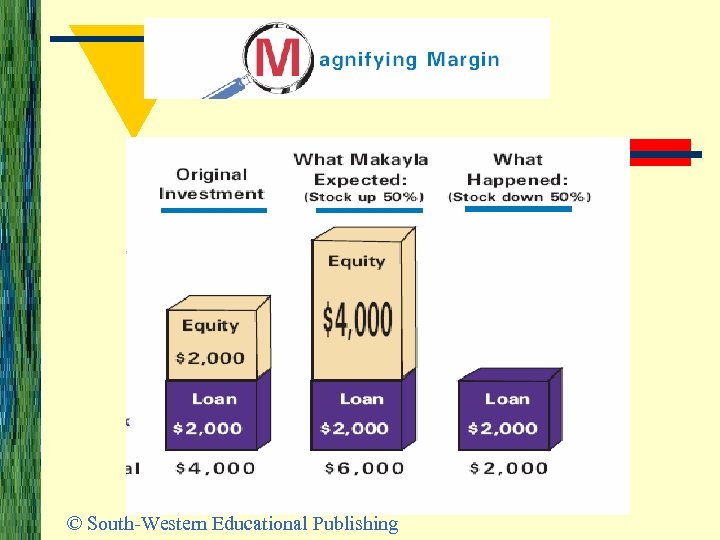
RISK Think a 50% loss is bad? It can get much worse. Buying on margin is the only stock-based investment where you stand to lose more money than you invested. A dive of 50% or more will cause you to lose more than 100%, with interest and commissions on top of that. © South-Western Educational Publishing
What are the advantages of buying stock on margin? An investor can buy MORE stock and make HIGHER returns © South-Western Educational Publishing
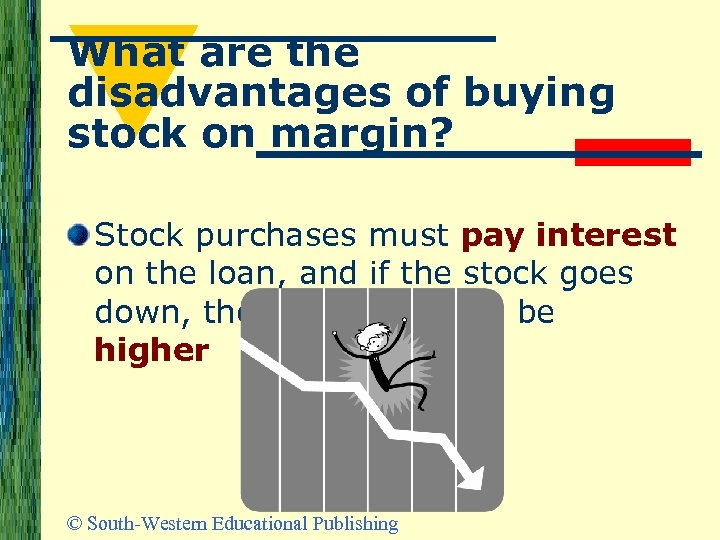
What are the disadvantages of buying stock on margin? Stock purchases must pay interest on the loan, and if the stock goes down, their losses would be higher © South-Western Educational Publishing
The amount of collateral that investors must deposit to open a margin account – initial margin requirement Must be 50% (one-half) of the total value of stock purchased/sold short © South-Western Educational Publishing
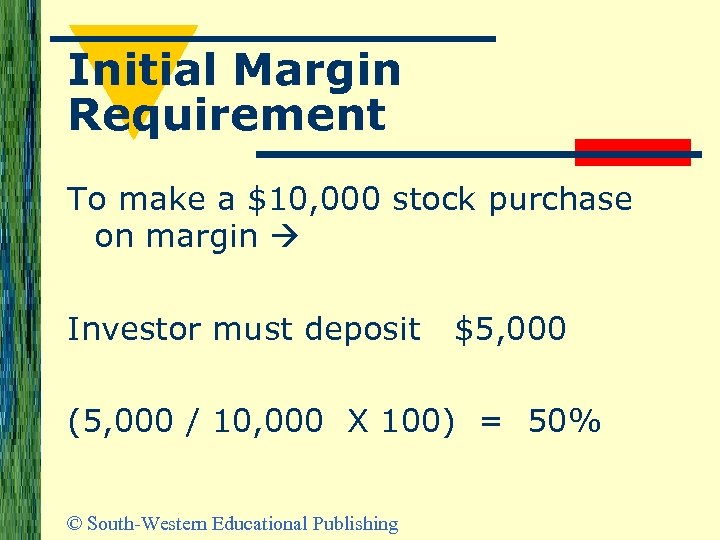
Initial Margin Requirement To make a $10, 000 stock purchase on margin Investor must deposit $5, 000 (5, 000 / 10, 000 X 100) = 50% © South-Western Educational Publishing
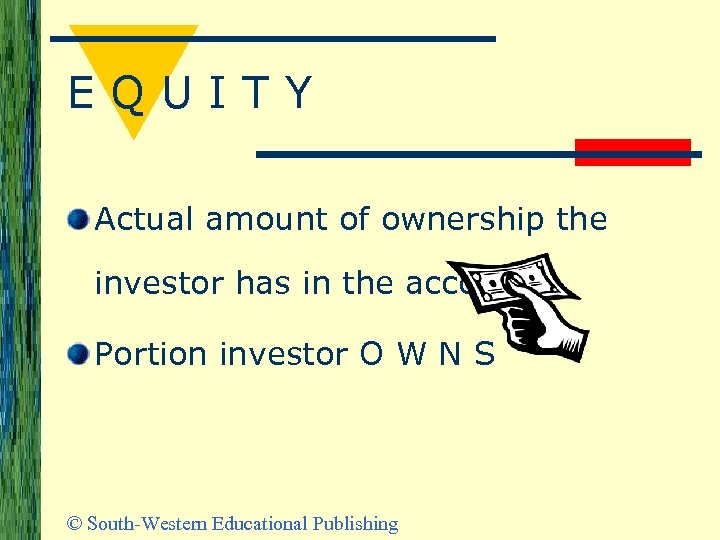
E Q U I T Y Actual amount of ownership the investor has in the account Portion investor O W N S © South-Western Educational Publishing
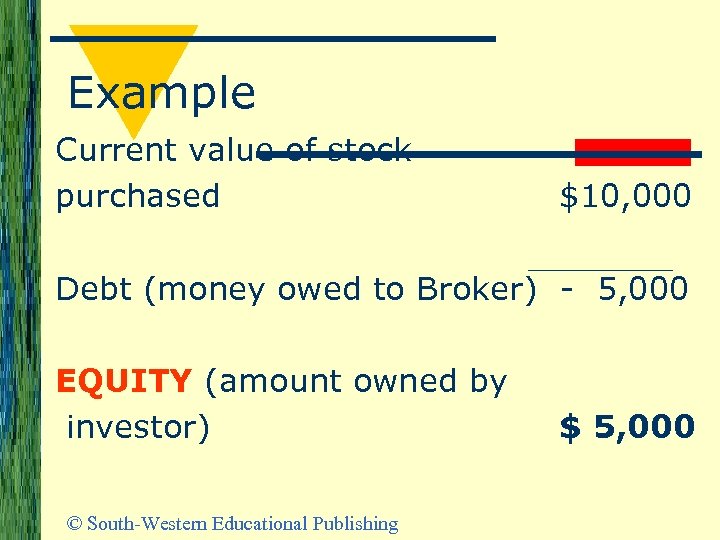
Example Current value of stock purchased $10, 000 Debt (money owed to Broker) - 5, 000 EQUITY (amount owned by investor) © South-Western Educational Publishing $ 5, 000
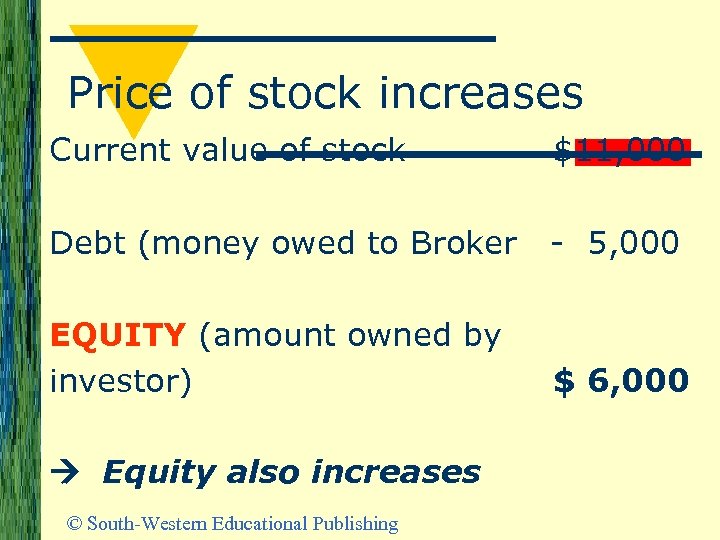
Price of stock increases Current value of stock $11, 000 Debt (money owed to Broker - 5, 000 EQUITY (amount owned by investor) Equity also increases © South-Western Educational Publishing $ 6, 000
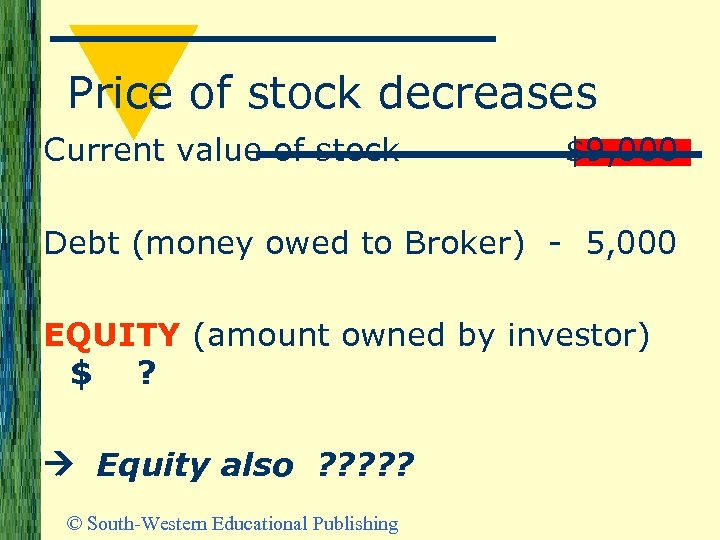
Price of stock decreases Current value of stock $9, 000 Debt (money owed to Broker) - 5, 000 EQUITY (amount owned by investor) $ ? Equity also ? ? ? © South-Western Educational Publishing
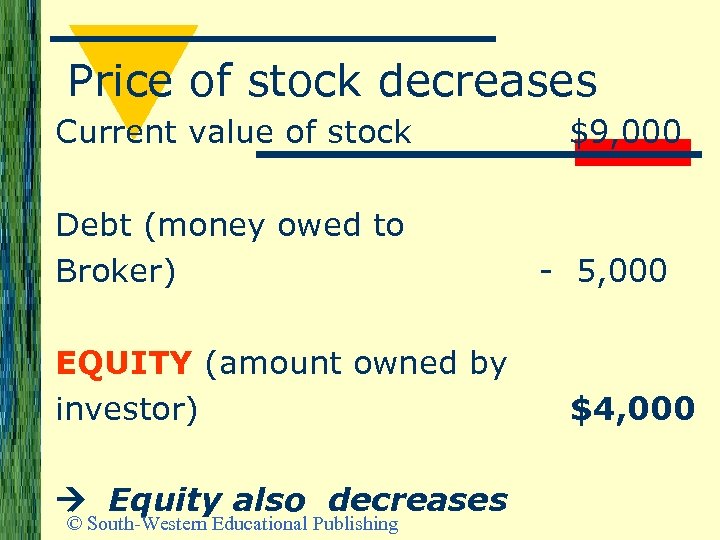
Price of stock decreases Current value of stock $9, 000 Debt (money owed to Broker) - 5, 000 EQUITY (amount owned by investor) Equity also decreases © South-Western Educational Publishing $4, 000
© South-Western Educational Publishing
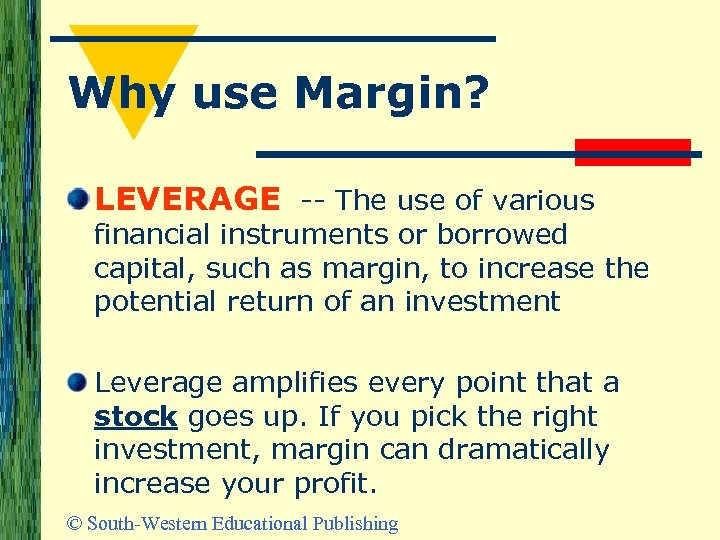
Why use Margin? LEVERAGE -- The use of various financial instruments or borrowed capital, such as margin, to increase the potential return of an investment Leverage amplifies every point that a stock goes up. If you pick the right investment, margin can dramatically increase your profit. © South-Western Educational Publishing
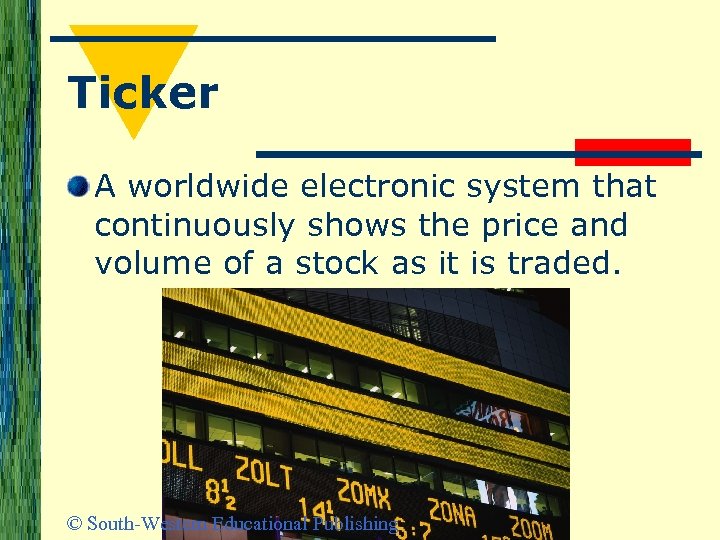
Ticker A worldwide electronic system that continuously shows the price and volume of a stock as it is traded. © South-Western Educational Publishing
Stock Index Statistical gauge that uses a given number of stocks to measure changes in the overall stock market © South-Western Educational Publishing
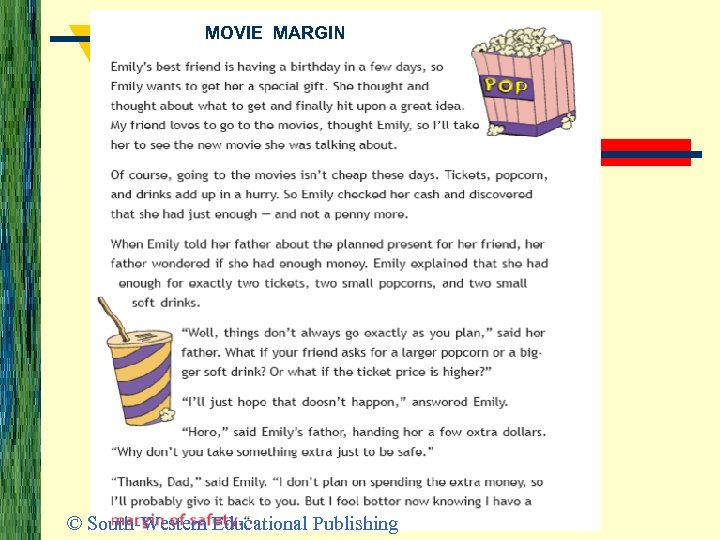
MOVIE MARGIN © South-Western Educational Publishing
MARGIN OF SAFETY An amount beyond the minimum necessary © South-Western Educational Publishing
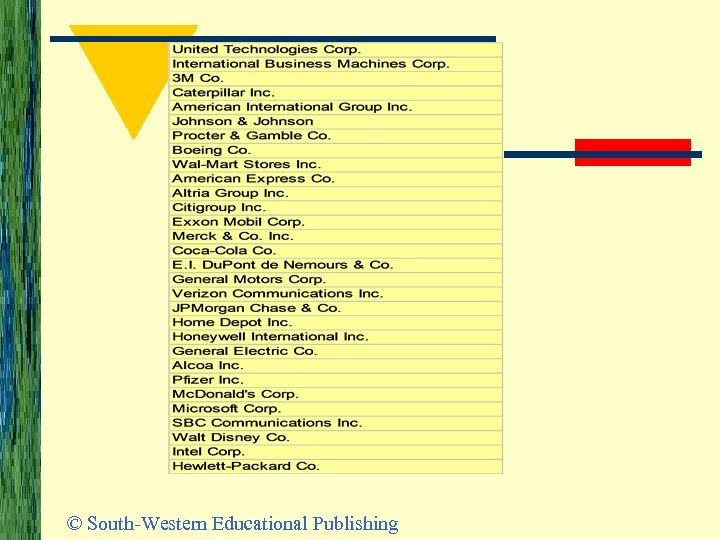
DOW Jones Industrial Average Formula based on the stock prices of 30 industrial companies Formula adds up the stocks’ prices and the divides by a certain number to derive the average The Dow Jones Industrial Average is a Dow key barometer of U. S. equities that is recognized and used the world over. © South-Western Educational Publishing
DOW Price-weighted - company’s weight or importance depends upon “price’ i. e. 1% change in a high-priced stock has larger impact than a 1% increase in a lower-priced stock © South-Western Educational Publishing
© South-Western Educational Publishing
Stock Index Statistical gauge that uses a given number of stocks to measure changes in the overall stock market © South-Western Educational Publishing
NASDAQ Composite Index (^IXIC) Nearly 4, 000 companies listed on NASDAQ Stock Market Popular gauge for technology stocks © South-Western Educational Publishing
Russell 2000 Index Gauge of smaller companies Of 3, 000 U. S. largest companies, the smallest 2, 000 represent the Russell 2000 © South-Western Educational Publishing
S & P 500 (GSPC) Popular measure of stock prices consisting of 500 large companies that represent the major sectors of the U. S. economy Value-weighted - weight or importance of each company depends upon its market cap ( outstanding shares X price) © South-Western Educational Publishing
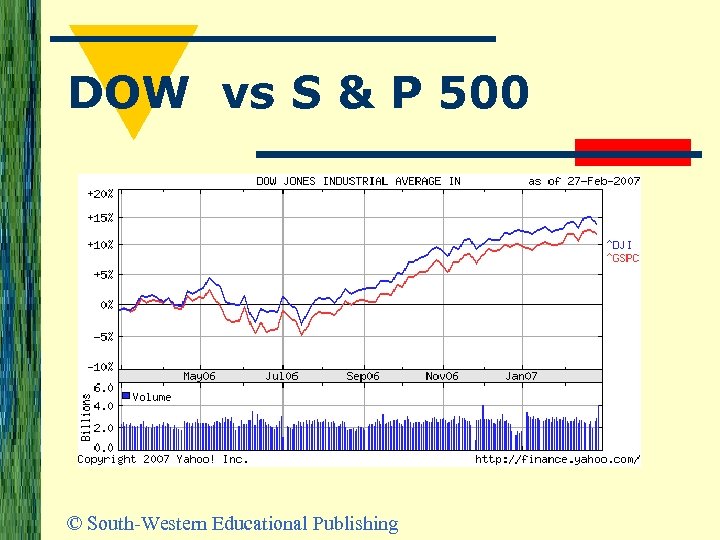
DOW vs S & P 500 © South-Western Educational Publishing
Auction Market Buyers and sellers interacting by announcing bids and offers and thereby determining prices, usually at a physical location like a trading floor NYSE (New York Stock Exchange) – largest, oldest, and most widelyknown © South-Western Educational Publishing Hours 9: 30 a. m. to 4: 00 p. m.
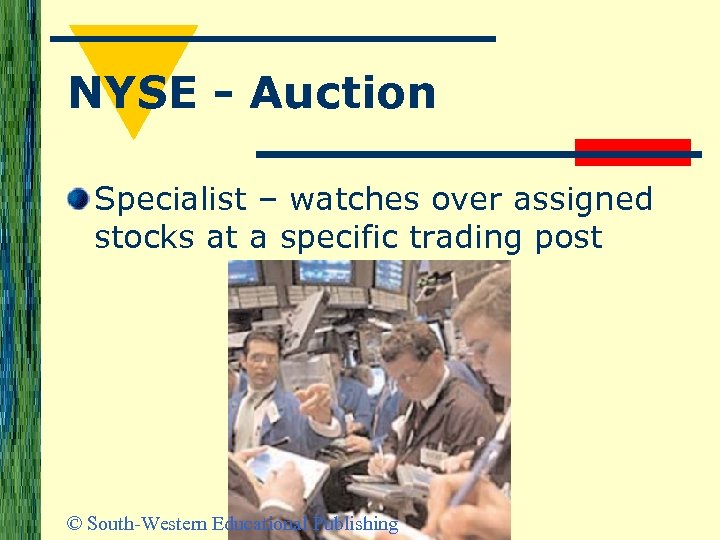
NYSE - Auction Specialist – watches over assigned stocks at a specific trading post © South-Western Educational Publishing
NASDAQ National Association of Securities Dealers Automated Quotation Computerized market that relies on Market Makers not a physical place © South-Western Educational Publishing
OTC – Over The Counter An electronic quotation system for many stocks that don't qualify for listing on the national markets. BB Bulletin Board © South-Western Educational Publishing
Market Maker A business that stands ready to buy or sell stock at publicly quoted prices Keeps an inventory of stock (like a shoe store) Investors deal directly with market makers, not other investors © South-Western Educational Publishing
Market Maker Always quotes a Bid / Ask price and the number of shares it stands ready to buy or sell at those prices © South-Western Educational Publishing
AMEX American Stock Exchange The third largest stock market in the U. S. , with a trading floor in New York City where people trade stocks and other investments on behalf of investors. © South-Western Educational Publishing
The Securities Market Securities exchanges –marketplace where brokers who are representing investor meet to buy and sell securities largest organization in US NYSE (2/3 rd size of football field) – AUCTION MARKET Floorbrokers buy and sell on the exchange Trading posts – specialists American Stock Exchange © South-Western Educational Publishing
© South-Western Educational Publishing
© South-Western Educational Publishing
Www. marketrac. nyse. com © South-Western Educational Publishing
Large-Cap Stock Companies whose market capitalization is large ($$$$$) $5 Billion or more IBM Market Cap: 200. 63 B © South-Western Educational Publishing
Small-Cap Stock Companies whose market capitalization is small ($$) Under $500 Million 1 -800 -Flowers. com Market Cap: 454. 74 M © South-Western Educational Publishing
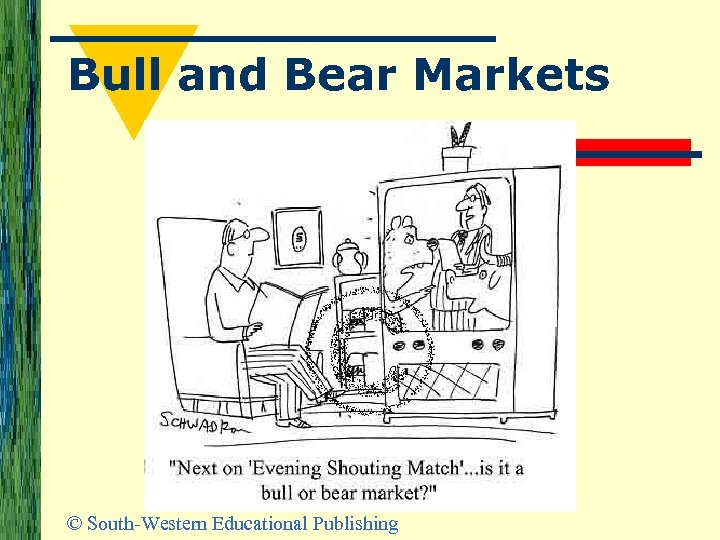
Bull and Bear Markets © South-Western Educational Publishing
What is Market Capitalization (Market Cap)? © South-Western Educational Publishing
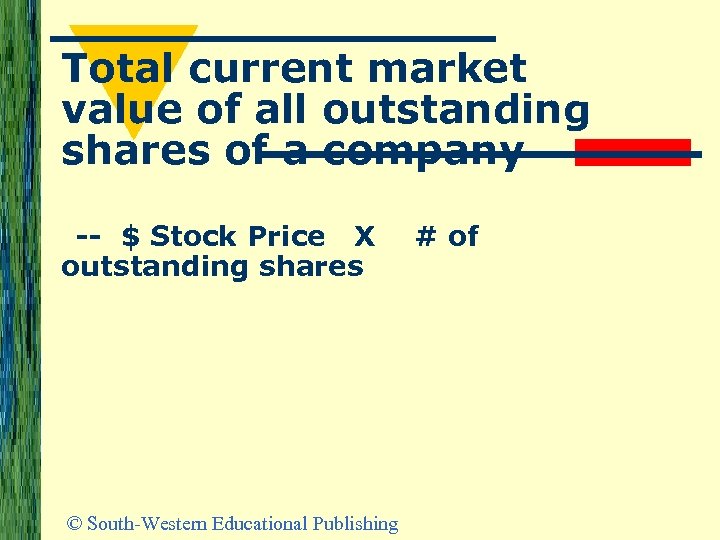
Total current market value of all outstanding shares of a company -- $ Stock Price X outstanding shares © South-Western Educational Publishing # of
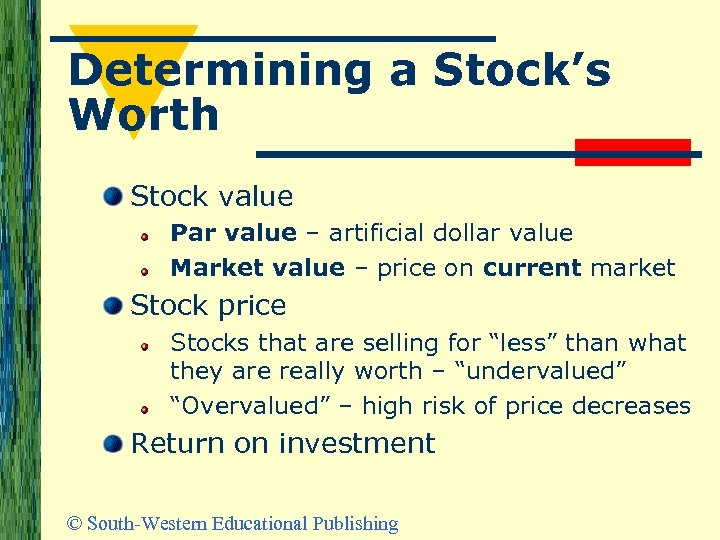
Determining a Stock’s Worth Stock value Par value – artificial dollar value Market value – price on current market Stock price Stocks that are selling for “less” than what they are really worth – “undervalued” “Overvalued” – high risk of price decreases Return on investment © South-Western Educational Publishing
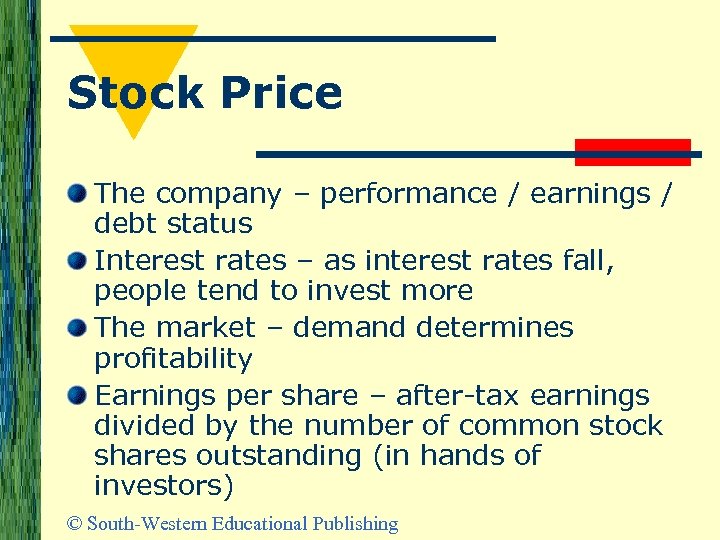
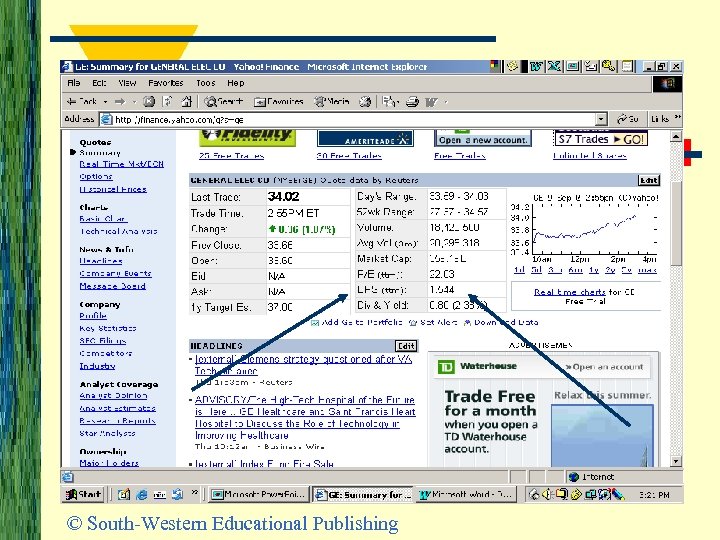
Stock Price The company – performance / earnings / debt status Interest rates – as interest rates fall, people tend to invest more The market – demand determines profitability Earnings per share – after-tax earnings divided by the number of common stock shares outstanding (in hands of investors) © South-Western Educational Publishing
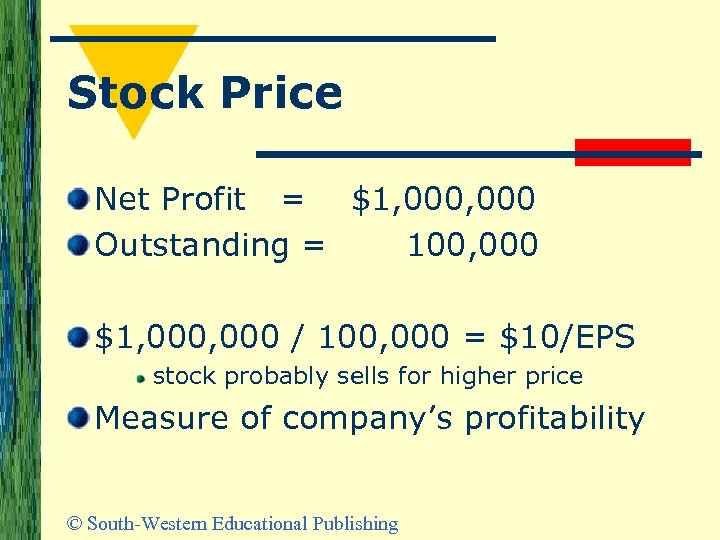
Stock Price Net Profit = $1, 000 Outstanding = 100, 000 $1, 000 / 100, 000 = $10/EPS stock probably sells for higher price Measure of company’s profitability © South-Western Educational Publishing
© South-Western Educational Publishing
What is Short Selling Short selling is the sale of stock borrowed from a broker It is a strategy often used when a buyer believes a particular stock will go down in value. © South-Western Educational Publishing
Short Selling A short seller believes a particular stock’s price will drop and enable him/her to repay the borrowed shares with lower-priced ones. The difference in the price between when the stock was borrowed from the broker and when it was repaid would be the short seller’s gain. © South-Western Educational Publishing
If the stock’s price rises, however, a short-seller will lose money because the borrowed shares will be repaid with higher-priced ones. © South-Western Educational Publishing
Example if an investor borrows 100 shares of a particular stock from a broker at $10. 00 a share , selling it on the market at that price, the investor sees the stock drop to $5. 00 a share and buys the 100 shares from the market to repay the broker making a $5. 00 per share profit. © South-Western Educational Publishing
This can be a risky transaction; if the shares go up to $15. 00 per share the investor will lose $5. 00 per share and needs to use cash to buy back the shares. © South-Western Educational Publishing
When a particular stock or the market in general (bear market) is declining, the opportunity to sell before buying or short sell gives investors a chance to realize gains on declining stocks. Sell-high, buy-low strategy © South-Western Educational Publishing
When a particular stock or the market in general (bear market) is declining, the opportunity to sell before buying or short sell gives investors a chance to realize gains on declining stocks. Sell-high, buy-low strategy © South-Western Educational Publishing
Should the stock rise in price the loss potential is unlimited. Many financial advisors, therefore, recommend short selling only to experienced investors. © South-Western Educational Publishing
Should the stock rise in price the loss potential is unlimited. Many financial advisors, therefore, recommend short selling only to experienced investors. © South-Western Educational Publishing
Short Cover Buying stock in order to repay a broker for the shares borrowed when the stock was sold short. © South-Western Educational Publishing
Long Position The condition of owning stock. The value of a long position is a stock’s current share price multiplied by the number of shares owned. © South-Western Educational Publishing
Short Selling GOALS © South-Western Educational Publishing
What is Short Selling Short selling is the sale of stock borrowed from a broker It is a strategy often used when a buyer believes a particular stock will go down in value. © South-Western Educational Publishing
Short Selling A short seller believes a particular stock’s price will drop and enable him/her to repay the borrowed shares with lower-priced ones. The difference in the price between when the stock was borrowed from the broker and when it was repaid would be the short seller’s gain. © South-Western Educational Publishing
If the stock’s price rises, however, a short-seller will lose money because the borrowed shares will be repaid with higher-priced ones. © South-Western Educational Publishing
Example if an investor borrows 100 shares of a particular stock from a broker at $10. 00 a share , selling it on the market at that price, the investor sees the stock drop to $5. 00 a share and buys the 100 shares from the market to repay the broker making a $5. 00 per share profit. © South-Western Educational Publishing
This can be a risky transaction; if the shares go up to $15. 00 per share the investor will lose $5. 00 per share and needs to use cash to buy back the shares. © South-Western Educational Publishing
When a particular stock or the market in general (bear market) is declining, the opportunity to sell before buying or short sell gives investors a chance to realize gains on declining stocks. Sell-high, buy-low strategy © South-Western Educational Publishing
Should the stock rise in price the loss potential is unlimited. Many financial advisors, therefore, recommend short selling only to experienced investors. © South-Western Educational Publishing
Short Cover Buying stock in order to repay a broker for the shares borrowed when the stock was sold short. © South-Western Educational Publishing
Long Position The condition of owning stock. The value of a long position is a stock’s current share price multiplied by the number of shares owned. © South-Western Educational Publishing
Lesson 12. 2 Buying and Selling Stock GOALS Describe market channels and the process for buying and selling securities. Describe short- and long-term investment strategies when buying and selling stocks. Explain how to read the stock listings in financial publications and how to use stock indexes. © South-Western Educational Publishing
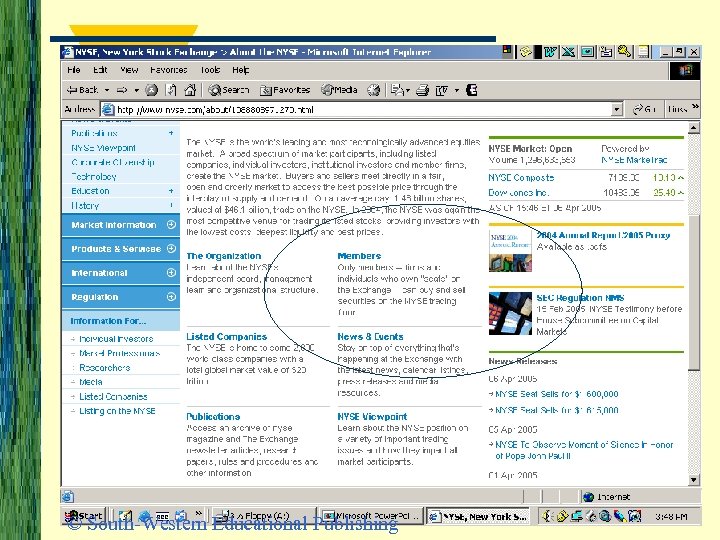
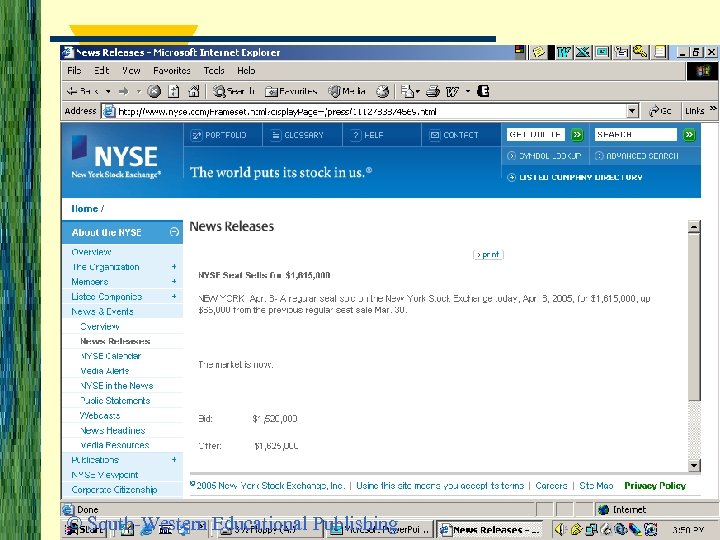
A member firm is a company or individual who owns or leases a "seat" on the NYSE. Only member firms are allowed to buy and sell securities on the trading floor. To become a member firm, a company must meet rigorous professional standards set by the Exchange. The number of seats has remained constant, at 1, 366, since 1953. © South-Western Educational Publishing
The Securities Market Over-the-counter market – securities bought and sold through broker but not through a stock exchange, the transaction is over-the-counter OTC Network of brokers who buy/sell securities of corporations that are not listed on a securities exchange Brokers operating in the OTC market use an electronic quotation system called NASDAQ © South-Western Educational Publishing
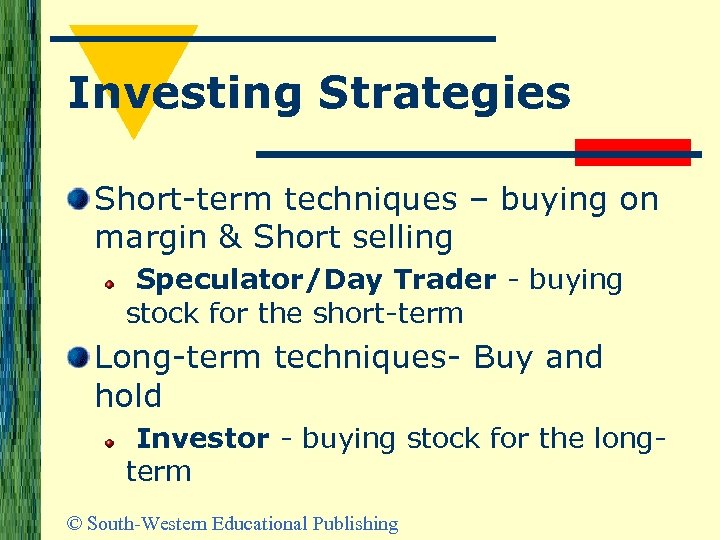
Investing Strategies Short-term techniques – buying on margin & Short selling Speculator/Day Trader - buying stock for the short-term Long-term techniques- Buy and hold Investor - buying stock for the longterm © South-Western Educational Publishing
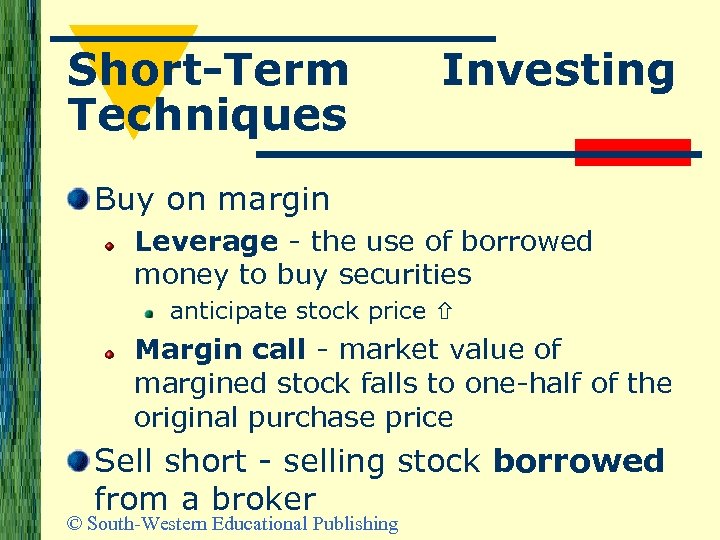
Short-Term Techniques Investing Buy on margin Leverage - the use of borrowed money to buy securities anticipate stock price Margin call - market value of margined stock falls to one-half of the original purchase price Sell short - selling stock borrowed from a broker © South-Western Educational Publishing
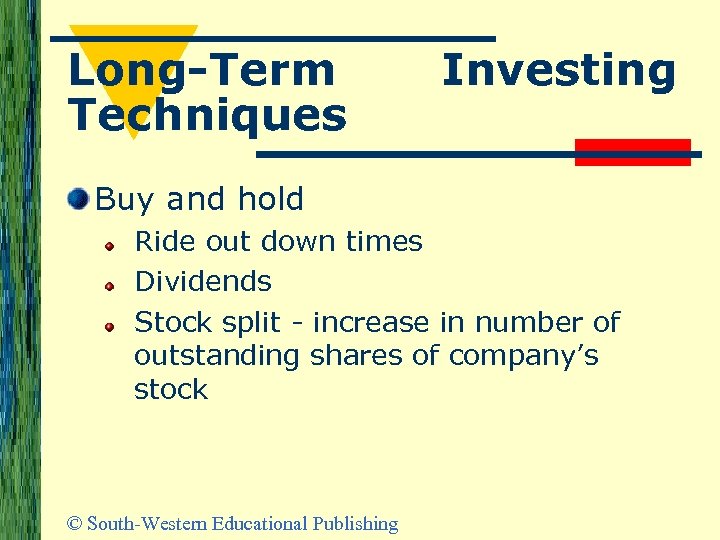
Long-Term Techniques Investing Buy and hold Ride out down times Dividends Stock split - increase in number of outstanding shares of company’s stock © South-Western Educational Publishing
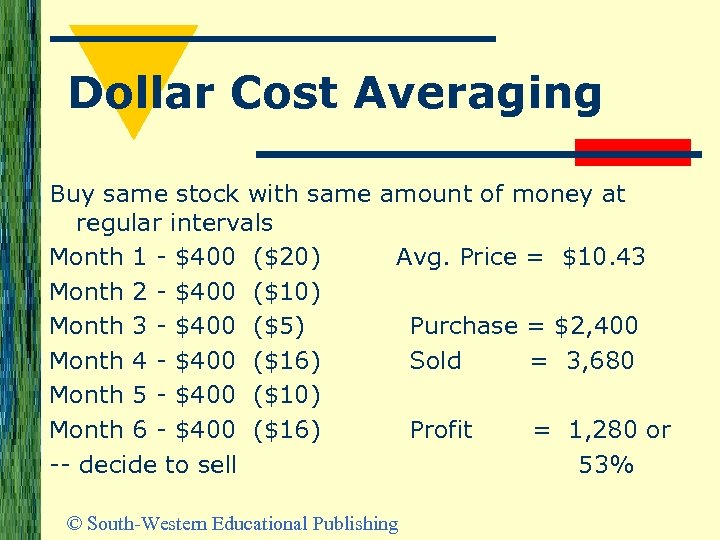
Dollar Cost Averaging Buy same stock with same amount of money at regular intervals Month 1 - $400 ($20) Avg. Price = $10. 43 Month 2 - $400 ($10) Month 3 - $400 ($5) Purchase = $2, 400 Month 4 - $400 ($16) Sold = 3, 680 Month 5 - $400 ($10) Month 6 - $400 ($16) Profit = 1, 280 or -- decide to sell 53% © South-Western Educational Publishing
Long-Term Techniques Investing Dollar-cost averaging - systematic purchase of an equal dollar amount of the same stock at regular intervals Direct investment - buy stock directly from company Reinvesting dividends avoids broker fees & other costs © South-Western Educational Publishing
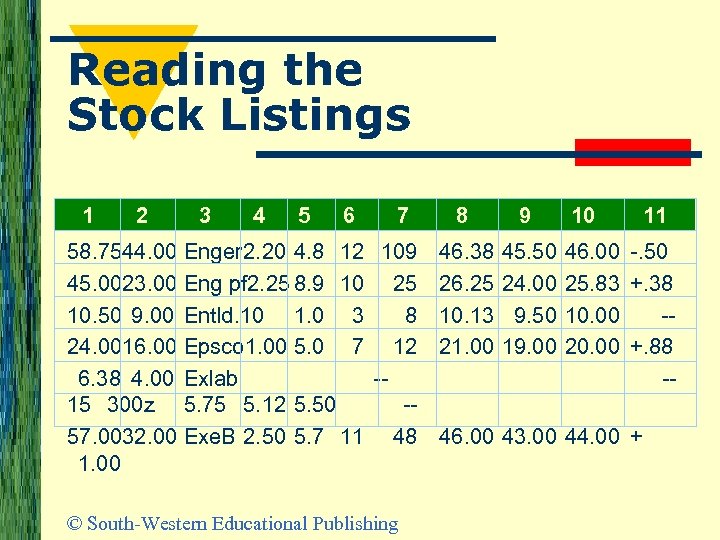
Reading the Stock Listings 1 2 3 4 5 6 7 58. 7544. 00 Enger 2. 20 4. 8 12 109 45. 0023. 00 Eng pf 2. 25 8. 9 10 25 10. 50 9. 00 Entld. 10 1. 0 3 8 24. 0016. 00 Epsco 1. 00 5. 0 7 12 6. 38 4. 00 Exlab . -15 300 z 5. 75 5. 12 5. 50. -57. 0032. 00 Exe. B 2. 50 5. 7 11 48 1. 00 © South-Western Educational Publishing 8 9 46. 38 26. 25 10. 13 21. 00 45. 50 24. 00 9. 50 19. 00 10 46. 00 25. 83 10. 00 20. 00 11 -. 50 +. 38 . -+. 88. -- 46. 00 43. 00 44. 00 +
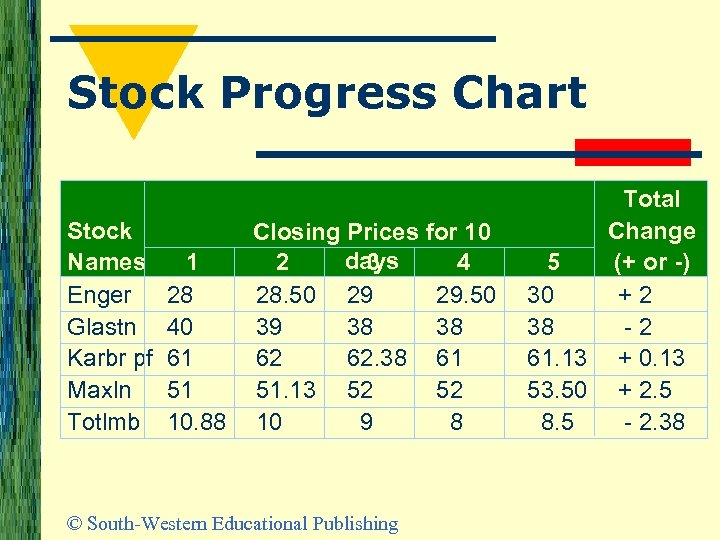
Stock Progress Chart Stock Names Enger Glastn Karbr pf Maxln Totlmb 1 28 40 61 51 10. 88 Closing Prices for 10 days 2 3 4 28. 50 29 29. 50 39 38 38 62 62. 38 61 51. 13 52 52 10 9 8 © South-Western Educational Publishing Total Change 5 (+ or -) 30 + 2 38 - 2 61. 13 + 0. 13 53. 50 + 2. 5 8. 5 - 2. 38
Stock Indexes Dow Jones Industrial Average Standard & Poor’s 500 NASDAQ Composite Index © South-Western Educational Publishing
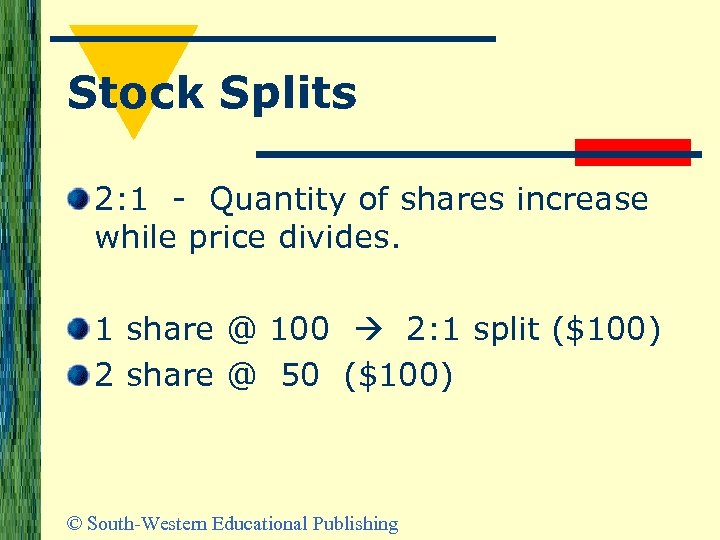
Stock Splits 2: 1 - Quantity of shares increase while price divides. 1 share @ 100 2: 1 split ($100) 2 share @ 50 ($100) © South-Western Educational Publishing
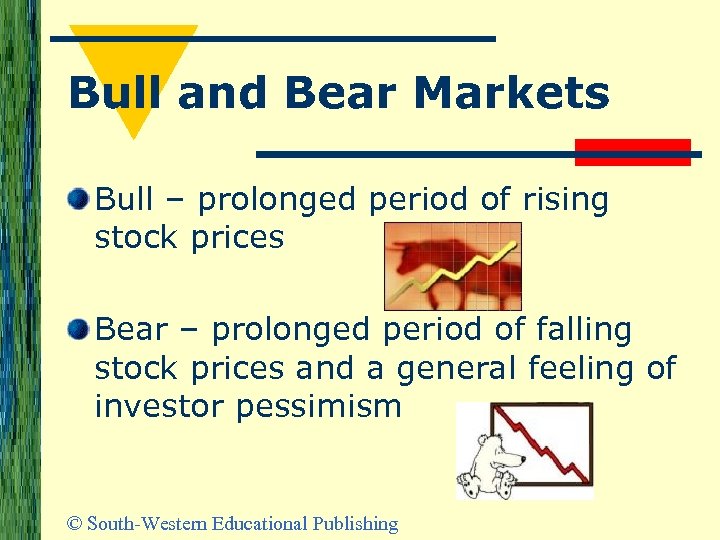
Bull and Bear Markets Bull – prolonged period of rising stock prices Bear – prolonged period of falling stock prices and a general feeling of investor pessimism © South-Western Educational Publishing
Bid / Ask Prices Spread – difference between Bid and Ask price Large difference means stock is volatile (risky; price changes often) © South-Western Educational Publishing
Annual Report Annual reports are intended to give shareholders and other interested people information about the company's activities and financial performance. © South-Western Educational Publishing
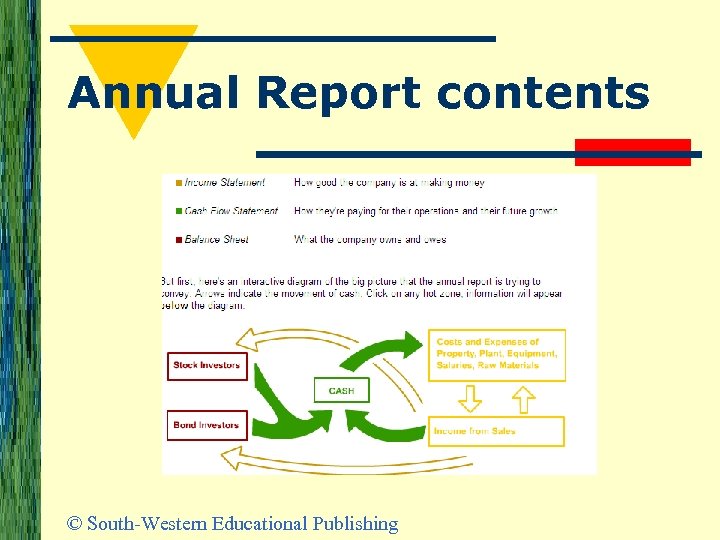
Annual Report contents © South-Western Educational Publishing
Shareholder’s letter (written by CEO) – positive nature Auditor’s Report Mission Statement © South-Western Educational Publishing
Corporations Must disclose financial information financial if they are PUBLIC. © South-Western Educational Publishing
Incorporation Elect a Board of Directors © South-Western Educational Publishing
Steps to Incorporate The articles of incorporation (also called a charter, certificate of incorporation or letters patent) are filed with the appropriate state office, listing the purpose of the corporation, its principal place of business and the number and type of shares of stock. © South-Western Educational Publishing
Steps to Incorporate Authorize the number of shares of stock a company can issue. © South-Western Educational Publishing
Steps to Incorporate Bylaws – outline of company meetings and rules and regulations by which the company will be governed. Must be filed with the STATE. © South-Western Educational Publishing
Stock Screener © South-Western Educational Publishing
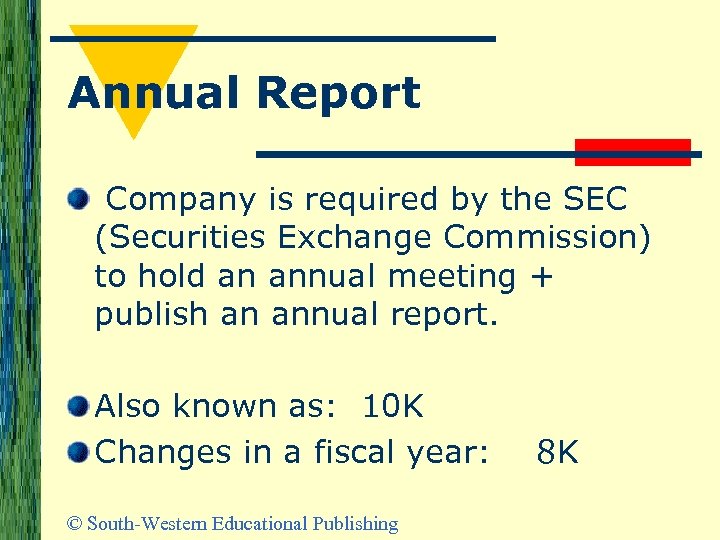
Annual Report Company is required by the SEC (Securities Exchange Commission) to hold an annual meeting + publish an annual report. Also known as: 10 K Changes in a fiscal year: 8 K © South-Western Educational Publishing
Скачать презентацию Chapter 12 Investing in Stocks Evaluating Stocks Buying
e06c061edd86d3b59f4d183f24bede3f.ppt