


 Скачать презентацию Chapter 12 Decision Rights The Level of Empowerment
8d2fc1f6811e9dd3b72903e351cadb7b.ppt
- Количество слайдов: 27
 Chapter 12 Decision Rights The Level of Empowerment
 Assigning tasks and decision rights • Production process involves tasks bundled into jobs • Job dimensions – variety of tasks • few or many – decision authority • limited or broad
 Centralization versus decentralization benefits of decentralization • Effective use of local knowledge – local tastes and preferences – price sensitivities of particular customers • Conservation of management time – senior management focus on strategy • Training and motivation for local managers
 Centralization versus decentralization costs of decentralization • Potential agency problems – effective control systems may be expensive • Coordination costs and failures • Less effective use of central information
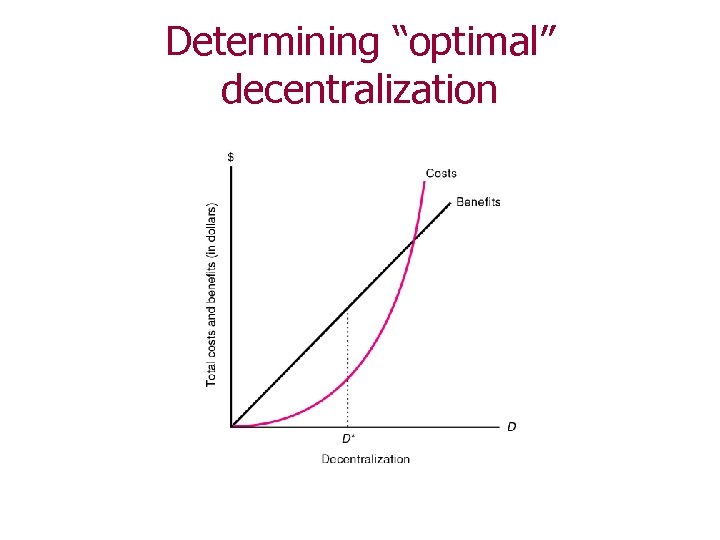 Determining “optimal” decentralization
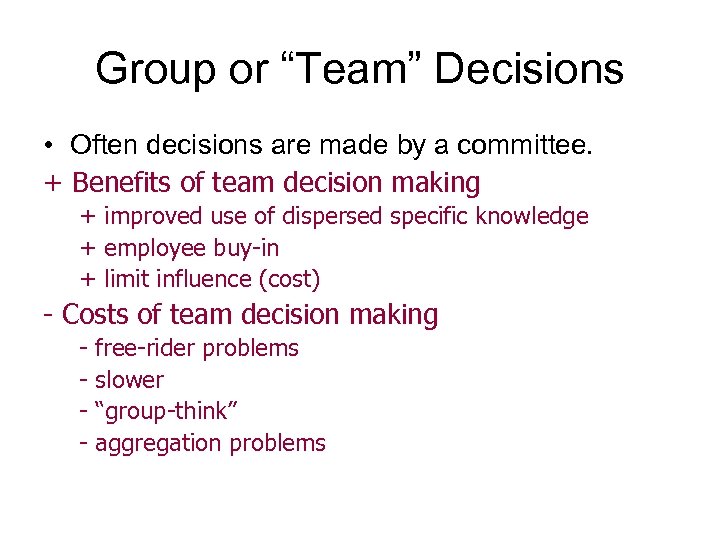 Group or “Team” Decisions • Often decisions are made by a committee. + Benefits of team decision making + improved use of dispersed specific knowledge + employee buy-in + limit influence (cost) - Costs of team decision making - free-rider problems slower “group-think” aggregation problems
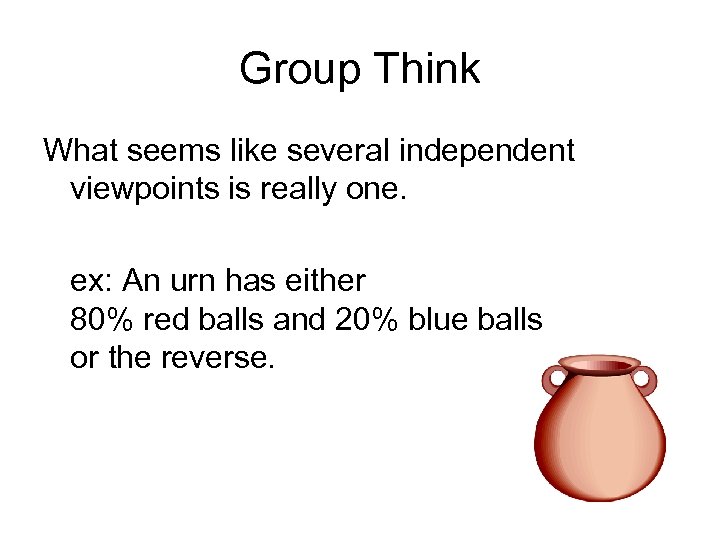 Group Think What seems like several independent viewpoints is really one. ex: An urn has either 80% red balls and 20% blue balls or the reverse.
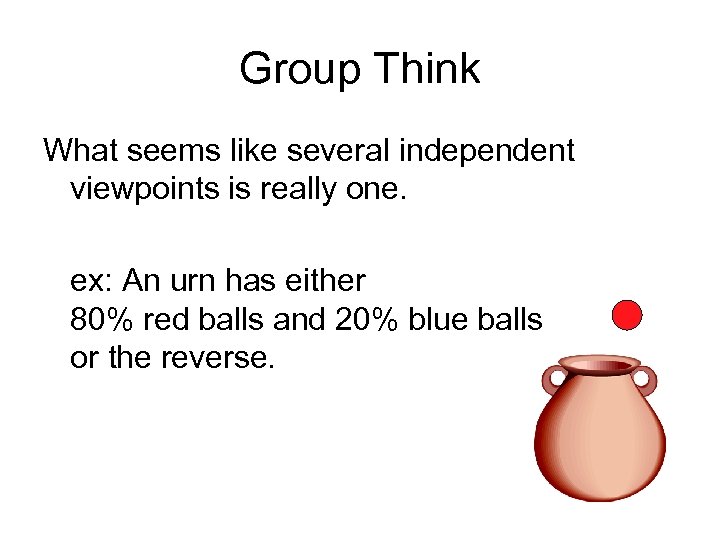 Group Think What seems like several independent viewpoints is really one. ex: An urn has either 80% red balls and 20% blue balls or the reverse.
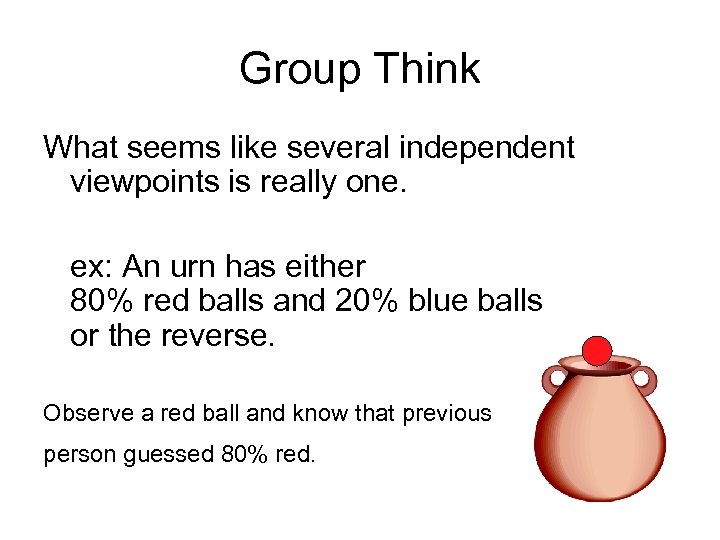 Group Think What seems like several independent viewpoints is really one. ex: An urn has either 80% red balls and 20% blue balls or the reverse. Observe a red ball and know that previous person guessed 80% red.
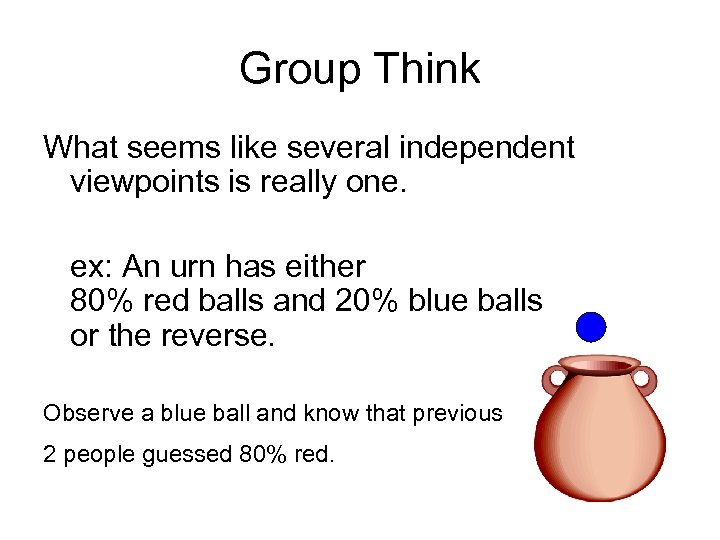 Group Think What seems like several independent viewpoints is really one. ex: An urn has either 80% red balls and 20% blue balls or the reverse. Observe a blue ball and know that previous 2 people guessed 80% red.
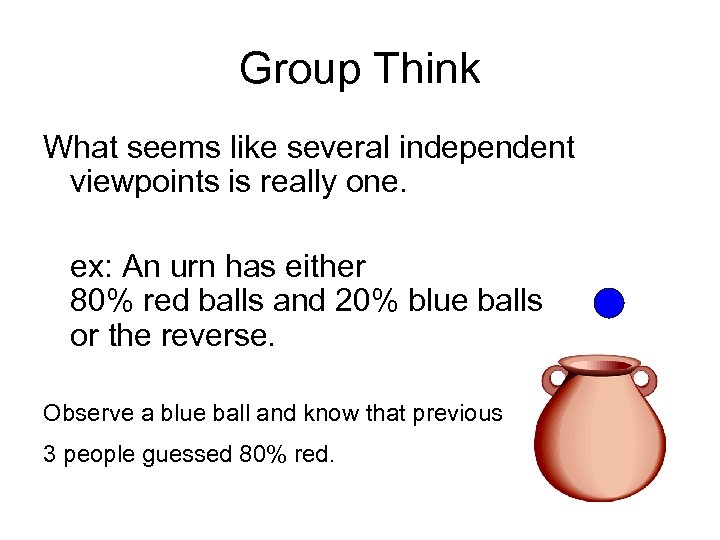 Group Think What seems like several independent viewpoints is really one. ex: An urn has either 80% red balls and 20% blue balls or the reverse. Observe a blue ball and know that previous 3 people guessed 80% red.
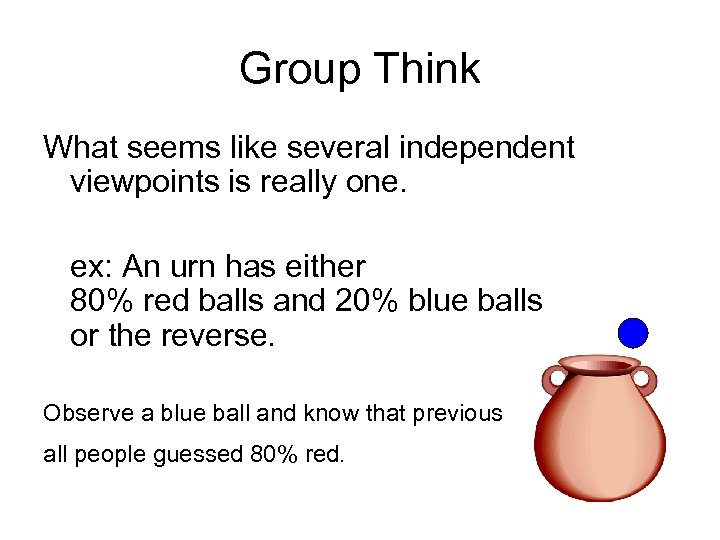 Group Think What seems like several independent viewpoints is really one. ex: An urn has either 80% red balls and 20% blue balls or the reverse. Observe a blue ball and know that previous all people guessed 80% red.









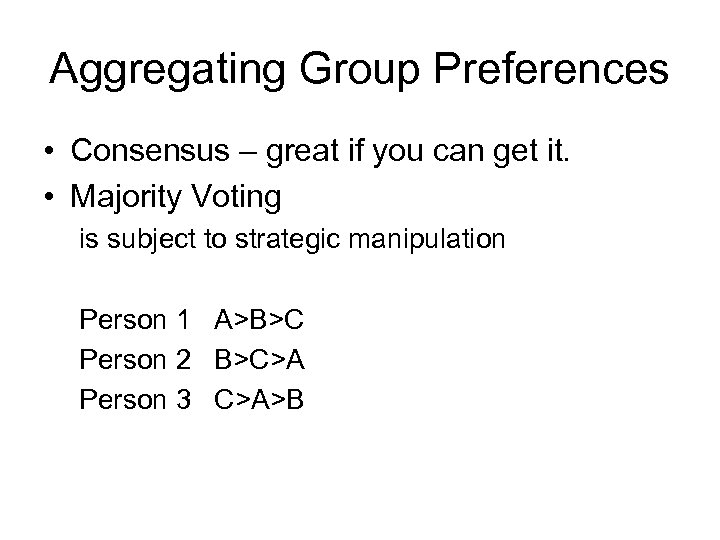 Aggregating Group Preferences • Consensus – great if you can get it. • Majority Voting is subject to strategic manipulation Person 1 A>B>C Person 2 B>C>A Person 3 C>A>B
 Majority Voting May’s Theorem Anything that has the following 3 properties is equivalent to majority voting. symmetric – one’s ID does not matter neutral – if all preferences are reversed so is the outcome positive responsive – if no one thinks worse of option x and someone thinks better of it then option x should fare no worse.
 Borda Count Each person ranks options and get more points for higher ranks. ex: who are the top 2 college football teams? AP O> U> A Coaches U> O> A Computer A> U> O
 Borda Count Each person ranks options and get more points for higher ranks. ex: who are the top 2 college football teams? AP O> U> A> T> G Coaches U> O> A> T> G Computer A> T> U> G> O
 Arrow’s Impossibility Theorem A social choice function cannot have all fo the following properties 1) Pareto – if we all prefer A to B then A is ranked higher than B. 2) Independence of Irrelevant Alternativeshow two options compare does not depended on the ranking of any other options. 3) Non-dictatorial – the rankings are not simply one member of the groups preferences.
 Allocating Decision Rights If decision makers do not bear the wealth effects of the decisions then decision management and decision control should be separated. Decision Management – initiation and implementation Decision Control – ratification and monitoring