


 Скачать презентацию Chapter 12 Congress The Representatives and Senators
8e6dd93a90adb089b1219cbb8d35626b.ppt
- Количество слайдов: 28
 Chapter 12 Congress
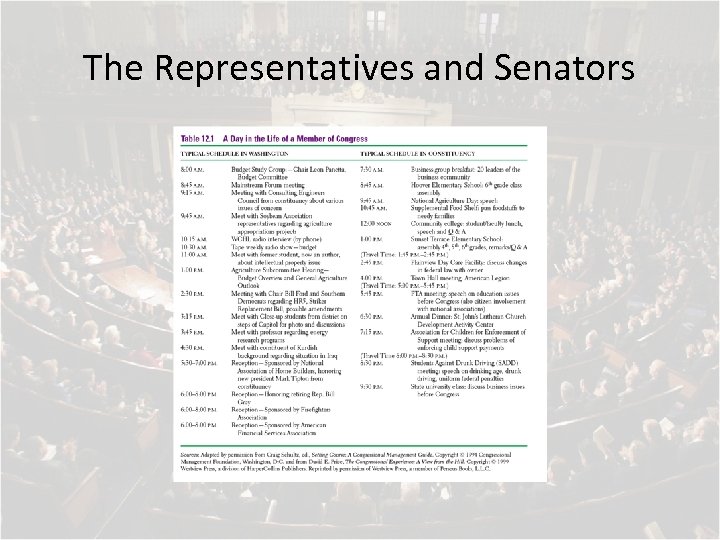
 The Representatives and Senators • The Job – Salary of $168, 500 with retirement benefits – Office space in D. C. and at home with staff – Travel allowances and franking privileges – Requires long hours, a lot of time away from family, and pressure from others to support their policies
 The Representatives and Senators
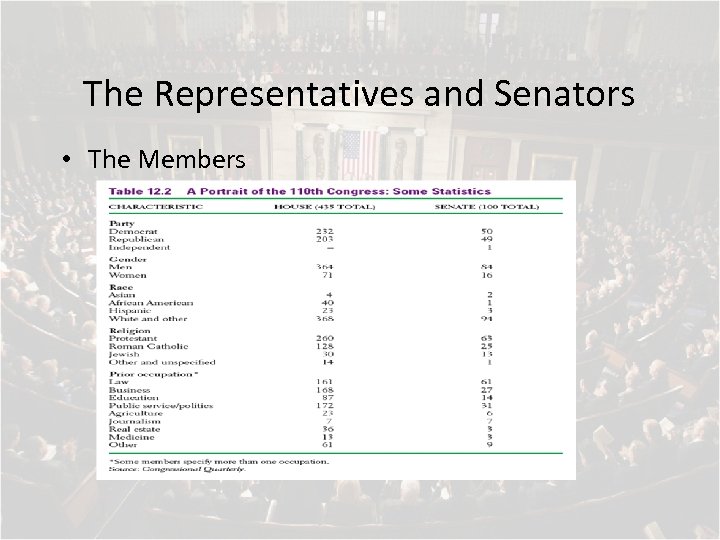 The Representatives and Senators • The Members
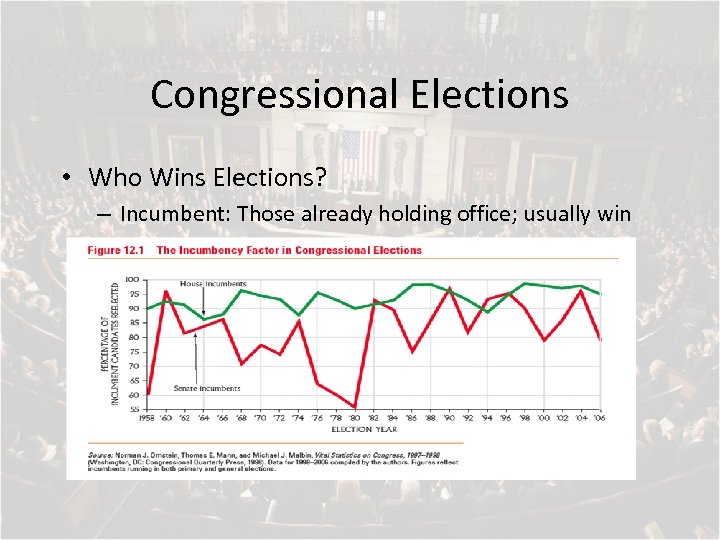 Congressional Elections • Who Wins Elections? – Incumbent: Those already holding office; usually win
 Congressional Elections • The Advantages of Incumbents – Advertising: • The goal is to be visible to your constituents • Frequent trips home, use of newsletter, and technology – Credit Claiming: • Service to constituents through: – Casework: specifically helping constituents get what they think they have a right to – Pork Barrel: federal projects, grants, etc. made available in a congressional district or state
 Congressional Elections • The Advantages of Incumbents – Position Taking: • Portray themselves as hard working, dedicated individuals • Occasionally take a partisan stand on an issue – Weak Opponents: • Inexperienced in politics, unorganized, and underfunded – Campaign Spending: • Challengers need to raise large sums to defeat an incumbent • PACs give most of their money to incumbents • Does PAC money “buy” votes in Congress?
 Congressional Elections • The Role of Party Identification – Most members represent the majority party in their district, and most who identify with a party reliably vote for its candidates • Defeating Incumbents – One tarnished by scandal or corruption becomes vulnerable to a challenger – Redistricting may weaken the incumbency advantage – Major political tidal wave may defeat incumbents
 Congressional Elections • Open Seats – Greater likelihood of competition – Most turnover occurs in open seats • Stability and Change – Incumbents provide stability in Congress – Change in Congress occurs less frequently through elections – Are term limits an answer?
 How Congress is Organized to Make Policy l. American Bicameralism –Bicameral: legislature divided into two houses • The House – 435 members, 2 year terms of office – Initiates all revenue bills, more influential on budget – House Rules Committee – Limited debates • The Senate – 100 members, 6 year terms of office – Gives “advice & consent, ” more influential on foreign affairs – Unlimited debates (filibuster)
 How Congress is Organized to Make Policy l. Congressional l Leadership The House l The Senate – Led by Speaker of the – Formerly lead by Vice House—elected by House members – Presides over House – Major role in committee assignments and legislation – Assisted by majority leader and whips President – Really lead by Majority Leader—chosen by party members – Assisted by whips – Must work with Minority leader
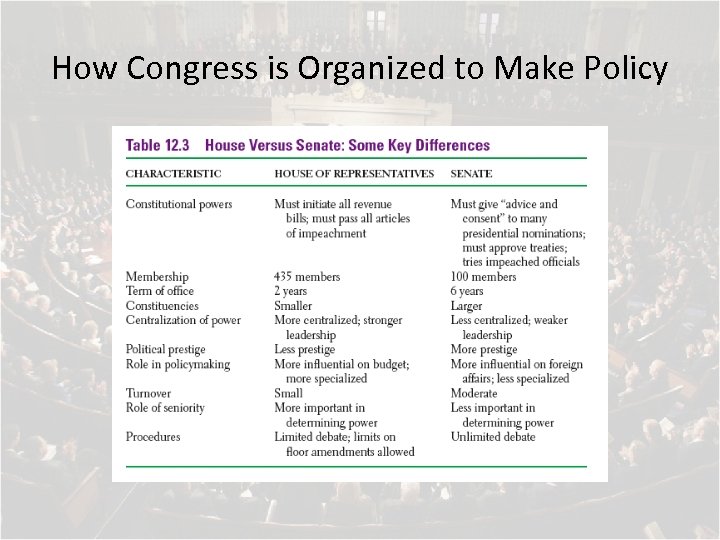 How Congress is Organized to Make Policy
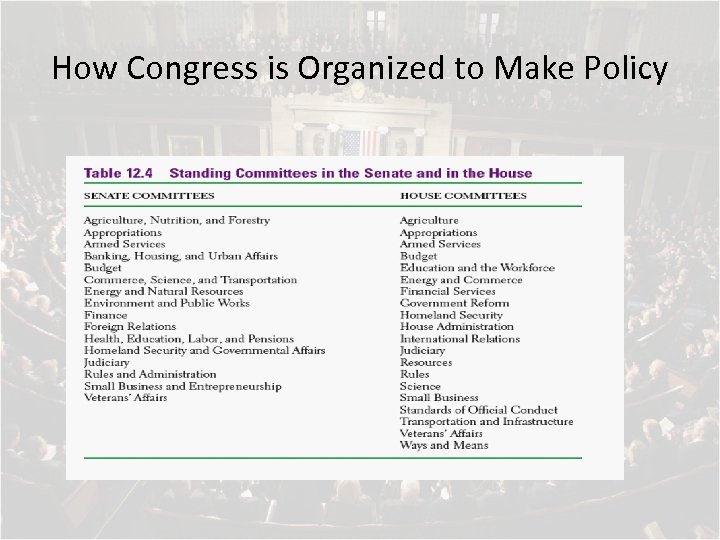
 How Congress is Organized to Make Policy • The Committees and Subcommittees – Four types of committees: • Standing committees: subject matter committees that handle bills in different policy areas • Joint committees: a few subject-matter areas— membership drawn from House and Senate • Conference committees: resolve differences in House and Senate bills • Select committees: created for a specific purpose, such as the Watergate investigation
 How Congress is Organized to Make Policy
 How Congress is Organized to Make Policy • The Committees and Subcommittees – The Committees at Work: Legislation and Oversight • Legislation – Committees work on the 11, 000 bills every session – Some hold hearings and “mark up” meetings • Legislative oversight – Monitoring of the bureaucracy and its administration of policy through committee hearings – As publicity value of receiving credit for controlling spending has increase, so too has oversight grown – Oversight usually takes place after a catastrophe
 How Congress is Organized to Make Policy • The Committees and Subcommittees – Getting on a Committee • Members want committee assignments that will help them get reelected, gain influence, and make policy. • New members express their committee preferences to the party leaders. • Those who have supported their party’s leadership are favored in the selection process. • Parties try to grant committee preferences.
 How Congress is Organized to Make Policy • The Committees and Subcommittees – Getting Ahead on the Committee: Chairs and the Seniority System • Committee chair: the most important influencer of congressional agenda – Dominant role in scheduling hearings, hiring staff, appointing subcommittees, and managing committee bills when they are brought before the full house • Most chairs selected according to seniority system: – Members who have served on the committee the longest and whose party controlled Congress become chair
 How Congress is Organized to Make Policy • Caucuses: The Informal Organization of Congress – Caucus: a group of members of Congress sharing some interest or characteristic – About 300 caucuses – Caucuses pressure for committee meetings and hearings and for votes on bills. – Caucuses can be more effective than lobbyists.
 How Congress is Organized to Make Policy • Congressional Staff – Personal staff: They work for the member, mainly providing constituent service, but help with legislation too. – Committee staff: organize hearings, research and write legislation, target of lobbyists – Staff Agencies: CRS, GAO, CBO provide specific information to Congress
 The Congressional Process • Legislation: – Bill: a proposed law – Anyone can draft a bill, but only members of Congress can introduce them. – More rules in the House than in the Senate – Party leaders play a vital role in steering bills through both houses, but less in the Senate – Countless influences on the legislative process
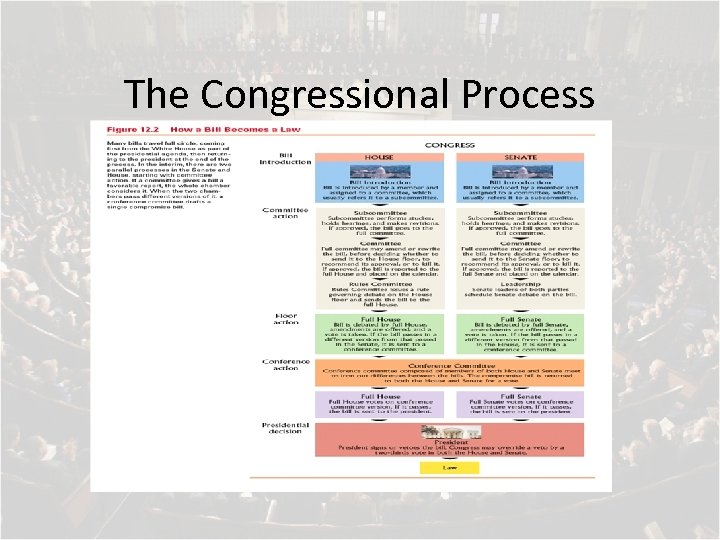 The Congressional Process
 The Congressional Process • Presidents and Congress: Partners and Protagonists – Presidents attempt to persuade Congress that what they want is what Congress wants. – Presidents have many resources to influence Congress. – But to succeed, the president must win at least 10 times. – Ultimately, residential leadership of Congress is at the margins.
 The Congressional Process • Party, Constituency, and Ideology – Party Influence: • Party leaders cannot force party members to vote a particular way, but many do vote along party lines. – Constituency versus Ideology • Prime determinant of member’s vote on most issues is ideology • On most issues that are not salient, legislators may ignore constituency opinion. • But on controversial issues, members are wise to heed constituent opinion.
 The Congressional Process • Lobbyists and Interest Groups – There are 35, 000 registered lobbyists trying to influence Congress—the bigger the issue, the more lobbyists will be working on it. – Lobbyists try to influence legislators’ votes. – Lobbyists can be ignored, shunned and even regulated by Congress. – Ultimately, it is a combination of lobbyists and others that influence legislators’ votes.
 Understanding Congress • Congress and Democracy – Leadership and committee assignments are not representative – Congress does try to respond to what the people want, but some argue it could do a better job. – Members of Congress are responsive to the people, if the people make clear what they want.
 Understanding Congress • Congress and Democracy – Representation versus Effectiveness • Supporters claim that Congress: – is a forum in which many interests compete for policy – is decentralized, so there is no oligarchy to prevent comprehensive action • Critics argue that Congress: – is responsive to so many interests that policy is uncoordinated, fragmented, and decentralized – is so representative that it is incapable of taking decisive action to deal with difficult problems
 Understanding Congress • Congress and the Scope of Government – The more policies Congress works on, the more ways it can serve their constituencies. – The more programs that get created, the bigger the government gets. – Contradiction in public opinion: everybody wants government programs cut, just not their programs
 Summary • • Members of Congress make policy. They have a sizeable incumbency advantage. Congress is structurally complex. Presidents, parties, constituencies, and interest groups all affect legislators’ vote choices.