 Скачать презентацию chapter 12 Behind the Supply Curve Inputs
KW2_Micro_Ch12_FINAL.ppt
- Количество слайдов: 36



chapter: 12 >> Behind the Supply Curve: Inputs and Costs Krugman/Wells Economics © 2009 Worth Publishers
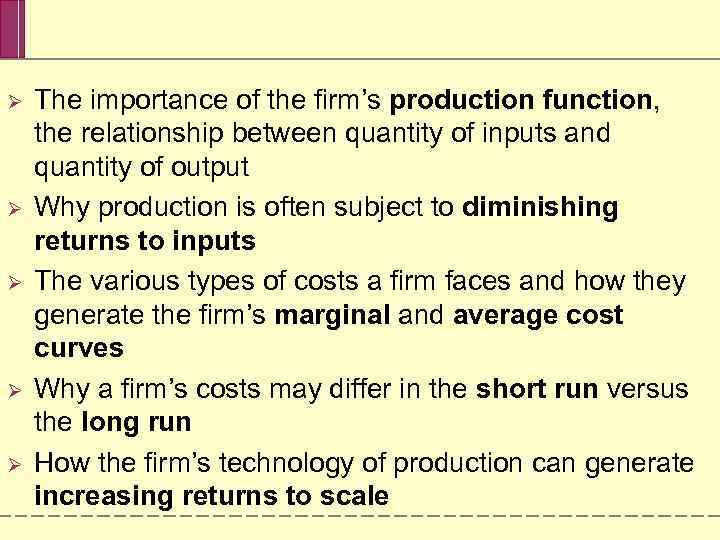
Ø Ø Ø The importance of the firm’s production function, the relationship between quantity of inputs and quantity of output Why production is often subject to diminishing returns to inputs The various types of costs a firm faces and how they generate the firm’s marginal and average cost curves Why a firm’s costs may differ in the short run versus the long run How the firm’s technology of production can generate increasing returns to scale
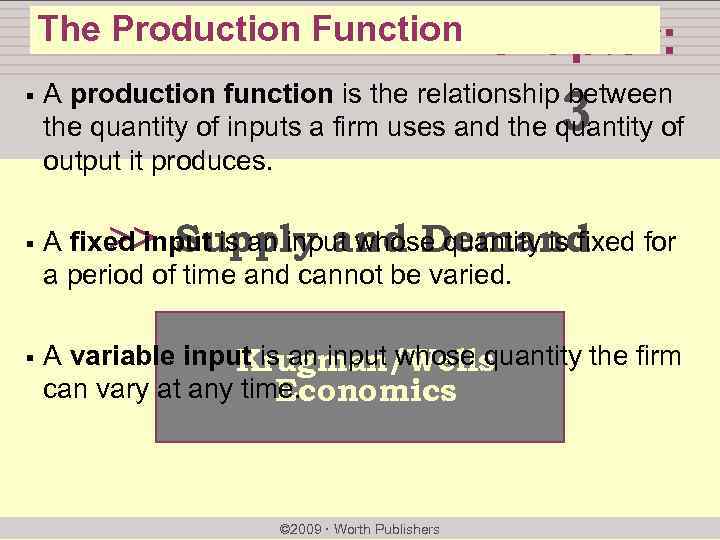
The Production Function § § § chapter: A production function is the relationship between the quantity of inputs a firm uses and the quantity of output it produces. 3 A fixed input is an input whose quantity is fixed for >> Supply and Demand a period of time and cannot be varied. A variable input is an input whose quantity the firm Krugman/Wells can vary at any time. Economics © 2009 Worth Publishers
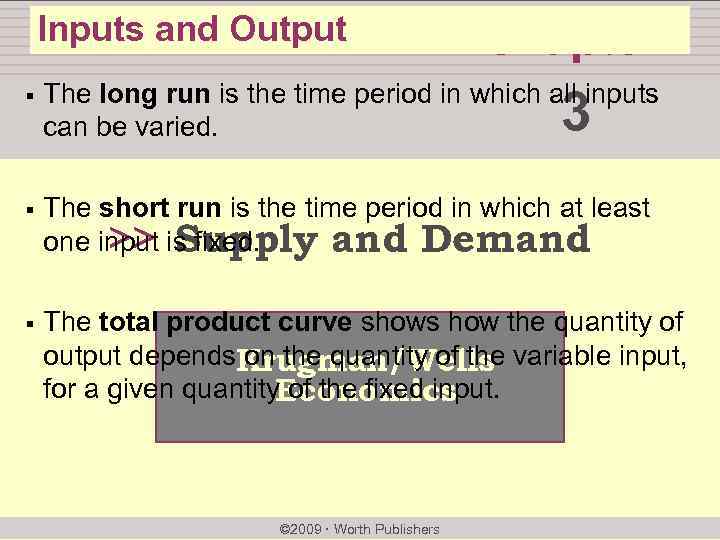
Inputs and Output chapter: § The long run is the time period in which all inputs can be varied. § The short run is the time period in which at least one input is fixed. >> Supply and Demand § The total product curve shows how the quantity of output depends. Krugman/Wells variable input, on the quantity of the for a given quantity. Economics of the fixed input. 3 © 2009 Worth Publishers
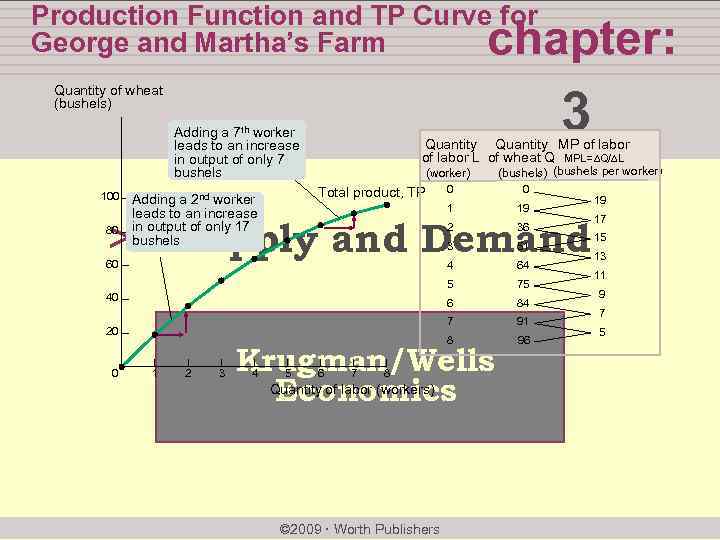
Production Function and TP Curve for George and Martha’s Farm chapter: 3 Quantity of wheat (bushels) Adding a 7 th worker leads to an increase in output of only 7 bushels Quantity MP of labor L of wheat Q MPL= DQ/ DL (worker) (bushels per worker) 0 1 19 2 36 3 51 4 64 75 6 84 7 91 8 Total product, TP Adding a 2 nd worker leads to an increase in output of only 17 bushels 0 5 100 96 >> Supply and Demand 80 60 40 20 0 1 2 3 Krugman/Wells Quantity of labor (workers) Economics 4 5 6 7 8 © 2009 Worth Publishers 19 17 15 13 11 9 7 5
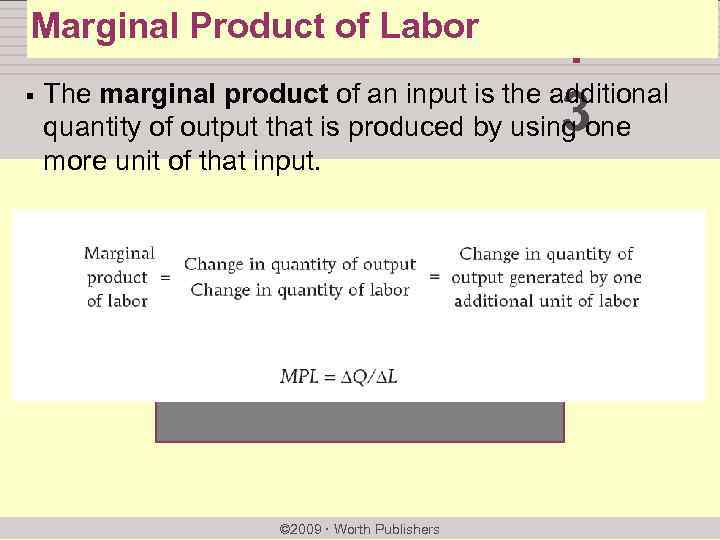
Marginal Product of Labor chapter: § The marginal product of an input is the additional quantity of output that is produced by using one more unit of that input. 3 >> Supply and Demand Krugman/Wells Economics © 2009 Worth Publishers
Diminishing Returns to an chapter: Input § There are diminishing returns to an input when an increase in the quantity of that input, holding the levels of all other inputs fixed, leads to a decline in the marginal product of that input. 3 >> Supply and Demand Krugman/Wells Economics © 2009 Worth Publishers
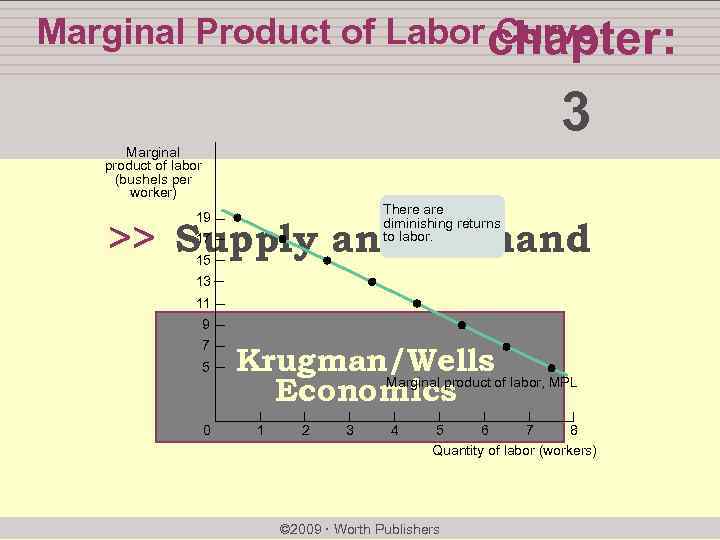
Marginal Product of Labor chapter: Curve 3 Marginal product of labor (bushels per worker) There are diminishing returns to labor. 19 >> Supply and Demand 17 15 13 11 9 7 5 0 Krugman/Wells Marginal product of labor, MPL Economics 1 2 3 4 5 6 7 8 Quantity of labor (workers) © 2009 Worth Publishers
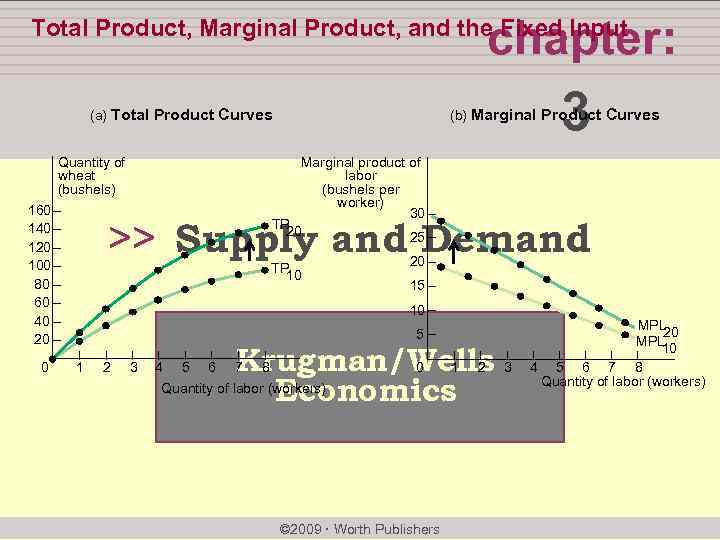
chapter: Total Product, Marginal Product, and the Fixed Input 3 (a) Total Product Curves Quantity of wheat (bushels) 160 140 120 100 80 60 40 20 0 (b) Marginal Product Curves Marginal product of labor (bushels per worker) 30 TP 20 25 >> Supply and Demand TP 10 20 15 10 5 1 2 3 Krugman/Wells 3 0 1 2 Economics 4 5 6 7 8 Quantity of labor (workers) © 2009 Worth Publishers MPL 20 MPL 10 4 5 6 7 8 Quantity of labor (workers)
From the Production Function to Cost Curves chapter: § § A fixed cost is a cost that does not depend on the quantity of output produced. It is the cost of the fixed input. 3 A variable. Supply and depends on the >> cost is a cost that Demand quantity of output produced. It is the cost of the variable input. Krugman/Wells Economics © 2009 Worth Publishers
Total Cost Curve § chapter: The total cost of producing a given quantity of output is the sum of the fixed cost and the variable cost of producing that quantity of output. 3 TC FC + Demand >> Supply=and VC § The total cost curve becomes steeper as more output is produced due to diminishing returns. Krugman/Wells Economics © 2009 Worth Publishers
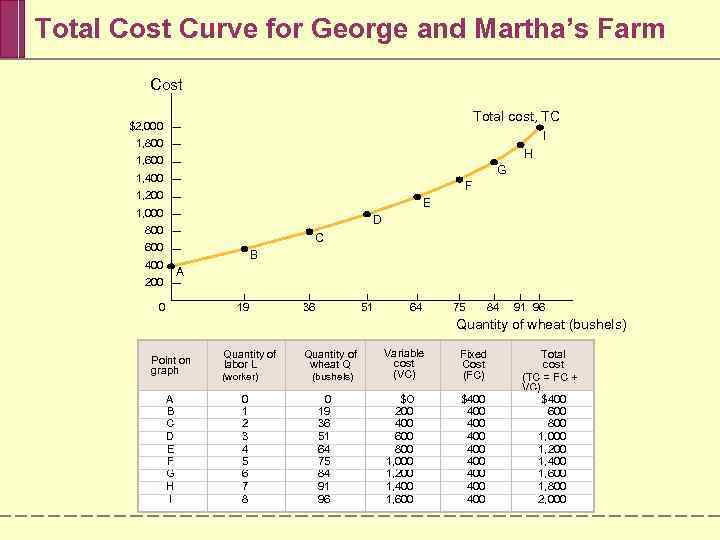
Total Cost Curve for George and Martha’s Farm Cost Total cost, TC $2, 000 I 1, 800 H 1, 600 G 1, 400 F 1, 200 E 1, 000 D 800 C 600 B 400 A 200 0 19 36 51 64 75 84 91 96 Quantity of wheat (bushels) Point on graph A B C D E F G H I Quantity of labor L (worker) 0 1 2 3 4 5 6 7 8 Quantity of wheat Q (bushels) 0 19 36 51 64 75 84 91 96 Variable cost (VC) Fixed Cost (FC) $O 200 400 600 800 1, 000 1, 200 1, 400 1, 600 $400 400 400 Total cost (TC = FC + VC) $ 400 600 800 1, 000 1, 200 1, 400 1, 600 1, 800 2, 000
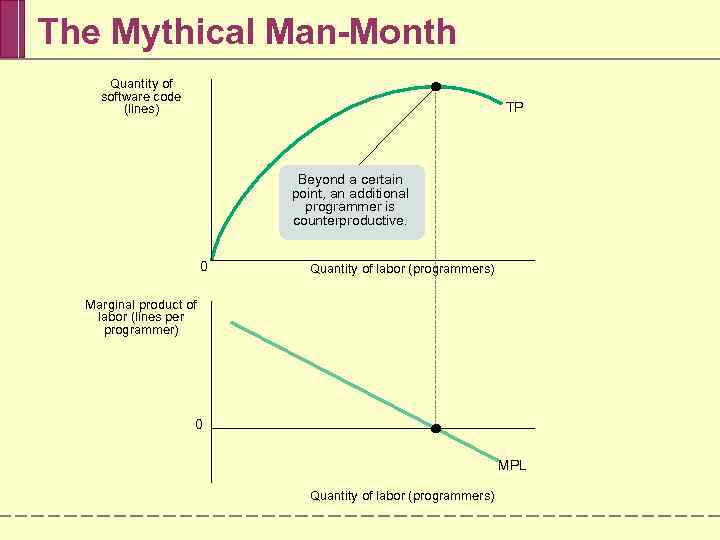
The Mythical Man-Month Quantity of software code (lines) TP Beyond a certain point, an additional programmer is counterproductive. 0 Quantity of labor (programmers) Marginal product of labor (lines per programmer) 0 MPL Quantity of labor (programmers)
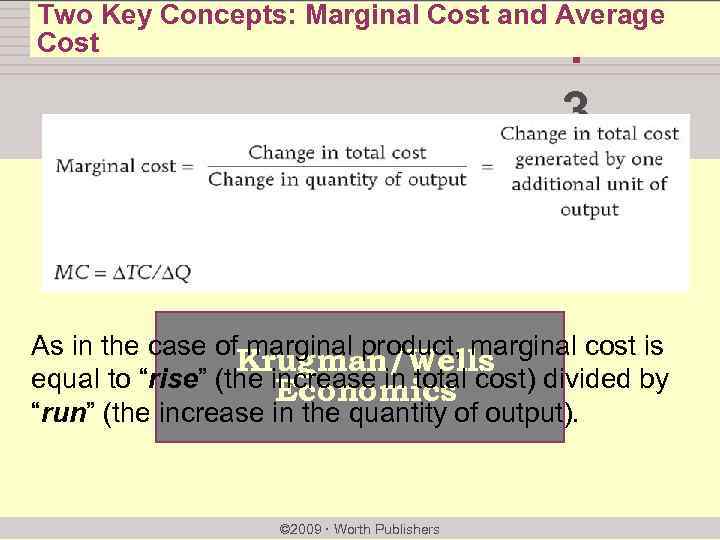
Two Key Concepts: Marginal Cost and Average Cost chapter: 3 >> Supply and Demand As in the case of marginal product, marginal cost is Krugman/Wells equal to “rise” (the increase in total cost) divided by Economics “run” (the increase in the quantity of output). © 2009 Worth Publishers
Costs at Selena’s Gourmet Salsas
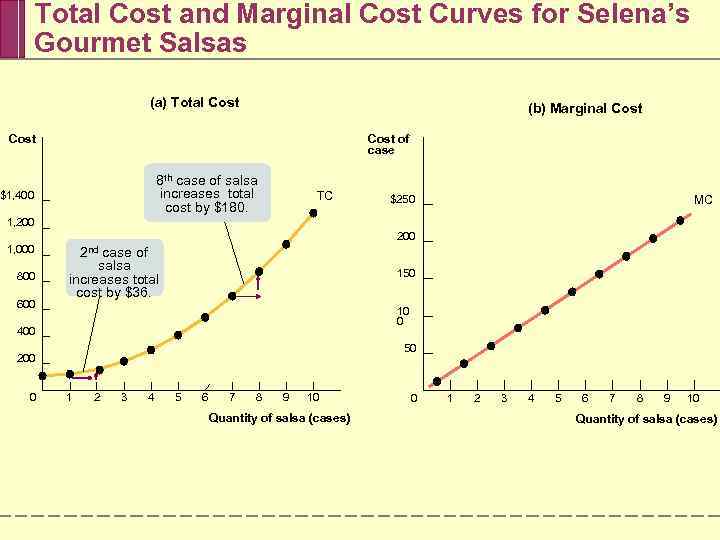
Total Cost and Marginal Cost Curves for Selena’s Gourmet Salsas (a) Total Cost (b) Marginal Cost of case 8 th case of salsa increases total cost by $180. $1, 400 TC $250 MC 1, 200 1, 000 800 600 2 nd case of salsa increases total cost by $36. 150 10 0 400 50 200 0 1 2 3 4 5 6 7 8 9 10 Quantity of salsa (cases)
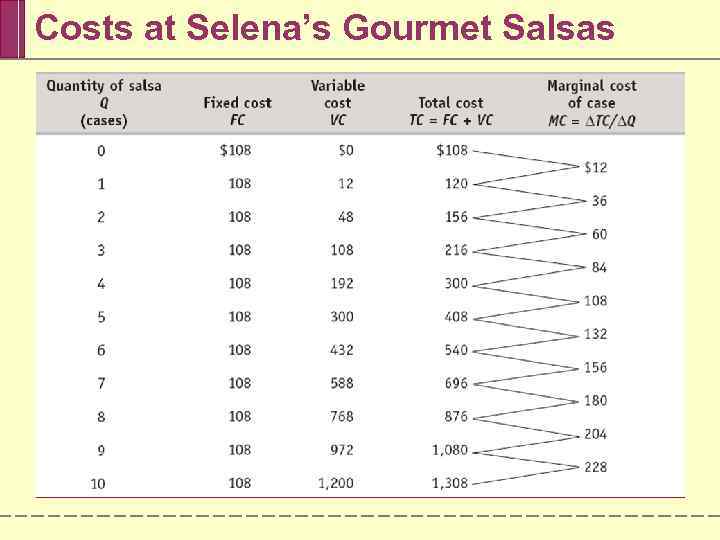
Why is the Marginal Cost Curve Upward Sloping? § Because there are diminishing returns to inputs in this example. As output increases, the marginal product of the variable input declines. § This implies that more and more of the variable input must be used to produce each additional unit of output as the amount of output already produced rises. § And since each unit of the variable input must be paid for, the cost per additional unit of output also rises.
Average Cost § chapter: Average total cost, often referred to simply as average cost, is total cost divided by quantity of output produced. 3 ATC = TC/Q = (Total Cost) / (Quantity of Output) >> Supply and Demand § A U-shaped average total cost curve falls at low levels of output, then rises at higher levels. Krugman/Wells § Average fixed cost is the fixed cost per unit of output. Economics AFC = FC/Q = (Fixed Cost) / (Quantity of Output) © 2009 Worth Publishers
Average Cost § chapter: Average variable cost is the variable cost per unit of output. 3 AVC = VC/Q= (Variable Cost) / (Quantity of Output) >> Supply and Demand Krugman/Wells Economics © 2009 Worth Publishers
Average Total Cost Curve chapter: § Increasing output has two opposing effects on average total cost: 3 § The spreading effect: the larger the output, the greater Supply of output over which fixed >> the quantity and Demand cost is spread, leading to lower the average fixed cost. Krugman/Wells the larger the § The diminishing returns effect: Economics output, the greater the amount of variable input required to produce additional units leading to higher average variable cost. © 2009 Worth Publishers
Average Costs for Selena’s Gourmet Salsas
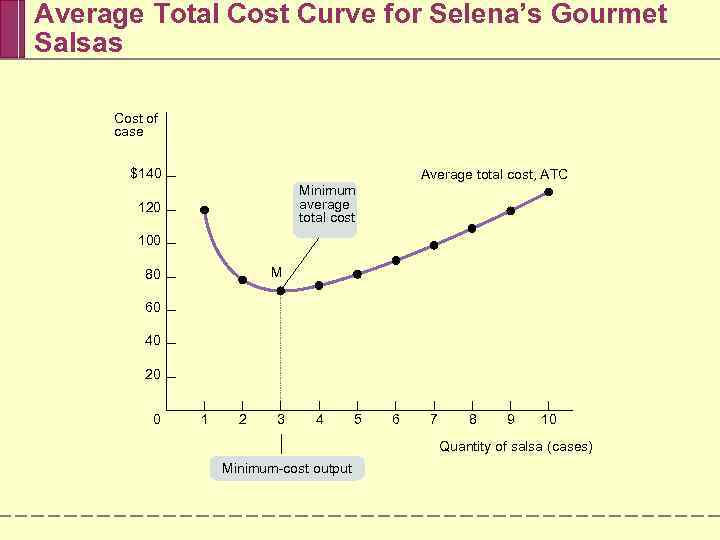
Average Total Cost Curve for Selena’s Gourmet Salsas Cost of case $140 Average total cost, ATC Minimum average total cost 120 100 M 80 60 40 20 0 1 2 3 4 5 6 7 8 9 10 Quantity of salsa (cases) Minimum-cost output
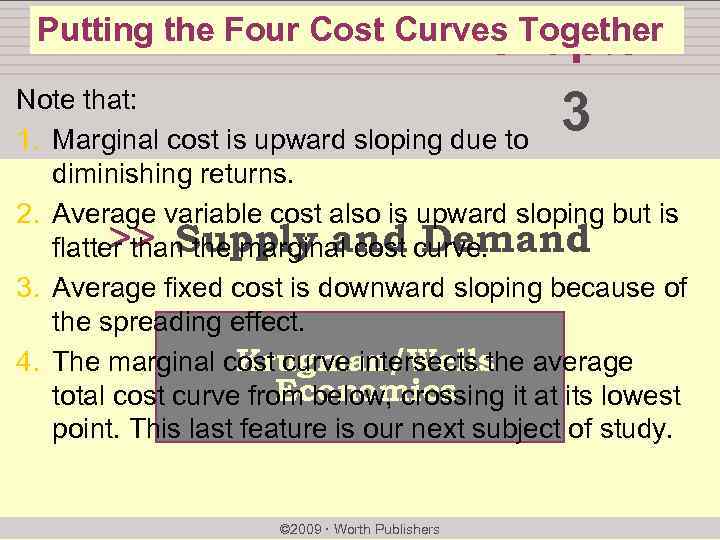
Putting the Four Cost Curves Together chapter: 3 Note that: 1. Marginal cost is upward sloping due to diminishing returns. 2. Average variable cost also is upward sloping but is >> Supply and Demand flatter than the marginal cost curve. 3. Average fixed cost is downward sloping because of the spreading effect. Krugman/Wells 4. The marginal cost curve intersects the average Economics total cost curve from below, crossing it at its lowest point. This last feature is our next subject of study. © 2009 Worth Publishers
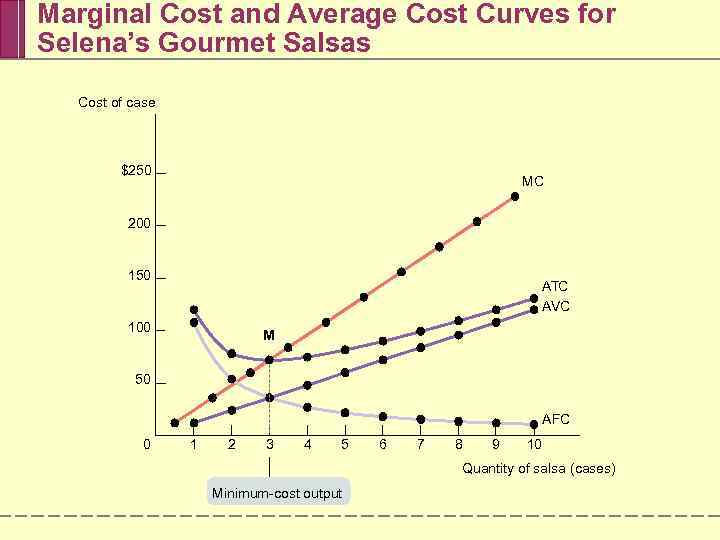
Marginal Cost and Average Cost Curves for Selena’s Gourmet Salsas Cost of case $250 MC 200 150 ATC AVC 100 M 50 AFC 0 1 2 3 4 5 6 7 8 9 10 Quantity of salsa (cases) Minimum-cost output
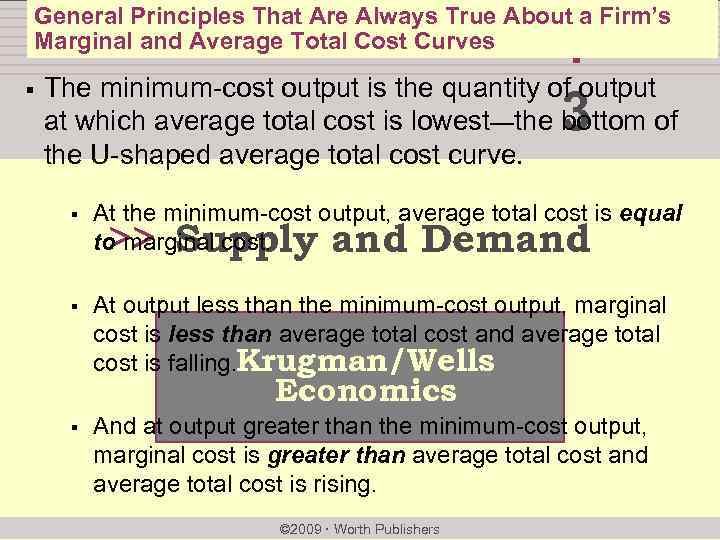
General Principles That Are Always True About a Firm’s Marginal and Average Total Cost Curves chapter: § The minimum-cost output is the quantity of output at which average total cost is lowest—the bottom of the U-shaped average total cost curve. 3 § At the minimum-cost output, average total cost is equal to marginal cost. § At output less than the minimum-cost output, marginal cost is less than average total cost and average total cost is falling. Krugman/Wells >> Supply and Demand Economics § And at output greater than the minimum-cost output, marginal cost is greater than average total cost and average total cost is rising. © 2009 Worth Publishers
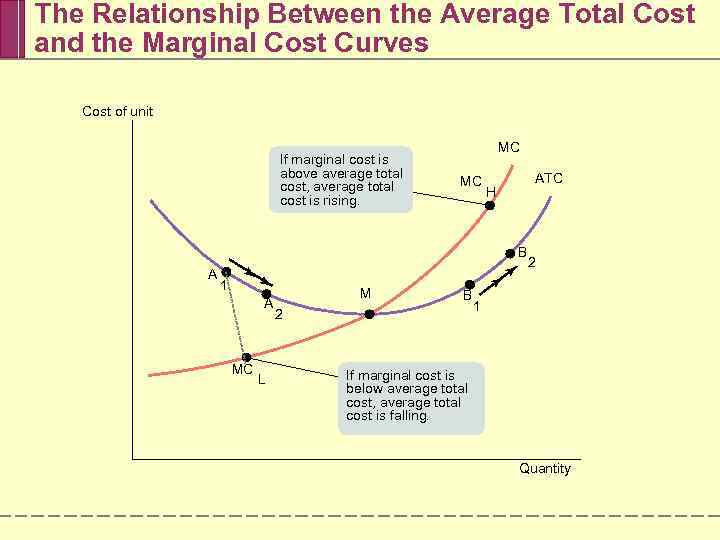
The Relationship Between the Average Total Cost and the Marginal Cost Curves Cost of unit If marginal cost is above average total cost, average total cost is rising. MC MC ATC H B A 1 A MC L M B 2 2 1 If marginal cost is below average total cost, average total cost is falling. Quantity
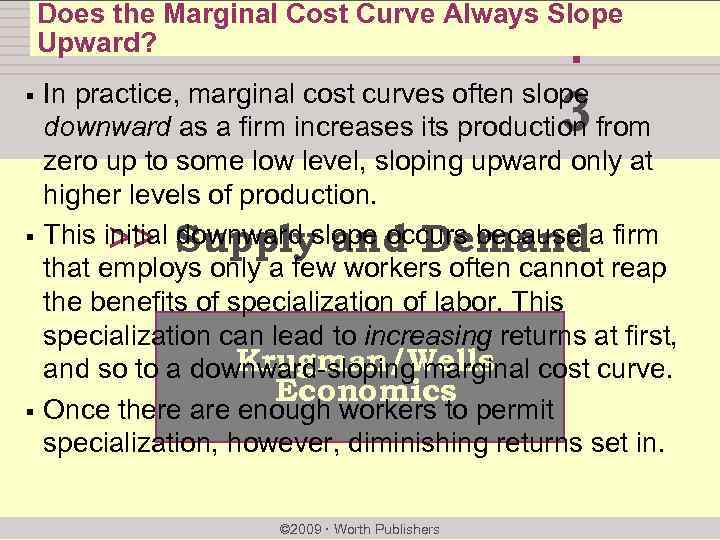
Does the Marginal Cost Curve Always Slope Upward? chapter: § § § In practice, marginal cost curves often slope downward as a firm increases its production from zero up to some low level, sloping upward only at higher levels of production. This initial Supply and Demanda firm >> downward slope occurs because that employs only a few workers often cannot reap the benefits of specialization of labor. This specialization can lead to increasing returns at first, Krugman/Wells and so to a downward-sloping marginal cost curve. Economics Once there are enough workers to permit specialization, however, diminishing returns set in. 3 © 2009 Worth Publishers
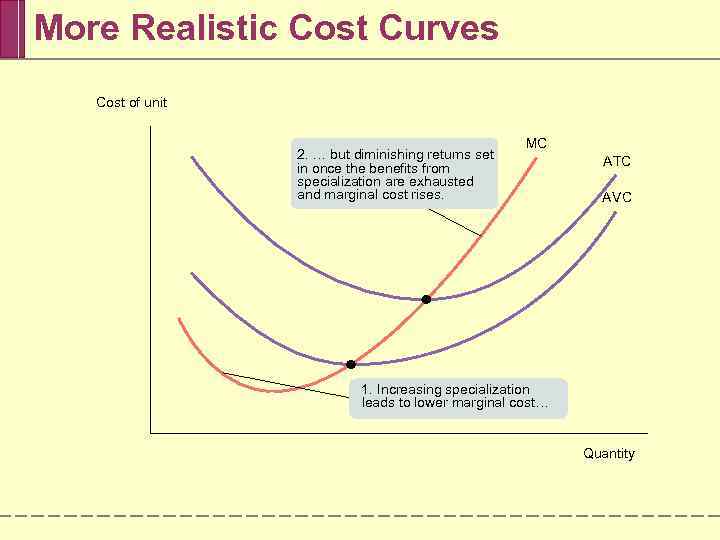
More Realistic Cost Curves Cost of unit 2. … but diminishing returns set in once the benefits from specialization are exhausted and marginal cost rises. MC ATC AVC 1. Increasing specialization leads to lower marginal cost… Quantity
Short-Run versus Long-Run Costs chapter: § § In the short run, fixed cost is completely outside the control of a firm. But all inputs are variable in the long run. 3 The firm will choose its and Demand run >> Supply fixed cost in the long based on the level of output it expects to produce. Krugman/Wells Economics © 2009 Worth Publishers
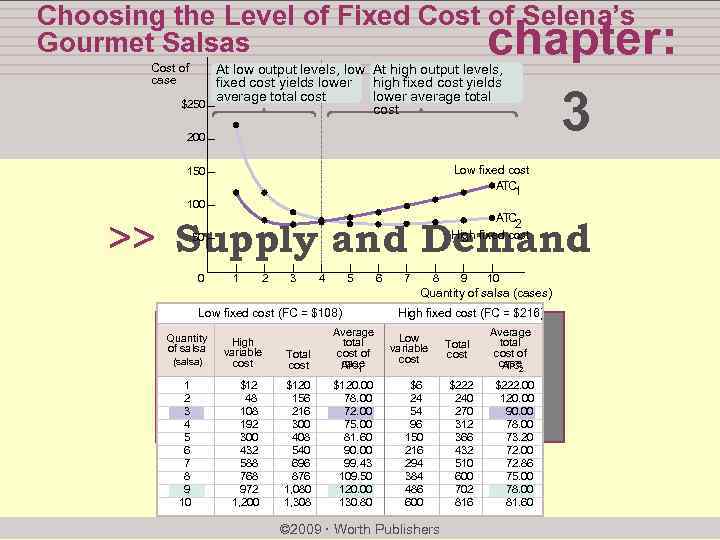
Choosing the Level of Fixed Cost of Selena’s Gourmet Salsas chapter: Cost of case $250 At low output levels, low At high output levels, fixed cost yields lower high fixed cost yields average total cost lower average total cost 200 3 Low fixed cost ATC 1 150 100 ATC 2 High fixed cost >> Supply and Demand 50 0 1 2 3 4 5 6 7 8 9 10 Quantity of salsa (cases) Low fixed cost (FC = $108) (salsa) High variable cost Total cost Average total cost of case ATC 1 1 2 3 4 5 6 7 8 9 10 $12 48 108 192 300 432 588 768 972 1, 200 $120 156 216 300 408 540 696 876 1, 080 1, 308 $120. 00 78. 00 72. 00 75. 00 81. 60 90. 00 99. 43 109. 50 120. 00 130. 80 Quantity of salsa High fixed cost (FC = $216) Low variable cost Total cost Average total cost of case ATC 2 Krugman/Wells Economics $6 24 54 96 150 216 294 384 486 600 © 2009 Worth Publishers $222 240 270 312 366 432 510 600 702 816 $222. 00 120. 00 90. 00 78. 00 73. 20 72. 00 72. 86 75. 00 78. 00 81. 60
The Long-run Average Totalchapter: Cost Curve § The long-run average total cost curve shows the relationship between output and average total cost when fixed cost has been chosen to minimize average total cost for each level of output. 3 >> Supply and Demand Krugman/Wells Economics © 2009 Worth Publishers
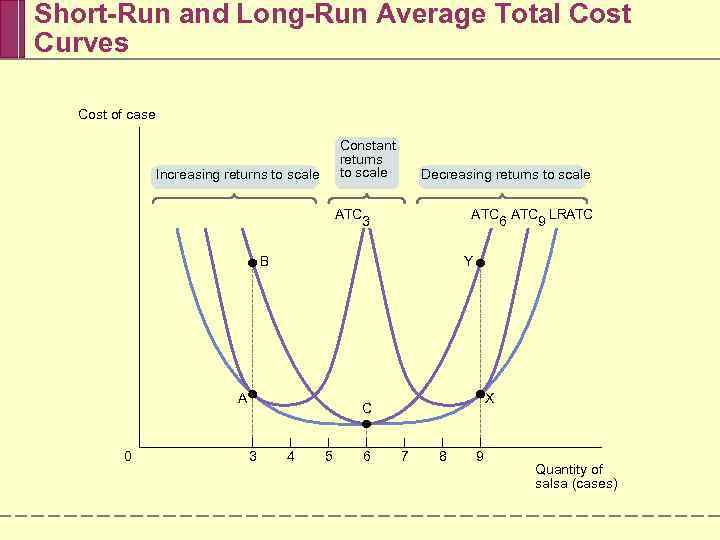
Short-Run and Long-Run Average Total Cost Curves Cost of case Constant returns to scale Increasing returns to scale Decreasing returns to scale ATC 3 ATC LRATC 6 9 B Y A 0 X C 3 4 5 6 7 8 9 Quantity of salsa (cases)
Returns to Scale § § § chapter: 3 There are increasing returns to scale (economies of scale) when long-run average total cost declines as output increases. >> Supply returns to scale There are decreasing and Demand (diseconomies of scale) when long-run average total cost increases as output increases. Krugman/Wells There are constant returns to scale when long. Economics run average total cost is constant as output increases. © 2009 Worth Publishers
SUMMARY 1. The relationship between inputs and output is a producer’s production function. In the short run, the quantity of a fixed input cannot be varied but the quantity of a variable input can. In the long run, the quantities of all inputs can be varied. For a given amount of the fixed input, the total product curve shows how the quantity of output changes as the quantity of the variable input changes. 2. There are diminishing returns to an input when its marginal product declines as more of the input is used, holding the quantity of all other inputs fixed. 3. Total cost is equal to the sum of fixed cost, which does not depend on output, and variable cost, which does depend on output.
SUMMARY 4. Average total cost, total cost divided by quantity of output, is the cost of the average unit of output, and marginal cost is the cost of one more unit produced. Ushaped average total cost curves are typical, because average total cost consists of two parts: average fixed cost, which falls when output increases (the spreading effect), and average variable cost, which rises with output (the diminishing returns effect). 5. When average total cost is U-shaped, the bottom of the U is the level of output at which average total cost is minimized, the point of minimum-cost output. This is also the point at which the marginal cost curve crosses the average total cost curve from below.
SUMMARY 6. In the long run, a producer can change its fixed input and its level of fixed cost. The long-run average total cost curve shows the relationship between output and average total cost when fixed cost has been chosen to minimize average total cost at each level of output. 7. As output increases, there are increasing returns to scale if long-run average total cost declines; decreasing returns to scale if it increases; and constant returns to scale if it remains constant. Scale effects depend on the technology of production.
Скачать презентацию chapter 12 Behind the Supply Curve Inputs
KW2_Micro_Ch12_FINAL.ppt