


 Скачать презентацию Chapter 11 The Restless North 1815 1860
3ad5615d21615a65cba569ebd688173a.ppt
- Количество слайдов: 50
 Chapter 11 The Restless North, 1815– 1860
 I. The North as Distinctive § New England, Mid-Atlantic, and Old Northwest § Post-1815, take new economic path from rural, agrarian one shared with South § From society with markets to “market society” § Shift activities and aspirations § Some move to cities and work for wages § Farmers shift crops to meet urban demand § Result: growing interdependence in North
 II. Preindustrial Farms and Artisans § § § § Practice mixed agriculture Raise different crops/livestock for needs Barter (goods, labor) with neighbors Sell surplus for money to pay off debt Seek security more than profit Family members = main source of labor For artisans and farmers, § little specialization of labor § work not regimented
 III. Early Industrialization § Pre-1812, “putting-out” system starts § Merchants pay farm women/kids piecework wage to make goods for sale § Link with first factories § First spinning mill (RI, 1790) use system to convert thread into cloth § Ties farm women/kids to wages and markets § War of 1812 increases US investment in factories to replace European goods
 IV. Transportation Revolution § Rivers/roads limit commerce and move west § First steamboat (1807) = major innovation: § eastern rivers § Great Lakes § western rivers (Mississippi) § Erie Canal (1825): § § link NYC and Atlantic with Great Lakes and frontier make NYC preeminent US port move settlers and manufactured goods west bring Midwest grain/ food east (Map 11. 1)
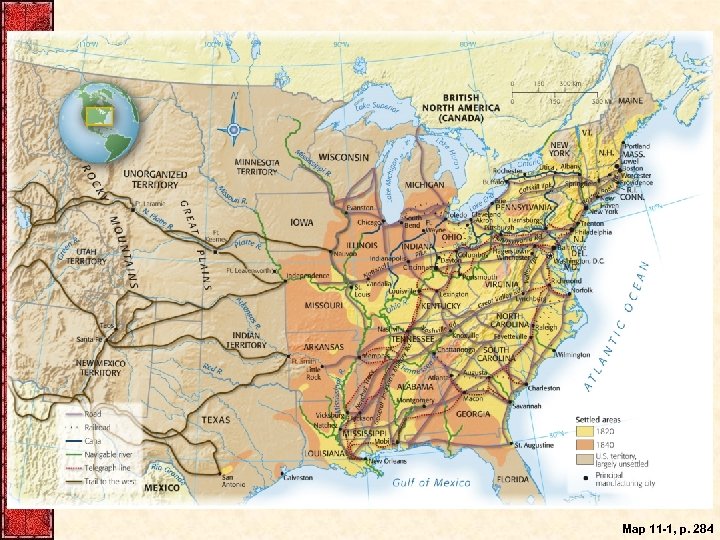 Map 11 -1, p. 284
 IV. Transportation Revolution (cont. ) § Railroads (start 1830 s): § surpass canals in cutting time and cost § increase East-West links § ties to global trade § Little North-South rail linkage: § North invest more than South § South also lack consumer base § Telegraph (1844) increase links § Northerners ambivalent on rapid changes
 V. Factories and Industrialization § Early factories change how raw materials (flour, hogs) processed § Work more impersonal and formal § Tasks divided into many specialized jobs § US government contracts spur machinetool industry (interchangeable parts) § Result = mass production and lower cost for many consumer goods
 V. Factories and Industrialization (cont. ) § New England textile factories emerge as most modern US industry § Ready-made cloth via specialized machines § Lowell mills hire young, single women (16) § Work a few years (5) till marry § Most mills hire entire families § Live in company-owned boarding houses Lowell Mill
 VI. Labor Protests § Profits take priority § Managers maximize production by: § speed-up § lengthen hours § cut wages § In response some strike (Lowell, 1834) § Early female unions weakened by § short tenure of workers § influx of immigrants
 VII. Consumption and Commercialization § Textiles spark ready-made clothing § First sewing machines (1846) accelerate process § So does standardization of sizes § Consumption shifts as people buy, rather than make, clothing § Commerce shifts as some businessmen specialize in specific products § 1 result: expansion of clerical jobs
 VIII. Commercial Farming § § Still backbone of economy but shift Semi-subsistence to market orientation Many move to cities or to west Others adjust: § Northeast shift to vegetables and livestock § Northwest specialize in large-scale grain and corn production with mechanization § Both feed eastern cities (new market) § Both increasingly use hired labor
 IX. Boom-and-Bust Cycles § Economic growth (1820 s and ’ 30 s) § Big contraction (1837– 43) § Direct result of new economy: § prosperity stimulate higher production § eventually surpasses demand § result: price/wage collapse § Downturn devastates workers and families
 X. The Growth of Cities § § § Rapid urban growth: Northeast and Midwest 1820: 13 cities with less than 10, 000 1860: 93 cities with less than 10, 000 NYC = largest city (less than 800, 000 in 1860) Northern cities ever changing: § many short-term residents § many immigrants § Explosive growth with mass transit (NYC) § Unlike South, many inland cities in North
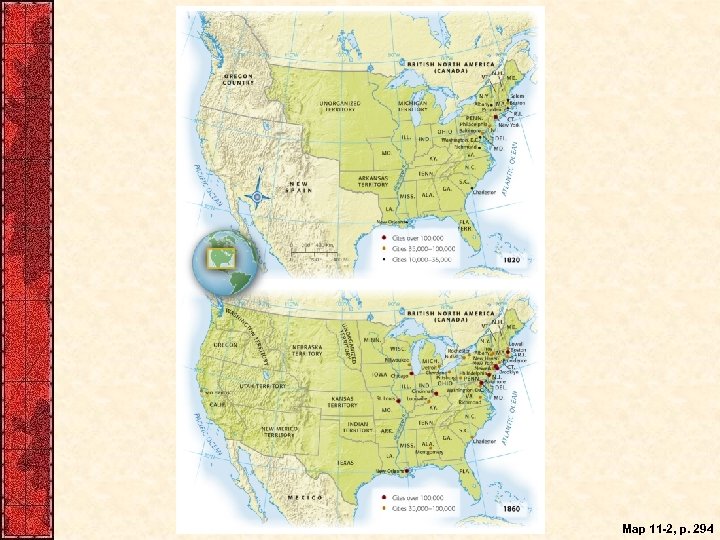 Map 11 -2, p. 294
 XI. Extremes of Wealth § Widening rich--poor gap throughout USA § Top 10% own 75% of wealth, 1860 § In North, cities display extremes: § mansions for a few § filthy tenements for majority § Rapid growth cause problems: § poverty § disease (lack safe water, waste removal) § Cities provide services (water, sanitation) only to those who can pay
 XI. Extremes of Wealth (cont. ) § § § § A few rich rise from poverty Most inherit wealth Then invest in commerce/industry Middle class of professionals emerges Larger middle class in North than South because North center of market economy Middle class values stress home/family
 XII. Immigrants § § 1830– 60: 5 million enter USA Most from Europe (esp. Irish, Germans) 1860: 15% of whites foreign born Leave native countries because of famine, etc. § States and companies recruit immigrants § Promise opportunities § Many leave when opportunities fall short
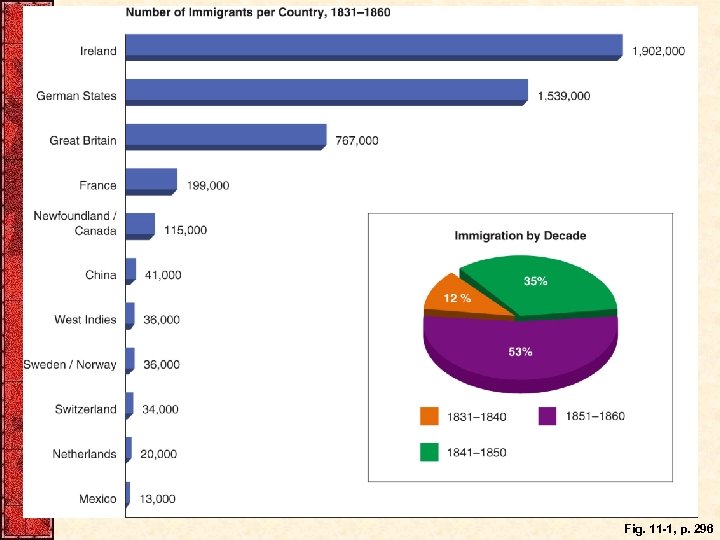 Fig. 11 -1, p. 296
 I. From Revival to Reform § § Religion = key motive for reform Evangelicals call for personal repentance/ conversion to: § § § attain salvation create basis for Second Coming Revivalists stress human perfectibility: § § § all can attain salvation all can improve all have moral obligation to fight evil
 I. From Revival to Reform (cont. ) § § § § South also embrace evangelicalism Break with North over slavery North’s revivalists stress personal and communal improvement Create many reform groups Tackle problems with new market economy Steam printing and railroads help publicize Women active in revivals and reform New public realm for women
 II. Reforms § § Basis = belief in human perfectibility Vice: § § help prostitutes find decent jobs punish male patrons Prison reform Dix seek reform for mentally ill § § expose problems lobby for improvement
 III. Temperance § § § See alcohol as sin Stress damage to families American Society for Promotion of Temperance (1826) seek: § § § individual abstinence state prohibition laws Per capita alcohol consumption drops Nativist (anti-immigrant, anti-Catholic) To immigrants and workers, § temperance = middle-class interference
 IV. Education Reforms § § Expansion of public education causes debate Catholic immigrants: § § § Mann (MA) advocate public education to: § § resent Protestant influence on public education set up schools Americanize immigrants prepare for citizenship and work (end poverty) train women as teachers (moral guardian role) Literacy increase
 V. Engineering and Science § § Use science to solve problems Disease result of bad water, not immorality NYC’s Croton Aqueduct Smithsonian Institution (1846): § § Acquire/disseminate scientific knowledge See religion and science as compatible
 VI. Communitarian Experiments § § Upset at changes from market economy Rural utopias: § § § Shakers (largest experiment, 1820– 60): § § § seek cooperation reject competition self-sufficient and communal men and women share leadership Decline because of § § celibacy requirement most only stay briefly
 VII. Mormons § § Most successful utopian group J. Smith start (NY, 1830) after revelations Violent opposition forces move west Opponents upset at § § political/ economic power polygamy Great Salt Lake valley (1840 s) Church control water, trade, industry, and government
 VIII. Brook Farm (1841– 1847); American Renaissance § Farm cooperative (MA): § § § intuition and spirituality (transcendentalism) reject materialism praise intellectualism Help with distinctively American literature Emerson stress individualism, self-reliance Thoreau’s civil disobedience
 IX. Abolitionism § African Americans (Walker, Douglas, Tubman, Truth): § § § demand immediate, uncompensated end stress evils of slavery call for racial equality Pre-1830 s, few whites support abolition American Colonization Society (1816): § § gradual, voluntary abolition deportation to Africa (Liberia, 1824)
 X. William Lloyd Garrison and Immediatists (1830 s) § § § A few whites join black immediatists Motivated by religion (slavery = sin) Intense activists: § § reject compromise change via “moral suasion” Found Liberator (1831) American Anti-Slavery Society (1833): § § § contrast with Colonization Society open on class and race women key
 XI. Opposition to Abolitionism § § § Massive white resistance to abolitionists, esp. immediatists, in South and North Key: white racism national Riots, murders, censorship Some immediatists break with Garrison Form Liberty Party (1840): § § § need political action, not just “moral suasion” upset by female participation oppose westward expansion of slavery
 XII. Women’s Rights § Women abolitionists examine gender because § § § criticism from abolition opponents and some male abolitionists Become more assertive in language Revivalism encourage effort to address legal, social, and political limits on women Some inheritance/property laws change Husbands still own what family members produce/earn
 XII. Women’s Rights (cont. ) § § § Stanton, etc. organize first convention Use 1776 Declaration as model for Declaration at Seneca Falls (1848) Equality in society, economy, and politics Launch women’s rights movement Encounter massive male resistance Debate over female vote divisive
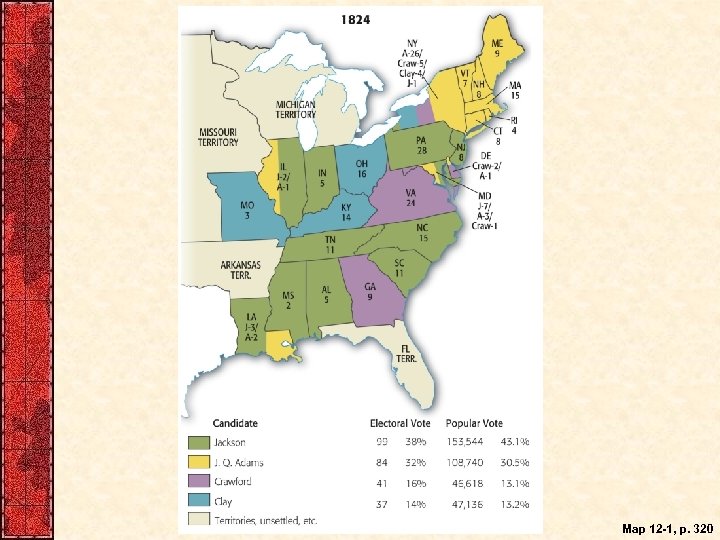 Map 12 -1, p. 320
 XIII. Party Politics and Election of 1824 § Many states: § § § § drop property restrictions let popular vote pick electors = increase electorate and participation Regional candidates challenge candidate from congressional caucus Democratic-Republicans split No one earns majority House picks J. Q. Adams He uses government to promote growth
 XIV. Election of 1828 § § Clay’s “corrupt bargain” angers Jackson supporters Democrats defeat National Republicans with § § § massive organization popular participation Democrats = first organized, national party
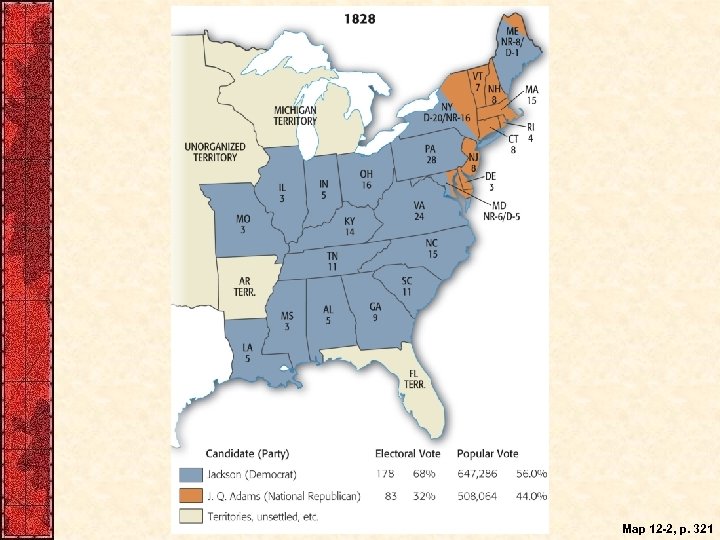 Map 12 -2, p. 321
 p. 321
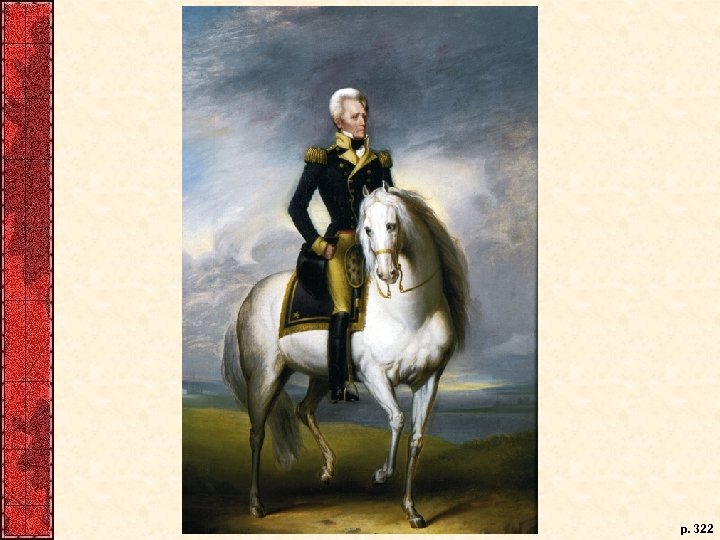
 XV. Andrew Jackson § § Wealthy planter/slaveowner Campaign on military victories Seek return to Jefferson’s agrarian republic Oppose: § § US Government activity of Adams centralized economic and political power assumes such policies favor rich Willing to use government against Indians
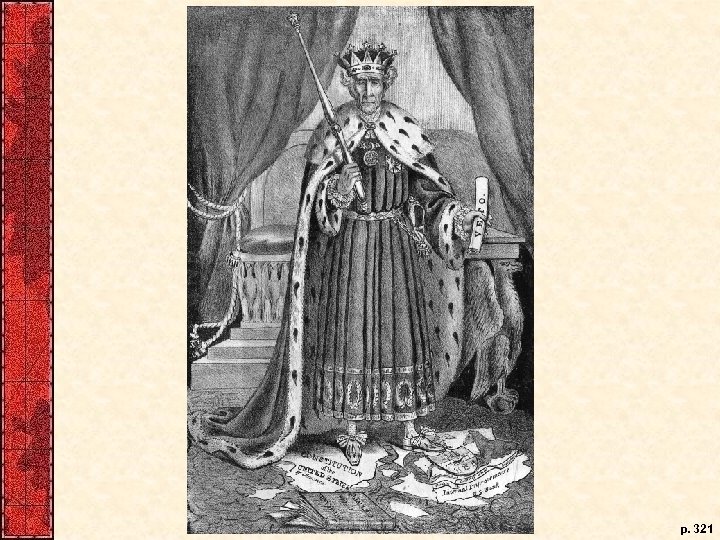
 XV. Andrew Jackson (cont. ) § Strengthens presidency: § § § Kitchen Cabinet for advice veto frequently to control Congress Expands spoils system Claims he wants majority rule Opponents see “King Andrew” as tyrant
 p. 322
 XVI. Nullification Crisis § § § Sectional debates (tariff) ignite crisis Relationship: states to US government Calhoun and Hayne assert: § § § state can void a US law the state sees as unconstitutional nullification protects minority (South) from tyranny of majority (North) SC planters fear any precedent for congressional action on slavery
 XVI. Nullification Crisis (cont. ) § Webster argues nullification will: § § Jackson agrees with Webster When SC nullifies tariff (1832), Jackson: § § create disorder undermine US strength prepares for military intervention offers tariff reduction SC retreats State/federal debate not resolved
 XVII. Second Bank of the United States (BUS) § § Helps with credit, currency, and state bank regulation, but states resent its influence Jackson (1832): § § § Major issue in 1832 campaign: § § vetoes recharter asserts undemocratic BUS helps rich Democrats easily defeat National Republicans (Clay) Jackson then dismantles BUS (1833)
 XVIII. 1832 Election § § § 1 st party conventions Pioneered by Antimasons Freemasons = secret fraternity of elite Antimasons see group as danger to Republic Politics intense: § § political violence: voter intimidation, fraud personal attacks in 1828 campaign
 XIX. Specie Circular (1836) § Jackson: § § § Result: § § § fear state banks issuing risky loans/notes speculators must use gold/silver to buy land credit contraction fewer land sales economic downturn Opponents see it as e. g. of “King Andrew” Congress oppose
 XX. Second Party System § § Whigs form (1834) to fight “tyranny” 2 parties compete nationally at all levels Organize; generate high voter participation 1840: § § § 2. 4 million men vote = 80% of eligible electorate only 360, 000 voted in 1824 Both avoid slavery House adopt “gag rule” (1836) to block
 XXI. Whigs § Activist US Government for: § § growth (new BUS, more paper currency) reform (public education) Class/religion/ethnicity affect membership Whigs: § § middle to upper-class evangelical Protestants blend politics and religion fear “excess of democracy”
 XXII. Democrats § § Separate politics and morality Appeal to “Have-nots, ” including § § § foreign-born Catholics non-evangelical Protestants
 XXIII. Elections of 1836 and 1840 § § § § Van Buren = early professional politician Defeats Whigs in 1836 Then hurt by depression (1837–’ 43) Whigs in 1840 campaign on economy Win with military hero, Harrison Dies soon after inaugural Tyler alienates fellow Whigs Stresses westward expansion