


 Скачать презентацию Chapter 11 The Origin and Dispersal of Modern
f6b6c2ecd87aac57cc42a21b3166cf71.ppt
- Количество слайдов: 31
 Chapter 11 The Origin and Dispersal of Modern Humans
 Chapter Outline § § § Approaches to Understanding Modern Human Origins The Earliest Discoveries of Modern Humans Something New and Different Technology and Art in the Upper Paleolithic Summary of Upper Paleolithic Culture
 Homo sapiens § § § All contemporary populations are placed in the subspecies Homo sapiens. Most paleoanthropologists agree that several fossil forms, dating as far back as 100, 000 y. a. , should be included in the same subspecies. Recently discovered fossils from Africa are clearly H. sapiens, but show minor differences from living people and could be described as “near-modern. ”
 Questions About the Origin and Dispersal of H. sapiens § § When did H. sapiens first appear? Where did the transition take place? § In one region or several? What was the pace of evolutionary change? § How fast did the transition occur? How did the dispersal of H. sapiens to other areas of the Old World take place?
 Theories of Human Origins § § § Complete Replacement Model Regional Continuity Model Partial Replacement Model
 Complete Replacement Model (Recent African Evolution) § § Developed by British paleoanthropologists Christopher Stringer and Peter Andrews. Proposes anatomically modern populations arose in Africa in the last 200, 000 years. They migrated from Africa, completely replacing populations in Europe and Asia. Does not account for the transition from archaic H. sapiens to modern H. sapiens anywhere except Africa.
 Partial Replacement Model § § Proposed by Günter Bräuer of the University of Hamburg. Postulates the earliest dates for African modern Homo sapiens at over 100, 000 y. a.
 Partial Replacement Model § § § Initial dispersal of H. sapiens from South Africa was influenced by environmental conditions. Moving into Eurasia, modern humans hybridized with resident groups, eventually replacing them. The disappearance of archaic humans was due to hybridization and replacement.
 Regional Continuity Model (Multiregional Evolution) § § Associated with paleoanthropologist Milford Wolpoff of the University of Michigan. Populations in Europe, Asia, and Africa continued evolutionary development from archaic H. sapiens to anatomically modern humans.
 The Regional Continuity Model (Multiregional Evolution) § § Question: How did modern humans evolve in different continents and end up so physically and genetically similar? Explanation: § Due to gene flow between archaic populations, modern humans are not a separate species. § Earlier modern H. sapiens did not originate exclusively in Africa.
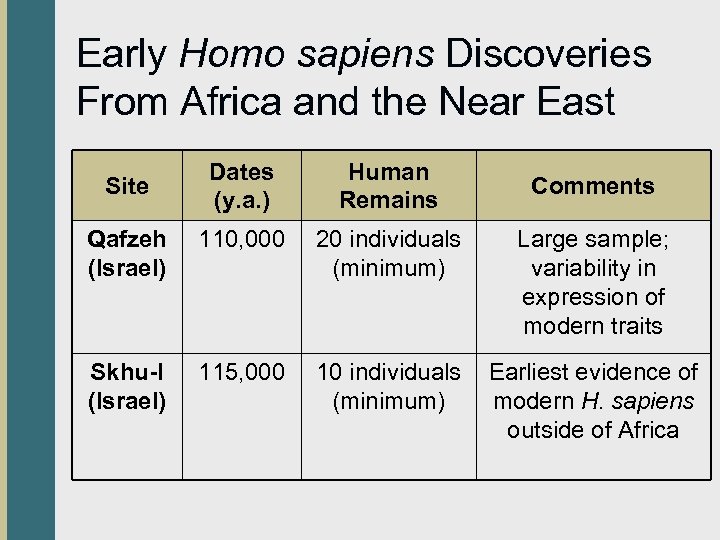 Early Homo sapiens Discoveries From Africa and the Near East Dates (y. a. ) Human Remains Qafzeh (Israel) 110, 000 20 individuals (minimum) Large sample; variability in expression of modern traits Skhu-l (Israel) 115, 000 10 individuals (minimum) Earliest evidence of modern H. sapiens outside of Africa Site Comments
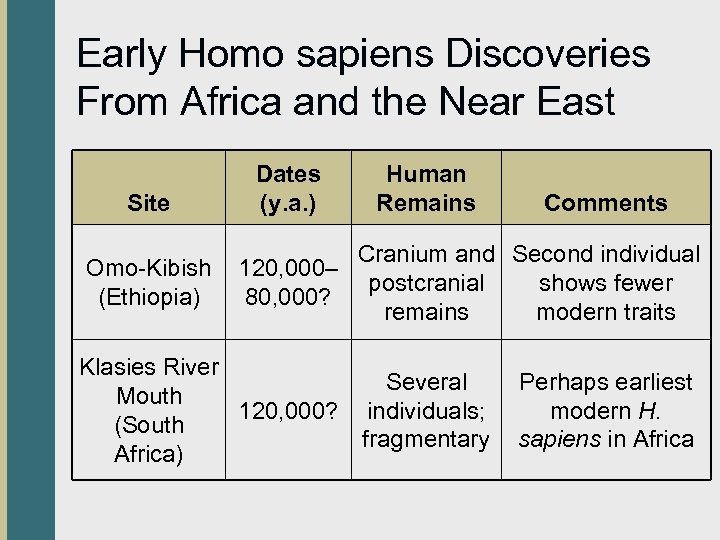 Early Homo sapiens Discoveries From Africa and the Near East Site Omo-Kibish (Ethiopia) Dates (y. a. ) Human Remains Comments Cranium and Second individual 120, 000– postcranial shows fewer 80, 000? remains modern traits Klasies River Several Mouth 120, 000? individuals; (South fragmentary Africa) Perhaps earliest modern H. sapiens in Africa
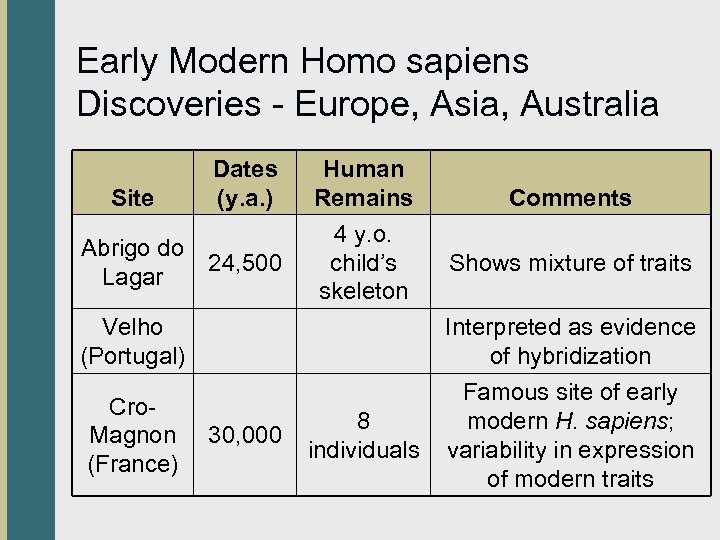 Early Modern Homo sapiens Discoveries - Europe, Asia, Australia Site Abrigo do Lagar Dates (y. a. ) Human Remains 24, 500 4 y. o. child’s skeleton Velho (Portugal) Cro. Magnon (France) 30, 000 8 individuals Comments Shows mixture of traits Interpreted as evidence of hybridization Famous site of early modern H. sapiens; variability in expression of modern traits
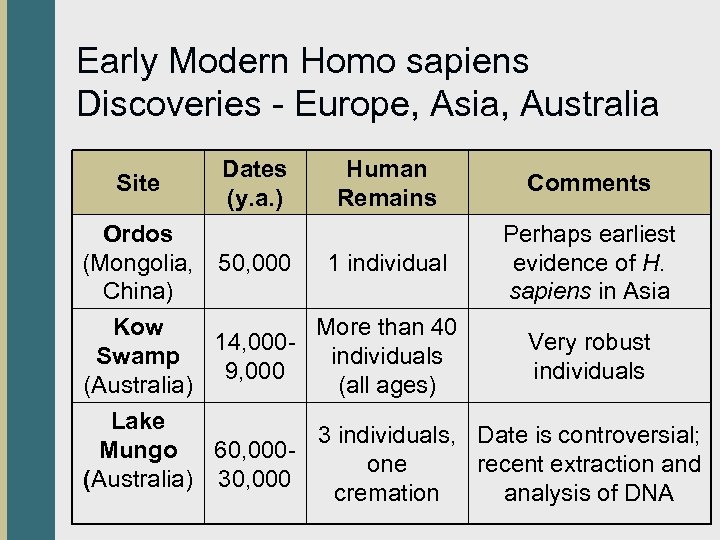 Early Modern Homo sapiens Discoveries - Europe, Asia, Australia Site Dates (y. a. ) Human Remains Ordos (Mongolia, 50, 000 1 individual China) Kow More than 40 14, 000 Swamp individuals 9, 000 (Australia) (all ages) Comments Perhaps earliest evidence of H. sapiens in Asia Very robust individuals Lake 3 individuals, Date is controversial; Mungo 60, 000 one recent extraction and (Australia) 30, 000 cremation analysis of DNA
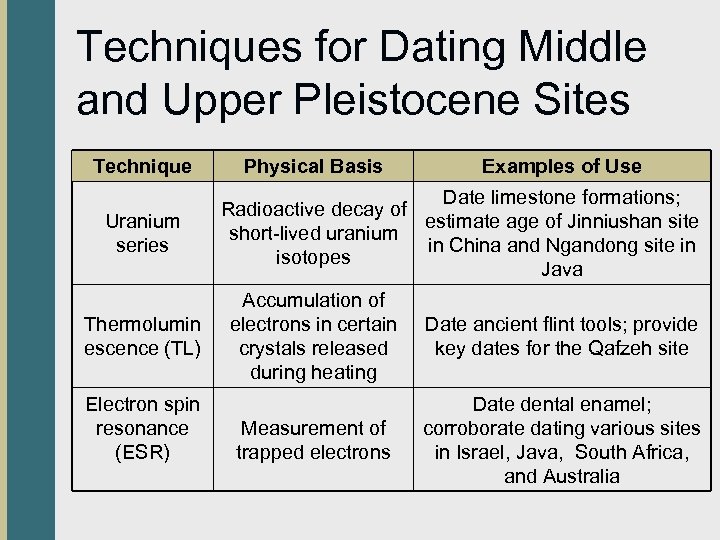 Techniques for Dating Middle and Upper Pleistocene Sites Technique Uranium series Thermolumin escence (TL) Electron spin resonance (ESR) Physical Basis Examples of Use Date limestone formations; Radioactive decay of estimate age of Jinniushan site short-lived uranium in China and Ngandong site in isotopes Java Accumulation of electrons in certain crystals released during heating Date ancient flint tools; provide key dates for the Qafzeh site Measurement of trapped electrons Date dental enamel; corroborate dating various sites in Israel, Java, South Africa, and Australia
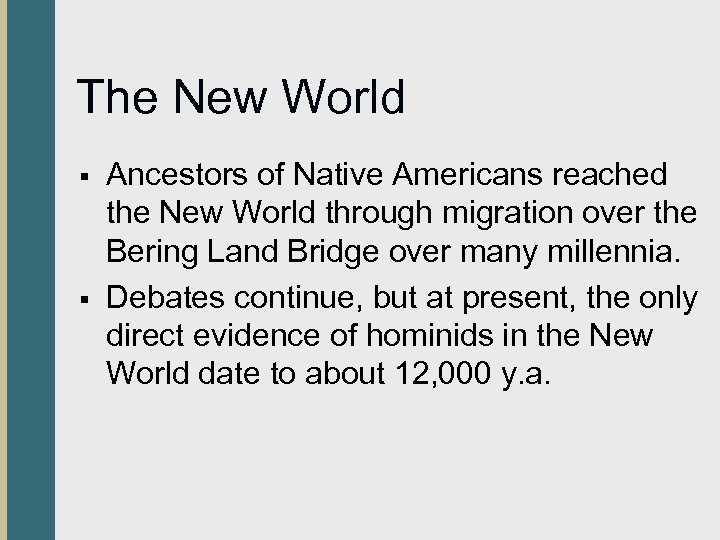 The New World § § Ancestors of Native Americans reached the New World through migration over the Bering Land Bridge over many millennia. Debates continue, but at present, the only direct evidence of hominids in the New World date to about 12, 000 y. a.
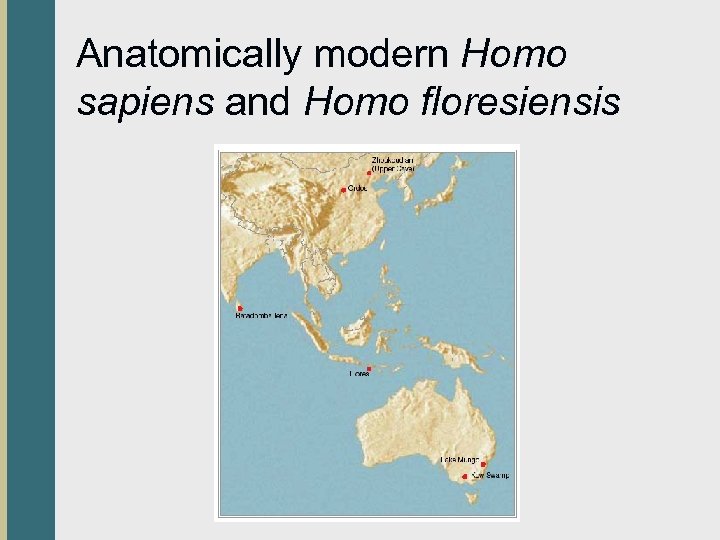 Anatomically modern Homo sapiens and Homo floresiensis
 The Upper Paleolithic § § Cultural period began in western Europe approximately 40, 000 years ago. Industries based on tool technologies: 1. Chatelperronian 2. Aurignacian 3. Gravettian 4. Solutrean 5. Magdalenian
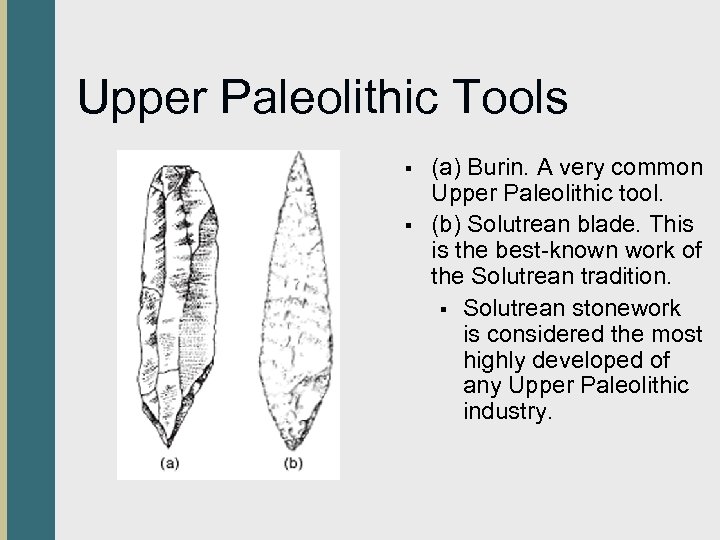 Upper Paleolithic Tools § § (a) Burin. A very common Upper Paleolithic tool. (b) Solutrean blade. This is the best-known work of the Solutrean tradition. § Solutrean stonework is considered the most highly developed of any Upper Paleolithic industry.
 Cultural Periods of the European Upper Paleolithic (beginnings) Cultural Periods 17, 000 21, 000 27, 000 40, 000 Magdalenian Solutrean Gravettian Aurignacian Chatelperronian Middle Paleolithic Mousterian
 Cave Art § § Majority from southwestern France and northern Spain. Grotte Chauvet § Dating has placed the cave painting during the Aurignacian period more than 30, 000 y. a. § Images include stylized dots, human handprints and animal representations. § Among traces are dozens of footprints on the cave floor produced by bears and humans.
 Africa § § § Rock art is found in southern Africa dating to between 28, 000 and 19, 000 y. a. Personal adornment dates back to 38, 000 y. a. in the form of beads made from ostrich shells. Excavations in the Katanda area show remarkable bone craftsmanship. § Intricate bone tools resembling harpoons were made from the ribs of large mammals.
 Quick Quiz
 1. Which of the following is NOT one of the hypotheses explaining the origins and dispersal of anatomically modern humans? a) the partial replacement model b) the regional continuity model c) the regional replacement model d) the complete replacement model
 Answer: c § The regional replacement model is NOT one of the hypotheses explaining the origins and dispersal of anatomically modern humans.
 2. Scientists are fairly clear on when anatomically modern Homo sapiens first appeared. § True § False
 Answer: False § Scientists are not fairly clear on when anatomically modern Homo sapiens first appeared.
 3. The _________ holds that anatomically modern populations arose in Africa within the last 200, 000 years, migrated out and replaced populations in Europe and Asia. They did not interbreed because they were a separate species.
 Answer: Complete Replacement Model 3. The Complete Replacement Model holds that anatomically modern populations arose in Africa within the last 200, 000 years, migrated out and replaced populations in Europe and Asia. They did not interbreed because they were a separate species.
 4. The model also known as "Recent African Evolution" is based on the origin of modern humans a) in Africa and their interbreeding with local African populations. b) in Africa and their replacement of local populations in Europe and Asia. c) in China and their relatively recent evolution in Africa. d) simultaneously in Africa and China.
 Answer: b § The model also known as "Recent African Evolution" is based on the origin of modern humans in Africa and their replacement of local populations in Europe and Asia.