


 Скачать презентацию Chapter 11 The Late Middle Ages Crisis and
758417c07feaa7b07fb5a24a5d6df459.ppt
- Количество слайдов: 26
 Chapter 11 The Late Middle Ages: Crisis and Disintegration in the Fourteenth Century
 An enigmatic era n n Medieval crises precipitate the Renaissance Forces driving this change: ¨ War ¨ Plague ¨ “Infidel” Invasion by Mongols and Ottoman Turks ¨ Religions Schism n This opens door for… ¨ Centralized “New Monarchies” ¨ Higher living standards ¨ Secular culture ¨ Religious Reform
 Medieval Developments to 1340 n n n Feudalism sets stage for larger-scale government, protection of rights and duty to state Agricultural advancements – population thrives! Expansion and bureaucratization of the Church preserves aspects of Classical learning, provides order, and establishes universities/institutions of advanced learning Crusades allow for contact and exchange with Byzantine and Arab worlds The end result was an advanced civilization that fused Greco-Roman traditions with Christian, Germanic, Arabic and Byzantine elements to surpass other regions in the world at the time
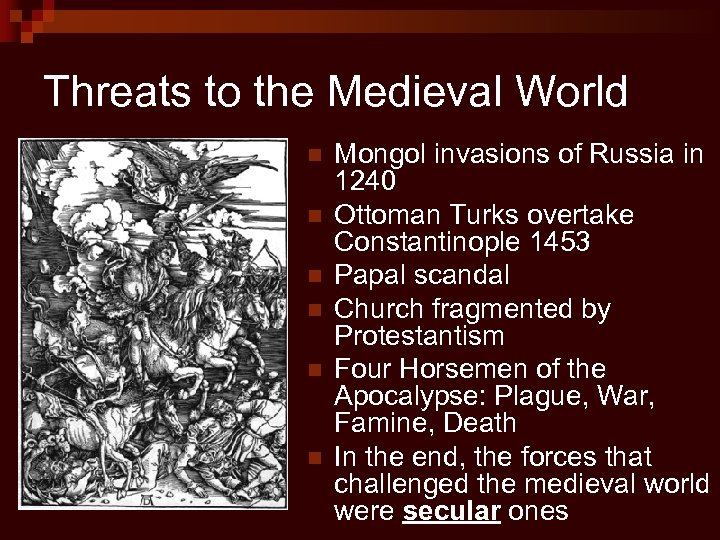 Threats to the Medieval World n n n Mongol invasions of Russia in 1240 Ottoman Turks overtake Constantinople 1453 Papal scandal Church fragmented by Protestantism Four Horsemen of the Apocalypse: Plague, War, Famine, Death In the end, the forces that challenged the medieval world were secular ones
 The Black Death: A Recipe for Plague “Little Ice Age” n The Great Famine (1315 – 1317) n Inability to sustain growing population with agricultural methods used at the time n Upheaval to urban areas n
 The Black Death n n Most devastating natural disaster in European History Bubonic Plague ¨ Rats and Fleas? Perhaps not! ¨ Pneumonic causes? ¨ Yersinia pestis n n Arrived in Europe in 1347 Mortality reached 50 – 60 percent in some areas Wiped out between 25 – 50 percent of European population (19 – 38 million dead in four years) Plague returns in 1361 – 1362 and 1369
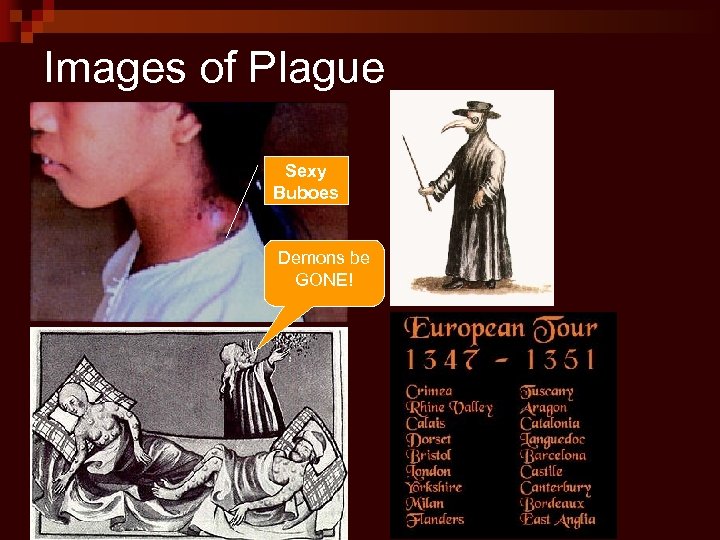 Images of Plague Sexy Buboes Demons be GONE!
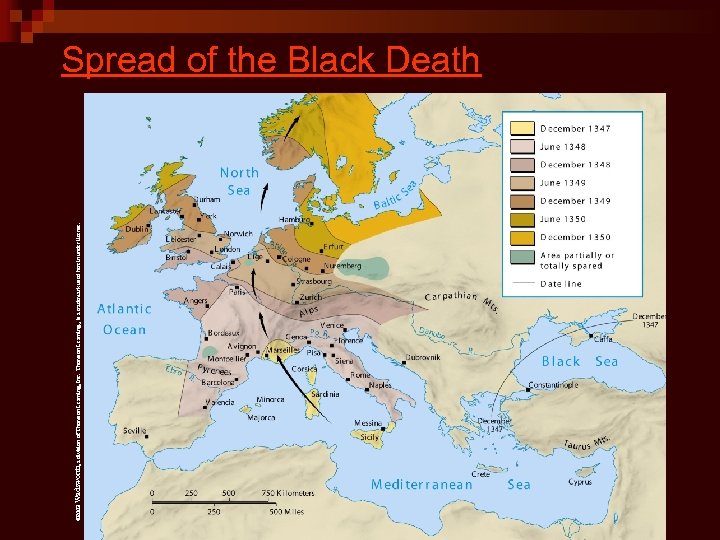 © 2003 Wadsworth, a division of Thomson Learning, Inc. Thomson Learning™ is a trademark used herein under license. Spread of the Black Death
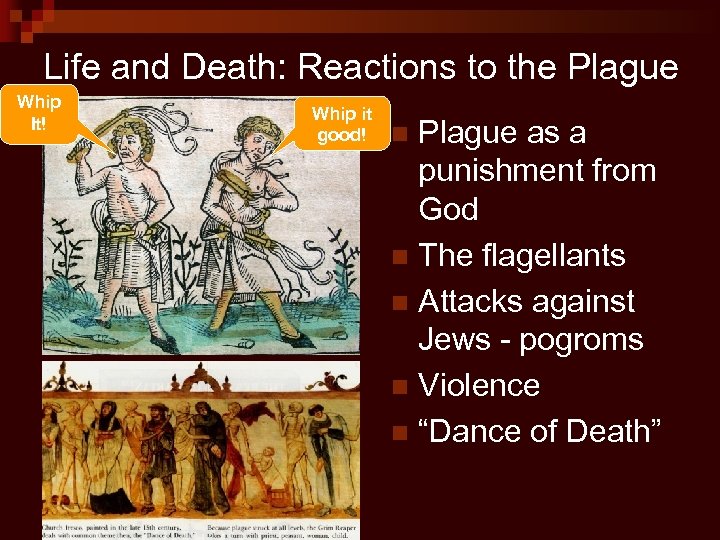 Life and Death: Reactions to the Plague Whip It! Whip it good! Plague as a punishment from God n The flagellants n Attacks against Jews - pogroms n Violence n “Dance of Death” n
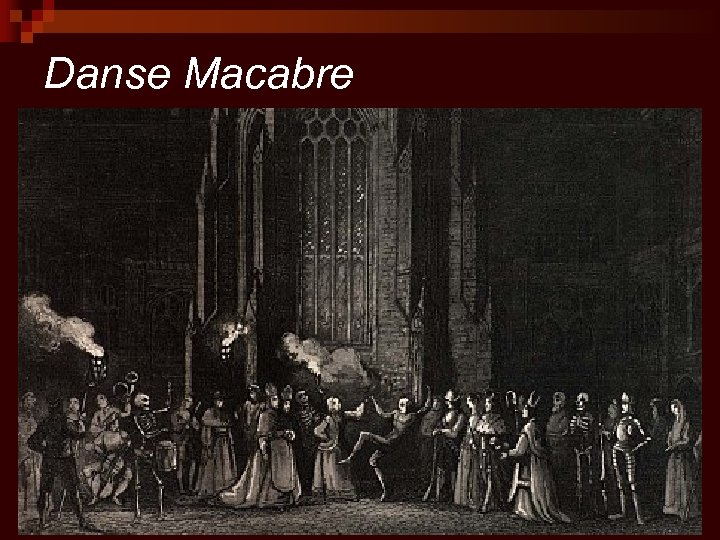 Danse Macabre
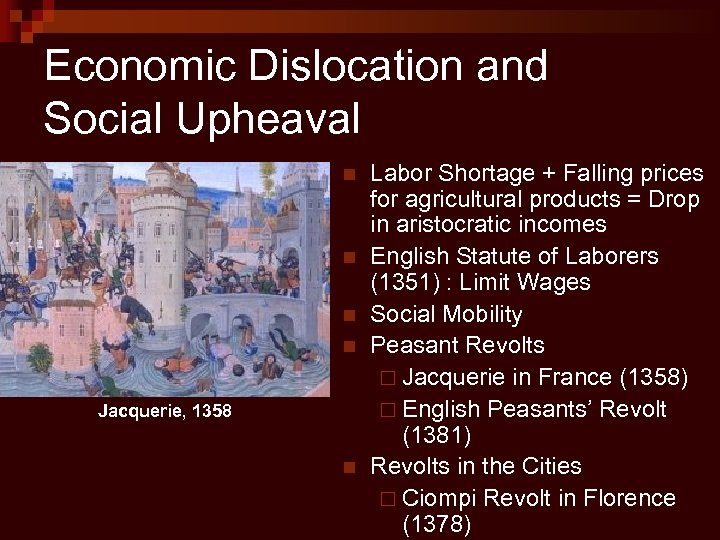 Economic Dislocation and Social Upheaval n n Jacquerie, 1358 n Labor Shortage + Falling prices for agricultural products = Drop in aristocratic incomes English Statute of Laborers (1351) : Limit Wages Social Mobility Peasant Revolts ¨ Jacquerie in France (1358) ¨ English Peasants’ Revolt (1381) Revolts in the Cities ¨ Ciompi Revolt in Florence (1378)
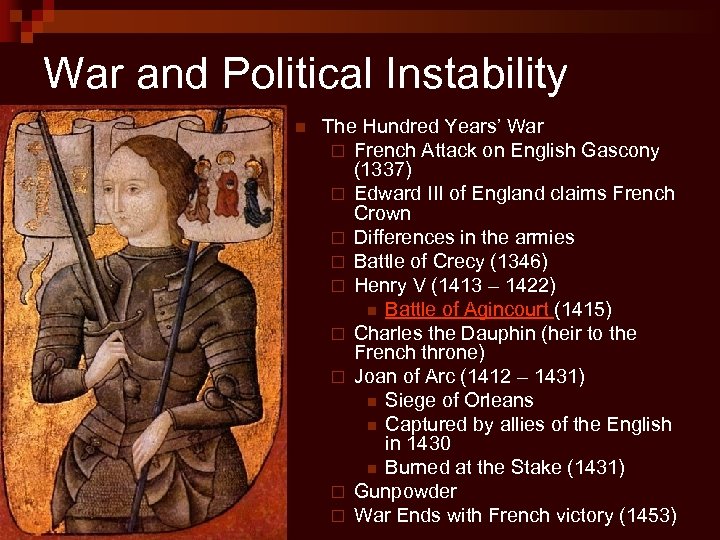 War and Political Instability n The Hundred Years’ War ¨ French Attack on English Gascony (1337) ¨ Edward III of England claims French Crown ¨ Differences in the armies ¨ Battle of Crecy (1346) ¨ Henry V (1413 – 1422) n Battle of Agincourt (1415) ¨ Charles the Dauphin (heir to the French throne) ¨ Joan of Arc (1412 – 1431) n Siege of Orleans n Captured by allies of the English in 1430 n Burned at the Stake (1431) ¨ Gunpowder ¨ War Ends with French victory (1453)
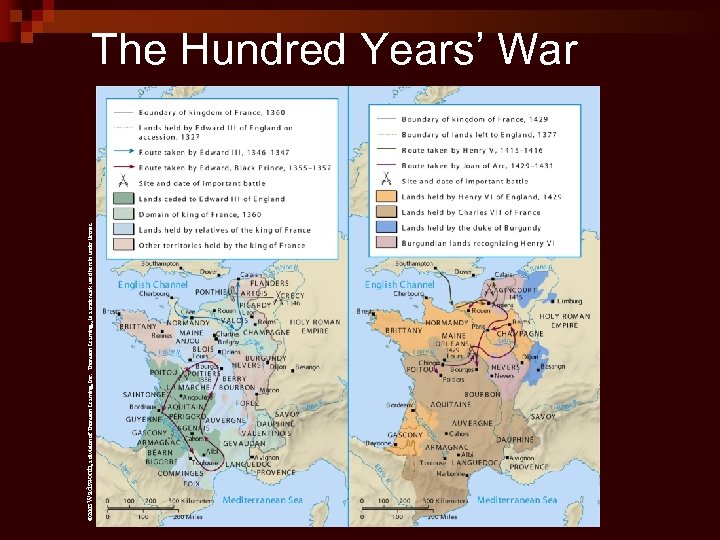 © 2003 Wadsworth, a division of Thomson Learning, Inc. Thomson Learning™ is a trademark used herein under license. The Hundred Years’ War
 Political Instability n Breakdown of Feudal Institutions ¨ Attempts at political centralization ¨ Scutage: “buy out” of military service n New Royal Dynasties ¨ Problems of succession ¨ Challenge of noble families n Financial Problems ¨ Parliaments gain power ¨ Ongoing war creates need to tax
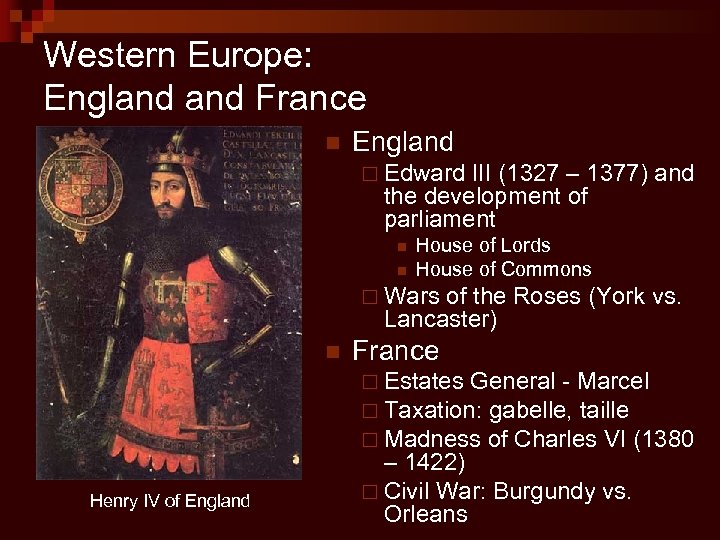 Western Europe: England France n England ¨ Edward III (1327 – 1377) and the development of parliament n n House of Lords House of Commons ¨ Wars of the Roses (York vs. Lancaster) n France ¨ Estates General - Marcel ¨ Taxation: gabelle, taille ¨ Madness of Charles VI (1380 Henry IV of England – 1422) ¨ Civil War: Burgundy vs. Orleans
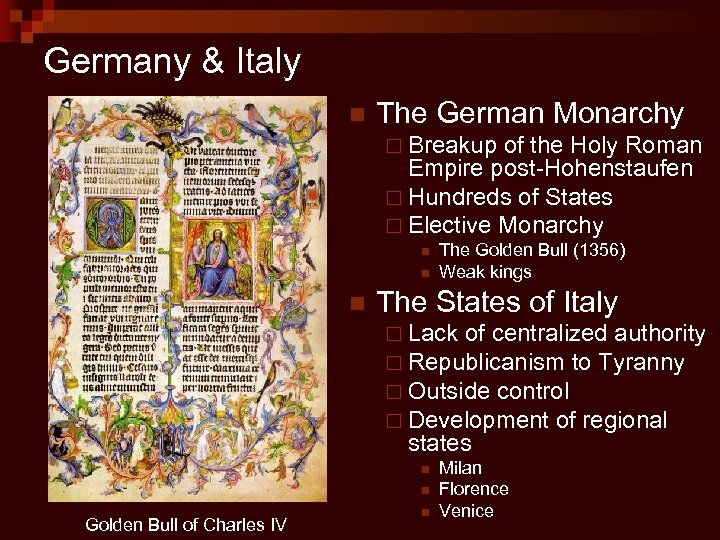 Germany & Italy n The German Monarchy ¨ Breakup of the Holy Roman Empire post-Hohenstaufen ¨ Hundreds of States ¨ Elective Monarchy n n n The Golden Bull (1356) Weak kings The States of Italy ¨ Lack of centralized authority ¨ Republicanism to Tyranny ¨ Outside control ¨ Development of regional states n n Golden Bull of Charles IV n Milan Florence Venice
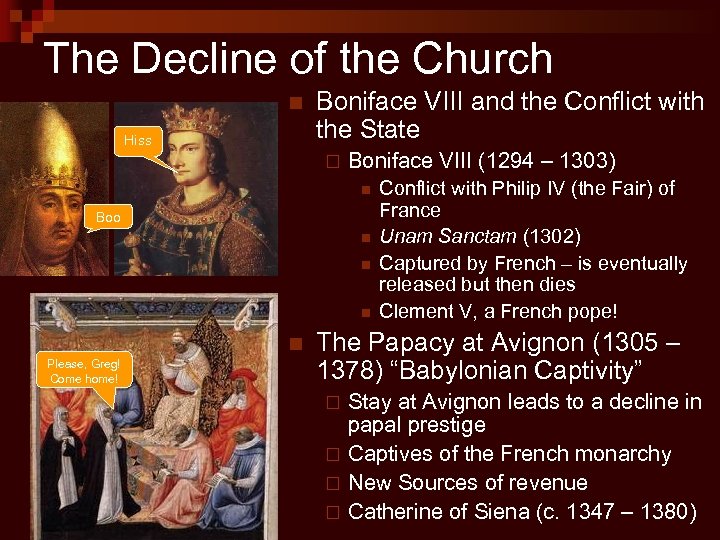 The Decline of the Church n Hiss Boniface VIII and the Conflict with the State ¨ Boniface VIII (1294 – 1303) n Boo n n Please, Greg! Come home! Conflict with Philip IV (the Fair) of France Unam Sanctam (1302) Captured by French – is eventually released but then dies Clement V, a French pope! The Papacy at Avignon (1305 – 1378) “Babylonian Captivity” Stay at Avignon leads to a decline in papal prestige ¨ Captives of the French monarchy ¨ New Sources of revenue ¨ Catherine of Siena (c. 1347 – 1380) ¨
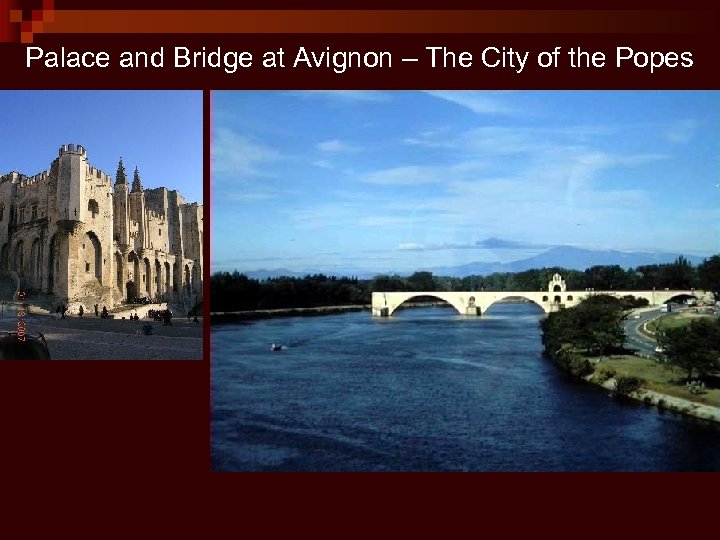 Palace and Bridge at Avignon – The City of the Popes
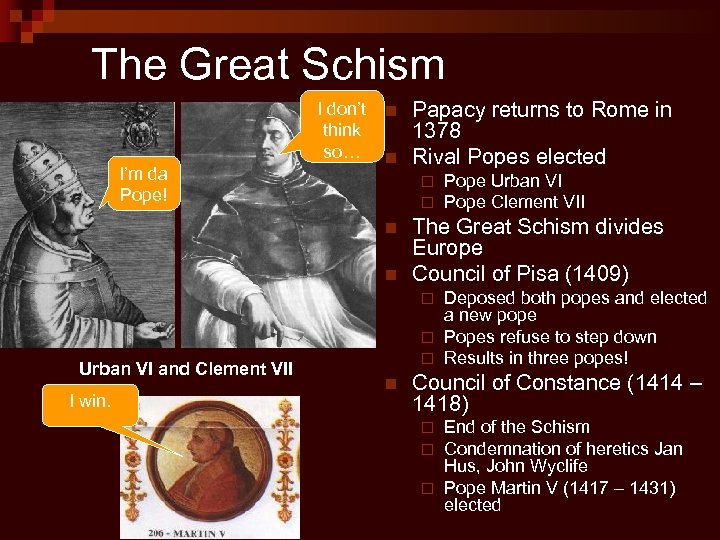 The Great Schism I don’t think so… I’m da Pope! n n Papacy returns to Rome in 1378 Rival Popes elected ¨ ¨ n n Pope Urban VI Pope Clement VII The Great Schism divides Europe Council of Pisa (1409) Deposed both popes and elected a new pope ¨ Popes refuse to step down ¨ Results in three popes! ¨ Urban VI and Clement VII I win. n Council of Constance (1414 – 1418) End of the Schism Condemnation of heretics Jan Hus, John Wyclife ¨ Pope Martin V (1417 – 1431) elected ¨ ¨
 Changes for the Church n End of conciliarism ¨ Council of Basel 1449 ends it ¨ Paves way for “Renaissance Papacy” n Popes behaving badly… n Patronage of art/culture n Lay Piety and Mysticism ¨ Preoccupation with salvation after plague and war ¨ Purgatory and indulgences ¨ Meister Eckhart, Johannes Tauler, Gerhard Groote ¨ Female mystics – Catherine, Hildegard, Beguines n Nominalism and the challenge to theology and scholasticism ¨ Aquinas vs. Occam
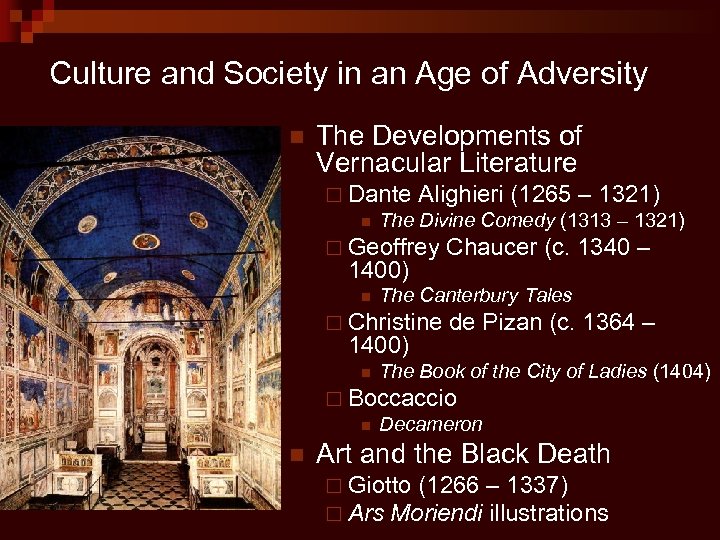 Culture and Society in an Age of Adversity n The Developments of Vernacular Literature ¨ Dante Alighieri (1265 – 1321) n The Divine Comedy (1313 – 1321) ¨ Geoffrey Chaucer (c. 1340 – 1400) n The Canterbury Tales ¨ Christine 1400) n de Pizan (c. 1364 – The Book of the City of Ladies (1404) ¨ Boccaccio n Decameron n Art and the Black Death ¨ Giotto (1266 – 1337) ¨ Ars Moriendi illustrations
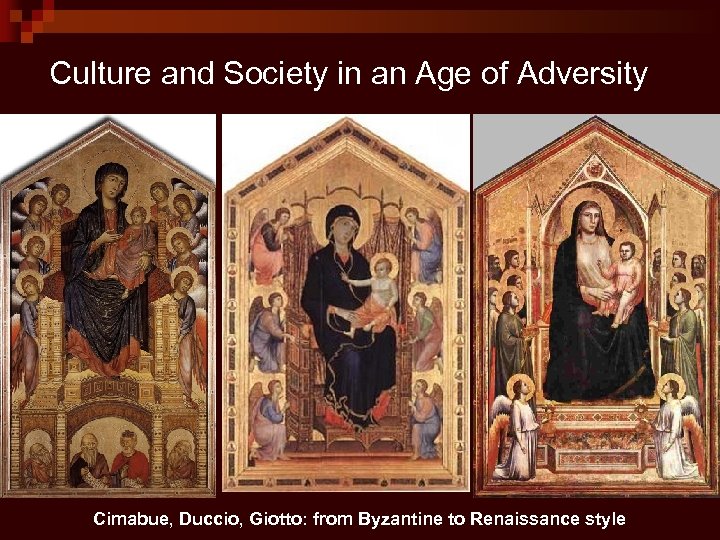 Culture and Society in an Age of Adversity Cimabue, Duccio, Giotto: from Byzantine to Renaissance style
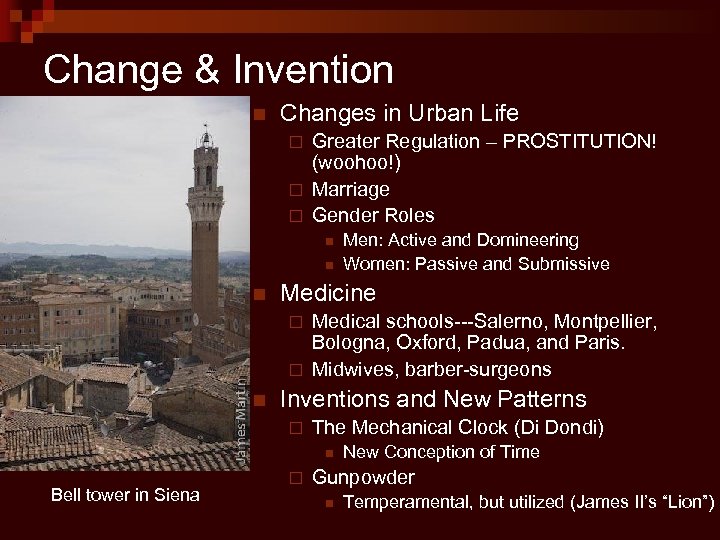 Change & Invention n Changes in Urban Life Greater Regulation – PROSTITUTION! (woohoo!) ¨ Marriage ¨ Gender Roles ¨ n n n Men: Active and Domineering Women: Passive and Submissive Medicine Medical schools---Salerno, Montpellier, Bologna, Oxford, Padua, and Paris. ¨ Midwives, barber-surgeons ¨ n Inventions and New Patterns ¨ The Mechanical Clock (Di Dondi) n Bell tower in Siena ¨ New Conception of Time Gunpowder n Temperamental, but utilized (James II’s “Lion”)
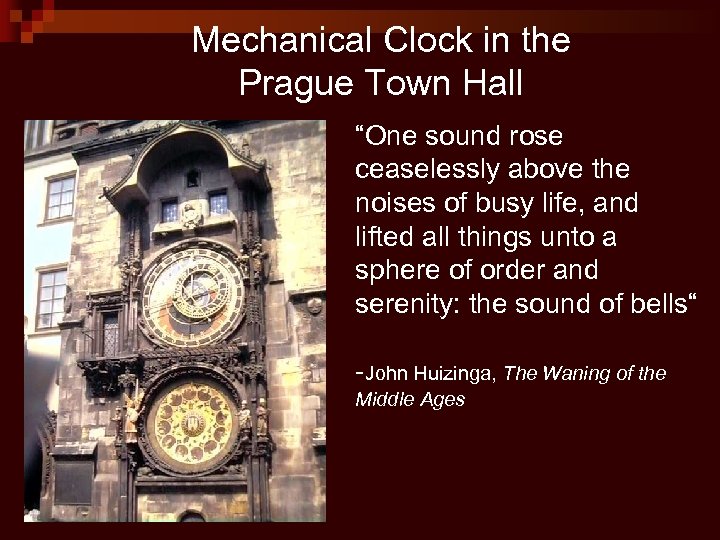 Mechanical Clock in the Prague Town Hall “One sound rose ceaselessly above the noises of busy life, and lifted all things unto a sphere of order and serenity: the sound of bells“ -John Huizinga, The Waning of the Middle Ages
 Discussion Questions n n n n What impact did the Black Death have on medieval European society? What were the causes of the Hundred Years’ War? Who was Joan of Arc and what role did she play in the Hundred Years’ War? How did the Hundred Years’ War impact the relations between the English King and his Parliament? Why did the stay at Avignon lead to a decline in papal prestige? How was the Great Schism finally ended? How did Dante, Chaucer and Christine de Pisan reflect the values of their respective societies? How did the Black Death affect urban and family life?
 Web Links n n n n ORB – Online Reference Book for Medieval Studies The End of Europe’s Middle Ages The Black Death, 1347 – 1350 Medieval Dance of Death De Re Militari – Society for Medieval Military History The Age of King Charles V The World of Dante Geoffrey Chaucer