


 Скачать презентацию Chapter 11 Technology Culture Everyday Life
fd7312a305b36f4ff8f70c4962b51118.ppt
- Количество слайдов: 25
 Chapter 11: Technology, Culture, & Everyday Life
 Section 1 • Focus Question: What technological improvements increased industrial productivity between 1840 -1860? • Big Picture: ▫ Technology improves lives, agriculture, and the economy at a price.
 Just Think About It • How does technology improve our daily lives? • How does technology improve our lives, but comes at a price (consequences)?
 Agriculture • 1834: Cyrus Mc. Cormick—Mechanical Reaper • 1837—John Deere—Steel Tipped Plow ▫ Both assisted farmers harvest “frontier” ▫ Civil War • Farmers could work more land ▫ Downfall: purchased land & loans = debt ▫ Farm land without conservation
 Technology & Industry • 1800—Eli Whitney began metal tool production ▫ Cotton gin & interchangeable parts ▫ Most parts still purchased from BR • 1840 -1860’s—U. S. creates “American System” (H. Clay) ▫ U. S. less reliant on European goods ▫ Tariffs for manufacturing (N) Encouraged entrepreneurs & inventions ▫ RR & Canals for trade (W) Communications for business—telegraphs ▫ No plans for agricultural south
 Railroad Boom • 1850’s—American rail 3 x’s faster than BR • Dangerous Conditions Improvements: Time zone invented + 1860—Chicago major RR shipping hub to connect East to Midwest (replaced NO) Depression of 1830’s slowed down RR creation 1850’s led to RR boom = stock exchange
 Prosperity • New technologies = more efficient working = lower prices ▫ ▫ Small artisans could not compete More wages = more buying = more demand Growth of cities (more $ = expanding) Women & children had opportunities to work and supplement farming family income ▫ Urbanization in N & W = economic opportunites for all
 Section 2 • Focus Question: How did American pastimes and entertainment change between 1840 -1860? • Big Picture: ▫ People have more educated, have more leisure time, and are forming social groups.
 Dwellings • Urban Setting: Brick row-homes ▫ Working class homes sectioned off and popular among immigrants (Irish) and free blacks • Middle class: building odd shaped houses ▫ Fancy, lots of wood, & upholstered • Rural poor class: poorly constructed cabins
 1840 -1850 Life Improves Conveniences Inconveniences • • • Coal dust & carbon monoxide • Fresh fruits/veggies only available to wealthy • Salted pork • Lack of running water • Conditions ▫ Body odor ▫ Hogs as street cleaners ▫ Poor sanitation Transportation & industry Coal stoves Railroads Pipes & aqueducts for fresh water in urban areas ▫ NY
 Diseases & Health • Epidemics—rapidly spreading diseases ▫ Cholera & Yellow Fever killed 1/5 of New Orleans ▫ High infant mortality ▫ Distrusted doctors b/c they could not cure • Quarantine—separate sick from society
 Diseases & Health • 1840—Health Advancements ▫ Nitrous Oxide (laughing gas) anesthetic ▫ Sulfuric Ether in surgery ▫ Lack of sterilizing equipment • Health Movements ▫ Water Cure 1840 s (Europe) ▫ 1832—Sylvester Graham ▫ Abstinence & utopian communities
 Phrenology • Orson & Lorenzo Fowler 1830 s ▫ “bumps” in head are connected towards personality ▫ Exercising “bumps” = improved character ▫ Popular for helping pick mates & employees
 Section 3 • Focus Question: • Big Picture: 1830 -1860 allowed Americans higher wages = more leisure time
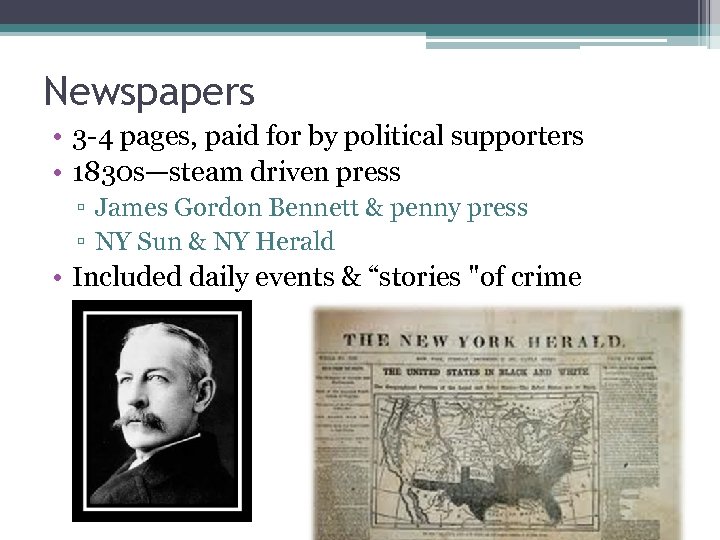 Newspapers • 3 -4 pages, paid for by political supporters • 1830 s—steam driven press ▫ James Gordon Bennett & penny press ▫ NY Sun & NY Herald • Included daily events & “stories "of crime
 Theater • • 50 cents/seat & crowded All classes, even prostitution allowed Astor Place Riots Melodramas like Shakespeare & short performances
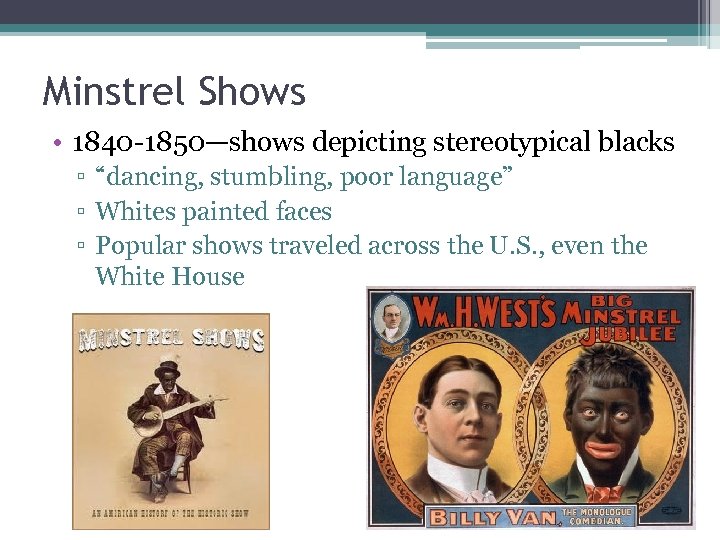 Minstrel Shows • 1840 -1850—shows depicting stereotypical blacks ▫ “dancing, stumbling, poor language” ▫ Whites painted faces ▫ Popular shows traveled across the U. S. , even the White House
 P. T. Barnum • From CT, journalist, & “crook” • 1834—began career in “circus shows” ▫ Books 80 yo black woman who claimed to be GW nurse (169 yo!) • 1841—purchased the American Museum in NY ▫ Typical museums had stuffed animals ▫ Barnum displayed “oddities” Magicians, Tom Thumb, Mermaid, albinos
 Tom Thumb
 Section 4 • Focus Question: How did Americans express their distinctiveness in their literature in art? • Big Picture: Move from “fancy” writing/art to more accessible material for the masses/
 Roots of the Renaissance Economic & Philosophical Fiction & Poetry • Transportation Revolution = ideas of fiction and unknown • Prior to 1800 s ▫ Classicism—educated writers showing off understanding of Ancient literature. • During 1800’s ▫ Romanticism ▫ Popular b/c more were educated and now had access to new type of literature. ▫ Books taught morals with interesting and identifiable characters
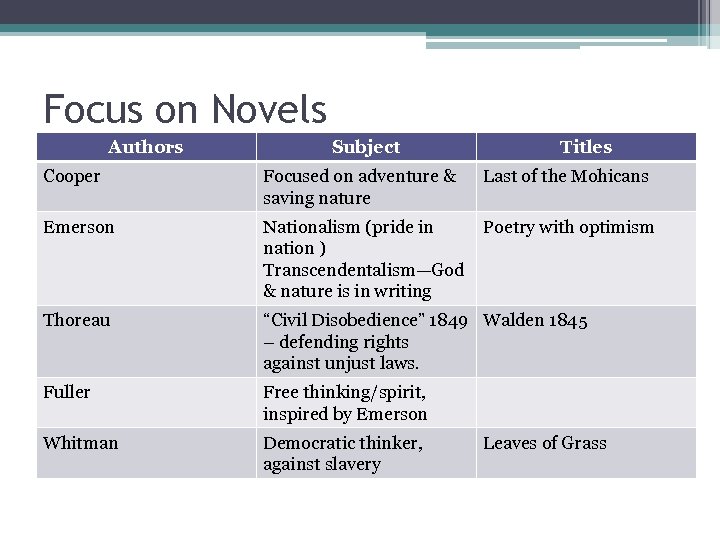 Focus on Novels Authors Subject Titles Cooper Focused on adventure & saving nature Last of the Mohicans Emerson Nationalism (pride in nation ) Transcendentalism—God & nature is in writing Poetry with optimism Thoreau “Civil Disobedience” 1849 Walden 1845 – defending rights against unjust laws. Fuller Free thinking/spirit, inspired by Emerson Whitman Democratic thinker, against slavery Leaves of Grass
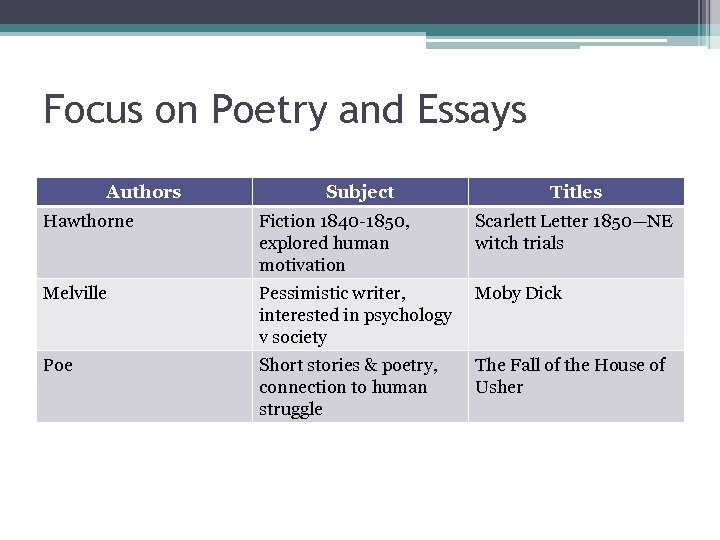 Focus on Poetry and Essays Authors Subject Titles Hawthorne Fiction 1840 -1850, explored human motivation Scarlett Letter 1850—NE witch trials Melville Pessimistic writer, interested in psychology v society Moby Dick Poe Short stories & poetry, connection to human struggle The Fall of the House of Usher
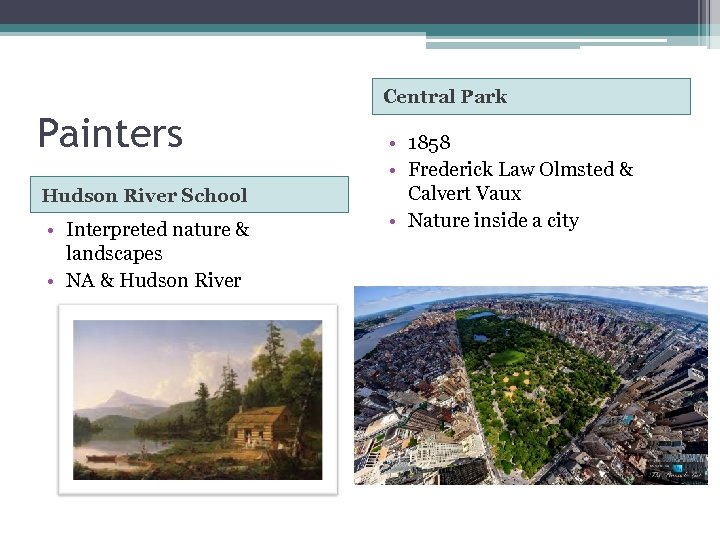 Central Park Painters Hudson River School • Interpreted nature & landscapes • NA & Hudson River • 1858 • Frederick Law Olmsted & Calvert Vaux • Nature inside a city
 Changes in Society Reflected in Literature