 Скачать презентацию Chapter 11 Supply Chain Management and Global Information
a8a5f68f20ba88763eca69d93dc96851.ppt
- Количество слайдов: 38



Chapter 11 Supply Chain Management and Global Information Systems Management Information Systems, 4 th Edition 1
Learning Objectives • Explain the difference between vertical and horizontal markets • Describe vertical and horizontal information integration among companies • Articulate the differences between traditional and Web-based EDI • Recognize the benefits of supply chain management systems • Explain the role of global information systems • Cite the legal, cultural, and other challenges to implementing international information systems Management Information Systems, 4 th Edition 2
Sharing Information Systems: The Rise of E-Commerce • Interorganizational Information Systems – Systems shared by two or more organizations • Built and owned by one organization • Increases efficiency and effectiveness • Organizations use similar systems to serve international sites Management Information Systems, 4 th Edition 3
Sharing Information Systems: The Rise of E-Commerce (Cont. ) • Vertical market – A market in which the goods of one business are used as raw materials or components in the production or sale process of another business • Horizontal market – All players in the market buy or sell the same products; they are in competition Management Information Systems, 4 th Edition 4
Vertical Information Exchange • Vertically related – Output of one organization used in processes of another – Integrating ISs between vertically related organizations highly beneficial • Saves time and money • Better serves customers Management Information Systems, 4 th Edition 5
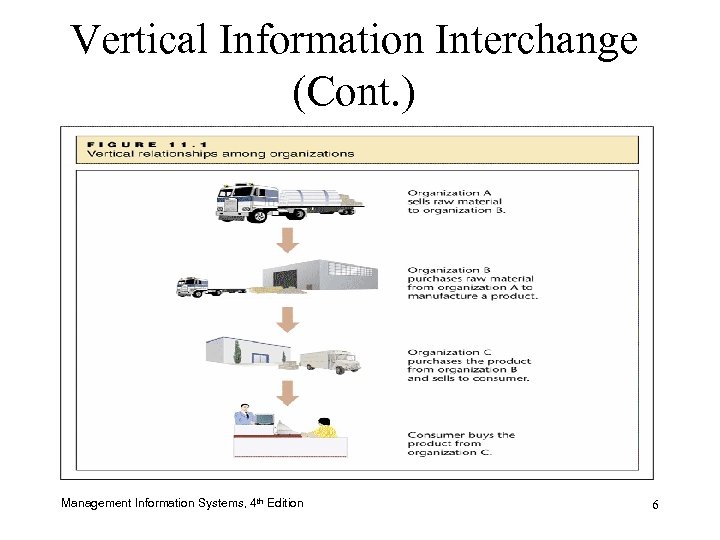
Vertical Information Interchange (Cont. ) Management Information Systems, 4 th Edition 6
Horizontal Information Systems • Horizontal Information Interchange – Organizations performing similar activities share information • Real estate agencies maintain multiple listing service • Financial institutions share financial information • Airlines share reservation systems – Legal implications and risks similar to those of EDI Management Information Systems, 4 th Edition 7
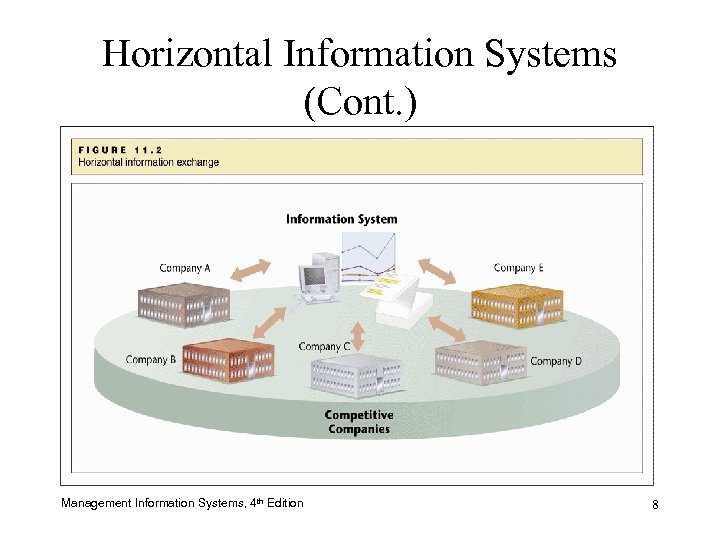
Horizontal Information Systems (Cont. ) Management Information Systems, 4 th Edition 8
Electronic Data Interchange • What is EDI? – Exchange of electronic data using interorganizational information systems – Set of hardware, software, and standards that accommodate the EDI process Management Information Systems, 4 th Edition 9
Benefits of EDI • Cost Savings • Speed • Accuracy • Security • System Integration • Just-in-time Support Management Information Systems, 4 th Edition 10
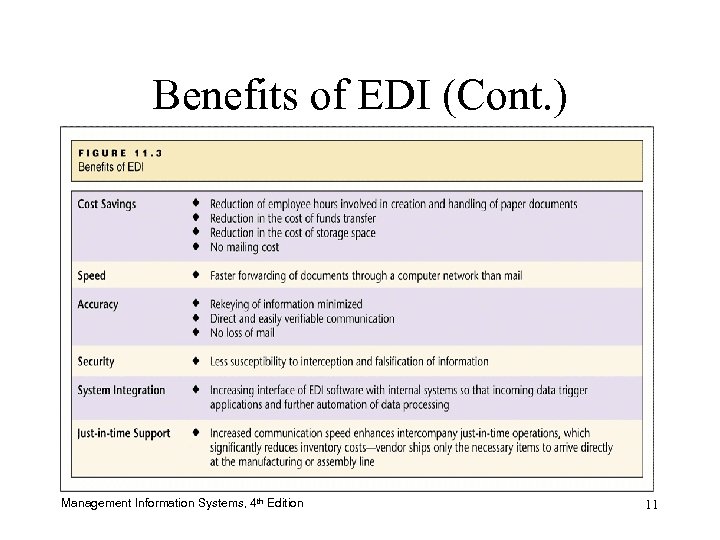
Benefits of EDI (Cont. ) Management Information Systems, 4 th Edition 11
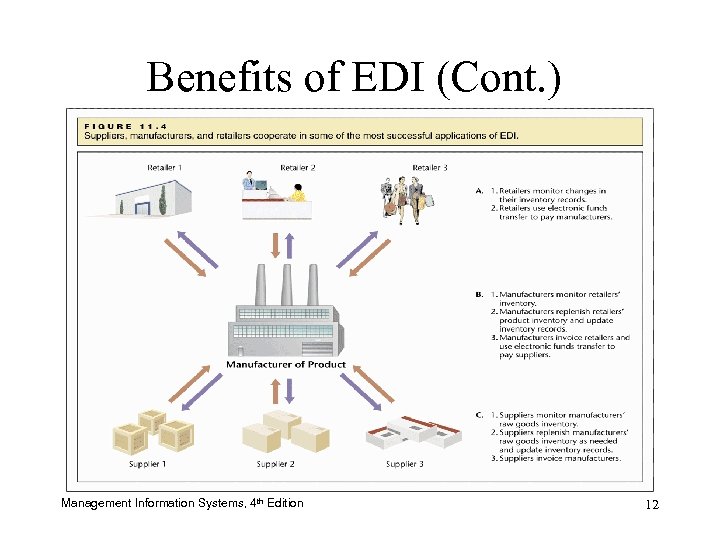
Benefits of EDI (Cont. ) Management Information Systems, 4 th Edition 12
How does EDI work? 1. Supplier’s proposal sent electronically to purchasing organization 2. Electronic contract approved over network 3. Supplier manufactures and packages goods, attaching shipping data recorded on a bar code 4. Quantities shipped and prices entered in system and flowed to invoicing program; invoices transmitted to purchasing organization Management Information Systems, 4 th Edition 13
How does EDI work? (Cont. ) 5. Manufacturer ships order 6. Purchasing organization receives packages, scans bar code, and compares data to invoices actual items received 7. Payment approval transferred electronically 8. Bank transfers funds from purchaser to supplier’s account using electronic fund transfer (EFT) Management Information Systems, 4 th Edition 14
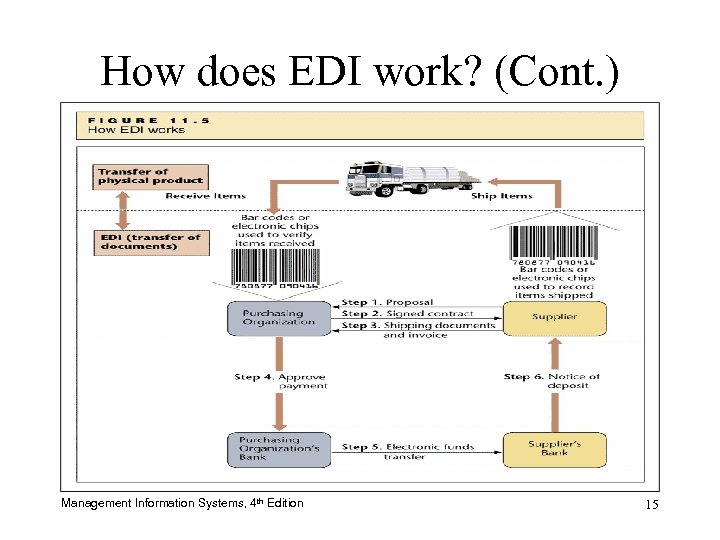
How does EDI work? (Cont. ) Management Information Systems, 4 th Edition 15
Electronic Data Interchange • All documents are digital • Most users are health-care, insurance and retailing • Others are banking, automotive, petroleum and chemical, and transportation companies Management Information Systems, 4 th Edition 16
Value Added Network EDI • Business partners subscribe to service and use VAN’s private communication lines, mailboxes, and special software • VAN mediates EDI communication, translates business documents into EDI documents • Batches transmitted several times per day Management Information Systems, 4 th Edition 17
Value Added Network EDI (Cont. ) • Advantages: – Transaction integrity – Privacy and security – Nonrepudiation – Solid standards Management Information Systems, 4 th Edition 18
Web EDI • Majority of EDI still done through VAN lines • Decreasing rapidly in favor of the Web • All new EDI implementations use Web technologies • Reduces cost • Use of XML standards allows business partners to create their own tags Management Information Systems, 4 th Edition 19
Web EDI (Cont. ) • Advantages – Lower cost – More familiar software – Worldwide connectivity – Fast communication – Real time information exchange Management Information Systems, 4 th Edition 20
Supply Chain Management • Less money being tied to inventory • Management of supplies throughout the manufacturing process, from one organization to the next • Monitoring and controlling the supply chain is Supply Chain Management (SCM) Management Information Systems, 4 th Edition 21
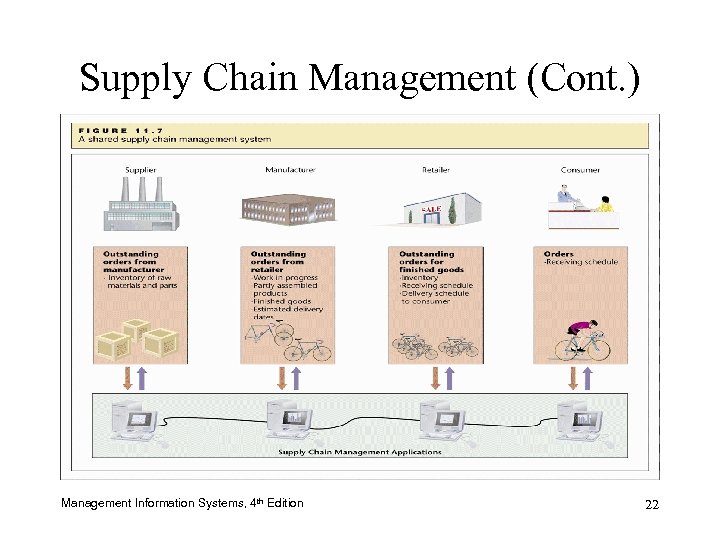
Supply Chain Management (Cont. ) Management Information Systems, 4 th Edition 22
Supply Chain Management (Cont. ) • SCM applications streamline operations from suppliers to customers – Reduction in inventories – Reduction in cycle time – Reduction in production cost Management Information Systems, 4 th Edition 23
The Importance of Trust • SCM systems most effective when all businesses in the chain link their systems and share all information pertinent to planning production and shipment • Not all organizations are willing • Systems can be used beyond the sale Management Information Systems, 4 th Edition 24
The Musical Chairs of Inventory • Saving costs by forcing another business to hold inventory may backfire • If supply chain is linked through SCM systems, sharing information enables all in the chain to reduce costs Management Information Systems, 4 th Edition 25
The Future of SCM: RFID • RFID: Radio Frequency Identification • Very small microprocessor with antennas • With lower cost, will be embedded in many products for tracking • Microchips communicate with wi-fi devices when in production lines, packed, shipped, unloaded and more Management Information Systems, 4 th Edition 26
Collaborative Logistics • Web enables organizations that are not horizontally or vertically related to streamline operations through collaboration • Examples – Combine freight with other businesses – Maximize use of warehouse space Management Information Systems, 4 th Edition 27
Multinational Organizations • Headquarters in a single country, operation of divisions and subsidiaries in different countries • A company’s nationality is not clear • NAFTA may result in the internationalization of many corporations Management Information Systems, 4 th Edition 28
Using the Web for International Commerce • The Web is important for both B 2 B and B 2 C commerce • Opportunities for businesses all over the world • Organizations must be sensitive to local audiences (globalization) Management Information Systems, 4 th Edition 29
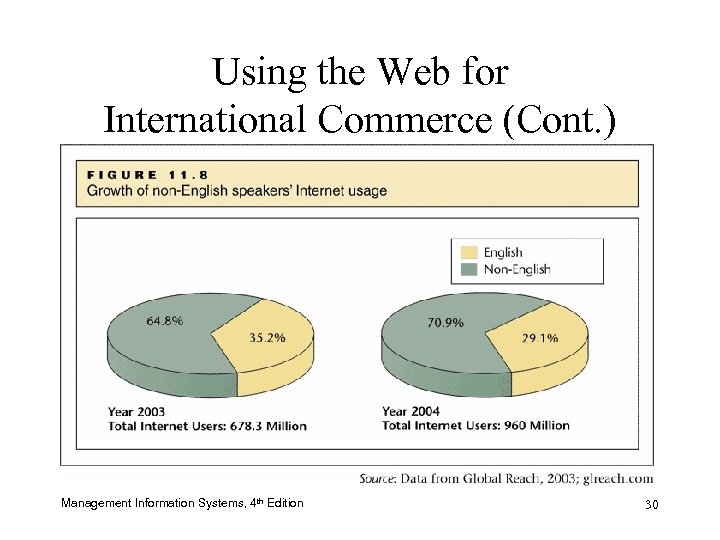
Using the Web for International Commerce (Cont. ) Management Information Systems, 4 th Edition 30
International Web Commerce Benefits • Increased revenues – Increased international Web participation – Potential Web participation • Cost savings – Printing and shipping costs – Customer service costs Management Information Systems, 4 th Edition 31
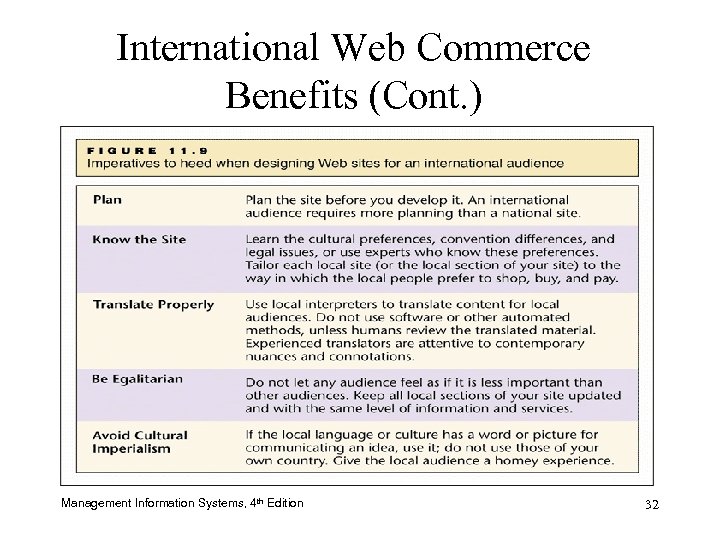
International Web Commerce Benefits (Cont. ) Management Information Systems, 4 th Edition 32
Challenges to Global Information Systems • Technological Challenges – Non-uniform information infrastructures • Regulations and Tariffs – Executives concerned about hassle-factor – Software can reduce confusion • Differences in Payment Mechanisms – Non-uniform preferred payment method Management Information Systems, 4 th Edition 33
Challenges to Global Information Systems (Cont. ) • Language Differences – Translation delays – Laws forbid foreign language accounting and other systems • Cultural Differences – Cultural imperialism Management Information Systems, 4 th Edition 34
Challenges to Global Information Systems (Cont. ) • Conflicting Economic, Scientific, and Security Interests – Government restriction on sharing sensitive information – Varying treatment of trade secrets, patents, and copyrights • Political Challenges – Fear that access to information threatens sovereignty – Government pressure to buy only national software Management Information Systems, 4 th Edition 35
Challenges to Global Information Systems • Different Standards – Varying standards for date format, measurements, etc. • Legal Barriers – Incompatible data privacy laws in U. S. and Europe Management Information Systems, 4 th Edition 36
Ethical and Societal Issues Legal Jurisdiction in Cyberspace • Global Free Speech – More than one law may govern a business practice or communication of ideas – No longer is the legal environment confined to national boundaries • Consumer Protection by Whom? • Two Approaches to Jurisdiction Management Information Systems, 4 th Edition 37
Summary • Markets can be viewed as either vertical or horizontal, or both • There are differences between traditional and Web -based EDI • Supply chain management systems have various benefits • Global information systems play an important role in business Management Information Systems, 4 th Edition 38
Скачать презентацию Chapter 11 Supply Chain Management and Global Information
a8a5f68f20ba88763eca69d93dc96851.ppt