


 Скачать презентацию Chapter 11 Stockholders Equity Using Financial Accounting Information
1359ae092eabb72096d0cf34683f34de.ppt
- Количество слайдов: 52
 Chapter 11 Stockholders’ Equity Using Financial Accounting Information: The Alternative to Debits and Credits, 6 th by Gary A. Porter and Curtis L. Norton Copyright © 2009 South-Western, a part of Cengage Learning
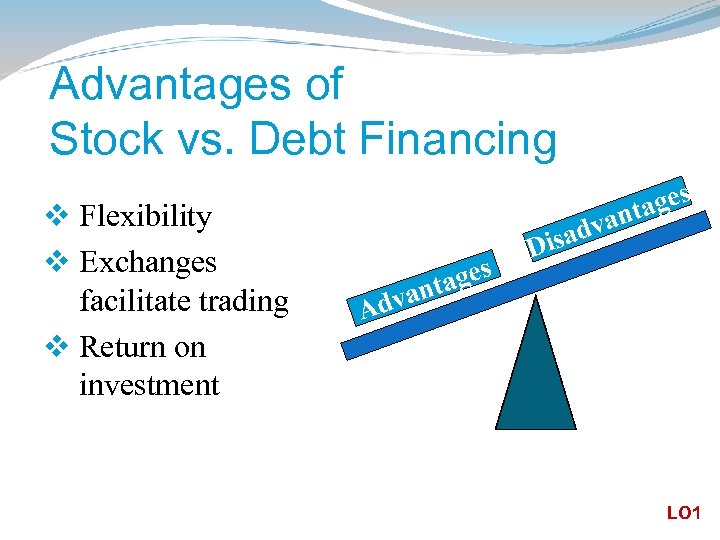 Advantages of Stock vs. Debt Financing v Flexibility v Exchanges facilitate trading v Return on investment ges nta ages ant dva isa D Adv LO 1
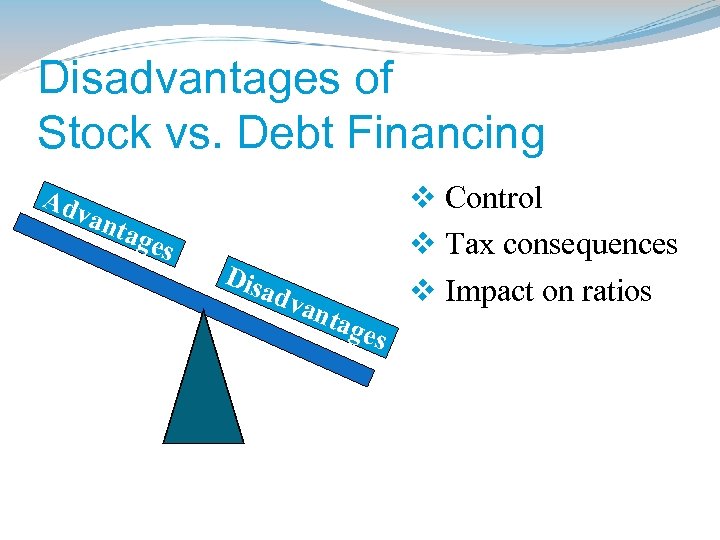 Disadvantages of Stock vs. Debt Financing Adv a v Control v Tax consequences v Impact on ratios nta ges Dis adv ant age s
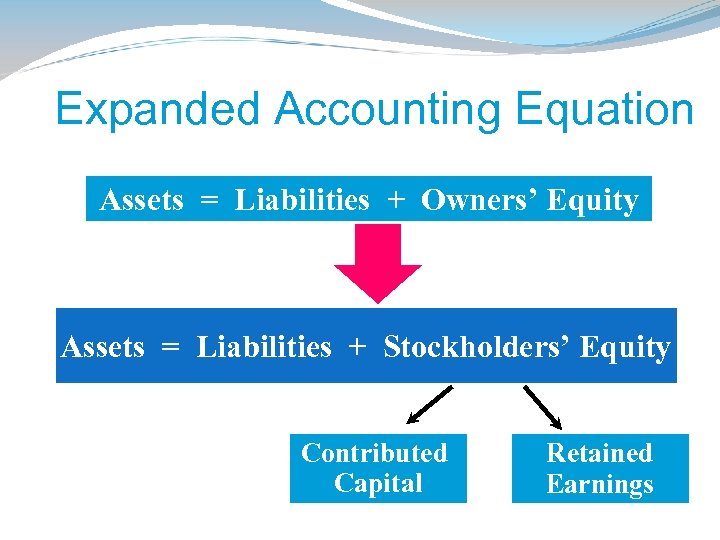 Expanded Accounting Equation Assets = Liabilities + Owners’ Equity Assets = Liabilities + Stockholders’ Equity Contributed Capital Retained Earnings
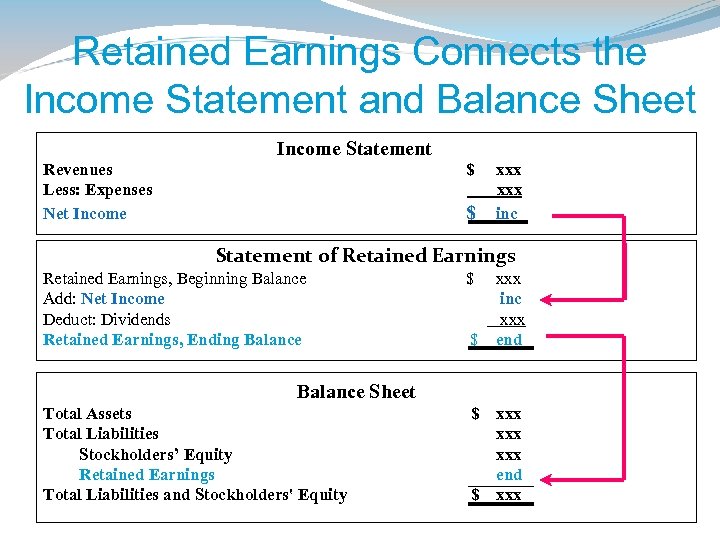 Retained Earnings Connects the Income Statement and Balance Sheet Income Statement Revenues Less: Expenses Net Income $ $ xxx inc Statement of Retained Earnings, Beginning Balance Add: Net Income Deduct: Dividends Retained Earnings, Ending Balance $ $ xxx inc xxx end Balance Sheet Total Assets Total Liabilities Stockholders’ Equity Retained Earnings Total Liabilities and Stockholders' Equity $ $ xxx xxx end xxx
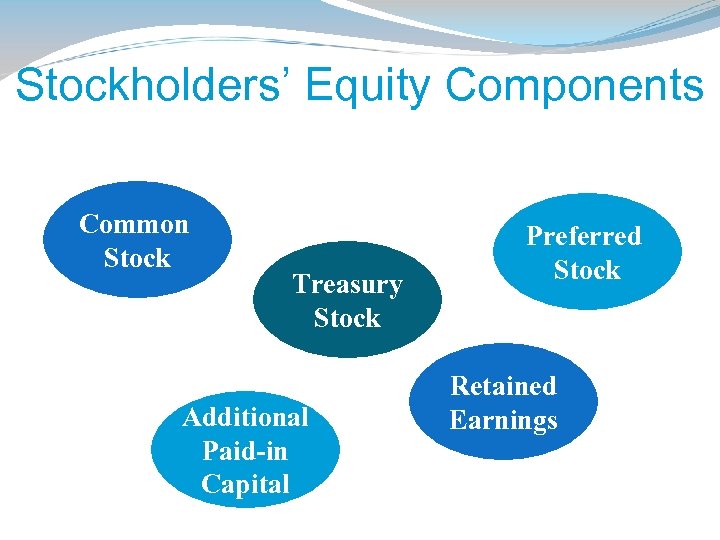 Stockholders’ Equity Components Common Stock Treasury Stock Additional Paid-in Capital Preferred Stock Retained Earnings
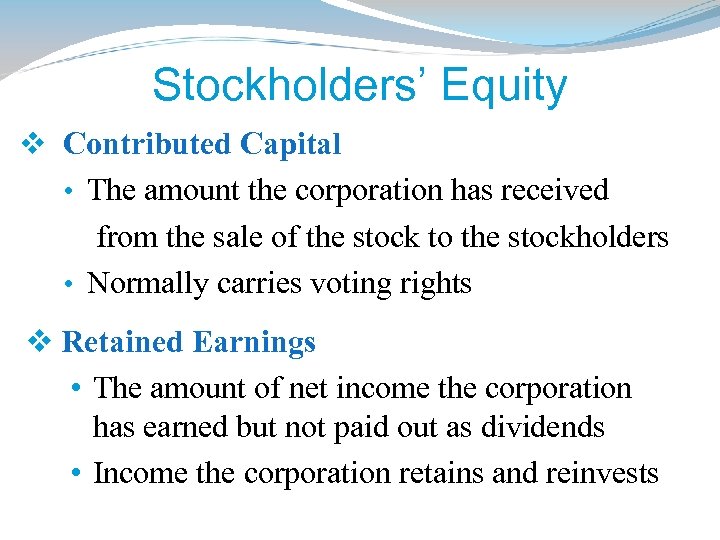 Stockholders’ Equity v Contributed Capital • The amount the corporation has received from the sale of the stock to the stockholders • Normally carries voting rights v Retained Earnings • The amount of net income the corporation has earned but not paid out as dividends • Income the corporation retains and reinvests
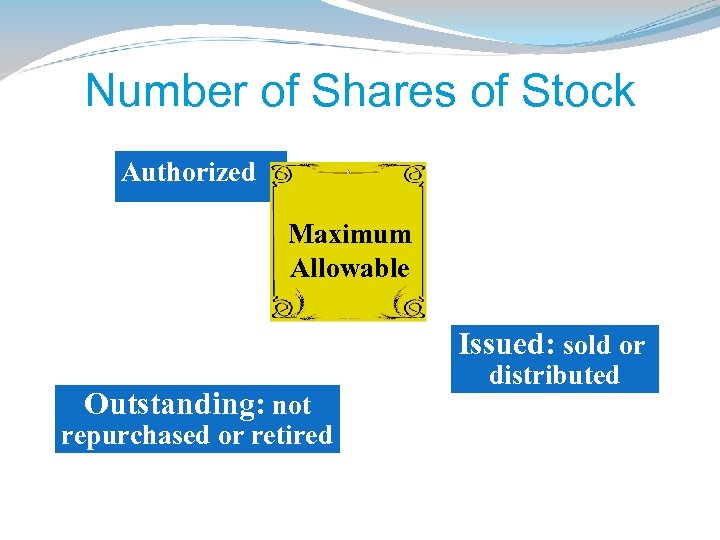 Number of Shares of Stock Authorized Maximum Allowable Issued: sold or Outstanding: not repurchased or retired distributed
 Par Value v “Legal capital” v Arbitrary amount stated on stock certificate v Also called “stated value”
 Additional Paid-in Capital v Amount received in excess of par when stock was originally issued
 Retained Earnings v Net income retained in the business (not paid out as dividends) since its inception v Reinvested in a variety of assets (not necessarily liquid or cash)
 Preferred Stock v Can tailor to specific needs of firm v Stated dividend rate • Percentage of the stock’s par value • Per-share amount v Often carries dividend preference over common stock LO 2
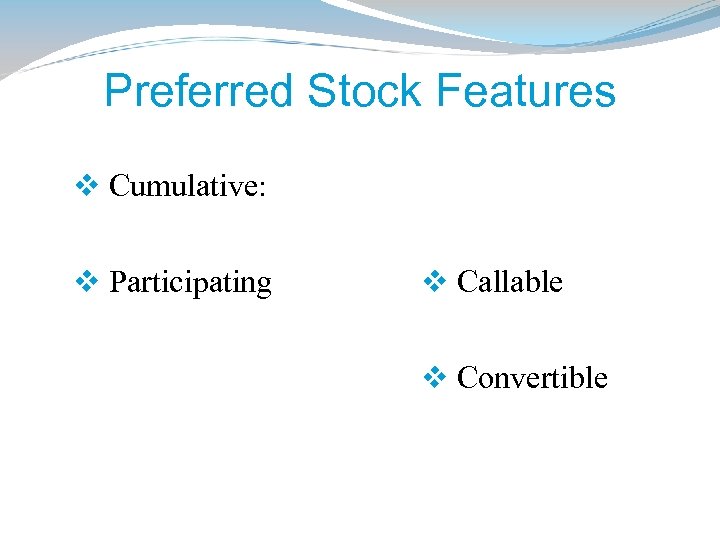 Preferred Stock Features v Cumulative: v Participating v Callable v Convertible
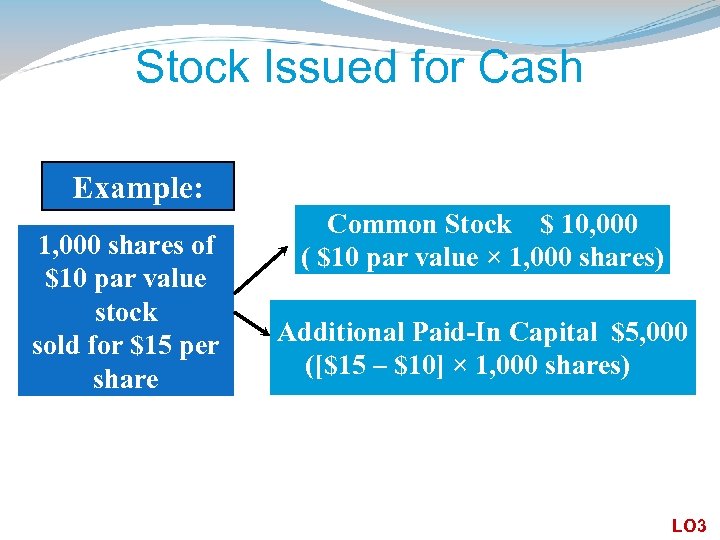 Stock Issued for Cash Example: 1, 000 shares of $10 par value stock sold for $15 per share Common Stock $ 10, 000 ( $10 par value × 1, 000 shares) Additional Paid-In Capital $5, 000 ([$15 – $10] × 1, 000 shares) LO 3
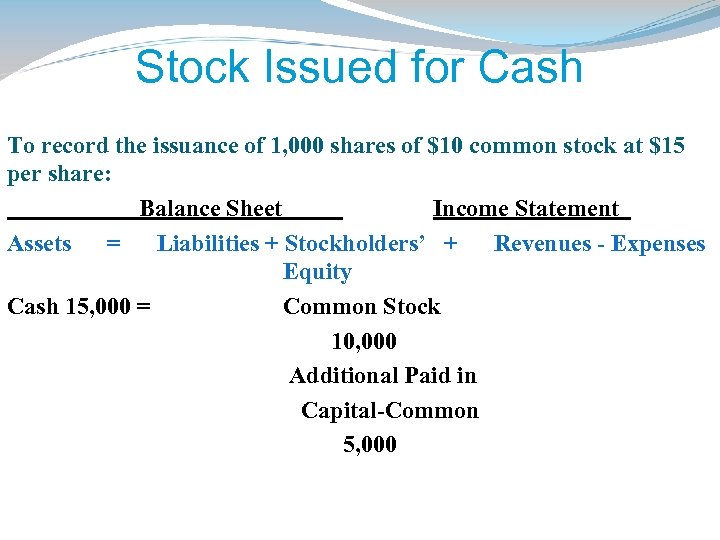 Stock Issued for Cash To record the issuance of 1, 000 shares of $10 common stock at $15 per share: Balance Sheet Income Statement Assets = Liabilities + Stockholders’ + Revenues - Expenses Equity Cash 15, 000 = Common Stock 10, 000 Additional Paid in Capital-Common 5, 000
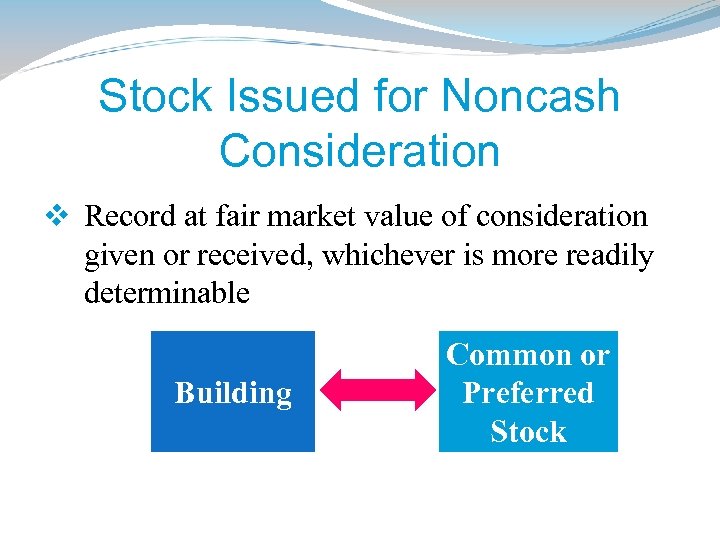 Stock Issued for Noncash Consideration v Record at fair market value of consideration given or received, whichever is more readily determinable Building Common or Preferred Stock
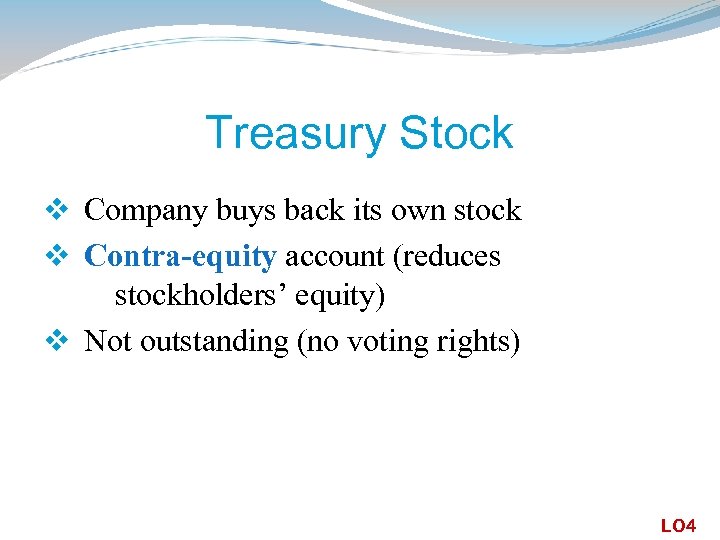 Treasury Stock v Company buys back its own stock v Contra-equity account (reduces stockholders’ equity) v Not outstanding (no voting rights) LO 4
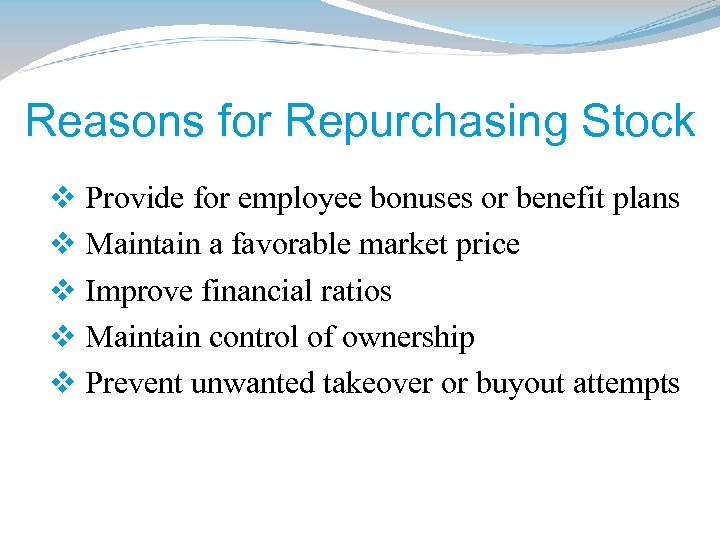 Reasons for Repurchasing Stock v Provide for employee bonuses or benefit plans v Maintain a favorable market price v Improve financial ratios v Maintain control of ownership v Prevent unwanted takeover or buyout attempts
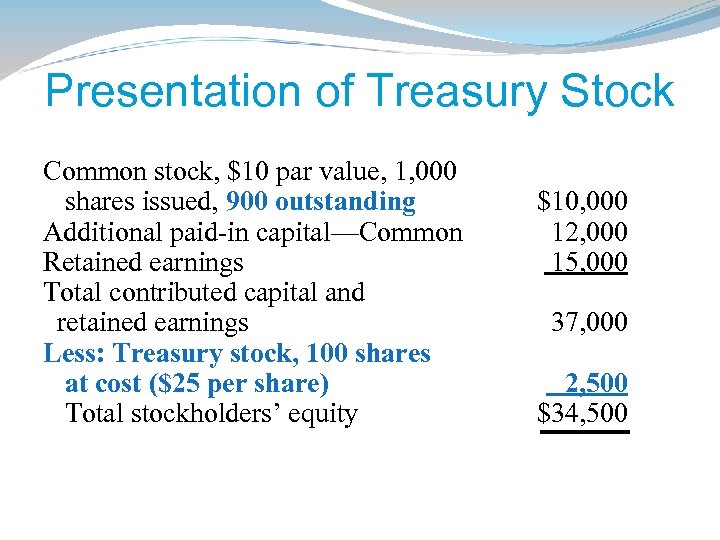 Presentation of Treasury Stock Common stock, $10 par value, 1, 000 shares issued, 900 outstanding Additional paid-in capital—Common Retained earnings Total contributed capital and retained earnings Less: Treasury stock, 100 shares at cost ($25 per share) Total stockholders’ equity $10, 000 12, 000 15, 000 37, 000 2, 500 $34, 500
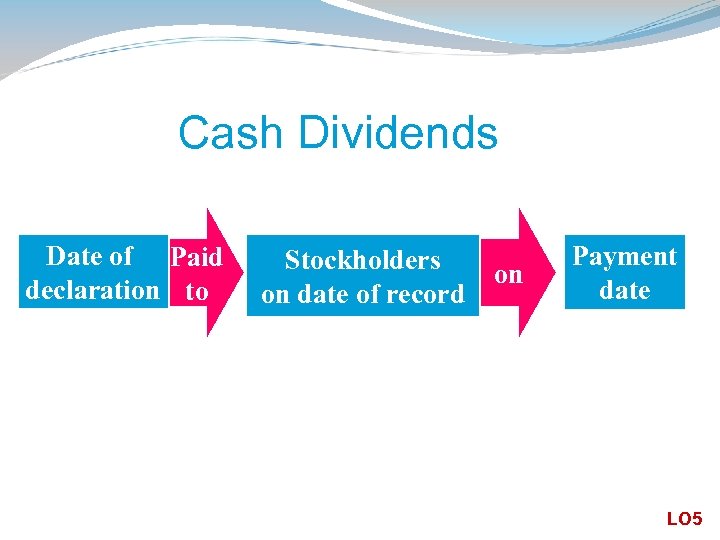 Cash Dividends Date of Paid declaration to Stockholders on date of record on Payment date LO 5
 Dividend Requirements v Sufficient cash v Positive retained earnings
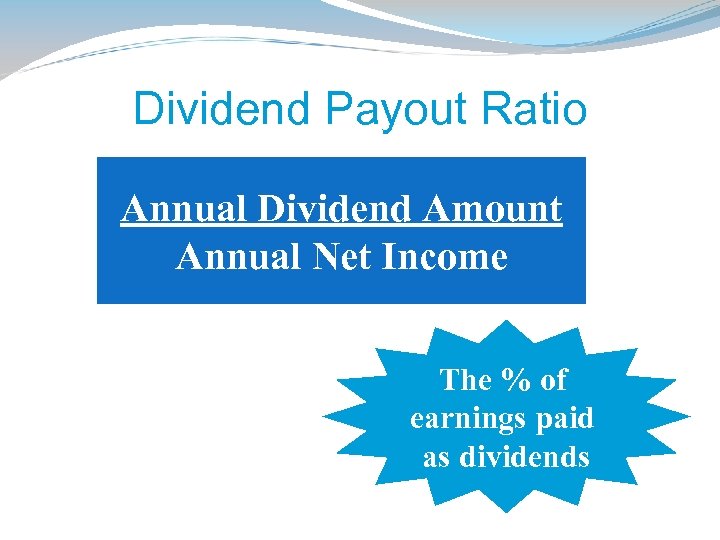 Dividend Payout Ratio Annual Dividend Amount Annual Net Income The % of earnings paid as dividends
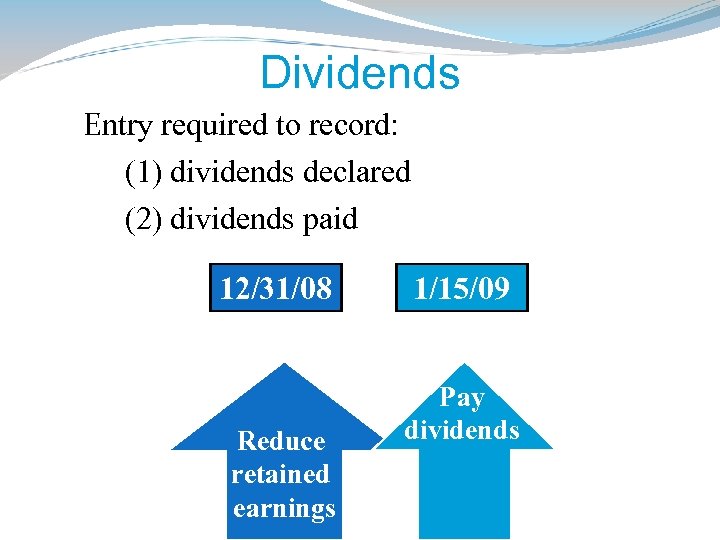 Dividends Entry required to record: (1) dividends declared (2) dividends paid 12/31/08 Reduce retained earnings 1/15/09 Pay dividends
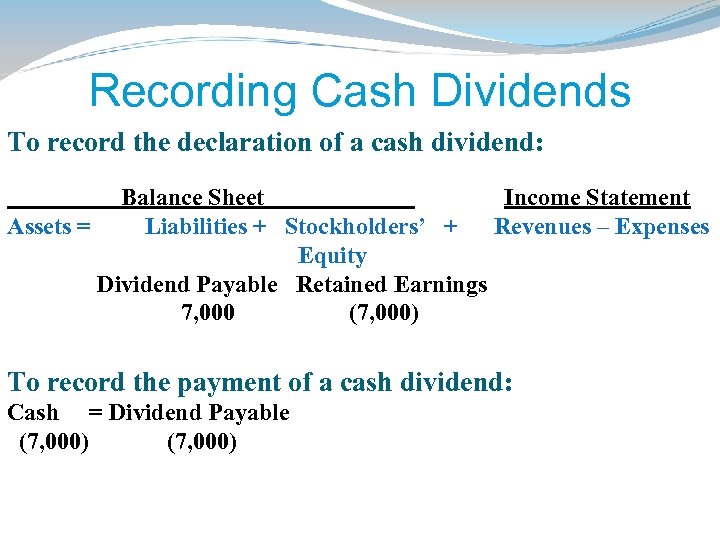 Recording Cash Dividends To record the declaration of a cash dividend: Balance Sheet Income Statement Assets = Liabilities + Stockholders’ + Revenues – Expenses Equity Dividend Payable Retained Earnings 7, 000 (7, 000) To record the payment of a cash dividend: Cash = Dividend Payable (7, 000)
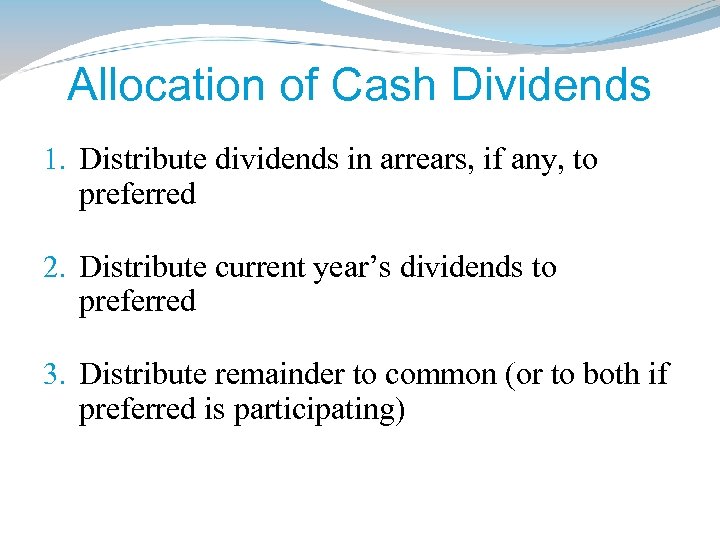 Allocation of Cash Dividends 1. Distribute dividends in arrears, if any, to preferred 2. Distribute current year’s dividends to preferred 3. Distribute remainder to common (or to both if preferred is participating)
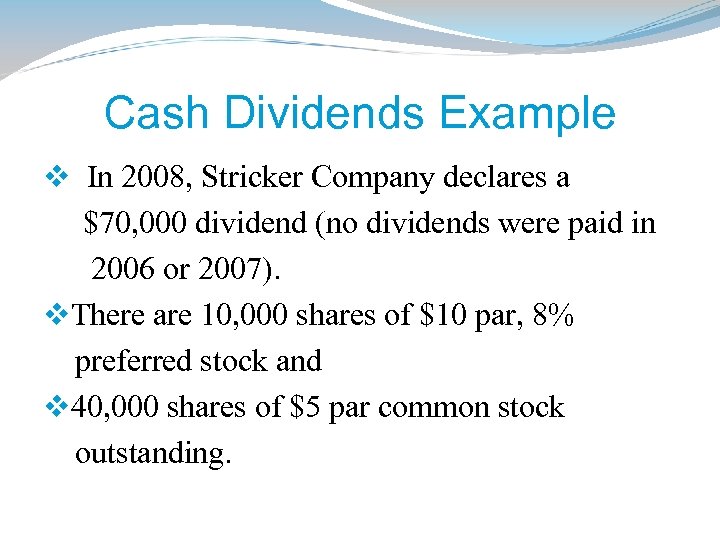 Cash Dividends Example v In 2008, Stricker Company declares a $70, 000 dividend (no dividends were paid in 2006 or 2007). v. There are 10, 000 shares of $10 par, 8% preferred stock and v 40, 000 shares of $5 par common stock outstanding.
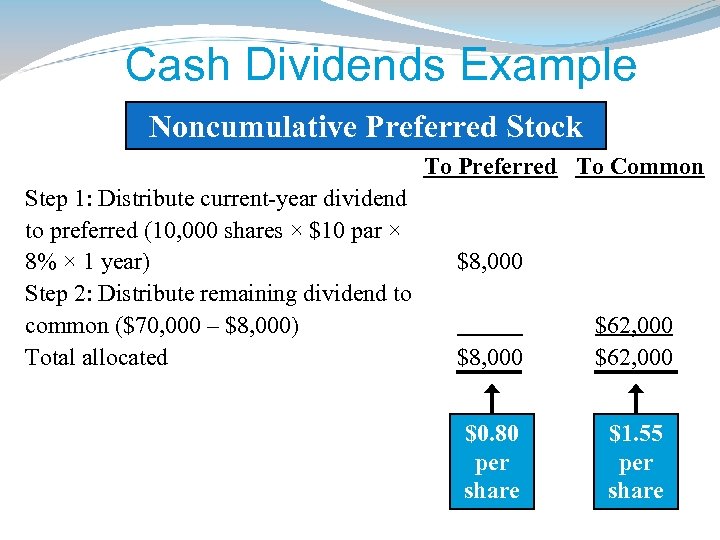 Cash Dividends Example Noncumulative Preferred Stock To Preferred To Common Step 1: Distribute current-year dividend to preferred (10, 000 shares × $10 par × 8% × 1 year) Step 2: Distribute remaining dividend to common ($70, 000 – $8, 000) Total allocated $8, 000 $62, 000 $0. 80 per share $1. 55 per share
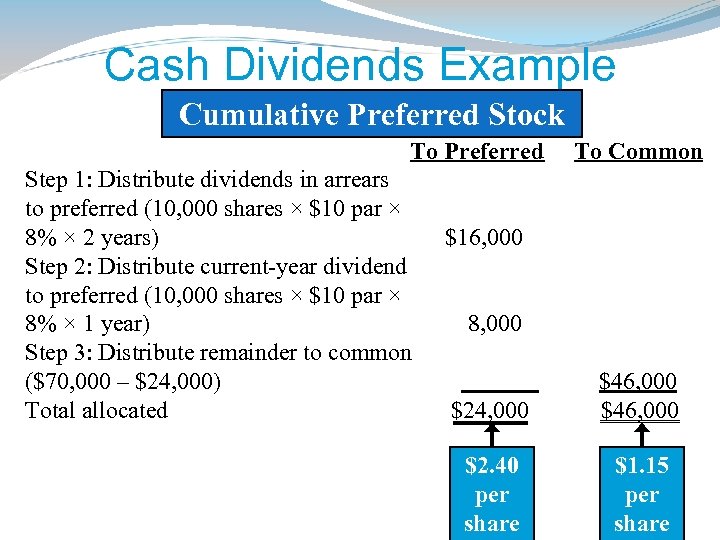 Cash Dividends Example Cumulative Preferred Stock To Preferred Step 1: Distribute dividends in arrears to preferred (10, 000 shares × $10 par × 8% × 2 years) Step 2: Distribute current-year dividend to preferred (10, 000 shares × $10 par × 8% × 1 year) Step 3: Distribute remainder to common ($70, 000 – $24, 000) Total allocated To Common $16, 000 8, 000 $24, 000 $46, 000 $2. 40 per share $1. 15 per share
 Stock Dividends v Issue of additional shares proportionately to existing stockholders v Reasons: • Insufficient cash • Market price reduction • Nontaxable to recipients LO 6
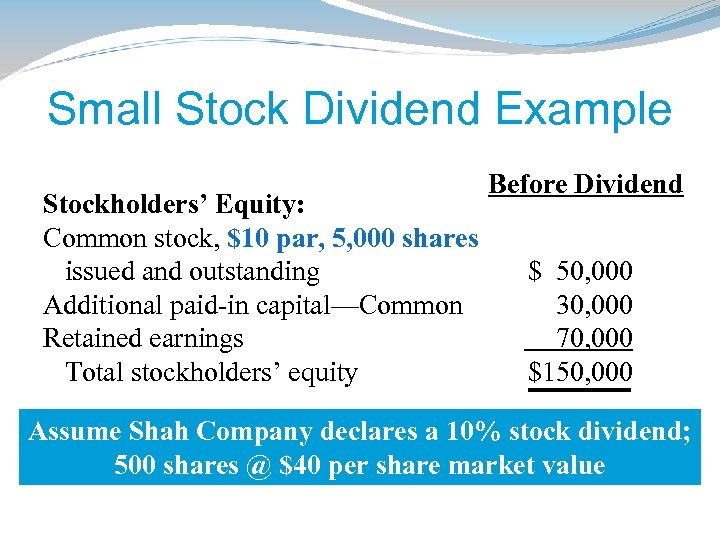 Small Stock Dividend Example Stockholders’ Equity: Common stock, $10 par, 5, 000 shares issued and outstanding Additional paid-in capital—Common Retained earnings Total stockholders’ equity Before Dividend $ 50, 000 30, 000 70, 000 $150, 000 Assume Shah Company declares a 10% stock dividend; 500 shares @ $40 per share market value
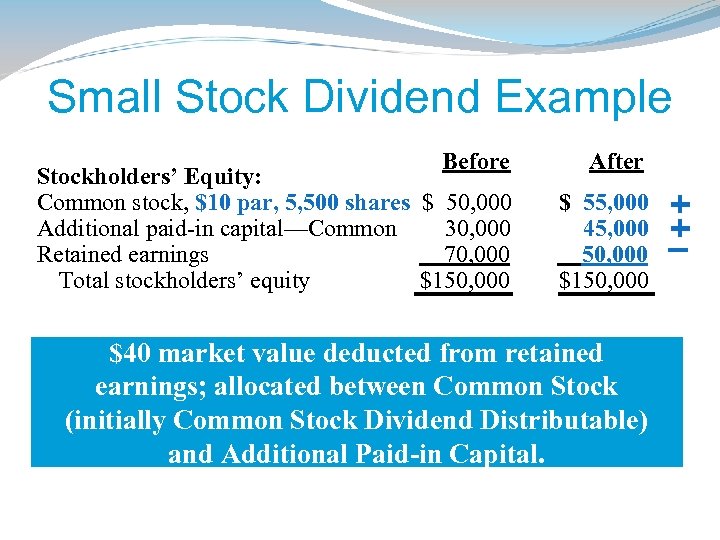 Small Stock Dividend Example Before Stockholders’ Equity: Common stock, $10 par, 5, 500 shares $ 50, 000 Additional paid-in capital—Common 30, 000 Retained earnings 70, 000 Total stockholders’ equity $150, 000 After $ 55, 000 45, 000 50, 000 $150, 000 $40 market value deducted from retained earnings; allocated between Common Stock (initially Common Stock Dividend Distributable) and Additional Paid-in Capital. + + –
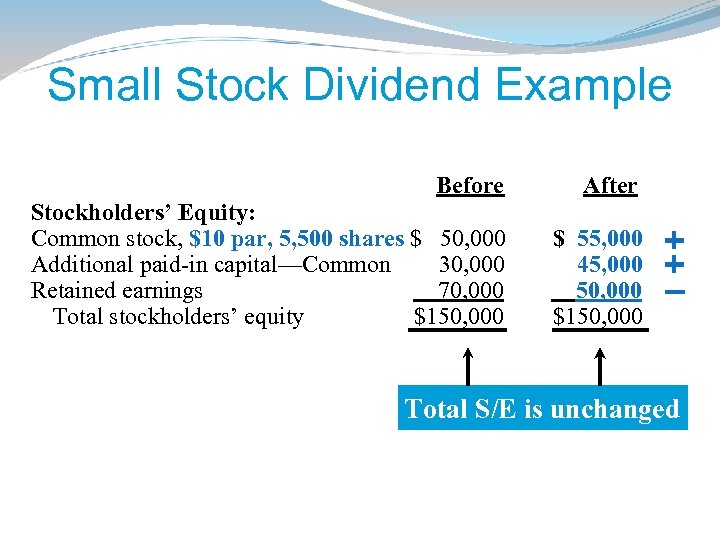 Small Stock Dividend Example Before After Stockholders’ Equity: Common stock, $10 par, 5, 500 shares $ 50, 000 Additional paid-in capital—Common 30, 000 Retained earnings 70, 000 Total stockholders’ equity $150, 000 $ 55, 000 45, 000 50, 000 $150, 000 + + – Total S/E is unchanged
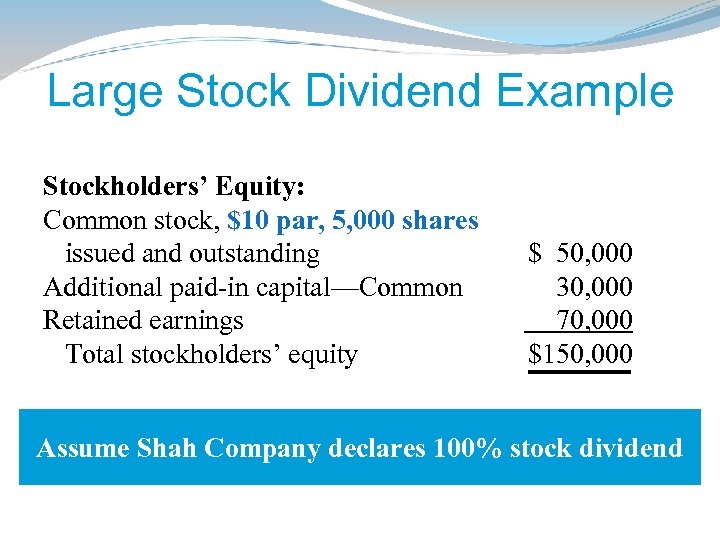 Large Stock Dividend Example Before Dividend Stockholders’ Equity: Common stock, $10 par, 5, 000 shares issued and outstanding $ 50, 000 Additional paid-in capital—Common 30, 000 Retained earnings 70, 000 Total stockholders’ equity $150, 000 Assume Shah Company declares 100% stock dividend
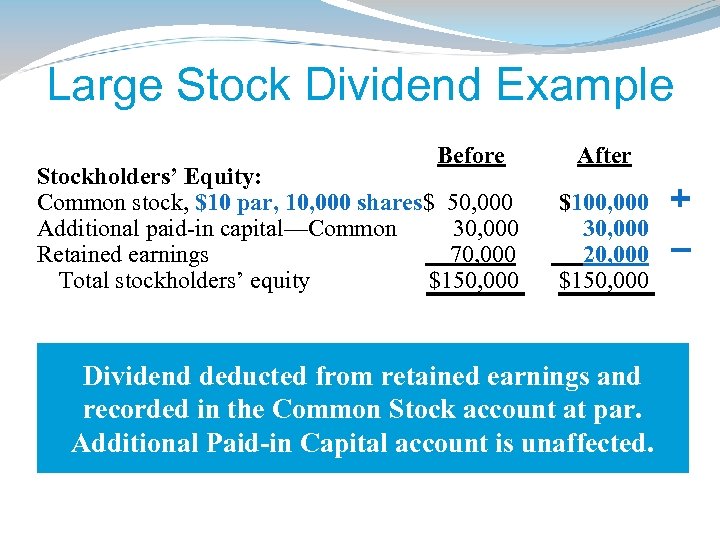 Large Stock Dividend Example Before Stockholders’ Equity: Common stock, $10 par, 10, 000 shares$ 50, 000 Additional paid-in capital—Common 30, 000 Retained earnings 70, 000 Total stockholders’ equity $150, 000 After $100, 000 30, 000 20, 000 $150, 000 Dividend deducted from retained earnings and recorded in the Common Stock account at par. Additional Paid-in Capital account is unaffected. + –
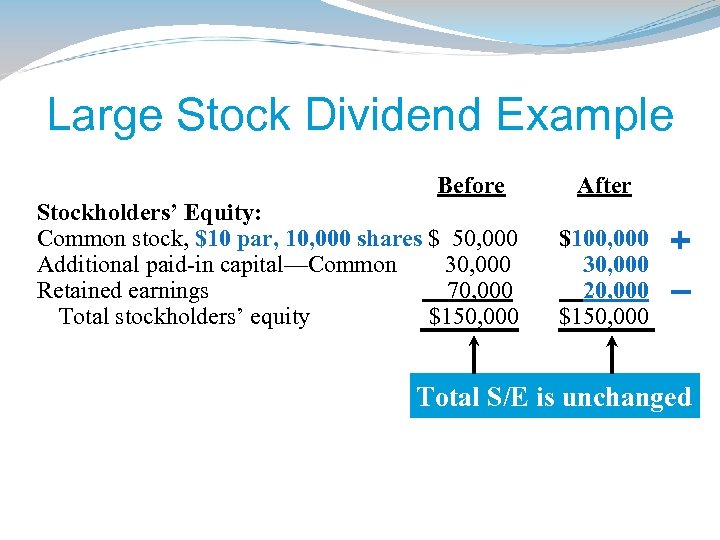 Large Stock Dividend Example Before Stockholders’ Equity: Common stock, $10 par, 10, 000 shares $ 50, 000 Additional paid-in capital—Common 30, 000 Retained earnings 70, 000 Total stockholders’ equity $150, 000 After $100, 000 30, 000 20, 000 $150, 000 + – Total S/E is unchanged
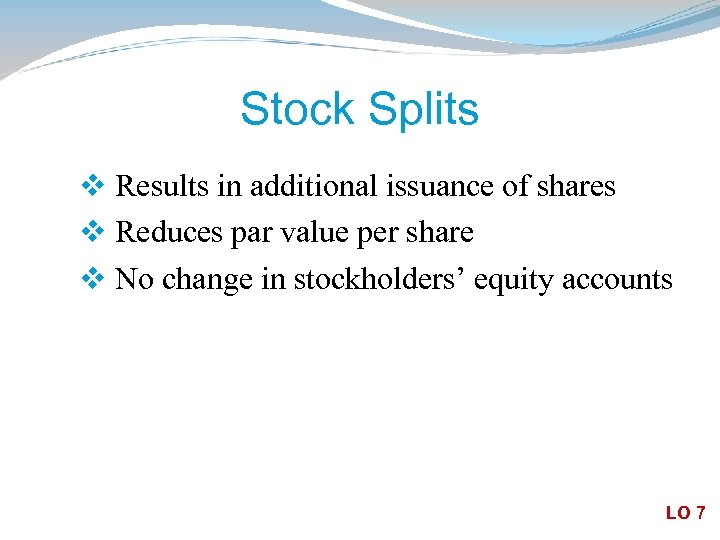 Stock Splits v Results in additional issuance of shares v Reduces par value per share v No change in stockholders’ equity accounts LO 7
 Stock Splits v Not recorded in accounts v Reduce market price per share and make the stock more accessible to a wider range of investors v Disclosed in notes
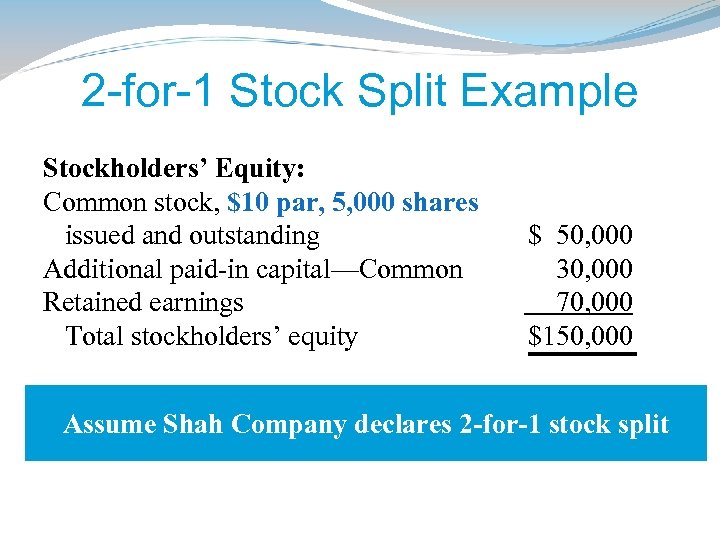 2 -for-1 Stock Split Example Stockholders’ Equity: Before Split Common stock, $10 par, 5, 000 shares issued and outstanding $ 50, 000 Additional paid-in capital—Common 30, 000 Retained earnings 70, 000 Total stockholders’ equity $150, 000 Assume Shah Company declares 2 -for-1 stock split
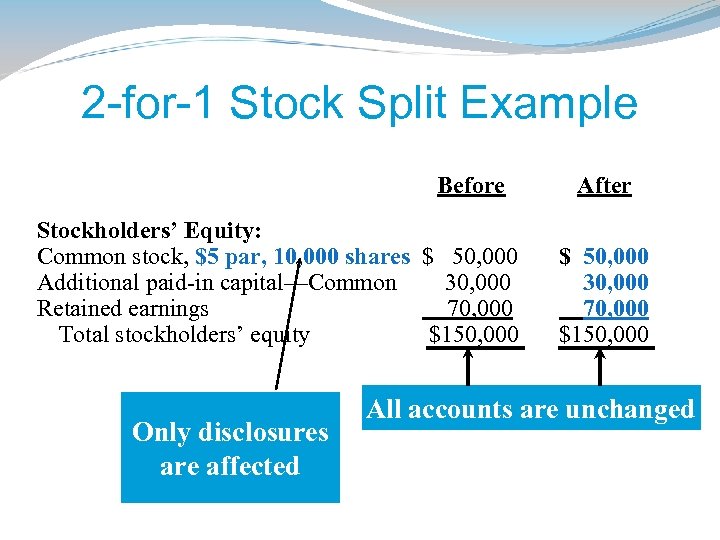 2 -for-1 Stock Split Example Before Stockholders’ Equity: Common stock, $5 par, 10, 000 shares $ 50, 000 Additional paid-in capital—Common 30, 000 Retained earnings 70, 000 Total stockholders’ equity $150, 000 Only disclosures are affected After $ 50, 000 30, 000 70, 000 $150, 000 All accounts are unchanged
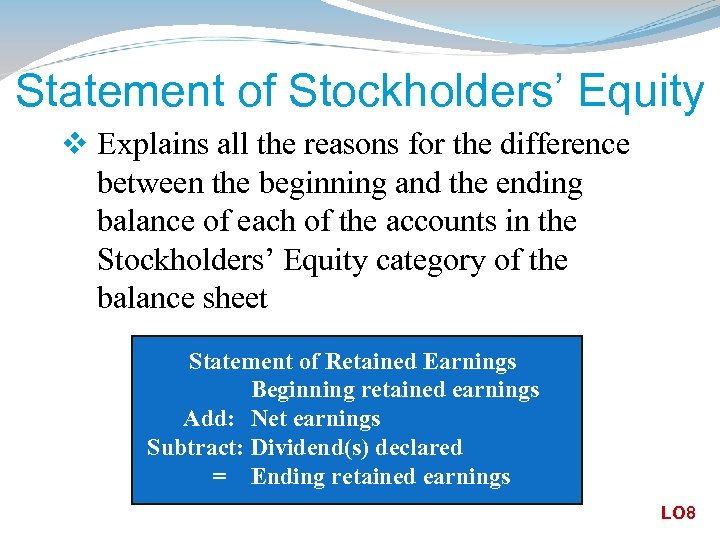 Statement of Stockholders’ Equity v Explains all the reasons for the difference between the beginning and the ending balance of each of the accounts in the Stockholders’ Equity category of the balance sheet Statement of Retained Earnings Beginning retained earnings Add: Net earnings Subtract: Dividend(s) declared = Ending retained earnings LO 8
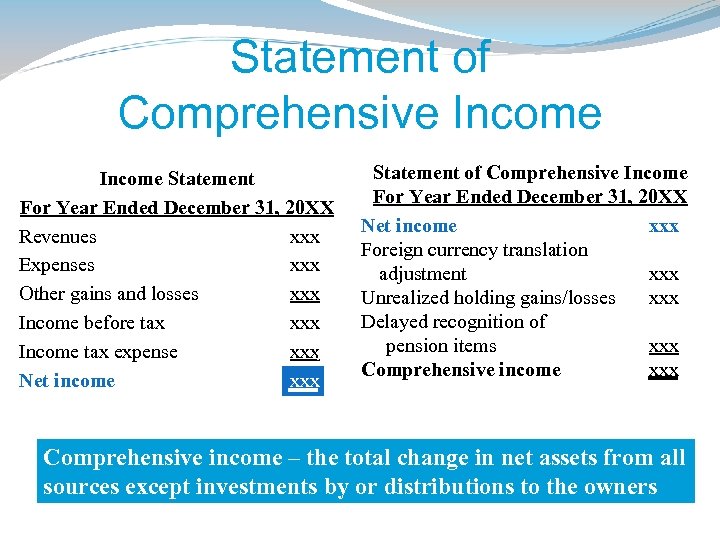 Statement of Comprehensive Income Statement For Year Ended December 31, 20 XX Revenues xxx Expenses xxx Other gains and losses xxx Income before tax xxx Income tax expense xxx Net income xxx Statement of Comprehensive Income For Year Ended December 31, 20 XX Net income xxx Foreign currency translation adjustment xxx Unrealized holding gains/losses xxx Delayed recognition of pension items xxx Comprehensive income – the total change in net assets from all sources except investments by or distributions to the owners
 Analyzing Owners’ Equity v Book value per share • Rights that each share of common stock has to the net assets of corporation v Market value per share • Price at which stock is currently selling LO 9
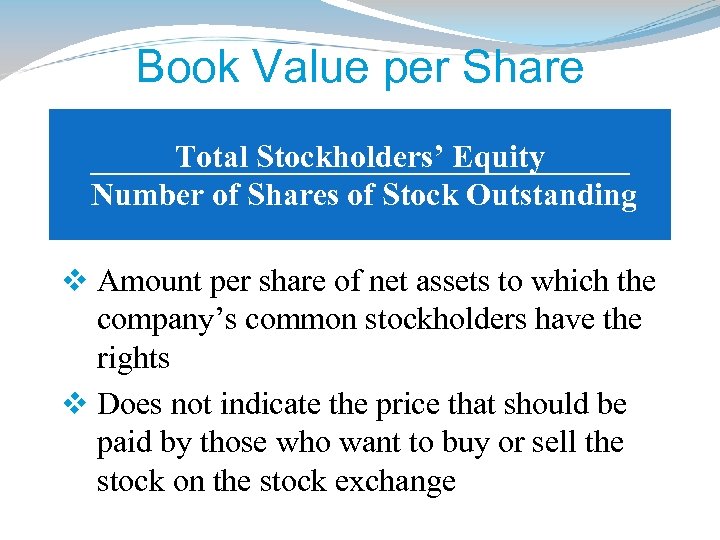 Book Value per Share Total Stockholders’ Equity Number of Shares of Stock Outstanding v Amount per share of net assets to which the company’s common stockholders have the rights v Does not indicate the price that should be paid by those who want to buy or sell the stock on the stock exchange
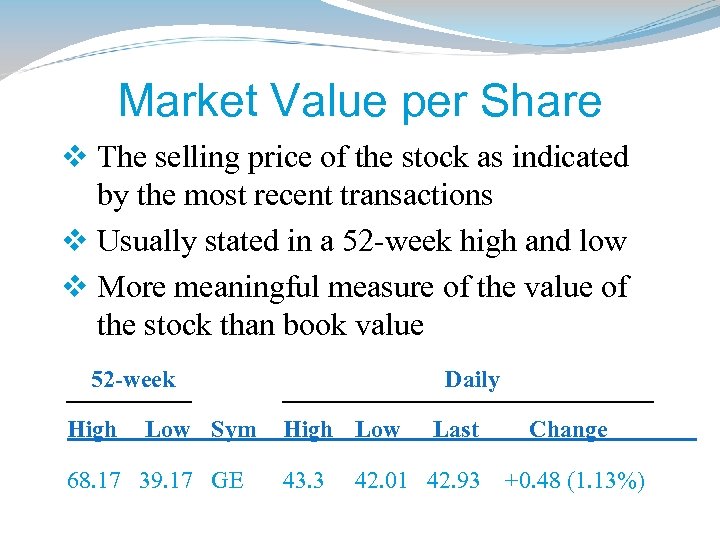 Market Value per Share v The selling price of the stock as indicated by the most recent transactions v Usually stated in a 52 -week high and low v More meaningful measure of the value of the stock than book value 52 -week High Low Sym 68. 17 39. 17 GE Daily High Low 43. 3 Last 42. 01 42. 93 Change +0. 48 (1. 13%)
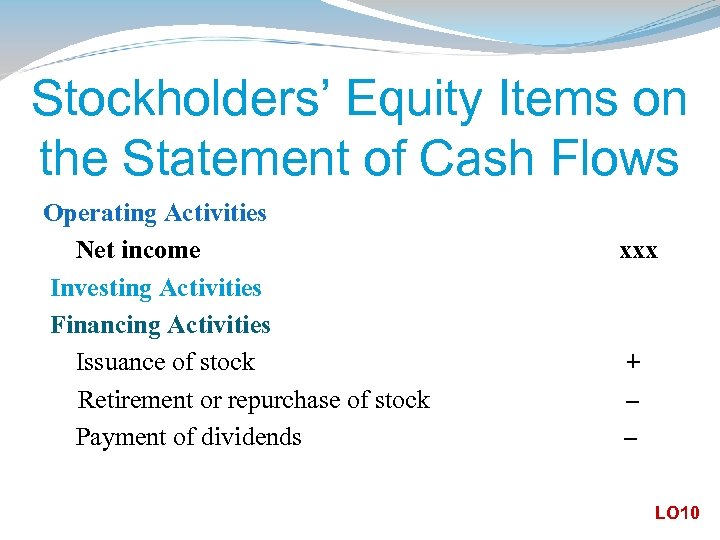 Stockholders’ Equity Items on the Statement of Cash Flows Operating Activities Net income Investing Activities Financing Activities Issuance of stock Retirement or repurchase of stock Payment of dividends xxx + – – LO 10
 Appendix Accounting Tools: Unincorporated Businesses
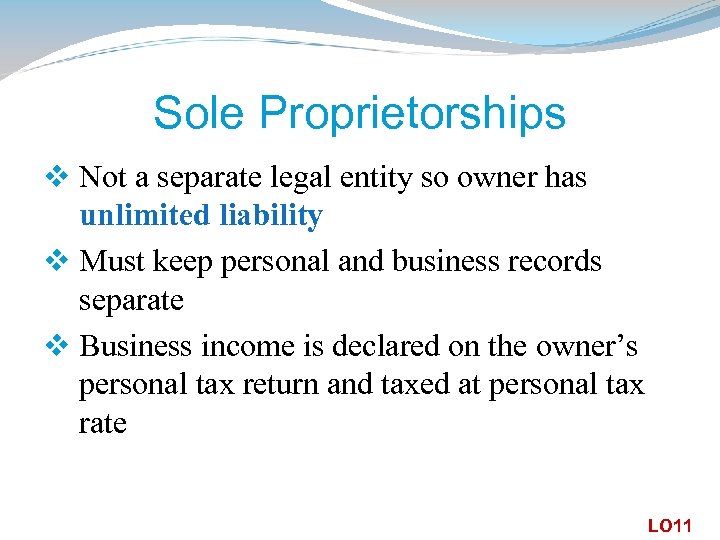 Sole Proprietorships v Not a separate legal entity so owner has unlimited liability v Must keep personal and business records separate v Business income is declared on the owner’s personal tax return and taxed at personal tax rate LO 11
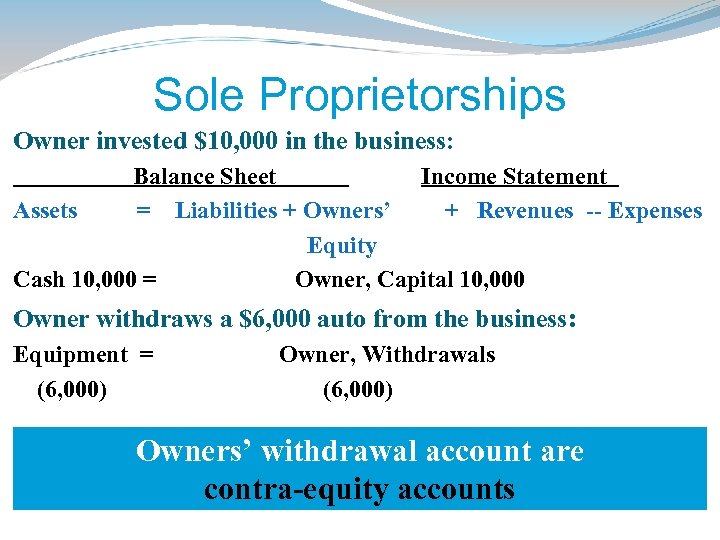 Sole Proprietorships Owner invested $10, 000 in the business: Balance Sheet Income Statement Assets = Liabilities + Owners’ + Revenues -- Expenses Equity Cash 10, 000 = Owner, Capital 10, 000 Owner withdraws a $6, 000 auto from the business: Equipment = (6, 000) Owner, Withdrawals (6, 000) Owners’ withdrawal account are contra-equity accounts
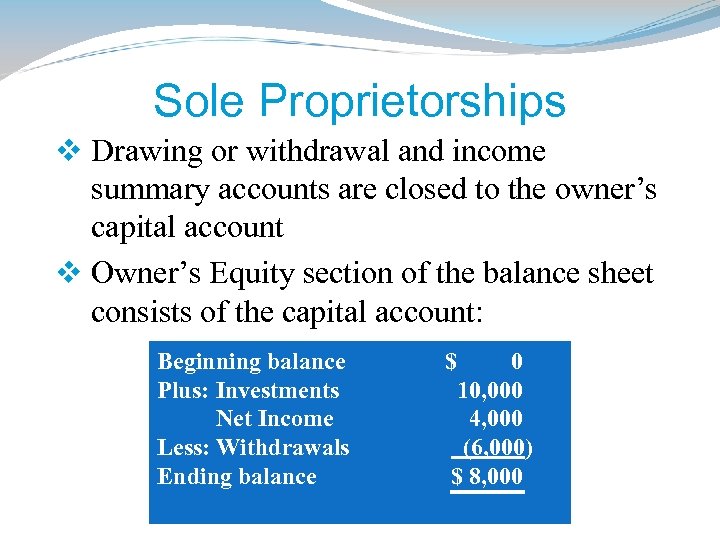 Sole Proprietorships v Drawing or withdrawal and income summary accounts are closed to the owner’s capital account v Owner’s Equity section of the balance sheet consists of the capital account: Beginning balance Plus: Investments Net Income Less: Withdrawals Ending balance $ 0 10, 000 4, 000 (6, 000) $ 8, 000
 Partnerships v Unlimited liability v Limited life – partnership agreements can and do end v Not taxed as a separate entity
 Partnerships Distribution of income: v Equal distribution v Stated ratio v Other allocation • For example, based on salaries, interest on invested capital, and a stated ratio
 End of Chapter 11