 Скачать презентацию Chapter 11 Pricing Decisions Power Point By Kristopher
8be830e1e5fe679dcbd6811e84bdaf4f.ppt
- Количество слайдов: 34



Chapter 11 Pricing Decisions Power Point By Kristopher Blanchard North Central University © 2005 Prentice Hall 11 -1
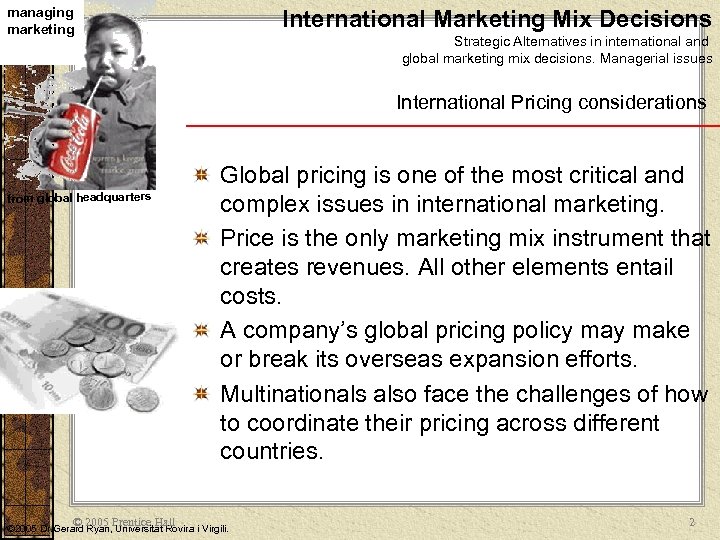
managing marketing International Marketing Mix Decisions Strategic Alternatives in international and global marketing mix decisions. Managerial issues International Pricing considerations from global headquarters © 2005 Prentice Hall Global pricing is one of the most critical and complex issues in international marketing. Price is the only marketing mix instrument that creates revenues. All other elements entail costs. A company’s global pricing policy make or break its overseas expansion efforts. Multinationals also face the challenges of how to coordinate their pricing across different countries. © 2005 Dr. Gerard Ryan, Universitat Rovira i Virgili. 2
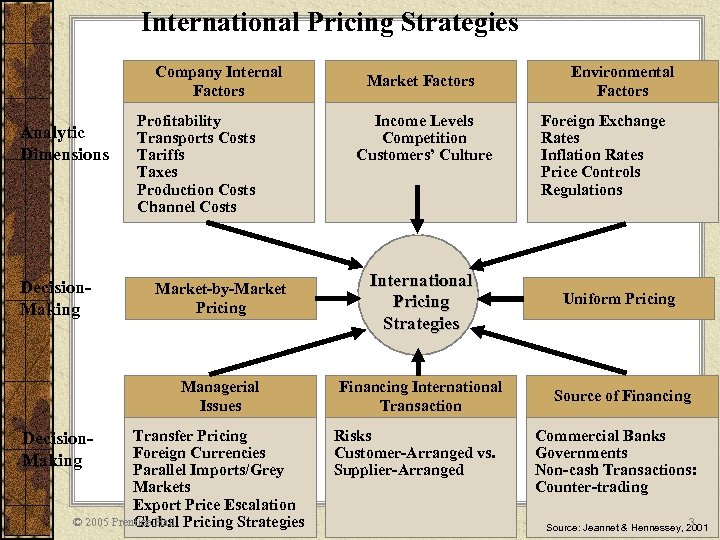
International Pricing Strategies Company Internal Factors Analytic Dimensions Profitability Transports Costs Tariffs Taxes Production Costs Channel Costs Market Factors Income Levels Competition Customers’ Culture Environmental Factors Foreign Exchange Rates Inflation Rates Price Controls Regulations Market-by-Market Pricing International Pricing Strategies Uniform Pricing Managerial Issues Decision. Making Financing International Transaction Source of Financing Transfer Pricing Foreign Currencies Parallel Imports/Grey Markets Export Price Escalation © 2005 Prentice Hall Pricing Strategies Global Decision. Making Risks Customer-Arranged vs. Supplier-Arranged Commercial Banks Governments Non-cash Transactions: Counter-trading 3 Source: Jeannet & Hennessey, 2001
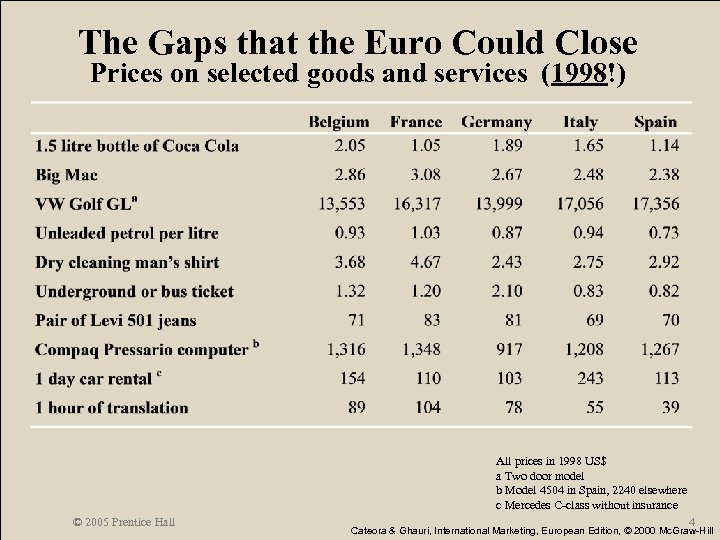
The Gaps that the Euro Could Close Prices on selected goods and services (1998!) All prices in 1998 US$ a Two door model b Model 4504 in Spain, 2240 elsewhere c Mercedes C-class without insurance © 2005 Prentice Hall 4 Cateora & Ghauri, International Marketing, European Edition, © 2000 Mc. Graw-Hill
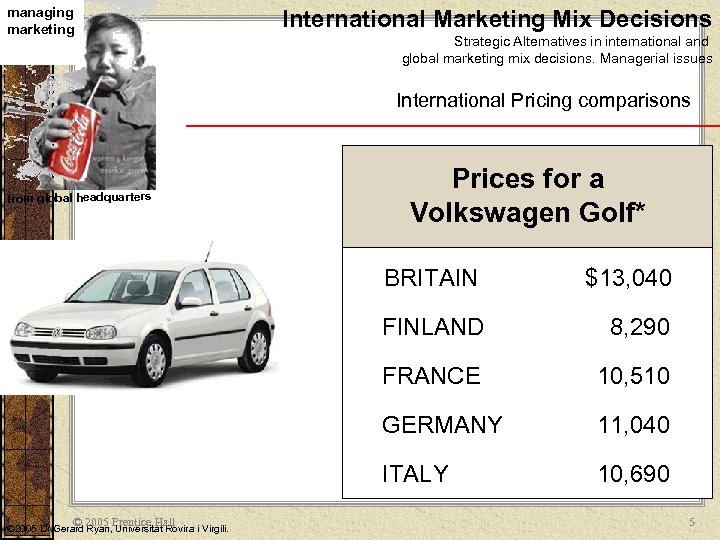
managing marketing International Marketing Mix Decisions Strategic Alternatives in international and global marketing mix decisions. Managerial issues International Pricing comparisons from global headquarters Prices for a Volkswagen Golf* BRITAIN FINLAND 10, 510 GERMANY 11, 040 ITALY © 2005 Prentice Hall 8, 290 FRANCE © 2005 Dr. Gerard Ryan, Universitat Rovira i Virgili. $13, 040 10, 690 5
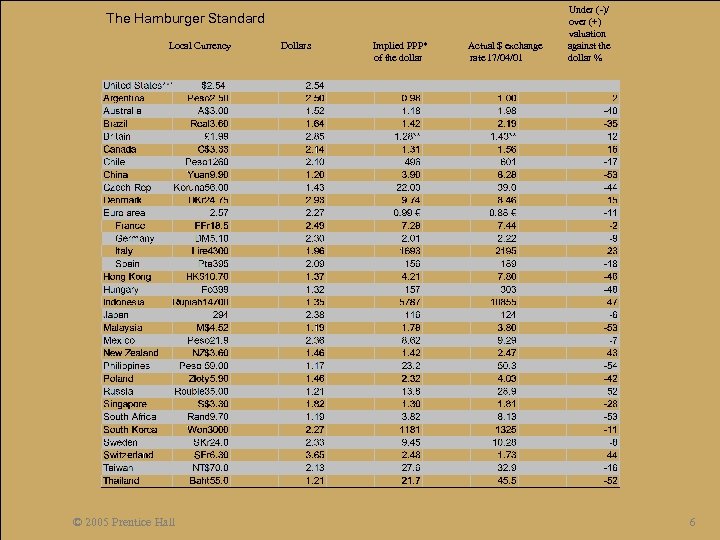
The Hamburger Standard Local Currency © 2005 Prentice Hall Dollars Implied PPP* of the dollar Actual $ exchange rate 17/04/01 Under (-)/ over (+) valuation against the dollar % 6
Basic Pricing Concepts The Global Manager must develop systems and policies that address – Price Floors – Price Ceilings – Optimum Prices Must be consistent with global opportunities and constraints © 2005 Prentice Hall 7
Global Pricing Objectives and Strategies Managers must determine the objectives for the pricing objectives – Unit Sales – Market Share – Return on investment They must then develop strategies to achieve those objectives – Penetration Pricing – Market Skimming © 2005 Prentice Hall 8
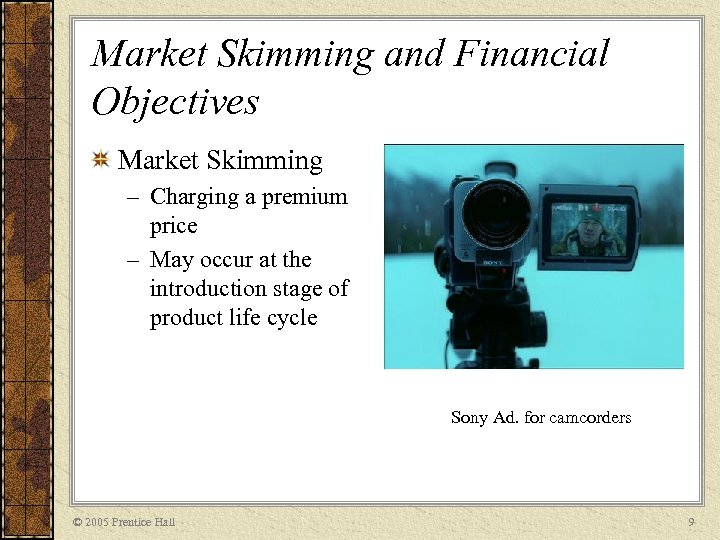
Market Skimming and Financial Objectives Market Skimming – Charging a premium price – May occur at the introduction stage of product life cycle Sony Ad. for camcorders © 2005 Prentice Hall 9
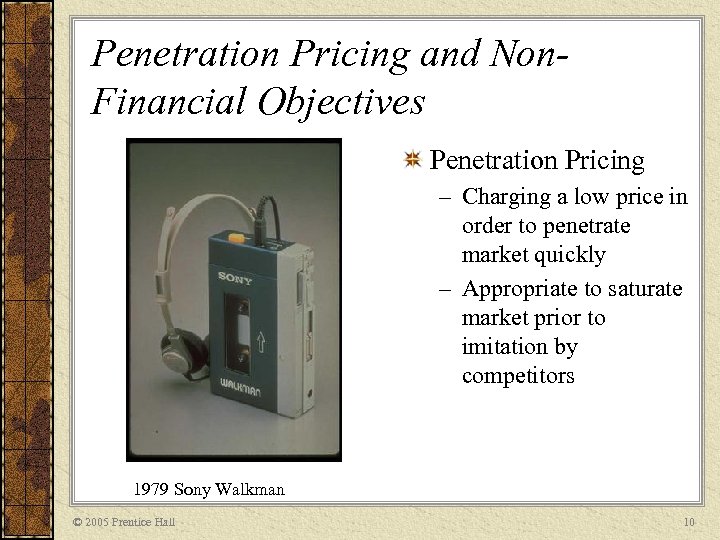
Penetration Pricing and Non. Financial Objectives Penetration Pricing – Charging a low price in order to penetrate market quickly – Appropriate to saturate market prior to imitation by competitors 1979 Sony Walkman © 2005 Prentice Hall 10
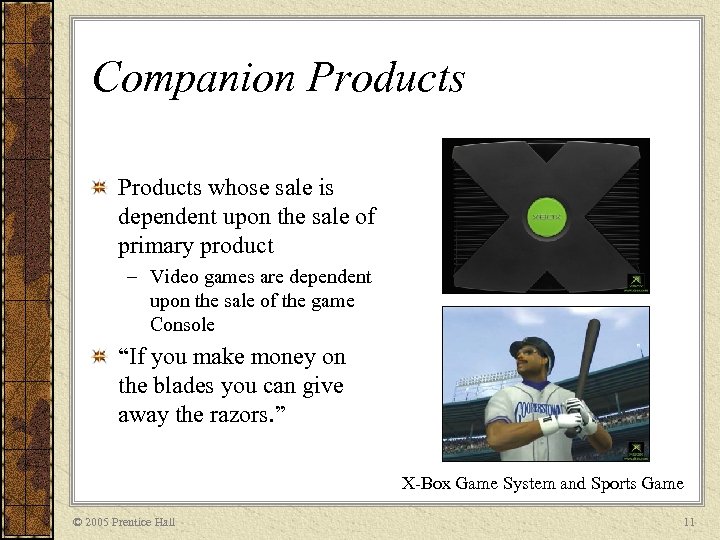
Companion Products whose sale is dependent upon the sale of primary product – Video games are dependent upon the sale of the game Console “If you make money on the blades you can give away the razors. ” X-Box Game System and Sports Game © 2005 Prentice Hall 11
Target Costing – 8 Questions 1. Does the price reflect the product’s quality? 2. Is the price competitive given local market conditions? 3. Should the firm pursue market penetration, market skimming, or some other pricing objective? 4. What type of discount (trade, cash, quantity) and allowance (advertising, trade-off) should the firm offer its international customers? 5. Should prices differ with market segment? 6. What pricing options are available if the firm’s costs increase or decrease? Is demand in the international market elastic or inelastic? 7. Are the firm’s prices likely to be viewed by the hostcountry government as reasonable or exploitative? 8. Do the foreign country’s dumping laws pose a problem? © 2005 Prentice Hall 12
Dumping In international trade, this occurs when one country exports a significant amount of goods to another country at prices much lower than in the domestic market http: //en. wikipedia. org/wiki/Dumping_%28 pricing_policy%29 © 2005 Prentice Hall 13
Target Costing Cost-Based Pricing is based on an analysis of internal and external cost Firms using western cost accounting principles use the Full absorption cost method – Per-unit product costs are the sum of all past or current direct and indirect manufacturing and overhead costs © 2005 Prentice Hall 14
Target Costing Rigid cost-plus pricing means that companies set prices without regard to the eight foundational pricing considerations Flexible cost-plus pricing ensures that prices are competitive in the contest of the particular market environment © 2005 Prentice Hall 15
Terms of the Sale Incoterms make international trade easier and help traders in different countries to understand one another. These standard trade definitions that are most commonly used in international contracts are protected by ICC copyright – Ex-works – seller places goods at the disposal of the buyer at the time specified in the contract; buyer takes delivery at the premises of the seller and bears all risks and expenses from that point on. – Delivery duty paid – seller agrees to deliver the goods to the buyer at the place he or she names in the country of import with all costs, including duties, paid. © 2005 Prentice Hall 17
Environmental Influences on Pricing Decisions Currency Fluctuations Inflationary Environment Government Controls, Subsidies, Regulations Competitive Behavior Sourcing © 2005 Prentice Hall 18
Global Pricing: Three Policy Alternatives Extension Adaptation Geocentric © 2005 Prentice Hall 19
Gray Market Goods Trademarked products are exported from one country to another where they are sold by unauthorized persons or organizations Occurs when product is in short supply, when producers use skimming strategies in some markets, and when goods are subject to substantial mark-ups © 2005 Prentice Hall 20
Dumping Sale of an imported product at a price lower than that normally charged in a domestic market or country of origin. Occurs when imports sold in the US market are priced at either levels that represent less than the cost of production plus an 8% profit margin or at levels below those prevailing in the producing countries To prove, both price discrimination and injury must be shown © 2005 Prentice Hall 21
Price Fixing Representatives of two or more companies secretly set similar prices for their products – Illegal act because it is anticompetitive Horizontal price fixing occurs when competitor within an industry that make and market the same product conspire to keep prices high Vertical price fixing occurs when a manufacture conspires with wholesalers/retailers to ensure certain retail prices are maintained © 2005 Prentice Hall 22
Transfer Pricing of goods, services, and intangible property bought and sold by operating units or divisions of a company doing business with an affiliate in another jurisdiction Intra-corporate exchanges – Cost-based transfer pricing – Market-based transfer pricing – Negotiated transfer pricing © 2005 Prentice Hall 23
Countertrade occurs when payment is made in some form other than money Options – Barter – Counter-purchase – Offset – Compensation trading – Cooperation agreements – Switch trading © 2005 Prentice Hall 24
Barter The least complex and oldest form of bilateral, non-monetary counter-trade A direct exchange of goods or services between two parties © 2005 Prentice Hall 25
Looking Ahead Chapter 12 Global Marketing Channels and Physical Distribution © 2005 Prentice Hall 26
Incoterms FAS (free alongside ship) named port of destination – seller places goods alongside the vessel or other mode of transport and pays all charges up to that point FOB (free on board) – seller’s responsibility does not end until goods have actually been placed aboard ship CIF (cost, insurance, freight) named port of destination – risk of loss or damage of goods is transferred to buyer once goods have passed the ship’s rail CFR (cost and freight) – seller is not responsible at any point outside of factory Return © 2005 Prentice Hall 27
Extension Ethnocentric Per-unit price of an item is the same no matter where in the world the buyer is located Importer must absorb freight and import duties Fails to respond to each national market Return © 2005 Prentice Hall 28
Adaptation Polycentric Permits affiliate managers or independent distributors to establish price as they feel is most desirable in their circumstances Sensitive to market conditions but creates potential for gray marketing Return © 2005 Prentice Hall 29
Geocentric Intermediate course of action Recognizes that several factors are relevant to pricing decision – Local costs – Income levels – Competition – Local marketing strategy Return © 2005 Prentice Hall 30
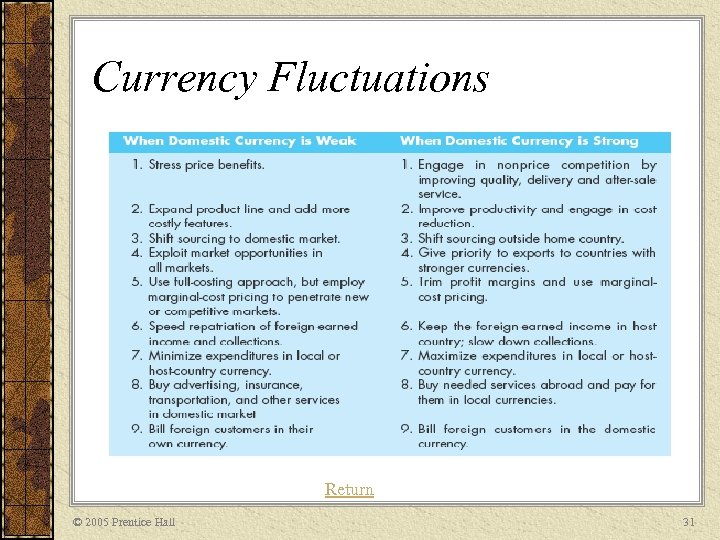
Currency Fluctuations Return © 2005 Prentice Hall 31
Inflationary Environment Defined as a persistent upward change in price levels – Can be caused by an increase in the money supply – Can be caused by currency devaluation Essential requirement for pricing is the maintenance of operating margins Return © 2005 Prentice Hall 32
Government Controls, Subsidies, and Regulations The types of policies and regulations that affect pricing decisions are: – Dumping legislation – Resale price maintenance legislation – Price ceilings – General reviews of price levels Return © 2005 Prentice Hall 33
Competitive Behavior If competitors do not adjust their prices in response to rising costs it is difficult to adjust your pricing to maintain operating margins If competitors are manufacturing or sourcing I a lower-cost country, it may be necessary to cut prices to stay competitive Return © 2005 Prentice Hall 34
Using Sourcing as a Strategic Pricing Tool Marketers of domestically manufactured finished products may move to offshore sourcing of certain components to keep costs down and prices competitive Can you stay competitive while staying local? Return © 2005 Prentice Hall 35
Скачать презентацию Chapter 11 Pricing Decisions Power Point By Kristopher
8be830e1e5fe679dcbd6811e84bdaf4f.ppt