


 Скачать презентацию Chapter 11 Medication Errors Copyright 2016 Cengage
f56928d822745278ba9899bccf7d0544.ppt
- Количество слайдов: 37
 Chapter 11 Medication Errors Copyright © 2016 Cengage Learning. ALL RIGHTS RESERVED.
 Overview • Medication error – any preventable event causing or leading to inappropriate medication use or patient harm • Involve health care professionals, patients, or consumers • Occur during manufacturing, prescribing, transcribing, dispensing, and administering medications Copyright © 2016 Cengage Learning. ALL RIGHTS RESERVED.
 Occurrence of Medication Errors • May happen anywhere • Approximately 98, 000 Americans die each year as a result of medical errors, with nearly 7, 000 of these attributable to actual medication errors (continues) Copyright © 2016 Cengage Learning. ALL RIGHTS RESERVED.
 Occurrence of Medication Errors • Most errors occur during ordering (39%) and administration (38%), with the rest divided between transcription and pharmacy dispensing Copyright © 2016 Cengage Learning. ALL RIGHTS RESERVED.
 Prescribing Errors • Most medication errors occur when physicians, nurse practitioners, physician assistants, dentists, and pharmacists order prescriptions • Illegible handwriting can cause the wrong drug to be given Copyright © 2016 Cengage Learning. ALL RIGHTS RESERVED.
 Dispensing Errors • Medication errors during dispensing can be made by pharmacists or pharmacy technicians • The pharmacy technician must be skilled in: – – Generic and trade names of drugs Performing dosage calculations Awareness of sound-alike and look-alike drugs Aseptic technique Copyright © 2016 Cengage Learning. ALL RIGHTS RESERVED.
 Administration Errors • During administration of medication, errors may occur due to: – Misuse of infusion pumps and other parenteral delivery systems – Memory lapses – Faulty drug identification or dose verification – Wrong drug, dose, patient, time, route, technique, or information on the patient chart Copyright © 2016 Cengage Learning. ALL RIGHTS RESERVED.
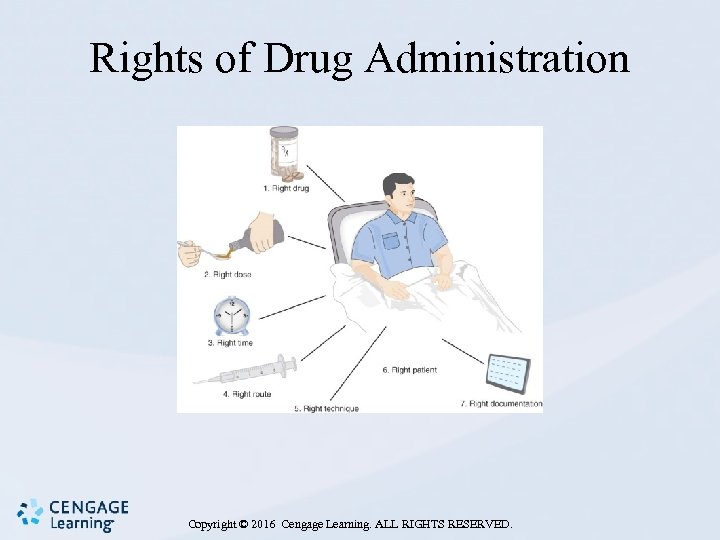 Rights of Drug Administration Copyright © 2016 Cengage Learning. ALL RIGHTS RESERVED.
 The Patient’s Role in Medication Errors • They may occur when patients self-administer drugs at home • Patients must be informed regarding their: – – – Condition and treatment plan Prognosis Risks and benefits Alternative treatments Complications that may occur Other vital pieces of information Copyright © 2016 Cengage Learning. ALL RIGHTS RESERVED.
 Medications of “Highest Alert” • According to the Institute for Safe Medication Practices (ISMP), these medications are of “highest alert”: – – – Insulin Narcotics and opiates Potassium chloride injections Heparin Concentrated sodium chloride (>0. 9%) Copyright © 2016 Cengage Learning. ALL RIGHTS RESERVED.
 Risk Factors for Medication Errors • Risk factors include: – – – – Fatigue Noise and stress Poor lighting and management Illegible handwriting Inadequate patient monitoring Lack of drug knowledge or patient information Rule violations (continues) Copyright © 2016 Cengage Learning. ALL RIGHTS RESERVED.
 Risk Factors for Medication Errors • Risk factors include: – Problems with herbal remedies and OTC drugs – Problems with medications sold over the Internet – Illegal drugs Copyright © 2016 Cengage Learning. ALL RIGHTS RESERVED.
 Human Factors • Human factors related to medication errors include: – – Lack of attention to details Failure to recognize certain facts Choosing incorrect medications Failing to remember something concerning the medication or patient – Making incorrect choices about what actions are to be taken Copyright © 2016 Cengage Learning. ALL RIGHTS RESERVED.
 Fatigue • Fatigue has many effects that can allow medication errors to occur, including: – – – – Slowed reaction times Reduced accuracy Inability to recognize changes in the patient Lapses of attention Impaired communication ability Memory lapses Decreased energy Copyright © 2016 Cengage Learning. ALL RIGHTS RESERVED.
 Noise • Internal and external noise can interrupt the concentration of health care workers and cause medication errors • Types of noise include: – Outside construction and traffic noise – Interior repair work, conversations, cell phones ringing, and overhead music systems Copyright © 2016 Cengage Learning. ALL RIGHTS RESERVED.
 Poor Lighting • Adequate, bright lighting has been proven to decrease medication errors by increasing alertness and the ability to read information more accurately • Poor lighting may cause labels to be misread Copyright © 2016 Cengage Learning. ALL RIGHTS RESERVED.
 Poor Management • If pharmacy technicians are not adequately supervised due to staff shortages, they make errors that will go unchecked by pharmacists or other personnel • Other areas of poor management include: – Not addressing air-conditioning problems – Not addressing unhealthy conditions – Not addressing anything that may cause workers to have a lack of focus Copyright © 2016 Cengage Learning. ALL RIGHTS RESERVED.
 Stress • Stress is often linked to a variety of medication errors • Stress causes distraction and lack of focus • Stress may be caused by: – – – Personal and family problems Sickness Poverty Conflicts with staff members Dealing with upset or angry patients Copyright © 2016 Cengage Learning. ALL RIGHTS RESERVED.
 Illegible Handwriting • Illegible handwriting has been documented as the second most prevalent cause of medication errors • Methods of counteracting illegible handwriting include: – – Writing prescriptions more slowly and clearly Dictating or typing prescriptions Reviewing prescriptions for accuracy and clarity Discussing prescriptions with other health care staff members Copyright © 2016 Cengage Learning. ALL RIGHTS RESERVED.
 Inadequate Patient Monitoring • Health care professionals must monitor patients to ensure safe medication administration and outcomes • Vital signs and levels of consciousness can be verified • Pain scales are printed charts that patients can view and then respond to • Diagnostic tests are also important for patient monitoring Copyright © 2016 Cengage Learning. ALL RIGHTS RESERVED.
 Lack of Drug Knowledge • Patients who do not understand their medications and the requirements for their use may inadvertently harm themselves • Caregivers must likewise be knowledgeable • Patients should be encouraged to ask questions about their medications Copyright © 2016 Cengage Learning. ALL RIGHTS RESERVED.
 Lack of Patient Information • Patient information that is essential in reducing medication errors includes: – – – Age Sex Pregnancy Diagnoses Allergies Height and weight (continues) Copyright © 2016 Cengage Learning. ALL RIGHTS RESERVED.
 Lack of Patient Information • Patient information that is essential in reducing medication errors includes: – – Lab test values and diagnostic study results Vital signs Patient identity Ability to pay for prescriptions Copyright © 2016 Cengage Learning. ALL RIGHTS RESERVED.
 Rule Violations • Health care professionals must follow the rules of their health care practice setting • For example, physicians are required to verify allergy history, and pharmacists are required to counsel patients • During administration of medications, the “seven rights” of administration must be followed Copyright © 2016 Cengage Learning. ALL RIGHTS RESERVED.
 Problems with Herbal Remedies • Herbal remedies may interact dangerously with certain medications prescribed by a physician, dispensed by a pharmacist, or administered by a nurse • It is vital to ask patients what types of herbal remedies they are taking – they must list all of them Copyright © 2016 Cengage Learning. ALL RIGHTS RESERVED.
 Problems with OTC Drugs • Lack of knowledge of drug interactions with prescribed medications Copyright © 2016 Cengage Learning. ALL RIGHTS RESERVED.
 Problems with Medications Sold over the Internet • Patients often purchase medications via Internet web sites in order to get them more cheaply • Often, these web sites originate in other countries that use different formulations • They may not be approved by the FDA, and may even be illegal to purchase, as well as being potentially dangerous Copyright © 2016 Cengage Learning. ALL RIGHTS RESERVED.
 Illegal Drugs • Some patients use illegal drugs, which they often do not report to their physicians • The potential for interactions with prescribed drugs is dangerous • For example, a sedative prescribed for a patient using heroin or cocaine may severely harm the patient Copyright © 2016 Cengage Learning. ALL RIGHTS RESERVED.
 Dangerous Abbreviations and Numerical Terms • Medication errors frequently occur when prescribers use abbreviations • The “do not use” list includes: – – – U – Write out the word “units” instead IU – Write out “international units” instead QD – Write out the word “daily” instead SC or SQ – Write out the word “sublingual” instead D/C – Write out “discharge” or “discontinue” instead HS – Write out “half strength” or “hour of sleep” instead Copyright © 2016 Cengage Learning. ALL RIGHTS RESERVED.
 Leading Zeros and Trailing Zeros • Leading zeros should be used before decimal points, as follows: – Write “ 0. 2 mg” instead of “. 2 mg” • Trailing zeros should not be used after decimal points, as follows: – Write “ 2 mg” instead of “ 2. 0 mg” Copyright © 2016 Cengage Learning. ALL RIGHTS RESERVED.
 Avoiding Medication Errors • Prevention must be the most important priority of health care professionals, and they must educate patients • Keep these in mind: – Confirm patient’s identity – Verify the original prescription, medication calculation, and patient allergy history – Communicate concerns to the pharmacist – Inquire if the patient has questions for the pharmacist – Maintain continuing education Copyright © 2016 Cengage Learning. ALL RIGHTS RESERVED.
 Medication Error Reporting • The reporting of medication errors and problems with products must be done whenever they occur, even though the reporting process is voluntarily • There are two medication error reporting systems: – FDA Med. Watch Program – U. S. Pharmacopeia’s (USP) Medication Error Reporting Program Copyright © 2016 Cengage Learning. ALL RIGHTS RESERVED.
 FDA Med. Watch Program • Med. Watch allows reporting of medication errors or product problems by phone, fax, and through the Internet • It also provides important and timely clinical information, including: – – Prescription and OTC drugs Biologics Medical and radiation-emitting devices Special nutritional products Copyright © 2016 Cengage Learning. ALL RIGHTS RESERVED.
 USP’s Medication Error Reporting Program • This program provides the sharing of medication error experiences through a nationwide network • It was designed to recognize circumstances and causes of actual and potential errors • Reporting is confidential, and can be anonymous Copyright © 2016 Cengage Learning. ALL RIGHTS RESERVED.
 Minimizing Liability • Upon detecting an error in dispensing, the pharmacy technician must take all necessary steps to rectify it promptly and notify the pharmacist immediately • The pharmacist should inform the patient and prescribing physician immediately Copyright © 2016 Cengage Learning. ALL RIGHTS RESERVED.
 Negligence / Malpractice / Penalties • Pharmacy laws protect the public by ensuring double-checking of results of the prescribing process and overseeing use of medications • Negligence is the failure to do something that a reasonable person might do, or doing something that a reasonable person might not do (continues) Copyright © 2016 Cengage Learning. ALL RIGHTS RESERVED.
 Negligence / Malpractice / Penalties • Malpractice is negligence performed by a professional • Penalties may include restrictions on practice, suspension of practice, fines, revocation of practice, and jail sentences Copyright © 2016 Cengage Learning. ALL RIGHTS RESERVED.