


 Скачать презентацию CHAPTER 11 INTEREST GROUPS Copyright 2012 Cengage
867e35bf16d1f2783380a317a6ac29ce.ppt
- Количество слайдов: 50
 CHAPTER 11 INTEREST GROUPS Copyright © 2012 Cengage Learning
 CHAPTER 11: LEARNING OBJECTIVES v. Appreciate the function of interest groups as a mechanism by which groups of people attempt to influence government to advance shared goals v. Assess both the benefits and criticisms of the interest group system in the United States Copyright © 2012 Cengage Learning
 CHAPTER 11: LEARNING OBJECTIVES v. Define pluralism as theory that public policy is largely the product of a variety of different interest groups competing with one another to promote laws that benefit members of their respective groups v. Compare the role of interest groups to that of political parties Copyright © 2012 Cengage Learning
 CHAPTER 11: LEARNING OBJECTIVES v. Understand the reasons for the growth of interest groups in the United States during the twentieth century v. Evaluate the critical role interest groups play in influencing policy making through structures such as iron triangles and issue networks Copyright © 2012 Cengage Learning
 CHAPTER 11: LEARNING OBJECTIVES v. Assess solidary benefits as one of the reasons people join interest groups v. Explain the “free rider” problem that many interest groups face v. Assess the factors that contribute to each interest group’s level of influence on policy Copyright © 2012 Cengage Learning
 CHAPTER 11: LEARNING OBJECTIVES v. Distinguish between economic interest groups and noneconomic interest groups according to their primary purpose and cite examples of each type of group v. Identify the activities interest groups engage in to achieve their goals and influence public policy Copyright © 2012 Cengage Learning
 LOBBYING SCANDALS WITH A RING OF FAMILIARITY: NOW & THEN v. Lobbying legislators may be a timehonored practice, however, v. Legislative favors in return for financial interests can quickly cross the line and betray the public trust v. A group’s original cause may be noble, but corruption can destroy public faith Copyright © 2012 Cengage Learning
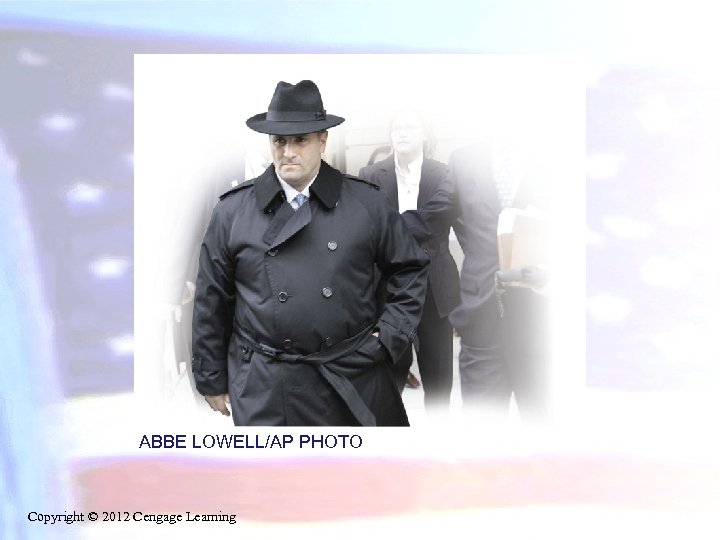 ABBE LOWELL/AP PHOTO Copyright © 2012 Cengage Learning
 NOW … NATIVE AMERICAN TRIBES AND JACK ABRAMOFF v. The 1988 Indian Gaming Regulatory Act allowed tribe-run casinos on reservations v. In the 1990 s, tribal leaders hired lobbyist Jack Abramoff v. Initially, Abramoff was very successful in protecting tribal interests in Congress, however… Copyright © 2012 Cengage Learning
 NOW … NATIVE AMERICAN TRIBES AND JACK ABRAMOFF v. Abramoff was accused of bribing U. S. Congressmen with gifts and donations v. Also defrauded the tribes: overbilled them and orchestrated lobbying activities against his own clients v. Pleaded guilty to numerous charges and named the Congressmen who had benefited from his “generosity” Copyright © 2012 Cengage Learning
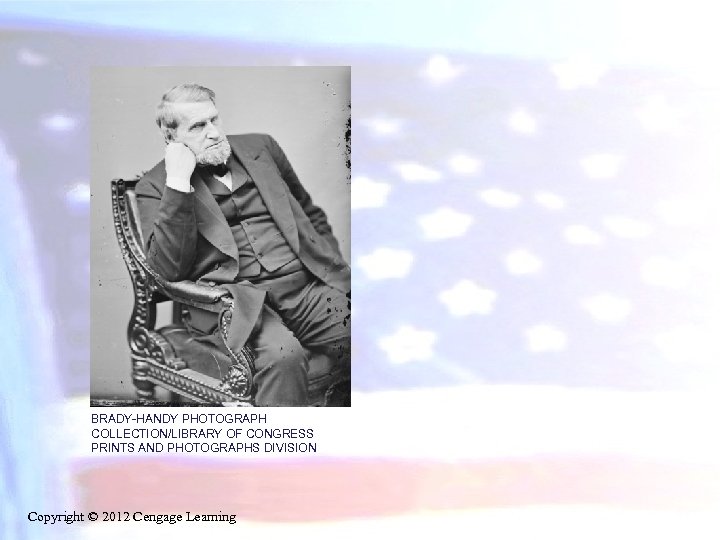 BRADY-HANDY PHOTOGRAPH COLLECTION/LIBRARY OF CONGRESS PRINTS AND PHOTOGRAPHS DIVISION Copyright © 2012 Cengage Learning
 THEN… THE UNION PACIFIC RAILROAD v. After the Civil War, railroads were the dominant interest in Washington, D. C. v. Oakes Ames, an influential House member, obtained Union Pacific construction contracts for his family firm v. A front company, Crédit Mobilier, funneled money back to the railroads through their own construction contracts Copyright © 2012 Cengage Learning
 THEN… THE UNION PACIFIC RAILROAD v. Ames allowed members of Congress to purchase railroad shares at face rather than market value v. In return, they ignored illegal transactions v. The railroad went bankrupt in the 1870 s and Ames was censured v. But many politicians escaped merely with “the embarrassment of public exposure” Copyright © 2012 Cengage Learning
 NOW & THEN… v. No one questions the importance of the railways during the post–Civil War period, and v. Native Americans, downtrodden for so long, gaining economic prominence in the 1990 s, was welcomed by many v. Unfortunately, aggressive lobbying on behalf of these two groups went too far Copyright © 2012 Cengage Learning
 PLURALISM AND THE INTEREST GROUP SYSTEM v. What Is an Interest Group? v. Aka - “pressure group” or “organized interest” v. Organization of people with shared goals that tries to influence public policy through a variety of activities v. Allows them to protect or advance their interests Copyright © 2012 Cengage Learning
 PLURALISM AND THE INTEREST GROUP SYSTEM v. Pluralism: theory that public policy largely results from interest groups competing with one another to promote laws that benefit their members v. Majoritarianism: theory that public policy is a product of what majorities of citizens prefer Copyright © 2012 Cengage Learning
 AMERICAN GOVERNMENT… IN POPULAR PERSPECTIVE v. In the Words of French Political Philosopher Alexis de Tocqueville v. After touring the U. S. , de Tocqueville wrote Democracy in America (1835): v. Observed that U. S. “associations” are a “necessary guarantee against the tyranny of the majority” Copyright © 2012 Cengage Learning
 THE PROS AND CONS OF INTEREST GROUPS v. The Pros: v. Provide all groups with an opportunity to win support for their ideas and positions v. Joining groups and working for the interests of the group is a natural inclination of citizens and should be encouraged Copyright © 2012 Cengage Learning
 THE PROS AND CONS OF INTEREST GROUPS v. Association is implicitly protected by the First Amendment which affords individuals the right “…peaceably to assemble…” v. The system is fair in that it gives all groups an equitable opportunity to compete Copyright © 2012 Cengage Learning
 THE PROS AND CONS OF INTEREST GROUPS v. The Cons: v. Unfair because groups supported by the wealthy have far greater resources to promote their interests v. Promotes advancement of interests that don’t always strive for the common good, i. e. , large, profit-conscious corporations Copyright © 2012 Cengage Learning
 THE PROS AND CONS OF INTEREST GROUPS v. Too many groups slow policy making to a state of gridlock v. Interest group leaders are not elected, thus interest group dominance of the system is an affront to democracy v. Groups concentrate benefits for the few while distributing costs to the many Copyright © 2012 Cengage Learning
 INTEREST GROUPS VERSUS POLITICAL PARTIES v. Parties and interest groups differ in two important ways: 1. Most interest groups don’t run candidates for office 2. Groups tend to focus narrowly on special issues or sets of issues while the major parties are more generalist Copyright © 2012 Cengage Learning
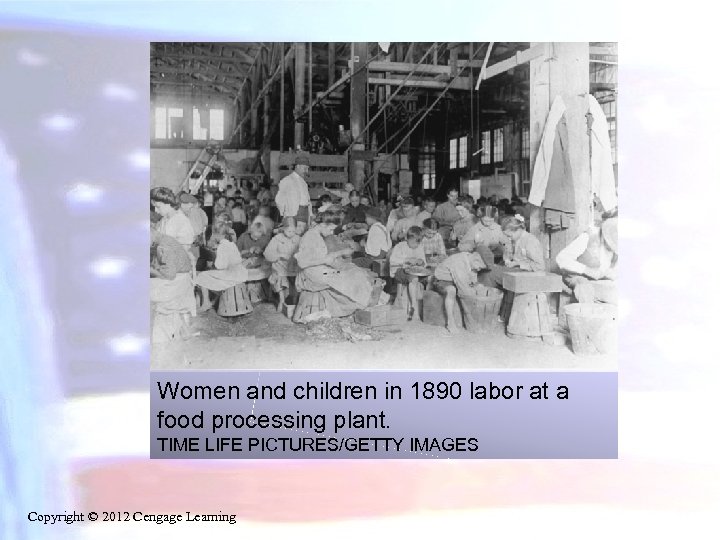 Women and children in 1890 labor at a food processing plant. TIME LIFE PICTURES/GETTY IMAGES Copyright © 2012 Cengage Learning
 INTEREST GROUPS AND SOCIAL MOVEMENTS v. Many movements have been propelled by interest group activities v. Political § Example: women’s suffrage v. Economic § Example: labor and consumer rights v. Social § Example: the civil rights movements Copyright © 2012 Cengage Learning
 THE GROWTH OF INTEREST GROUPS v. As the number of government programs and agencies has expanded v. Opportunities for influence via interest group activities have expanded as well v 1960– 2000: the number of groups increased 400% (5, 843 to 23, 298) v. Lobbying spending increased from $1. 43 billion (1998) to $3. 47 billion (2009) Copyright © 2012 Cengage Learning
 AMERICAN GOVERNMENT… IN POPULAR PERSPECTIVE v. AARP: The Behemoth of Interest Group Politics v. One of the largest, most popular groups in America (over 40 million members) v 2009: spent $30 million in lobbying v. Its size and activities have invited criticisms and led to some controversies Copyright © 2012 Cengage Learning
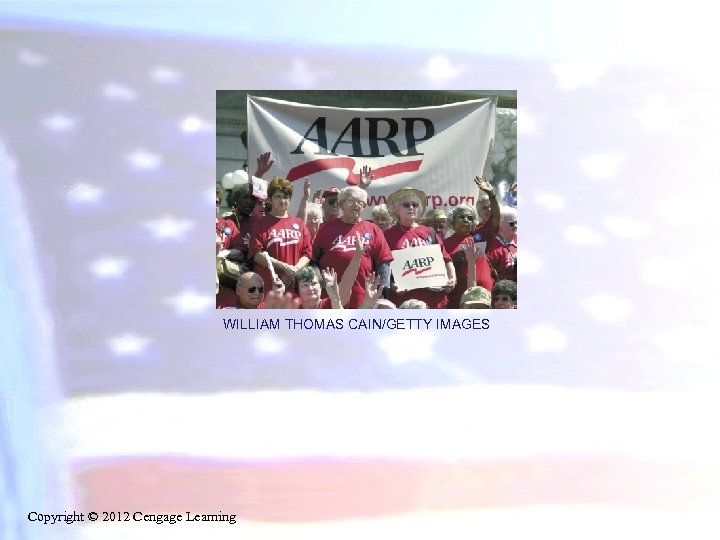 WILLIAM THOMAS CAIN/GETTY IMAGES Copyright © 2012 Cengage Learning
 IRON TRIANGLES, ISSUE NETWORKS, AND THE INFLUENCE OF GROUPS 1. Congressional committees and subcommittees over a specific policy area + 2. Executive agencies administrating policies in this area + 3. Interest groups seeking to influence the policy area = iron triangles Copyright © 2012 Cengage Learning
 IRON TRIANGLES, ISSUE NETWORKS, AND THE INFLUENCE OF GROUPS v. They may not always agree but they seek to promote favorable policies v. Depend on one another for support and influence v. Together, they dominate public policy development v. Example: U. S. defense policies Copyright © 2012 Cengage Learning
 IRON TRIANGLES, ISSUE NETWORKS, AND THE INFLUENCE OF GROUPS v. Issue networks: broader set of actors who have a vested interest in an area of public policy, and v. Try to collectively influence their policy area, i. e. , § Congressional staff, journalists who report on the policy area, and experts Copyright © 2012 Cengage Learning
 MEMBERSHIP IN GROUPS v. Many citizens, businesses, nonprofit organizations, and public entities belong to interest groups v. Individuals who are more likely to belong to interest groups often have higher incomes and greater resources v. Often are better educated and employed in professional occupations Copyright © 2012 Cengage Learning
 MEMBERSHIP IN GROUPS v. Reasons for membership: v. Material benefits: specific, tangible benefits v. Purposive benefits: rewards benefiting society more generally v. Solidary benefits: satisfaction from interacting with like-minded individuals for a cause Copyright © 2012 Cengage Learning
 WHAT MAKES SOME GROUPS MORE POWERFUL THAN OTHERS? 1. Size of the membership: § Power in numbers, i. e. , AFBF 2. Wealth of the members § Increased contributions, i. e. , ATLA 3. Dedication of members to the goals of the group § Time, effort, and resources, i. e. , NRLC Copyright © 2012 Cengage Learning
 CHECK THE LIST v. The Top Ten Most Influential Interest Groups v. Fortune magazine annually identifies the top ten most influential interest groups based on a survey of political players v. One recent top ten list consisted of the following: Copyright © 2012 Cengage Learning
 CHECK THE LIST 1. AARP 2. National Rifle Association (NRA) 3. National Federation of Independent Businesses (NFIB) 4. American Israel Public Affairs Committee (AIPAC) 5. American Federation of Labor. Congress of Industrial Organizations (AFL-CIO) Copyright © 2012 Cengage Learning
 CHECK THE LIST 6. The Association of Trial Lawyers of America (ATLA) 7. The U. S. Chamber of Commerce 8. National Right to Life Committee (NRLC) 9. The National Education Association (NEA) 10. The National Restaurant Association Copyright © 2012 Cengage Learning
 TYPES OF INTEREST GROUPS v. Economic Groups: promote economic advantages and opportunities v. Business Groups: promote interests of companies and corporations v. Trade associations: typically focus on one particular industry v. Free riders: enjoy the benefits of membership without paying for the costs Copyright © 2012 Cengage Learning
 TYPES OF INTEREST GROUPS v. Labor Unions: promote the interests of American workers v. Open shop: membership is optional v. Closed shop: mandatory membership - banned by the Taft-Hartley Act v. Union shop: must either join the union or pay the equivalent of union dues Copyright © 2012 Cengage Learning
 TYPES OF INTEREST GROUPS v. Professional Associations: v. Lawyers and medical doctors have highprofile and powerful interest groups v. American Medical Association (AMA) and the American Bar Association (ABA) v. The National Association of Realtors (NAR) is also large and influential Copyright © 2012 Cengage Learning
 NONECONOMIC GROUPS v. Public interest groups: Promote the broad, collective good of citizens and consumers v. Issue or ideological groups: Focus on specific issues and ideological perspectives v. Government groups: Represent the interests of governments Copyright © 2012 Cengage Learning
 YOUR PERSPECTIVE. . . ON AMERICAN POLITICS v“Before the Lecture Begins, Students from PIRG have an announcement…” v. Public Interest Research Group–claims to “stand up to powerful special interests on behalf of the American public” v. Does PIRG operate on your campus? Copyright © 2012 Cengage Learning
 YOUR PERSPECTIVE. . . ON AMERICAN POLITICS v. What other interest groups are active at your college? v. Have you ever been asked to get involved in PIRG or another interest group’s activities? v. What kinds of interest groups are you most willing to support? Copyright © 2012 Cengage Learning
 HOW INTEREST GROUPS ACHIEVE THEIR GOALS v. Lobbying: v. Provide information and expertise to public officials v. Attempt to convince officials to vote or act in a manner favorable to their interest v. Lobbying has been part of the American political system since the colonial era Copyright © 2012 Cengage Learning
 HOW INTEREST GROUPS ACHIEVE THEIR GOALS v. Supporting candidates and parties in election campaigns: v. Provide financing via PACs, volunteers, endorsements, etc… v. Litigation: v. Initiate lawsuits, request injunctions, defend members, and file legal briefs Copyright © 2012 Cengage Learning
 HOW INTEREST GROUPS ACHIEVE THEIR GOALS v. Persuasion campaigns v. Media campaigns to persuade the public to support their position on issues v. Sophisticated public relations operations communicate their positions v. Use tactics such as “targeted mass mailings” Copyright © 2012 Cengage Learning
 NOW & THEN: MAKING THE CONNECTION v. The railways and Native American tribes were interest groups that exerted a strong influence on policymaking v. Both were well-respected, yet when Oakes Ames and Jack Abramoff used greed as an enticement, the democratic system suffered Copyright © 2012 Cengage Learning
 POLITICS INTERACTIVE! v. The Newest Way for Organized Interests to Influence Elections: 527 s v. Politically oriented organizations with tax -exempt status and no limits on the amount of soft money they can theoretically raise and spend v. Develop and air “issue” advertisements v 2008–spent nearly $500 million Copyright © 2012 Cengage Learning
 POLITICS INTERACTIVE! v. Go to www. opensecrets. org/527 s v. Which industries have been most active in forming these groups? v. What kinds of ads have they produced? v. Who do you think benefits more– Democrat or Republican candidates? Copyright © 2012 Cengage Learning
 POLITICS INTERACTIVE! v. Do these groups legitimately contribute to the “marketplace of ideas, ” or v. Is this an example of “free speech run amuck”? vwww. cengage. com/dautrich/america ngovernment/2 e Find the link for details on 527 s; consult the various links that relate to 527 advertisements Copyright © 2012 Cengage Learning
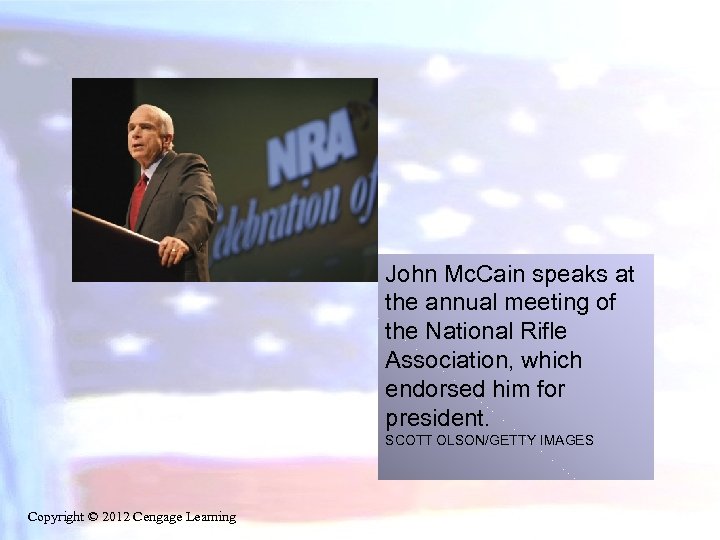 John Mc. Cain speaks at the annual meeting of the National Rifle Association, which endorsed him for president. SCOTT OLSON/GETTY IMAGES Copyright © 2012 Cengage Learning