


 Скачать презентацию Chapter 11 Excretion 11 1 Structure and
47ef80ab53e2a3ef5d2624e1743ea627.ppt
- Количество слайдов: 102
 Chapter 11: Excretion
 11. 1 Structure and function of kidneys a) Define excretion and explain the importance of removing nitrogenous and other compounds from the body (b) Outline the function of kidney tubules with reference to ultra-filtration and selective reabsorption in the production of urine (c) Outline the role of anti-diuretic hormone (ADH) in the regulation of osmotic concentration 11. 2 Kidney dialysis (d) Outline the mechanism of dialysis in the case of kidney failure
 The process by which metabolic waste products and toxic materials are removed from the body of an organism.
 What is Metabolism? The sum total of all the chemical reactions taking place in living cells in order to keep an organism alive. Metabolism = Catabolism + Anabolism
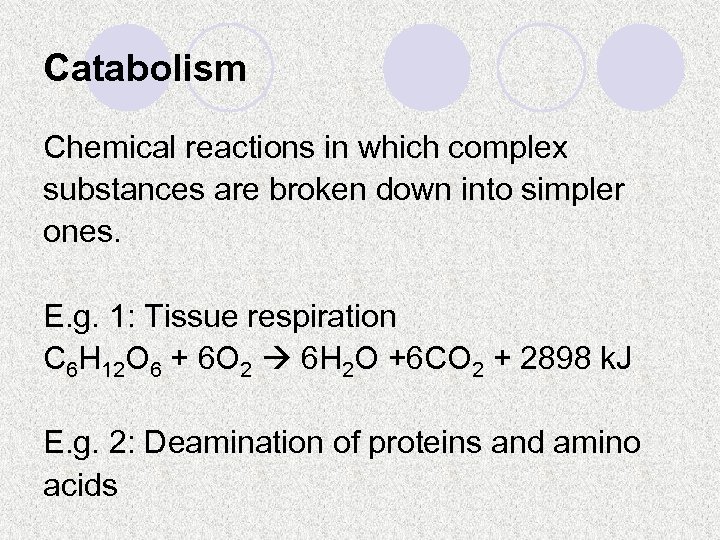 Catabolism Chemical reactions in which complex substances are broken down into simpler ones. E. g. 1: Tissue respiration C 6 H 12 O 6 + 6 O 2 6 H 2 O +6 CO 2 + 2898 k. J E. g. 2: Deamination of proteins and amino acids
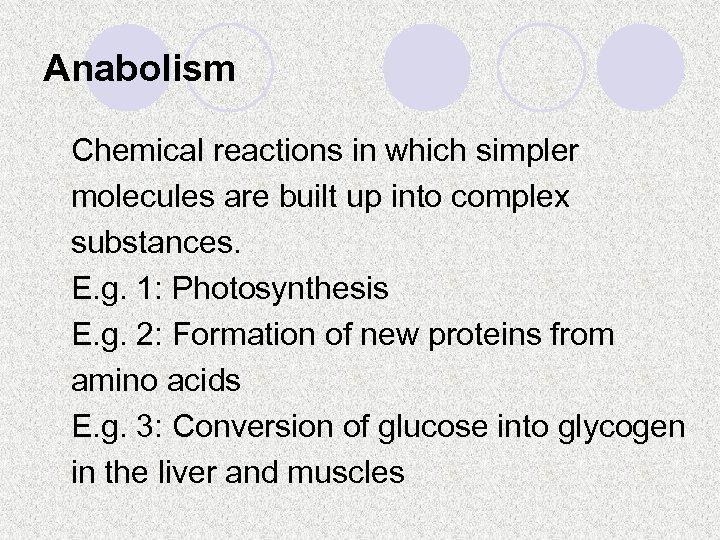 Anabolism Chemical reactions in which simpler molecules are built up into complex substances. E. g. 1: Photosynthesis E. g. 2: Formation of new proteins from amino acids E. g. 3: Conversion of glucose into glycogen in the liver and muscles
 Importance of Excretion Metabolic reactions produce waste products which are harmful if accumulated in the body.
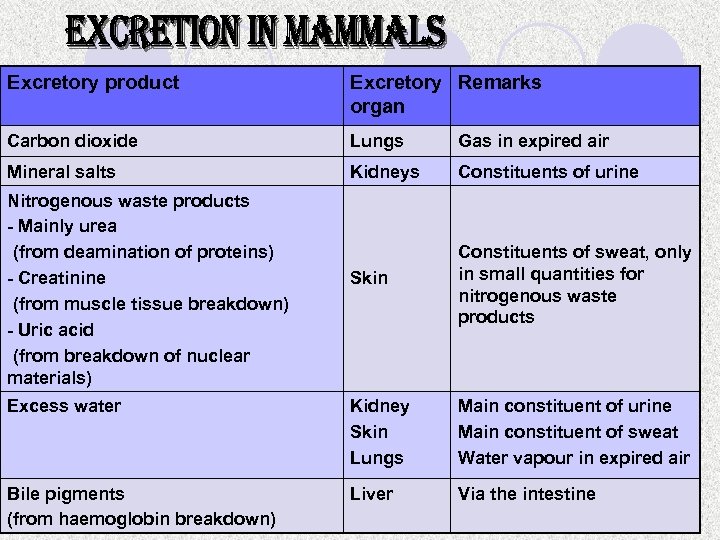 Excretory product Excretory Remarks organ Carbon dioxide Lungs Gas in expired air Mineral salts Kidneys Constituents of urine Skin Constituents of sweat, only in small quantities for nitrogenous waste products Excess water Kidney Skin Lungs Main constituent of urine Main constituent of sweat Water vapour in expired air Bile pigments (from haemoglobin breakdown) Liver Via the intestine Nitrogenous waste products - Mainly urea -(from deamination of proteins) - Creatinine -(from muscle tissue breakdown) - Uric acid -(from breakdown of nuclear materials)
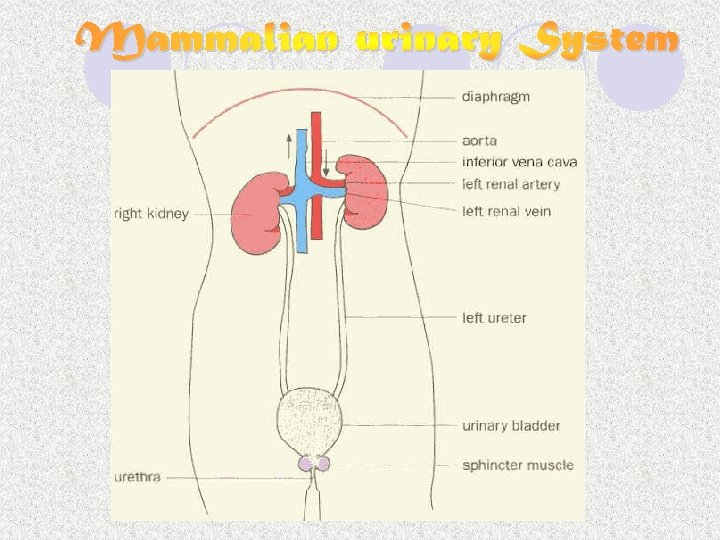
 Kidneys l Contains a lot of nephrons which remove urea and excess water and heat from the blood to form urine l Responsible for osmoregulation Ureter l Narrow tube through which urine flows from each kidney to the urinary bladder (by peristalsis) Urinary bladder l A hollow, distensible muscular bag which stores urine temporarily
 Renal pelvis l The enlarged portion of the ureter inside the kidney Sphincter muscle l Contracts or relaxes to control the flow of urine into the urethra Urethra l Duct through which urine flows from the bladder to the exterior
 The Kidneys l A pair of dark red, bean-shaped organs embedded in a mass of fat in the abdominal cavity (just below the stomach, but above the waistline). l They are attached to the dorsal body wall, one on each side of the vertebral column. l The left kidney is slightly higher than the right one.
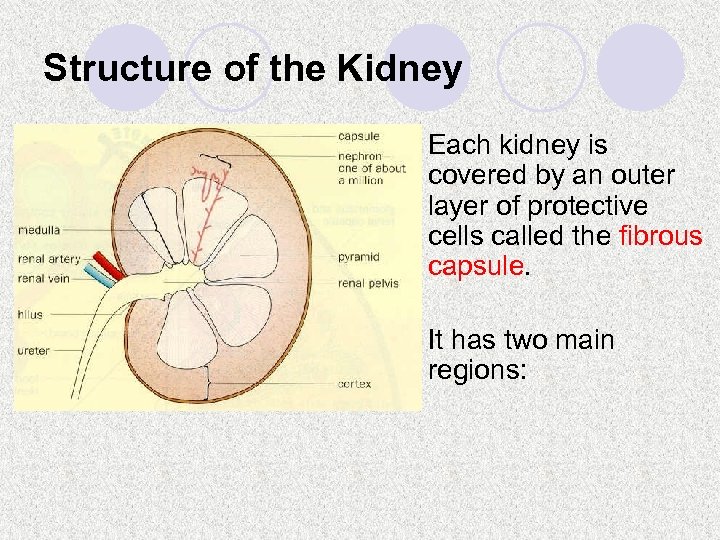 Structure of the Kidney l Each kidney is covered by an outer layer of protective cells called the fibrous capsule. l It has two main regions:
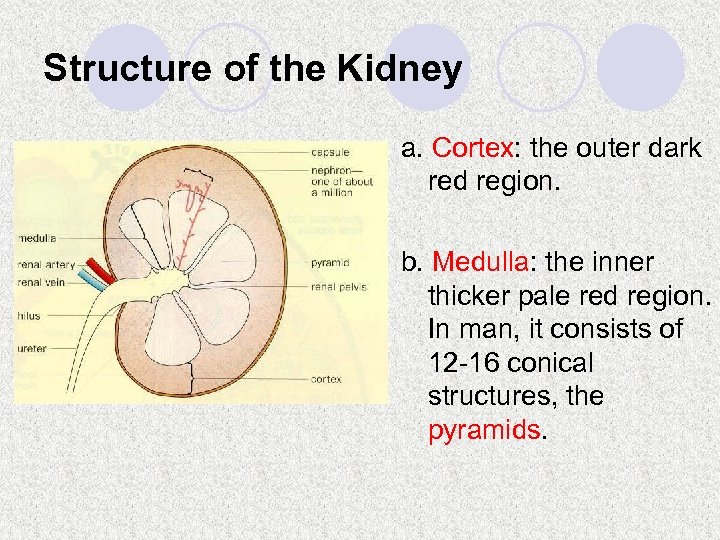 Structure of the Kidney a. Cortex: the outer dark red region. b. Medulla: the inner thicker pale red region. In man, it consists of 12 -16 conical structures, the pyramids.
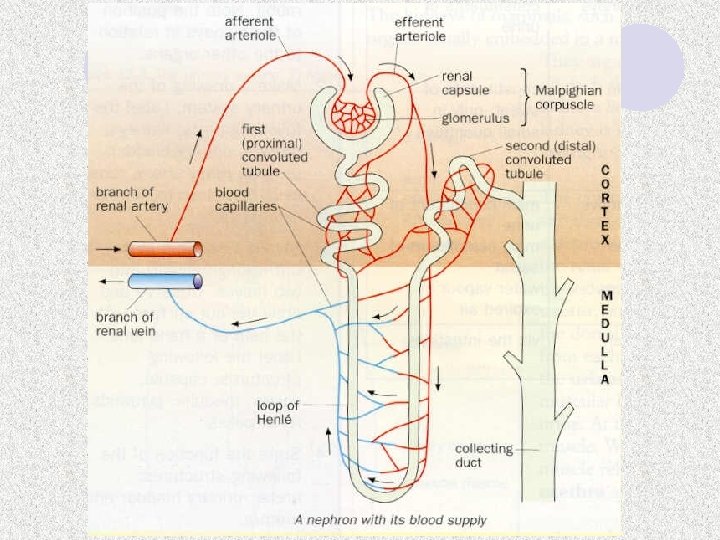
 Structure of a Kidney Tubule - The Nephron l The functional unit of the kidney. l About 1 million of them in each kidney. l Each is about 3 cm in length. (Total length: about 60 km)
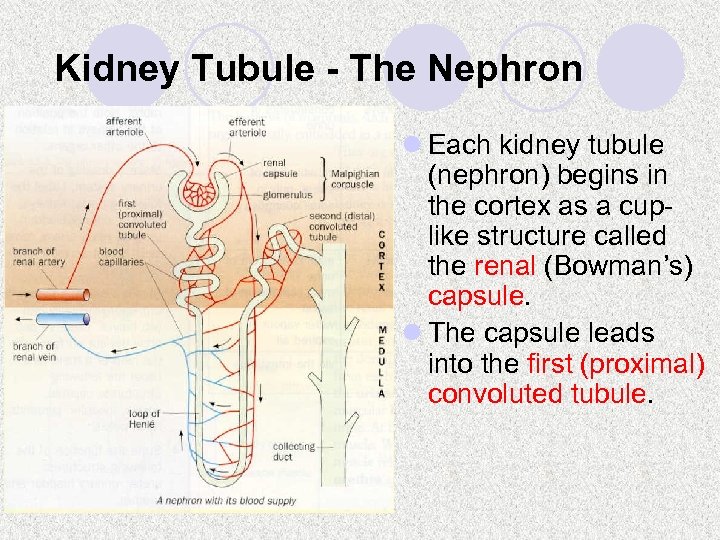 Kidney Tubule - The Nephron l Each kidney tubule (nephron) begins in the cortex as a cuplike structure called the renal (Bowman’s) capsule. l The capsule leads into the first (proximal) convoluted tubule.
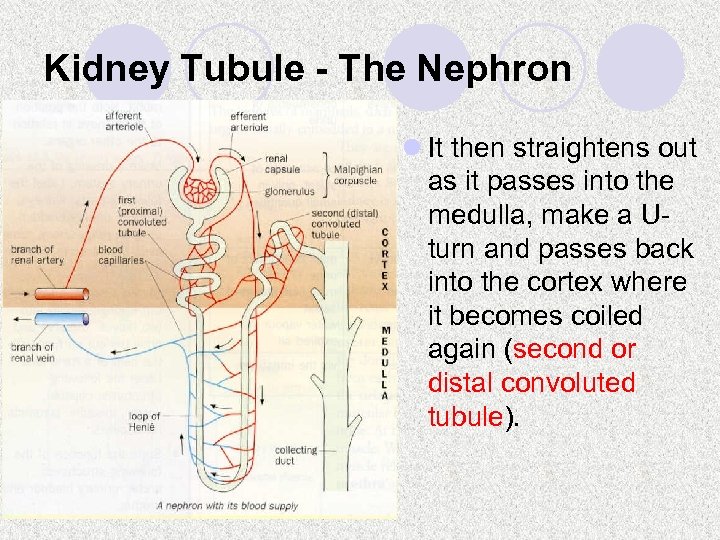 Kidney Tubule - The Nephron l It then straightens out as it passes into the medulla, make a Uturn and passes back into the cortex where it becomes coiled again (second or distal convoluted tubule).
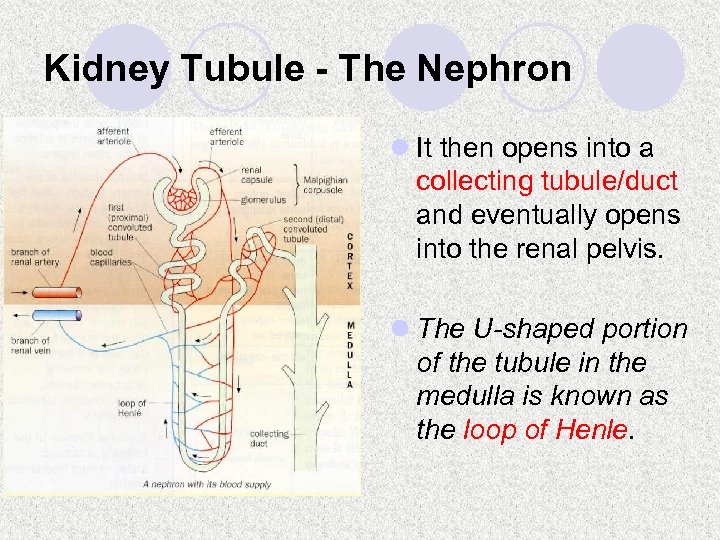 Kidney Tubule - The Nephron l It then opens into a collecting tubule/duct and eventually opens into the renal pelvis. l The U-shaped portion of the tubule in the medulla is known as the loop of Henle.
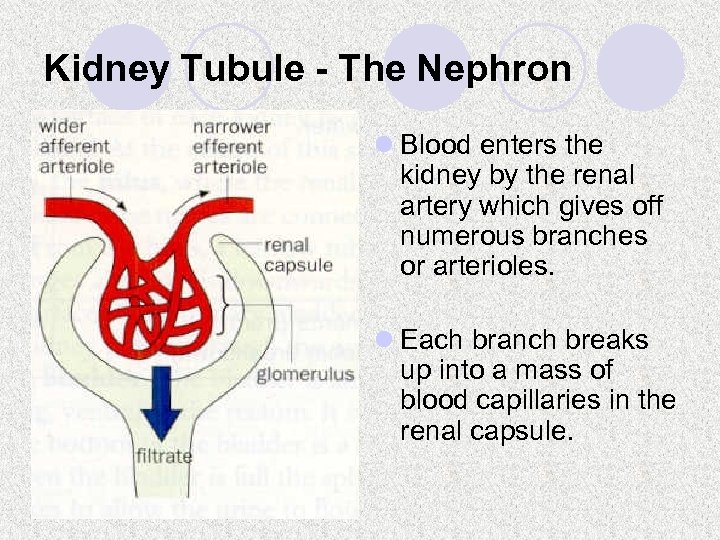 Kidney Tubule - The Nephron l Blood enters the kidney by the renal artery which gives off numerous branches or arterioles. l Each branch breaks up into a mass of blood capillaries in the renal capsule.
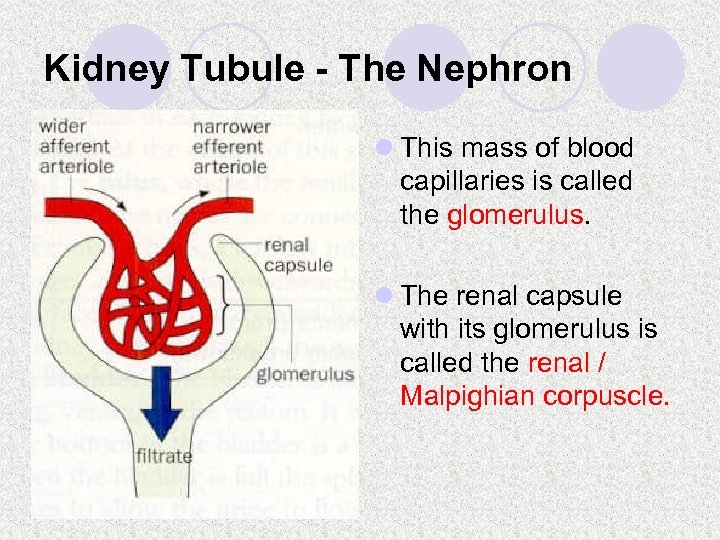 Kidney Tubule - The Nephron l This mass of blood capillaries is called the glomerulus. l The renal capsule with its glomerulus is called the renal / Malpighian corpuscle.
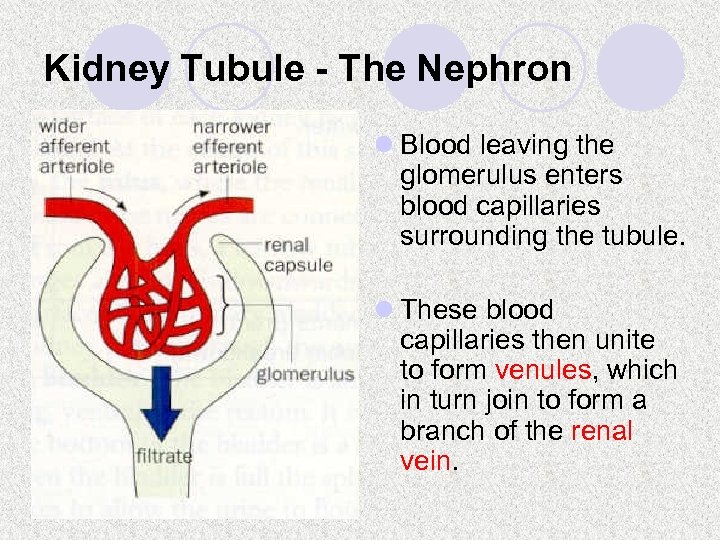 Kidney Tubule - The Nephron l Blood leaving the glomerulus enters blood capillaries surrounding the tubule. l These blood capillaries then unite to form venules, which in turn join to form a branch of the renal vein.
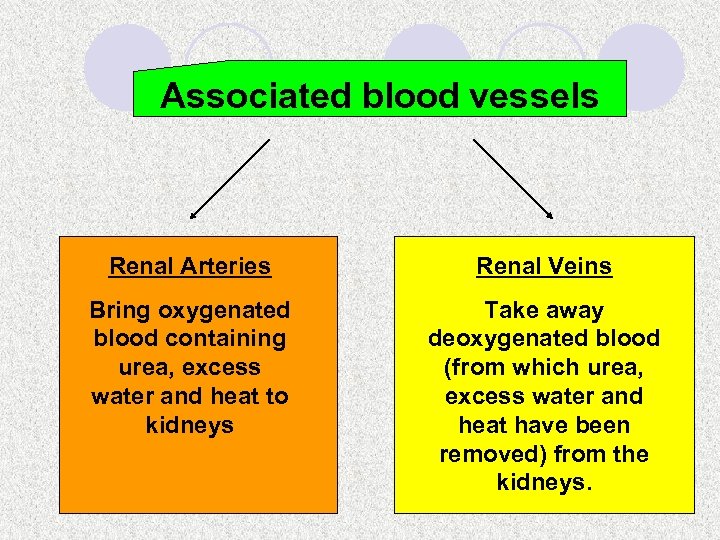 Associated blood vessels Renal Arteries Renal Veins Bring oxygenated blood containing urea, excess water and heat to kidneys Take away deoxygenated blood (from which urea, excess water and heat have been removed) from the kidneys.
 How Blood Enters the Kidney Tubule 3/18/2018
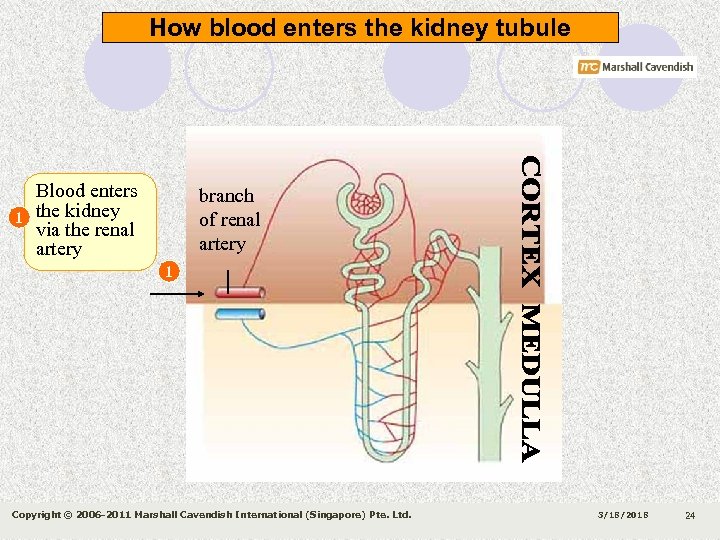 How blood enters the kidney tubule 1 Blood enters the kidney via the renal artery branch of renal artery 1 Copyright © 2006 -2011 Marshall Cavendish International (Singapore) Pte. Ltd. 3/18/2018 24
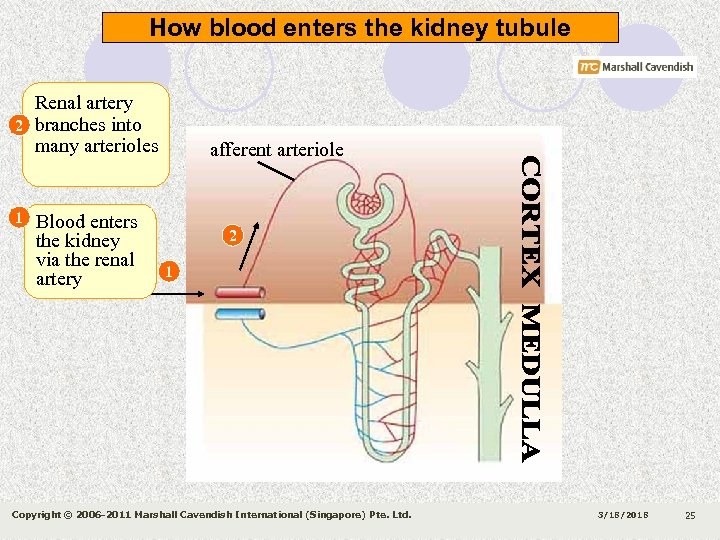 How blood enters the kidney tubule 2 1 Renal artery branches into many arterioles Blood enters the kidney via the renal artery afferent arteriole 2 1 Copyright © 2006 -2011 Marshall Cavendish International (Singapore) Pte. Ltd. 3/18/2018 25
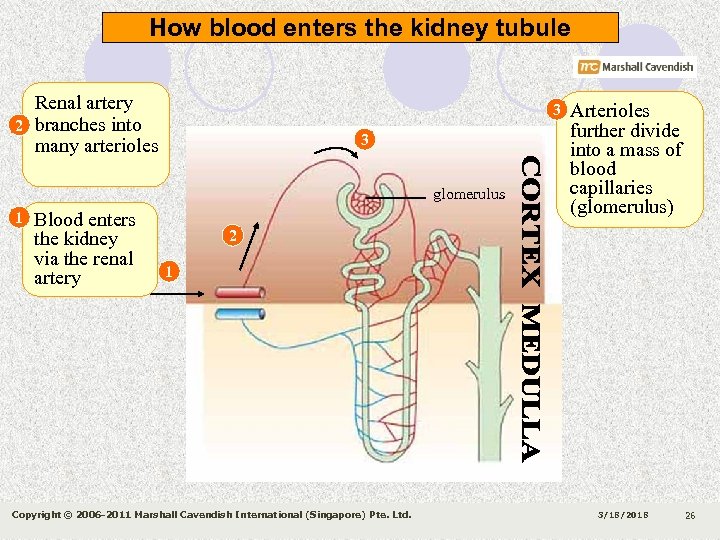 How blood enters the kidney tubule 2 Renal artery branches into many arterioles 3 3 glomerulus 1 Blood enters the kidney via the renal artery Arterioles further divide into a mass of blood capillaries (glomerulus) 2 1 Copyright © 2006 -2011 Marshall Cavendish International (Singapore) Pte. Ltd. 3/18/2018 26
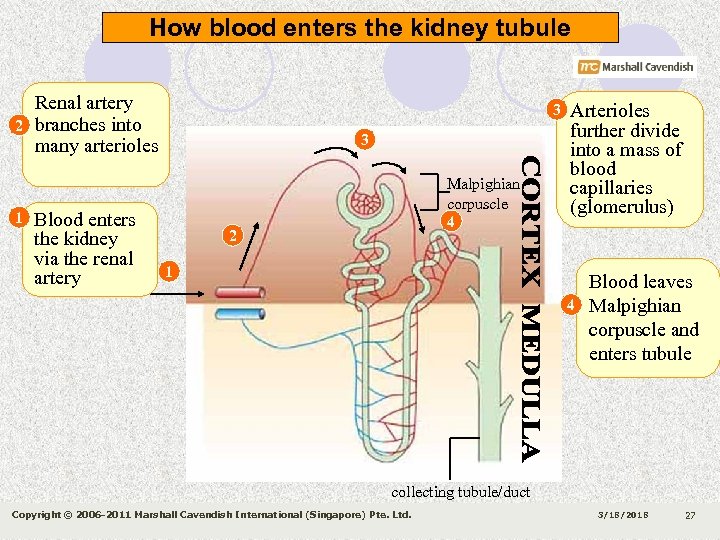 How blood enters the kidney tubule 2 1 Renal artery branches into many arterioles Blood enters the kidney via the renal artery 3 3 Malpighian corpuscle 4 2 Arterioles further divide into a mass of blood capillaries (glomerulus) 1 4 Blood leaves Malpighian corpuscle and enters tubule collecting tubule/duct Copyright © 2006 -2011 Marshall Cavendish International (Singapore) Pte. Ltd. 3/18/2018 27
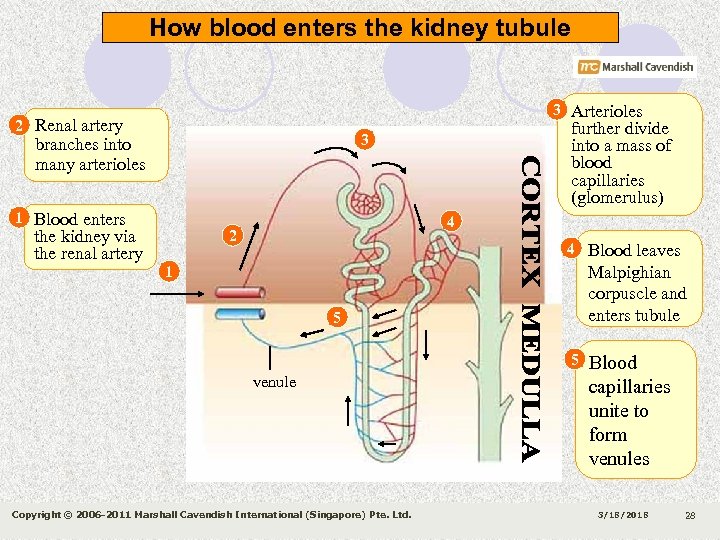 How blood enters the kidney tubule 3 Arterioles 2 Renal artery branches into many arterioles 1 Blood enters the kidney via the renal artery further divide into a mass of blood capillaries (glomerulus) 3 4 2 4 Blood leaves Malpighian corpuscle and enters tubule 1 5 5 venule Copyright © 2006 -2011 Marshall Cavendish International (Singapore) Pte. Ltd. Blood capillaries unite to form venules 3/18/2018 28
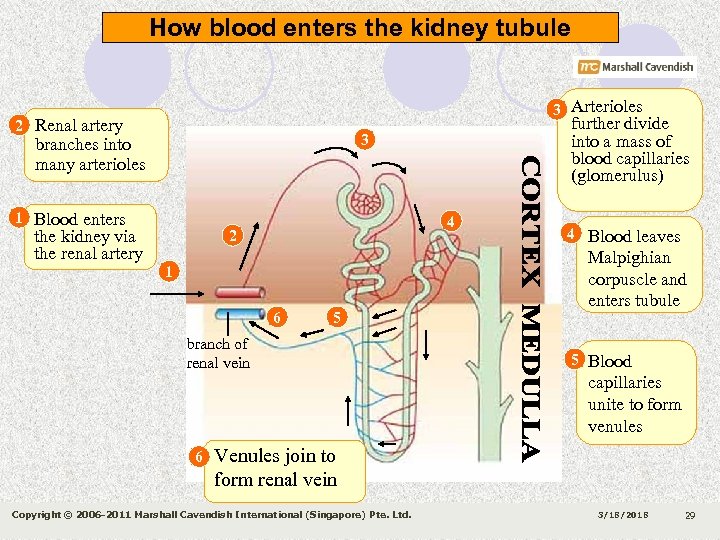 How blood enters the kidney tubule 3 Arterioles 2 Renal artery 3 branches into many arterioles 1 Blood enters the kidney via the renal artery further divide into a mass of blood capillaries (glomerulus) 4 2 1 6 5 branch of renal vein 4 Blood leaves Malpighian corpuscle and enters tubule 5 Blood capillaries unite to form venules 6 Venules join to form renal vein Copyright © 2006 -2011 Marshall Cavendish International (Singapore) Pte. Ltd. 3/18/2018 29
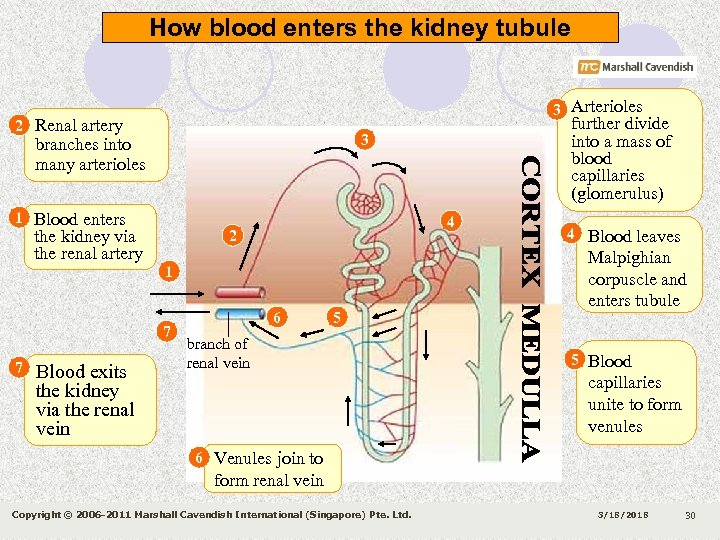 How blood enters the kidney tubule 3 Arterioles 2 Renal artery 3 branches into many arterioles 1 Blood enters the kidney via the renal artery Blood exits the kidney via the renal vein 4 2 1 7 7 further divide into a mass of blood capillaries (glomerulus) 6 5 branch of renal vein 4 Blood leaves Malpighian corpuscle and enters tubule 5 Blood capillaries unite to form venules 6 Venules join to form renal vein Copyright © 2006 -2011 Marshall Cavendish International (Singapore) Pte. Ltd. 3/18/2018 30
 Urine Formation Two main processes are involved: l Ultrafiltration of small molecules from the blood. l Selective reabsorption of useful materials.
 Ultrafiltration l Blood passes from the renal artery into the glomeruli in the renal capsules. l Mechanical filtration occurs in each glomerulus. l Blood plasma is forced out of the glomerular blood capillaries into the renal capsule.
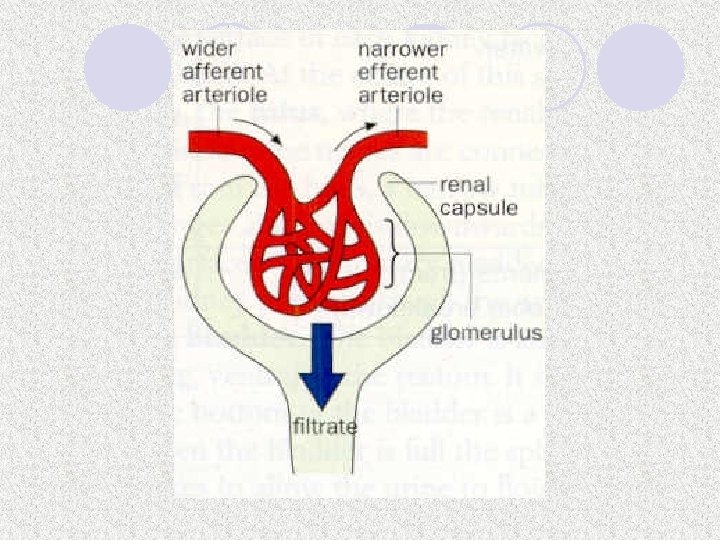
 Ultrafiltration l The afferent arteriole that brings blood into the glomerulus is wider than the efferent arteriole that carries blood away. l A high pressure is built up in the glomerulus, squeezing the blood through two living membranes: the capillary wall of the glomerulus (partially permeable membrane) and the inner wall of the renal capsule. l It is this blood pressure that provides the main force required for the filtration process.
 Why is it called Ultrafiltration? l It is caused by very high blood pressure. l The membrane around the glomerular blood capillaries is like a very fine filter. l Only very small molecules are filtered off the blood. These include water, mineral salts, glucose and urea. l Most proteins and fats are too big, so they stay in the blood, together with the blood cells.
 Ultrafiltration l In human, the kidneys filter about 60 litres of blood an hour, and it takes only 5 minutes to filter an amount which is equal to the body’s entire blood supply (5 litres). l The filtration process produces about 7. 5 litres of glomerulus filtrate an hour, and this liquid contains not only urea, but many useful substances (e. g. glucose).
 Ultrafiltration l If all of this is excreted, the body would lose most of its water and soluble food supplies in a few hours. l However, this does not happen because 99% of the filtrate is reabsorbed.
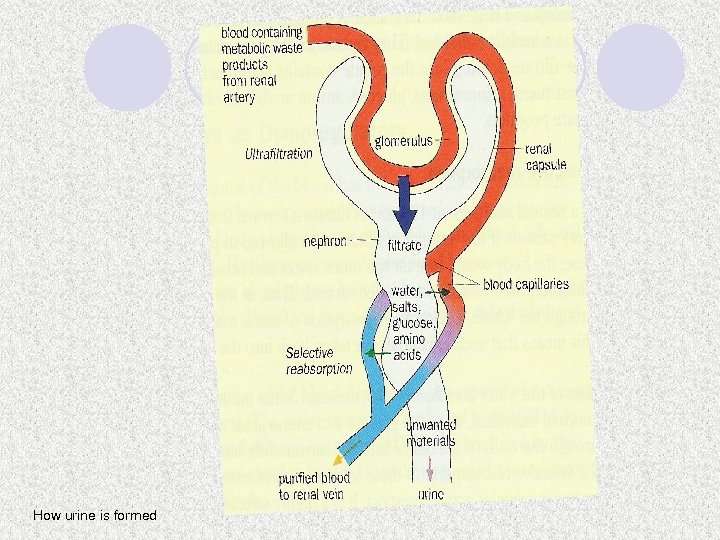 How urine is formed
 Selective Reabsorption l This takes place in the kidney tubules / nephrons. l The useful materials are taken back into the blood stream through the capillaries which surround the tubules.
 Selective Reabsorption at the Proximal Convoluted Tubule l These include all the glucose, amino acids and most mineral salts. l It is by diffusion and active transport. l Most of the water is reabsorbed by osmosis back into the blood stream (through surrounding blood capillaries).
 Selective Reabsorption at the Loop of Henle and Distal Convoluted Tubule l Some of the water is reabsorbed back into the blood stream (through surrounding blood capillaries).
 Selective Reabsorption at the Distal Convoluted Tubule l Some salts are reabsorbed.
 Selective Reabsorption at the Conducting Duct l Some water is reabsorbed.
 Selective Reabsorption l Excess water, mineral salts, and nitrogenous wastes (e. g. urea, uric acid and creatinine) pass out of the collecting duct into the renal pelvis as urine.
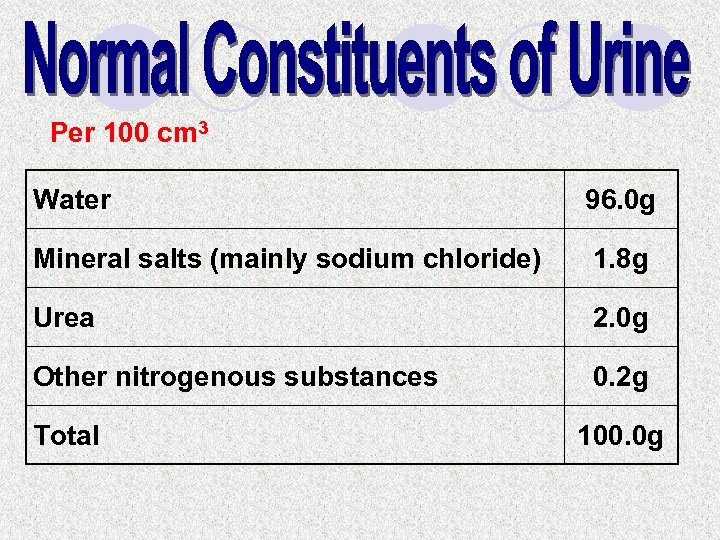 Per 100 cm 3 Water 96. 0 g Mineral salts (mainly sodium chloride) 1. 8 g Urea 2. 0 g Other nitrogenous substances 0. 2 g Total 100. 0 g
 Composition of urine Varies depending on several factors: l Rich protein diet higher content of urea l Heavy sugary food in the diet some sugar in urine l Larger intake of fluid urine lighter in colour ; more urine l Cold weather (less sweat) more urine l Salty food in the diet excess salt excreted in urine Abnormal situation l Sugar diabetes (diabetes mellitus) – large amounts of glucose in urine
 Kidneys as Osmoregulators l The water potential of the blood has to be kept relatively constant. l If the blood plasma is too dilute, water will enter the blood cells by osmosis and the blood cells will swell and burst. l If the blood plasma is too concentrated, water will leave the blood cells by osmosis and the blood cells will become dehydrated and shrink (may be fatal).
 Kidneys as Osmoregulators l The water potential of the blood depends on the amount of water and salts in the plasma. l Kidneys help to regulate the water or salt concentration in the blood, thus maintaining a constant water potential in the body.
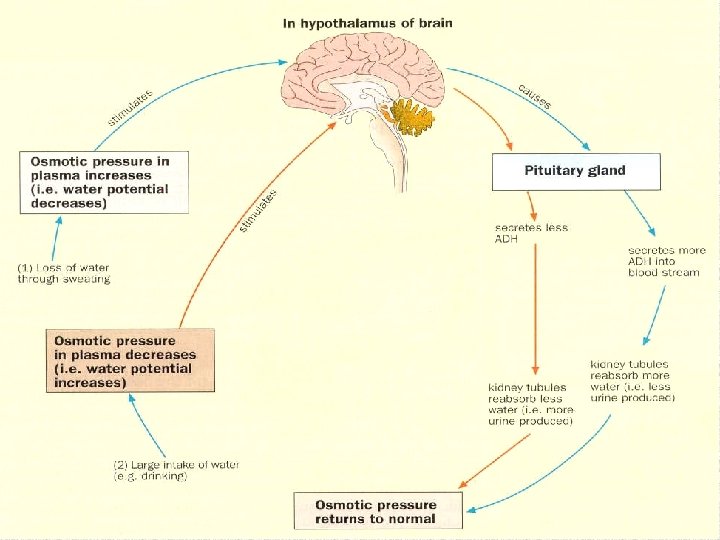
 Osmoregulation by kidneys – an example of Homeostasis l If the water content of the blood is lower than usual (through heavy perspiration), the additional quantities of water needed are taken in through the tubule. How?
 Osmoregulation by kidneys – an example of Homeostasis l Hypothalamus of the brain produces vasopressin or antidiuretic hormone (ADH). l Dehydration of the body is detected by the hypothalamus. l The pituitary gland is stimulated to release ADH into bloodstream to increase the water reabsorption by the kidney tubules.
 Osmoregulation by kidneys – an example of Homeostasis l Water content of the blood is thus restored. l Urine production drops and urine becomes more concentrated.
 Osmoregulation by kidneys – an example of Homeostasis l If the blood becomes too diluted (large intake of water), the secretion of ADH is inhibited. l The tubules will reabsorb less water. l Urine production increases and urine becomes less concentrated.
 Summary of the Functions l Excretion of metabolic wastes, especially the nitrogenous wastes (e. g. urea), & excess water, mineral salts. l Regulation of composition of the blood plasma – by the selective reabsorption of useful substances (salts and water) along the kidney tubules.
 Summary of the Functions l Regulating the water content (see osmoregulation). l Regulating the salt content. If there is too much sodium chloride in the plasma, less of them is reabsorbed from the glomerulus filtrate.
 Summary of the Functions l Regulating the p. H of the blood to be around p. H 7. 3 to 7. 4 by the exchange of ions when the acidity or alkalinity of the blood tends to rise. (p. H of urine can vary from 4. 5 – 8. 5).
 Kidney Failure l High blood pressure and diabetes are common causes of kidney failures. l A person can still lead a normal life if only one kidney fails to function. l But if both kidneys fail to work, urea and other wastes will accumulate in the blood. The patient can die unless prompt medical treatment is given. l Treatment: Dialysis or kidney transplant.
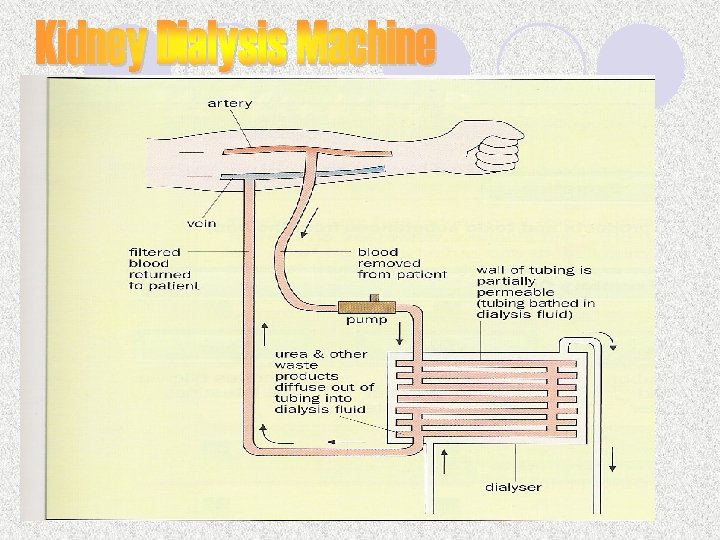
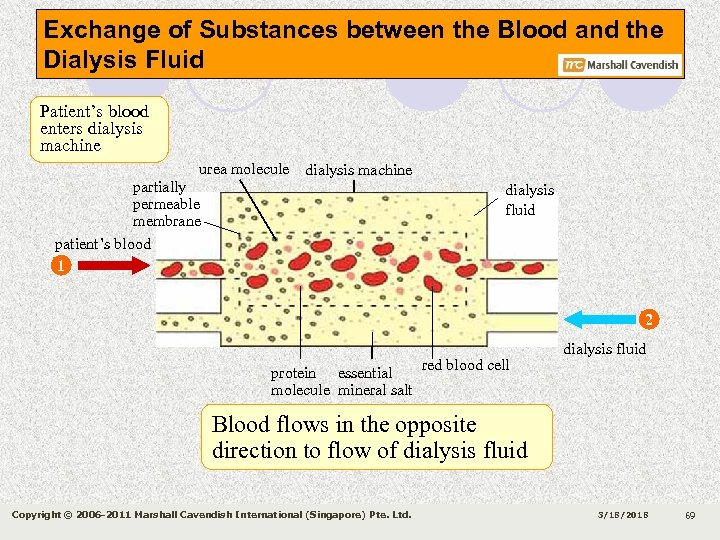
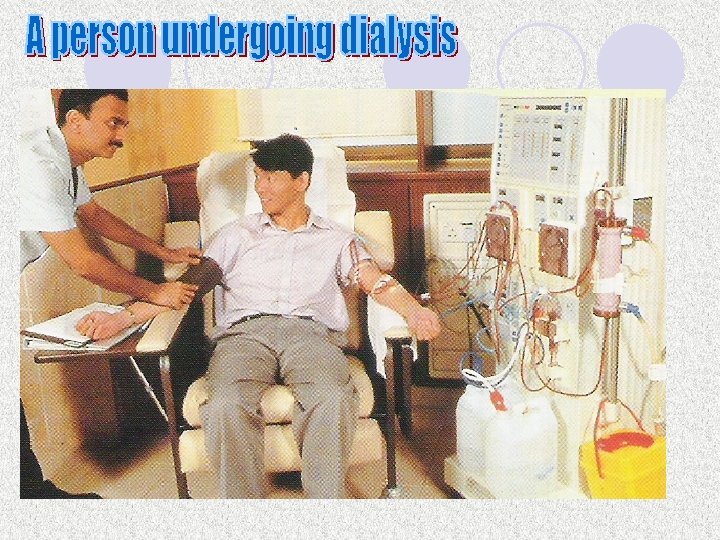
 Dialysis or Kidney Machine l What the kidney performs by ultrafiltration and selective reabsorption, a kidney machine performs in one step – diffusion. l Blood is drawn from an artery in the patient’s arm and allowed to be pumped through the tubing in the dialysis machine.
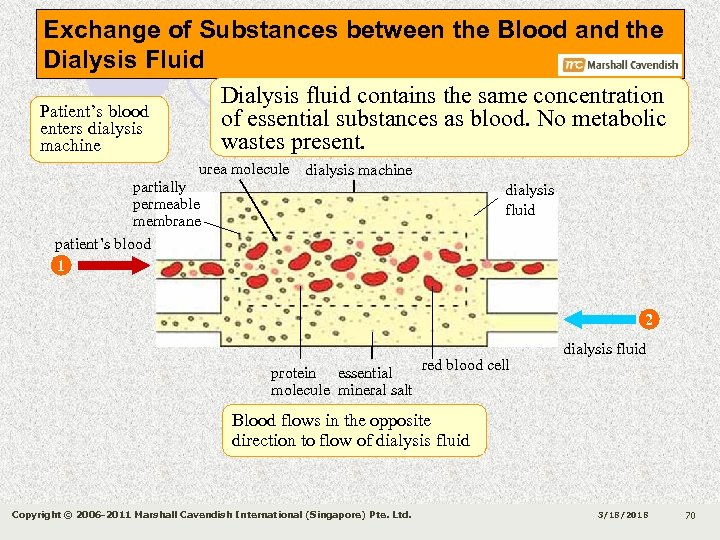
 Dialysis or Kidney Machine l The tubing is bathed in a dialysis fluid which contains the same concentration of essential substances (e. g. mineral salts) as the blood, but without metabolic waste products. l The walls of the tubing are partially permeable.
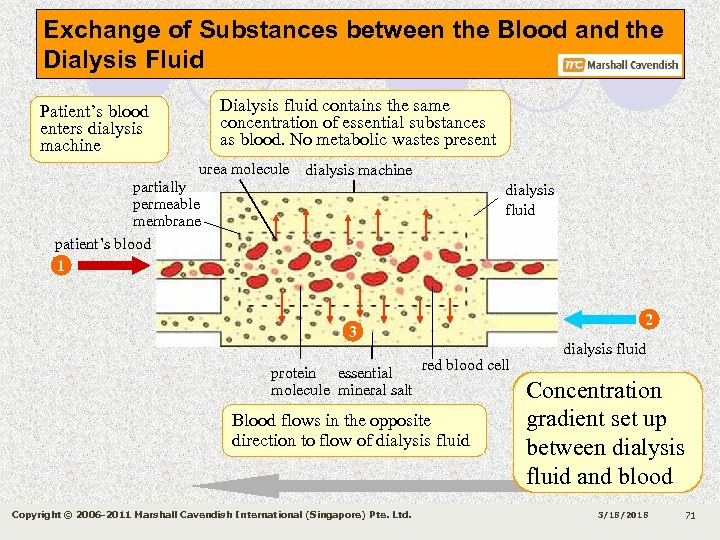
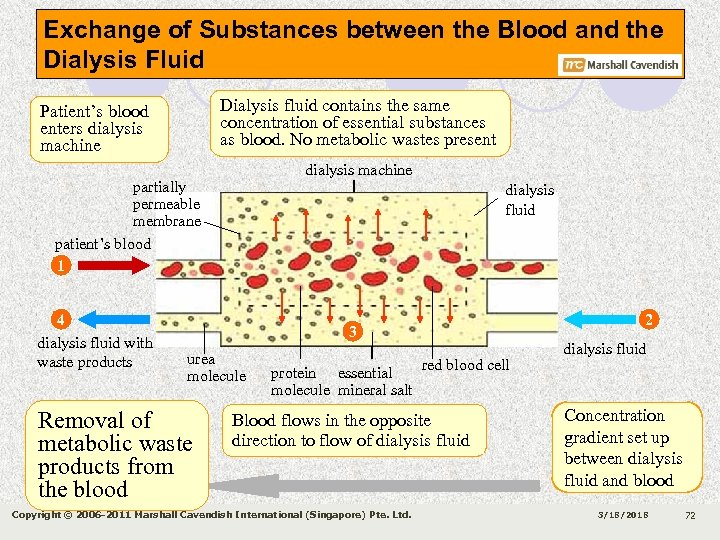
 Dialysis or Kidney Machine l Substances pass from a higher concentration to a lower concentration along a concentration gradient through this membrane (dialysis membrane). l Since there is no urea, uric acid and creatinine in the dialysis fluid, they diffuse out of the tubing into the dialysis fluid. Excess water and mineral salts also diffuse out of the tubing. These waste products are thus removed from the blood.
 Dialysis or Kidney Machine l Big molecules like proteins and blood cells remain in the blood. l This process is called dialysis, hence the name dialysis machine.
 Dialysis or Kidney Machine Other points to take note: l The tubing is narrow, long and coiled to increase the surface area to volume ratio. This speeds up the rate of exchange of substances between the blood and the dialysis fluid.
 Dialysis or Kidney Machine l The direction of blood flow is opposite to the flow of the dialysis fluid. This maintains the concentration/diffusion gradient for the removal of waste products. l The filtered blood is then returned to a vein in the patient’s arm.
 Dialysis or Kidney Machine l The patient needs to be treated about 2 -3 times a week. Each treatment takes several hours.
 Exchange of Substances between the Blood and the Dialysis Fluid 3/18/2018
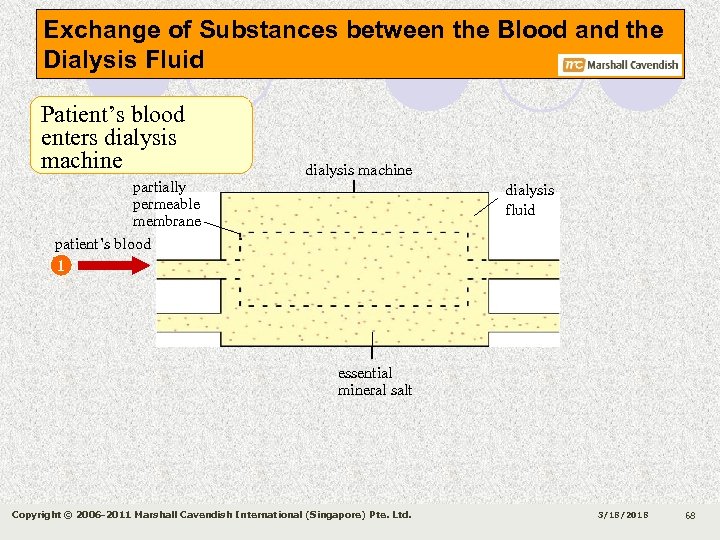 Exchange of Substances between the Blood and the Dialysis Fluid Patient’s blood enters dialysis machine partially permeable membrane patient’s blood 1 dialysis machine dialysis fluid essential mineral salt Copyright © 2006 -2011 Marshall Cavendish International (Singapore) Pte. Ltd. 3/18/2018 68
 Exchange of Substances between the Blood and the Dialysis Fluid Patient’s blood enters dialysis machine urea molecule dialysis machine partially permeable membrane patient’s blood 1 dialysis fluid 2 red blood cell protein essential molecule mineral salt dialysis fluid Blood flows in the opposite direction to flow of dialysis fluid Copyright © 2006 -2011 Marshall Cavendish International (Singapore) Pte. Ltd. 3/18/2018 69
 Exchange of Substances between the Blood and the Dialysis Fluid Dialysis fluid contains the same concentration Patient’s blood of essential substances as blood. No metabolic enters dialysis wastes present. machine urea molecule dialysis machine partially permeable membrane patient’s blood 1 dialysis fluid 2 red blood cell protein essential molecule mineral salt dialysis fluid Blood flows in the opposite direction to flow of dialysis fluid Copyright © 2006 -2011 Marshall Cavendish International (Singapore) Pte. Ltd. 3/18/2018 70
 Exchange of Substances between the Blood and the Dialysis Fluid Dialysis fluid contains the same concentration of essential substances as blood. No metabolic wastes present Patient’s blood enters dialysis machine urea molecule dialysis machine partially permeable membrane patient’s blood 1 dialysis fluid 3 red blood cell protein essential molecule mineral salt Blood flows in the opposite direction to flow of dialysis fluid Copyright © 2006 -2011 Marshall Cavendish International (Singapore) Pte. Ltd. 2 dialysis fluid Concentration gradient set up between dialysis fluid and blood 3/18/2018 71
 Exchange of Substances between the Blood and the Dialysis Fluid Dialysis fluid contains the same concentration of essential substances as blood. No metabolic wastes present Patient’s blood enters dialysis machine partially permeable membrane patient’s blood 1 4 dialysis fluid with waste products dialysis fluid 3 urea molecule Removal of metabolic waste products from the blood red blood cell protein essential molecule mineral salt Blood flows in the opposite direction to flow of dialysis fluid Copyright © 2006 -2011 Marshall Cavendish International (Singapore) Pte. Ltd. 2 dialysis fluid Concentration gradient set up between dialysis fluid and blood 3/18/2018 72
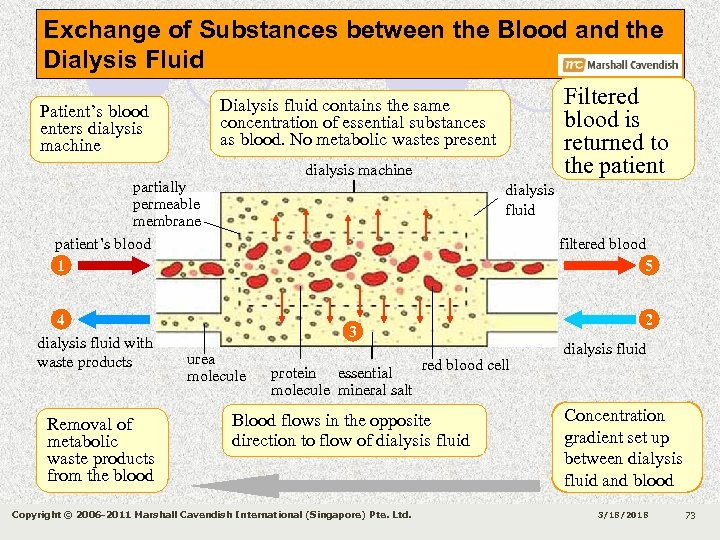 Exchange of Substances between the Blood and the Dialysis Fluid Filtered Dialysis fluid contains the same Patient’s blood is concentration of essential substances enters dialysis as blood. No metabolic wastes present returned to machine the patient dialysis machine partially permeable membrane patient’s blood 1 4 dialysis fluid with waste products Removal of metabolic waste products from the blood dialysis fluid filtered blood 5 3 urea molecule red blood cell protein essential molecule mineral salt Blood flows in the opposite direction to flow of dialysis fluid Copyright © 2006 -2011 Marshall Cavendish International (Singapore) Pte. Ltd. 2 dialysis fluid Concentration gradient set up between dialysis fluid and blood 3/18/2018 73
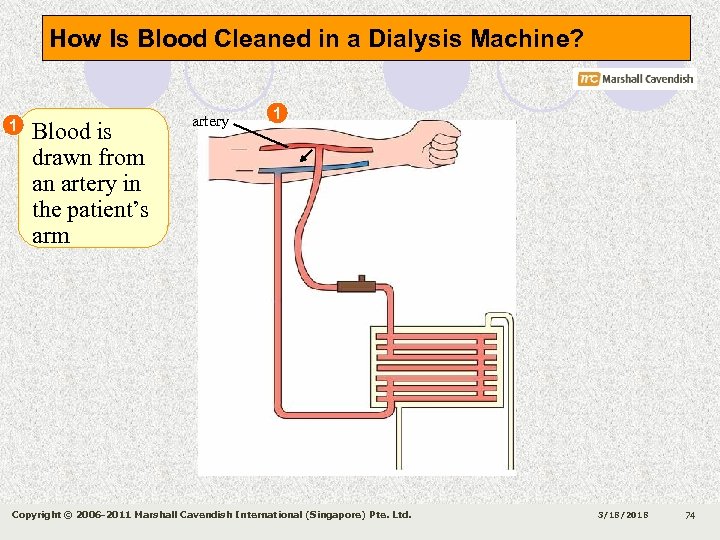 How Is Blood Cleaned in a Dialysis Machine? 1 Blood is drawn from an artery in the patient’s arm artery 1 Copyright © 2006 -2011 Marshall Cavendish International (Singapore) Pte. Ltd. 3/18/2018 74
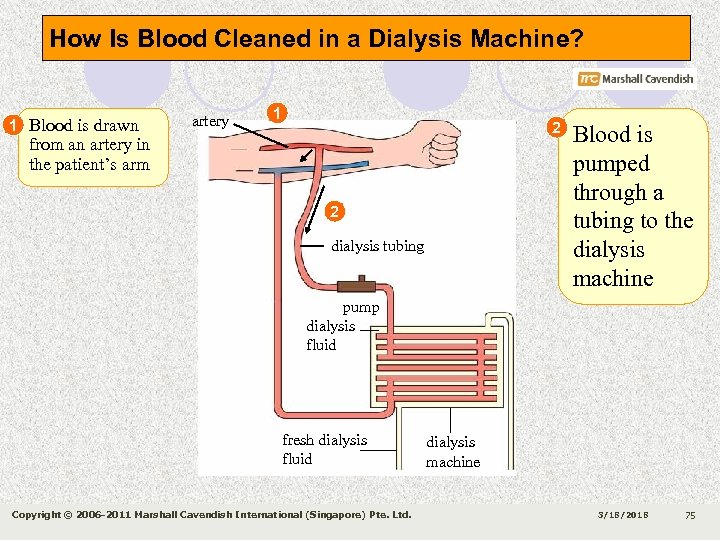 How Is Blood Cleaned in a Dialysis Machine? 1 Blood is drawn artery 1 2 from an artery in the patient’s arm 2 dialysis tubing Blood is pumped through a tubing to the dialysis machine pump dialysis fluid fresh dialysis fluid Copyright © 2006 -2011 Marshall Cavendish International (Singapore) Pte. Ltd. dialysis machine 3/18/2018 75
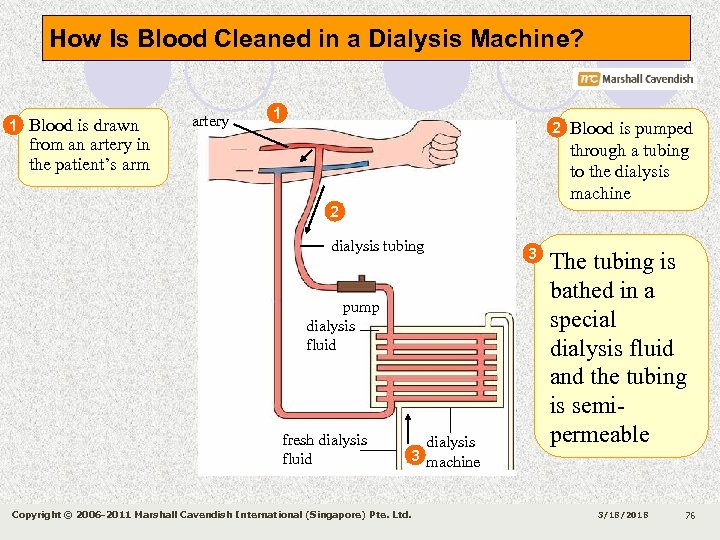 How Is Blood Cleaned in a Dialysis Machine? 1 Blood is drawn artery 1 2 Blood is pumped from an artery in the patient’s arm through a tubing to the dialysis machine 2 dialysis tubing pump dialysis fluid fresh dialysis fluid dialysis 3 machine Copyright © 2006 -2011 Marshall Cavendish International (Singapore) Pte. Ltd. 3 The tubing is bathed in a special dialysis fluid and the tubing is semipermeable 3/18/2018 76
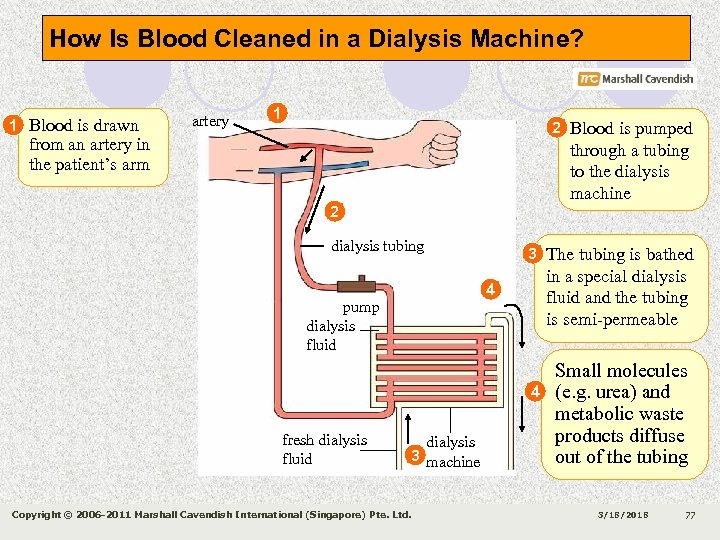 How Is Blood Cleaned in a Dialysis Machine? 1 Blood is drawn artery 1 2 Blood is pumped from an artery in the patient’s arm through a tubing to the dialysis machine 2 dialysis tubing 3 The tubing is bathed in a special dialysis fluid and the tubing is semi-permeable 4 pump dialysis fluid 4 fresh dialysis fluid dialysis 3 machine Copyright © 2006 -2011 Marshall Cavendish International (Singapore) Pte. Ltd. Small molecules (e. g. urea) and metabolic waste products diffuse out of the tubing 3/18/2018 77
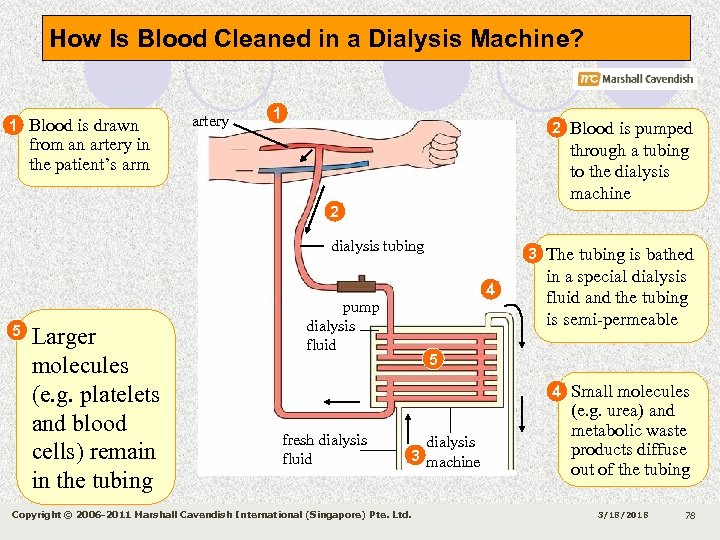 How Is Blood Cleaned in a Dialysis Machine? 1 Blood is drawn artery 1 2 Blood is pumped from an artery in the patient’s arm through a tubing to the dialysis machine 2 dialysis tubing 5 Larger molecules (e. g. platelets and blood cells) remain in the tubing 3 The tubing is bathed 4 pump dialysis fluid in a special dialysis fluid and the tubing is semi-permeable 5 4 Small molecules fresh dialysis fluid dialysis 3 machine Copyright © 2006 -2011 Marshall Cavendish International (Singapore) Pte. Ltd. (e. g. urea) and metabolic waste products diffuse out of the tubing 3/18/2018 78
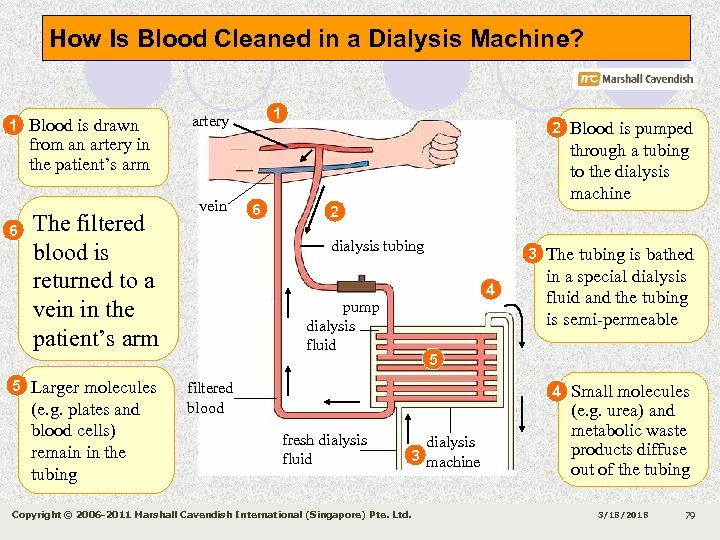 How Is Blood Cleaned in a Dialysis Machine? 1 Blood is drawn 1 artery 2 Blood is pumped from an artery in the patient’s arm 6 The filtered blood is returned to a vein in the patient’s arm 5 Larger molecules (e. g. plates and blood cells) remain in the tubing vein 6 through a tubing to the dialysis machine 2 dialysis tubing 3 The tubing is bathed 4 pump dialysis fluid in a special dialysis fluid and the tubing is semi-permeable 5 filtered blood 4 Small molecules fresh dialysis fluid dialysis 3 machine Copyright © 2006 -2011 Marshall Cavendish International (Singapore) Pte. Ltd. (e. g. urea) and metabolic waste products diffuse out of the tubing 3/18/2018 79
 Excretion is a process by which metabolic waste products and toxic materials are removed from an organism’s body Copyright © 2006 -2011 Marshall Cavendish International (Singapore) Pte. Ltd. 3/18/2018 81
 Excretion is carried out by Excretory Organs Copyright © 2006 -2011 Marshall Cavendish International (Singapore) Pte. Ltd. 3/18/2018 82
 Excretion is carried out by Excretory Organs Lungs Copyright © 2006 -2011 Marshall Cavendish International (Singapore) Pte. Ltd. 3/18/2018 83
 Excretion is carried out by Excretory Organs Lungs Excrete carbon dioxide and water (water vapour) Copyright © 2006 -2011 Marshall Cavendish International (Singapore) Pte. Ltd. 3/18/2018 84
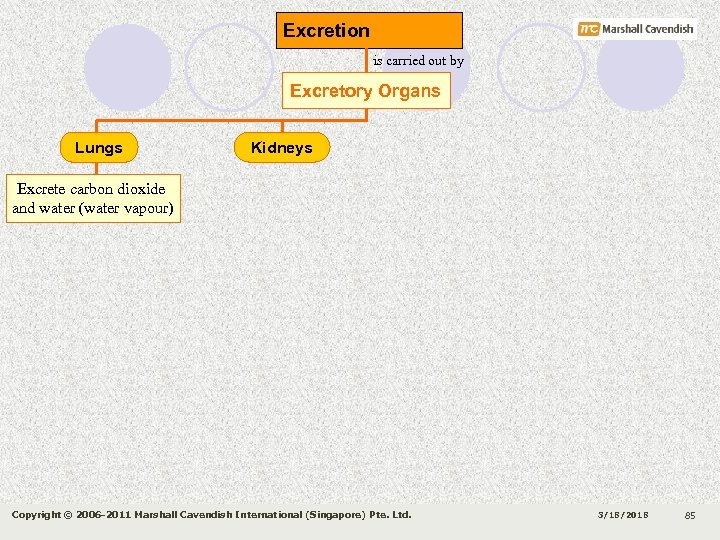 Excretion is carried out by Excretory Organs Lungs Kidneys Excrete carbon dioxide and water (water vapour) Copyright © 2006 -2011 Marshall Cavendish International (Singapore) Pte. Ltd. 3/18/2018 85
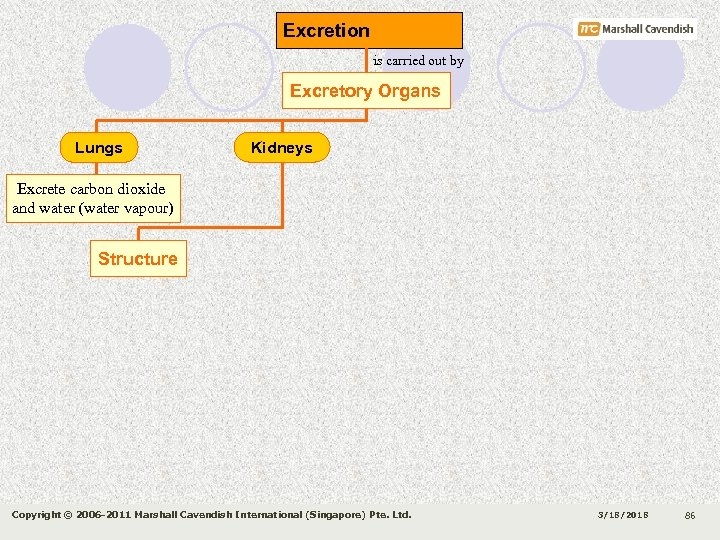 Excretion is carried out by Excretory Organs Lungs Kidneys Excrete carbon dioxide and water (water vapour) Structure Copyright © 2006 -2011 Marshall Cavendish International (Singapore) Pte. Ltd. 3/18/2018 86
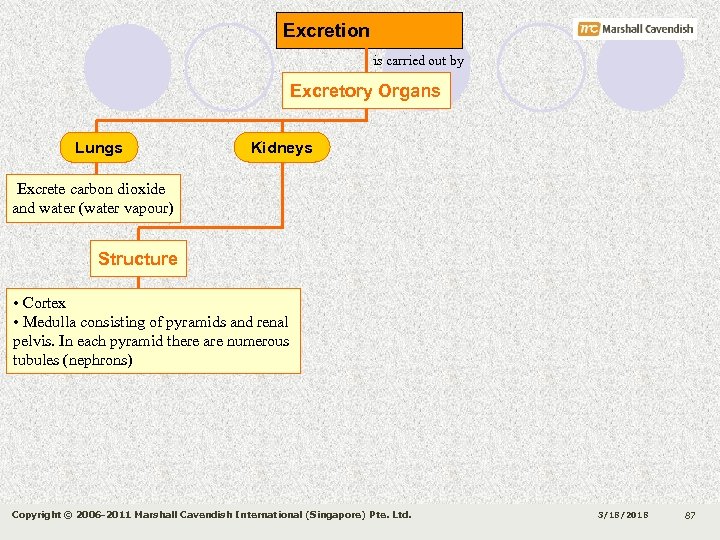 Excretion is carried out by Excretory Organs Lungs Kidneys Excrete carbon dioxide and water (water vapour) Structure • Cortex • Medulla consisting of pyramids and renal pelvis. In each pyramid there are numerous tubules (nephrons) Copyright © 2006 -2011 Marshall Cavendish International (Singapore) Pte. Ltd. 3/18/2018 87
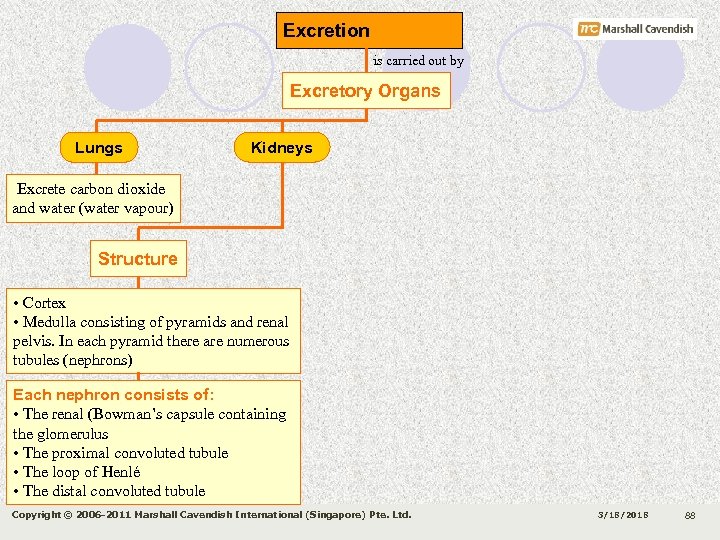 Excretion is carried out by Excretory Organs Lungs Kidneys Excrete carbon dioxide and water (water vapour) Structure • Cortex • Medulla consisting of pyramids and renal pelvis. In each pyramid there are numerous tubules (nephrons) Each nephron consists of: • The renal (Bowman’s capsule containing the glomerulus • The proximal convoluted tubule • The loop of Henlé • The distal convoluted tubule Copyright © 2006 -2011 Marshall Cavendish International (Singapore) Pte. Ltd. 3/18/2018 88
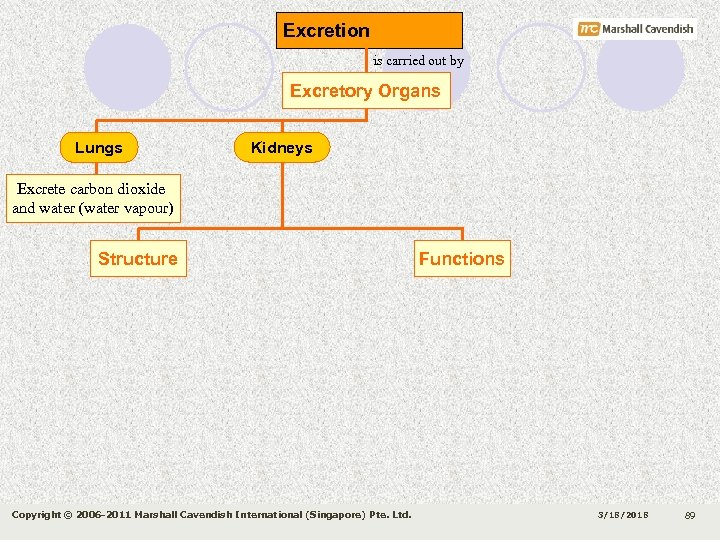 Excretion is carried out by Excretory Organs Lungs Kidneys Excrete carbon dioxide and water (water vapour) Structure Copyright © 2006 -2011 Marshall Cavendish International (Singapore) Pte. Ltd. Functions 3/18/2018 89
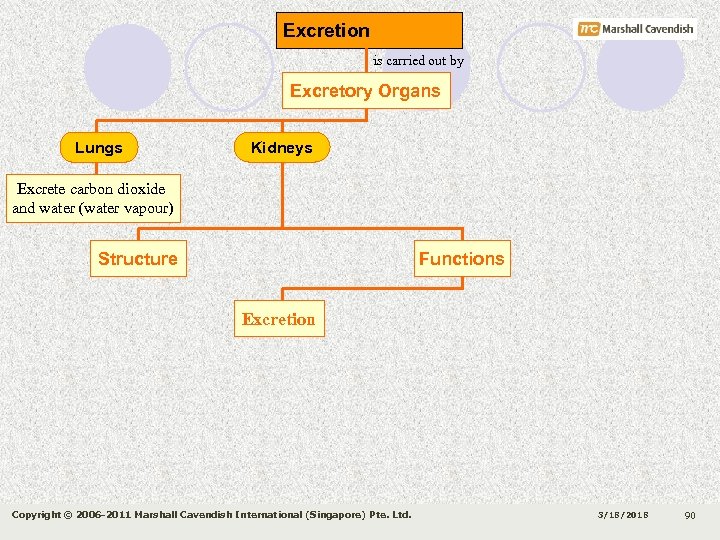 Excretion is carried out by Excretory Organs Lungs Kidneys Excrete carbon dioxide and water (water vapour) Structure Functions Excretion Copyright © 2006 -2011 Marshall Cavendish International (Singapore) Pte. Ltd. 3/18/2018 90
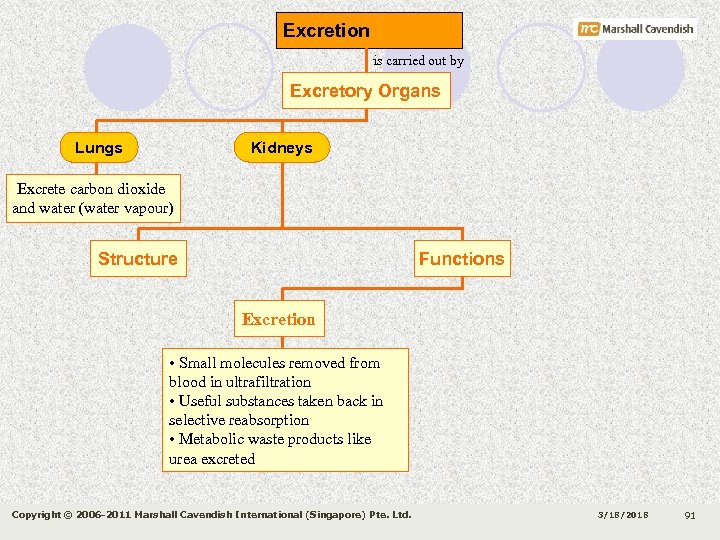 Excretion is carried out by Excretory Organs Lungs Kidneys Excrete carbon dioxide and water (water vapour) Structure Functions Excretion • Small molecules removed from blood in ultrafiltration • Useful substances taken back in selective reabsorption • Metabolic waste products like urea excreted Copyright © 2006 -2011 Marshall Cavendish International (Singapore) Pte. Ltd. 3/18/2018 91
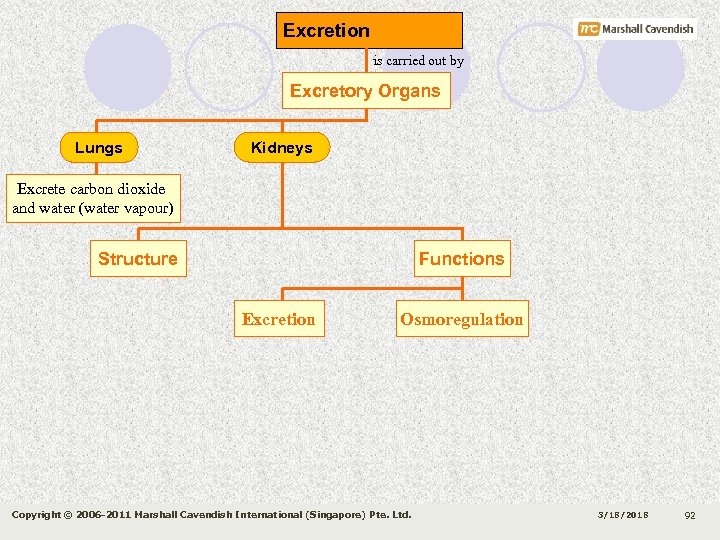 Excretion is carried out by Excretory Organs Lungs Kidneys Excrete carbon dioxide and water (water vapour) Structure Functions Excretion Osmoregulation Copyright © 2006 -2011 Marshall Cavendish International (Singapore) Pte. Ltd. 3/18/2018 92
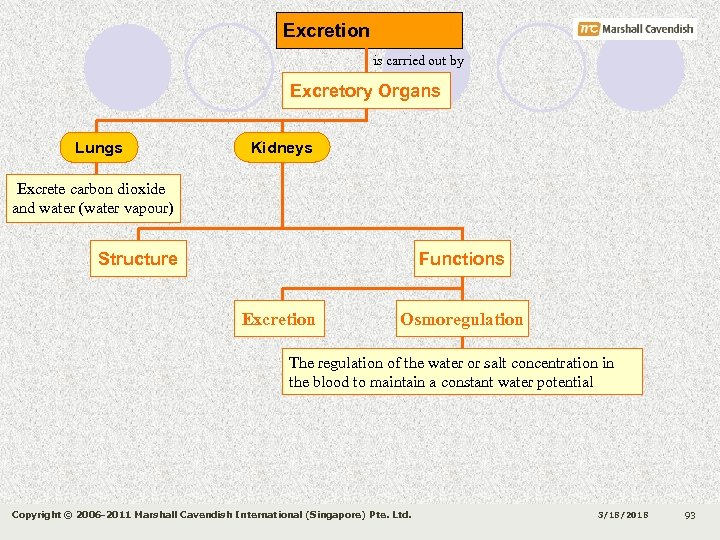 Excretion is carried out by Excretory Organs Lungs Kidneys Excrete carbon dioxide and water (water vapour) Structure Functions Excretion Osmoregulation The regulation of the water or salt concentration in the blood to maintain a constant water potential Copyright © 2006 -2011 Marshall Cavendish International (Singapore) Pte. Ltd. 3/18/2018 93
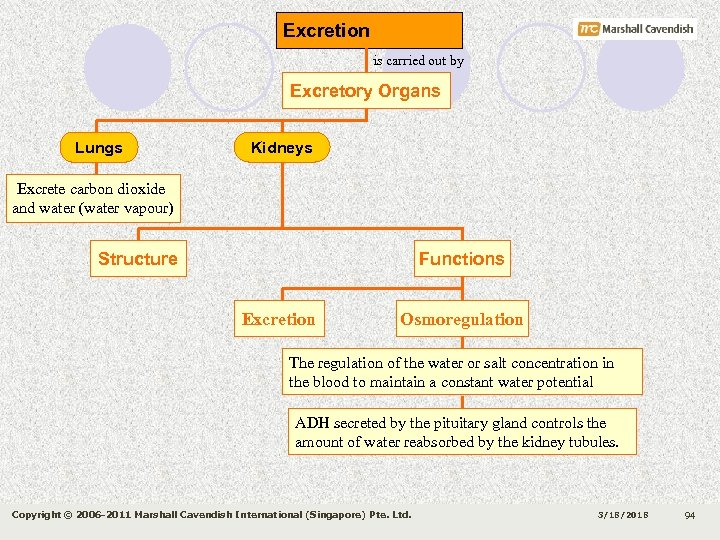 Excretion is carried out by Excretory Organs Lungs Kidneys Excrete carbon dioxide and water (water vapour) Structure Functions Excretion Osmoregulation The regulation of the water or salt concentration in the blood to maintain a constant water potential ADH secreted by the pituitary gland controls the amount of water reabsorbed by the kidney tubules. Copyright © 2006 -2011 Marshall Cavendish International (Singapore) Pte. Ltd. 3/18/2018 94
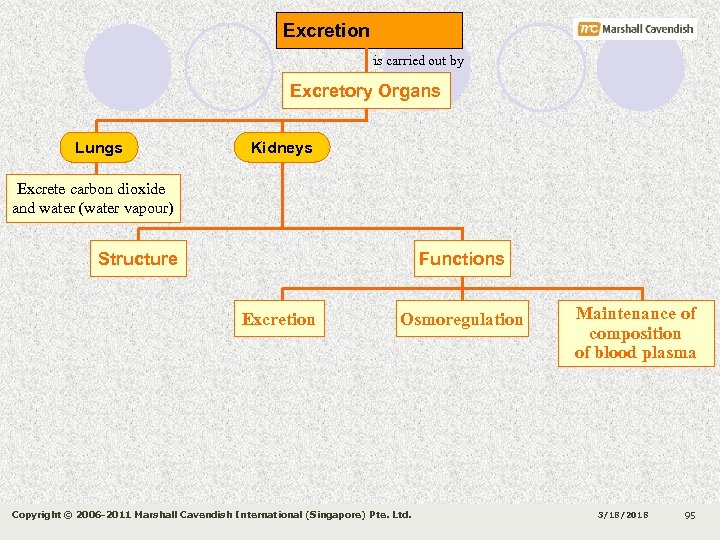 Excretion is carried out by Excretory Organs Lungs Kidneys Excrete carbon dioxide and water (water vapour) Structure Functions Excretion Osmoregulation Copyright © 2006 -2011 Marshall Cavendish International (Singapore) Pte. Ltd. Maintenance of composition of blood plasma 3/18/2018 95
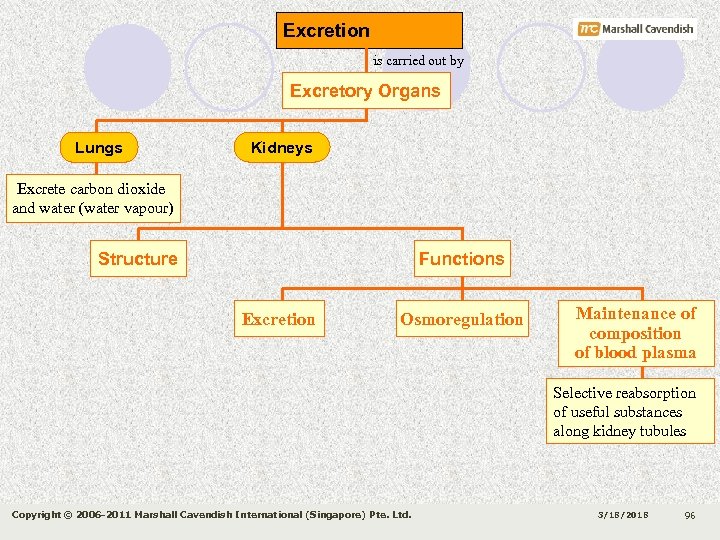 Excretion is carried out by Excretory Organs Lungs Kidneys Excrete carbon dioxide and water (water vapour) Structure Functions Excretion Osmoregulation Maintenance of composition of blood plasma Selective reabsorption of useful substances along kidney tubules Copyright © 2006 -2011 Marshall Cavendish International (Singapore) Pte. Ltd. 3/18/2018 96
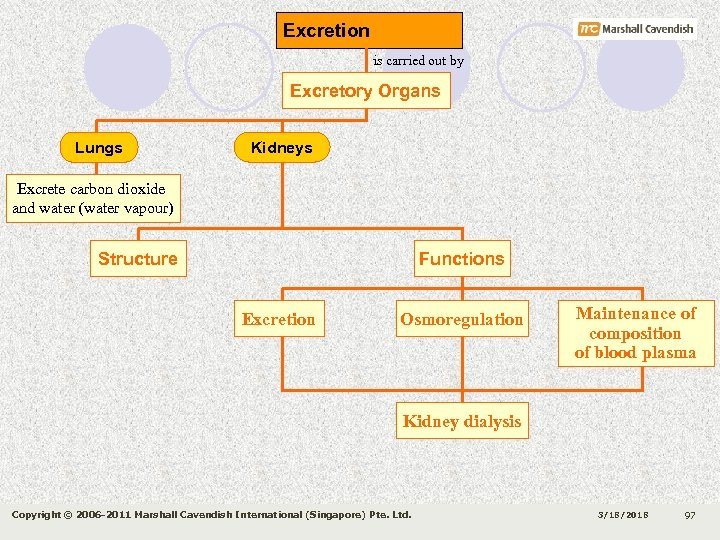 Excretion is carried out by Excretory Organs Lungs Kidneys Excrete carbon dioxide and water (water vapour) Structure Functions Excretion Osmoregulation Maintenance of composition of blood plasma Kidney dialysis Copyright © 2006 -2011 Marshall Cavendish International (Singapore) Pte. Ltd. 3/18/2018 97
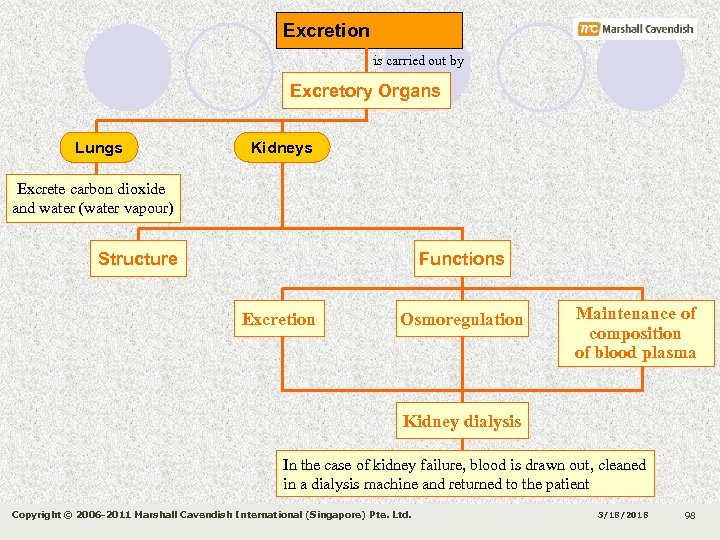 Excretion is carried out by Excretory Organs Lungs Kidneys Excrete carbon dioxide and water (water vapour) Structure Functions Excretion Osmoregulation Maintenance of composition of blood plasma Kidney dialysis In the case of kidney failure, blood is drawn out, cleaned in a dialysis machine and returned to the patient Copyright © 2006 -2011 Marshall Cavendish International (Singapore) Pte. Ltd. 3/18/2018 98
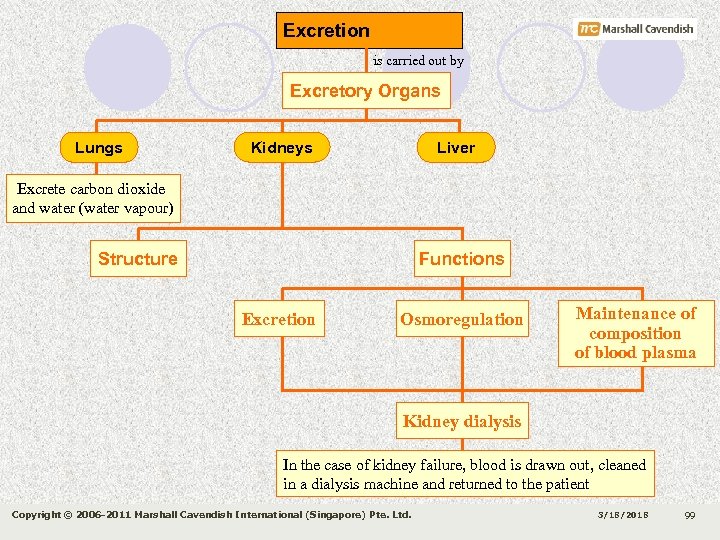 Excretion is carried out by Excretory Organs Lungs Kidneys Liver Excrete carbon dioxide and water (water vapour) Structure Functions Excretion Osmoregulation Maintenance of composition of blood plasma Kidney dialysis In the case of kidney failure, blood is drawn out, cleaned in a dialysis machine and returned to the patient Copyright © 2006 -2011 Marshall Cavendish International (Singapore) Pte. Ltd. 3/18/2018 99
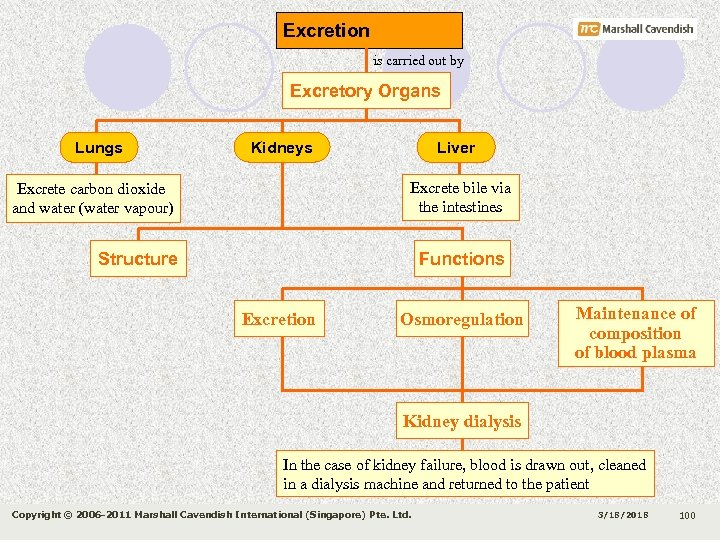 Excretion is carried out by Excretory Organs Lungs Kidneys Liver Excrete bile via the intestines Excrete carbon dioxide and water (water vapour) Structure Functions Excretion Osmoregulation Maintenance of composition of blood plasma Kidney dialysis In the case of kidney failure, blood is drawn out, cleaned in a dialysis machine and returned to the patient Copyright © 2006 -2011 Marshall Cavendish International (Singapore) Pte. Ltd. 3/18/2018 100
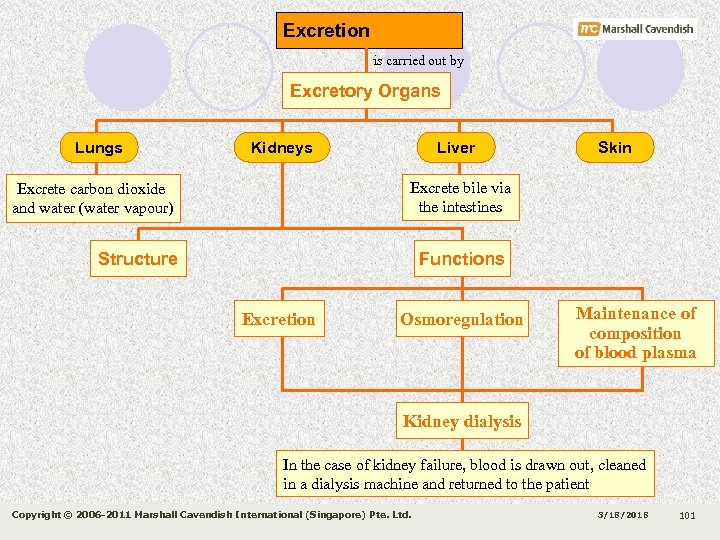 Excretion is carried out by Excretory Organs Lungs Kidneys Liver Skin Excrete bile via the intestines Excrete carbon dioxide and water (water vapour) Structure Functions Excretion Osmoregulation Maintenance of composition of blood plasma Kidney dialysis In the case of kidney failure, blood is drawn out, cleaned in a dialysis machine and returned to the patient Copyright © 2006 -2011 Marshall Cavendish International (Singapore) Pte. Ltd. 3/18/2018 101
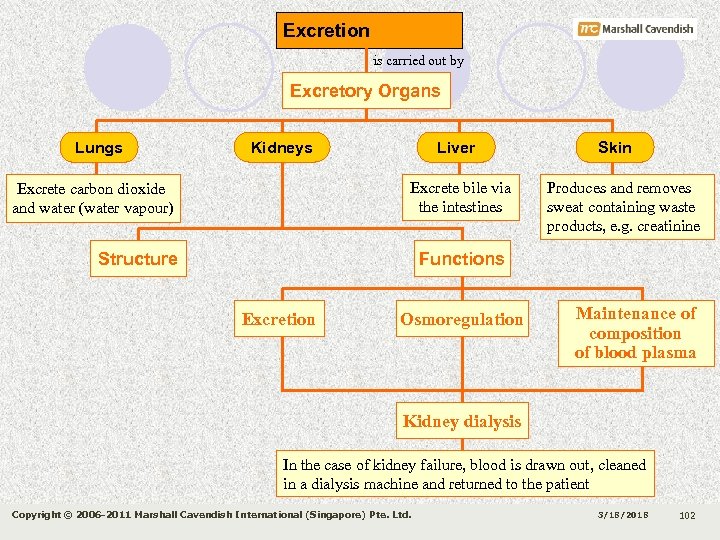 Excretion is carried out by Excretory Organs Lungs Kidneys Liver Excrete bile via the intestines Excrete carbon dioxide and water (water vapour) Structure Skin Produces and removes sweat containing waste products, e. g. creatinine Functions Excretion Osmoregulation Maintenance of composition of blood plasma Kidney dialysis In the case of kidney failure, blood is drawn out, cleaned in a dialysis machine and returned to the patient Copyright © 2006 -2011 Marshall Cavendish International (Singapore) Pte. Ltd. 3/18/2018 102