


 Скачать презентацию Chapter 10 Systems Development 2008 Pearson Prentice
f902d31ea89ac16a0019c74a216b6cc3.ppt
- Количество слайдов: 23
 Chapter 10 Systems Development © 2008 Pearson Prentice Hall, Experiencing MIS, David Kroenke
 This Could Happen to You l Dee wanted to develop a blog for communication – – – Focused goal Short time frame Was successful because system was simple l l l RFID at DSI more sophisticated – – 2 Single contributor No user training Vendors would need to place RFID chips Computer program would be needed to process data © 2008 Pearson Prentice Hall, Experiencing MIS, David Kroenke
 Study Questions l l l l l 3 What is systems development? Why is systems development difficult and risky? What are the five phases of the systems development life cycle? How is systems definition accomplished? What is the user’s role in the requirements phase? How are the five components designed? How is an information system implemented? What are the tasks for systems maintenance? What are the problems with SDLC? How does the knowledge from this chapter help DSI? © 2008 Pearson Prentice Hall, Experiencing MIS, David Kroenke
 Systems Development l l Systems analysis and design Process of creating and maintaining information systems – – Development involves all five components Requires more than programming or technical expertise l l Information systems are never off-the-shelf – 4 Human relation skills Business knowledge Understanding of group dynamics Must be adapted to fit needs of business and people © 2008 Pearson Prentice Hall, Experiencing MIS, David Kroenke
 MIS in Use: Thinking Big about Systems Development l Large scale corporate information systems are more complex – – – l l 5 Need to ensure all employees are working toward same goals Must develop system that will function consistently in different languages May need to store information on worldwide use of product and the relevant laws Most information systems are process-design oriented Must be carefully planned and executed © 2008 Pearson Prentice Hall, Experiencing MIS, David Kroenke
 Major Development Challenges l l l Difficulty of determining requirements Requirements change as system develops Scheduling and budgeting difficult to estimate – l l Technology changes Diseconomies of scale – 6 Change as scope changes Brook’s Law © 2008 Pearson Prentice Hall, Experiencing MIS, David Kroenke
 Systems Development Processes l Methodologies: – – l Systems development life cycle (SDLC) Rapid application development (RAD) Object-oriented systems development (OOD) Extreme programming (XP) No single process works in all situations – – Different requirements Some systems wholly automated, others not l 7 Use augmentation system to fill gaps © 2008 Pearson Prentice Hall, Experiencing MIS, David Kroenke
 SDLC l Classical process with five phases: – Systems definition l – Requirements analysis l – Implement, test, and install new system System maintenance l 8 Based on approved user requirements Implementation l – Identify features and functions Component design l – Management’s statement defines new system Repair, add new features, maintain © 2008 Pearson Prentice Hall, Experiencing MIS, David Kroenke
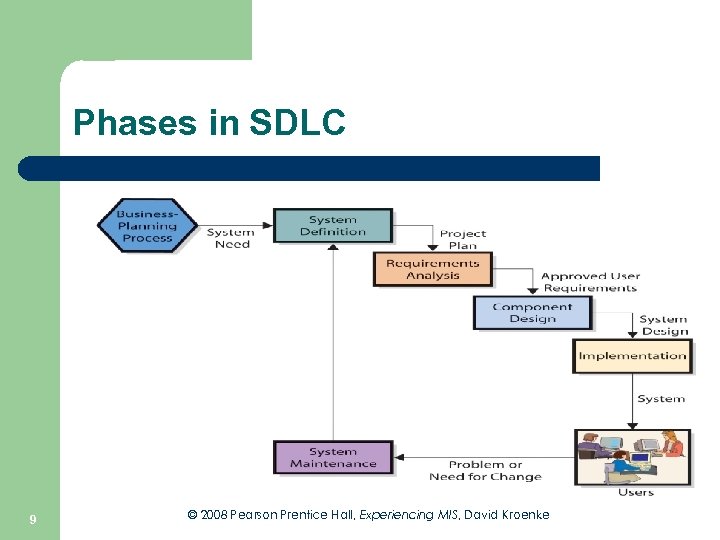 Phases in SDLC Figure 10 -2 9 © 2008 Pearson Prentice Hall, Experiencing MIS, David Kroenke
 Systems Definition l Define goals and purpose for new system – – – l Determine project’s scope – l May be delineated by users, processes, or facilities Assess feasibility of project – – 10 Must facilitate organization’s competitive strategy Supports business processes Improves decision making Cost Schedule Technical Organizational feasibility © 2008 Pearson Prentice Hall, Experiencing MIS, David Kroenke
 Systems Definition, continued l If deemed feasible, project team created from IT personnel and users – – 11 Managers Systems analysts Programmers and software testers Users © 2008 Pearson Prentice Hall, Experiencing MIS, David Kroenke
 Ethics Guide: Estimation Ethics l Buy-ins – Companies agree to produce products for less than it knows will be required l l – In-house projects are often started with buy-ins l l l – 12 “Time and materials” contracts Fixed-cost contracts Projects started with hopes of more money later Team members may disagree about costs Not all costs may have been included in estimate Also may have buy-in on schedule © 2008 Pearson Prentice Hall, Experiencing MIS, David Kroenke
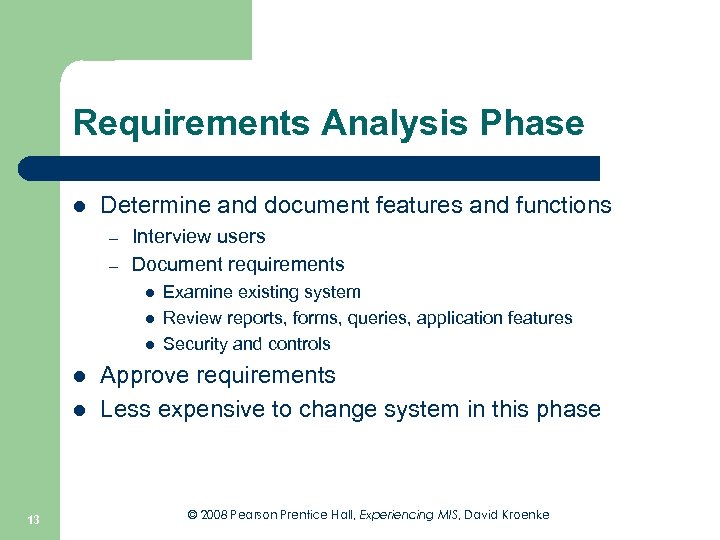 Requirements Analysis Phase l Determine and document features and functions – – Interview users Document requirements l l l 13 Examine existing system Review reports, forms, queries, application features Security and controls Approve requirements Less expensive to change system in this phase © 2008 Pearson Prentice Hall, Experiencing MIS, David Kroenke
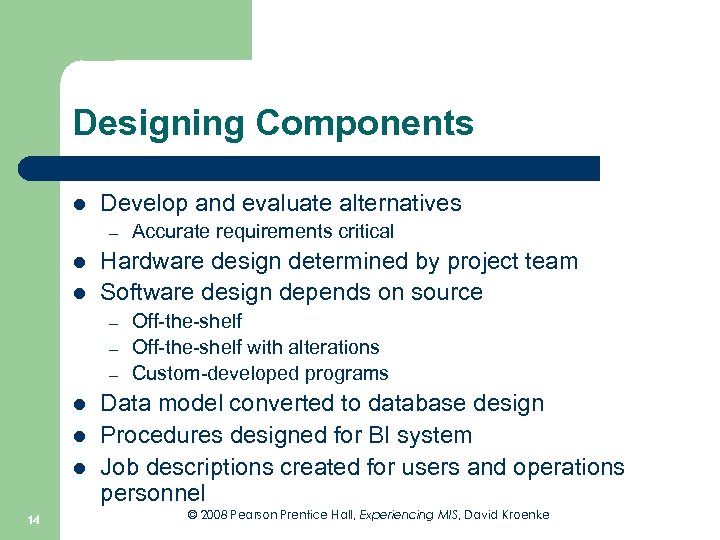 Designing Components l Develop and evaluate alternatives – l l Hardware design determined by project team Software design depends on source – – – l l l 14 Accurate requirements critical Off-the-shelf with alterations Custom-developed programs Data model converted to database design Procedures designed for BI system Job descriptions created for users and operations personnel © 2008 Pearson Prentice Hall, Experiencing MIS, David Kroenke
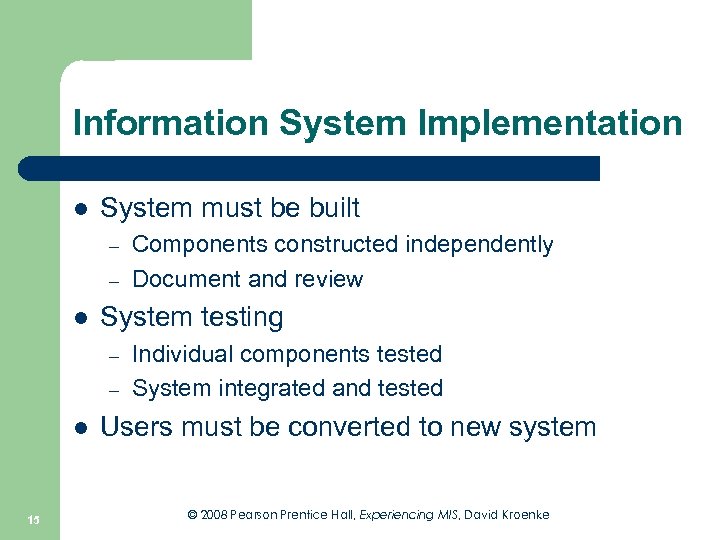 Information System Implementation l System must be built – – l System testing – – l 15 Components constructed independently Document and review Individual components tested System integrated and tested Users must be converted to new system © 2008 Pearson Prentice Hall, Experiencing MIS, David Kroenke
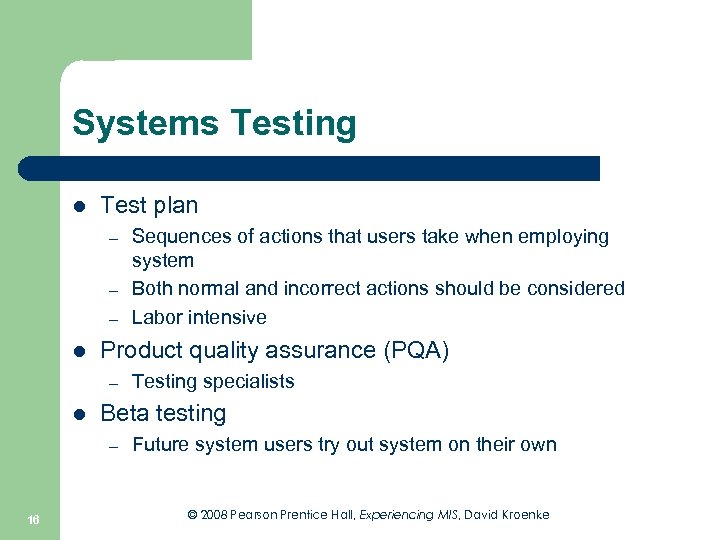 Systems Testing l Test plan – – – l Product quality assurance (PQA) – l Testing specialists Beta testing – 16 Sequences of actions that users take when employing system Both normal and incorrect actions should be considered Labor intensive Future system users try out system on their own © 2008 Pearson Prentice Hall, Experiencing MIS, David Kroenke
 System Conversion l Converting business activity from old system to new – Pilot l l l – Phased l l 17 Organization implements entire system on single, limited unit If systems fails, it only affects limited boundary Reduces exposure New system installed in phases Tested after each phase Continues until installed at entire organization Can’t be used in tightly integrated systems © 2008 Pearson Prentice Hall, Experiencing MIS, David Kroenke
 System Conversion, continued – Parallel l l – Plunge l l l 18 New system runs in parallel with old system during testing Expensive and time consuming Data must be entered twice Provides easy fallback position Direct installation Install new system and discontinue old There is no backup position © 2008 Pearson Prentice Hall, Experiencing MIS, David Kroenke
 Systems Maintenance l Fixing or adapting system – – – Need method to track system failures and enhancements Corrections usually prioritized based on severity Enhancements usually prioritized based on business decision l l 19 Must generate reasonable rate of return Decision to restart systems development process © 2008 Pearson Prentice Hall, Experiencing MIS, David Kroenke
 Problems With SDLC l SDLC waterfall – – l Difficulty in documenting requirements – l Analysis paralysis or uncertain requirements Scheduling and budget difficulties – – 20 Phases are not supposed to be repeated Often teams have need to repeat requirements and/or design phases Multiyear projects difficult to properly schedule Estimations on labor often produce insufficient budgets © 2008 Pearson Prentice Hall, Experiencing MIS, David Kroenke
 Guide: The Real Estimation Process l l l Estimating is just theory Project managers sum up estimates and take to management Management then negotiates the schedule and budget – l 21 Every change will negatively impact the project Start with optimistic schedules and end up with late projects © 2008 Pearson Prentice Hall, Experiencing MIS, David Kroenke
 How Does the Knowledge from This Chapter Help You at DSI? l You can now give a summary of the phases of SDLC – – 22 Describe tasks more specifically Create a realistic schedule © 2008 Pearson Prentice Hall, Experiencing MIS, David Kroenke
 Active Review l l l l l 23 What is systems development? Why is systems development difficult and risky? What are the five phases of the systems development life cycle? How is systems definition accomplished? What is the user’s role in the requirements phase? How are the five components designed? How is an information system implemented? What are the tasks for systems maintenance? What are the problems with SDLC? How does the knowledge from this chapter help DSI? © 2008 Pearson Prentice Hall, Experiencing MIS, David Kroenke