


 Скачать презентацию CHAPTER 10 SALES Topics for this chapter
ef8f7167b4e82670873fefa459881018.ppt
- Количество слайдов: 70
 CHAPTER 10 SALES
 Topics for this chapter: • UN Convention on Contracts for the International Sale of Goods (CISG) • Transactions Covered in CISG • Contractual Issues Excluded from Coverage of CISG • Interpreting CISG • Interpreting Sales Contracts • Formation of the Contract • General Standards for Performance • Seller’s Obligations • The Passing of Risk • Remedies • Excuses for Nonperformance
 Contract One party makes an offer that another accepts. 1. Offer(要约) 2. Acceptance(接受) 3. Consideration (in the USA)(对价) Consideration consists of a bargained for exchange (USA) or legal detriment and a bargain. – A legal detriment is a promise to do something or refrain from doing something. – A bargain is something the promisor wants.
 UN Convention on Contracts for the International Sale of Goods • • • The CISG, adopted in 1980, incorporates rules from all the major legal systems. It provides accepted substantive rules on which contracting parties, courts, and arbitrators may rely. It has been ratified by 79 countries, but has not been ratified by India and UK.
 Transactions Covered in CISG • CISG applies to contracts for international sale of goods. – The buyer and seller must have their place of business in different states. Either: 1. Both of the states must be contracting parties to the convention, or 2. The rules of private international law must lead to the application of the law of a contracting state. • A ratifying state may declare that it will apply CISG only when the buyer and seller are both from contracting states.
 Are they defined as international under CISG? • The business between a Korean citizen and a Japanese citizen? • The business is negotiated entirely in a foreign country? • Goods will be delivered to a foreign country? • Place of business of buyer’s and seller’s are in different states?
 Hypo: suppose there is a contract between two French companies. The contract is negotiated entirely within France. However, one of the companies has place of business outside France. The contract was formed with that branch and to be performed outside France. Issue: Does CISG govern this transaction? • Yes, it is “place of business” that determines “international” or not. Nationality of individuals, location of negotiation and place of delivery is not a determinate factor for “international”.
 Opting In and Out • • Parties to a contract may exclude or modify CISG’s application by a choice-oflaw clause. A choice-of-law clause is a contractual provision that identifies the law to be applied in the event of a dispute over the terms or the performance of the contract.
 Hypo: Suppose there is a contract of sale of goods between a German company (place of business in Germany) and a Chinese company (place of business in China) Issue: Does CISG govern the contract with or without “opt-out” clause? • Yes, CISG will automatically apply to the contract between contracting states without “opt-out” clause. If there is an “opt-out” clause, CISG will not apply because it is an optional law.
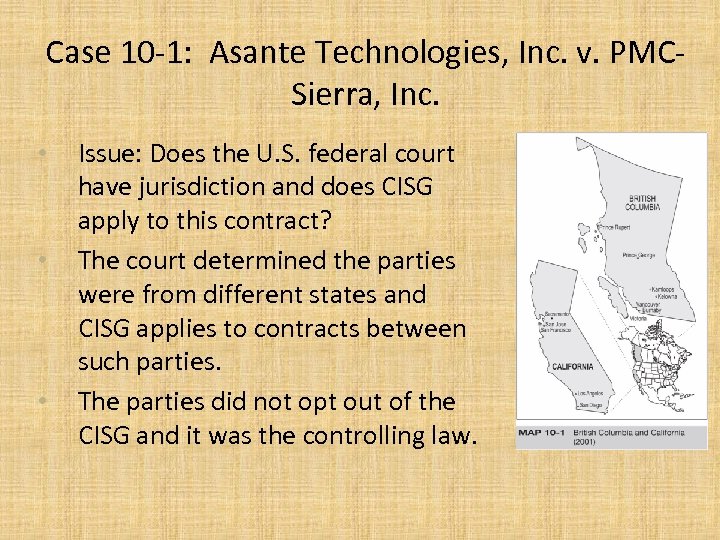 Case 10 -1: Asante Technologies, Inc. v. PMCSierra, Inc. • • • Issue: Does the U. S. federal court have jurisdiction and does CISG apply to this contract? The court determined the parties were from different states and CISG applies to contracts between such parties. The parties did not opt out of the CISG and it was the controlling law.
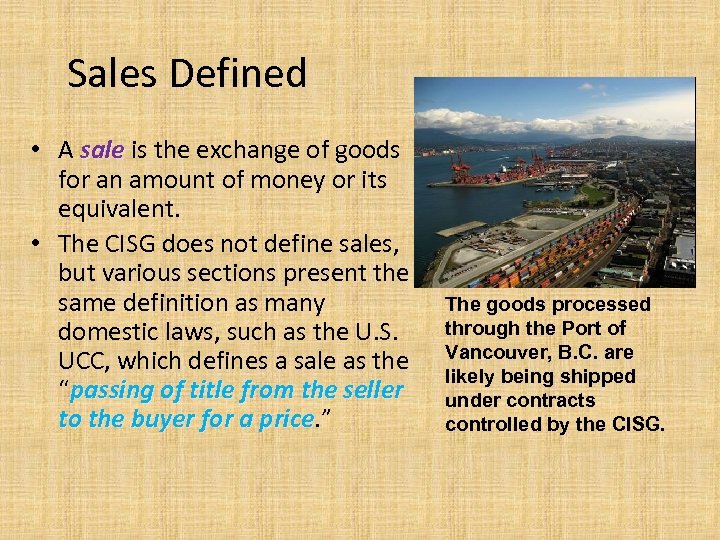 Sales Defined • A sale is the exchange of goods for an amount of money or its equivalent. • The CISG does not define sales, but various sections present the same definition as many domestic laws, such as the U. S. UCC, which defines a sale as the “passing of title from the seller to the buyer for a price. ” price The goods processed through the Port of Vancouver, B. C. are likely being shipped under contracts controlled by the CISG.
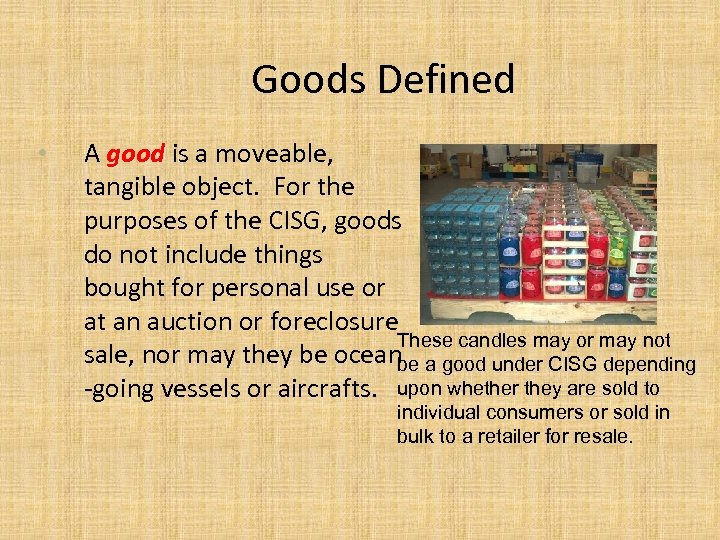 Goods Defined • A good is a moveable, tangible object. For the purposes of the CISG, goods do not include things bought for personal use or at an auction or foreclosure These candles may or may not sale, nor may they be oceanbe a good under CISG depending -going vessels or aircrafts. upon whether they are sold to individual consumers or sold in bulk to a retailer for resale.
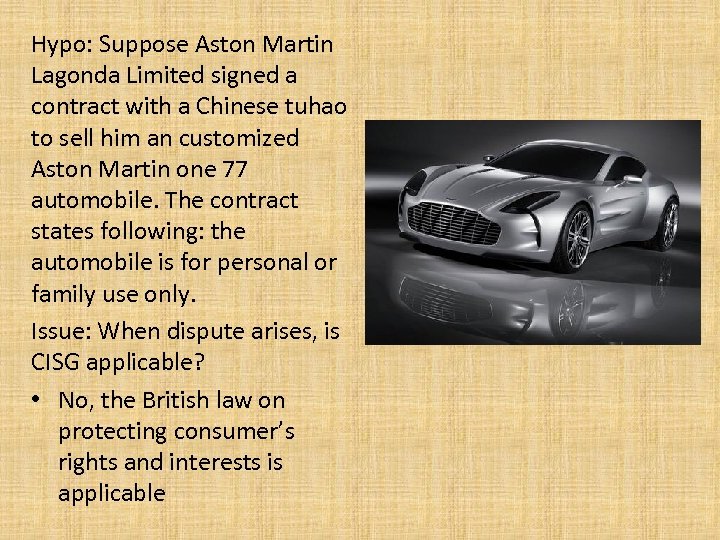 Hypo: Suppose Aston Martin Lagonda Limited signed a contract with a Chinese tuhao to sell him an customized Aston Martin one 77 automobile. The contract states following: the automobile is for personal or family use only. Issue: When dispute arises, is CISG applicable? • No, the British law on protecting consumer’s rights and interests is applicable
 Hypo: IBM US limited received a purchasing order for 100 computer servers from a PRC resident. The purchasing order is for powerful, cutting edge, and expensive server of the sort commonly bought for use in business firms. Issue: When dispute arises, is the contract covered by CISG or laws on protecting consumers? • The contract is covered by CISG.
 Mixed Sales • • Seller of goods often furnishes services when delivering a product. CISG looks upon mixed sales and service contracts as sales of goods, unless the preponderant part of the obligation” of the seller “consists in the supply of labor or other services. ”
 Hypo: Suppose the allocation of the contract price is following: 1. $19, 000 worth of equipment, and $18, 000 worth of technical support service? 2. $20, 000 worth of technical support service, and $19, 000 worth of equipment? • Preponderant part means more than half part. The first allocation is for goods sale covered by CISG, and the second allocation is for service sale not covered by CISG.
 Contractual Issues Excluded From the Coverage of CISG only deals with: 1. The formation of the contract, and 2. The remedies available to the buyer and seller. CISG excludes questions about: 1. the legality of the contract 2. the competency of the parties 3. the rights of third parties 4. liability for death or personal injury
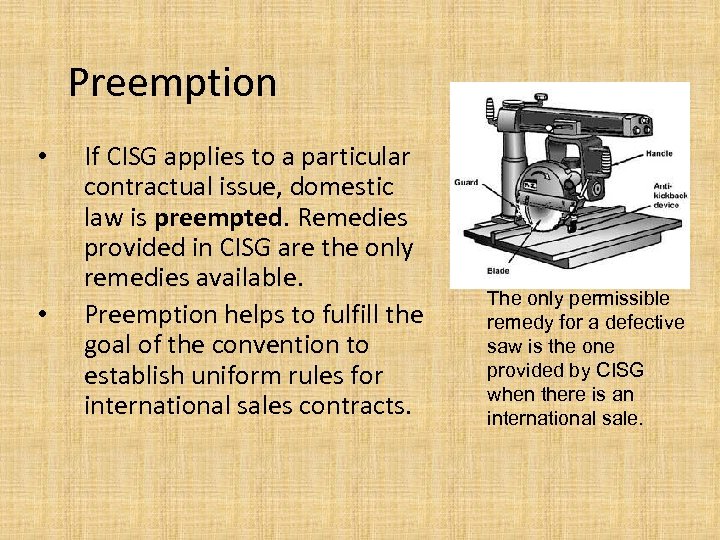 Preemption • • If CISG applies to a particular contractual issue, domestic law is preempted. Remedies provided in CISG are the only remedies available. Preemption helps to fulfill the goal of the convention to establish uniform rules for international sales contracts. The only permissible remedy for a defective saw is the one provided by CISG when there is an international sale.
 Interpreting CISG To interpret CISG, a court is to consider: 1. the international character of the convention, 2. the need to promote uniformity in the convention’s application, and 3. the observance of good faith. • The CISG implies that a court may only use the plain meaning of the language of the convention. • Courts may also look (the travaux preparatories) legislative history to determine intent. •
 Interpreting CISG: General Principles CISG calls for courts to look to the general principles on which the convention is based principles when interpreting its provisions. • Two of the suggested principles are: 1. A party to a contract has the duty to communicate information needed by the other party, and 2. Parties have the obligation to mitigate damages resulting from a breach. (减损义务) •
 Interpreting Sales Contracts • • • A contract is said to be formed only when the parties have a meeting of the minds. (意思表示一致) minds This subjective intent approach says that contracts should be interpreted according to the actual intent and understanding of the parties at the time they made their agreement. CISG says courts are to use subjective intent only if the other party knew or could not have been unaware of the speaker’s intent. If intent is unclear, courts use objective intent
 Negotiations When a court is to determine intent, CISG directs that due consideration be given to all relevant circumstances, including: 1. the negotiations leading up to the contract, 2. the practices that the parties have established between themselves, and 3. the parties’ conduct after they agree to the contract. • CISG does not apply the technical rules that domestic courts use to interpret contracts, such as the parole evidence rule •
 Practices and Usages • • • Parties are bound by any practices(习惯做法) which they have established between themselves. A court is allowed to consider any usages that the parties agreed to. A usage (惯例)is the customary method of performing or acting that is followed by a particular group of people, such as people within a particular trade. CISG lets a court consider “a usage of which the parties knew or ought to have known which in international trade is widely known to, and regularly observed by parties to contracts of the type involved in the particular trade concerned. ”
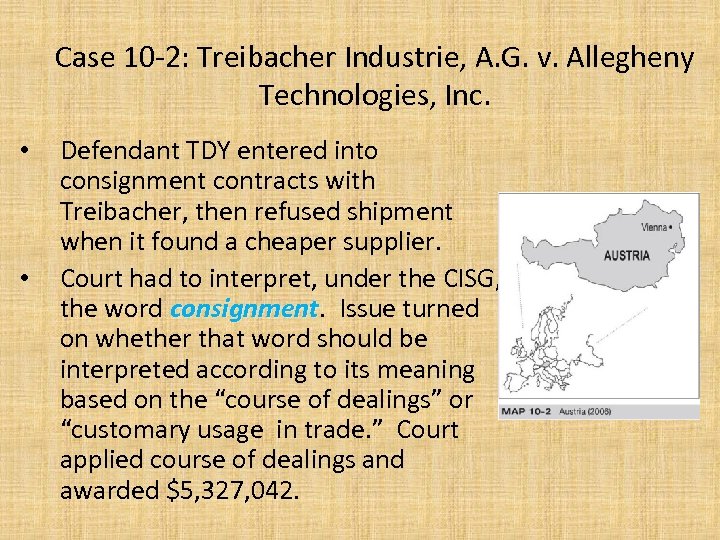 Case 10 -2: Treibacher Industrie, A. G. v. Allegheny Technologies, Inc. • • Defendant TDY entered into consignment contracts with Treibacher, then refused shipment when it found a cheaper supplier. Court had to interpret, under the CISG, the word consignment. Issue turned consignment on whether that word should be interpreted according to its meaning based on the “course of dealings” or “customary usage in trade. ” Court applied course of dealings and awarded $5, 327, 042.
 Form • • The CISG states that a contract for sale need not be concluded in or evidenced by writing and is not subject to any other requirements as to form. It may be proved by any means, including witnesses. However, CISG authorizes a contracting state whose legislation requires contracts of sale to be concluded in or evidenced by writing to make a declaration at the time of ratification the CISG provision does not apply where any party has his or her place of business in that state.
 Formation of the Contract: The Offer A contract is formed when an offer to buy or sell a good is accepted. l An offer is a proposal by one person to another indicating an intention to enter into a contract under specific terms. l To be a valid offer: offer l • • the offeror must communicate an intention to be bound. A proposal is sufficiently definite if it indicates the goods and expressly or implicitly fixes or makes provision for determining the quantity and price.
 Effectiveness of an Offer Effective Date: • • An offer becomes effective only after it reaches the offeree, a specific person addressed in the offer. Withdraw & Revoke of Offer • • • Offers can be withdrawn before they reach the offeree. Offers can be revoked any time before the offeree dispatches an acceptance.
 Effectiveness of an Offer Irrevocable offer • • • if offer indicates, whether by stating a fixed time for acceptance or otherwise, that it is irrevocable; or if it was reasonable for the offeree to rely on the offer as being irrevocable and the offeree has acted in reliance on the offer.
 Acceptance • Concept of Acceptance: • An acceptance is a statement of conduct by the offeree indicating assent that is communicated to the offeror. • Effect of Acceptance: • A contract comes into existence at the time the offer is accepted. • Form of Acceptance • Silence does not constitute acceptance, except agreed otherwise. • Notice • Specific action
 Acceptance • Effective time of an acceptance • Acceptance is effective when received by offeror. • Acceptance must be received within the time period specified in the offer. If no time period is given, acceptance must be received within a reasonable time. • The time when specified act is performed. • If the offeror asks for performance of an act rather than the indication of acceptance, the acceptance is effective when the act is performed.
 Case 10 -3: United Technologies International, Inc. v. Magyar Legi Kozlekedesi Vallalat • Pratt and Whitney (P&W) offered to sell Málev Hungarian Airlines (MHA) either two or three PW 4000 series engines for installation in a Boeing aircraft or two or three PW 4100 series engines for installation in an Airbus aircraft. The offer stated different prices for the different series engines. It also said that it was subject to Hungarian and US government approval. One week later, MHA sent a letter accepting the offer for the PW 4000 series engines. When MHA reneged on going forward with the purchase, P&W sued to obtain a declaratory judgment that a contract existed.
 ISSUES: (1) Was there an offer? (2) Was there an acceptance? (3) Was the requirement of governmental approval meant to be a condition precedent or condition subsequent? Holdings: (1) Yes, The offer described the goods, and the fact the buyer had the right to choose between the listed engines does not affect the description of the engines. The offer stated a quantity, even though the buyer could choose between two or three engines. The offer stated a price and the offer stated a time for delivery. Thus, there was a valid offer.
 (2)Yes, MHA’s letter unambiguously stated its acceptance. A contract was therefore concluded at the time of acceptance. (3)Condition Subsequent, the term requiring government approval was not a condition precedent to a valid contract, but was only a condition subsequent, which, if it occurred, might suspend the parties obligations.
 Acceptance • Withdrawal of an acceptance • An offeree may withdraw his/her acceptance any time before or simultaneous with its receipt. • Rejection • rejection becomes effective when it reaches the offeror. If the offeree sends both an acceptance and a rejection, the one that reached the offeror first would be given effect.
 Acceptance With Material Modifications • • • If the acceptance modifies some of the terms of the offer, there is a counteroffer instead of an acceptance if these inconsistencies are “material. ” Material: Under the CISG, additional terms or different terms relating, among other things, to the price, payment, quality of the goods, place, and time of delivery, extent of one party’s liability to the other, or the settlement of disputes are considered to alter the terms of the offer materially.
 Acceptance With Non-Material Modifications • • • A reply to an offer which purports to be an acceptance but contains additional or different terms which do not materially alter the terms of the offer constitutes an acceptance, unless the offeror, without undue delay, objects orally to the discrepancy or dispatches a notice to that effect. If he does not so object, the terms of the contract are the terms of the offer with the modifications contained in the acceptance.
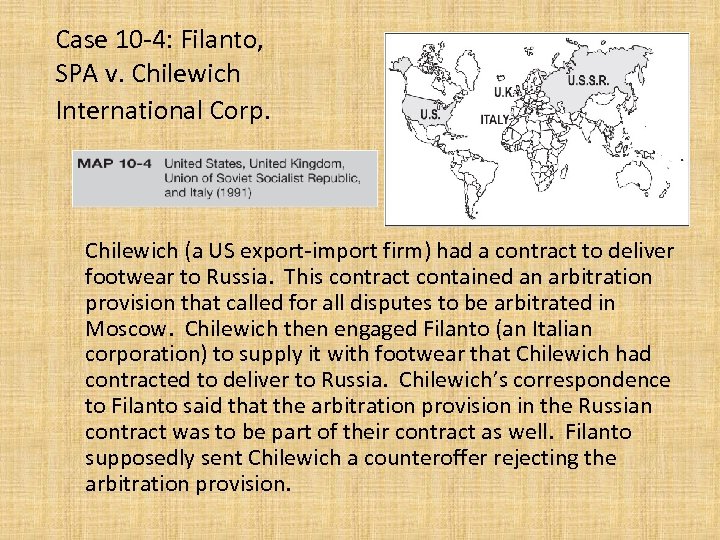 Case 10 -4: Filanto, SPA v. Chilewich International Corp. Chilewich (a US export-import firm) had a contract to deliver footwear to Russia. This contract contained an arbitration provision that called for all disputes to be arbitrated in Moscow. Chilewich then engaged Filanto (an Italian corporation) to supply it with footwear that Chilewich had contracted to deliver to Russia. Chilewich’s correspondence to Filanto said that the arbitration provision in the Russian contract was to be part of their contract as well. Filanto supposedly sent Chilewich a counteroffer rejecting the arbitration provision.
 Chilewich meanwhile proceeded to obtain a letter of credit benefiting Filanto and proceeded as if there was a contract. Filanto, however, signed a contract on August 7 that contained this provision, although it said in its cover letter that it was not bound by the provision. When a dispute arose and Filanto sued in a US court, Chilewich invoked the arbitration provision and asked the court to dismiss Filanto’s suit. ISSUE: (1) Was the August 7 reply a counteroffer? (2) If it was, was there a contract anyway based on unobjected-to performance?
 Law: A reply that purports to be an acceptance but contains material (such as the rejection of an arbitration provision) additions, limitations, or modifications are a rejection of the offer and a counteroffer. If the offeree knows that the offeror has begun performance and fails to notify the offeror within a reasonable time that it objects to the terms of the contract, it will be deemed to have assented to those terms. Holdings: : (1) The objections to the arbitration provision in the August 7 cover letter were a material modification amounting to a rejection of the offer. (2) Because Chilewich went ahead with the contract (getting the letter of credit) and Filanto did not timely object, Filanto accepted the terms of the Chilewich’s proposed contract.
 Seller’s Obligations • A seller’s Obligation: 1. deliver the goods, 2. hand over any documents relating to them, 3. ensure that the goods conform to the contract. • Issues in Delivery of Goods • • • Time and Place of delivery and hand over of documents Conformity of goods Guarantees of ownership & free from any third party claim Examination of goods Curing the defect by Seller
 Place for Delivery and Turning Over Documents • 1. Place of Delivery – The place for delivery is the place agreed to in the contract. Otherwise, it is(Article 31): 1. the first carrier’s place of business, or 2. the place where the parties knew the goods were located or were to be manufactured.
 Time for Delivery and Turning Over Documents • Time of deliverry – Seller is to deliver goods on the date fixed in the contract. • If no fixed date, within a reasonable time after the conclusion of the contract. • Turning over the documents – At time and place of delivery, seller must turn over any documents relating to the goods that the contract requires. – If documents are delivered early, seller has the right to cure any defect in the documents provided that it dose not cause defect buyer unreasonable inconvenience or expenses.
 Conformity of Good(货物相符) • • Seller must deliver goods which are of the quantity, quality, and description required by the contract and are packaged in the manner required. Goods do not conform unless they: a) are fit for the purpose of which goods of the same description would ordinarily be used; b) are fit for any particular purpose expressly or impliedly made known to the seller (with exception); impliedly c) possess the qualities of goods which the seller has held out for the buyer as a sample or model; d) are packaged in the same manner usual for such goods, (if no such manner) adequate to preserve and protect the goods. • Exception – At the time of conclusion, buyer knew or should knew the lack of conformity
 Third-Party Claims, Waiver, Time for Examining Goods, and Curing Defects • Goods are nonconforming if they are subject to thirdparty claims such as ownership and rights in intellectual property. (Art. 41, 42) • The parties may waive the conformity requirement. • Examining the goods • Buyer has an obligation to examine the goods for defects within as short a period as is practicable after delivery (Art. 39) • Buyer is obligated to inform the seller of any discovered defect within a reasonable time(Maximum 2 years). • Curing the defects • If a seller delivers early, he or she may cure any defect up to early the agreed upon date for delivery. (Art. 37)
 Buyer’s Obligations • • A buyer is required to: (1) pay the price and (2) take delivery of the goods Time: Unless a different time is specified, the buyer must pay when the goods or the documents controlling their disposition are delivered. Place If place of delivery is specified, payment is also made there. If no place of delivery is specified, then buyer must pay at the seller’s place of business.
 Case 10 -5 The Natural Gas Case • Buyer agreed to buy natural gas for itself and a third party. Seller agreed to ship gas from the US. Buyer agreed to obtain a letter of credit, but told seller that its bank needed to know the place of loading in order to issue the letter. Seller agreed to provide the place of loading, but never did so. Later, the seller told buyer that its US supplier would not agree to export the gas to buyer in Belgium. The third party bought gas from another source for an additional $141, 131.
 Buyer then sued seller to recover the $141, 131 for the third party plus $15, 000 in loss profits for itself. Seller asserted: that it was not liable because the buyer had never obtained the letter of credit; if it was liable, that the buyer had avoided the contract and the damages should be calculated accordingly, that the buyer was not entitled to loss profits and that the buyer/third party failed to mitigate the damages. ISSUES: (1) Had the buyer breached by not obtaining the letter of credit? (2) Had the seller breached? (3) Was the contract avoided? (4) Was the buyer entitled to lost profits? (5) Had the buyer failed to mitigate?
 Holdings: (1)No, the buyer did not breach, because the failure to provide a letter of credit was caused by the seller’s failure to provide the place of loading. (2)Yes, the seller breached by failing to obtain clearance for the export of the gas and failing to deliver the gas. (3)No, the buyer never notified the seller that it was avoiding the contract. Notification of the amount of losses incurred is not a notification of avoidance. (4)Yes, when merchantable goods are sold to a merchant, resale is presumed. Indeed, seller knew that this was the case. Lost profits, therefore, are an appropriate measure of damages. (5)No, the seller failed to show the buyer could have mitigated.
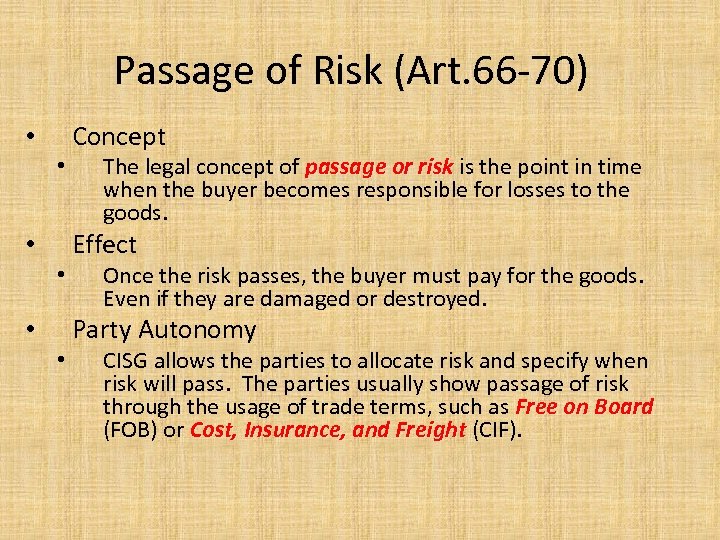 Passage of Risk (Art. 66 -70) • • • Concept The legal concept of passage or risk is the point in time risk when the buyer becomes responsible for losses to the goods. Effect Once the risk passes, the buyer must pay for the goods. Even if they are damaged or destroyed. Party Autonomy CISG allows the parties to allocate risk and specify when risk will pass. The parties usually show passage of risk through the usage of trade terms, such as Free on Board (FOB) or Cost, Insurance, and Freight (CIF).
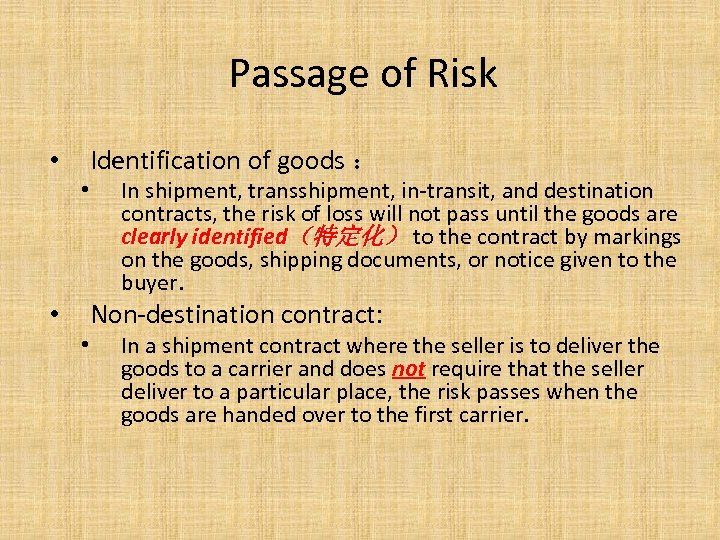 Passage of Risk • • Identification of goods : In shipment, transshipment, in-transit, and destination contracts, the risk of loss will not pass until the goods are clearly identified(特定化) to the contract by markings on the goods, shipping documents, or notice given to the buyer. Non-destination contract: In a shipment contract where the seller is to deliver the goods to a carrier and does not require that the seller deliver to a particular place, the risk passes when the goods are handed over to the first carrier.
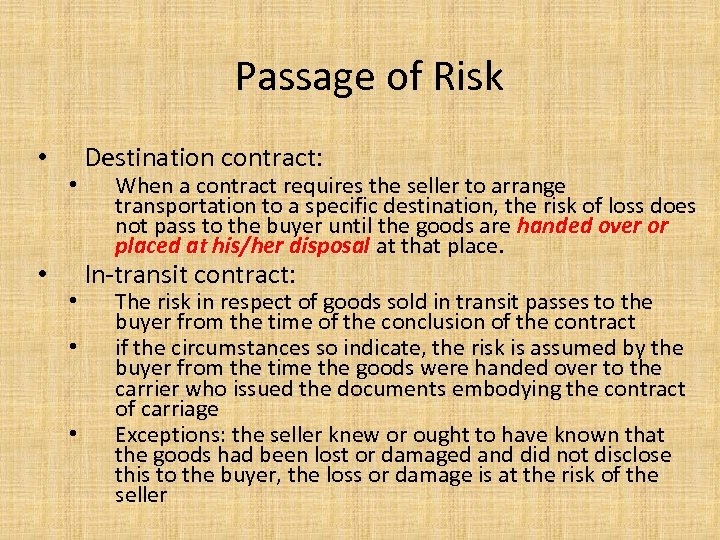 Passage of Risk • • • Destination contract: When a contract requires the seller to arrange transportation to a specific destination, the risk of loss does not pass to the buyer until the goods are handed over or placed at his/her disposal at that place. In-transit contract: The risk in respect of goods sold in transit passes to the buyer from the time of the conclusion of the contract if the circumstances so indicate, the risk is assumed by the buyer from the time the goods were handed over to the carrier who issued the documents embodying the contract of carriage Exceptions: the seller knew or ought to have known that the goods had been lost or damaged and did not disclose this to the buyer, the loss or damage is at the risk of the seller
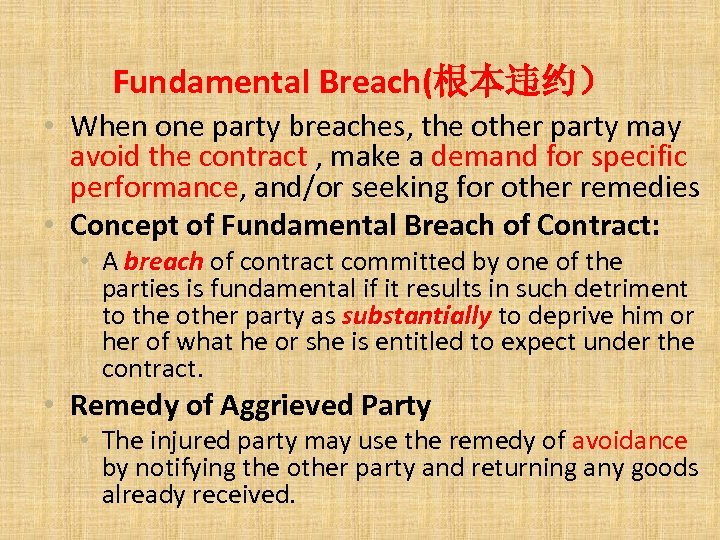 Fundamental Breach(根本违约) • When one party breaches, the other party may avoid the contract , make a demand for specific performance, and/or seeking for other remedies • Concept of Fundamental Breach of Contract: • A breach of contract committed by one of the parties is fundamental if it results in such detriment to the other party as substantially to deprive him or her of what he or she is entitled to expect under the contract. • Remedy of Aggrieved Party • The injured party may use the remedy of avoidance by notifying the other party and returning any goods already received.
 Avoidance(art. 81 -84)(宣告合同无效) • Concept: • notification by the party that he is canceling the contract. • Procedure: • the injured party must-in all cases-notify the other party • The effect of avoidance • Releases both parties from their obligations , return the good and prices (with interests)already received. • Dose not affect the provisions of settlement of disputes or any other provision of the contract governing the rights and obligations of the parties consequent upon the avoidance of the contract.
 Avoidance • Lost of right to claim avoidance • If it is impossible for aggrieved buyer to make restitution of the goods substantially in the condition in which he received them • Exceptions to Lost of right • if the impossibility of making is not due to his act or omission; • if the goods or part of the goods have perished or deteriorated as a result of the; or • if the goods or part of the goods have been sold in the normal course of business or have been consumed or transformed by the buyer in the course of normal use before he discovered or ought to have discovered the lack of conformity.
 Requests for Specific Performance(实际履行) • Concept of Specific performance • court order directing a party to carry out the obligations he or she had contractually promised to do. • The request for specific performance • one party is entitled to require performance of any obligation by the other party, a court is not bound to enter a judgment for specific performance unless the court would do so under its own law in respect of similar contracts of sale not governed by CISG. • In some civil law countries, a party is entitled to require performance. • In the US, specific performance is granted if the goods are unique and cannot be obtained elsewhere.
 Buyer’s Remedies • • The buyer’s remedies are cumulative, meaning cumulative they are able to be joined or taken together. The remedies unique to the buyer are: 1. to compel specific performance(实 际履行) 2. to avoid the contract(宣告合同无效) 3. to reduce the price 4. to refuse early delivery 5. to refuse excess quantities
 Buyer’s Remedies • The buyer may avoid a contract if either 1. The seller commits a fundamental breach or 2. The buyer gives the seller a Nachfrist notice and the seller rejects it or does not perform within the period it specifies. • A buyer’s Nachfrist notice is the fixing of an additional period of time of reasonable length for performance by the seller of his or her obligations. • During the Nachfrist period, the seller is entitled to correct or cure the nonconformity at his or her own expense.
 Case 10 -6 The Shoe Seller’s Case • The plaintiff delivered shoes to the defendant. Delivery was late and the shoes did not completely conform to the sample the plaintiff-seller had originally shown to the defendant-buyer. When the defendant-buyer refused to pay on two invoices, the plaintiff-seller brought suit. On appeal, the defendant argued that she was entitled to invoke the remedy of avoidance because of the plaintiff’s late delivery and the nonconformity of the goods.
 ISSUE: Is the remedy of avoidance available to the defendant? LAW: (1) Avoidance is only allowed after a buyer gives the seller a Nachfrist notice and defines an additional fixed period in which the seller is to make delivery. (2) There is no nonconformity in cases where a buyer is able to use some of the goods. Holding: No, the buyer did not give the seller a Nachfrist notice. The buyer also was able to use some of the goods delivered
 Case 10 -7: Nuova Fucinati, SPA v. Fondmetall International, AB • A seller, in Italy, contracted in Sweden to deliver 1, 000 tons of ore to a buyer, in Sweden. The seller’s costs increased by 43%, so the seller sought to use the excuse of “commercial impracticability” to avoid the contract. The buyer defended by arguing that the contract was governed by the CISG and the excuse of commercial impracticability is not available under the CSIG.
 ISSUES: (1) Does the CISG provide for the excuse of commercial impracticability? (2) Does the CISG apply to this case? (3) Is the seller excused because of commercial impracticability? Holdings: (1)No, CISG does not provide for the excuse of commercial impracticability. (2)No, the CISG does not apply because (a) Sweden was not a party to the CISG when the contract was signed and (b) because Italy’s rules of private international law direct the court to use Swedish law (as the contract was signed in Sweden), and Swedish law at the time did not recognize the CISG. (3)No, an increase of 43% in costs to the seller is not so burdensome that the seller cannot perform
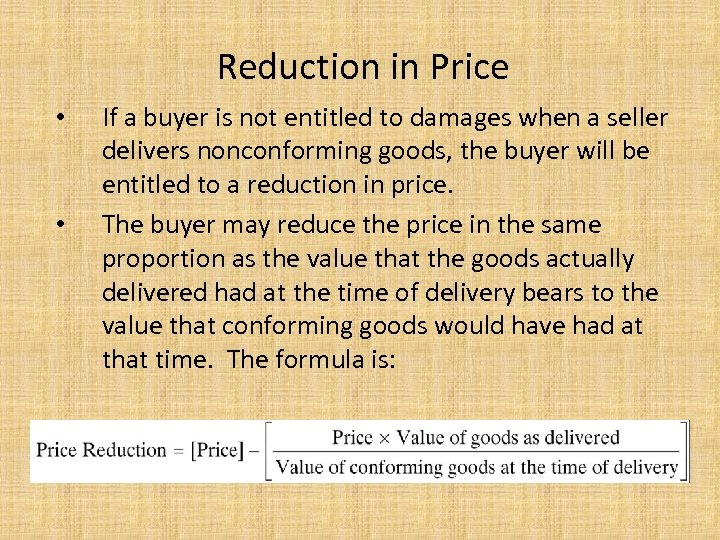 Reduction in Price • • If a buyer is not entitled to damages when a seller delivers nonconforming goods, the buyer will be entitled to a reduction in price. The buyer may reduce the price in the same proportion as the value that the goods actually delivered had at the time of delivery bears to the value that conforming goods would have had at that time. The formula is:
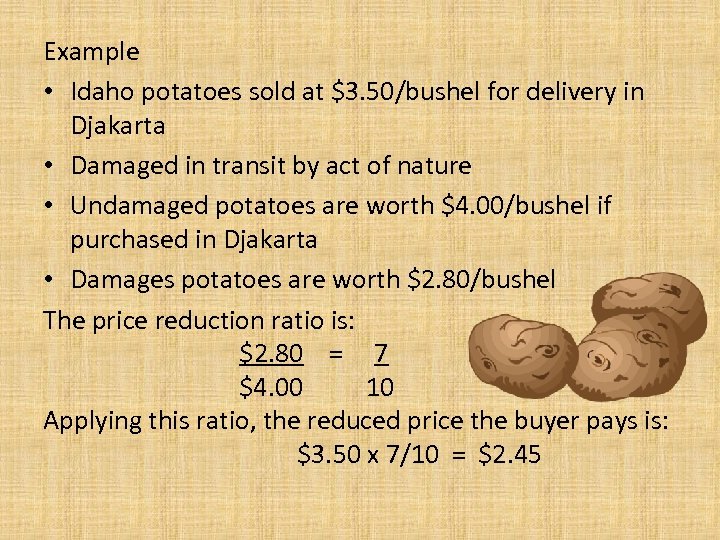 Example • Idaho potatoes sold at $3. 50/bushel for delivery in Djakarta • Damaged in transit by act of nature • Undamaged potatoes are worth $4. 00/bushel if purchased in Djakarta • Damages potatoes are worth $2. 80/bushel The price reduction ratio is: $2. 80 = 7 $4. 00 10 Applying this ratio, the reduced price the buyer pays is: $3. 50 x 7/10 = $2. 45
 Seller’s Remedies The seller’s remedies mirror those of the buyer. • The seller’s remedies are both cumulative and immediate. • The remedies unique to the seller are: 1. To compel specific performance 2. To avoid the contract for a fundamental breach or failure to cure a defect 3. To obtain missing specifications(要求买 方确定货物规格) •
 Remedies Available to Both Buyers and Sellers • Remedies available to both are: 1. Suspension of performance 2. Avoidance in anticipation of a fundamental breach (Art. 71) l A remedy available to either party when it becomes clear that the other party will commit a fundamental breach. 3. Avoidance of an installment contract 4. Damages l A breaching party is liable only for those damages that he/she foresaw or ought to have foreseen.
 Remedies Available to Both Buyers and Sellers • 1. Suspension of performance (Art. 71) • • a serious deficiency in his ability to perform or in his creditworthiness his conduct in preparing to perform or in performing the contract. • 2. Avoidance in anticipation of a fundamental breach (Art. 71) • A remedy available to either party when it becomes clear that the other party will commit a fundamental breach.
 Remedies Available to Both Buyers and Sellers • 3. Avoidance of an instalment contract • • Handle each installment individually: if one party fails to perform in one instalment constitute fundamental breach, that installment can be declared voidance. If one party’s failure to perform any of his obligations in respect of any instalment gives the other party good grounds to conclude that a fundamental breach of contract will occur with respect to future instalments, he may declare the contract avoided for the future, provided that he does so within a reasonable time.
 Remedies Available to Both Buyers and Sellers • 4. Damages • Sum of damages • Damages for breach of contract by one party consist of a sum equal to the loss, including loss of profit, suffered by the other party as a consequence of the breach. • Foreseeable Rule • damages may not exceed the loss which the party in breach foresaw or ought to have foreseen at the time of the conclusion of the contract, in the light of the facts and matters of which he then knew or ought to have known, as a possible consequence of the breach of contract • Obligation of aggrieved party to mitigate losses
 Excuses for Nonperformance Force majeure( 不可抗力) • • a party is not liable for any damages resulting from his/her failure to perform if the party can show: 1. the failure was due to an impediment beyond his/her control 2. that the impediment was not something he/she could have reasonably taken into account at the time of contracting 3. that he/she remains unable to overcome the impediment • Examples: disasters, war, strikes
 Thank you! The End of Chapter 10 Sales